REVIEW 5 major objections 6 minor 25 references
CaseEdit: Enhancing Localized Commonsense Reasoning via Null-Space Constrained Knowledge Editing in Small Parameter Language Models
T0 review · 5 major / 6 minor · reviewed 2026-08-07 · deepseek-v4-flash
Pith's one-line read CaseEdit, a new benchmark from the ATOMIC2020 graph, tests whether small models can absorb household-specific commonsense edits; the paper reports that null-space-constrained AlphaEdit does so with the least damage to unrelated knowledge.
desk verdict CaseEdit is a genuinely useful dataset for commonsense knowledge editing, but the evaluation is currently undermined by an impossible base-model locality score that likely reflects a mis-keyed answer rule. read the letter →
The pith
A machine-rendered reading of the paper's core claim, the machinery that carries it, and where it could break.
The reading
What carries the argument
The object that carries the argument is the null-space projection used by AlphaEdit. When an edit is made, the method computes a weight update that satisfies the new fact while keeping the change in activation space orthogonal to the directions that encode preserved knowledge, and this is what confines the edit to the targeted association. The other load-bearing piece is the CaseEdit generation chain itself: it takes a subject from the ATOMIC2020 graph, asks GPT-4o-mini to invent an unusual but plausible household location, then asks it to generate a new use, property, or location statement conditioned on that context, and finally generates the four evaluation questions. The benchmark's statistics, including 900 subject edits and 3,600 evaluation questions, make the edits numerous enough to reveal interference between sequential updates.
What would settle it
Take the unedited base model and run it on the locality questions from Table 4: it should answer unrelated-object questions correctly, so a 0.00 locality score for the base model would indicate the correct-answer mapping is broken rather than the edit having erased knowledge, and replacing the GPT-4o-mini-assigned answers with human-verified labels and re-scoring would settle whether AlphaEdit's margin is real.
Extended reading notes
Core claim
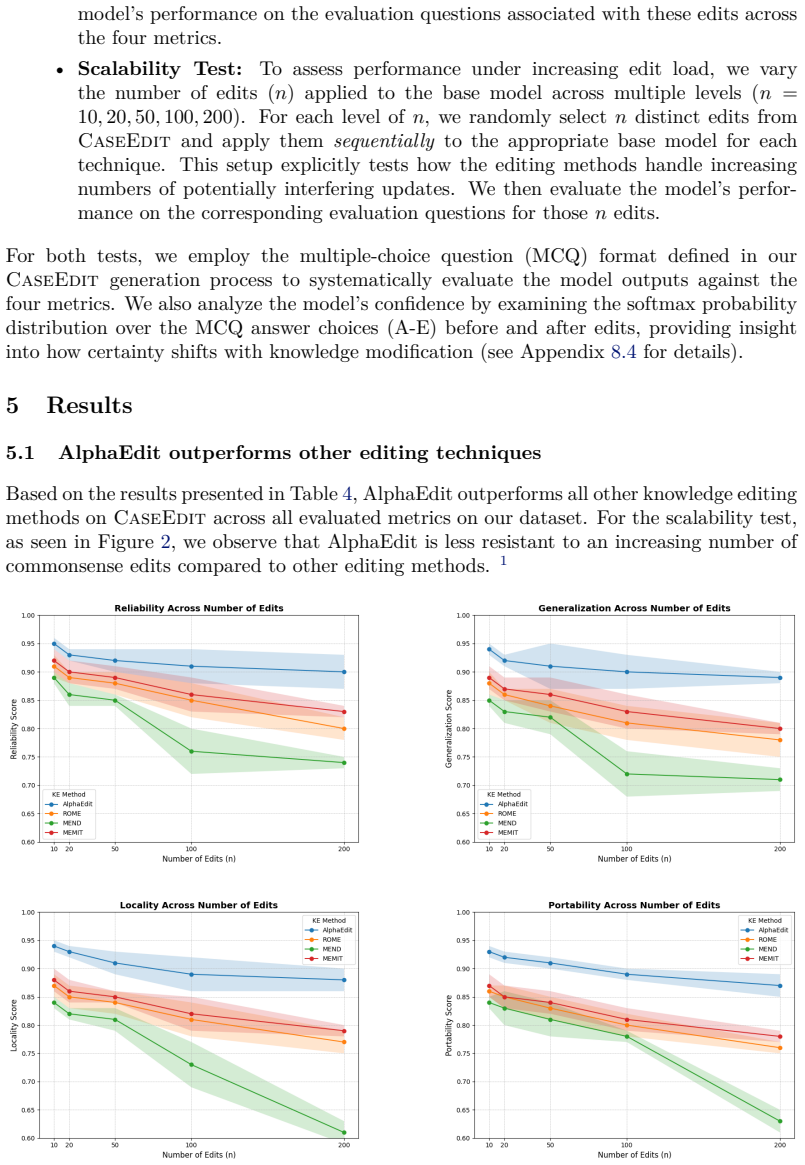
The central claim is that localized commonsense editing in small language models is feasible when the edit is constrained to avoid interfering with unrelated knowledge. Rather than editing arbitrary facts, the paper defines edits as paired typical and atypical uses of household objects, generated by a multi-stage prompt chain over ATOMIC2020 relation types such as ObjectUse, HasProperty, and AtLocation, with GPT-4o-mini proposing an unusual location and then a new ground-truth statement conditioned on it. Four multiple-choice questions per edit measure whether the new fact is installed (reliability), generalizes to related phrasings (generalization), leaves unrelated objects untouched (locality), and supports simple downstream reasoning (portability). On 50 sequential edits applied to LLaMA 3.2 3B-Instruct, AlphaEdit achieves the highest scores on all four metrics, with 0.93 reliability, 0.91 generalization, 0.87 locality, and 0.90 portability, and its advantage persists as the number of edits grows from 10 to 200, which the paper reads as evidence that null-space projection reduces ripple effects.
Load-bearing premise
The load-bearing premise is that the GPT-4o-mini-generated new ground truths are correct and that each multiple-choice question has a well-defined right answer; the paper's own limitations section notes that no human evaluation was conducted, so if the generated answers are implausible or the option labels are misassigned, the reported scores would not measure what they claim.
Editorial extensions
If this is right
- A 3B-parameter model can internalize personalized commonsense facts with a reliability of about 0.93 after 50 sequential edits, suggesting that household customization does not require retraining or a larger model.
- AlphaEdit's locality score of 0.87 means roughly nine in ten unrelated-object questions still receive the correct answer after an edit, so the ripple effect is small but not zero.
- Because AlphaEdit's advantage over other methods grows as the edit count increases, null-space constraints appear to matter more as more personalized facts accumulate in one model.
- CaseEdit itself provides 900 subject edits and 3,600 questions, enough to serve as a reusable benchmark for future commonsense-editing methods.
Reading between the lines
- Beyond the paper's experiments, the same pipeline could generate edits for other personalization domains, such as medical routines, workplace tools, or cultural practices, by swapping the unusual-location generator for another context generator; this is an extension the paper does not test.
- The reported 0.00 base-model locality score in Table 4 is a warning sign: an unedited model should answer unrelated-object questions correctly, so either the correct-answer mapping in the multiple-choice set is misaligned or the questions are not truly unaffected by edits, and a human-checked subset would resolve which.
- If null-space localization transfers to other architectures, AlphaEdit-style constraints could be combined with distributed commonsense editors to get both locality and broader generalization, a hybrid direction the paper itself mentions as open.
Editorial analysis
A structured set of objections, weighed in public.
Referee Report
Summary. The paper introduces CaseEdit, a dataset and generation pipeline for evaluating localized, personalized commonsense knowledge editing in small language models. The dataset is built on ATOMIC2020 and uses GPT-4o-mini to generate atypical household contexts, new ground-truth statements, and four evaluation questions per edit, covering reliability, generalization, locality, and portability in a multiple-choice format. The authors evaluate AlphaEdit, ROME, MEND, MEMIT, and MEMIT-CSK on the dataset, reporting that AlphaEdit outperforms all baselines on a LLaMA 3.2 3B-Instruct model with minimal ripple effects, and that this advantage persists in scalability tests up to 200 sequential edits.
Significance. If the dataset and evaluation are valid, CaseEdit addresses a real gap: existing knowledge-editing benchmarks focus on factual recall, while personalized commonsense editing in small-parameter models is underexplored. The pipeline is transparent and largely reproducible, with prompts and dataset statistics included in the appendix, and the four-axis evaluation follows standard knowledge-editing metrics. However, the central empirical claim about AlphaEdit's superiority and minimal ripple effects rests entirely on the MCQ scoring, and the reported base-model scores indicate a likely flaw in the correct-answer assignment. Because that flaw undermines Table 4 and Figure 2, the significance of the comparative results cannot be assessed until the evaluation is corrected.
major comments (5)
- [Table 4; §4.2] The Base Model row reports 0.00 ± 0.00 on all four metrics, including Locality. Under the definition in §4.2, locality measures whether an edit leaves unrelated inputs unchanged, so an unedited model should answer a question such as 'What is a chef's knife used for?' correctly. While 0.00 for reliability, generalization, and portability might be expected for an unedited model that does not know the new ground truth, 0.00 for locality is not. A uniform 0.00 across every metric strongly suggests that the correct-answer key is always the newly generated ground truth, rather than the metric-appropriate answer. Section 3.2 specifies only that previous ground truth, new ground truth, and distractors are 'curated and randomly assigned labels from A to E,' and it never defines which option is correct for locality and portability questions. This scoring ambiguity invalidates the 'minimal ripple effects' claim and the relative ranking of methods in Table 4 and Figure 2.
- [§4.3; §4.1] The experimental setup is inconsistent about the base model: §4.3 states 'AlphaEdit, ROME, MEND, MEMIT on LLaMA 3 8B,' while the abstract, §4.1, and §5 state LLaMA 3.2 3B-Instruct. The manuscript must specify which model was actually edited; if it is LLaMA 3 8B, the abstract's claim about a 3B model is unsupported, and if it is LLaMA 3.2 3B, Section 4.3 contains a typo that must be corrected before the results can be reproduced.
- [§4.1; Table 4] MEMIT-CSK is evaluated on GPT-2 XL (1.5B parameters) while AlphaEdit, ROME, MEND, and MEMIT are evaluated on a LLaMA 3.2 3B model. Table 4 nevertheless reports all techniques in a single comparison, and §5.1 concludes that AlphaEdit 'outperforms all other knowledge editing methods.' This cross-model comparison is confounded by architecture and parameter count; the claim of outperformance over MEMIT-CSK is not valid unless all methods are run on the same base model.
- [§3.2; §7] The same GPT-4o-mini model generates the atypical ground truths and the evaluation questions and answer choices, and Section 7 acknowledges that no human evaluation was conducted. This creates a circularity risk: the MCQ may measure whether the edited model reproduces GPT-4o-mini's own phrasing rather than whether the edit is plausible commonsense. The paper should provide human adjudication of a sample of edits and questions, or use independently sourced answer labels, to rule out this alternative interpretation.
- [Table 4; §5] No statistical significance tests are reported, and the description of the error bars is missing: the paper does not state whether the means and standard deviations come from multiple random seeds, repeated sampling of 50 subjects, or some other procedure. For example, AlphaEdit's reliability is 0.93 ± 0.02 versus MEMIT's 0.90 ± 0.02; without knowing whether these are paired over the same 50 subjects, it is impossible to assess whether AlphaEdit's advantage is meaningful. The paper should report paired significance tests or bootstrap confidence intervals.
minor comments (6)
- [§5.1] The sentence 'AlphaEdit is less resistant to an increasing number of commonsense edits' appears to contradict the claim that AlphaEdit degrades less than other methods; 'more resistant' is likely intended.
- [§1] The cross-reference 'See Appendix 4' should point to the correct appendix; the parameter-size data actually appears in Appendix 8.1.
- [Table 2] The table caption mentions tokens highlighted in blue and red, but no highlighting is visible in the manuscript; either render the colors or remove the reference.
- [Abstract; §3] The notation 'ATOMIC20/20' is inconsistent; the rest of the paper uses ATOMIC2020, so the abstract should be updated for consistency.
- [§4.3] The fixed-edits test uses 50 subjects from CaseEdit, which contains 900 subjects; the paper should justify this sample size and state how the subjects were randomly selected.
- [Appendix 8.3] The placeholder code comments contain garbled text from PDF extraction, such as '# --- P l a c e h o l d e r v ar ia bl es ---'; the appendix should provide clean listings to be usable by readers.
Circularity Check
The locality metric is inverted by construction: Table 4's base-model 0.00 locality row and the unspecified MCQ answer-key in Section 3.2 indicate that the new ground truth is scored as correct for all four axes, so AlphaEdit's 'minimal ripple effects' is an artifact of answer-label assignment rather than a measured property.
-
self definitional
[Section 3.2 (Evaluation Question Generation) and Table 4 (n=50)]
"In this framework, the previous ground truth, the newly generated ground truth, and three unrelated distractor choices are curated and randomly assigned labels from A to E."
The paper never specifies which option is scored as correct for reliability, generalization, locality, or portability. Table 4 reports Base Model 0.00±0.00 on every metric. Under the Section 4.2 definition, locality asks whether an edit leaves unrelated inputs unchanged, so an unedited model should answer an unrelated-object question (e.g., 'What is a chef's knife used for?') correctly. A uniform 0.00 base row is therefore only consistent with keying the new ground truth as the correct answer for all four axes. With that key, the 'locality' score rewards over-application of the edit to unrelated questions and penalizes preservation, so the claimed 'minimal ripple effects' of AlphaEdit is an artifact of the scoring rule by construction, not a measured outcome.
-
other
[Appendix 8.3.3 (Inference Step 3: Generate Evaluation Questions) and Section 7 (Limitations)]
"Given an object (Subject) and a newly established atypical commonsense fact about it (New Ground Truth), generate four distinct evaluation questions designed to test different aspects of knowledge editing... Systematic evaluation of CaseEdit was limited by the lack of large-scale human evaluations."
The same GPT-4o-mini model that invents the atypical new ground truth also writes the evaluation questions and answer choices, and Section 7 concedes there was no human adjudication. Consequently, the gold labels of CaseEdit are, by construction, GPT-4o-mini's own generations: a model scores well by agreeing with the generator rather than by satisfying an independent standard of plausible, human-like commonsense. The paper's conclusion that AlphaEdit allows small models to 'internalize high-quality, context-sensitive common-sense knowledge' therefore reduces to consistency with its own data-generation model, not to a benchmark-external ground truth.
full rationale
This is not a self-citation chain: AlphaEdit, ROME, MEMIT, MEND, and MEMIT-CSK are all cited from external groups, so the authorship-related circularity patterns do not apply. The circularity is in the evaluation design. The paper defines locality as preservation of unrelated knowledge, but its MCQ procedure never assigns the correct option per axis, and the reported base-model row (0.00 on locality, generalization, and portability) shows that the scoring is inconsistent with that definition. If the new ground truth is the scored answer for every question, then locality and portability scores measure how widely the edit leaks to other questions, which is the opposite of the ripple-effect claim. Additionally, because GPT-4o-mini generates both the edited facts and the evaluation questions, the benchmark is self-referential: no human or independent check confirms the 'new ground truth' is a plausible commonsense edit. The paper itself flags the missing human evaluation in Section 7. These two issues make the central claim of minimal ripple effects and superior commonsense editing partially circular, so a score of 6 is appropriate rather than a higher score, since the reliability and generalization comparisons among editing methods may still contain independent information.
Assumptions & free parameters
free parameters (1)
- GPT-4o-mini sampling temperature =
0.7 for location and ground-truth steps; 0.6 for evaluation-question step
assumptions (4)
- domain assumption ATOMIC2020 typical facts and relationship buckets are valid commonsense anchors for the edit targets.
- ad hoc to paper GPT-4o-mini generated atypical locations and new ground truths are plausible and correctly conditioned on the unusual location.
- domain assumption The MCQ evaluation has a well-defined correct answer for each reliability, generalization, locality, and portability question.
- domain assumption AlphaEdit's null-space projection preserves unrelated knowledge as claimed in the cited prior work.
Cite this review
Pith. "Pith review of CaseEdit: Enhancing Localized Commonsense Reasoning via Null-Space Constrained Knowledge Editing in Small Parameter Language Models." pith.science (2026). https://pith.science/paper/UHUJGF2X
@misc{pith2026250519383,
  author       = {Pith},
  title        = {Pith review of: CaseEdit: Enhancing Localized Commonsense Reasoning via Null-Space Constrained Knowledge Editing in Small Parameter Language Models},
  year         = {2026},
  howpublished = {\url{https://pith.science/paper/UHUJGF2X}},
  note         = {Machine review of arXiv:2505.19383}
}
read the original abstract
Large language models (LLMs) exhibit strong performance on factual recall and general reasoning but struggle to adapt to user-specific, commonsense knowledge, a challenge particularly acute in small-parameter settings where computational efficiency is prioritized. We introduce CaseEdit, a new dataset and generation pipeline for evaluating localized, personalized commonsense knowledge editing in small LLMs to address this. Built upon the ATOMIC20/20 commonsense graph, CaseEdit uses a multi-stage inference process to generate both typical and atypical contextual edits for household objects, paired with targeted evaluation questions across four axes: reliability, generalization, locality, and portability. We evaluate established knowledge editing methods using CaseEdit and demonstrate that AlphaEdit, a technique employing null-space projection to minimize interference with unrelated knowledge, consistently outperforms other methods when applied to an LLaMA 3.2 3B model, even in scalability tests, showing minimal ripple effects. Our results indicate that using CaseEdit with effective editing techniques like AlphaEdit allows small models to internalize high-quality, context-sensitive common-sense knowledge, paving the way for lightweight, personalized assistants.
Figures


Figures from the paper (1 more)

Reference graph
Works this paper leans on
-
[1]
OpenAI. Gpt-4o system card, 2024. URLhttps://arxiv.org/abs/2410.21276
arXiv 2024
-
[2]
A. Grattafiori, A. Dubey, A. Jauhri, A. Pandey, and e. a. Abhishek Kadian. The llama 3 herd of models, 2024. URLhttps://arxiv.org/abs/2407.21783
arXiv 2024
- [3]
-
[4]
TinyChat: Efficient and lightweight system for llm deployment on the edge
MIT-Han-Lab. TinyChat: Efficient and lightweight system for llm deployment on the edge. https://hanlab.mit.edu/blog/tinychat, 2024
work page 2024
-
[5]
X. L. Li, A. Kuncoro, J. Hoffmann, C. de Masson d’Autume, P. Blunsom, and A. Ne- matzadeh. A systematic investigation of commonsense knowledge in large language models. In Conference on Empirical Methods in Natural Language Processing, 2021. URL https://api.semanticscholar.org/CorpusID:253244266
work page 2021
-
[6]
Y. Yao, P. Wang, B. Tian, S. Cheng, Z. Li, S. Deng, H. Chen, and N. Zhang. Editing large language models: Problems, methods, and opportunities, 2023. URL https: //arxiv.org/abs/2305.13172
arXiv 2023
-
[7]
P. Wang, Z. Li, N. Zhang, Z. Xu, Y. Yao, Y. Jiang, P. Xie, F. Huang, and H. Chen. Wise: Rethinking the knowledge memory for lifelong model editing of large language models. arXiv preprint arXiv:2405.14768, 2024
arXiv 2024
-
[9]
K. Meng, A. S. Sharma, A. Andonian, Y. Belinkov, and D. Bau. Locating and editing factual associations in gpt.arXiv preprint arXiv:2202.05262, 2022
arXiv 2022
Show all 25 references
-
[11]
P. Wang, N. Zhang, X. Xie, Y. Yao, B. Tian, M. Wang, Z. Xi, S. Cheng, K. Liu, G. Zheng, et al. Easyedit: An easy-to-use knowledge editing framework for large language models. arXiv preprint arXiv:2308.07269, 2023
2023 arXiv
-
[12]
Gupta, D
A. Gupta, D. Mondal, A. K. Sheshadri, W. Zhao, X. L. Li, S. Wiegreffe, and N. Tandon. Editing common sense in transformers. In Proceedings of the 2023 Conference on Empirical Methods in Natural Language Processing, pages 8215–8227, 2023
2023
-
[13]
Mitchell, C
E. Mitchell, C. Lin, A. Bosselut, C. Finn, and C. D. Manning. Fast model editing at scale. arXiv preprint arXiv:2110.11309, 2021. 16
2021 arXiv
-
[14]
J. Fang, H. Jiang, K. Wang, Y. Ma, X. Wang, X. He, and T. seng Chua. Alphaedit: Null-space constrained knowledge editing for language models, 2024. URL https: //arxiv.org/abs/2410.02355
2024 arXiv
-
[15]
M. Sap, R. Le Bras, E. M. Bender, and Y. Choi. Atomic 2020: On symbolic and neural commonsense knowledge graphs. InProceedings of the AAAI Conference on Artificial Intelligence, volume 34, pages 63–71, 2020
2020
-
[16]
J. D. Hwang, C. Bhagavatula, R. Le Bras, J. Da, K. Sakaguchi, A. Bosselut, and Y. Choi. Comet-atomic 2020: On symbolic and neural commonsense knowledge graphs. In Proceedings of the AAAI Conference on Artificial Intelligence, volume 35, pages 14933–14941, 2021
2020
-
[17]
Y. Yao, N. Zhang, Z. Zhang, Y. Lin, and Z. Liu. A survey on knowledge editing for large language models.arXiv preprint arXiv:2310.16218, 2023
2023 arXiv
-
[18]
Speer, J
R. Speer, J. Chin, and C. Havasi. Conceptnet 5.5: An open multilingual graph of general knowledge. In Proceedings of the Thirty-First AAAI Conference on Artificial Intelligence, pages 4444–4451, 2017
2017
-
[19]
X. L. Li, A. Kuncoro, J. Hoffmann, C. de Masson d’Autume, P. Blunsom, and A. Ne- matzadeh. A systematic investigation of commonsense knowledge in large language models. In Proceedings of the 2022 Conference on Empirical Methods in Natural Lan- guage Processing, pages 9414–9427, 2022
2022
-
[20]
P.West, C.Bhagavatula, J.Hessel, J.D.Hwang, L.Jiang, R.LeBras, X.Lu, S.Welleck, and Y. Choi. Symbolic knowledge distillation: from general language models to com- monsense models. arXiv preprint arXiv:2110.07178, 2021
2021 arXiv
-
[21]
S. Pan, L. Luo, Y. Wang, C. Chen, J. Wang, and X. Wu. Unifying large language models and knowledge graphs: A roadmap.arXiv preprint arXiv:2306.08302, 2023
2023 arXiv
-
[22]
Zhang, Y
N. Zhang, Y. Yao, B. Tian, P. Wang, S. Deng, M. Wang, Z. Xi, S. Mao, J. Zhang, Y. Ni, S. Cheng, Z. Xu, X. Xu, J.-C. Gu, Y. Jiang, P. Xie, F. Huang, L. Liang, Z. Zhang, X. Zhu, J. Zhou, and H. Chen. A comprehensive study of knowledge editing for large language models, 2024. URL...
2024 arXiv
-
[23]
Ouyang, J
L. Ouyang, J. Wu, X. Jiang, D. Almeida, C. L. Wainwright, P. Mishkin, C. Zhang, S. Agarwal, K. Slama, A. Ray, J. Schulman, J. Hilton, F. Kelton, L. Miller, M. Simens, A. Askell, P. Welinder, P. Christiano, J. Leike, and R. Lowe. Training language models to follow instructions ...
2022 arXiv
-
[24]
tau Yih, T
P.Lewis, E.Perez, A.Piktus, F.Petroni, V.Karpukhin, N.Goyal, H.Küttler, M.Lewis, W. tau Yih, T. Rocktäschel, S. Riedel, and D. Kiela. Retrieval-augmented generation for knowledge-intensive nlp tasks, 2021. URLhttps://arxiv.org/abs/2005.11401
2021 arXiv
-
[25]
e. a. DeepSeek-AI. Deepseek-r1: Incentivizing reasoning capability in llms via rein- forcement learning, 2025. URLhttps://arxiv.org/abs/2501.12948
2025 arXiv
-
[26]
K. Meng, A. S. Sharma, A. Andonian, Y. Belinkov, and D. Bau. Mass-editing memory in a transformer.arXiv preprint arXiv:2210.07229, 2022
2022 arXiv
-
[27]
Mitchell, C
E. Mitchell, C. Lin, A. Bosselut, C. Finn, and C. D. Manning. Fast model editing at scale. In International Conference on Learning Representations (ICLR), 2022. 17
2022
Reviewed August 7, 2026 · model on record in the stance chip above.
Discussion (0). Sign in to comment.