REVIEW 3 major objections 5 minor 33 references
Maximum Approximated Likelihood Estimation
T0 review · 3 major / 5 minor · reviewed 2026-08-14 · deepseek-v4-flash
Pith's one-line read This paper proves that maximum approximated likelihood estimators have the same asymptotic distribution as exact maximum likelihood whenever the approximation's worst-case error, including the gradient, shrinks faster than $n^{-1/2}$.
desk verdict A clean maximal-approximated-likelihood framework whose central theorems require uniform approximation error over the whole covariate space, a condition the paper's own mixed-logit example with unbounded covariates fails, so the examples outrun the theorems as stated. read the letter →
The pith
A machine-rendered reading of the paper's core claim, the machinery that carries it, and where it could break.
The reading
What carries the argument
The central object is the worst-case approximation error $E(r)$ defined in equation (3.7), together with the link function $R:\mathbb{N}\to\mathbb{N}$ that couples the number of integration points to the sample size. The proof route is to view $\hat\theta_{\mathrm{MAL}}$ as an extremum estimator with an approximated objective and transfer uniform convergence of the approximation to the log-likelihood and its first two derivatives; a technical lemma on logarithms bounds the distance between $\log\tilde f$ and $\log f$ by a multiple of the distance between $\tilde f$ and $f$, provided each is bounded away from zero. What carries the argument is that the condition $\sqrt{n}E(R(n))\to 0$ is the natural rate threshold: it makes the approximation error in the score negligible against the $O_p(n^{-1/2})$ size of the exact score.
What would settle it
Take a model with a known true parameter and approximate the likelihood by Monte Carlo with $r=n^\beta$ for $\beta=1/2$ and $\beta=1$. The theorem predicts that the second estimator is asymptotically normal with variance $I^{-1}$, while the first uses a link function for which $\sqrt{n}E(R(n))$ does not vanish; a simulation showing the opposite would refute the claimed rate threshold. A sharper check is to compute the actual worst-case error $E(R(n))$ for a Gauss-Hermite approximation of a mixed-logit likelihood with bounded covariates and verify numerically whether $\sqrt{n}E(R(n))$ tends to zero under the prescribed $R(n)$ while the estimator's distribution matches $N(0,I^{-1})$.
Extended reading notes
Core claim
The central claim is that maximum approximated likelihood (MAL) estimation inherits the statistical properties of maximum likelihood once the approximation is good enough relative to the sample size. Define $E(r)=\sup_{z\in\mathcal{Z},\theta\in\Theta}(|\tilde f_r(z,\theta)-f(z,\theta)|+\|\nabla_\theta \tilde f_r(z,\theta)-\nabla_\theta f(z,\theta)\|)$. If $R(n)$ quadrature points are used for a sample of size $n$, and $\sqrt{n}E(R(n))\to 0$ in probability, then $\sqrt{n}(\hat\theta_{\mathrm{MAL}}-\theta_0)\xrightarrow{d} N(0,I^{-1})$, the same limit the exact maximum likelihood estimator would have. The paper proves this by treating the approximated log-likelihood as an M-estimator objective and showing that the approximation error in the gradient is controlled by $E(R(n))$; the same argument gives consistency from uniform convergence of $\tilde f_{R(n)}$ to $f$. Rate conclusions follow: algebraic convergence $E(r)\le cr^{-s}$ requires $R(n)\sim n^{\gamma/s}$ for any $\gamma>1/2$, while exponential convergence $E(r)\le c e^{-\alpha r^\beta}$ requires only $R(n)\sim(\log n)^{1/\beta}$.
Load-bearing premise
The whole argument hangs on the assumption that the approximation error has a finite worst case over every possible data point and every parameter value, and that this worst case shrinks uniformly; with unbounded covariates this is not available for the mixed-logit example, because derivatives of the logit grow linearly in the covariate.
Editorial extensions
If this is right
- For deterministic rules with exponential convergence, $R(n)$ as small as $(\log n)^{1/\beta}$ suffices, so the computational cost is roughly $n\log n$ integrand evaluations instead of $n^2$ for Monte Carlo under identical sampling.
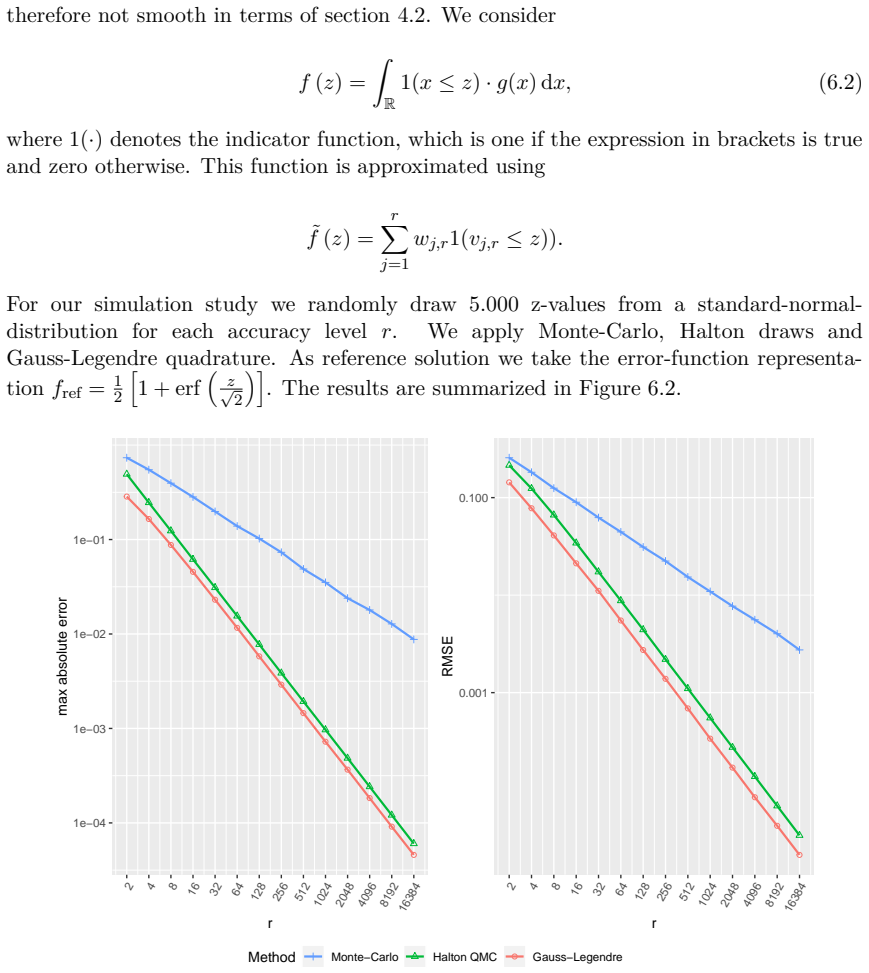
- Quasi-Monte Carlo rules with error $O(r^{-1+\varepsilon})$ require $R(n)=n^\beta$ with $\beta>1/2$, a square-root reduction compared with Monte Carlo.
- Gaussian quadrature and sparse-grid approximations can therefore deliver estimators with the same asymptotic efficiency as exact maximum likelihood at substantially lower cost, provided the integrand has the required smoothness.
- The paper's conditions also imply a practical warning: for a fixed approximation accuracy, the extra estimation error grows with the sample size, so large datasets demand more accurate quadrature than small ones.
Reading between the lines
- The sup-norm formulation suggests a testable modification: replacing the supremum over an unbounded data space by an expectation-weighted norm might extend the theorem to mixed-logit settings with unbounded covariates, where the current worst-case condition is infinite.
- The framework likely transfers to other approximate M-estimators such as simulated GMM or minimum distance, since the underlying argument only uses uniform convergence of the approximated objective and its derivatives.
- The rate threshold suggests an adaptive implementation: a practitioner could estimate the quadrature error and keep increasing $r$ until the error is below $c/\sqrt{n}$, instead of committing to a fixed link function.
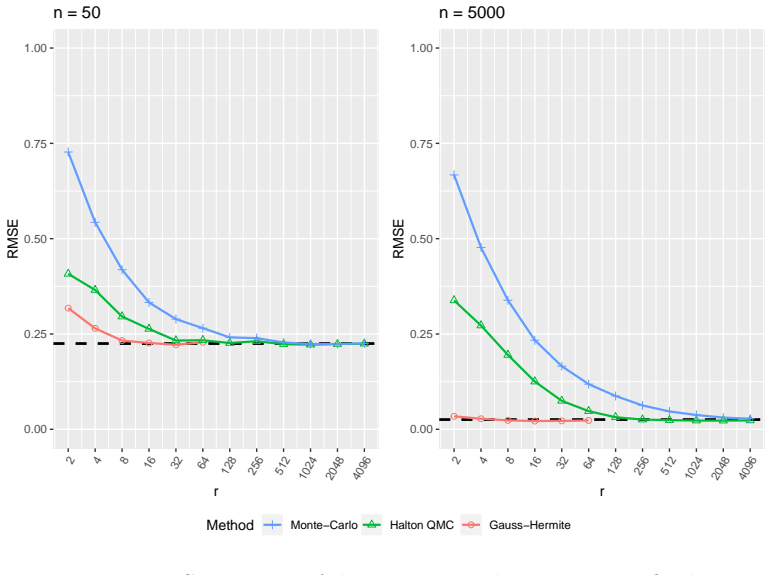
- The finite-sample simulations imply that efficiency comparisons among approximation methods can be made before fitting the model, by checking which rule has the smaller worst-case error at the chosen $R(n)$.
Signed reviews
Editorial analysis
A structured set of objections, weighed in public.
Referee Report
Summary. The paper develops asymptotic theory for maximum approximated likelihood (MAL) estimators, in which each log-likelihood contribution is replaced by a numerical quadrature approximation with an accuracy level r that grows with the sample size n. It states general consistency and asymptotic normality results for MAL estimators (Theorems 7 and 8), derives sufficient growth rates for r under algebraic and exponential quadrature error bounds (Theorem 9), and applies the framework to Monte Carlo, quasi-Monte Carlo, Gauss-Hermite quadrature, and sparse grid integration. The theoretical results are illustrated with mixed logit and Butler-Moffitt examples and a simulation study comparing approximation methods.
Significance. If the stated conditions are met, the paper gives a useful unifying framework: maximum simulated likelihood emerges as a special case, and the link-function results (e.g., logarithmic growth of r for exponentially convergent quadrature) are practically relevant. The algebraic manipulations in Theorem 9 are correct, and the proofs of the general theorems follow standard extremum-estimator arguments. The paper also provides a helpful simulation comparison of approximation methods. However, the scope of the central theorems is narrower than the examples suggest: the uniform sup-norm error condition used throughout is not satisfied for the paper's own mixed logit examples when covariates are unbounded, which is the standard empirical setting. This gap is load-bearing and requires a substantial clarification or modification of the assumptions.
major comments (3)
- [Section 5, Example Ia; Theorem 7(iii) and Eq. (3.7)] For the mixed logit example with unbounded covariates, the uniform approximation error E(r)=sup_{z∈Z,θ∈Θ}(|\tilde f_r(z,θ)-f(z,θ)|+||∇_θ \tilde f_r(z,θ)-∇_θ f(z,θ)||) does not vanish as r→∞. With f(z,θ)=∫ σ(z(θ2 v+θ1)) φ(v) dv and Gauss-Hermite quadrature, for fixed r and z→∞, \tilde f_r(z,θ) tends to W_r(θ)=Σ_{j: θ2 v_j+θ1>0} w_j while f(z,θ)→1, so sup_z |\tilde f_r-f| is bounded below by a positive constant for generic θ. The gradient term is worse: ∂\tilde f_r/∂θ1=Σ_j w_j z σ'(z(θ2 v_j+θ1)) has no finite supremum over z∈R when θ2 v_j+θ1=0 for some node, and over a compact parameter set containing points arbitrarily close to such a hyperplane the supremum is unbounded. Thus Theorem 7(iii) and Theorem 8(ii) fail for the paper's headline example unless Z is assumed bounded or the error norm is changed to a data-dependent or weighted norm. This is a missing scope condition, not a contradiction inside the theorems, but it must be addressed for the examples to be covered by the theory.
- [Proof of Theorem 8, constants C1(f) and C2(f)] The proof of Theorem 8 defines C1(f) and C2(f) using sup_{z∈Z,θ∈Θ}||∇_θ f(z,θ)|| and sup_{z∈Z,θ∈Θ}||∇_{θθ} f(z,θ)||, and then bounds the approximation error of the log-likelihood gradient by C1(f)√n E(R(n)). However, the assumptions of Theorem 8 do not state that these suprema are finite. If Z is unbounded, as in the mixed logit example, the suprema are infinite, and the displayed inequality is not justified. The proof therefore implicitly assumes uniform boundedness of f and its θ-derivatives up to order two over Z×Θ; this assumption needs to be stated explicitly and verified in the applications.
- [Section 5 and Lemma 20] The verification of the Gauss-Hermite error bounds for the logit examples is incomplete. Lemma 20 provides bounds of the form |D^{(θ)}_α D^{(v)}_β f(θ,v)| ≤ c(α,β) θ^β e^{v^T v/2} ∏ sqrt(1+v_i^2), so the constant depends on the parameter θ through the factor θ^β. When applied to φ(v,z_i,θ)=σ(z_i(θ2 v+θ1)), the relevant parameter vector includes z_i, so the constant c(k,α) is actually a function of z_i and is not uniform over an unbounded covariate space Z. Consequently, the paper does not establish the uniform-in-z bound (4.10) or (4.13) that is needed to obtain a finite, r-independent constant in the quadrature error estimate (4.11) for the mixed logit example.
minor comments (5)
- [Theorem 2] The conclusion of Theorem 2 states 'plim_{n→∞} \hatθ_M = θ0'; this should refer to the approximated estimator \hatθ_AM, not the infeasible M-estimator \hatθ_M.
- [Section 2, after Theorem 2] The sentence beginning 'accuracy parameter r to the number of observations n we introduce a function R' lacks a subject or transition; it should read something like 'To link the accuracy parameter r to the number of observations n, we introduce a function R: N→N.'
- [Corollary 11] The condition numbering in Corollary 11 jumps from (ii) to (iv); condition (iii) is missing.
- [Section 6, Figure 6.3] The vertical axis of Figure 6.3 is labeled 'n × max abs Err', but the text and the caption refer to √n E(R(n)); the label should be √n × max abs Err to match the quantity being plotted.
- [Section 1, paragraph 2] The word 'independed' should be 'independent'.
Circularity Check
No significant circularity: the paper proves conditional asymptotic theorems from standard extremum-estimator arguments and cites external quadrature-error bounds; no prediction reduces to a fitted input or self-citation by construction.
full rationale
This paper's results are conditional asymptotic theorems. Theorems 2 and 4 show that an extremum estimator based on a uniformly consistent approximation of the objective function inherits consistency and asymptotic normality; both proofs proceed directly from Newey-McFadden-type arguments via the triangle inequality and do not use the target result as an input. Theorem 8 makes the required rate explicit by defining E(r) as the worst-case error in the approximated likelihood and its gradient, then proves that the condition sqrt(n) E(R(n)) -> 0 is sufficient for the MAL estimator to have the same limit distribution as the infeasible MLE; the conclusion is a proof that this condition suffices, not a claim that any particular approximation scheme satisfies it. Theorem 9 converts assumed algebraic or exponential error bounds into a required growth rate R(n); the derivation is simple algebra and contains no fitted parameters. The self-citations (Griebel and Oettershagen; Gerstner and Griebel) are used only as sources for sparse-grid and tensor-product error estimates, which are independent numerical-analysis statements about quadrature rules and do not presuppose the paper's econometric conclusions. No parameter is estimated from the target data, no uniqueness theorem is imported from the authors' own prior work to exclude alternatives, and no known empirical pattern is renamed as a theoretical result. The applied examples inherit assumptions from external quadrature-error theorems; whether those assumptions hold for unbounded covariate spaces is a scope or correctness question, not a circularity. The paper is therefore self-contained against external benchmarks for the claims it actually states.
Assumptions & free parameters
assumptions (6)
- domain assumption The infeasible ML estimator satisfies the standard Newey-McFadden regularity conditions (compact parameter space, identification, dominance) for consistency and asymptotic normality.
- domain assumption The likelihood contributions f(z,theta) are bounded below uniformly by delta > 0 over z in Z, theta in Theta.
- domain assumption The quadrature rule converges uniformly over z in Z and theta in Theta for f, its gradient and Hessian (E(r), Ebar_k(r)).
- ad hoc to paper The functions f and its theta-derivatives up to order 2 are uniformly bounded over Z x Theta (needed for constants C1, C2 in the proof of Theorem 8).
- standard math External quadrature error bounds (Gauss-Hermite, sparse grids, QMC) from cited numerical analysis literature hold in the required sup-norm form.
- ad hoc to paper For the logit examples, the integrand satisfies the growth conditions (4.10) or (4.13), verified via Lemma 20 assuming bounded covariates z.
Cite this review
Pith. "Pith review of Maximum Approximated Likelihood Estimation." pith.science (2026). https://pith.science/paper/UI4TMIDO
@misc{pith2026190804110,
  author       = {Pith},
  title        = {Pith review of: Maximum Approximated Likelihood Estimation},
  year         = {2026},
  howpublished = {\url{https://pith.science/paper/UI4TMIDO}},
  note         = {Machine review of arXiv:1908.04110}
}
read the original abstract
Empirical economic research frequently applies maximum likelihood estimation in cases where the likelihood function is analytically intractable. Most of the theoretical literature focuses on maximum simulated likelihood (MSL) estimators, while empirical and simulation analyzes often find that alternative approximation methods such as quasi-Monte Carlo simulation, Gaussian quadrature, and integration on sparse grids behave considerably better numerically. This paper generalizes the theoretical results widely known for MSL estimators to a general set of maximum approximated likelihood (MAL) estimators. We provide general conditions for both the model and the approximation approach to ensure consistency and asymptotic normality. We also show specific examples and finite-sample simulation results.
Figures


Figures from the paper (2 more)

Reference graph
Works this paper leans on
-
[1]
Ackerberg, D., J. Geweke, and J. Hahn (2009) ‘Supplement to Comments on ”Convergence Properties of the Likelihood of Computed Dynamic Models”.’Econometrica77(6), 2009– 26 2017
work page 2009
-
[2]
Bhat, C. (2001) ‘Quasi-random maximum simulated likelihood estimation of the mixed multinomial logit model.’Transportation Research Part B: Methodological35(7), 677– 693
work page 2001
-
[3]
(1984) ‘Asymptotic coefficients of Hermite function series.’J
Boyd, J. (1984) ‘Asymptotic coefficients of Hermite function series.’J. of Computational Physics pp. 382–410
work page 1984
-
[4]
Butler, J., and R. Moffitt (1982) ‘A computationally efficient quadrature procedure for the one factor multinomial probit model.’Econometrica50(3), 761–764
work page 1982
-
[5]
Davis, P., and P. Rabinowitz (2007)Methods of Numerical IntegrationDover Books on Mathematics Series (Dover Publications)
work page 2007
-
[6]
Pillichshammer (2010)Digital Nets and Sequences
Dick, J., and F. Pillichshammer (2010)Digital Nets and Sequences. Discrepancy Theory and quasi-Monte Carlo Integration(Cambridge University Press, Cambridge)
work page 2010
-
[7]
Griebel (1998) ‘Numerical integration using sparse grids.’Numerical Algorithms 18, 209–232
Gerstner, T., and M. Griebel (1998) ‘Numerical integration using sparse grids.’Numerical Algorithms 18, 209–232
work page 1998
-
[8]
Gerstner, T., and M. Griebel (2003) ‘Dimension–adaptive tensor–product quadrature.’ Computing 71(1), 65–87 Gouriéroux, C., and A. Monfort (1996)Simulation-Based Econometric Methods(Oxford University Press)
work page 2003
Show all 33 references
-
[9]
Oettershagen (2014) ‘Dimension-adaptive sparse grid quadrature for in- tegrals with boundary singularities.’ In ‘Sparse grids and Applications,’ vol
Griebel, M., and J. Oettershagen (2014) ‘Dimension-adaptive sparse grid quadrature for in- tegrals with boundary singularities.’ In ‘Sparse grids and Applications,’ vol. 97 ofLecture Notes in Computational Science and Engineering(Springer) pp. 109–136 (2016) ‘On tensor product...
2014
-
[10]
McFadden (1998) ‘The method of simulated scores for the esti- mation of LDV models.’Econometrica66(4), 863–896
Hajivassiliou, V., and D. McFadden (1998) ‘The method of simulated scores for the esti- mation of LDV models.’Econometrica66(4), 863–896
1998
-
[11]
Ruud (1994) ‘Classical estimation methods for LDV models using simulation.’ In ‘Handbook of Econometrics,’ vol
Hajivassiliou, V., and P. Ruud (1994) ‘Classical estimation methods for LDV models using simulation.’ In ‘Handbook of Econometrics,’ vol. 4 pp. 2383–2441
1994
-
[12]
(1964) ‘Algorithm 247: Radical-inverse quasi-random point sequence.’Commun
Halton, J. (1964) ‘Algorithm 247: Radical-inverse quasi-random point sequence.’Commun. ACM 7(12), 701–702
1964
-
[13]
Winschel (2008) ‘Likelihood approximation by numerical integration on sparse grids.’J
Heiss, F., and V. Winschel (2008) ‘Likelihood approximation by numerical integration on sparse grids.’J. of Econometrics144(1), 62–80 27
2008
-
[14]
Train, and J
Hess, S., K. Train, and J. Polak (2006) ‘On the use of a modified Latin Hypercube Sam- pling (MLHS) method in the estimation of a Mixed Logit Model for vehicle choice.’ Transportation Research Part B: Methodological40(2), 147–163
2006
-
[15]
Markhasin, J
Hinrichs, A., L. Markhasin, J. Oettershagen, and T. Ullrich (2016) ‘Optimal quasi-Monte Carlo rules on higher order digital nets for the numerical integration of multivariate periodic functions.’Numerische Mathematik134(1), 163–196
2016
-
[16]
(1963) ‘On the method for numerical integration of Clenshaw and Curtis.’Nu- merische Mathematik5(1), 138–141
Imhof, J. (1963) ‘On the method for numerical integration of Clenshaw and Curtis.’Nu- merische Mathematik5(1), 138–141
1963
-
[17]
Kritzer, G
Irrgeher, C., P. Kritzer, G. Leobacher, and F. Pillichshammer (2015) ‘Integration in Her- mite spaces of analytic functions.’J. of Complexity31(3), 380–404
2015
-
[18]
Webster, and G
Jantsch, P., C. Webster, and G. Zhang (2016) ‘On the Lebesgue constant of weighted Leja points for Lagrange interpolation on unbounded domains.’ arXiv preprint arXiv:1606.07093
2016 arXiv
-
[19]
Kristensen, Dennis, and Bernard SalaniÃľ (2017) ‘Higher-order properties of approximate estimators.’Journal of Econometrics198(2), 189–208
2017
-
[20]
Woźniakowski (2011) ‘Gauss-Hermite quadratures for functions from Hilbert spaces with Gaussian reproducing kernels.’ BIT Numerical Mathematics 52(2), 425–436
Kuo, F., and H. Woźniakowski (2011) ‘Gauss-Hermite quadratures for functions from Hilbert spaces with Gaussian reproducing kernels.’ BIT Numerical Mathematics 52(2), 425–436
2011
-
[21]
Monegato (1994) ‘Error estimates for Gauss-Laguerre and Gauss- Hermite quadrature formulas.’ InApproximation and Computation: A Festschrift in Honor of Walter Gautschi,ed
Mastroianni, G., and G. Monegato (1994) ‘Error estimates for Gauss-Laguerre and Gauss- Hermite quadrature formulas.’ InApproximation and Computation: A Festschrift in Honor of Walter Gautschi,ed. R. Zahar, vol. 119 ofISNM International Series of Nu- merical Mathematics(Birkhae...
1994
-
[22]
(1989) ‘A method of simulated moments for estimation of discrete response models without numerical integration.’Econometrica57, 995–1026
McFadden, D. (1989) ‘A method of simulated moments for estimation of discrete response models without numerical integration.’Econometrica57, 995–1026
1989
-
[23]
Train (2000) ‘Mixed MNL models for discrete response.’J
McFadden, D., and K. Train (2000) ‘Mixed MNL models for discrete response.’J. of Applied Econometrics 15, 447–470
2000
-
[24]
McFadden (1994) ‘Large sample estimation and hypothesis testing.’ vol
Newey, W., and D. McFadden (1994) ‘Large sample estimation and hypothesis testing.’ vol. 4 pp. 2111–2245
1994
-
[25]
(1992) Random Number Generation and Quasi-Monte Carlo Methods (SIAM, Philadelphia)
Niederreiter, H. (1992) Random Number Generation and Quasi-Monte Carlo Methods (SIAM, Philadelphia)
1992
-
[26]
Ritter (1996) ‘High dimensional integration of smooth functions over cubes.’Numerische Mathematik75(1), 79–97 28
Novak, E., and K. Ritter (1996) ‘High dimensional integration of smooth functions over cubes.’Numerische Mathematik75(1), 79–97 28
1996
-
[27]
(2005) ‘Multidimensional variation for quasi-Monte Carlo.’ In ‘International Con- ference on Statistics in honour of Professor Kai-Tai Fang’s 65th birthday’ pp
Owen, A. (2005) ‘Multidimensional variation for quasi-Monte Carlo.’ In ‘International Con- ference on Statistics in honour of Professor Kai-Tai Fang’s 65th birthday’ pp. 49–74 (2006) ‘Halton sequences avoid the origin.’SIAM review48(3), 487–503
2005
-
[28]
Patterson, T.(1968)‘Theoptimumadditionofpointstoquadratureformulae.’ Mathematics of Computation22(104), 847–847 Sándor, Z., and K.Train(2004) ‘Quasi-randomsimulation ofdiscrete choicemodels.’Trans- portation Research Part B: Methodological38(4), 313 – 327
1968
-
[29]
Joe (1994)Lattice Methods for Multiple Integration(New York: Oxford University Press)
Sloan, I., and S. Joe (1994)Lattice Methods for Multiple Integration(New York: Oxford University Press)
1994
-
[30]
Sloan, and A
Smith, W., I. Sloan, and A. Opie (1983) ‘Product integration over infinite intervals I . Rules based on the zeros of Hermite polynomials.’ 40(162), 519–535
1983
-
[31]
(1967) ‘The distribution of points in a cube and the approximate evaluation of integrals.’J
Sobol, I. (1967) ‘The distribution of points in a cube and the approximate evaluation of integrals.’J. Comp. Mathematics and Math. Physics7, 86–112
1967
-
[32]
(2009)Discrete Choice Methods with Simulation,2nd ed
Train, K. (2009)Discrete Choice Methods with Simulation,2nd ed. (Cambridge University Press)
2009
-
[33]
Gunzburger, and W
Zhang, G., M. Gunzburger, and W. Zhao (2013) ‘A sparse grid method for multi- dimensional backward stochastic differential equations.’J. of Computational Mathemat- ics 31(3), 221–248 A. Appendix: Technical results In Section 3, we have worked with distances of the log likelihoo...
2013
Reviewed August 14, 2026 · model on record in the stance chip above.
Discussion (0). Continue with ORCID to comment.