REVIEW 4 major objections 8 minor 28 references
Learning Multi-view Multi-class Anomaly Detection
T0 review · 4 major / 8 minor · reviewed 2026-08-16 · deepseek-v4-flash
Pith's one-line read One model outperforms per-class detectors on multi-view defects
desk verdict Genuinely new task combination and plausible SOTA on Real-IAD, but the anomaly amplification module driving the main ablation gain is not reproducibly defined in the paper. read the letter →
The pith
A machine-rendered reading of the paper's core claim, the machinery that carries it, and where it could break.
The reading
What carries the argument
The load-bearing mechanism is the Anomaly Amplification Module (AAM). It computes query/key/value projections over image tokens, forms an attention-weighted feature $F$, normalizes it along the token dimension, and derives a per-token similarity score summed over tokens and scaled by a learnable temperature $\gamma$. A softmax turns these scores into an attention distribution $\Pi$, and a suppression factor $\mathrm{Att} = 1/(1 + \Pi^\top F^2)$ is applied so that tokens close to the dominant normal pattern are attenuated while outlier tokens dominate the output $f_m = W_{out}(-(F \cdot \Pi) \cdot \mathrm{Att})$. The semi-frozen encoder's pre-encoder prior enhancement (normalize, channel-weight by $|\gamma|$, sigmoid-gate by spatial mean statistics) lets the frozen DINOv2 backbone adapt to different views, and the cross-feature loss aligns encoder layer 1 with decoder layer 2 and vice versa over the top 10% most similar locations.
What would settle it
Train the same MVMCAD pipeline on a Real-IAD category whose defects closely mimic the normal surface texture, then inspect the per-category image-level AUROC and the anomaly heatmaps; if AUROC drops toward the baseline level or the heatmap fails to light up the ground-truth defect region while normal textured regions stay bright, the assumption that anomalies are rare feature-norm tokens has failed.
Extended reading notes
Core claim
The paper claims that multi-view multi-class anomaly detection can be solved by a unified encoder-decoder trained only on normal images, and that the key is to make the frozen pretrained encoder view-adaptive without destroying its representation power. The semi-frozen encoder puts a lightweight trainable prior mechanism in front of the frozen DINOv2 backbone, so each view's low-level statistics are recalibrated before patching. The anomaly amplification module then models global token relationships, computes normalized token similarities, and applies an inverse-weighting suppression factor so tokens that strongly resemble dominant normal patterns are down-weighted while rare or deviant tokens are amplified. The cross-feature loss exchanges shallow and deep features between encoder and decoder and asks the top 10% most similar pairs to agree, which the authors argue lets the decoder catch both texture-level and structure-level anomalies. On Real-IAD the method reports state-of-the-art image-level and pixel-level results, beating Dinomaly by +1.7/+1.8/+1.9 AUROC/AP/F1-max at image level and +0.3/+1.1/+1.1/+1.3 at pixel level.
Load-bearing premise
The central bet is that anomalies show up as feature-norm outliers in the frozen DINOv2 space: if a defect is texturally or structurally similar to the normal surface pattern, the AAM's inverse weighting will suppress it instead of amplifying it, and the paper does not analyze when that happens.
Editorial extensions
If this is right
- A single MVMCAD model can replace per-class models for multi-view industrial inspection while improving accuracy, because it trains one set of weights across all Real-IAD categories.
- The reported margins over Dinomaly indicate that a small trainable adapter plus token-level suppression can improve on a frozen-feature-only detector without fine-tuning the whole backbone.
- Because the method already reaches state-of-the-art with ViT-Small, its gains do not depend on the largest backbone; scaling to ViT-Base and ViT-Large yields only incremental improvements.
- In the separate-class setting the same model still beats UniAD and MVAD on average, so the multi-class training objective is not what buys the gain.
- The authors report that the AAM can over-amplify and slightly hurt pixel-level AP/F1-max, so the configuration that maximizes image-level accuracy is not exactly the one that maximizes pixel-level precision.
Reading between the lines
- The inverse-weighting step acts as a learned rarity detector, so applying AAM on top of other frozen self-supervised features (for example MAE or CLIP) is a natural test of whether the amplification mechanism transfers across feature spaces.
- The over-amplification observation points to a precision-recall knob: scaling the suppression factor per category could trade image-level recall for pixel-level precision, a direction the paper leaves untested.
- The top-10% loss selection behaves like a hard-example miner over patch similarity, so annealing the percentile during training or weighting the two cross terms by anomaly-frequency priors are plausible extensions.
- The pre-encoder prior is a cheap input-space gating that could benefit any frozen-encoder anomaly detector, including single-view ones, even though the paper evaluates it only in multi-view settings.
Signed reviews
Editorial analysis
A structured set of objections, weighed in public.
Referee Report
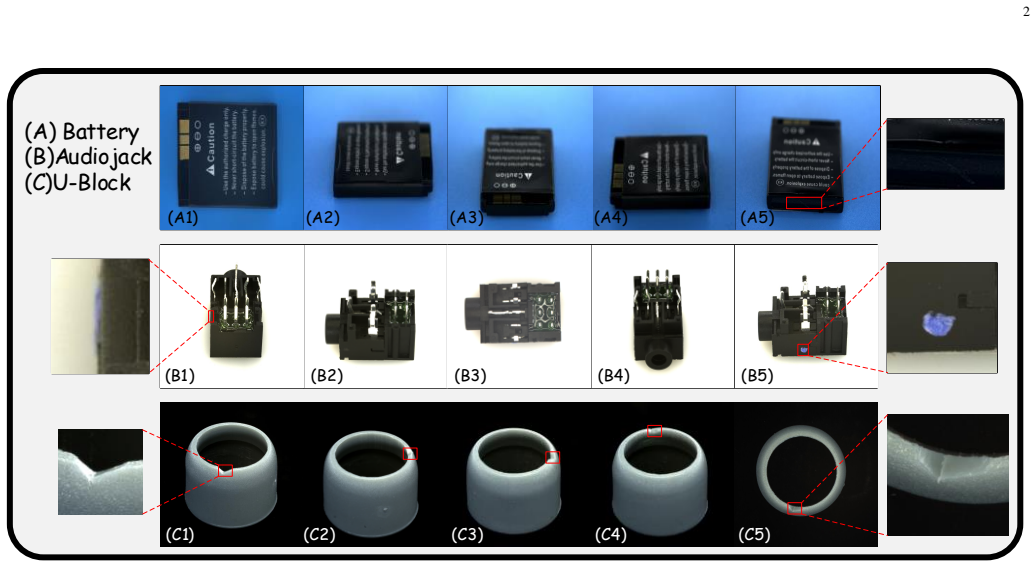
Summary. The paper proposes MVMCAD, a unified multi-view multi-class anomaly detection method built on a frozen DINOv2 encoder with a trainable pre-encoder, an Anomaly Amplification Module (AAM), and a Cross-Feature Loss (CFL). On the Real-IAD benchmark it reports state-of-the-art results of 91.0/88.6/82.1 for image-level AUROC/AP/F1-max and 99.1/43.9/48.2/95.2 for pixel-level AUROC/AP/F1-max/AUPRO. The central claim is that the three proposed components, especially AAM, improve multi-view anomaly detection by suppressing normal tokens and amplifying deviant ones, while CFL aligns cross-scale encoder and decoder features.
Significance. If the method is correctly specified and the reported numbers are reproducible, this would be a meaningful advance for unified multi-class multi-view anomaly detection: it builds on frozen DINOv2 features, is evaluated on an external benchmark, and beats strong recent baselines such as Dinomaly. The contribution is potentially useful for practical industrial inspection. However, the current specification of the component responsible for the largest ablation gain is not type-consistent, and the headline numbers are not auditable from the text as written. The external evaluation and normal-only training mean there is no circularity concern, but the reproducibility gap currently blocks a clean assessment.
major comments (4)
- [Sec. III-C, Eqs. (7)-(13)] The anomaly amplification module is not defined in a way that type-checks. Eq. (7) assigns V the same shape R^{B*h*N*d_k} as Q and K, although the value stream must have its own dimension d_v and the attention weights are computed from QK^T/sqrt(d_k). Eq. (10) defines Sim = sum_{j=1}^N ||F_hat_j||_2 * gamma with no token index on the left-hand side, so it cannot produce the per-token tensor Pi in R^{B*h*N} required by Eq. (11); the sum over j collapses the token dimension, and gamma in R^{h*1} is not conformable with a per-token score. Eq. (12) computes Att = 1/(1 + (Pi^T * F^2)), where Pi in R^{B*h*N} and F (presumably R^{B*N*D}) are not conformable for matrix multiplication, and F^2 is not defined (element-wise square is never stated). Eq. (13) then multiplies (F * Pi) by Att without specifying the required reshaping. Since Table III shows AAM is the component with the largest single ablation gain (image AUROC 87.9 vs. 84.8 without it), the headline numbers 91.0/88.6/82.1 and 99.1/43.9/48.2/95.2 cannot be audited from the text as written. Please give explicit tensor shapes at every step, define all products, and provide pseudocode or released code.
- [Sec. IV-E, Table III] The full model does not achieve the best pixel-level AP/F1-max among the ablations. The configuration with SFE and AAM but without CFL reaches 45.0/48.9, and SFE with CFL but without AAM reaches 44.7/48.9, while the full model reaches 43.9/48.2. The text attributes this to an 'over-amplification effect' but provides no supporting experiment. Because the abstract and Sec. IV-C specifically advertise pixel-level AP/F1-max as part of the SOTA claim, this internal inconsistency should be analyzed (e.g., by varying the AAM strength and reporting the resulting AP/F1-max) rather than explained by a conjecture.
- [Secs. IV-C and IV-E] All reported numbers are single runs, so the claimed 'significant margins' over Dinomaly and the ablation differences are not statistically supported. For example, image-level AUROC/AP/F1-max improve by +1.7/+1.8/+1.9 and pixel-level by +0.3/+1.1/+1.1/+1.3; some per-class deltas are much smaller. Please report mean +/- standard deviation over at least three seeds for the headline comparisons and the ablation rows, or provide a paired significance test.
- [Sec. III-C] The AAM relies on the assumption that anomalous tokens are those whose feature norms are rare or deviant, so inverse similarity weighting suppresses normal patterns. This assumption is not tested. If a defect closely resembles the normal surface texture in the frozen DINOv2 feature space, the inverse weighting could suppress, rather than amplify, the defect. Please include an analysis (e.g., distribution of normalized token norms or similarities for normal vs. defective patches on representative Real-IAD categories, plus failure examples) to delineate when the module helps and when it hurts.
minor comments (8)
- [Sec. III-B, Eq. (4)] The displayed formula for beta_{h,w} appears to be missing the fraction bar; it should read beta_{h,w} = M_{h,w} / (sum_{h'=1}^H sum_{w'=1}^W M_{h',w'}). Please fix the typography.
- [Sec. III-B, Eq. (2)] The denominator is written as sum_{k=1}^C |gamma_k|, but the numerator uses |gamma_c|; clarify that gamma_c is the per-channel BatchNorm scale and specify which parameters of the 'pre-encoder' are trainable.
- [Sec. III-C, Eq. (7)] The text says 'Q,K,V in R^{B*h*N*d_k} are linear mapping weights', but Q, K, V are feature maps, not weights; the projection weights are W^Q, W^K, W^V. Also, V should have its own head dimension d_v.
- [Sec. IV-B, last sentence] 'All hyperparameters in the experiment are set to 1 by default' is incompatible with the top-10% threshold h used in Sec. III-D, which is a hyperparameter and cannot be 1 for the selection in Eq. (15). Please specify the actual values or remove the assertion.
- [Figure 3] The legend entries 'Avg(C): Channel Average', 'Abs&Avg', and 'Norm&Square' are not defined in the caption; define each operation to make the figure self-contained.
- [Throughout] 'an unified model' in the Introduction and Conclusion should be 'a unified model'; 'MV AD' vs. 'MVAD' is used inconsistently; and the table headers 'NeurlPS' should be 'NeurIPS'.
- [Tables I and II] The slash-separated triplets/quadruplets in each cell are difficult to scan; restate the metric order in the caption and consider splitting the tables or using column groups for readability.
- [Sec. IV-H, Table IV] The table caption should state the training iterations (5000 per category) that are currently given only in the text, so the separate-class setting is self-contained.
Circularity Check
No significant circularity: the SOTA claim is benchmarked against the external Real-IAD test set, and the self-citations are background only.
full rationale
The paper's central claim—state-of-the-art multi-view multi-class anomaly detection on Real-IAD—is an empirical result measured against an external benchmark with fixed ground-truth labels; none of the reported AUROC/AP/F1/AUPRO numbers are defined as outputs of the model's equations in a way that makes them true by construction. The three proposed components (semi-frozen encoder, AAM, cross-feature loss) are trained on normal samples only, and the evaluation set is separate from the training set. The self-citations [6] and [25] appear only in the introduction and related-work survey as examples of individual-model or general anomaly-detection approaches; they are not invoked to justify the main derivation or the SOTA numbers, so they are not load-bearing. No uniqueness theorem is imported from prior work, and no fitted parameter is renamed as a prediction. Although the AAM equations in Sec. III-C contain shape inconsistencies that raise reproducibility concerns, dimensional mismatch is a correctness issue, not a circularity issue: the module is not defined in terms of the benchmark metric. Because the derivation is self-contained and the claims are validated against external data, the circularity score is 0.
Assumptions & free parameters
free parameters (2)
- top-10% threshold h in Cross-Feature Loss =
10%
- AAM learnable temperature gamma =
learned
assumptions (3)
- domain assumption DINOv2 features are a suitable frozen backbone for multi-view anomaly detection across 30 product classes
- domain assumption Anomalies are rare, semantically deviant tokens that can be amplified by inverse weighting
- domain assumption Reconstruction error on normal-trained decoder localizes anomalies
Cite this review
Pith. "Pith review of Learning Multi-view Multi-class Anomaly Detection." pith.science (2026). https://pith.science/paper/UI6QCF73
@misc{pith2026250421294,
  author       = {Pith},
  title        = {Pith review of: Learning Multi-view Multi-class Anomaly Detection},
  year         = {2026},
  howpublished = {\url{https://pith.science/paper/UI6QCF73}},
  note         = {Machine review of arXiv:2504.21294}
}
read the original abstract
The latest trend in anomaly detection is to train a unified model instead of training a separate model for each category. However, existing multi-class anomaly detection (MCAD) models perform poorly in multi-view scenarios because they often fail to effectively model the relationships and complementary information among different views. In this paper, we introduce a Multi-View Multi-Class Anomaly Detection model (MVMCAD), which integrates information from multiple views to accurately identify anomalies. Specifically, we propose a semi-frozen encoder, where a pre-encoder prior enhancement mechanism is added before the frozen encoder, enabling stable cross-view feature modeling and efficient adaptation for improved anomaly detection. Furthermore, we propose an Anomaly Amplification Module (AAM) that models global token interactions and suppresses normal regions to enhance anomaly signals, leading to improved detection performance in multi-view settings. Finally, we propose a Cross-Feature Loss that aligns shallow encoder features with deep decoder features and vice versa, enhancing the model's sensitivity to anomalies at different semantic levels under multi-view scenarios. Extensive experiments on the Real-IAD dataset for multi-view multi-class anomaly detection validate the effectiveness of our approach, achieving state-of-the-art performance of 91.0/88.6/82.1 and 99.1/43.9/48.2/95.2 for image-level and the pixel-level, respectively.
Figures


Figures from the paper (1 more)

Reference graph
Works this paper leans on
-
[1]
Mvtec ad–a comprehensive real-world dataset for unsupervised anomaly detection
Paul Bergmann, Michael Fauser, David Sattlegger, and Carsten Steger. Mvtec ad–a comprehensive real-world dataset for unsupervised anomaly detection. In Proceedings of the IEEE/CVF conference on computer vision and pattern recognition , pages 9592–9600, 2019. 2
work page 2019
-
[2]
Uninformed students: Student-teacher anomaly detection with discrimi- native latent embeddings
Paul Bergmann, Michael Fauser, David Sattlegger, and Carsten Steger. Uninformed students: Student-teacher anomaly detection with discrimi- native latent embeddings. In Proceedings of the IEEE/CVF conference on computer vision and pattern recognition , pages 4183–4192, 2020. 2
work page 2020
-
[3]
Multi-view 3d object detection network for autonomous driving
Xiaozhi Chen, Huimin Ma, Ji Wan, Bo Li, and Tian Xia. Multi-view 3d object detection network for autonomous driving. In Proceedings of the IEEE conference on Computer Vision and Pattern Recognition , pages 1907–1915, 2017. 3
work page 1907
-
[4]
Vision transformers need registers
Timoth ´ee Darcet, Maxime Oquab, Julien Mairal, and Piotr Bojanowski. Vision transformers need registers. arXiv preprint arXiv:2309.16588 ,
-
[5]
Anomaly detection via reverse distillation from one-class embedding
Hanqiu Deng and Xingyu Li. Anomaly detection via reverse distillation from one-class embedding. In Proceedings of the IEEE/CVF Conference on Computer Vision and Pattern Recognition , pages 9737–9746, 2022. 1, 3, 5, 6
work page 2022
-
[6]
Prioritized local matching network for cross-category few-shot anomaly detection
Huilin Deng, Hongchen Luo, Wei Zhai, Yang Cao, and Yu Kang. Prioritized local matching network for cross-category few-shot anomaly detection. IEEE Transactions on Artificial Intelligence , 2024. 1, 2
work page 2024
-
[7]
Nng-mix: Improving semi-supervised anomaly detection with pseudo- anomaly generation
Hao Dong, Ga ¨etan Frusque, Yue Zhao, Eleni Chatzi, and Olga Fink. Nng-mix: Improving semi-supervised anomaly detection with pseudo- anomaly generation. IEEE Transactions on Neural Networks and Learning Systems, 2024. 2
work page 2024
-
[8]
Dong Gong, Lingqiao Liu, Vuong Le, Budhaditya Saha, Moussa Reda Mansour, Svetha Venkatesh, and Anton van den Hengel. Memorizing normality to detect anomaly: Memory-augmented deep autoencoder for unsupervised anomaly detection. In Proceedings of the IEEE/CVF international conference on computer vision , pages 1705–1714, 2019. 2
work page 2019
Show all 28 references
-
[9]
Recon- trast: Domain-specific anomaly detection via contrastive reconstruction
Jia Guo, Shuai Lu, Lize Jia, Weihang Zhang, and Huiqi Li. Recon- trast: Domain-specific anomaly detection via contrastive reconstruction. Advances in Neural Information Processing Systems , 36:10721–10740,
-
[10]
Dinomaly: The less is more philosophy in multi-class unsupervised anomaly detection
Jia Guo, Shuai Lu, Weihang Zhang, Fang Chen, Hongen Liao, and Huiqi Li. Dinomaly: The less is more philosophy in multi-class unsupervised anomaly detection. arXiv preprint arXiv:2405.14325 , 2024. 1, 3, 5, 6
2024 arXiv
-
[11]
Mambaad: Exploring state space models for multi-class unsupervised anomaly detection
Haoyang He, Yuhu Bai, Jiangning Zhang, Qingdong He, Hongxu Chen, Zhenye Gan, Chengjie Wang, Xiangtai Li, Guanzhong Tian, and Lei Xie. Mambaad: Exploring state space models for multi-class unsupervised anomaly detection. In The Thirty-eighth Annual Conference on Neural Informat...
2024
-
[12]
A diffusion- based framework for multi-class anomaly detection
Haoyang He, Jiangning Zhang, Hongxu Chen, Xuhai Chen, Zhishan Li, Xu Chen, Yabiao Wang, Chengjie Wang, and Lei Xie. A diffusion- based framework for multi-class anomaly detection. In Proceedings of the AAAI conference on artificial intelligence , volume 38, pages 8472– 8480, 2...
2024
-
[13]
Learning multi-view anomaly detection
Haoyang He, Jiangning Zhang, Guanzhong Tian, Chengjie Wang, and Lei Xie. Learning multi-view anomaly detection. arXiv preprint arXiv:2407.11935, 2024. 1, 3, 8
2024 arXiv
-
[14]
Cut- paste: Self-supervised learning for anomaly detection and localization
Chun-Liang Li, Kihyuk Sohn, Jinsung Yoon, and Tomas Pfister. Cut- paste: Self-supervised learning for anomaly detection and localization. In Proceedings of the IEEE/CVF conference on computer vision and pattern recognition, pages 9664–9674, 2021. 2
2021
-
[15]
Center- aware adversarial autoencoder for anomaly detection
Daoming Li, Qinghua Tao, Jiahao Liu, and Huangang Wang. Center- aware adversarial autoencoder for anomaly detection. IEEE Transactions on Neural Networks and Learning Systems , 33(6):2480–2493, 2021. 2
2021
-
[16]
Anomaly detection on attributed networks via contrastive self- supervised learning
Yixin Liu, Zhao Li, Shirui Pan, Chen Gong, Chuan Zhou, and George Karypis. Anomaly detection on attributed networks via contrastive self- supervised learning. IEEE transactions on neural networks and learning systems, 33(6):2378–2392, 2021. 2
2021
-
[17]
Simplenet: A simple network for image anomaly detection and localization
Zhikang Liu, Yiming Zhou, Yuansheng Xu, and Zilei Wang. Simplenet: A simple network for image anomaly detection and localization. In Proceedings of the IEEE/CVF conference on computer vision and pattern recognition, pages 20402–20411, 2023. 1, 3, 5, 6
2023
-
[18]
Zoom in and out: A mixed-scale triplet network for camouflaged object detection
Youwei Pang, Xiaoqi Zhao, Tian-Zhu Xiang, Lihe Zhang, and Huchuan Lu. Zoom in and out: A mixed-scale triplet network for camouflaged object detection. In Proceedings of the IEEE/CVF Conference on computer vision and pattern recognition , pages 2160–2170, 2022. 3
2022
-
[19]
Towards total recall in industrial anomaly detection
Karsten Roth, Latha Pemula, Joaquin Zepeda, Bernhard Sch ¨olkopf, Thomas Brox, and Peter Gehler. Towards total recall in industrial anomaly detection. In Proceedings of the IEEE/CVF conference on computer vision and pattern recognition , pages 14318–14328, 2022. 2
2022
-
[20]
Multi-view convolutional neural networks for 3d shape recogni- tion
Hang Su, Subhransu Maji, Evangelos Kalogerakis, and Erik Learned- Miller. Multi-view convolutional neural networks for 3d shape recogni- tion. In Proceedings of the IEEE international conference on computer vision, pages 945–953, 2015. 3
2015
-
[21]
Real-iad: A real-world multi-view dataset for benchmarking versatile industrial anomaly detection
Chengjie Wang, Wenbing Zhu, Bin-Bin Gao, Zhenye Gan, Jiangning Zhang, Zhihao Gu, Shuguang Qian, Mingang Chen, and Lizhuang Ma. Real-iad: A real-world multi-view dataset for benchmarking versatile industrial anomaly detection. In Proceedings of the IEEE/CVF Conference on Comput...
2024
-
[22]
Mvster: Epipolar transformer for efficient multi-view stereo
Xiaofeng Wang, Zheng Zhu, Guan Huang, Fangbo Qin, Yun Ye, Yijia He, Xu Chi, and Xingang Wang. Mvster: Epipolar transformer for efficient multi-view stereo. In European Conference on Computer Vision, pages 573–591. Springer, 2022. 3
2022
-
[23]
Aide: A vision-driven multi-view, multi-modal, multi-tasking dataset for assistive driving perception
Dingkang Yang, Shuai Huang, Zhi Xu, Zhenpeng Li, Shunli Wang, Mingcheng Li, Yuzheng Wang, Yang Liu, Kun Yang, Zhaoyu Chen, et al. Aide: A vision-driven multi-view, multi-modal, multi-tasking dataset for assistive driving perception. In Proceedings of the IEEE/CVF International...
-
[24]
A unified model for multi-class anomaly detection
Zhiyuan You, Lei Cui, Yujun Shen, Kai Yang, Xin Lu, Yu Zheng, and Xinyi Le. A unified model for multi-class anomaly detection. Advances in Neural Information Processing Systems , 35:4571–4584, 2022. 1, 2, 5, 6, 8
2022
-
[25]
Tf 2: Few-shot text-free training-free defect image generation for industrial anomaly inspection
Qianzi Yu, Kai Zhu, Yang Cao, Feijie Xia, and Yu Kang. Tf 2: Few-shot text-free training-free defect image generation for industrial anomaly inspection. IEEE Transactions on Circuits and Systems for Video Technology, 2024. 2
2024
-
[26]
Draem-a discrimi- natively trained reconstruction embedding for surface anomaly detection
Vitjan Zavrtanik, Matej Kristan, and Danijel Sko ˇcaj. Draem-a discrimi- natively trained reconstruction embedding for surface anomaly detection. In Proceedings of the IEEE/CVF international conference on computer vision, pages 8330–8339, 2021. 2
2021
-
[27]
Reconstruction by inpainting for visual anomaly detection
Vitjan Zavrtanik, Matej Kristan, and Danijel Sko ˇcaj. Reconstruction by inpainting for visual anomaly detection. Pattern Recognition , 112:107706, 2021. 2
2021
-
[28]
Destseg: Segmentation guided denoising student-teacher for anomaly detection
Xuan Zhang, Shiyu Li, Xi Li, Ping Huang, Jiulong Shan, and Ting Chen. Destseg: Segmentation guided denoising student-teacher for anomaly detection. In Proceedings of the IEEE/CVF Conference on Computer Vision and Pattern Recognition , pages 3914–3923, 2023. 1, 3, 5, 6
2023
Reviewed August 16, 2026 · model on record in the stance chip above.
Discussion (0). Continue with ORCID to comment.