REVIEW 5 major objections 5 minor 51 references
RoE-FND: A Case-Based Reasoning Approach with Dual Verification for Fake News Detection via LLMs
T0 review · 5 major / 5 minor · reviewed 2026-08-07 · deepseek-v4-flash
Pith's one-line read A training-free framework claims LLM fake-news detection improves when the model is given a memory of its own past reasoning errors, built through case-based reflection and used to choose between two opposing analyses.
desk verdict Training-free CBR+reflection framework with consistent gains, but the dual-channel selection mechanism needs conditional analysis to rule out label-bias. read the letter →
The pith
A machine-rendered reading of the paper's core claim, the machinery that carries it, and where it could break.
The reading
What carries the argument
The load-bearing object is the dual-channel analysis: every claim is examined by an ordinary analyst, which retrieves evidence and reaches a verdict, and by a special analyst, which is told a label in advance and asked to argue for it. During exploration the special analyst receives the true label; during deployment it receives the opposite of the ordinary verdict. Three further agents make this comparison useful: the Reflector turns a correct-versus-incorrect pair into a stored lesson, the Advisor retrieves the most semantically similar stored lessons for a new claim and condenses them into criteria, and the Judger scores the two analyses against those criteria and selects the winner. The whole pipeline is prompt-based and uses a semantic similarity tool for retrieval, so the only moving parts are the language model calls and the stored reflections.
What would settle it
Run the deployment stage with the Advisor's advice replaced by a generic, non-retrieved instruction; if accuracy on any dataset does not fall materially below the full framework, then the experience-retrieval component is not the source of the claimed gains.
Extended reading notes
Core claim
The central discovery, as the authors state it, is that the reliability of an LLM fact-checker can be raised by comparing two opposing analyses and learning, in advance, what separates a correct analysis from an incorrect one. The framework stores these lessons as text and reuses them at test time, so no parameters are updated. The paper reports that with the strongest tested configuration RoE-FND reaches accuracies of 0.890 on CHEF, 0.863 on Snopes, and 0.711 on PolitiFact, beating supervised methods such as MUSER and SEE and training-free baselines such as ProgramFC on nearly all metrics; a variant with a different tested model reaches 0.891, 0.860, and 0.712. In cross-dataset tests the framework's accuracy drops less than the trained baselines, and in an ablation every component — the reflector, the advisor's summarization, the dual-channel comparison, and case retrieval — contributes; removing the dual-channel comparison alone lowers accuracy by roughly 10-12 percent across datasets. A fine-tuning extension, in which a smaller model is trained on high-quality analyses produced by a larger model, pushes accuracy to 0.904 on CHEF, 0.876 on Snopes, and 0.891 on PolitiFact, above two strong reasoning models.
Load-bearing premise
The framework assumes that a language model told the news label before writing its analysis produces genuinely stronger reasoning, rather than merely rationalizing the assigned label, because the stored reflections and the advice built from them inherit that assumption.
Editorial extensions
If this is right
- If correct, the framework removes the need for task-specific training: the same language model becomes more accurate with an experience base, so new domains can be handled by building a new knowledge base rather than retraining.
- The opposite-label channel gives the framework an internal counterexample for every claim, and the Judger's arbitration makes the final verdict depend on comparative strength of argument rather than one model's initial inclination.
- Cross-domain transfer is achieved through retrieved reflections rather than shared parameters, so the framework should degrade more gracefully on unseen platforms; the paper's cross-dataset experiments show smaller relative drops than the trained baselines.
- A small model fine-tuned on analyses produced by a much larger model within the framework reaches higher accuracy than standalone reasoning models on all three datasets, showing the framework's components can be compressed into a cheaper deployment.
Reading between the lines
- A direct extension the paper does not develop is to treat the two competing analyses as counterfactual explanations: the difference between them marks which evidence items changed the verdict, which could be harvested as evidence-level supervision for smaller models.
- The framework's reliance on the special analyst's genuine superiority is testable in isolation: if label-consistent analyses are no better reasoned than ordinary ones on claims where both reach the truth, the stored reflections are lessons in style rather than substance.
- Because all experiences are stored as natural language, the knowledge base can be updated online during deployment; the paper names this as future work, but the architecture already permits it.
- The same dual-channel arbitration could transfer to other high-stakes verification tasks, such as medical or legal claim checking, where a single LLM pass is known to be biased by the conclusion it starts from.
Editorial analysis
A structured set of objections, weighed in public.
Referee Report
Summary. The paper proposes RoE-FND, a training-free framework for evidence-based fake news detection that combines LLM reasoning with case-based experiential learning. In the exploration stage, an ordinary analyst and a special analyst (given the ground-truth label) each produce an analysis; a reflector compares them on cases where the ordinary analyst erred and stores reflections in a knowledge base. At deployment, an advisor retrieves similar cases and synthesizes advice, and a judger selects between the ordinary analysis and a special analysis produced with the opposite of the ordinary prediction. Experiments on CHEF, Snopes, and PolitiFact report accuracy gains over trained baselines and standalone LLMs, cross-dataset generalization improvements, ablations, and a fine-tuning variant. The paper also includes qualitative analyses of generated rationales and advice keywords.
Significance. If the reported results hold, RoE-FND would be a valuable contribution: it is training-free at inference, produces interpretable rationales, and generalizes across datasets, addressing known LLM failure modes such as hallucinated reasoning and conclusion bias. The framework is clearly described, and the evaluation covers three datasets with multiple LLM backbones, a cross-dataset test, and ablations. However, the central claims of 'superior effectiveness and generalization' are not yet statistically supported: there are no error bars or significance tests for stochastic LLM outputs, some table results contradict the text, and the deployment design may introduce a selection bias that the current analysis does not rule out. The paper would be strengthened by conditional analyses of the judger's decisions, multi-run statistics, and a reconciliation of the inconsistencies noted below.
major comments (5)
- [Section 3.2.1, Eq. (3); Section 3.2.3, Eq. (5); Table 2] In deployment, the Special Analyst is always given the opposite of the ordinary prediction y_o, so on every test case where y_o is already correct, the Special Analyst is instructed to defend a false label. The knowledge base, however, is built only from exploration cases (Section 3.1.2) where the Special Analyst was given the ground-truth label and thus argued the true side. Advice synthesized from those true-label-anchored reflections need not discriminate against a confident, well-structured rationalization of a false label. The reported numbers impose a tight bound on how often the Judger may overrule a correct y_o: for DeepSeekv3 on CHEF, ordinary ACC is 0.780 and final ACC is 0.890, so even if every wrong y_o is corrected, the Judger can overrule a correct y_o on at most about 14% of the correct cases. The manuscript does not report any conditional breakdown of Judger decisions by y_o correctness. I request that the authors report P(Judger selects the special analysis | y_o correct) and P(Judger selects the special analysis | y_o incorrect) on the test sets, and show that the former is low enough to explain the observed gains.
- [Section 4.2.2, Table 2] All results are reported as single numbers with no error bars, variance estimates, or significance tests, despite the use of stochastic LLM decoding. The differences that support the central claims are often small (e.g., 0.890 vs 0.891 between DeepSeekv3 and 4o-mini on CHEF in Table 2), and the gap against the best trained baseline on PolitiFact is negative on ACC (MUSER 0.729 vs RoE-FND DeepSeekv3 0.711). Without confidence intervals or paired significance tests, the claims of 'superior effectiveness and generalization' are not established. Please report means and standard deviations over at least three runs with different random seeds, and where possible use paired tests on the same test items.
- [Section 4.2.2, Table 2] The text states that 'RoE-FND achieves the best results on nearly all metrics and datasets,' but Table 2 itself shows that on PolitiFact, MUSER attains ACC 0.729 and F1 0.732, while RoE-FND with DeepSeekv3 attains ACC 0.711 and F1 0.658, and RoE-FND with 4o-mini attains ACC 0.712 and F1 0.735. Thus the framework does not beat the best trained baseline on this dataset on ACC, and the abstract's 'across three datasets' claim is too strong. Please revise the claim or provide a more careful comparison protocol that justifies the stated conclusion.
- [Section 4.3.1, Table 4] The ablation setting names do not match between the text and the table. The text describes 'w/o Advisor' and 'w/o Case Specified Experience,' but Table 4 lists 'w/o Summarizer' and 'w/o Case Retrieval.' The term 'Summarizer' is not defined anywhere in the paper, so it is impossible to know which component is actually ablated in that row. This inconsistency undermines the interpretability claims and must be fixed by aligning the names and defining each ablated component.
- [Section 4.3.2, Table 5] The fine-tuning subsection reports large accuracy gains but omits key experimental details: the LoRA rank, alpha, dropout, learning rate, number of epochs, and which components of RoE-FND use the fine-tuned model (ordinary analyst, special analyst, or both). In addition, the RoE-FND row in Table 5 is inconsistent with Table 2 for PolitiFact (ACC 0.702 vs 0.711; F1 0.735 vs 0.658), making the comparison against o1 and DeepSeek-R1 non-reproducible. Please provide the missing hyperparameters and reconcile the numbers between tables.
minor comments (5)
- [Section 2.1] The heading 'Evidende-based Fake News Detection' contains a typo and should read 'Evidence-based Fake News Detection.'
- [Section 3.2.1, Eq. (3)] The term 'OridinaryAnalyst' is a typo for 'OrdinaryAnalyst'; the same typo appears in the equation label.
- [Table 3] The meaning of the '↓(%)' columns is unclear: the relative decrease values shown (e.g., 42.2 for GET on PolitiFact when trained on Snopes) do not match a straightforward computation from the in-domain and cross-domain accuracies in the same row. Please clarify the formula or reformat the table.
- [Appendix A] The statement 'The Ollama platform uses Q4 quantization' is only stated for locally run models; please clarify whether the API models are used with standard precision and whether the 2,048 token generation limit applies to all components of the framework.
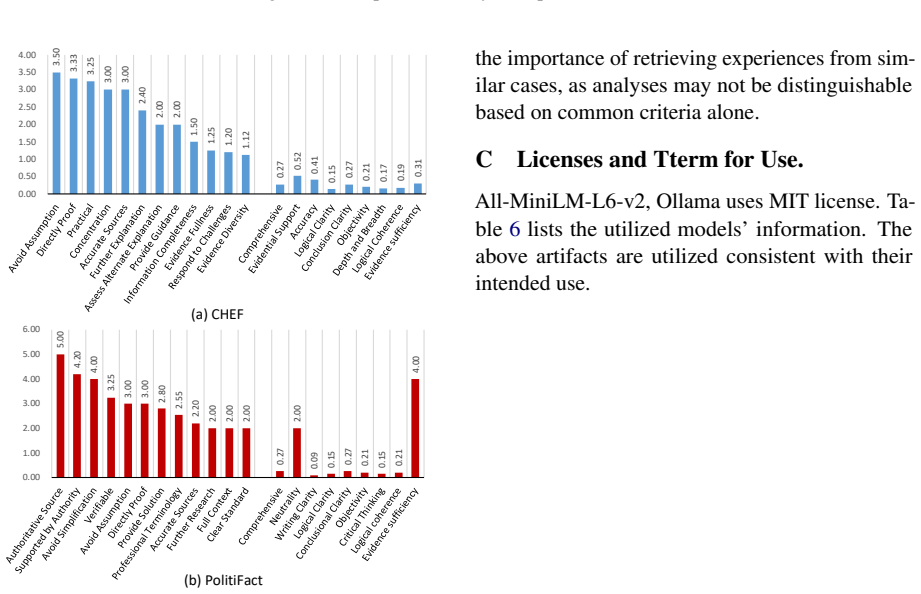
- [Section 4.4.2, Figure 6] The text says 'most frequently mentioned keywords' but does not define the frequency unit or the extraction method; please specify how the keywords were counted (e.g., per advice response) and what the percentages in the figure represent.
Circularity Check
No circularity: test-set predictions are produced from a training-set knowledge base without test-label leakage, and the only self-citation is a non-load-bearing baseline.
full rationale
The central claim is an empirical accuracy claim on held-out test splits. The knowledge base is built in the exploration stage from the training set only: Section 3.1 states that the framework produces experiences 'by exploring samples in the training set,' and Eq. (1) reveals the ground-truth label y̌ only to the special analyst during exploration. In deployment, Eq. (3) sets the special analyst's label ys to be the opposite of the ordinary prediction yo, not the ground truth, and Eq. (5) selects between the two analyses. Thus no test label enters the pipeline, and the final prediction is not a fitted value renamed as a prediction. The framework is a training-free, nonparametric use of training examples to form advice, which is standard supervised experience construction. The only self-citation is the SEE baseline (Yang et al., 2024), used as a comparison method and described in related work; it does not justify the framework's core premise. The skeptical concern that the deployment special analyst, when yo is correct, is instructed to defend the false label is a legitimate robustness or validity risk, but it is not circularity: nothing in Eqs. (3)-(5) forces the Judger to prefer the special channel, and the reported gains are not guaranteed by construction. No equation in the paper reduces the claimed result to its inputs, so no circular step is present.
Assumptions & free parameters
free parameters (2)
- Number of retrieved cases n =
1
- Fine-tuning hyperparameters (LoRA rank, alpha, learning rate, epochs) =
Not reported
assumptions (3)
- domain assumption The evidence materials provided in the datasets are sufficient and reliable for verifying news claims.
- domain assumption LLMs can generate logically consistent rationales when guided by retrieved criteria.
- ad hoc to paper A special analyst given a label produces a correct and higher-quality analysis that can serve as a reference for reflection.
Cite this review
Pith. "Pith review of RoE-FND: A Case-Based Reasoning Approach with Dual Verification for Fake News Detection via LLMs." pith.science (2026). https://pith.science/paper/UI7JTZ7B
@misc{pith2026250611078,
  author       = {Pith},
  title        = {Pith review of: RoE-FND: A Case-Based Reasoning Approach with Dual Verification for Fake News Detection via LLMs},
  year         = {2026},
  howpublished = {\url{https://pith.science/paper/UI7JTZ7B}},
  note         = {Machine review of arXiv:2506.11078}
}
read the original abstract
The proliferation of deceptive content online necessitates robust Fake News Detection (FND) systems. While evidence-based approaches leverage external knowledge to verify claims, existing methods face critical limitations: noisy evidence selection, generalization bottlenecks, and unclear decision-making processes. Recent efforts to harness Large Language Models (LLMs) for FND introduce new challenges, including hallucinated rationales and conclusion bias. To address these issues, we propose \textbf{RoE-FND} (\textbf{\underline{R}}eason \textbf{\underline{o}}n \textbf{\underline{E}}xperiences FND), a framework that reframes evidence-based FND as a logical deduction task by synergizing LLMs with experiential learning. RoE-FND encompasses two stages: (1) \textit{self-reflective knowledge building}, where a knowledge base is curated by analyzing past reasoning errors, namely the exploration stage, and (2) \textit{dynamic criterion retrieval}, which synthesizes task-specific reasoning guidelines from historical cases as experiences during deployment. It further cross-checks rationales against internal experience through a devised dual-channel procedure. Key contributions include: a case-based reasoning framework for FND that addresses multiple existing challenges, a training-free approach enabling adaptation to evolving situations, and empirical validation of the framework's superior generalization and effectiveness over state-of-the-art methods across three datasets.
Figures


Figures from the paper (8 more)




Reference graph
Works this paper leans on
-
[1]
Anthropic. 2024. https://www.anthropic.com/news/claude-3-family Introducing the next generation of claude . Technical report, Anthropic
work page 2024
-
[2]
Self-rag: Learning to retrieve, generate, and critique through self-reflection
Akari Asai, Zeqiu Wu, Yizhong Wang, Avirup Sil, and Hannaneh Hajishirzi. Self-rag: Learning to retrieve, generate, and critique through self-reflection. In The Twelfth International Conference on Learning Representations
-
[3]
Kevin Matthe Caramancion. 2023. News verifiers showdown: a comparative performance evaluation of chatgpt 3.5, chatgpt 4.0, bing ai, and bard in news fact-checking. In 2023 IEEE Future Networks World Forum (FNWF), pages 1--6. IEEE
work page 2023
-
[4]
Carlos Castillo, Marcelo Mendoza, and Barbara Poblete. 2011. Information credibility on twitter. In Proceedings of the 20th international conference on World wide web, pages 675--684
work page 2011
-
[5]
Chain-of-verification reduces hallucination in large language models
Shehzaad Dhuliawala, Mojtaba Komeili, Jing Xu, Roberta Raileanu, Xian Li, Asli Celikyilmaz, and Jason E Weston. Chain-of-verification reduces hallucination in large language models. In ICLR 2024 Workshop on Reliable and Responsible Foundation Models
work page 2024
-
[6]
Song Feng, Ritwik Banerjee, and Yejin Choi. 2012. Syntactic stylometry for deception detection. In Proceedings of the 50th Annual Meeting of the Association for Computational Linguistics (Volume 2: Short Papers), pages 171--175
work page 2012
-
[7]
Marc Fisher, John Woodrow Cox, and Peter Hermann. 2016. Pizzagate: From rumor, to hashtag, to gunfire in dc. Washington Post, 6:8410--8415
2016
-
[8]
Chunxi Guo, Zhiliang Tian, Jintao Tang, Pancheng Wang, Zhihua Wen, Kang Yang, and Ting Wang. 2023. Prompting gpt-3.5 for text-to-sql with de-semanticization and skeleton retrieval. In Pacific Rim International Conference on Artificial Intelligence, pages 262--274
work page 2023
Show all 51 references
-
[9]
Daya Guo, Dejian Yang, Haowei Zhang, Junxiao Song, Ruoyu Zhang, Runxin Xu, Qihao Zhu, Shirong Ma, Peiyi Wang, Xiao Bi, et al. 2025. Deepseek-r1: Incentivizing reasoning capability in llms via reinforcement learning. arXiv preprint arXiv:2501.12948
2025 arXiv
-
[10]
Beizhe Hu, Qiang Sheng, Juan Cao, Yuhui Shi, Yang Li, Danding Wang, and Peng Qi. 2024. Bad actor, good advisor: Exploring the role of large language models in fake news detection. In Proceedings of the AAAI Conference on Artificial Intelligence, volume 38, pages 22105--22113
2024
-
[11]
Xuming Hu, Zhijiang Guo, GuanYu Wu, Aiwei Liu, Lijie Wen, and S Yu Philip. 2022. Chef: A pilot chinese dataset for evidence-based fact-checking. In Proceedings of the 2022 Conference of the North American Chapter of the Association for Computational Linguistics: Human Language...
2022
-
[12]
Xuming Hu, Zhaochen Hong, Zhijiang Guo, Lijie Wen, and Philip Yu. 2023. Read it twice: Towards faithfully interpretable fact verification by revisiting evidence. In Proceedings of the 46th International ACM SIGIR Conference on Research and Development in Information Retrieval,...
2023
-
[13]
Lei Huang, Weijiang Yu, Weitao Ma, Weihong Zhong, Zhangyin Feng, Haotian Wang, Qianglong Chen, Weihua Peng, Xiaocheng Feng, Bing Qin, et al. 2023. A survey on hallucination in large language models: Principles, taxonomy, challenges, and open questions. arXiv preprint arXiv:2311.05232
2023 arXiv
-
[14]
Aaron Jaech, Adam Kalai, Adam Lerer, Adam Richardson, Ahmed El-Kishky, Aiden Low, Alec Helyar, Aleksander Madry, Alex Beutel, Alex Carney, et al. 2024. Openai o1 system card. arXiv preprint arXiv:2412.16720
2024 arXiv
-
[15]
Soyeong Jeong, Jinheon Baek, Sukmin Cho, Sung Ju Hwang, and Jong C Park. 2024. Adaptive-rag: Learning to adapt retrieval-augmented large language models through question complexity. In Proceedings of the 2024 Conference of the North American Chapter of the Association for Comp...
2024
-
[16]
Zhiwei Jin, Juan Cao, Han Guo, Yongdong Zhang, and Jiebo Luo. 2017. Multimodal fusion with recurrent neural networks for rumor detection on microblogs. In Proceedings of the 25th ACM international conference on Multimedia, pages 795--816
2017
-
[17]
Rohit Kumar Kaliyar, Anurag Goswami, and Pratik Narang. 2021. Fakebert: Fake news detection in social media with a bert-based deep learning approach. Multimedia tools and applications, 80(8):11765--11788
2021
-
[18]
Takeshi Kojima, Shixiang Shane Gu, Machel Reid, Yutaka Matsuo, and Yusuke Iwasawa. 2022. Large language models are zero-shot reasoners. Advances in neural information processing systems, 35:22199--22213
2022
-
[19]
Janet L Kolodner. 1992. An introduction to case-based reasoning. Artificial intelligence review, 6(1):3--34
1992
-
[20]
Yaliang Li, Jing Gao, Chuishi Meng, Qi Li, Lu Su, Bo Zhao, Wei Fan, and Jiawei Han. 2016. A survey on truth discovery. ACM Sigkdd Explorations Newsletter, 17(2):1--16
2016
-
[21]
Hao Liao, Jiahao Peng, Zhanyi Huang, Wei Zhang, Guanghua Li, Kai Shu, and Xing Xie. 2023. Muser: A multi-step evidence retrieval enhancement framework for fake news detection. In Proceedings of the 29th ACM SIGKDD Conference on Knowledge Discovery and Data Mining, pages 4461--4472
2023
-
[22]
Junyu Luo, Cao Xiao, and Fenglong Ma. 2023. Zero-resource hallucination prevention for large language models. arXiv preprint arXiv:2309.02654
2023 arXiv
-
[23]
Jing Ma, Wei Gao, Shafiq Joty, and Kam-Fai Wong. 2019. Sentence-level evidence embedding for claim verification with hierarchical attention networks. Association for Computational Linguistics
2019
-
[24]
https://chat.openai.com Chatgpt
OpenAI. https://chat.openai.com Chatgpt . Technical report, OpenAI
-
[25]
Liangming Pan, Michael Saxon, Wenda Xu, Deepak Nathani, Xinyi Wang, and William Yang Wang. 2023 a . Automatically correcting large language models: Surveying the landscape of diverse self-correction strategies. arXiv preprint arXiv:2308.03188
2023 arXiv
-
[26]
Liangming Pan, Xiaobao Wu, Xinyuan Lu, Anh Tuan Luu, William Yang Wang, Min-Yen Kan, and Preslav Nakov. 2023 b . Fact-checking complex claims with program-guided reasoning. In Proceedings of the 61st Annual Meeting of the Association for Computational Linguistics (Volume 1: Lo...
2023
-
[27]
Kashyap Popat, Subhabrata Mukherjee, Jannik Str \"o tgen, and Gerhard Weikum. 2017. Where the truth lies: Explaining the credibility of emerging claims on the web and social media. In Proceedings of the 26th international conference on world wide web companion, pages 1003--1012
2017
-
[28]
Kashyap Popat, Subhabrata Mukherjee, Andrew Yates, and Gerhard Weikum. 2018. Declare: Debunking fake news and false claims using evidence-aware deep learning. arXiv preprint arXiv:1809.06416
2018 arXiv
-
[29]
Hannah Rashkin, Eunsol Choi, Jin Yea Jang, Svitlana Volkova, and Yejin Choi. 2017. Truth of varying shades: Analyzing language in fake news and political fact-checking. In Proceedings of the 2017 conference on empirical methods in natural language processing, pages 2931--2937
2017
-
[30]
Kai Shu, Deepak Mahudeswaran, Suhang Wang, Dongwon Lee, and Huan Liu. 2020. Fakenewsnet: A data repository with news content, social context, and spatiotemporal information for studying fake news on social media. Big data, 8(3):171--188
2020
-
[31]
Kai Shu, Amy Sliva, Suhang Wang, Jiliang Tang, and Huan Liu. 2017. Fake news detection on social media: A data mining perspective. ACM SIGKDD explorations newsletter, 19(1):22--36
2017
-
[32]
Zhivar Sourati, Filip Ilievski, Hng-n Sandlin, and Alain Mermoud. 2023. Case-based reasoning with language models for classification of logical fallacies. In The 61st Annual Meeting Of The Association For Computational Linguistics
2023
-
[33]
James Thorne, Andreas Vlachos, Christos Christodoulopoulos, and Arpit Mittal. 2018. Fever: a large-scale dataset for fact extraction and verification. In Proceedings of the 2018 Conference of the North American Chapter of the Association for Computational Linguistics: Human La...
2018
-
[34]
Llama: Open and efficient foundation language models
Hugo Touvron, Thibaut Lavril, Gautier Izacard, Xavier Martinet, Marie-Anne Lachaux, Timothee Lacroix, Baptiste Rozi \`e re, Naman Goyal, Eric Hambro, Faisal Azhar, et al. Llama: Open and efficient foundation language models
-
[35]
Nguyen Vo and Kyumin Lee. 2021. Hierarchical multi-head attentive network for evidence-aware fake news detection. In Proceedings of the 16th Conference of the European Chapter of the Association for Computational Linguistics: Main Volume, pages 965--975
2021
-
[36]
Xuezhi Wang, Jason Wei, Dale Schuurmans, Quoc Le, Ed Chi, Sharan Narang, Aakanksha Chowdhery, and Denny Zhou. 2022. Self-consistency improves chain of thought reasoning in language models. arXiv preprint arXiv:2203.11171
2022 arXiv
-
[37]
Jason Wei, Yi Tay, Rishi Bommasani, Colin Raffel, Barret Zoph, Sebastian Borgeaud, Dani Yogatama, Maarten Bosma, Denny Zhou, Donald Metzler, et al. 2022 a . Emergent abilities of large language models. Transactions on Machine Learning Research
2022
-
[38]
Jason Wei, Xuezhi Wang, Dale Schuurmans, Maarten Bosma, Fei Xia, Ed Chi, Quoc V Le, Denny Zhou, et al. 2022 b . Chain-of-thought prompting elicits reasoning in large language models. Advances in neural information processing systems, 35:24824--24837
2022
-
[39]
Lianwei Wu, Yuan Rao, Yuqian Lan, Ling Sun, and Zhaoyin Qi. 2021 a . Unified dual-view cognitive model for interpretable claim verification. In Proceedings of the 59th Annual Meeting of the Association for Computational Linguistics and the 11th International Joint Conference o...
2021
-
[40]
Lianwei Wu, Yuan Rao, Xiong Yang, Wanzhen Wang, and Ambreen Nazir. 2021 b . Evidence-aware hierarchical interactive attention networks for explainable claim verification. In Proceedings of the Twenty-Ninth International Conference on International Joint Conferences on Artifici...
2021
-
[41]
Rewoo: Decoupling reasoning from observations for efficient augmented language models, may 2023
Binfeng Xu, Zhiyuan Peng, Bowen Lei, Subhabrata Mukherjee, Yuchen Liu, and Dongkuan Xu. Rewoo: Decoupling reasoning from observations for efficient augmented language models, may 2023. arXiv preprint arXiv:2305.18323
2023 arXiv
-
[42]
Weizhi Xu, Junfei Wu, Qiang Liu, Shu Wu, and Liang Wang. 2022. Evidence-aware fake news detection with graph neural networks. In Proceedings of the ACM web conference 2022, pages 2501--2510
2022
-
[43]
Yuzhou Yang, Yangming Zhou, Qichao Ying, Zhenxing Qian, and Xinpeng Zhang. 2024. Search, examine and early-termination: Fake news detection with annotation-free evidences. In ECAI 2024, pages 1463--1470. IOS Press
2024
-
[44]
Zhiwei Yang, Jing Ma, Hechang Chen, Hongzhan Lin, Ziyang Luo, and Yi Chang. 2022. A coarse-to-fine cascaded evidence-distillation neural network for explainable fake news detection. In Proceedings of the 29th International Conference on Computational Linguistics, pages 2608--2621
2022
-
[45]
Zonglin Yang, Xinya Du, Erik Cambria, and Claire Cardie. 2023. End-to-end case-based reasoning for commonsense knowledge base completion. In Proceedings of the 17th Conference of the European Chapter of the Association for Computational Linguistics, pages 3509--3522
2023
-
[46]
Shunyu Yao, Jeffrey Zhao, Dian Yu, Nan Du, Izhak Shafran, Karthik Narasimhan, and Yuan Cao. 2022. React: Synergizing reasoning and acting in language models. arXiv preprint arXiv:2210.03629
2022 arXiv
-
[47]
Xueyao Zhang, Juan Cao, Xirong Li, Qiang Sheng, Lei Zhong, and Kai Shu. 2021. Mining dual emotion for fake news detection. In Proceedings of the web conference 2021, pages 3465--3476
2021
-
[48]
Xinyi Zhou and Reza Zafarani. 2020. https://doi.org/10.1145/3395046 A survey of fake news: Fundamental theories, detection methods, and opportunities . ACM Comput. Surv., 53(5)
2020 doi
-
[49]
Yongchun Zhu, Qiang Sheng, Juan Cao, Qiong Nan, Kai Shu, Minghui Wu, Jindong Wang, and Fuzhen Zhuang. 2022. Memory-guided multi-view multi-domain fake news detection. IEEE Transactions on Knowledge and Data Engineering, 35(7):7178--7191
2022
-
[50]
online" 'onlinestring :=
ENTRY address archivePrefix author booktitle chapter edition editor eid eprint eprinttype howpublished institution journal key month note number organization pages publisher school series title type volume year doi pubmed url lastchecked label extra.label sort.label short.list...
-
[51]
write newline
" write newline "" before.all 'output.state := FUNCTION n.dashify 't := "" t empty not t #1 #1 substring "-" = t #1 #2 substring "--" = not "--" * t #2 global.max substring 't := t #1 #1 substring "-" = "-" * t #2 global.max substring 't := while if t #1 #1 substring * t #2 gl...
Reviewed August 7, 2026 · model on record in the stance chip above.
Discussion (0). Sign in to comment.