REVIEW 5 minor 134 references
Paired Explicit Relaxation Runge-Kutta Methods: Entropy-Conservative and Entropy-Stable High-Order Optimized Multirate Time Integration
T0 review · 0 major / 5 minor · reviewed 2026-08-06 · deepseek-v4-flash
Pith's one-line read Paired Explicit Relaxation Runge-Kutta methods combine P-ERK multirate pairing with per-step entropy relaxation, yielding explicit high-order integrators that conserve linear invariants and match the semidiscrete entropy without losing…
desk verdict A careful, reproducible combination of P-ERK with relaxation; the entropy plots are construction checks, but the accuracy, invariant, and speedup claims hold up. read the letter →
The pith
A machine-rendered reading of the paper's core claim, the machinery that carries it, and where it could break.
The reading
What carries the argument
The central object is the relaxation parameter $\gamma_n$, a per-step scalar rescaling of the Runge-Kutta update, together with the sparse-weight P-ERK structure that makes computing the entropy change cheap. The relaxed update is $U^{n+1}(\gamma_n) = U^n + \gamma_n \Delta t \sum_i b_i K_i$, and $\gamma_n$ is chosen by solving the relaxation equation so that the discrete entropy change matches the semidiscrete one. The P-ERK pairing assigns high-stage schemes with larger stability domains to regions with high characteristic speeds and cheaper schemes to slow regions, while the shared weight vector $b^T$ across partitions guarantees conservation of linear invariants and lets the relaxation parameter act as a time-limiter that improves nonlinear stability.
What would settle it
Run the weak blast wave or isentropic vortex test from the paper with a P-ERRK scheme on an entropy-conservative DGSEM discretization and record $H(U^{n+1}) - H(U^n)$ over many steps; the claim says the defect stays at round-off, so any drift above roughly $10^{-12}$ in double precision would falsify it. Repeating the same run with a non-entropy-stable spatial discretization should show the defect being controlled by the space scheme, not the time integrator.
Extended reading notes
Core claim
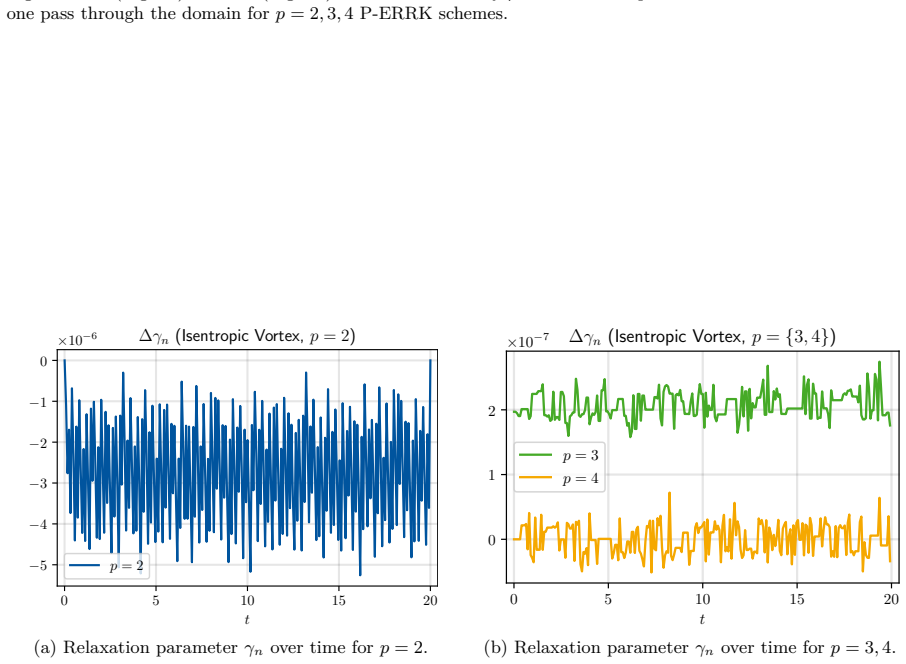
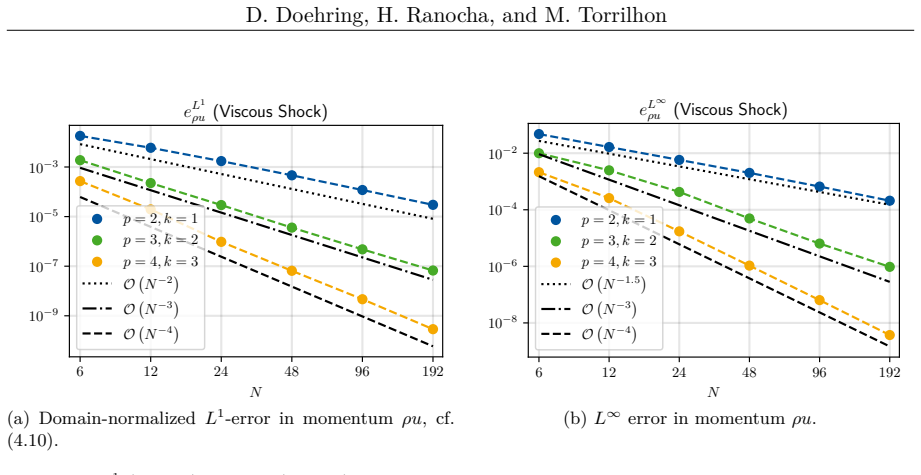
On the paper's own terms, the central discovery is that combining Paired Explicit Runge-Kutta methods with relaxation yields a family of explicit multirate integrators that are entropy-conservative when the semidiscretization is entropy-conservative and entropy-stable when it is entropy-dissipative, while preserving design order up to four. The relaxation parameter $\gamma_n$ solves a scalar nonlinear equation per step so that $H(U^{n+1}(\gamma_n)) = H(U^n) + \gamma_n \Delta H_n$, forcing the fully discrete entropy to follow the semidiscrete entropy tendency. Validation shows entropy defects at round-off for entropy-conservative setups, conserved mass, momentum, and energy, designed convergence orders on non-uniform meshes, and improved robustness in under-resolved and adaptively refined simulations.
Load-bearing premise
The fully discrete entropy property holds only when the underlying spatial semidiscretization is already entropy-conservative or entropy-stable; the time integrator cannot restore entropy behavior that the space discretization lacks.
Editorial extensions
If this is right
- If the central claim is right, entropy-stable multirate time stepping can be dropped into existing entropy-conserving or entropy-stable spatial discretizations without re-deriving the space scheme.
- The relaxation mechanism acts as a time-limiter, so under-resolved or AMR-driven simulations run longer before positivity loss, extending the reach of explicit high-order discontinuous Galerkin methods.
- Right-hand-side evaluation savings of factors two to four over single-rate relaxed Runge-Kutta methods make multirate integrators attractive for production-scale compressible flow and MHD simulations.
- The relaxation parameter can be interpreted as an adaptive timestep controller based on a nonlinear solution functional rather than an embedded error estimate, which suggests a new robustness diagnostic for explicit time integration.
Reading between the lines
- Editorial extension: the relaxation parameter could serve as a cheap nonlinearity-based indicator for adaptive mesh refinement or shock-capturing activation, since it deviates from unity precisely when the standard scheme's entropy starts changing.
- Editorial extension: applying the same relaxation equation to implicit-explicit P-ERK variants, which the paper lists as future work, should yield entropy-stable IMEX methods with the same per-step scalar solve.
- Editorial extension: because the cost of computing the entropy correction scales with the number of nonzero entries in the weight vector, future tableau optimization for sparser $b$ would directly reduce overhead in entropy-stable codes.
Editorial analysis
A structured set of objections, weighed in public.
Referee Report
Summary. The paper introduces Paired Explicit Relaxation Runge-Kutta (P-ERRK) methods, which combine paired explicit Runge-Kutta (P-ERK) multirate integrators with the relaxation methodology. The central idea is to preserve, at the fully discrete level, the entropy conservation or entropy stability of the underlying semidiscretization by solving a scalar relaxation equation for a parameter gamma_n that scales the update. Optimized schemes of orders two, three, and four are presented, together with convergence studies, tests of linear invariant conservation, entropy-defect measurements, robustness demonstrations (advection, Kelvin-Helmholtz instability, positivity preservation), and performance comparisons against standalone relaxed Runge-Kutta methods on several compressible flow problems, including Navier-Stokes-Fourier, visco-resistive MHD, and inviscid transonic configurations. The manuscript also provides a reproducibility repository. The theoretical derivation in Sections 2 and 3 is transparent: shared weights across partitions, nonnegative weights b_i, the direction d_n = sum_i b_i K_i, and the relaxation equation enforce consistency between the entropy change of the semidiscretization and that of the relaxed update.
Significance. If the results hold, the paper provides a practical, high-order multirate time integrator that inherits entropy behavior from entropy-conservative or entropy-stable semidiscretizations and substantially reduces RHS evaluations and runtime relative to standalone relaxed Runge-Kutta schemes. The main strengths are the optimized schemes up to fourth order, the reproducible implementation, the convergence studies in Section 4.3 showing designed orders for L1 errors, the round-off-level entropy conservation in Section 4.1 when the semidiscretization is EC, and the round-off-level preservation of linear invariants in Section 4.2. The entropy-conservation results are built into the method by construction, so Figures 4b and 7b are implementation checks rather than independent predictions; this is inherent to relaxation methods and is not a flaw. The paper is also honest about scope: Section 4.3.1 explicitly notes that L2 projection mortars break exact entropy conservation in the AMR convergence study, and the production runs in Sections 5.1, 5.2, and 5.5 use BR1 or shock-capturing semidiscretizations that are not strictly entropy-stable.
minor comments (5)
- [Section 5.1.2] The text says 'The values in Table 2 correspond to the run from t = 0 to t = 30 t_c', but the performance comparison appears in Table 3, not Table 2; the cross-reference should be corrected.
- [Section 4.3.3] The passage 'we confirmed by performing the same convergence study with the standard P-ERRK schemes' appears to refer to the non-relaxed baseline; it should read 'standard P-ERK schemes'.
- [Figure 10] The captions of Figures 10a and 10b refer to 'Fig. 8a' and 'Fig. 8b'; these should refer to Figures 10a and 10b, respectively.
- [Throughout] Several typographical errors should be corrected: 'erronous' in Section 2.4, 'conenctrate' in Section 5.1.2, 'reprensented' in Section 5.5.1, 'svaings' in Section 5.5.2, 'obatined' in the caption of Figure B.19, and 'signficantly'/'constrast' in the caption of Figure 16.
- [Section 6] The concluding sentence that P-ERRK methods 'introduce no defects in the global entropy' would be more precise if it explicitly restated the scope condition that this guarantee holds when the underlying semidiscretization is entropy-conservative or entropy-stable; the paper states this condition in the technical sections, but the conclusion is currently slightly broader in wording.
Circularity Check
Entropy conservation is enforced by the relaxation solve; all other central claims are independently validated.
-
self definitional
[Section 4.1.2 (validation of entropy conservation), enforcing Eq. (2.16) via Eq. (3.3); see also Fig. 7b]
"For this case, the second equality in (2.16) is enforced, i.e., the entropy at any timestep n is forced to be equal to the entropy of the initial condition H(U 0)."
Entropy conservation is not an independent output of the P-ERRK scheme: equation (3.3), r(γn)=H(Un+γnΔtdn)−H(Un)−γnΔHn=0, is solved at every step, and for an entropy-conservative semidiscretization (2.15) one has ΔHn=0 by (2.27). Therefore the solver enforces H(Un+1)=H(Un) (or H(Un)=H(U0)) exactly. Figures 4b, 5b and 7b thus confirm the Newton solve and the EC spatial flux, not a predicted property of the time integrator. The paper is transparent about this (the word 'enforced'), so this is a consistency check rather than a falsifiable claim; it does not affect the independent order and performance validations.
full rationale
The paper's core novelty is the combination of optimized P-ERK multirate coefficients with the relaxation machinery of Ketcheson and Ranocha et al. The relaxation parameter γ is a design variable solving (3.3), and for an EC/ES semidiscretization this enforces the entropy condition by construction. The entropy-conservation plots in Section 4.1 are therefore implementation checks, as the paper itself states by using 'enforced' and 'forced.' This is a mild constructional circularity in the validation of one advertised property, but it is openly disclosed and does not masquerade as an independent prediction. The remaining load-bearing claims are validated independently: design order of accuracy against analytic solutions (Section 4.3), linear-invariant conservation to round-off (Section 4.2), and runtime/RHS-evaluation reductions against external baseline methods such as R-RK4, R-TS4;6, R-CKL4;5, and SSP10 (Section 5). The cited P-ERK construction and relaxation theory are external, reproducible, and not replaced by a self-citation chain. Overall, the central derivation is self-contained apart from the definitional entropy-enforcement step, so the circularity is bounded and minor.
Assumptions & free parameters
assumptions (4)
- domain assumption Relaxation parameters gamma_n exist, are unique, and preserve the order of accuracy for at least second-order Runge-Kutta methods.
- domain assumption The semidiscrete DGSEM satisfies a discrete entropy equality (2.15) or inequality (2.17) for the chosen entropy.
- standard math The mathematical entropy H is a convex function of the conserved variables for the considered ideal-gas and MHD systems.
- domain assumption P-ERK methods used here satisfy internal consistency (identical abscissae and shared weight vector), ensuring the partitioned scheme has the designed order and conserves linear invariants.
Cite this review
Pith. "Pith review of Paired Explicit Relaxation Runge-Kutta Methods: Entropy-Conservative and Entropy-Stable High-Order Optimized Multirate Time Integration." pith.science (2026). https://pith.science/paper/UIDYDLTP
@misc{pith2026250704991,
  author       = {Pith},
  title        = {Pith review of: Paired Explicit Relaxation Runge-Kutta Methods: Entropy-Conservative and Entropy-Stable High-Order Optimized Multirate Time Integration},
  year         = {2026},
  howpublished = {\url{https://pith.science/paper/UIDYDLTP}},
  note         = {Machine review of arXiv:2507.04991}
}
read the original abstract
We present novel entropy-conservative and entropy-stable multirate Runge-Kutta methods based on Paired Explicit Runge-Kutta (P-ERK) schemes with relaxation for conservation laws and related systems of partial differential equations. Optimized schemes up to fourth-order of accuracy are derived and validated in terms of order of consistency, conservation of linear invariants, and entropy conservation/stability. We demonstrate the effectiveness of these P-ERRK methods when combined with a high-order, entropy-conservative/stable discontinuous Galerkin spectral element method on unstructured meshes. The Paired Explicit Relaxation Runge-Kutta methods(P-ERRK) are readily implemented for partitioned semidiscretizations arising from problems with equation-based scale separation such as non-uniform meshes. We highlight that the relaxation approach acts as a time-limiting technique which improves the nonlinear stability and thus robustness of the multirate schemes. The P-ERRK methods are applied to a range of problems, ranging from compressible Euler over compressible Navier-Stokes to the visco-resistive magnetohydrodynamics equations in two and three spatial dimensions. For each test case, we compare computational load and runtime to standalone relaxed Runge-Kutta methods which are outperformed by factors up to four. All results can be reproduced using a publicly available repository.
Figures


Figures from the paper (14 more)




Reference graph
Works this paper leans on
-
[1]
O. A. Ole˘ ınik, Uniqueness and stability of the generalized solution of the Cauchy problem for a quasi-linear equation, Russian Mathematical Surveys 14 (1959) 165–170. doi: 10. 1090/trans2/033/09, English translation: Amer. Math. Soc. Trans., Series 2, Volume 33, Pages 285-290
1959
-
[2]
P. D. Lax, Hyperbolic systems of conservation laws II, Communications on Pure and Applied Mathematics 10 (1957) 537–566. doi: 10.1002/cpa.3160100406
-
[3]
S. N. Kruˇ zkov, First order quasilinear equations in several independent variables, Math- ematics of the USSR-Sbornik 10 (1970) 217. doi: 10.1070/SM1970v010n02ABEH002156
-
[4]
P. D. Lax, Hyperbolic systems of conservation laws and the mathematical theory of shock waves, CBMS-NSF Regional Conference Series in Applied Mathematics, SIAM, 1973. doi:10.1137/1.9781611970562
-
[5]
C. M. Dafermos, Hyperbolic conservation laws in continuum physics, Grundlehren der mathematischen Wissenschaften, 4 ed., Springer Berlin, Heidelberg, 2005. doi: 10.1007/ 978-3-662-49451-6
2005
-
[6]
Courant, K
R. Courant, K. O. Friedrichs, Supersonic flow and shock waves, volume 21 of Applied Mathematical Sciences, 1 ed., Springer New York, NY, 1976
1976
-
[7]
G. J. Gassner, A. R. Winters, D. A. Kopriva, Split form nodal discontinuous Galerkin schemes with summation-by-parts property for the compressible Euler equations, Journal of Computational Physics 327 (2016) 39–66. doi: 10.1016/j.jcp.2016.09.013
-
[8]
B. Sj¨ ogreen, H. Yee, High order entropy conservative central schemes for wide ranges of compressible gas dynamics and MHD flows, Journal of Computational Physics 364 (2018) 153–185. doi:10.1016/j.jcp.2018.02.003
Show all 134 references
-
[9]
Manzanero, G
J. Manzanero, G. Rubio, D. A. Kopriva, E. Ferrer, E. Valero, An entropy–stable discontin- uous Galerkin approximation for the incompressible Navier–Stokes equations with variable density and artificial compressibility, Journal of Computational Physics 408 (2020) 109241. doi:10...
2020
-
[10]
Rojas, R
D. Rojas, R. Boukharfane, L. Dalcin, D. C. D. R. Fern´ andez, H. Ranocha, D. E. Keyes, M. Parsani, On the robustness and performance of entropy stable collocated discontinuous Galerkin methods, Journal of Computational Physics 426 (2021) 109891. doi: 10.1016/j. jcp.2020.109891
2021
-
[11]
J. Chan, H. Ranocha, A. M. Rueda-Ram´ ırez, G. Gassner, T. Warburton, On the entropy projection and the robustness of high order entropy stable discontinuous Galerkin schemes for under-resolved flows, Frontiers in Physics 10 (2022) 898028. doi: 10.3389/fphy.2022. 898028
2022 doi
-
[12]
Tadmor, Entropy conservative finite element schemes, in: T
E. Tadmor, Entropy conservative finite element schemes, in: T. E. Tezduyar, T. J. R. Hughes (Eds.), Proceedings of the winter annual meeting of the American Society of Mechanical Engineering, volume 78, 1986, pp. 149–158
1986
-
[13]
Tadmor, The numerical viscosity of entropy stable schemes for systems of con- servation laws
E. Tadmor, The numerical viscosity of entropy stable schemes for systems of con- servation laws. i, Mathematics of Computation 49 (1987) 91–103. doi: 10.1090/ S0025-5718-1987-0890255-3 . 44 D. Doehring, H. Ranocha, and M. Torrilhon
1987
-
[14]
U. S. Fjordholm, S. Mishra, E. Tadmor, Arbitrarily high-order accurate entropy stable essentially nonoscillatory schemes for systems of conservation laws, SIAM Journal on Numerical Analysis 50 (2012) 544–573. doi: 10.1137/110836961
2012 doi
-
[15]
T. C. Fisher, M. H. Carpenter, High-order entropy stable finite difference schemes for nonlinear conservation laws: Finite domains, Journal of Computational Physics 252 (2013) 518–557. doi:10.1016/j.jcp.2013.06.014
2013 doi
-
[16]
G. J. Gassner, A skew-symmetric discontinuous Galerkin spectral element discretization and its relation to SBP-SAT finite difference methods, SIAM Journal on Scientific Com- puting 35 (2013) A1233–A1253. doi: 10.1137/120890144
2013 doi
-
[17]
M. H. Carpenter, M. Parsani, E. J. Nielsen, T. C. Fisher, Towards an entropy stable spectral element framework for computational fluid dynamics, in: 54th AIAA Aerospace Sciences Meeting, 2016, p. 1058. doi: 10.2514/6.2016-1058
2016 doi
-
[18]
J. S. Hesthaven, T. Warburton, Nodal discontinuous Galerkin methods: Algorithms, anal- ysis, and applications, Texts in Applied Mathematics, 1 ed., Springer New York, NY, 2007. doi:10.1007/978-0-387-72067-8
2007 doi
-
[19]
Black, A conservative spectral element method for the approximation of compressible fluid flow, Kybernetika 35 (1999) 133–146
K. Black, A conservative spectral element method for the approximation of compressible fluid flow, Kybernetika 35 (1999) 133–146
1999
-
[20]
D. A. Kopriva, Implementing spectral methods for partial differential equations: Al- gorithms for scientists and engineers, Scientific Computation (SCIENTCOMP), 1 ed., Springer Science & Business Media, 2009. doi: 10.1007/978-90-481-2261-5
2009 doi
-
[21]
Chen, C.-W
T. Chen, C.-W. Shu, Entropy stable high order discontinuous Galerkin methods with suitable quadrature rules for hyperbolic conservation laws, Journal of Computational Physics 345 (2017) 427–461. doi: 10.1016/j.jcp.2017.05.025
2017 doi
-
[23]
P. Chandrashekar, Kinetic energy preserving and entropy stable finite volume schemes for compressible Euler and Navier-Stokes equations, Communications in Computational Physics 14 (2013) 12521286. doi: 10.4208/cicp.170712.010313a
2013
-
[24]
A. R. Winters, G. J. Gassner, Affordable, entropy conserving and entropy stable flux functions for the ideal MHD equations, Journal of Computational Physics 304 (2016) 72–108. doi:10.1016/j.jcp.2015.09.055
2016 doi
-
[25]
Ranocha, Comparison of some entropy conservative numerical fluxes for the Euler equations, Journal of Scientific Computing 76 (2018) 216–242
H. Ranocha, Comparison of some entropy conservative numerical fluxes for the Euler equations, Journal of Scientific Computing 76 (2018) 216–242. doi: 10.1007/ s10915-017-0618-1
2018
-
[26]
Ranocha, Entropy conserving and kinetic energy preserving numerical methods for the euler equations using summation-by-parts operators, in: S
H. Ranocha, Entropy conserving and kinetic energy preserving numerical methods for the euler equations using summation-by-parts operators, in: S. J. Sherwin, D. Moxey, J. Peir´ o, P. E. Vincent, C. Schwab (Eds.), Spectral and High Order Methods for Partial Differential Equatio...
2018 doi
-
[27]
Tadmor, Entropy stability theory for difference approximations of nonlinear conser- vation laws and related time-dependent problems, Acta Numerica 12 (2003) 451–512
E. Tadmor, Entropy stability theory for difference approximations of nonlinear conser- vation laws and related time-dependent problems, Acta Numerica 12 (2003) 451–512. doi:10.1017/S0962492902000156. 45 Paired Explicit Relaxation Runge-Kutta Methods: Entropy Conservative and E...
2003 doi
-
[28]
Hiltebrand, S
A. Hiltebrand, S. Mishra, Entropy stable shock capturing space–time discontinuous Galerkin schemes for systems of conservation laws, Numerische Mathematik 126 (2014) 103–151. doi:10.1007/s00211-013-0558-0
2014 doi
-
[29]
Friedrich, G
L. Friedrich, G. Schn¨ ucke, A. R. Winters, D. C. D. R. Fern´ andez, G. J. Gassner, M. H. Carpenter, Entropy stable space–time discontinuous Galerkin schemes with summation- by-parts property for hyperbolic conservation laws, Journal of Scientific Computing 80 (2019) 175–222. ...
2019 doi
-
[30]
Gaburro, P
E. Gaburro, P. ¨Offner, M. Ricchiuto, D. Torlo, High order entropy preserving ADER-DG schemes, Applied Mathematics and Computation 440 (2023) 127644. doi:10.1016/j.amc. 2022.127644
2023
-
[32]
Hairer, C
E. Hairer, C. Lubich, G. Wanner, Geometric numerical integration, Springer Series in Computational Mathematics, 2 ed., Springer Berlin, Heidelberg, 2006. doi: 10.1007/ 3-540-30666-8
2006
-
[33]
Calvo, M
M. Calvo, M. Laburta, J. Montijano, L. R´ andez, Projection methods preserving Lyapunov functions, BIT Numerical Mathematics 50 (2010) 223–241. doi: 10.1007/ s10543-010-0259-3
2010
-
[34]
Kojima, Invariants preserving schemes based on explicit Runge–Kutta methods, BIT Numerical Mathematics 56 (2016) 1317–1337
H. Kojima, Invariants preserving schemes based on explicit Runge–Kutta methods, BIT Numerical Mathematics 56 (2016) 1317–1337. doi: 10.1007/s10543-016-0608-y
2016 doi
-
[35]
M. R. Najafian, B. C. Vermeire, Quasi-orthogonal Runge-Kutta projection methods, Jour- nal of Computational Physics 530 (2025) 113917. doi: 10.1016/j.jcp.2025.113917
2025
-
[36]
Calvo, D
M. Calvo, D. Hern´ andez-Abreu, J. I. Montijano, L. R´ andez, On the preservation of invariants by explicit Runge–Kutta methods, SIAM Journal on Scientific Computing 28 (2006) 868–885. doi: 10.1137/04061979X
2006 doi
-
[37]
D. I. Ketcheson, Relaxation Runge–Kutta methods: Conservation and stability for inner- product norms, SIAM Journal on Numerical Analysis 57 (2019) 2850–2870. doi: 10.1137/ 19M1263662
2019
-
[38]
Ranocha, M
H. Ranocha, M. Sayyari, L. Dalcin, M. Parsani, D. I. Ketcheson, Relaxation Runge–Kutta methods: Fully discrete explicit entropy-stable schemes for the compressible Euler and Navier–Stokes equations, SIAM Journal on Scientific Computing 42 (2020) A612–A638. doi:10.1137/19M1263480
2020 doi
-
[39]
S. Kang, E. M. Constantinescu, Entropy–preserving and entropy–stable relaxation IMEX and multirate time–stepping methods, Journal of Scientific Computing 93 (2022) 23. doi:10.1007/s10915-022-01982-w
2022 doi
-
[40]
Ranocha, L
H. Ranocha, L. Dalcin, M. Parsani, Fully discrete explicit locally entropy-stable schemes for the compressible Euler and Navier–Stokes equations, Computers & Mathematics with Applications 80 (2020) 1343–1359. doi: 10.1016/j.camwa.2020.06.016
2020 doi
-
[41]
Ranocha, L
H. Ranocha, L. L´ oczi, D. I. Ketcheson, General relaxation methods for initial-value prob- lems with application to multistep schemes, Numerische Mathematik 146 (2020) 875–906. doi:10.1007/s00211-020-01158-4. 46 D. Doehring, H. Ranocha, and M. Torrilhon
2020 doi
-
[42]
J. M. Sanz-Serna, An explicit finite-difference scheme with exact conservation proper- ties, Journal of Computational Physics 47 (1982) 199–210. doi: 10.1016/0021-9991(82) 90074-2
1982 doi
-
[43]
Sanz-Serna, V
J. Sanz-Serna, V. Manoranjan, A method for the integration in time of certain partial differential equations, Journal of Computational Physics 52 (1983) 273–289. doi: 10.1016/ 0021-9991(83)90031-1
1983
-
[44]
Dekker, J
K. Dekker, J. G. Verwer, Stability of Runge-Kutta methods for stiff nonlinear differential equations, CWI monographs 2 (1984) 307
1984
-
[45]
B. C. Vermeire, Paired explicit Runge-Kutta schemes for stiff systems of equations, Journal of Computational Physics 393 (2019) 465–483. doi: 10.1016/j.jcp.2019.05.014
2019 doi
-
[46]
S. H. Nasab, B. C. Vermeire, Third-order paired explicit Runge-Kutta schemes for stiff systems of equations, Journal of Computational Physics 468 (2022) 111470. doi: 10.1016/ j.jcp.2022.111470
2022
-
[47]
Doehring, L
D. Doehring, L. Christmann, M. Schlottke-Lakemper, G. J. Gassner, M. Torrilhon, Fourth- order paired-explicit Runge-Kutta methods, arXiv preprint arXiv:2408.05470 (2024). doi:10.48550/arXiv.2408.05470
2024 doi
-
[48]
E. M. Constantinescu, A. Sandu, Multirate timestepping methods for hyperbolic conservation laws, Journal of Scientific Computing 33 (2007) 239–278. doi: 10.1007/ s10915-007-9151-y
2007
-
[49]
G. J. Gassner, A. R. Winters, D. A. Kopriva, A well balanced and entropy conservative discontinuous Galerkin spectral element method for the shallow water equations, Applied Mathematics and Computation 272 (2016) 291–308. doi: 10.1016/j.amc.2015.07.014
2016 doi
-
[50]
M. J. Castro, U. S. Fjordholm, S. Mishra, C. Par´ es, Entropy conservative and entropy sta- ble schemes for nonconservative hyperbolic systems, SIAM Journal on Numerical Analysis 51 (2013) 1371–1391. doi: 10.1137/110845379
2013 doi
-
[51]
B. C. Vermeire, Embedded paired explicit Runge-Kutta schemes, Journal of Computa- tional Physics 487 (2023) 112159. doi: 10.1016/j.jcp.2023.112159
2023
-
[52]
Rentrop, Partitioned Runge-Kutta methods with stiffness detection and stepsize control, Numerische Mathematik 47 (1985) 545–564
P. Rentrop, Partitioned Runge-Kutta methods with stiffness detection and stepsize control, Numerische Mathematik 47 (1985) 545–564. doi: 10.1007/BF01389456
1985 doi
-
[53]
Bruder, K
J. Bruder, K. Strehmel, R. Weiner, Partitioned adaptive Runge-Kutta methods for the solution of nonstiff and stiff systems, Numerische Mathematik 52 (1988) 621–638. doi: 10. 1007/BF01395815
1988
-
[54]
G¨ unther, A
M. G¨ unther, A. Kvaernø, P. Rentrop, Multirate partitioned Runge-Kutta methods, BIT Numerical Mathematics 41 (2001) 504–514. doi: 10.1023/A:1021967112503
2001 doi
-
[55]
Hairer, G
E. Hairer, G. Wanner, S. P. Nørsett, Solving Ordinary Differential Equations I: Nonstiff Problems, Springer Series in Computational Mathematics, 2 ed., Springer Berlin, Heidel- berg, 1993. doi: 10.1007/978-3-540-78862-1
1993 doi
-
[56]
M. J. Berger, J. Oliger, Adaptive mesh refinement for hyperbolic partial differential equa- tions, Journal of Computational Physics 53 (1984) 484–512. doi: 10.1016/0021-9991(84) 90073-1
1984 doi
-
[57]
Dawson, R
C. Dawson, R. Kirby, High resolution schemes for conservation laws with locally varying time steps, SIAM Journal on Scientific Computing 22 (2001) 2256–2281. doi: 10.1137/ S1064827500367737. 47 Paired Explicit Relaxation Runge-Kutta Methods: Entropy Conservative and Entropy-St...
2001
-
[58]
L¨ orcher, G
F. L¨ orcher, G. Gassner, C.-D. Munz, A discontinuous Galerkin scheme based on a space– time expansion. I. inviscid compressible flow in one space dimension, Journal of Scientific Computing 32 (2007) 175–199. doi: 10.1007/s10915-007-9128-x
2007 doi
-
[59]
Dumbser, M
M. Dumbser, M. K¨ aser, E. F. Toro, An arbitrary high-order discontinuous Galerkin method for elastic waves on unstructured meshes – V. Local time stepping and p- adaptivity, Geophysical Journal International 171 (2007) 695–717. doi: 10.1111/j. 1365-246X.2007.03427.x
2007 arXiv
-
[60]
Krivodonova, An efficient local time-stepping scheme for solution of nonlinear conserva- tion laws, Journal of Computational Physics 229 (2010) 8537–8551
L. Krivodonova, An efficient local time-stepping scheme for solution of nonlinear conserva- tion laws, Journal of Computational Physics 229 (2010) 8537–8551. doi: 10.1016/j.jcp. 2010.07.037
2010 doi
-
[61]
M. J. Grote, M. Mehlin, T. Mitkova, Runge–Kutta-based explicit local time-stepping methods for wave propagation, SIAM Journal on Scientific Computing 37 (2015) A747– A775. doi:10.1137/140958293
2015 doi
-
[62]
Luther, Y
J. Luther, Y. Wang, P. Jenny, Adaptive conservative time integration for unsteady com- pressible flow, Journal of Computational Physics 517 (2024) 113324. doi: 10.1016/j.jcp. 2024.113324
2024
-
[63]
Ketcheson, A
D. Ketcheson, A. Ahmadia, Optimal stability polynomials for numerical integration of ini- tial value problems, Communications in Applied Mathematics and Computational Science 7 (2013) 247–271. doi: 10.2140/camcos.2012.7.247
2013 doi
-
[64]
Doehring, G
D. Doehring, G. J. Gassner, M. Torrilhon, Many-stage optimal stabilized Runge-Kutta methods for hyperbolic partial differential equations, Journal of Scientific Computing 99 (2024). doi:10.1007/s10915-024-02478-5
2024 doi
-
[65]
Wanner, E
G. Wanner, E. Hairer, Solving ordinary differential equations II: Stiff and Differential- Algebraic Problems, volume 375 of Springer Series in Computational Mathematics , 2 ed., Springer Berlin, Heidelberg, 1996. doi: 10.1007/978-3-642-05221-7
1996 doi
-
[66]
Rusanov, The calculation of the interaction of non-stationary shock waves and obstacles, USSR Computational Mathematics and Mathematical Physics 1 (1962) 304–320
V. Rusanov, The calculation of the interaction of non-stationary shock waves and obstacles, USSR Computational Mathematics and Mathematical Physics 1 (1962) 304–320. doi: 10. 1016/0041-5553(62)90062-9
1962
-
[67]
Hundsdorfer, D
W. Hundsdorfer, D. I. Ketcheson, I. Savostianov, Error analysis of explicit partitioned Runge-Kutta schemes for conservation laws, Journal of Scientific Computing 63 (2015) 633–653. doi:10.1007/s10915-014-9906-1
2015 doi
-
[68]
Doehring, M
D. Doehring, M. Schlottke-Lakemper, G. J. Gassner, M. Torrilhon, Multirate time- integration based on dynamic ODE partitioning through adaptively refined meshes for compressible fluid dynamics, Journal of Computational Physics 514 (2024) 113223. doi:10.1016/j.jcp.2024.113223
2024
-
[69]
C.-W. Shu, S. Osher, Efficient implementation of essentially non-oscillatory shock- capturing schemes, Journal of Computational Physics 77 (1988) 439–471. doi: 10.1016/ 0021-9991(88)90177-5
1988
-
[70]
Gottlieb, C.-W
S. Gottlieb, C.-W. Shu, E. Tadmor, Strong stability-preserving high-order time discretiza- tion methods, SIAM Review 43 (2001) 89–112. doi: 10.1137/S003614450036757X
2001 doi
-
[71]
Gottlieb, C.-W
S. Gottlieb, C.-W. Shu, Total variation diminishing Runge-Kutta schemes, Mathematics of Computation 67 (1998) 73–85. doi: 10.1090/S0025-5718-98-00913-2 . 48 D. Doehring, H. Ranocha, and M. Torrilhon
1998 doi
-
[72]
Forth, A second order accurate, space-time limited, BDF scheme for the linear advection equation, in: E
S. Forth, A second order accurate, space-time limited, BDF scheme for the linear advection equation, in: E. F. Toro (Ed.), Godunov Methods: Theory and Applications, Springer, New York, NY, 2001, pp. 335–342. doi: 10.1007/978-1-4615-0663-8_35
2001 doi
-
[73]
Duraisamy, J
K. Duraisamy, J. D. Baeder, J.-G. Liu, Concepts and application of time-limiters to high resolution schemes, Journal of Scientific Computing 19 (2003) 139–162. doi: 10.1023/A: 1025395707090
2003 doi
-
[74]
Duraisamy, J
K. Duraisamy, J. D. Baeder, Implicit scheme for hyperbolic conservation laws using nonoscillatory reconstruction in space and time, SIAM Journal on Scientific Comput- ing 29 (2007) 2607–2620. doi: 10.1137/070683271
2007 doi
-
[75]
Arbogast, C.-S
T. Arbogast, C.-S. Huang, X. Zhao, D. N. King, A third order, implicit, finite volume, adaptive Runge–Kutta WENO scheme for advection–diffusion equations, Computer Meth- ods in Applied Mechanics and Engineering 368 (2020) 113155
2020
-
[76]
Puppo, M
G. Puppo, M. Semplice, G. Visconti, Quinpi: integrating conservation laws with CWENO implicit methods, Communications on Applied Mathematics and Computation 5 (2023) 343–369. doi:10.1007/s42967-021-00171-0
2023 doi
- [77]
-
[78]
Harten, High resolution schemes for hyperbolic conservation laws, Journal of Compu- tational Physics 135 (1997) 260–278
A. Harten, High resolution schemes for hyperbolic conservation laws, Journal of Compu- tational Physics 135 (1997) 260–278. doi: 10.1006/jcph.1997.5713
1997
- [79]
-
[80]
Einfeldt, On Godunov-type methods for gas dynamics, SIAM Journal on Numerical Analysis 25 (1988) 294–318
B. Einfeldt, On Godunov-type methods for gas dynamics, SIAM Journal on Numerical Analysis 25 (1988) 294–318. doi: 10.1137/0725021
1988 doi
-
[81]
Hennemann, A
S. Hennemann, A. M. Rueda-Ram´ ırez, F. J. Hindenlang, G. J. Gassner, A provably entropy stable subcell shock capturing approach for high order split form DG for the compressible Euler equations, Journal of Computational Physics 426 (2021) 109935. doi: 10.1016/j. jcp.2020.109935
2021
-
[82]
Ranocha, M
H. Ranocha, M. Schlottke-Lakemper, A. R. Winters, E. Faulhaber, J. Chan, G. Gassner, Adaptive numerical simulations with Trixi.jl: A case study of Julia for scientific com- puting, Proceedings of the JuliaCon Conferences 1 (2022) 77. doi: 10.21105/jcon.00077. arXiv:2108.06476
2022 arXiv
-
[83]
Schlottke-Lakemper, A
M. Schlottke-Lakemper, A. R. Winters, H. Ranocha, G. Gassner, A purely hyperbolic dis- continuous Galerkin approach for self-gravitating gas dynamics, Journal of Computational Physics 442 (2021) 110467. doi: 10.1016/j.jcp.2021.110467. arXiv:2008.10593
2021
-
[84]
Schlottke-Lakemper, G
M. Schlottke-Lakemper, G. Gassner, H. Ranocha, A. R. Winters, J. Chan, Trixi.jl: Adap- tive high-order numerical simulations of hyperbolic PDEs in Julia, https://github.com/ trixi-framework/Trixi.jl, 2021. doi: 10.5281/zenodo.3996439
2021 doi
-
[85]
Bezanson, A
J. Bezanson, A. Edelman, S. Karpinski, V. B. Shah, Julia: A fresh approach to numerical computing, SIAM review 59 (2017) 65–98. doi: 10.1137/141000671. 49 Paired Explicit Relaxation Runge-Kutta Methods: Entropy Conservative and Entropy-Stable High-Order Optimized Multirate Tim...
2017 doi
-
[86]
Doehring, H
D. Doehring, H. Ranocha, M. Torrilhon, Reproducibility repository for ”paired explicit relaxation runge-kutta methods: Entropy conservative/stable high-order optimized multi- rate time integration”, https://github.com/DanielDoehring/paper-2025-perrk, 2025. doi:10.5281/zenodo.15601890
2025 doi
-
[87]
Hindenlang, G
F. Hindenlang, G. Gassner, A new entropy conservative two-point flux for ideal MHD equations derived from first principles, Talk presented at HONOM: High Order Numer- ical Methods for Evolutionary PDEs (2019). URL: https://eventos.emagister.com/ _files/_event/_13680/_editorFil...
2019
-
[88]
Z. J. Wang, K. Fidkowski, R. Abgrall, F. Bassi, D. Caraeni, A. Cary, H. Deconinck, R. Hartmann, K. Hillewaert, H. T. Huynh, et al., High-order CFD methods: Current status and perspective, International Journal for Numerical Methods in Fluids 72 (2013) 811–845. doi:10.1002/fld.3767
2013 doi
-
[89]
E. F. Toro, M. Spruce, W. Speares, Restoration of the contact surface in the HLL-Riemann solver, Shock Waves 4 (1994) 25–34. doi: 10.1007/BF01414629
1994 doi
-
[90]
D. I. Ketcheson, Highly efficient strong stability-preserving Runge-Kutta methods with low-storage implementations, SIAM Journal on Scientific Computing 30 (2008) 2113–2136. doi:10.1137/07070485X
2008 doi
-
[91]
Rackauckas, Q
C. Rackauckas, Q. Nie, Differentialequations.jl – a performant and feature-rich ecosystem for solving differential equations in julia, The Journal of Open Research Software 5 (2017). URL: https://app.dimensions.ai/details/publication/pub.1085583166andhttp: //openresearchsoftwa...
2017 doi
-
[92]
Becker, Stosswelle und Detonation, Zeitschrift f¨ ur Physik 8 (1922) 321–
R. Becker, Stosswelle und Detonation, Zeitschrift f¨ ur Physik 8 (1922) 321–
1922
-
[93]
Morduchow, P
M. Morduchow, P. A. Libby, On a complete solution of the one-dimensional flow equations of a viscous, heat-conducting, compressible gas, Journal of the Aeronautical Sciences 16 (1949) 674–684. doi: 10.2514/8.11882
1949 doi
-
[94]
L. G. Margolin, J. M. Reisner, P. M. Jordan, Entropy in self-similar shock profiles, Interna- tional Journal of Non-Linear Mechanics 95 (2017) 333–346. doi:10.1016/j.ijnonlinmec. 2017.07.003
2017 doi
-
[95]
C.-D. Munz, P. Omnes, R. Schneider, E. Sonnendr¨ ucker, U. Voss, Divergence correction techniques for Maxwell solvers based on a hyperbolic model, Journal of Computational Physics 161 (2000) 484–511. doi: 10.1006/jcph.2000.6507
2000
-
[96]
Dedner, F
A. Dedner, F. Kemm, D. Kr¨ oner, C.-D. Munz, T. Schnitzer, M. Wesenberg, Hyperbolic divergence cleaning for the MHD equations, Journal of Computational Physics 175 (2002) 645–673. doi:10.1006/jcph.2001.6961
2002
-
[97]
Derigs, A
D. Derigs, A. R. Winters, G. J. Gassner, S. Walch, M. Bohm, Ideal GLM-MHD: About the entropy consistent nine-wave magnetic field divergence diminishing ideal mag- netohydrodynamics equations, Journal of Computational Physics 364 (2018) 420–467. doi:10.1016/j.jcp.2018.03.002
2018 doi
-
[98]
D. A. Kopriva, A conservative staggered-grid Chebyshev multidomain method for com- pressible flows. II. A semi-structured method, Journal of Computational Physics 128 (1996) 475–488. doi: 10.1006/jcph.1996.0225. 50 D. Doehring, H. Ranocha, and M. Torrilhon
1996
-
[99]
J. Chan, M. J. Bencomo, D. C. Del Rey Fern´ andez, Mortar-based entropy-stable discontin- uous Galerkin methods on non-conforming quadrilateral and hexahedral meshes, Journal of Scientific Computing 89 (2021) 1–33. doi: 10.1007/s10915-021-01652-3
2021 doi
-
[100]
Bassi, S
F. Bassi, S. Rebay, A high-order accurate discontinuous finite element method for the numerical solution of the compressible Navier–Stokes equations, Journal of Computational Physics 131 (1997) 267–279. doi: 10.1006/jcph.1996.5572
1997
-
[101]
G. J. Gassner, A. R. Winters, F. J. Hindenlang, D. A. Kopriva, The BR1 scheme is stable for the compressible Navier–Stokes equations, Journal of Scientific Computing 77 (2018) 154–200. doi:10.1007/s10915-018-0702-1
2018 doi
-
[102]
Cockburn, C.-W
B. Cockburn, C.-W. Shu, The local discontinuous Galerkin method for time-dependent convection-diffusion systems, SIAM journal on numerical analysis 35 (1998) 2440–2463. doi:10.1137/S0036142997316712
1998 doi
-
[103]
Cockburn, B
B. Cockburn, B. Dong, An analysis of the minimal dissipation local discontinuous Galerkin method for convection–diffusion problems, Journal of Scientific Computing 32 (2007) 233–
2007
-
[104]
M. Bohm, A. R. Winters, G. J. Gassner, D. Derigs, F. Hindenlang, J. Saur, An entropy stable nodal discontinuous Galerkin method for the resistive MHD equations. Part I: The- ory and numerical verification, Journal of Computational Physics 422 (2020) 108076. doi:10.1016/j.jcp.2...
2020 doi
-
[105]
Warburton, G
T. Warburton, G. E. Karniadakis, A discontinuous Galerkin method for the viscous MHD equations, Journal of computational Physics 152 (1999) 608–641. doi:10.1006/jcph.1999. 6248
1999 doi
-
[106]
K. G. Powell, P. L. Roe, T. J. Linde, T. I. Gombosi, D. L. De Zeeuw, A solution-adaptive upwind scheme for ideal magnetohydrodynamics, Journal of Computational Physics 154 (1999) 284–309. doi: 10.1006/jcph.1999.6299
1999
-
[107]
T´ oth, The div(b)=0 constraint in shock-capturing magnetohydrodynamics codes, Jour- nal of Computational Physics 161 (2000) 605–652
G. T´ oth, The div(b)=0 constraint in shock-capturing magnetohydrodynamics codes, Jour- nal of Computational Physics 161 (2000) 605–652. doi: 10.1006/jcph.2000.6519
2000
-
[108]
Derigs, A
D. Derigs, A. R. Winters, G. J. Gassner, S. Walch, A novel high-order, entropy stable, 3D AMR MHD solver with guaranteed positive pressure, Journal of Computational Physics 317 (2016) 223–256. doi: 10.1016/j.jcp.2016.04.048
2016 doi
-
[109]
H. T. Huynh, Third international workshop on high-order CFD methods, https://www1. grc.nasa.gov/research-and-engineering/hiocfd/, 2015
2015
-
[110]
Schmitt, F
V. Schmitt, F. Charpin, Pressure distributions on the ONERA-M6 wing at transonic Mach numbers, Technical Report Advisory Report AR-138, AGARD, 1979. Experimental Data Base for Computer Program Assessment
1979
-
[111]
J. W. Slater, ONERA M6 Wing: Study #1: Demonstrate computation for a 3D wing flow, Technical Report, NASA John H. Glenn Research Center, 2002. URL: https://www.grc. nasa.gov/www/wind/valid/m6wing/m6wing.html
2002
-
[112]
Mengaldo, D
G. Mengaldo, D. De Grazia, F. Witherden, A. Farrington, P. Vincent, S. Sherwin, J. Peiro, A guide to the implementation of boundary conditions in compact high-order methods for compressible aerodynamics, in: 7th AIAA Theoretical Fluid Mechanics Conference, 2014, p. 2923. doi: ...
2014 doi
-
[113]
Uranga, P.-O
A. Uranga, P.-O. Persson, M. Drela, J. Peraire, Implicit large eddy simulation of tran- sition to turbulence at low Reynolds numbers using a Discontinuous Galerkin method, International Journal for Numerical Methods in Engineering 87 (2011) 232–261. doi: 10. 1002/nme.3036
2011
-
[114]
M. R. L´ opez-Morales, J. R. Bull, J. Crabill, T. D. Economon, D. E. Manosalvas, J. Romero, A. Sheshadri, J. E. Watkins, D. M. Williams, F. Palacios, A. Jameson, Verification and validation of HiFiLES: a high-order LES unstructured solver on multi- GPU platforms, in: 32nd AIAA...
2014 doi
-
[115]
Tselios, T
K. Tselios, T. E. Simos, Runge–Kutta methods with minimal dispersion and dissipation for problems arising from computational acoustics, Journal of Computational and Applied Mathematics 175 (2005) 173–181. doi: 10.1016/j.cam.2004.06.012
2005 doi
-
[116]
C. A. Kennedy, M. H. Carpenter, R. M. Lewis, Low-storage, explicit Runge–Kutta schemes for the compressible Navier–Stokes equations, Applied numerical mathematics 35 (2000) 177–219. doi:10.1016/S0168-9274(99)00141-5
2000 doi
-
[117]
Van der Houwen, Explicit Runge-Kutta formulas with increased stability boundaries, Numerische Mathematik 20 (1972) 149–164
P. Van der Houwen, Explicit Runge-Kutta formulas with increased stability boundaries, Numerische Mathematik 20 (1972) 149–164. doi: 10.1007/BF01404404
1972 doi
-
[118]
Crawford, G
C. Crawford, G. Karniadakis, Control of external flows via electro-magnetic fields, in: Processings of the 26th AIAA Fluid Dynamics Conference, 1995, p. 12. doi: 10.2514/6. 1995-2185
1995 doi
-
[119]
Weier, G
T. Weier, G. Gerbeth, G. Mutschke, E. Platacis, O. Lielausis, Experiments on cylinder wake stabilization in an electrolyte solution by means of electromagnetic forces localized on the cylinder surface, Experimental Thermal and Fluid Science 16 (1998) 84–91. doi:10. 1016/S0894-...
1998
-
[120]
Kanaris, X
N. Kanaris, X. Albets, D. Grigoriadis, S. Kassinos, Three-dimensional numerical simula- tions of magnetohydrodynamic flow around a confined circular cylinder under low, mod- erate, and strong magnetic fields, Physics of Fluids 25 (2013). doi: 10.1063/1.4811398
2013 doi
-
[121]
D. A. Kopriva, A. R. Winters, M. Schlottke-Lakemper, J. A. Schoonover, H. Ranocha, HOHQMesh: An all quadrilateral/hexahedral unstructured mesh generator for high order elements, Journal of Open Source Software 9 (2024) 7476. doi: 10.21105/joss.07476
2024 doi
-
[122]
J. J. W. van der Vegt, H. van der Ven, Slip flow boundary conditions in discontinuous Galerkin discretizations of the Euler equations of gas dynamics, Technical Report NLR- TP-2002-300, National Aerospace Laboratory NLR, 2002. URL: https://core.ac.uk/ download/pdf/53034515.pdf
2002
-
[123]
Harten, P
A. Harten, P. D. Lax, B. v. Leer, On upstream differencing and Godunov-type schemes for hyperbolic conservation laws, SIAM Review 25 (1983) 35–61. doi: 10.1137/1025002
1983 doi
-
[124]
S. F. Davis, Simplified second-order Godunov-type methods, SIAM Journal on Scientific and Statistical Computing 9 (1988) 445–473. doi: 10.1137/0909030
1988 doi
-
[125]
A. M. Rueda-Ram´ ırez, S. Hennemann, F. J. Hindenlang, A. R. Winters, G. J. Gassner, An entropy stable nodal discontinuous Galerkin method for the resistive MHD equations. Part II: Subcell finite volume shock capturing, Journal of Computational Physics 444 (2021) 110580. doi: ...
2021
-
[126]
Geuzaine, J.-F
C. Geuzaine, J.-F. Remacle, Gmsh: A 3-d finite element mesh generator with built-in pre- and post-processing facilities, International Journal for Numerical Methods in Engineering 79 (2009) 1309–1331. doi: 10.1002/nme.2579
2009 doi
-
[127]
E. F. Toro, Riemann solvers and numerical methods for fluid dynamics: A practical intro- duction, 3 ed., Springer Berlin, Heidelberg, 2013. doi: 10.1007/b79761
2013 doi
-
[128]
G. G., E. van der Weide, M. Sv¨ ard, M. H. Carpenter, K. Mattson, Case C1.2: Flow over the NACA0012 airfoil, https://www1.grc.nasa.gov/wp-content/uploads/C1.2_ Twente.pdf, 2015
2015
-
[129]
J. A. Heyns, O. F. Oxtoby, A. Steenkamp, Modelling high-speed flow using a matrix- free coupled solver, in: Proceedings of the 9th OpenFOAM Workshop, Zagreb, Croatia, 2014, pp. 23–26. Mesh provided at https://gitlab.com/hisa/hisa/-/blob/master/ examples/oneraM6/mesh/p3dMesh/m6...
2014
-
[130]
T. D. Economon, F. Palacios, S. R. Copeland, T. W. Lukaczyk, J. J. Alonso, SU2: An open-source suite for multiphysics simulation and design, AIAA Journal 54 (2016) 828–
2016
-
[131]
Ralston, Runge-Kutta methods with minimum error bounds, Mathematics of Compu- tation 16 (1962) 431–437
A. Ralston, Runge-Kutta methods with minimum error bounds, Mathematics of Compu- tation 16 (1962) 431–437. doi: 10.2307/2003133
1962 doi
-
[132]
Vassberg, M
J. Vassberg, M. Dehaan, M. Rivers, R. Wahls, Development of a common research model for applied CFD validation studies, in: 26th AIAA Applied Aerodynamics Conference, 2008, p. 6919. doi: 10.2514/6.2008-6919
2008 doi
-
[133]
D. I. Ketcheson, L. L´ oczi, M. Parsani, Internal error propagation in explicit Runge- Kutta methods, SIAM Journal on Numerical Analysis 52 (2014) 2227–2249. doi: 10.1137/ 130936245. 53
2014
-
[262]
doi:10.1007/s10915-007-9130-3
-
[362]
English translations: Impact waves and detonation
doi: 10.1007/BF01329605, in German. English translations: Impact waves and detonation. Part I. https://ntrs.nasa.gov/citations/19930090862 Part II. https://ntrs.nasa.gov/citations/19930090863
-
[846]
io/tutorials/Inviscid_ONERAM6/
doi:10.2514/1.J053813, inviscid ONERA M6 tutorial: https://su2code.github. io/tutorials/Inviscid_ONERAM6/
Reviewed August 6, 2026 · model on record in the stance chip above.
Discussion (0). Sign in to comment.