REVIEW 3 major objections 4 minor 45 references
Mechanism behind creating qubit gates expressed as interfering quantum pathway amplitudes
T0 review · 3 major / 4 minor · reviewed 2026-08-07 · deepseek-v4-flash
Pith's one-line read The paper claims that optimal-control qubit gates are built from interfering Dyson-series pathway amplitudes, and that different pulses for the same gate can use different mechanisms.
desk verdict The X-gate decomposition is clean and self-contained, but the CNOT/SWAP mechanism tables rest on an unjustified amplitude cutoff and need a convergence check before fine-grained claims are trusted. read the letter →
The pith
A machine-rendered reading of the paper's core claim, the machinery that carries it, and where it could break.
The reading
What carries the argument
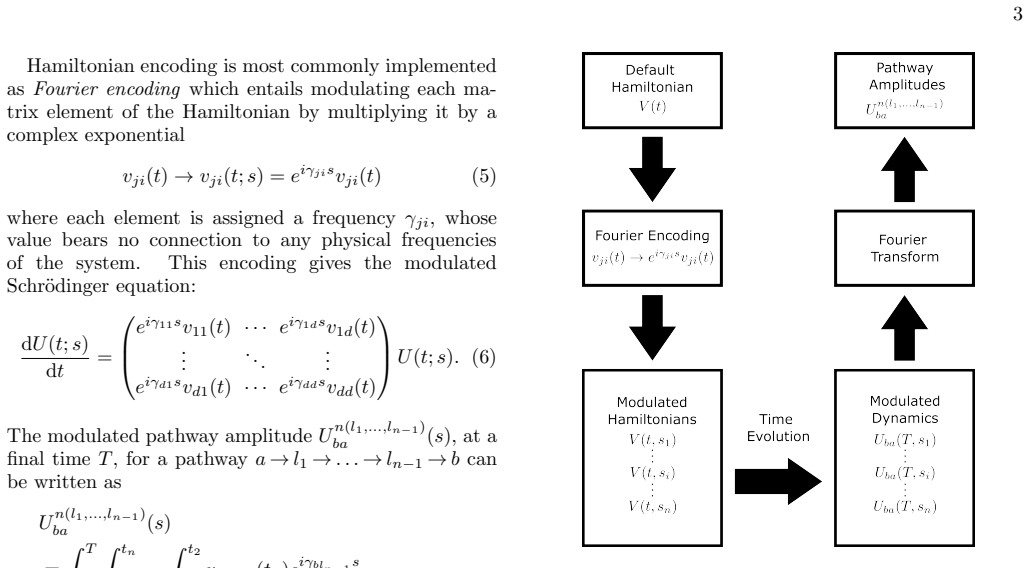
The central object is the pathway amplitude $U^n_{ba}(l_1,\ldots,l_{n-1})$, the iterated time integral assigned to one ordered sequence of $n$ transitions between computational basis states in the Dyson expansion of a matrix element $\langle b|U(T)|a\rangle$. Grouping pathways by shared intermediate states modulo time ordering and modulo backtracking gives non-Hermitian ($NH$) and Hermitian ($H$) pathway classes, whose complex amplitudes are computed by Hamiltonian encoding: each Hamiltonian matrix element is multiplied by a distinct Fourier frequency $\gamma_{ji}$, the modulated Schrödinger equation is solved at many encoding parameters $s$, and a Fourier transform of $U_{ba}(s)$ recovers the amplitude of every resolvable pathway class. The machinery works because each gate matrix element is analyzed separately and the exact matrix element is the vector sum of all pathway amplitudes, so interference is visible directly in the complex plane.
What would settle it
Take one reported gate and recompute the full matrix element $\langle b|U(T)|a\rangle$ by Hamiltonian encoding with a threshold ten to a hundred times smaller than the paper's cutoff, for example $10^{-4}$ instead of $0.083$. Sum all newly resolved sub-threshold pathway class amplitudes as complex vectors. If the tail vector has magnitude comparable to the smallest listed class, or if adding it to the listed sum moves the result away from the exact matrix element by more than numerical tolerance, then the truncation does not capture the core mechanism and the dominance claim fails. A direct target is the $\langle 00|U(T)|00\rangle$ element of CNOT(i): check whether the eight listed classes in Table II reproduce the unit modulus to the reported precision before concluding that the omitted classes are negligible.
Extended reading notes
Core claim
On its own terms, the paper's discovery is that the mechanism of a qubit gate is the interfering complex-amplitude sum over Dyson-series pathways, and this decomposition exposes structure that population dynamics hide. For the X-gate, the population curves look like a simple monotone transfer, yet the mechanism requires an infinite alternating series of back-and-forth pathways whose amplitudes must cancel to zero for the $\langle 0|U(T)|0\rangle$ element and combine to one for $\langle 1|U(T)|0\rangle$. For CNOT(i), Hamiltonian encoding shows that the intermediate states $|00\rangle$ and $|01\rangle$ carry substantial pathway amplitudes even though their populations stay small, because the corresponding pathways destructively interfere; for CNOT(ii), the same target gate uses fundamentally different pathway classes, not merely different backtracking within shared classes. For the SWAP gate, the two lowest-order routes $|01\rangle\to|00\rangle\to|10\rangle$ and $|01\rangle\to|11\rangle\to|10\rangle$ dominate, and their different weights are explained by the distribution of higher-order backtracking sub-pathways inside each Hermitian class.
Load-bearing premise
The load-bearing premise is that the listed pathway classes, selected by a magnitude cutoff such as 'all classes with magnitude greater than 0.083', capture the core mechanism; the paper gives no bound on the collective contribution of all sub-threshold amplitudes, so if many small amplitudes align, the vector sums and the conclusions about which states matter could change.
Editorial extensions
If this is right
- Population plots alone can hide the mechanism: states that barely appear in the final populations can carry large pathway amplitudes whose destructive interference removes them from observation, so mechanism tables are a richer diagnostic than state populations.
- Two optimal controls with the same target gate are not necessarily equivalent at the dynamical level; CNOT(i) and CNOT(ii) differ in the significant Hermitian pathway classes, not just in fine backtracking details.
- Zero matrix elements of a target unitary are not the absence of dynamics but the result of near-total destructive interference among many nonzero pathway amplitudes.
- The same encoding procedure applies to any gate and any bounded Hamiltonian control field, so mechanism analysis can be repeated for other gates, models, or robustly optimized pulses.
Reading between the lines
- An implicit extension is to turn the magnitude cutoff into a convergence guarantee: by tracking the total complex amplitude of all sub-threshold pathway classes across a range of thresholds, one could state precisely how many classes are needed for a target accuracy in each matrix element.
- The finding that same-fidelity controls can have different mechanisms implies that ancillary objectives such as robustness, speed, or reduced leakage might be pursued by selecting among mechanisms rather than only among fields; testing this requires comparing pathway tables of robust and non-robust pulses for the same gate.
- Because Hermitian classes collapse all backtracking details, two controls that look alike at the H-class level can still differ substantially in their NH-class structure; an implicit consequence is that claims of 'same mechanism' are meaningful only when the coarse-graining level (H vs NH) is specified.
Editorial analysis
A structured set of objections, weighed in public.
Referee Report
Summary. The paper applies Hamiltonian encoding to decompose the dynamics of several optimal-control-implemented qubit gates (an X gate, two distinct CNOT gates, and a SWAP gate) into interfering complex pathway amplitudes derived from the Dyson series. The authors show that the X-gate mechanism can be derived analytically, and they present numerical pathway-class tables and complex-plane vector plots for the CNOT and SWAP gates, with the goal of demonstrating that different optimal control fields realizing the same gate can have different underlying mechanisms. The paper is explicitly framed as illustrative: the tools are claimed to be generic, and the specific gates and controls are examples rather than a complete taxonomy.
Significance. If the numerical pathway decompositions are accurate, this paper offers a concrete, quantitative language for speaking about the 'mechanism' of a quantum gate, going beyond population plots to reveal the role of hidden intermediate states and destructive interference. The X-gate section is a fully analytic, self-contained derivation, and the overall framework of interfering Dyson-series pathways is a natural and potentially useful way to compare different optimal control solutions. The central qualitative message, that distinct controls can realize the same unitary through different interfering pathway structures, is plausible and interesting. However, the quantitative mechanism tables, and therefore the detailed comparisons between CNOT(i) and CNOT(ii) and between the two SWAP pathway classes, rest on truncation and numerical-decoding assumptions that are not validated in the manuscript. For this reason the specific numerical claims are conditional, even though the underlying framework is sound.
major comments (3)
- [II A, Tables II-VII] The truncation of the pathway expansion is not validated. The text states in Section II A that 'the core mechanism is dominated by the largest amplitudes and the interference pattern between them,' and the tables list only pathway classes above ad hoc magnitude thresholds (e.g., 0.083 in Table II, 0.13 in Table III, 0.001 in Tables V/VI, 0.01 in Table VII). No bound is provided on the collective contribution of the omitted pathway classes, and the fact that the listed vector sums reproduce the exact matrix elements to displayed precision does not rule out substantial omitted amplitudes that cancel one another. This matters for load-bearing claims such as the statement in Section III C that 'the presence of large pathways within [01->00->10]H means that many other blue pathway classes with smaller magnitudes likely do not play as important roles,' and for the 0.001-level comparison of CNOT(i) and CNOT(ii) in Tables V and VI. A convergence study or an L1/L2 bound on the omitted classes is needed to support these quantitative mechanism assignments.
- [II B, Tables II-VII] The Fourier decoding step that produces all numerical pathway amplitudes is not independently validated or reproducible. The paper does not report the specific encoding frequencies gamma_ji used for each table, nor any check for spectral leakage or aliasing between close frequencies. Since every quantitative result in the CNOT and SWAP sections is obtained by Fourier decoding of the modulated evolution, a leakage error could systematically contaminate the extracted amplitudes and alter the apparent mechanism. The authors refer to [29] for frequency-selection conventions, but the manuscript should at least report the frequency sets or describe the leakage check that justifies the chosen decoding. Without this information, the numerical tables cannot be verified by a reader.
- [III B.2, Tables V-VI] The central comparison between CNOT(i) and CNOT(ii) is based on Hermitian pathway class amplitudes, but the contrast between 'very small role' and 'more than 15 times larger' is drawn from a thresholded listing (all classes with magnitude greater than 0.001). Because the omitted classes are not bounded, the statement that CNOT(ii) 'utilizes fundamentally new routes and pathways' is at risk: if many sub-threshold classes in CNOT(i) collectively contribute significantly, the quantitative distinction could be overstated. The dominance of the leading class (0.9997 vs 0.934) is probably robust, but the specific claim about the importance of the two four-transition classes needs a convergence check.
minor comments (4)
- [III A] The word 'exasperated' in the sentence 'the situation is exasperated for higher dimensional and more complex gates' should be 'exacerbated'.
- [III B] In the sentence 'The two CNOT gates considered here only differ in their optimal control fields ϵx(t) and ϵ x(t)', the second field should presumably be ϵ_y(t), not a repeated ϵ_x(t).
- [III C] The spacing of 'SW AP' in the text and tables is inconsistent with the rest of the manuscript ('SWAP'); this appears to be a formatting artifact and should be corrected.
- [II B] The paper would benefit from a brief statement about the tolerance used when solving Eq. (6) for each s-point and the number of s-points sampled, since these numerical parameters directly affect the precision of the reported magnitudes and phases.
Circularity Check
No significant circularity: the pathway amplitudes are defined and computed from the Dyson series via Fourier decoding, and no fitted parameter or self-citation chain forces the reported gate mechanisms.
full rationale
The claimed derivation chain is self-contained. Pathway amplitudes are defined by the Dyson expansion in Eqs. (2)-(4), and Hamiltonian encoding is introduced as an exact modulation of the Hamiltonian such that each pathway acquires a distinct frequency; the amplitudes are then recovered by Fourier decoding of U(T;s) as expressed in Eqs. (5)-(9). This is a numerical evaluation of independently defined Dyson-series terms, not a fit to the target gate. The X-gate amplitudes are derived analytically from the exact series in Eqs. (14)-(15), and the CNOT and SWAP tables are reported decompositions that sum to the computed matrix elements, rather than predictions of those matrix elements from fitted parameters. The threshold cutoffs (e.g., 'All pathway classes with a magnitude greater than 0.083 are listed') are an unquantified completeness assumption about neglected small-amplitude pathways, which is a correctness or convergence concern, not a circular reduction. The paper's reliance on the same group's prior encoding algorithms, Refs. [28] and [29], is a normal methodological citation: the core encoding identity is re-derived in this paper, and the cited efficient encoding procedure is a separate published method that is not being used to define the target result. Therefore no load-bearing step reduces to its own input, and the central claim is independent of any fitted parameter or circular self-citation.
Assumptions & free parameters
free parameters (2)
- Pathway magnitude thresholds =
0.083, 0.13, 0.2, 0.001, 0.01 (varies by table)
- Encoding frequencies gamma_ji =
Not specified; set per ref. [29]
assumptions (4)
- standard math Dyson series converges for a bounded Hamiltonian
- domain assumption The interaction-picture decomposition with a chosen H0 defines a physically meaningful mechanism
- domain assumption Non-Hermitian encoding yields the pathway amplitudes of the original Hermitian dynamics
- ad hoc to paper A finite threshold-truncated set of pathways captures the core mechanism
Cite this review
Pith. "Pith review of Mechanism behind creating qubit gates expressed as interfering quantum pathway amplitudes." pith.science (2026). https://pith.science/paper/UIHKLFSC
@misc{pith2026250605600,
  author       = {Pith},
  title        = {Pith review of: Mechanism behind creating qubit gates expressed as interfering quantum pathway amplitudes},
  year         = {2026},
  howpublished = {\url{https://pith.science/paper/UIHKLFSC}},
  note         = {Machine review of arXiv:2506.05600}
}
read the original abstract
Hamiltonian encoding was introduced as a technique for revealing the mechanism of controlled quantum systems. It does so by decomposing the evolution into pathways between the computational basis states, where each pathway has an associated complex amplitude. The magnitude of a pathway amplitude determines its significance and many pathways constructively and/or destructively interfere to produce the final evolution of the system. In this paper, we apply Hamiltonian encoding to reveal the mechanism behind creating qubit gates implemented via optimal control pulses. An X gate, two CNOT gates, and a SWAP gate are examined to determine the degree of interference involved and to demonstrate that different optimal controls produce distinct mechanisms. Although the detailed mechanism for creating any gate depends on the nature of the control field, the mechanism analysis tools are generic. The presented gates and their mechanisms in this paper are thus illustrative and a researcher may apply these same tools to any gate with a suitable optimal control field.
Figures


Figures from the paper (6 more)


Reference graph
Works this paper leans on
-
[29]
X. Ge, H. Ding, H. Rabitz, and R.-B. Wu, Robust quan- tum control in games: An adversarial learning approach, Physical Review A101, 052317 (2020)
work page 2020
-
[1]
CNOT(i) Gate The first CNOT gate that will be investigated has pop- ulation plots shown in Figures 3a and 3b for initial states |00⟩and|10⟩respectively. Although the basis consists of four states, only two population plots with distinct initial states are depicted with the key difference being that 3a is concerned with mechanism analysis for⟨00|U(T)|00⟩ a...
-
[2]
Second CNOT(ii) Gate The second CNOT(ii) gate investigated utilizes the same Hamiltonian system as the first gate with the only difference being a distinct set of optimal control fields ϵx(t) andϵ y(t). Additionally, for CNOT(ii) a final time ofT= 1 is used, consistent with the controls having higher fluence than CNOT(i). Population plots of the system st...
-
[3]
C. D. Bruzewicz, J. Chiaverini, R. McConnell, and J. M. Sage, Trapped-ion quantum computing: Progress and challenges, Applied Physics Reviews6, 021314 (2019), https://pubs.aip.org/aip/apr/article- pdf/doi/10.1063/1.5088164/14577412/021314 1 online.pdf
-
[4]
Loss and D
D. Loss and D. P. DiVincenzo, Quantum computation with quantum dots, Phys. Rev. A57, 120 (1998)
1998
-
[5]
P. Kok, W. J. Munro, K. Nemoto, T. C. Ralph, J. P. Dowling, and G. J. Milburn, Linear optical quantum computing with photonic qubits, Rev. Mod. Phys.79, 135 (2007)
2007
-
[6]
Saffman, T
M. Saffman, T. G. Walker, and K. Mølmer, Quantum information with rydberg atoms, Rev. Mod. Phys.82, 2313 (2010)
2010
-
[7]
F. Jelezko, T. Gaebel, I. Popa, M. Domhan, A. Gruber, and J. Wrachtrup, Observation of coherent oscillation of a single nuclear spin and realization of a two-qubit condi- tional quantum gate, Phys. Rev. Lett.93, 130501 (2004)
work page 2004
Show all 45 references
-
[8]
M. H. Devoret and R. J. Schoelkopf, Su- perconducting circuits for quantum informa- tion: An outlook, Science339, 1169 (2013), https://www.science.org/doi/pdf/10.1126/science.1231930
2013 doi
-
[9]
W. Y. Ren-Bao Liu and L. Sham, Quan- tum computing by optical control of electron spins, Advances in Physics59, 703 (2010), https://doi.org/10.1080/00018732.2010.505452
2010
-
[10]
M. J. Calder´ on, A. Saraiva, B. Koiller, and S. Das Sarma, Quantum control and manipu- lation of donor electrons in Si-based quantum computing, Journal of Applied Physics105, 122410 (2009), https://pubs.aip.org/aip/jap/article- pdf/doi/10.1063/1.3124084/13906141/122410 1 online.pdf
2009 doi
-
[11]
L. M. K. Vandersypen and I. L. Chuang, Nmr techniques for quantum control and computation, Rev. Mod. Phys. 76, 1037 (2005)
2005
-
[12]
Shi and H
S. Shi and H. Rabitz, Quantum mechanical op- timal control of physical observables in mi- crosystems, The Journal of Chemical Physics92, https://doi.org/10.1063/1.458438 (1990)
1990 doi
-
[13]
Cheng and A
T. Cheng and A. Brown, Pulse shaping for optimal con- trol of molecular processes, The Journal of Chemical Physics124, https://doi.org/10.1063/1.2187977 (2006)
2006 doi
-
[14]
G. A. Worth and G. W. Richings, Optimal control by computer, Annu. Rep. Prog. Chem., Sect. C: Phys. Chem.109, 113 (2013)
2013
-
[15]
Rothman, T.-S
A. Rothman, T.-S. Ho, and H. Rabitz, Observable- preserving control of quantum dynamics over a family of related systems, Phys. Rev. A72, 023416 (2005)
2005
-
[16]
Shu, T.-S
C.-C. Shu, T.-S. Ho, X. Xing, and H. Rabitz, Frequency domain quantum optimal control under multiple con- straints, Phys. Rev. A93, 033417 (2016)
2016
-
[17]
C. P. Koch, M. Lemeshko, and D. Sugny, Quantum con- trol of molecular rotation, Rev. Mod. Phys.91, 035005 (2019)
2019
-
[18]
Chakrabarti and H
R. Chakrabarti and H. Rabitz, Quantum control land- scapes, International Reviews in Physical Chemistry26, 671 (2007), https://doi.org/10.1080/01442350701633300
2007 doi
-
[19]
Doria, T
P. Doria, T. Calarco, and S. Montangero, Optimal control technique for many-body quantum dynamics, Phys. Rev. Lett.106, 190501 (2011)
2011
-
[20]
Rembold, N
P. Rembold, N. Oshnik, M. M. M¨ uller, S. Montangero, T. Calarco, and E. Neu, Introduction to quantum optimal control for quantum sensing with nitrogen-vacancy cen- ters in diamond, A VS Quantum Science2, 024701 (2020)
2020
-
[21]
Greenman, K
L. Greenman, K. B. Whaley, D. J. Haxton, and C. W. McCurdy, Optimized pulses for raman excitation through the continuum: Verification using the multiconfigura- tional time-dependent hartree-fock method, Phys. Rev. A96, 013411 (2017)
2017
-
[22]
Rossi, D
M. Rossi, D. Mason, J. Chen, Y. Tsaturyan, and A. Schliesser, Measurement-based quantum control of mechanical motion, Nature563, 53 (2018)
2018
-
[23]
Soare, H
A. Soare, H. Ball, D. Hayes, J. Sastrawan, M. Jarratt, J. McLoughlin, X. Zhen, T. Green, and M. Biercuk, Ex- perimental noise filtering by quantum control, Nature Physics10, 825 (2014)
2014
-
[24]
Press, T
D. Press, T. D. Ladd, B. Zhang, and Y. Yamamoto, Com- plete quantum control of a single quantum dot spin using ultrafast optical pulses, Nature456, 218 (2008)
2008
-
[25]
R. L. Kosut, G. Bhole, and H. Rabitz, Robust quan- tum control: Analysis & synthesis via averaging, arXiv preprint arXiv:2208.14193 (2022)
2022 arXiv
-
[26]
Koswara, V
A. Koswara, V. Bhutoria, and R. Chakrabarti, Robust control of quantum dynamics under input and parameter uncertainty, Phys. Rev. A104, 053118 (2021)
2021
-
[27]
Daems, A
D. Daems, A. Ruschhaupt, D. Sugny, and S. Guerin, Robust quantum control by a single-shot shaped pulse, Physical Review Letters111, 050404 (2013)
2013
-
[28]
Dridi, K
G. Dridi, K. Liu, and S. Gu´ erin, Optimal robust quan- tum control by inverse geometric optimization, Physical Review Letters125, 250403 (2020)
2020
-
[30]
Mitra and H
A. Mitra and H. Rabitz, Identifying mechanisms in the control of quantum dynamics through hamiltonian en- coding, Phys. Rev. A67, 033407 (2003)
2003
-
[31]
Abrams, M
E. Abrams, M. Kasprzak, G. Bhole, T.-S. Ho, and H. Ra- 13 bitz, Efficient Hamiltonian encoding algorithms for ex- tracting quantum control mechanism as interfering path- way amplitudes in the Dyson series, Quantum9, 1626 (2025)
2025
-
[32]
Mitra, I
A. Mitra, I. R. Sol´ a, and H. Rabitz, Revealing quantum- control mechanisms through hamiltonian encoding in dif- ferent representations, Phys. Rev. A67, 043409 (2003)
2003
-
[33]
Mitra and H
A. Mitra and H. Rabitz, Quantum control mecha- nism analysis through field based hamiltonian encoding, The Journal of Chemical Physics125, 194107 (2006), https://doi.org/10.1063/1.2371079
2006 doi
-
[34]
Sharp, A
R. Sharp, A. Mitra, and H. Rabitz, Principles for deter- mining mechanistic pathways from observable quantum control data, Journal of Mathematical Chemistry44, 142 (2008)
2008
-
[35]
F. Gao, R. Rey-de Castro, Y. Wang, H. Rabitz, and F. Shuang, Identifying a cooperative control mechanism between an applied field and the environment of open quantum systems, Phys. Rev. A93, 053407 (2016)
2016
-
[36]
Mitra and H
A. Mitra and H. Rabitz, Mechanistic analysis of optimal dynamic discrimination of similar quantum systems, The Journal of Physical Chemistry A108, 4778 (2004)
2004
-
[37]
Mitra and H
A. Mitra and H. Rabitz, Quantum control mech- anism analysis through field based hamiltonian en- coding: A laboratory implementable algorithm, The Journal of Chemical Physics128, 044112 (2008), https://doi.org/10.1063/1.2820787
2008 doi
-
[38]
Rey-de Castro and H
R. Rey-de Castro and H. Rabitz, Laboratory imple- mentation of quantum-control-mechanism identification through hamiltonian encoding and observable decoding, Physical Review A81, 063422 (2010)
2010
-
[39]
Rey-de Castro, R
R. Rey-de Castro, R. Cabrera, D. I. Bondar, and H. Ra- bitz, Time-resolved quantum process tomography us- ing hamiltonian-encoding and observable-decoding, New Journal of Physics15, https://doi.org/10.1088/1367- 2630/15/2/025032 (2013)
2013 doi
-
[40]
N. J. Higham, The scaling and squaring method for the matrix exponential revisited, SIAM J. Matrix Anal. Appl.26, 1179–1193 (2005)
2005
-
[41]
Khaneja, T
N. Khaneja, T. Reiss, C. Kehlet, T. Schulte-Herbr¨ uggen, and S. J. Glaser, Optimal control of coupled spin dynam- ics: design of NMR pulse sequences by gradient ascent algorithms, J. Magn. Resonance172, 296 (2005)
2005
-
[42]
T.-S. Ho, J. Dominy, and H. Rabitz, Landscape of unitary transformations in controlled quantum dynamics, Phys. Rev. A79, 013422 (2009)
2009
-
[43]
This terminology will also apply to intermediate time steps when the control Hamiltonian is non-zero
-
[44]
In theory, up to 16 separate matrix elements could have been studied, but this extensive analysis is not needed to understand the control mechanism in this case
-
[45]
N. V. Vitanov, A. A. Rangelov, B. W. Shore, and K. Bergmann, Stimulated raman adiabatic passage in physics, chemistry, and beyond, Rev. Mod. Phys.89, 015006 (2017)
2017
Reviewed August 7, 2026 · model on record in the stance chip above.
Discussion (0). Sign in to comment.