REVIEW 4 major objections 5 minor 64 references
MARBLE: Material Recomposition and Blending in CLIP-Space
T0 review · 4 major / 5 minor · reviewed 2026-08-07 · deepseek-v4-flash
Pith's one-line read A pre-trained diffusion model can edit, blend, and parametrically control materials in images by manipulating only CLIP image features, with no fine-tuning of the model.
desk verdict A useful empirical contribution with a real inconsistency in the parametric-control formulation; needs major revision before it's publishable. read the letter →
The pith
A machine-rendered reading of the paper's core claim, the machinery that carries it, and where it could break.
The reading
What carries the argument
The load-bearing mechanism is targeted material-block injection: instead of injecting the CLIP material embedding into all attention layers as in the base ZeST architecture, MARBLE injects it only into the material block, the U-Net attention layer near the bottleneck that the authors identify as responsible for material attribution. This preserves geometry and lighting while transferring material. A second mechanism is the low-rank material-attribute direction: the paper stacks CLIP-space differences between image pairs with an attribute changed, applies SVD, keeps enough components to explain 67 to 80 percent of the variance, and trains a shallow MLP $p_\theta$ to predict that low-rank direction as a function of image and editing strength $\delta$. Blending uses linear interpolation $\alpha z_{m_1} + (1-\alpha) z_{m_2}$ of the two material embeddings.
What would settle it
Render a physical ground-truth sequence of an object with a material parameter moving continuously between two exemplars, then check whether MARBLE's CLIP-space interpolation and MLP-predicted directions reproduce the rendered intermediate materials at every strength; if the edited images diverge systematically from the ground-truth intermediates, the central claim of a linear material subspace in CLIP space is refuted.
Extended reading notes
Core claim
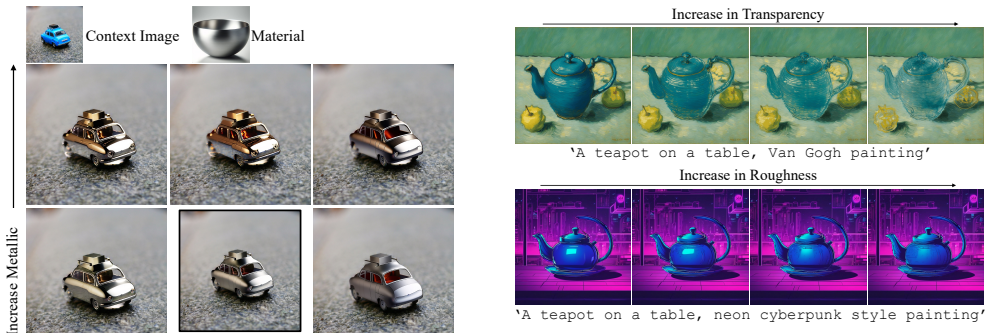
MARBLE's central claim is that a surprising amount of material editing is possible with CLIP image features alone. Given a material exemplar image $I_m$, the method extracts its CLIP embedding $z_m$ and injects it only into the U-Net attention block responsible for material attribution, identified by exhaustively visualizing per-block injections. For blending, the edited image is generated with $f(\alpha z_{m_1} + (1-\alpha)z_{m_2})$; for parametric control, the new embedding is $z_{m_{a+\delta}} = \mathrm{CLIP}(I_m) + p_\theta(I_m,\delta)$, where $p_\theta$ is a two-layer MLP trained to predict the low-rank SVD-approximated direction for increasing attribute $a$ by strength $\delta$. All this is done without fine-tuning the pre-trained diffusion model, and the paper shows the controls generalize to real photos, paintings, and multi-attribute edits in a single pass.
Load-bearing premise
The load-bearing premise is that CLIP image embeddings contain a low-rank, linearly interpolatable subspace for material attributes, learned from a few hundred synthetic Blender renders, that transfers to real photographs and paintings even though the SVD step discards 20 to 33 percent of the variance and the material block is chosen by visual inspection.
Editorial extensions
If this is right
- Material transfer, blending, and parametric attribute control can be combined in a single forward pass without retraining the diffusion model.
- The approach works on stylized content such as paintings because CLIP space is shared across styles, so the rendered-data-trained controls transfer.
- Dataset requirements are small: attribute control learns from as few as 16 synthetic objects, and the paper shows quality plateaus beyond that.
- Because attributes are encoded as independent CLIP-space directions, multiple controls such as roughness and metallic can be applied at once and remain disentangled.
- Targeted block injection preserves geometry better than full-block injection, preventing artifacts such as hallucinated hands during material transfer.
Reading between the lines
- If CLIP embeddings really contain a linearly interpolatable low-rank subspace for materials, the same targeted-injection recipe may extend to other low-level appearance factors such as lighting direction, camera blur, or aging, with the same tiny-data training regime.
- The shared block for style and material attribution suggests material transfer and style transfer may be the same operation at the bottleneck; a direct comparison of the material block and the style block could clarify whether one block controls both or whether the overlap is coincidental.
- A stricter falsification setup would render a physical ground truth for intermediate blend weights and check whether the CLIP-space interpolation tracks the shader parameter continuously; the paper currently validates on rendered validation sets and user preference, not on exact intermediate-material ground truth.
- The discarded 20 to 33 percent of CLIP variance may carry object identity and environment information; conditioning the SVD or learning per-attribute subspaces separately could reduce the texture-pattern artifacts noted as a limitation.
Editorial analysis
A structured set of objections, weighed in public.
Referee Report
Summary. The paper introduces MARBLE, a method for material editing that operates by manipulating CLIP image embeddings and injecting them into a selected U-Net block of a pre-trained diffusion inpainting model, without fine-tuning the diffusion model. It claims three capabilities: exemplar-based material transfer with improved geometry preservation via targeted material-block injection (Section 3.1), material blending by linear interpolation of CLIP features of two exemplars (Section 3.2, Eq. 2), and parametric control over roughness, metallic, transparency, and glow using a small MLP trained on synthetic Blender renders to predict a direction in CLIP-space (Section 3.3, Eqs. 3-4). The method builds on the authors' ZeST architecture, and is evaluated with qualitative comparisons to InstructPix2Pix and Concept Sliders, a quantitative comparison to image-trained Concept Sliders on a rendered validation set (Table 1), a small user study, and ablations of dataset size and multi-attribute control.
Significance. If the central claims hold, MARBLE would be a useful result: it demonstrates that a surprising amount of material control can be achieved by CLIP-space manipulation alone, with no diffusion-model fine-tuning, while supporting blending and multiple simultaneous parametric edits in a single forward pass. The paper also provides a data-efficiency ablation showing that as few as 16 objects suffice for training the attribute network, and shows qualitative generalization to painted and stylized images. These are strengths worth acknowledging. However, the parametric-control formulation as written contains an internal inconsistency between the training objective and the inference equation, and the quantitative evaluation is narrow, so the current manuscript does not fully establish its claims.
major comments (4)
- [Section 3.3, Eqs. (3) and (4)] The training objective and the inference equation are inconsistent, and this is load-bearing for the parametric-control claim. In Eq. (3), the loss minimises cosine-similarity and MSE between s_{ma+δ} and p_θ(I_ma, δ), so p_θ is trained to output the target low-rank CLIP feature directly. The text confirms this: 'p_θ learns to predict the low-rank approximated CLIP feature of the same original image with one attribute α increased by δ.' However, Eq. (4) computes z_{ma+δ} = CLIP(I_m) + p_θ(I_m, δ), adding the predicted target feature to the original embedding. This double-counts the target: if p_θ already equals the desired edited feature, then the sum is roughly the source plus the target, not a shift toward the target. If p_θ is instead intended to be an offset, then Eq. (3)'s target should be s_{ma+δ} − s_{ma} (or its low-rank projection), not s_{ma+δ}. Since the resulting z is injected into the UNet and determines the material appearance, this is not a cosmetic notation issue; the paper must clarify the intended semantics and make Eqs. (3) and (4) consistent, and if the current training was used, the reported parametric-control results need to be re-examined.
- [Section 4.2, Table 1 and user study] The quantitative comparison is too narrow to support the claim of superiority across 'all metrics for all attributes'. Table 1 reports only one baseline (image-trained Concept Slider) and gives no standard deviations, confidence intervals, or significance tests, despite the fact that the validation set is generated from 50 objects and the metrics are likely averaged over images; without variance or per-object statistics, the large gaps could still be informative, but the reader cannot assess stability or whether the result is driven by a few outliers. The user study uses only 16 participants and reports only that '87.5% participants chose images generated by our method' without defining how a participant's choice aggregates over the 20 real-world images, how the three image sets per user were constructed, or whether the comparison was paired and balanced. These reporting gaps should be addressed for the quantitative claims to be convincing.
- [Section 3.1 and Section 3.3] The central generalization premise—that a low-rank CLIP subspace learned from 250 Blender-rendered objects transfers to real photographs and paintings—is supported only by qualitative results. The paper states that the SVD retains only 67%–80% of the variance for the four attributes, and the material U-Net block is selected by 'exhaustively visualizing' outputs. These choices are reasonable as heuristics, but they are load-bearing for the method's applicability, and the manuscript presents no quantitative evaluation on real images or on held-out render configurations that vary object class, lighting, and background in a controlled way. A concrete test would be to report attribute-edit success rates or metric comparisons on a real-image set with human or pseudo-ground-truth judgements, and to validate the block choice quantitatively by ablating across a random sample of objects rather than relying on visual inspection.
- [Section 3.2, Eq. (2)] Material blending is a core contribution but is evaluated only qualitatively (Figure 5). The paper does not provide quantitative metrics for blending, such as whether the interpolated material at α=0.5 matches a ground-truth render with intermediate shader parameters, nor does it analyse how the interpolation behaves for the three stated configurations. Since blending is one of the paper's headline capabilities, adding a quantitative blending study on the rendered validation set would strengthen the claim substantially. Also, Eq. (2) states 'α > 0' but the interpolation formula α z_{m1} + (1−α) z_{m2} only makes sense for α in [0,1]; the intended range should be stated explicitly.
minor comments (5)
- [Section 3.3] The text says 'one attribute α increased by δ' but α is elsewhere used as a blending weight; the attribute name should be 'a' consistently.
- [Section 3.3] The description of the dataset says 300 synthetic objects are used but then states '250 for training and 50 for validation', which sums to 300; the text should clarify the split and whether the 250 training objects are the same as the 'as few as 8 objects' ablation set.
- [Section 4.3, Figure 11] The data-efficiency plot reports PSNR and DreamSim but the axes and the error bars (if any) are not described; adding error bars or shaded regions over repeated training runs would make the claim about 16 objects more robust.
- [Section 4.2] The user study result '87.5% participants chose images generated by our method' is presented without the raw counts or the exact question format; please report the number of participants, the number of comparisons, and the distribution of choices.
- [Section 3.1] The paper says the material block is identified following InstantStyle, but does not provide a table or figure showing the effect of injecting into each block; a supplementary figure or a quantitative ablation would help the reader reproduce the selection.
Circularity Check
No significant circularity: the quantitative claims are tested on held-out rendered objects and against external baselines; the main flagged issue is an internal Eq. 3/Eq. 4 inconsistency, which is a correctness concern rather than an input-output circularity.
full rationale
MARBLE's core pipeline is not circular. The material-block choice is found by exhaustive visualization rather than defined by the evaluation metric; the blending operation in Eq. 2 is a proposed interpolation whose plausibility is shown qualitatively; and the parametric controller is a supervised MLP trained with Eq. 3 on a 250-object rendered set and evaluated on a separate 50-object validation set against Concept Sliders, so the quantitative result is not a restatement of the training objective. The reliance on ZeST [15] is a self-citation to the authors' prior architecture, but it is used as a substrate with modifications and is not the sole justification for the central CLIP-space manipulation claim. The paper also acknowledges concrete limitations, which further indicates that the claims are not being forced by definition. The strongest caveat is that generalization to real photos and paintings rests on qualitative examples, and the implementation as written has a consistency issue: Eq. 3 makes p_theta approximate the absolute target feature s_{ma+delta}, while Eq. 4 adds p_theta to CLIP(I_m) as though it were an offset, which would double-count; this is an internal inconsistency and a correctness risk, not a definitional equivalence between input and output, so it does not constitute circularity under the provided rubric.
Assumptions & free parameters
free parameters (3)
- SVD rank per attribute =
not reported (chosen by elbow; variance explained 67-80%)
- Material U-Net block index =
not stated numerically
- MLP parameters p_theta =
learned on synthetic data
assumptions (5)
- domain assumption CLIP image embeddings encode material attributes in approximately linear, interpolatable subspaces
- domain assumption A single U-Net block near the bottleneck is responsible for material attribution
- domain assumption Pre-trained SDXL and IP-Adapter features can be repurposed for material editing without fine-tuning
- domain assumption Synthetic Blender renders with Objaverse objects and HDRIs are representative for learning directions that generalize to real images and paintings
- domain assumption Low-rank approximation retains sufficient attribute information (67-80% variance)
Cite this review
Pith. "Pith review of MARBLE: Material Recomposition and Blending in CLIP-Space." pith.science (2026). https://pith.science/paper/UIN73DF5
@misc{pith2026250605313,
  author       = {Pith},
  title        = {Pith review of: MARBLE: Material Recomposition and Blending in CLIP-Space},
  year         = {2026},
  howpublished = {\url{https://pith.science/paper/UIN73DF5}},
  note         = {Machine review of arXiv:2506.05313}
}
read the original abstract
Editing materials of objects in images based on exemplar images is an active area of research in computer vision and graphics. We propose MARBLE, a method for performing material blending and recomposing fine-grained material properties by finding material embeddings in CLIP-space and using that to control pre-trained text-to-image models. We improve exemplar-based material editing by finding a block in the denoising UNet responsible for material attribution. Given two material exemplar-images, we find directions in the CLIP-space for blending the materials. Further, we can achieve parametric control over fine-grained material attributes such as roughness, metallic, transparency, and glow using a shallow network to predict the direction for the desired material attribute change. We perform qualitative and quantitative analysis to demonstrate the efficacy of our proposed method. We also present the ability of our method to perform multiple edits in a single forward pass and applicability to painting. Project Page: https://marblecontrol.github.io/
Figures


Figures from the paper (8 more)




Reference graph
Works this paper leans on
-
[1]
Practical svbrdf capture in the frequency domain.ACM Trans
Miika Aittala, Tim Weyrich, and Jaakko Lehtinen. Practical svbrdf capture in the frequency domain.ACM Trans. Graph., 32(4):110–1, 2013. 3
work page 2013
-
[2]
Two- shot svbrdf capture for stationary materials.ACM Trans
Miika Aittala, Tim Weyrich, Jaakko Lehtinen, et al. Two- shot svbrdf capture for stationary materials.ACM Trans. Graph., 34(4):110–1, 2015. 3
work page 2015
-
[3]
Multidiffusion: Fusing diffusion paths for controlled image generation
Omer Bar-Tal, Lior Yariv, Yaron Lipman, and Tali Dekel. Multidiffusion: Fusing diffusion paths for controlled image generation. 2023. 2
2023
-
[4]
Continuous, Subject-Specific Attribute Control in T2I Models by Identifying Semantic Directions
Stefan Andreas Baumann, Felix Krause, Michael Neumayr, Nick Stracke, Vincent Tao Hu, and Björn Ommer. Continu- ous, subject-specific attribute control in t2i models by identi- fying semantic directions.arXiv preprint arXiv:2403.17064,
-
[5]
Material recognition in the wild with the materials in con- text database
Sean Bell, Paul Upchurch, Noah Snavely, and Kavita Bala. Material recognition in the wild with the materials in con- text database. InProceedings of the IEEE conference on computer vision and pattern recognition, pages 3479–3487,
-
[6]
Shariq Farooq Bhat, Niloy J Mitra, and Peter Wonka. Loosecontrol: Lifting controlnet for generalized depth con- ditioning.arXiv preprint arXiv:2312.03079, 2023. 3
arXiv 2023
-
[7]
In- structpix2pix: Learning to follow image editing instructions
Tim Brooks, Aleksander Holynski, and Alexei A Efros. In- structpix2pix: Learning to follow image editing instructions. InProceedings of the IEEE/CVF Conference on Computer Vision and Pattern Recognition, pages 18392–18402, 2023. 2, 3, 6
work page 2023
-
[8]
Mingdeng Cao, Xintao Wang, Zhongang Qi, Ying Shan, Xi- aohu Qie, and Yinqiang Zheng. Masactrl: Tuning-free mu- tual self-attention control for consistent image synthesis and editing.arXiv preprint arXiv:2304.08465, 2023. 2
arXiv 2023
Show all 64 references
-
[9]
Texfusion: Synthesizing 3d textures with text-guided image diffusion models
Tianshi Cao, Karsten Kreis, Sanja Fidler, Nicholas Sharp, and Kangxue Yin. Texfusion: Synthesizing 3d textures with text-guided image diffusion models. InProceedings of the IEEE/CVF International Conference on Computer Vision, pages 4169–4181, 2023. 3
2023
-
[10]
Matatlas: Text- driven consistent geometry texturing and material assign- ment.arXiv preprint arXiv:2404.02899, 2024
Duygu Ceylan, Valentin Deschaintre, Thibault Groueix, Rosalie Martin, Chun-Hao Huang, Romain Rouffet, Vladimir Kim, and Gaëtan Lassagne. Matatlas: Text- driven consistent geometry texturing and material assign- ment.arXiv preprint arXiv:2404.02899, 2024
2024 arXiv
-
[11]
Text2tex: Text-driven texture synthesis via diffusion models.arXiv preprint arXiv:2303.11396, 2023
Dave Zhenyu Chen, Yawar Siddiqui, Hsin-Ying Lee, Sergey Tulyakov, and Matthias Nießner. Text2tex: Text-driven texture synthesis via diffusion models.arXiv preprint arXiv:2303.11396, 2023. 3
2023 arXiv
-
[12]
Training-free layout control with cross-attention guidance
Minghao Chen, Iro Laina, and Andrea Vedaldi. Training-free layout control with cross-attention guidance. InProceed- ings of the IEEE/CVF Winter Conference on Applications of Computer Vision, pages 5343–5353, 2024. 2
2024
-
[13]
Subject-driven text-to-image generation via apprenticeship learning.arXiv preprint arXiv:2304.00186, 2023
Wenhu Chen, Hexiang Hu, Yandong Li, Nataniel Rui, Xuhui Jia, Ming-Wei Chang, and William W Cohen. Subject-driven text-to-image generation via apprenticeship learning.arXiv preprint arXiv:2304.00186, 2023. 2
2023 arXiv
-
[14]
Subject-driven text-to-image generation via apprenticeship learning.Advances in Neural Information Processing Sys- tems, 36, 2024
Wenhu Chen, Hexiang Hu, Yandong Li, Nataniel Ruiz, Xuhui Jia, Ming-Wei Chang, and William W Cohen. Subject-driven text-to-image generation via apprenticeship learning.Advances in Neural Information Processing Sys- tems, 36, 2024. 2
2024
-
[15]
Zest: Zero-shot material trans- fer from a single image
Ta-Ying Cheng, Prafull Sharma, Andrew Markham, Niki Trigoni, and Varun Jampani. Zest: Zero-shot material trans- fer from a single image. InEuropean Conference on Com- puter Vision, pages 370–386. Springer, 2025. 2, 3
2025
-
[16]
Objaverse: A universe of annotated 3d objects
Matt Deitke, Dustin Schwenk, Jordi Salvador, Luca Weihs, Oscar Michel, Eli VanderBilt, Ludwig Schmidt, Kiana Ehsani, Aniruddha Kembhavi, and Ali Farhadi. Objaverse: A universe of annotated 3d objects. InProceedings of the IEEE/CVF Conference on Computer Vision and Pattern Reco...
2023
-
[17]
A generative framework for image- based editing of material appearance using perceptual at- tributes
Johanna Delanoy, Manuel Lagunas, J Condor, Diego Gutier- rez, and Belén Masia. A generative framework for image- based editing of material appearance using perceptual at- tributes. InComputer Graphics Forum, pages 453–464. Wi- ley Online Library, 2022. 3
2022
-
[18]
Flexible svbrdf capture with a multi-image deep network
Valentin Deschaintre, Miika Aittala, Frédo Durand, George Drettakis, and Adrien Bousseau. Flexible svbrdf capture with a multi-image deep network. InComputer graphics fo- rum, pages 1–13. Wiley Online Library, 2019. 3
2019
-
[19]
Diffusion models beat gans on image synthesis.Advances in neural informa- tion processing systems, 34:8780–8794, 2021
Prafulla Dhariwal and Alexander Nichol. Diffusion models beat gans on image synthesis.Advances in neural informa- tion processing systems, 34:8780–8794, 2021. 2
2021
-
[20]
Dream- sim: Learning new dimensions of human visual similar- ity using synthetic data.arXiv preprint arXiv:2306.09344,
Stephanie Fu, Netanel Tamir, Shobhita Sundaram, Lucy Chai, Richard Zhang, Tali Dekel, and Phillip Isola. Dream- sim: Learning new dimensions of human visual similar- ity using synthetic data.arXiv preprint arXiv:2306.09344,
-
[21]
Concept sliders: Lora adap- tors for precise control in diffusion models.arXiv preprint arXiv:2311.12092, 2023
Rohit Gandikota, Joanna Materzynska, Tingrui Zhou, Anto- nio Torralba, and David Bau. Concept sliders: Lora adap- tors for precise control in diffusion models.arXiv preprint arXiv:2311.12092, 2023. 3, 6
2023 arXiv
-
[22]
Expressive text-to-image generation with rich text
Songwei Ge, Taesung Park, Jun-Yan Zhu, and Jia-Bin Huang. Expressive text-to-image generation with rich text. InProceedings of the IEEE/CVF International Conference on Computer Vision, pages 7545–7556, 2023. 2
2023
-
[23]
Texsliders: Diffusion- based texture editing in clip space
Julia Guerrero-Viu, Milos Hasan, Arthur Roullier, Midhun Harikumar, Yiwei Hu, Paul Guerrero, Diego Gutierrez, Be- len Masia, and Valentin Deschaintre. Texsliders: Diffusion- based texture editing in clip space. InACM SIGGRAPH 2024 Conference Papers, pages 1–11, 2024. 3
2024
-
[24]
Ganspace: Discovering interpretable gan con- trols.Advances in neural information processing systems, 33:9841–9850, 2020
Erik Härkönen, Aaron Hertzmann, Jaakko Lehtinen, and Sylvain Paris. Ganspace: Discovering interpretable gan con- trols.Advances in neural information processing systems, 33:9841–9850, 2020. 4
2020
-
[25]
Prompt-to-prompt im- age editing with cross attention control.arXiv preprint arXiv:2208.01626, 2022
Amir Hertz, Ron Mokady, Jay Tenenbaum, Kfir Aberman, Yael Pritch, and Daniel Cohen-Or. Prompt-to-prompt im- age editing with cross attention control.arXiv preprint arXiv:2208.01626, 2022. 2
2022 arXiv
-
[26]
Classifier-free diffusion guidance.arXiv preprint arXiv:2207.12598, 2022
Jonathan Ho and Tim Salimans. Classifier-free diffusion guidance.arXiv preprint arXiv:2207.12598, 2022. 2
2022 arXiv
-
[27]
Denoising dif- fusion probabilistic models.Advances in neural information processing systems, 33:6840–6851, 2020
Jonathan Ho, Ajay Jain, and Pieter Abbeel. Denoising dif- fusion probabilistic models.Advances in neural information processing systems, 33:6840–6851, 2020
2020
-
[28]
Cascaded diffusion models for high fidelity image generation.The Journal of Machine Learning Research, 23(1):2249–2281, 2022
Jonathan Ho, Chitwan Saharia, William Chan, David J Fleet, Mohammad Norouzi, and Tim Salimans. Cascaded diffusion models for high fidelity image generation.The Journal of Machine Learning Research, 23(1):2249–2281, 2022
2022
-
[29]
Scal- ing up gans for text-to-image synthesis
Minguk Kang, Jun-Yan Zhu, Richard Zhang, Jaesik Park, Eli Shechtman, Sylvain Paris, and Taesung Park. Scal- ing up gans for text-to-image synthesis. InProceedings of the IEEE/CVF Conference on Computer Vision and Pattern Recognition, pages 10124–10134, 2023
2023
-
[30]
Elucidating the design space of diffusion-based generative models.Advances in Neural Information Processing Sys- tems, 35:26565–26577, 2022
Tero Karras, Miika Aittala, Timo Aila, and Samuli Laine. Elucidating the design space of diffusion-based generative models.Advances in Neural Information Processing Sys- tems, 35:26565–26577, 2022. 2
2022
-
[31]
Image-based material editing.ACM Transactions on Graphics (TOG), 25(3):654–663, 2006
Erum Arif Khan, Erik Reinhard, Roland W Fleming, and Heinrich H Bülthoff. Image-based material editing.ACM Transactions on Graphics (TOG), 25(3):654–663, 2006. 2, 3
2006
-
[32]
In- trinsic image diffusion for indoor single-view material es- timation
Peter Kocsis, Vincent Sitzmann, and Matthias Nießner. In- trinsic image diffusion for indoor single-view material es- timation. InProceedings of the IEEE/CVF Conference on Computer Vision and Pattern Recognition, pages 5198– 5208, 2024. 3
2024
-
[33]
Multi-concept customization of text-to-image diffusion
Nupur Kumari, Bingliang Zhang, Richard Zhang, Eli Shechtman, and Jun-Yan Zhu. Multi-concept customization of text-to-image diffusion. InProceedings of the IEEE/CVF Conference on Computer Vision and Pattern Recognition, pages 1931–1941, 2023. 2
1931
-
[34]
Clearclip: Decom- posing clip representations for dense vision-language infer- ence.arXiv preprint arXiv:2407.12442, 2024
Mengcheng Lan, Chaofeng Chen, Yiping Ke, Xinjiang Wang, Litong Feng, and Wayne Zhang. Clearclip: Decom- posing clip representations for dense vision-language infer- ence.arXiv preprint arXiv:2407.12442, 2024. 5
2024 arXiv
-
[35]
Gligen: Open-set grounded text-to-image generation
Yuheng Li, Haotian Liu, Qingyang Wu, Fangzhou Mu, Jian- wei Yang, Jianfeng Gao, Chunyuan Li, and Yong Jae Lee. Gligen: Open-set grounded text-to-image generation. InPro- ceedings of the IEEE/CVF Conference on Computer Vision and Pattern Recognition, pages 22511–22521, 2023. 2
2023
-
[36]
Multimodal material segmentation
Yupeng Liang, Ryosuke Wakaki, Shohei Nobuhara, and Ko Nishino. Multimodal material segmentation. InProceedings of the IEEE/CVF Conference on Computer Vision and Pat- tern Recognition, pages 19800–19808, 2022. 3
2022
-
[37]
Material palette: Extraction of materials from a single image
Ivan Lopes, Fabio Pizzati, and Raoul de Charette. Material palette: Extraction of materials from a single image. InPro- ceedings of the IEEE/CVF Conference on Computer Vision and Pattern Recognition, pages 4379–4388, 2024. 3
2024
-
[38]
T2i-adapter: Learning adapters to dig out more controllable ability for text-to-image diffusion models.arXiv preprint arXiv:2302.08453, 2023
Chong Mou, Xintao Wang, Liangbin Xie, Jian Zhang, Zhon- gang Qi, Ying Shan, and Xiaohu Qie. T2i-adapter: Learning adapters to dig out more controllable ability for text-to-image diffusion models.arXiv preprint arXiv:2302.08453, 2023. 3
2023 arXiv
-
[39]
Glide: Towards photorealistic image generation and editing with text-guided diffusion models.arXiv preprint arXiv:2112.10741, 2021
Alex Nichol, Prafulla Dhariwal, Aditya Ramesh, Pranav Shyam, Pamela Mishkin, Bob McGrew, Ilya Sutskever, and Mark Chen. Glide: Towards photorealistic image generation and editing with text-guided diffusion models.arXiv preprint arXiv:2112.10741, 2021. 2
2021 arXiv
-
[40]
Drag your gan: Interactive point-based manipulation on the generative image manifold
Xingang Pan, Ayush Tewari, Thomas Leimkühler, Lingjie Liu, Abhimitra Meka, and Christian Theobalt. Drag your gan: Interactive point-based manipulation on the generative image manifold. InACM SIGGRAPH 2023 Conference Pro- ceedings, pages 1–11, 2023. 4
2023
-
[41]
Karran Pandey, Paul Guerrero, Metheus Gadelha, Yannick Hold-Geoffroy, Karan Singh, and Niloy J. Mitra. Diffusion handles: Enabling 3d edits for diffusion models by lifting activations to 3d.CVPR, 2024. 2
2024
-
[42]
Precisecontrol: En- hancing text-to-image diffusion models with fine-grained at- tribute control
Rishubh Parihar, VS Sachidanand, Sabariswaran Mani, Te- jan Karmali, and R Venkatesh Babu. Precisecontrol: En- hancing text-to-image diffusion models with fine-grained at- tribute control. InEuropean Conference on Computer Vision, pages 469–487. Springer, 2025. 3
2025
-
[43]
Learning transferable visual models from natural language supervi- sion
Alec Radford, Jong Wook Kim, Chris Hallacy, Aditya Ramesh, Gabriel Goh, Sandhini Agarwal, Girish Sastry, Amanda Askell, Pamela Mishkin, Jack Clark, et al. Learning transferable visual models from natural language supervi- sion. InInternational conference on machine learning, p...
2021
-
[44]
Hierarchical text-conditional image gener- ation with clip latents.arXiv preprint arXiv:2204.06125, 1 (2):3, 2022
Aditya Ramesh, Prafulla Dhariwal, Alex Nichol, Casey Chu, and Mark Chen. Hierarchical text-conditional image gener- ation with clip latents.arXiv preprint arXiv:2204.06125, 1 (2):3, 2022. 2
2022 arXiv
-
[45]
Texture: Text-guided texturing of 3d shapes.arXiv preprint arXiv:2302.01721, 2023
Elad Richardson, Gal Metzer, Yuval Alaluf, Raja Giryes, and Daniel Cohen-Or. Texture: Text-guided texturing of 3d shapes.arXiv preprint arXiv:2302.01721, 2023. 3
2023 arXiv
-
[46]
High-resolution image synthesis with latent diffusion models
Robin Rombach, Andreas Blattmann, Dominik Lorenz, Patrick Esser, and Björn Ommer. High-resolution image synthesis with latent diffusion models. 2022 ieee. InCVF Conference on Computer Vision and Pattern Recognition (CVPR), pages 10674–10685, 2021. 2, 3
2022
-
[47]
Rb-modulation: Training-free personalization of diffu- sion models using stochastic optimal control.arXiv preprint arXiv:2405.17401, 2024
Litu Rout, Yujia Chen, Nataniel Ruiz, Abhishek Kumar, Constantine Caramanis, Sanjay Shakkottai, and Wen-Sheng Chu. Rb-modulation: Training-free personalization of diffu- sion models using stochastic optimal control.arXiv preprint arXiv:2405.17401, 2024. 2
2024 arXiv
-
[48]
Dreambooth: Fine tuning text-to-image diffusion models for subject-driven generation.arXiv preprint arXiv:2208.12242, 2022
Nataniel Ruiz, Yuanzhen Li, Varun Jampani, Yael Pritch, Michael Rubinstein, and Kfir Aberman. Dreambooth: Fine tuning text-to-image diffusion models for subject-driven generation.arXiv preprint arXiv:2208.12242, 2022. 2
2022 arXiv
-
[49]
Photorealistic text-to-image diffusion models with deep language understanding.Advances in Neural Information Processing Systems, 35:36479–36494, 2022
Chitwan Saharia, William Chan, Saurabh Saxena, Lala Li, Jay Whang, Emily L Denton, Kamyar Ghasemipour, Raphael Gontijo Lopes, Burcu Karagol Ayan, Tim Salimans, et al. Photorealistic text-to-image diffusion models with deep language understanding.Advances in Neural Information ...
2022
-
[50]
Ziplora: Any subject in any style by effectively merging loras
Viraj Shah, Nataniel Ruiz, Forrester Cole, Erika Lu, Svet- lana Lazebnik, Yuanzhen Li, and Varun Jampani. Ziplora: Any subject in any style by effectively merging loras. In European Conference on Computer Vision, pages 422–438. Springer, 2025. 2
2025
-
[51]
Alchemist: Parametric control of material proper- ties with diffusion models.arXiv preprint arXiv:2312.02970,
Prafull Sharma, Varun Jampani, Yuanzhen Li, Xuhui Jia, Dmitry Lagun, Fredo Durand, William T Freeman, and Mark Matthews. Alchemist: Parametric control of material proper- ties with diffusion models.arXiv preprint arXiv:2312.02970,
-
[52]
Materialistic: Se- lecting similar materials in images.ACM Transactions on Graphics (TOG), 42(4):1–14, 2023
Prafull Sharma, Julien Philip, Michaël Gharbi, Bill Freeman, Fredo Durand, and Valentin Deschaintre. Materialistic: Se- lecting similar materials in images.ACM Transactions on Graphics (TOG), 42(4):1–14, 2023. 3
2023
-
[53]
Generative modeling by esti- mating gradients of the data distribution.Advances in neural information processing systems, 32, 2019
Yang Song and Stefano Ermon. Generative modeling by esti- mating gradients of the data distribution.Advances in neural information processing systems, 32, 2019. 2
2019
-
[54]
In-the-wild mate- rial appearance editing using perceptual attributes
J Daniel Subias and Manuel Lagunas. In-the-wild mate- rial appearance editing using perceptual attributes. InCom- puter Graphics Forum, pages 333–345. Wiley Online Li- brary, 2023. 3
2023
-
[55]
A dense material seg- mentation dataset for indoor and outdoor scene parsing
Paul Upchurch and Ransen Niu. A dense material seg- mentation dataset for indoor and outdoor scene parsing. In European Conference on Computer Vision, pages 450–466. Springer, 2022. 3
2022
-
[56]
Andrey V oynov, Qinghao Chu, Daniel Cohen-Or, and Kfir Aberman.p+: Extended textual conditioning in text-to- image generation.arXiv preprint arXiv:2303.09522, 2023. 2
2023 arXiv
-
[57]
Instantstyle: Free lunch towards style-preserving in text-to-image generation.arXiv preprint arXiv:2404.02733, 2024
Haofan Wang, Matteo Spinelli, Qixun Wang, Xu Bai, Zekui Qin, and Anthony Chen. Instantstyle: Free lunch towards style-preserving in text-to-image generation.arXiv preprint arXiv:2404.02733, 2024. 2, 3
2024 arXiv
-
[58]
Instancediffusion: Instance- level control for image generation.arXiv preprint arXiv:2402.03290, 2024
Xudong Wang, Trevor Darrell, Sai Saketh Rambhatla, Ro- hit Girdhar, and Ishan Misra. Instancediffusion: Instance- level control for image generation.arXiv preprint arXiv:2402.03290, 2024. 2
2024 arXiv
-
[59]
Reco: Region-controlled text-to-image genera- tion
Zhengyuan Yang, Jianfeng Wang, Zhe Gan, Linjie Li, Kevin Lin, Chenfei Wu, Nan Duan, Zicheng Liu, Ce Liu, Michael Zeng, et al. Reco: Region-controlled text-to-image genera- tion. InProceedings of the IEEE/CVF Conference on Com- puter Vision and Pattern Recognition, pages 14246–14255,
-
[60]
Ip- adapter: Text compatible image prompt adapter for text-to- image diffusion models.arXiv preprint arXiv:2308.06721,
Hu Ye, Jun Zhang, Sibo Liu, Xiao Han, and Wei Yang. Ip- adapter: Text compatible image prompt adapter for text-to- image diffusion models.arXiv preprint arXiv:2308.06721,
-
[61]
Texture- dreamer: Image-guided texture synthesis through geometry- aware diffusion.arXiv preprint arXiv:2401.09416, 2024
Yu-Ying Yeh, Jia-Bin Huang, Changil Kim, Lei Xiao, Thu Nguyen-Phuoc, Numair Khan, Cheng Zhang, Manmohan Chandraker, Carl S Marshall, Zhao Dong, et al. Texture- dreamer: Image-guided texture synthesis through geometry- aware diffusion.arXiv preprint arXiv:2401.09416, 2024. 3
2024 arXiv
-
[62]
Adding conditional control to text-to-image diffusion models
Lvmin Zhang, Anyi Rao, and Maneesh Agrawala. Adding conditional control to text-to-image diffusion models. In Proceedings of the IEEE/CVF International Conference on Computer Vision, pages 3836–3847, 2023. 3
2023
-
[63]
The unreasonable effectiveness of deep features as a perceptual metric
Richard Zhang, Phillip Isola, Alexei A Efros, Eli Shecht- man, and Oliver Wang. The unreasonable effectiveness of deep features as a perceptual metric. InProceedings of the IEEE conference on computer vision and pattern recogni- tion, pages 586–595, 2018. 6
2018
-
[64]
Uni-controlnet: All-in-one control to text-to-image diffusion models.Advances in Neural Information Processing Sys- tems, 36, 2024
Shihao Zhao, Dongdong Chen, Yen-Chun Chen, Jianmin Bao, Shaozhe Hao, Lu Yuan, and Kwan-Yee K Wong. Uni-controlnet: All-in-one control to text-to-image diffusion models.Advances in Neural Information Processing Sys- tems, 36, 2024. 3
2024
Reviewed August 7, 2026 · model on record in the stance chip above.
Discussion (0). Sign in to comment.