REVIEW 3 major objections 5 minor 1 cited by
Differentiable GPU-Parallelized Task and Motion Planning
T0 review · 3 major / 5 minor · reviewed 2026-08-12 · deepseek-v4-flash
Pith's one-line read A GPU-parallel planner solves tight manipulation problems in seconds.
desk verdict First GPU-parallelized TAMP planner that genuinely works on constrained packing, but the headline 'seconds' numbers come from Optuna-tuned weights that don't transfer across domains. read the letter →
The pith
A machine-rendered reading of the paper's core claim, the machinery that carries it, and where it could break.
The reading
What carries the argument
The central object is the particle batch: a matrix of $N_b$ candidate assignments to every continuous variable in a plan skeleton, optimized jointly by Adam on the mean cost $\frac{1}{N_b}\sum_x J(x)$, where $J$ is a weighted sum of differentiable constraint-violation and plan-cost terms (Eqs. 2 and 4). A 'sampling network'—a composition of conditional samplers, each solving a subgraph of the constraint network—initializes these particles near the solution manifold, and a plan-feasibility heuristic $H(\pi,P)$ (the average over constraints of the number of particles satisfying each constraint, with a large penalty for constraints satisfied by none) orders which skeletons to refine. Together these mechanisms let the planner explore many basins of attraction while keeping the full coupling of constraints.
What would settle it
Run cuTAMP on a new, comparably constrained TAMP domain (for example, a different packing or assembly task) using only the paper's default cost weights and no per-domain tuning, with a fixed time budget. If full coverage cannot be reached at any batch size unless the $\lambda$ weights are re-tuned for that domain, then the claim that the fixed weighted objective reliably drives particles into the tolerance region—and with it the general fast-solving claim—would be refuted.
Extended reading notes
Core claim
cuTAMP's discovery is that the continuous half of TAMP can be massively parallelized without losing the interdependence between parameters. Each candidate plan skeleton induces a constraint network; cuTAMP stacks a batch of thousands of candidate assignments to all free variables into matrices, evaluates a differentiable weighted objective made of constraint violations and plan costs, and runs Adam over the entire batch at once. To keep the non-convex optimization from falling into poor local minima, particles are initialized by composing samplers that solve constraint subgraphs (grasp, configuration, trajectory) near the solution manifold. The paper shows that this combination—parallelized differentiable optimization plus compositional sampling initialization—solves highly constrained problems such as packing five Tetris blocks, where sampling alone gets 0/50 coverage and serial optimization struggles, reaching full coverage in seconds.
Load-bearing premise
The method relies on a single fixed set of penalty weights and Adam optimization to pull randomly seeded particles into the narrow region where all constraints pass their tolerances; if those weights must be re-tuned for every new task, the claim that it solves constrained problems quickly and generally would break.
Editorial extensions
If this is right
- Increasing the particle batch size improves coverage and solution quality in constrained domains, with runtime roughly constant up to a few hundred particles and linear beyond that.
- cuTAMP finds feasible solutions for problems where pure parallel sampling finds none, such as 5-block Tetris, where sampling achieves 0/50 coverage at every batch size tested.
- The plan-feasibility heuristic lets the planner skip skeletons whose constraints no sampled particle satisfies, so it automatically discovers that a tool (stick) is needed when the robot cannot reach a button directly.
- The same cost weights and learning rates transfer across the tested simulated and real-robot domains, with only the batch size varied, and planning from perception to action runs in seconds on real robots.
- Subgraph caching of sampler outputs speeds particle initialization when skeletons share constraint subgraphs, reducing time to first solution.
Reading between the lines
- The fixed penalty weights $\lambda$ are the fragile link: the paper reports that the optimal configuration is sensitive to particle count and weights, and that Tetris-tuned weights slow down the Bookshelf domain, so a natural next step is to make the constraint weights adaptive during optimization, as the paper itself points toward.
- Because full trajectory motion planning is deferred until after placements and configurations are optimized, the reported solve times exclude the final motion-generation step; end-to-end planning time would add a few hundred milliseconds per trajectory on the tested setup.
- The same batch-optimization pattern could extend beyond manipulation to other high-dimensional constrained layout or scheduling problems, where the discrete structure is enumerable and the continuous constraints are differentiable.
- One testable extension is to use the zero-satisfying-particle signal from the feasibility heuristic as training data for a learned predictor of infeasible skeletons, potentially avoiding re-sampling failed subgraphs.
Editorial analysis
A structured set of objections, weighed in public.
Referee Report
Summary. The paper introduces cuTAMP, a TAMP algorithm that frames continuous constraint satisfaction as unconstrained optimization (Eq. 2) over a GPU-parallelized batch of particles initialized by compositional conditional samplers and optimized with Adam. A backtracking search over plan skeletons uses a feasibility heuristic (Eq. 5) to prioritize skeletons. The authors evaluate on simulated packing, bookshelf, goal-cost, Tetris, and stick-button domains, plus real UR5 and Kinova demos, and provide an appendix proof that a simplified cuTAMP is probabilistically complete. The headline quantitative result is Table IV: on Tetris with 5 blocks, parallelized sampling alone achieves 0/50 coverage at all batch sizes, while cuTAMP with Optuna-tuned weights reaches 50/50 coverage at Nb=1024 in 5.38 seconds.
Significance. The contribution is potentially significant: it demonstrates that GPU parallelism can be applied effectively to the interaction between discrete skeleton choice and continuous constraint satisfaction, with public code and videos, confidence intervals over many trials, and real-robot deployment. The scalability results (e.g., runtime roughly constant until 512-1024 particles in Figures A.3-A.4) are useful, and the probabilistic completeness proof for the simplified variant provides a useful theoretical complement. The central quantitative claim is, however, more fragile than the abstract suggests, because the strongest Tetris numbers rely on cost-weight tuning on the test domain.
major comments (3)
- [Section VIII-C, Table IV; Appendix A4-D; Section IX (Limitations)] The headline claim that cuTAMP solves highly constrained problems 'in just seconds' rests on the Optuna-tuned variant. At Nb=1024, untuned cuTAMP covers only 34/50 trials, and full coverage requires Nb=4096 with a mean time of 12.21 seconds, whereas the tuned variant reaches 50/50 at Nb=1024 in 5.38 seconds. The paper's own Limitations state that the optimal configuration is sensitive to the number of particles and cost weights lambda, and Appendix Table A.2 shows that the Tetris-tuned weights overfit and increase Bookshelf solve time. Moreover, the Optuna search was run on the same Tetris 5-block distribution used for evaluation, so the reported tuned row is an in-sample estimate that does not reflect out-of-the-box performance. Please report the default-weight Tetris results as the primary claim, or explicitly separate tuned and untuned claims in the abstract and conclusion, and state how the tuning budget relates to the reported planning times.
- [Section VIII-A; Appendix A4] The baselines labelled 'serial TAMP approaches' are single-particle instantiations of the paper's own SAMPLING and OPTIMIZATION components, not established serial TAMP planners such as PDDLStream or Logic-Geometric Programming. This is a reasonable ablation for isolating the effect of parallelism, but it does not support the abstract's unqualified statement that cuTAMP 'substantially outperforms serial TAMP approaches.' Either add a comparison to an existing serial TAMP planner on at least the easier domains, or rephrase the claim to refer specifically to the single-particle baselines used in the paper.
- [Section VII; Appendix A2] The plan feasibility heuristic in Eq. (5) and the associated subgraph-based pruning are used in all experiments, but the probabilistic completeness proof in Appendix A2 explicitly omits them. Because pruning can discard skeletons based on finite-sample zero counts, the practical planner is not covered by the theorem. Please state clearly whether pruned skeletons are guaranteed to be re-enqueued if a counterexample is later found, and otherwise qualify the completeness claim to the simplified version of the algorithm.
minor comments (5)
- [Section VIII-A] The text says OPTIMIZATION is 14x slower than the other approaches; please clarify that this refers to the Nb=1 row in Table I, since at larger batch sizes the factor is smaller.
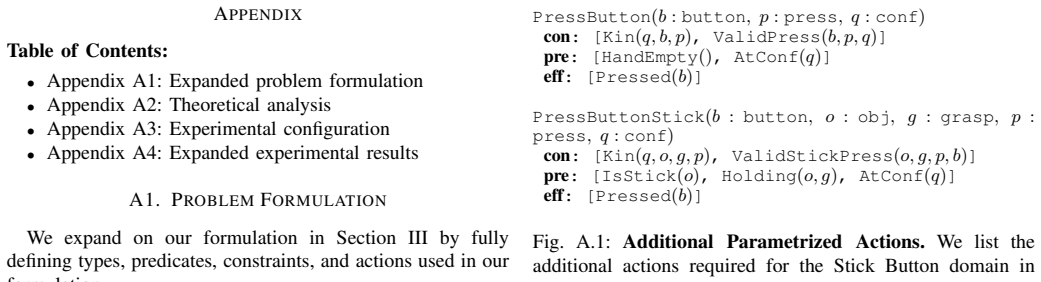
- [Appendix A1] In the action list, MoveFree has signature 'MoveFree(q1, q2: conf, tau: conf)', but the parameter tau should have type 'traj', as in Listing 1.
- [Figure 10 caption] The caption contains garbled text ('Pick Lego1 Pick /u1F353'); please replace it with the intended object names.
- [Section VIII-C] The sentence 'Only 0.3% of the optimized particles are satisfying' is only meaningful relative to a specific batch size and optimization budget; please state the configuration to which this percentage refers.
- [Section VIII-C] The main text does not mention that the Optuna objective was the average number of satisfying particles over three runs; adding one sentence in Section VIII-C would improve reproducibility.
Circularity Check
No significant circularity: the central claims are empirical benchmark results validated against external baselines; the Optuna weight dependence is disclosed and does not reduce the claim to a fit.
full rationale
cuTAMP is an empirical systems contribution, so its central claims (first GPU-parallelized TAMP planner; solves highly constrained problems in seconds) are supported by benchmark comparisons against external baselines (SAMPLING, OPTIMIZATION) across five domains and by real-robot deployments, not by a derivation that reduces to its inputs. The key logical separation is between the penalty objective of Eq. (2) and the satisfaction test of Eq. (3): the paper reports that only 0.3% of optimized particles are satisfying on Tetris, which would be impossible if satisfying solutions were produced by construction; this directly rules out the self-definitional pattern. The Optuna tuning in Section VIII-C is fully disclosed: tuned weights are reported in a separate 'cuTAMP Tuned' row, the untuned default-weight results appear in the same Table IV (50/50 coverage at Nb=4096, 12.21 s), and Section IX and Appendix Table A.2 explicitly acknowledge sensitivity to the weights and their poor transfer to Bookshelf. That is a transparency-and-robustness concern, not a fitted parameter renamed as a prediction. The probabilistic completeness proof in Appendix A2 is a standard self-contained saturation argument whose conclusion follows from the stated robust-feasibility assumption (positive-measure solution sets), and it invokes no unverified self-citation. Citations to cuRobo [17], PDDLStream [7], and related prior work are engineering and methodological reuse of externally validated results by overlapping authors; none is load-bearing for the empirical speedup claims. No circular step is present.
Assumptions & free parameters
free parameters (5)
- Cost weights lambda_c in Eq. (2) =
Defaults: 1.0 for most constraints, 5.0 for kinematic rotation, 2.0 for stable placement; Optuna-tuned for Tetris…
- Adam learning rate =
Not reported numerically in main text; fixed across experiments
- Constraint tolerances epsilon_c in Eq. (3) =
Collision 1 mm, self-collision 0, kinematics 5 mm and 0.05 rad, joint limits 0, stable placement 1 cm/1 mm
- Particle batch size N_b =
Swept from 1 to 8192
- Optimization steps and time budgets =
1000 optimization steps for cuTAMP; 5-10 second resampling/optimization budgets for baselines
assumptions (4)
- domain assumption Constraint functions J_c are differentiable and equality constraints have full-rank Jacobians, so solution sets are lower-dimensional submanifolds.
- domain assumption Robust feasibility holds: the set of satisfying parameter values has positive measure and sampling has positive probability density over the parameter space.
- domain assumption cuRobo's sphere-based collision checking and kinematics models provide sufficiently accurate gradients for optimization to reach satisfying solutions.
- ad hoc to paper The plan feasibility heuristic H(pi, P) in Eq. (5) correlates with true skeleton feasibility and correctly prioritizes skeletons.
Cite this review
Pith. "Pith review of Differentiable GPU-Parallelized Task and Motion Planning." pith.science (2026). https://pith.science/paper/UJ5UKOH7
@misc{pith2026241111833,
  author       = {Pith},
  title        = {Pith review of: Differentiable GPU-Parallelized Task and Motion Planning},
  year         = {2026},
  howpublished = {\url{https://pith.science/paper/UJ5UKOH7}},
  note         = {Machine review of arXiv:2411.11833}
}
read the original abstract
Planning long-horizon robot manipulation requires making discrete decisions about which objects to interact with and continuous decisions about how to interact with them. A robot planner must select grasps, placements, and motions that are feasible and safe. This class of problems falls under Task and Motion Planning (TAMP) and poses significant computational challenges in terms of algorithm runtime and solution quality, particularly when the solution space is highly constrained. To address these challenges, we propose a new bilevel TAMP algorithm that leverages GPU parallelism to efficiently explore thousands of candidate continuous solutions simultaneously. Our approach uses GPU parallelism to sample an initial batch of solution seeds for a plan skeleton and to apply differentiable optimization on this batch to satisfy plan constraints and minimize solution cost with respect to soft objectives. We demonstrate that our algorithm can effectively solve highly constrained problems with non-convex constraints in just seconds, substantially outperforming serial TAMP approaches, and validate our approach on multiple real-world robots. Project website and code: https://cutamp.github.io
Figures


Figures from the paper (4 more)



Forward citations
Cited by 1 Pith paper
-
TiPToP: A Modular Open-Vocabulary Robot Manipulation System That Plans
TiPToP, a zero-training modular planner using pretrained vision-language models and GPU-accelerated TAMP, achieves 74.6% success over 165 trials versus 52.4% for the 350-hour-trained pi0.5-DROID baseline across 28 man...
Reference graph
Works this paper leans on
-
[1]
Integrated Task and Motion Planning
Caelan Reed Garrett, Rohan Chitnis, Rachel Holladay, Beomjoon Kim, Tom Silver, Leslie Pack Kaelbling, and Tom ´as Lozano-P ´erez. Integrated Task and Motion Planning. Annual Review of Control, Robotics, and Autonomous Systems, 2021
work page 2021
-
[2]
Garrett, Tom ´as Lozano-P ´erez, and Leslie P
Caelan R. Garrett, Tom ´as Lozano-P ´erez, and Leslie P. Kaelbling. PDDLStream: Integrating Symbolic Planners and Blackbox Samplers. In ICAPS, 2020
work page 2020
-
[3]
Cooper- ative task and motion planning for multi-arm assembly systems
Jingkai Chen, Jiaoyang Li, Yijiang Huang, Caelan Gar- rett, Dawei Sun, Chuchu Fan, Andreas Hofmann, Caitlin Mueller, Sven Koenig, and Brian C Williams. Cooper- ative task and motion planning for multi-arm assembly systems. arXiv preprint arXiv:2203.02475 , 2022
arXiv 2022
-
[4]
Sequence-based plan feasibility prediction for efficient task and motion planning
Zhutian Yang, Caelan Reed Garrett, Tom ´as Lozano- P´erez, Leslie Kaelbling, and Dieter Fox. Sequence-based plan feasibility prediction for efficient task and motion planning. arXiv preprint arXiv:2211.01576 , 2022
arXiv 2022
-
[5]
Hierar- chical task and motion planning in the now
Leslie Pack Kaelbling and Tom ´as Lozano-P´erez. Hierar- chical task and motion planning in the now. In2011 IEEE International Conference on Robotics and Automation , pages 1470–1477. IEEE, 2011
2011
-
[6]
Combined task and motion planning through an extensible planner- independent interface layer
Siddharth Srivastava, Eugene Fang, Lorenzo Riano, Ro- han Chitnis, Stuart Russell, and Pieter Abbeel. Combined task and motion planning through an extensible planner- independent interface layer. In 2014 IEEE international conference on robotics and automation (ICRA) , pages 639–646. IEEE, 2014
2014
-
[7]
Sampling-based methods for factored task and motion planning
Caelan Reed Garrett, Tom ´as Lozano-P ´erez, and Leslie Pack Kaelbling. Sampling-based methods for factored task and motion planning. IJRR, 37(13-14), 2018
work page 2018
-
[8]
Asymptotically optimal planning under piecewise-analytic constraints
William Vega-Brown and Nicholas Roy. Asymptotically optimal planning under piecewise-analytic constraints. In Algorithmic Foundations of Robotics XII: Proceedings of the Twelfth Workshop on the Algorithmic Foundations of Robotics, pages 528–543. Springer, 2020
work page 2020
Show all 58 references
-
[9]
Dimsam: Diffusion models as samplers for task and motion planning under partial observability
Xiaolin Fang, Caelan Reed Garrett, Clemens Eppner, Tom´as Lozano-P ´erez, Leslie Pack Kaelbling, and Dieter Fox. Dimsam: Diffusion models as samplers for task and motion planning under partial observability. arXiv preprint arXiv:2306.13196, 2023
2023 arXiv
-
[10]
Tenenbaum, Tom ´as Lozano-P ´erez, and Leslie Pack Kaelbling
Zhutian Yang, Jiayuan Mao, Yilun Du, Jiajun Wu, Joshua B. Tenenbaum, Tom ´as Lozano-P ´erez, and Leslie Pack Kaelbling. Compositional Diffusion-Based Continuous Constraint Solvers. In CoRL, 2023
2023
-
[11]
A sur- vey of optimization-based task and motion planning: From classical to learning approaches
Zhigen Zhao, Shuo Chen, Yan Ding, Ziyi Zhou, Shiqi Zhang, Danfei Xu, and Ye Zhao. A sur- vey of optimization-based task and motion planning: From classical to learning approaches. arXiv preprint arXiv:2404.02817, 2024
2024 arXiv
-
[12]
Fast motion planning by parallel processing–a review
Dominik Henrich. Fast motion planning by parallel processing–a review. Journal of Intelligent and Robotic Systems, 20:45–69, 1997
1997
-
[13]
Lozano-Perez and P.A
T. Lozano-Perez and P.A. O’Donnell. Parallel robot mo- tion planning. In Proceedings. 1991 IEEE International Conference on Robotics and Automation , pages 1000– 1007 vol.2, 1991. doi: 10.1109/ROBOT.1991.131722
1991
-
[14]
Motions in microseconds via vectorized sampling-based planning
Wil Thomason, Zachary Kingston, and Lydia E Kavraki. Motions in microseconds via vectorized sampling-based planning. In 2024 IEEE International Conference on Robotics and Automation (ICRA) , pages 8749–8756. IEEE, 2024
2024
-
[15]
High-dimensional planning on the gpu
Joseph T Kider, Mark Henderson, Maxim Likhachev, and Alla Safonova. High-dimensional planning on the gpu. In 2010 IEEE International Conference on Robotics and Automation, pages 2515–2522. IEEE, 2010
2010
-
[16]
Gpu-based parallel colli- sion detection for fast motion planning
Jia Pan and Dinesh Manocha. Gpu-based parallel colli- sion detection for fast motion planning. The International Journal of Robotics Research , 31(2):187–200, 2012
2012
-
[17]
Curobo: Parallelized collision-free robot motion generation
Balakumar Sundaralingam, Siva Kumar Sastry Hari, Adam Fishman, Caelan Garrett, Karl Van Wyk, Valts Blukis, Alexander Millane, Helen Oleynikova, Ankur Handa, Fabio Ramos, et al. Curobo: Parallelized collision-free robot motion generation. In 2023 IEEE International Conference o...
2023
-
[18]
Probabilistic roadmaps for path planning in high-dimensional configuration spaces
Lydia E Kavraki, Petr Svestka, J-C Latombe, and Mark H Overmars. Probabilistic roadmaps for path planning in high-dimensional configuration spaces. IEEE transac- tions on Robotics and Automation , 12(4):566–580, 1996
1996
-
[19]
Ffrob: Leveraging symbolic planning for efficient task and motion planning
Caelan Reed Garrett, Tomas Lozano-Perez, and Leslie Pack Kaelbling. Ffrob: Leveraging symbolic planning for efficient task and motion planning. The International Journal of Robotics Research , 37(1): 104–136, 2018
2018
-
[20]
An incremental constraint-based framework for task and motion planning
Neil T Dantam, Zachary K Kingston, Swarat Chaudhuri, and Lydia E Kavraki. An incremental constraint-based framework for task and motion planning. IJRR, 37(10), 2018
2018
-
[21]
Randomized multi-modal motion planning for a humanoid robot ma- nipulation task
Kris Hauser and Victor Ng-Thow-Hing. Randomized multi-modal motion planning for a humanoid robot ma- nipulation task. The International Journal of Robotics Research, 30(6):678–698, 2011
2011
-
[22]
Learning to search in task and motion planning with streams
Mohamed Khodeir, Ben Agro, and Florian Shkurti. Learning to search in task and motion planning with streams. IEEE Robotics and Automation Letters , 8(4): 1983–1990, 2023
1983
-
[23]
Ex- tended tree search for robot task and motion planning
Tianyu Ren, Georgia Chalvatzaki, and Jan Peters. Ex- tended tree search for robot task and motion planning. In 2024 IEEE/RSJ International Conference on Intelligent Robots and Systems (IROS) , pages 12048–12055. IEEE, 2024
2024
-
[24]
Nlp sampling: Combining mcmc and nlp meth- ods for diverse constrained sampling
Marc Toussaint, Cornelius V Braun, and Joaquim Ortiz- Haro. Nlp sampling: Combining mcmc and nlp meth- ods for diverse constrained sampling. arXiv preprint arXiv:2407.03035, 2024
2024
-
[25]
Stamp: Differentiable task and motion planning via stein variational gradient descent
Yewon Lee, Philip Huang, Krishna Murthy Jatavallab- hula, Andrew Z Li, Fabian Damken, Eric Heiden, Kevin Smith, Derek Nowrouzezahrai, Fabio Ramos, and Florian Shkurti. Stamp: Differentiable task and motion planning via stein variational gradient descent. arXiv preprint arXiv:2...
-
[26]
Sampling-Based Robot Task and Motion Planning in the Real World
Caelan Reed Garrett. Sampling-Based Robot Task and Motion Planning in the Real World . PhD thesis, Mas- sachusetts Institute of Technology, 2021
2021
-
[27]
Optimal grasps and placements for task and motion planning in clutter
Carlos Quintero-Pena, Zachary Kingston, Tianyang Pan, Rahul Shome, Anastasios Kyrillidis, and Lydia E Kavraki. Optimal grasps and placements for task and motion planning in clutter. In 2023 IEEE International Conference on Robotics and Automation (ICRA) , pages 3707–3713. IEEE, 2023
2023
-
[28]
Smc: Satisfiability modulo convex optimiza- tion
Yasser Shoukry, Pierluigi Nuzzo, Alberto L Sangiovanni- Vincentelli, Sanjit A Seshia, George J Pappas, and Paulo Tabuada. Smc: Satisfiability modulo convex optimiza- tion. In Proceedings of the 20th international conference on hybrid systems: Computation and control , pages 19...
2017
-
[29]
Smc: Satisfiability modulo convex program- ming
Yasser Shoukry, Pierluigi Nuzzo, Alberto L Sangiovanni- Vincentelli, Sanjit A Seshia, George J Pappas, and Paulo Tabuada. Smc: Satisfiability modulo convex program- ming. Proceedings of the IEEE , 106(9):1655–1679, 2018
2018
-
[30]
ScottyActivity: mixed discrete-continuous plan- ning with convex optimization
Enrique Fern ´andez-Gonz´alez, Brian Williams, and Erez Karpas. ScottyActivity: mixed discrete-continuous plan- ning with convex optimization. Journal of Artificial Intelligence Research, 62:579–664, 2018
2018
-
[31]
Optimal constrained task planning as mixed integer programming
Alphonsus Adu-Bredu, Nikhil Devraj, and Odest Chad- wicke Jenkins. Optimal constrained task planning as mixed integer programming. In 2022 IEEE/RSJ Inter- national Conference on Intelligent Robots and Systems (IROS), pages 12029–12036. IEEE, 2022
2022
-
[32]
Sequential Quadratic Programming for Task Plan Optimization
Dylan Hadfield-Menell, Christopher Lin, Rohan Chitnis, Stuart Russell, and Pieter Abbeel. Sequential Quadratic Programming for Task Plan Optimization. In Intelligent Robots and Systems (IROS), 2016 IEEE/RSJ Interna- tional Conference on , pages 5040–5047. IEEE, 2016
2016
-
[33]
Newton methods for k-order markov constrained motion problems
Marc Toussaint. Newton methods for k-order markov constrained motion problems. arXiv preprint arXiv:1407.0414, 2014
2014 arXiv
-
[34]
Logic-geometric programming: an optimization-based approach to combined task and mo- tion planning
Marc Toussaint. Logic-geometric programming: an optimization-based approach to combined task and mo- tion planning. In IJCAI, 2015
2015
-
[35]
Differentiable physics and stable modes for tool-use and manipulation planning
Marc Toussaint, Kelsey Allen, Kevin Smith, and Joshua Tenenbaum. Differentiable physics and stable modes for tool-use and manipulation planning. In Proceedings of Robotics: Science and Systems, Pittsburgh, Pennsylvania, June 2018. doi: 10.15607/RSS.2018.XIV .044
2018 doi
-
[36]
A conflict-driven interface between sym- bolic planning and nonlinear constraint solving
Joaquim Ortiz-Haro, Erez Karpas, Michael Katz, and Marc Toussaint. A conflict-driven interface between sym- bolic planning and nonlinear constraint solving. IEEE RA-L, 7(4), 2022
2022
-
[37]
Conflict-directed diverse planning for logic-geometric programming
Joaquim Ortiz-Haro, Erez Karpas, Marc Toussaint, and Michael Katz. Conflict-directed diverse planning for logic-geometric programming. ICAPS, 2022
2022
-
[38]
Sydebo: Symbolic-decision-embedded bilevel optimiza- tion for long-horizon manipulation in dynamic environ- ments
Zhigen Zhao, Ziyi Zhou, Michael Park, and Ye Zhao. Sydebo: Symbolic-decision-embedded bilevel optimiza- tion for long-horizon manipulation in dynamic environ- ments. IEEE Access, 9:128817–128826, 2021
2021
-
[39]
PDDL: The Planning Domain Defi- nition Language
Drew McDermott, Malik Ghallab, Adele Howe, Craig Knoblock, Ashwin Ram, Manuela Veloso, Daniel Weld, and David Wilkins. PDDL: The Planning Domain Defi- nition Language. Technical report, Yale Center for Com- putational Vision and Control, 1998. URL https://www. cs.cmu.edu/∼mmv/...
1998
-
[40]
Adam: A method for stochastic optimization
Diederik P Kingma and Jimmy Ba. Adam: A method for stochastic optimization. arXiv preprint arXiv:1412.6980, 2014
2014 arXiv
-
[41]
Constrained differential op- timization
John Platt and Alan Barr. Constrained differential op- timization. In Neural Information Processing Systems , 1987
1987
-
[42]
A differentiable augmented lagrangian method for bilevel nonlinear optimization
Benoit Landry, Zachary Manchester, and Marco Pavone. A differentiable augmented lagrangian method for bilevel nonlinear optimization. arXiv preprint arXiv:1902.03319, 2019
1902 arXiv
-
[43]
Probabilistic inference of simulation parameters via parallel differ- entiable simulation
Eric Heiden, Christopher E Denniston, David Millard, Fabio Ramos, and Gaurav S Sukhatme. Probabilistic inference of simulation parameters via parallel differ- entiable simulation. In 2022 International Conference on Robotics and Automation (ICRA) , pages 3638–3645. IEEE, 2022
2022
-
[44]
Coordinate descent algorithms
Stephen J Wright. Coordinate descent algorithms. Math- ematical programming, 151(1):3–34, 2015
2015
-
[45]
On the limited memory bfgs method for large scale optimization
Dong C Liu and Jorge Nocedal. On the limited memory bfgs method for large scale optimization. Mathematical programming, 45(1):503–528, 1989
1989
-
[46]
Pytorch: An imperative style, high-performance deep learning library
Adam Paszke, Sam Gross, Francisco Massa, Adam Lerer, James Bradbury, Gregory Chanan, Trevor Killeen, Zem- ing Lin, Natalia Gimelshein, Luca Antiga, et al. Pytorch: An imperative style, high-performance deep learning library. Advances in neural information processing systems, 32, 2019
2019
-
[47]
Diffusionseeder: Seeding motion optimiza- tion with diffusion for rapid motion planning
Huang Huang, Balakumar Sundaralingam, Arsalan Mousavian, Adithyavairavan Murali, Ken Goldberg, and Dieter Fox. Diffusionseeder: Seeding motion optimiza- tion with diffusion for rapid motion planning. arXiv preprint arXiv:2410.16727, 2024
-
[48]
Optuna: A next-generation hyperparameter optimization framework
Takuya Akiba, Shotaro Sano, Toshihiko Yanase, Takeru Ohta, and Masanori Koyama. Optuna: A next-generation hyperparameter optimization framework. In Proceedings of the 25th ACM SIGKDD international conference on knowledge discovery & data mining , pages 2623–2631, 2019
2019
-
[49]
Long- horizon manipulation of unknown objects via task and motion planning with estimated affordances
Aidan Curtis, Xiaolin Fang, Leslie Pack Kaelbling, Tom´as Lozano-P ´erez, and Caelan Reed Garrett. Long- horizon manipulation of unknown objects via task and motion planning with estimated affordances. In ICRA, 2022
2022
-
[50]
Cud@ sat: Sat solving on gpus
Alessandro Dal Pal `u, Agostino Dovier, Andrea Formisano, and Enrico Pontelli. Cud@ sat: Sat solving on gpus. Journal of Experimental & Theoretical Artificial Intelligence, 27(3):293–316, 2015
2015
-
[51]
Planning as satis- fiability
Henry A Kautz, Bart Selman, et al. Planning as satis- fiability. In ECAI, volume 92, pages 359–363. Citeseer, 1992
1992
-
[52]
Inte- grated task and motion planning in belief space
Leslie Pack Kaelbling and Tom ´as Lozano-P ´erez. Inte- grated task and motion planning in belief space. The International Journal of Robotics Research , 32(9-10): 1194–1227, 2013
2013
-
[53]
Online replanning in belief space for partially observable task and motion problems
Caelan Reed Garrett, Chris Paxton, Tom ´as Lozano-P´erez, Leslie Pack Kaelbling, and Dieter Fox. Online replanning in belief space for partially observable task and motion problems. In 2020 IEEE International Conference on Robotics and Automation (ICRA) , pages 5678–5684. IEEE, 2020
2020
-
[54]
Decidability of semi-holonomic prehen- sile task and motion planning
Ashwin Deshpande, Leslie Pack Kaelbling, and Tomas Lozano-Perez. Decidability of semi-holonomic prehen- sile task and motion planning. In Algorithmic Foun- dations of Robotics XII: Proceedings of the Twelfth Workshop on the Algorithmic Foundations of Robotics , pages 544–559. ...
2020
-
[55]
Task and motion planning is pspace-complete
William Vega-Brown and Nicholas Roy. Task and motion planning is pspace-complete. In Proceedings of the AAAI Conference on Artificial Intelligence , volume 34, pages 10385–10392, 2020
2020
-
[56]
Sampling-based methods for motion planning with con- straints
Zachary Kingston, Mark Moll, and Lydia E Kavraki. Sampling-based methods for motion planning with con- straints. Annual review of control, robotics, and au- tonomous systems, 1(1):159–185, 2018
2018
-
[57]
Tree-structured parzen estimator: Understanding its algorithm components and their roles for better empirical performance
Shuhei Watanabe. Tree-structured parzen estimator: Understanding its algorithm components and their roles for better empirical performance. arXiv preprint arXiv:2304.11127, 2023
2023 arXiv
-
[58]
b *h 4 4
Nikolaus Hansen. The cma evolution strategy: A tutorial. arXiv preprint arXiv:1604.00772 , 2016. APPENDIX Table of Contents: • Appendix A1: Expanded problem formulation • Appendix A2: Theoretical analysis • Appendix A3: Experimental configuration • Appendix A4: Expanded experi...
2016 arXiv
Reviewed August 12, 2026 · model on record in the stance chip above.
Discussion (0). Continue with ORCID to comment.