MVG-KAN: Multi-View Geo-Wind Guided KAN for PM_(2.5) Forecasting
Pith reviewed 2026-06-25 23:58 UTC · model grok-4.3
The pith
MVG-KAN forecasts PM2.5 by separating periodic cycles, station residuals, and wind-guided pollutant transport across monitoring stations.
A machine-rendered reading of the paper's core claim, the machinery that carries it, and where it could break.
Core claim
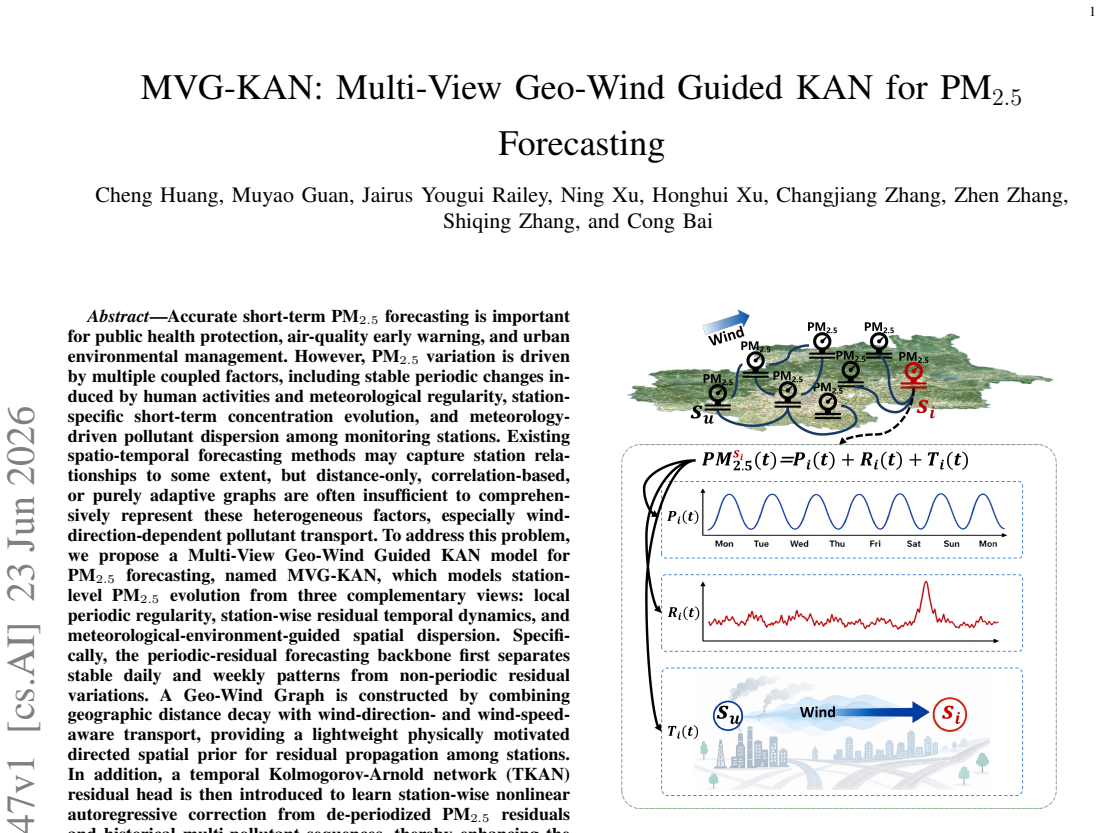
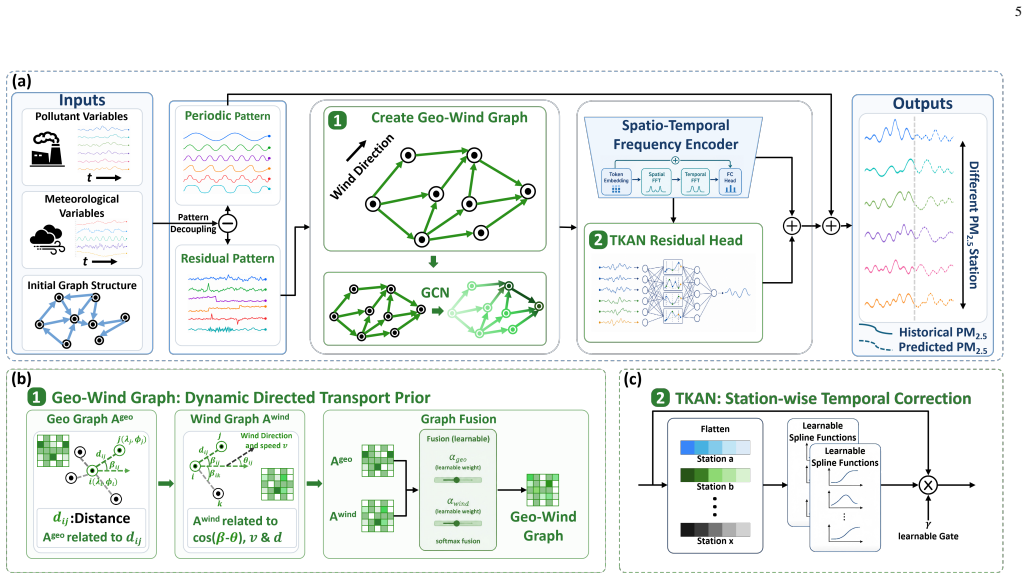
The MVG-KAN model models station-level PM2.5 evolution from three complementary views: local periodic regularity, station-wise residual temporal dynamics, and meteorological-environment-guided spatial dispersion. A periodic-residual forecasting backbone separates stable daily and weekly patterns from non-periodic residuals. A Geo-Wind Graph is built from geographic distance decay combined with wind-direction and wind-speed aware transport to supply a directed spatial prior. A temporal KAN residual head then learns station-wise nonlinear autoregressive corrections from the de-periodized residuals and historical multi-pollutant sequences.
What carries the argument
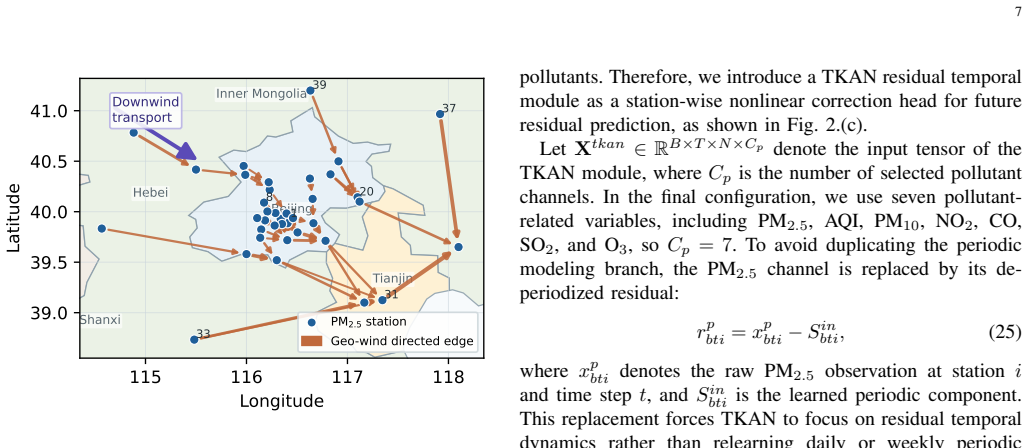
The Geo-Wind Graph, which combines geographic distance decay with wind-direction- and wind-speed-aware transport to supply a physically motivated directed spatial prior for residual propagation among stations.
If this is right
- The periodic-residual backbone isolates stable daily and weekly patterns so that the remaining model focuses only on non-periodic evolution.
- The Geo-Wind Graph supplies a lightweight physically motivated directed spatial prior instead of purely data-driven or distance-only connections.
- The temporal KAN residual head learns station-wise nonlinear autoregressive corrections from de-periodized PM2.5 and multi-pollutant histories.
- Overall the three-view design addresses heterogeneous drivers that distance-only or correlation-based graphs miss.
Where Pith is reading between the lines
- The same wind-weighted graph construction could be tried on other transported pollutants such as NO2 or ozone if the underlying dispersion physics is similar.
- Performance on networks with sparse stations or complex topography would test whether the distance-plus-wind rule remains sufficient without additional terrain terms.
- The periodic-residual split might allow the model to be retrained on new cities with only a short data window once the periodic component is estimated.
Load-bearing premise
Combining geographic distance decay with wind-direction- and wind-speed-aware transport produces a directed spatial prior that correctly represents how pollutants actually disperse between stations.
What would settle it
A controlled test in which the wind-direction and wind-speed terms are removed from the graph while keeping distance fixed, then measuring whether forecast error on held-out stations rises measurably when real wind transport events are present in the data.
Figures
read the original abstract
Accurate short-term PM$_{2.5}$ forecasting is important for public health protection, air-quality early warning, and urban environmental management. However, PM$_{2.5}$ variation is driven by multiple coupled factors, including stable periodic changes induced by human activities and meteorological regularity, station-specific short-term concentration evolution, and meteorology-driven pollutant dispersion among monitoring stations. Existing spatio-temporal forecasting methods may capture station relationships to some extent, but distance-only, correlation-based, or purely adaptive graphs are often insufficient to comprehensively represent these heterogeneous factors, especially wind-direction-dependent pollutant transport. To address this problem, we propose a Multi-View Geo-Wind Guided KAN model for PM$_{2.5}$ forecasting, named \textbf{MVG-KAN}, which models station-level PM$_{2.5}$ evolution from three complementary views: local periodic regularity, station-wise residual temporal dynamics, and meteorological-environment-guided spatial dispersion. Specifically, the periodic-residual forecasting backbone first separates stable daily and weekly patterns from non-periodic residual variations. A Geo-Wind Graph is constructed by combining geographic distance decay with wind-direction- and wind-speed-aware transport, providing a lightweight physically motivated directed spatial prior for residual propagation among stations. In addition, a temporal Kolmogorov-Arnold network (TKAN) residual head is then introduced to learn station-wise nonlinear autoregressive correction from de-periodized PM$_{2.5}$ residuals and historical multi-pollutant sequences, thereby enhancing the modeling of local residual inertia and pollutant co-variation.
Editorial analysis
A structured set of objections, weighed in public.
Referee Report
Summary. The manuscript proposes MVG-KAN for short-term PM2.5 forecasting. It decomposes the problem into three views via a periodic-residual backbone that isolates stable daily/weekly patterns, a Geo-Wind Graph that encodes directed spatial dispersion by combining geographic distance decay with wind-direction and wind-speed terms, and a TKAN residual head that performs station-wise nonlinear autoregressive correction on de-periodized residuals and multi-pollutant histories.
Significance. If the empirical results support the claims, the work would demonstrate a lightweight, physically motivated spatial prior that improves upon distance-only or purely adaptive graphs for pollutant transport modeling, with potential applicability to other environmental spatio-temporal tasks. The explicit separation of periodic, residual-temporal, and geo-wind components offers a structured alternative to monolithic graph neural forecasters.
major comments (2)
- [Abstract] Abstract (paragraph on Geo-Wind Graph): the assertion that combining distance decay with wind-direction- and wind-speed-aware transport yields a 'physically motivated directed spatial prior' for pollutant dispersion is load-bearing for the multi-view complementarity claim, yet the manuscript supplies no comparison against established dispersion models (Gaussian plume, CFD), no sensitivity analysis on wind-data quality or topography, and no ablation isolating the wind terms versus pure distance.
- [Abstract] Abstract (overall): no quantitative results, baselines, error bars, or ablation tables are referenced, so it is impossible to determine whether the three views are in fact complementary or whether the TKAN head and Geo-Wind Graph deliver measurable gains over simpler periodic-residual or distance-graph baselines.
minor comments (2)
- [Abstract] Notation for the Geo-Wind Graph edge weights and the TKAN residual head is introduced only descriptively; explicit equations or pseudocode would clarify the precise functional form of the wind-aware transport term.
- [Abstract] The term 'TKAN residual head' is introduced without prior definition or reference; a brief expansion on how the Kolmogorov-Arnold network is adapted for the temporal residual task would aid readability.
Simulated Author's Rebuttal
We thank the referee for the constructive feedback on our manuscript. We agree that the abstract should more clearly convey the empirical support for the proposed components and will revise it to reference key results and moderate certain claims. We address each major comment below.
read point-by-point responses
-
Referee: [Abstract] Abstract (paragraph on Geo-Wind Graph): the assertion that combining distance decay with wind-direction- and wind-speed-aware transport yields a 'physically motivated directed spatial prior' for pollutant dispersion is load-bearing for the multi-view complementarity claim, yet the manuscript supplies no comparison against established dispersion models (Gaussian plume, CFD), no sensitivity analysis on wind-data quality or topography, and no ablation isolating the wind terms versus pure distance.
Authors: We acknowledge that the manuscript does not contain direct comparisons to Gaussian plume or CFD models, nor sensitivity analyses on wind-data quality or topography; such analyses would require high-resolution simulation setups and datasets outside the scope of this short-term forecasting study. The Geo-Wind Graph is presented as a lightweight directed prior that incorporates wind information for directional transport rather than a full physical dispersion simulator. The full paper does include an ablation isolating the wind-direction and wind-speed terms versus distance-only (Section 4.3, Table 5). We will revise the abstract to reference this ablation result and rephrase the claim as 'a directed spatial prior informed by geographic distance and wind data' to avoid overstatement. revision: partial
-
Referee: [Abstract] Abstract (overall): no quantitative results, baselines, error bars, or ablation tables are referenced, so it is impossible to determine whether the three views are in fact complementary or whether the TKAN head and Geo-Wind Graph deliver measurable gains over simpler periodic-residual or distance-graph baselines.
Authors: We agree that the current abstract does not reference quantitative results. The full manuscript reports extensive experiments including multiple baselines, error bars from repeated runs, and ablation tables demonstrating complementarity of the periodic-residual backbone, Geo-Wind Graph, and TKAN head (Tables 2–5 and Figures 3–4). We will revise the abstract to include concise quantitative highlights (e.g., relative MAE/RMSE reductions) with pointers to the experimental sections. revision: yes
Circularity Check
No circularity: model construction uses explicit external inputs without self-referential reduction
full rationale
The provided abstract and description define the Geo-Wind Graph explicitly as a combination of geographic distance decay plus wind-direction/speed terms, presented as an input prior rather than a fitted or self-defined quantity. No equations, parameter fits, or predictions are shown that reduce by construction to the same inputs (e.g., no fitted scale renamed as prediction). No self-citations are invoked as load-bearing uniqueness theorems. The three-view separation is an architectural choice with independent content from the stated meteorological priors, making the derivation self-contained against external data sources.
Axiom & Free-Parameter Ledger
axioms (2)
- domain assumption Stable daily and weekly patterns can be separated from non-periodic residual variations in PM2.5 time series.
- domain assumption Wind-direction and wind-speed data provide a useful physical prior for pollutant transport between stations.
invented entities (2)
-
Geo-Wind Graph
no independent evidence
-
TKAN residual head
no independent evidence
Reference graph
Works this paper leans on
-
[1]
Health effects of fine particulate air pollution: Lines that connect,
C. A. Pope and D. W. Dockery, “Health effects of fine particulate air pollution: Lines that connect,”Journal of the Air & Waste Management Association, vol. 56, no. 6, pp. 709–742, 2006
2006
-
[2]
Particulate matter air pollution and cardiovascular disease: An update to the scientific statement from the american heart association,
R. D. Brook, S. Rajagopalan, C. A. Pope, J. R. Brook, A. Bhatnagar, A. V . Diez-Roux, F. Holguin, Y . Hong, R. V . Luepker, M. A. Mittleman, A. Peters, D. Siscovick, S. C. Smith, L. Whitsel, and J. D. Kaufman, “Particulate matter air pollution and cardiovascular disease: An update to the scientific statement from the american heart association,”Circu- lat...
2010
-
[3]
Impaired visibility: The air pollution people see,
N. P. Hyslop, “Impaired visibility: The air pollution people see,” Atmospheric Environment, vol. 43, no. 1, pp. 182–195, 2009
2009
-
[4]
The contribution of outdoor air pollution sources to premature mortality on a global scale,
J. Lelieveld, J. S. Evans, M. Fnais, D. Giannadaki, and A. Pozzer, “The contribution of outdoor air pollution sources to premature mortality on a global scale,”Nature, vol. 525, no. 7569, pp. 367–371, 2015
2015
-
[5]
Real- time air quality forecasting, part i: History, techniques, and current status,
Y . Zhang, M. Bocquet, V . Mallet, C. Seigneur, and A. Baklanov, “Real- time air quality forecasting, part i: History, techniques, and current status,”Atmospheric Environment, vol. 60, pp. 632–655, 2012
2012
-
[6]
Air pollution forecasts: An overview,
L. Bai, J. Wang, X. Ma, and H. Lu, “Air pollution forecasts: An overview,”International Journal of Environmental Research and Public Health, vol. 15, no. 4, p. 780, 2018
2018
-
[7]
P. J. Brockwell and R. A. Davis,Introduction to time series and forecasting. Springer, 2002
2002
-
[8]
U-Air: When urban air quality inference meets big data,
Y . Zheng, F. Liu, and H.-P. Hsieh, “U-Air: When urban air quality inference meets big data,” inProceedings of the 19th ACM SIGKDD International Conference on Knowledge Discovery and Data Mining. Association for Computing Machinery, 2013, pp. 1436–1444
2013
-
[9]
Long short- term memory neural network for air pollutant concentration predictions: Method development and evaluation,
X. Li, L. Peng, X. Yao, S. Cui, Y . Hu, C. You, and T. Chi, “Long short- term memory neural network for air pollutant concentration predictions: Method development and evaluation,”Environmental Pollution, vol. 231, pp. 997–1004, 2017
2017
-
[10]
Deep air learning: Interpolation, prediction, and feature analysis of fine-grained air quality,
Z. Qi, T. Wang, G. Song, W. Hu, X. Li, and Z. Zhang, “Deep air learning: Interpolation, prediction, and feature analysis of fine-grained air quality,” IEEE Transactions on Knowledge and Data Engineering, vol. 30, no. 12, pp. 2285–2297, 2018
2018
-
[11]
Finding structure in time,
J. L. Elman, “Finding structure in time,”Cognitive science, vol. 14, no. 2, pp. 179–211, 1990
1990
-
[12]
Long short-term memory,
S. Hochreiter and J. Schmidhuber, “Long short-term memory,”Neural Computation, vol. 9, no. 8, pp. 1735–1780, 1997
1997
-
[13]
Learning phrase representations using RNN encoder–decoder for statistical machine translation,
K. Cho, B. van Merrienboer, C. Gulcehre, D. Bahdanau, F. Bougares, H. Schwenk, and Y . Bengio, “Learning phrase representations using RNN encoder–decoder for statistical machine translation,” inProceed- ings of the 2014 Conference on Empirical Methods in Natural Language Processing. Association for Computational Linguistics, 2014, pp. 1724– 1734
2014
-
[14]
An empirical evaluation of generic convolutional and recurrent networks for sequence modeling,
S. Bai, J. Z. Kolter, and V . Koltun, “An empirical evaluation of generic convolutional and recurrent networks for sequence modeling,”arXiv preprint arXiv:1803.01271, 2018. [Online]. Available: https://arxiv.org/abs/1803.01271
Pith/arXiv arXiv 2018
-
[15]
Temporal fusion transform- ers for interpretable multi-horizon time series forecasting,
B. Lim, S. O. Arik, N. Loeff, and T. Pfister, “Temporal fusion transform- ers for interpretable multi-horizon time series forecasting,”International Journal of Forecasting, vol. 37, no. 4, pp. 1748–1764, 2021
2021
-
[16]
Informer: Beyond efficient transformer for long sequence time-series forecasting,
H. Zhou, S. Zhang, J. Peng, S. Zhang, J. Li, H. Xiong, and W. Zhang, “Informer: Beyond efficient transformer for long sequence time-series forecasting,” inProceedings of the AAAI Conference on Artificial Intelligence, vol. 35, no. 12, 2021, pp. 11 106–11 115
2021
-
[17]
iTransformer: Inverted transformers are effective for time series forecasting,
Y . Liu, T. Hu, H. Zhang, H. Wu, S. Wang, L. Ma, and M. Long, “iTransformer: Inverted transformers are effective for time series forecasting,” inInternational Conference on Learning Representations,
-
[18]
Available: https://openreview.net/forum?id=JePfAI8fah
[Online]. Available: https://openreview.net/forum?id=JePfAI8fah
-
[19]
Multi-modal cross-attention-guided network for audio-visual quality evaluation via visual saliency and mel-spectrum features,
J. Lin, Y . Cui, C. Fang, B. Pan, C. Pan, G. Jiang, S. Zhang, S. Ma, and Q. Tian, “Multi-modal cross-attention-guided network for audio-visual quality evaluation via visual saliency and mel-spectrum features,”IEEE Transactions on Circuits and Systems for Video Technology, vol. 36, no. 5, pp. 6783–6798, 2026
2026
-
[20]
GeoMAN: Multi- level attention networks for geo-sensory time series prediction,
Y . Liang, S. Ke, J. Zhang, X. Yi, and Y . Zheng, “GeoMAN: Multi- level attention networks for geo-sensory time series prediction,” in Proceedings of the Twenty-Seventh International Joint Conference on Artificial Intelligence, 2018, pp. 3428–3434
2018
-
[21]
Deep distributed fusion network for air quality prediction,
X. Yi, J. Zhang, Z. Wang, T. Li, and Y . Zheng, “Deep distributed fusion network for air quality prediction,” inProceedings of the 24th ACM SIGKDD International Conference on Knowledge Discovery and Data Mining. Association for Computing Machinery, 2018, pp. 965–973
2018
-
[22]
A hybrid model for spatiotempo- ral forecasting of pm2.5 based on graph convolutional neural network and long short-term memory,
Y . Qi, Q. Li, H. Karimian, and D. Liu, “A hybrid model for spatiotempo- ral forecasting of pm2.5 based on graph convolutional neural network and long short-term memory,”Science of the Total Environment, vol. 664, pp. 1–10, 2019
2019
-
[23]
DeepPM2.5: PM2.5 prediction under dynamic and heterogeneous conditions with contrastive learning and spatio-temporal graph convolution,
H. Zheng, C. Huang, Z. Zhang, and S. Zhang, “DeepPM2.5: PM2.5 prediction under dynamic and heterogeneous conditions with contrastive learning and spatio-temporal graph convolution,”IEEE Transactions on Geoscience and Remote Sensing, 2026
2026
-
[24]
Semi-supervised classification with graph convolutional networks,
T. N. Kipf and M. Welling, “Semi-supervised classification with graph convolutional networks,” inInternational Conference on Learning Representations, 2017. [Online]. Available: https://openreview.net/ forum?id=SJU4ayYgl
2017
-
[25]
Graph attention networks,
P. Velickovic, G. Cucurull, A. Casanova, A. Romero, P. Lio, and Y . Bengio, “Graph attention networks,” inInternational Conference on Learning Representations, 2018. [Online]. Available: https: //openreview.net/forum?id=rJXMpikCZ
2018
-
[26]
Diffusion convolutional recurrent neural network: Data-driven traffic forecasting,
Y . Li, R. Yu, C. Shahabi, and Y . Liu, “Diffusion convolutional recurrent neural network: Data-driven traffic forecasting,” inInternational Conference on Learning Representations, 2018. [Online]. Available: https://openreview.net/forum?id=SJiHXGW AZ
2018
-
[27]
Spatio-temporal graph convolutional net- works: A deep learning framework for traffic forecasting,
B. Yu, H. Yin, and Z. Zhu, “Spatio-temporal graph convolutional net- works: A deep learning framework for traffic forecasting,” inProceed- ings of the Twenty-Seventh International Joint Conference on Artificial Intelligence, 2018, pp. 3634–3640
2018
-
[28]
Pm2.5- gnn: A domain knowledge enhanced graph neural network for pm2.5 forecasting,
S. Wang, Y . Li, J. Zhang, Q. Meng, L. Meng, and F. Gao, “Pm2.5- gnn: A domain knowledge enhanced graph neural network for pm2.5 forecasting,” inProceedings of the 28th International Conference on Advances in Geographic Information Systems. Association for Com- puting Machinery, 2020, pp. 163–166
2020
-
[29]
Graph wavenet for deep spatial-temporal graph modeling,
Z. Wu, S. Pan, G. Long, J. Jiang, and C. Zhang, “Graph wavenet for deep spatial-temporal graph modeling,” inProceedings of the Twenty- Eighth International Joint Conference on Artificial Intelligence, 2019, pp. 1907–1913
2019
-
[30]
Autoformer: Decomposition transformers with auto-correlation for long-term series forecasting,
H. Wu, J. Xu, J. Wang, and M. Long, “Autoformer: Decomposition transformers with auto-correlation for long-term series forecasting,” in Advances in Neural Information Processing Systems, vol. 34, 2021, pp. 22 419–22 430. [Online]. Available: https://proceedings.neurips.cc/ paper/2021/hash/bcc0d400288793e8bdcd7c19a8ac0c2b-Abstract.html
2021
-
[31]
Are transformers effective for time series forecasting?
A. Zeng, M. Chen, L. Zhang, and Q. Xu, “Are transformers effective for time series forecasting?”Proceedings of the AAAI Conference on Artificial Intelligence, vol. 37, no. 9, pp. 11 121–11 128, 2023
2023
-
[32]
Hy- perd: Hybrid periodicity decoupling framework for traffic forecasting,
M. Shao, Z. Zhang, Y . Wang, Y . Dai, X. Shen, and X. Wang, “Hy- perd: Hybrid periodicity decoupling framework for traffic forecasting,” Proceedings of the AAAI Conference on Artificial Intelligence, vol. 40, no. 18, pp. 15 689–15 697, 2026
2026
-
[33]
Pm2.5 prediction with a novel multi- step-ahead forecasting model based on dynamic wind field distance,
M. Yang, H. Fan, and K. Zhao, “Pm2.5 prediction with a novel multi- step-ahead forecasting model based on dynamic wind field distance,” International Journal of Environmental Research and Public Health, vol. 16, no. 22, p. 4482, 2019
2019
-
[34]
Forecasting pm2.5 using hybrid graph convolution-based model considering dynamic wind-field to offer the benefit of spatial interpretability,
H. Zhou, F. Zhang, Z. Du, and R. Liu, “Forecasting pm2.5 using hybrid graph convolution-based model considering dynamic wind-field to offer the benefit of spatial interpretability,”Environmental Pollution, vol. 273, p. 116473, 2021
2021
-
[35]
A dual-path dynamic directed graph convolutional network for air quality prediction,
X. Xiao, Z. Jin, S. Wang, J. Xu, Z. Peng, R. Wang, W. Shao, and Y . Hui, “A dual-path dynamic directed graph convolutional network for air quality prediction,”Science of the Total Environment, vol. 827, p. 154298, 2022
2022
-
[36]
Noaa’s hysplit atmospheric transport and dispersion modeling system,
A. F. Stein, R. R. Draxler, G. D. Rolph, B. J. B. Stunder, M. D. Cohen, and F. Ngan, “Noaa’s hysplit atmospheric transport and dispersion modeling system,”Bulletin of the American Meteorological Society, vol. 96, no. 12, pp. 2059–2077, 2015
2059
-
[37]
Estimating long-term pm2.5 concentrations in china using satellite-based aerosol optical depth and a chemical transport model,
G. Geng, Q. Zhang, R. V . Martin, A. van Donkelaar, H. Huo, H. Che, J. Lin, and K. He, “Estimating long-term pm2.5 concentrations in china using satellite-based aerosol optical depth and a chemical transport model,”Remote Sensing of Environment, vol. 166, pp. 262–270, 2015
2015
-
[38]
Es- timating 1-km-resolution pm2.5 concentrations across china using the space-time random forest approach,
J. Wei, W. Huang, Z. Li, W. Xue, Y . Peng, L. Sun, and M. Cribb, “Es- timating 1-km-resolution pm2.5 concentrations across china using the space-time random forest approach,”Remote Sensing of Environment, vol. 231, p. 111221, 2019
2019
-
[39]
A spatial neighborhood deep neural network model for pm2.5 estimation across china,
D. Chen, H. Guo, X. Gu, T. Cheng, J. Yang, Y . Zhan, and X. Wei, “A spatial neighborhood deep neural network model for pm2.5 estimation across china,”IEEE Transactions on Geoscience and Remote Sensing, vol. 61, pp. 1–15, 2023. 13
2023
-
[40]
Artificial neural networks forecasting of pm2.5 pollution using air mass trajectory based geographic model and wavelet transformation,
X. Feng, Q. Li, Y . Zhu, J. Hou, L. Jin, and J. Wang, “Artificial neural networks forecasting of pm2.5 pollution using air mass trajectory based geographic model and wavelet transformation,”Atmospheric Environ- ment, vol. 107, pp. 118–128, 2015
2015
-
[41]
KAN: Kolmogorov–arnold networks,
Z. Liu, Y . Wang, S. Vaidya, F. Ruehle, J. Halverson, M. Soljacic, T. Y . Hou, and M. Tegmark, “KAN: Kolmogorov–arnold networks,” arXiv preprint arXiv:2404.19756, 2024. [Online]. Available: https: //arxiv.org/abs/2404.19756
Pith/arXiv arXiv 2024
-
[42]
Con- necting the dots: Multivariate time series forecasting with graph neural networks,
Z. Wu, S. Pan, G. Long, J. Jiang, X. Chang, and C. Zhang, “Con- necting the dots: Multivariate time series forecasting with graph neural networks,” inProceedings of the 26th ACM SIGKDD International Conference on Knowledge Discovery & Data Mining. Association for Computing Machinery, 2020, pp. 753–763
2020
-
[43]
Dynamic spatial-temporal graph convolutional neural networks for traffic forecast- ing,
Z. Diao, X. Wang, D. Zhang, Y . Liu, K. Xie, and S. He, “Dynamic spatial-temporal graph convolutional neural networks for traffic forecast- ing,” inProceedings of the AAAI Conference on Artificial Intelligence, vol. 33, no. 1, 2019, pp. 890–897
2019
-
[44]
Predicting air quality using a multi-scale spatiotemporal graph attention network,
X. Zhou, J. Wang, J. Wang, and Q. Guan, “Predicting air quality using a multi-scale spatiotemporal graph attention network,”Information Sciences, vol. 680, p. 121072, 2024
2024
discussion (0)
Sign in with ORCID, Apple, or X to comment. Anyone can read and Pith papers without signing in.