REVIEW 3 major objections 7 minor 71 references
Spin-orbital glass transition in a model of a frustrated pyrochlore magnet without quenched disorder
T0 review · 3 major / 7 minor · reviewed 2026-08-14 · deepseek-v4-flash
Pith's one-line read A disorder-free model of the pyrochlore magnet Y2Mo2O7 claims a genuine thermodynamic spin-orbital glass transition, with spins and Jahn-Teller distortions freezing together near T_c ≈ 0.07J.
desk verdict A plausible microscopic route to a disorder-free spin glass in Y2Mo2O7, with a testable dielectric signature; the evidence is strong but the thermodynamic label needs more static finite-size analysis. read the letter →
The pith
A machine-rendered reading of the paper's core claim, the machinery that carries it, and where it could break.
The reading
What carries the argument
The load-bearing object is the coupled Hamiltonian of Eqs. (1)-(2): a pyrochlore-lattice Heisenberg model whose exchange constants are controlled by binary Jahn-Teller displacement variables σ_i, plus an elastic ice-rule term -ε Σ_{<ij>} σ_i·σ_j. The displacements live on an ice-rule manifold of huge degeneracy, and the spins alone are likewise degenerate because of geometrical frustration. The coupling makes the effective exchange felt by each spin depend on the instantaneous distortion pattern, and the effective field felt by each distortion depend on the spin configuration, so neither subsystem is quenched; each continually generates the randomness the other responds to. The model's key observable signatures are the autocorrelation times, which diverge at a common T_c, and the two nonlinear susceptibilities, whose negative divergence identifies glassy freezing in both channels.
What would settle it
An experiment on Y2Mo2O7 measuring the nonlinear dielectric susceptibility χ3^σ across the known spin-glass freezing temperature would settle the central claim: if χ3^σ shows no negative divergence at the same temperature at which the magnetic χ3 diverges, the simultaneous-freezing scenario is wrong. On the numerical side, if longer equilibration or larger lattices show the relaxation times saturating rather than continuing to diverge, the would-be transition is a finite-time crossover.
Extended reading notes
Core claim
The central claim is that the spin-glass transition observed in Y2Mo2O7 can arise from the mutual dynamical coupling of two frustrated degrees of freedom, with no quenched randomness in the Hamiltonian. The model places classical Heisenberg spins S_i on the pyrochlore lattice and assigns each Mo ion a binary in/out displacement σ_i selected by the Jahn-Teller effect; the exchange coupling J_{σ_i,σ_j} = J[1 + δ(\hat{r}_{ij}·σ_i + (-\hat{r}_{ij})·σ_j)] takes different values for in-in, in-out, and out-out bonds, so the spin system sees a time-dependent mixture of ferromagnetic and antiferromagnetic bonds. At parameters δ = 1.5 and ε = 0.6, equilibrium Monte Carlo simulations with dynamical single-spin updates find that the spin and orbital autocorrelation times diverge at the same temperature T_c ≈ 0.07J with different power-law exponents, that neither degree of freedom develops long-range order, and that both the magnetic nonlinear susceptibility χ3 and the dielectric nonlinear susceptibility χ3^σ grow negatively and diverge as the system size increases. The authors conclude that the two subsystems freeze cooperatively, each acting as dynamical disorder for the other, and that the freezing is a thermodynamic transition rather than a crossover.
Load-bearing premise
The argument assumes that the lattice-distortion variables remain thermally active and keep exploring their many equivalent configurations up to and through the claimed transition, so the randomness felt by the spins is generated by the moving distortions themselves; if the distortions effectively froze first, the model would just be a standard quenched-random-bond spin glass.
Editorial extensions
If this is right
- A direct experimental prediction follows: the nonlinear dielectric susceptibility of Y2Mo2O7 should show a negative divergence at the same temperature where its magnetic nonlinear susceptibility diverges.
- The simultaneous freezing implies that the spin-glass state in a clean pyrochlore does not require quenched disorder; the Jahn-Teller distortions play the role of self-generated randomness.
- Because the spin and orbital relaxation times diverge with different power-law exponents at one common T_c, the transition is cooperative rather than caused by one degree of freedom freezing first.
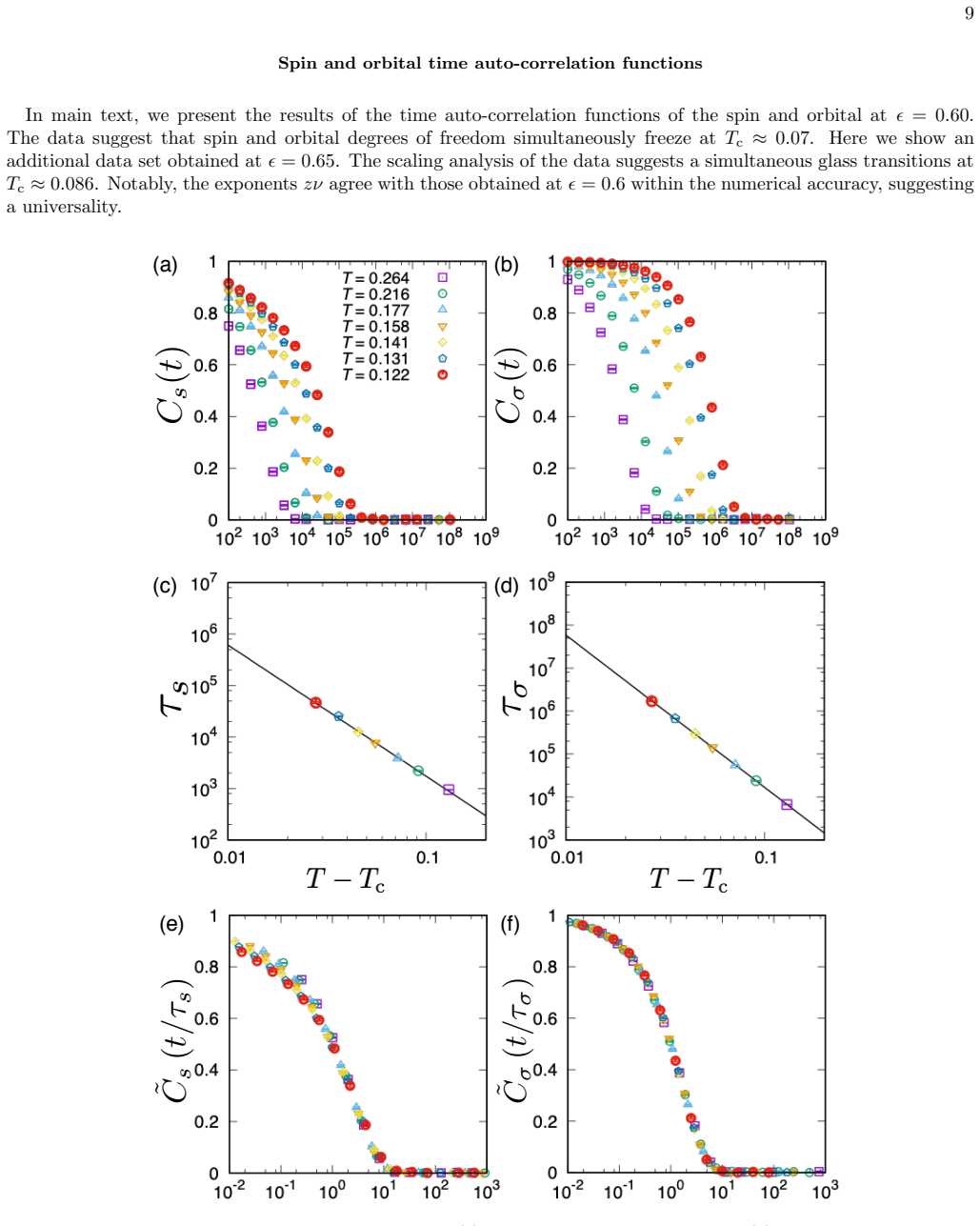
- Varying the elastic energy parameter to ε = 0.65 shifts T_c to roughly 0.086J while leaving the critical exponents essentially unchanged, suggesting a common universality class.
- If instead the distortions froze at a higher temperature, the model would reduce to the known Edwards-Anderson-type random-bond spin glass on the pyrochlore lattice, so the observed divergence pattern is what distinguishes the two scenarios.
Reading between the lines
- A sharper experimental test than the paper states explicitly would be to measure the nonlinear dielectric susceptibility of Y2Mo2O7 across the known spin-glass temperature as a function of frequency: the scenario predicts a strong, frequency-dependent divergence tied to the magnetic transition, whereas an orbital-freezing-first picture predicts no such electric anomaly at that temperature.
- The mechanism suggests a design rule for finding other disorder-free glasses: look for crystals with two frustrated degrees of freedom coupled by a sign-changing interaction; Jahn-Teller-active pyrochlores such as Tb2Mo2O7, mentioned briefly in the paper, are natural candidates for a search for simultaneous magnetic and dielectric glassy anomalies.
- Because the central evidence comes from finite-time Monte Carlo, the most decisive numerical check would be to test whether the divergence survives with systematically longer equilibration and larger system sizes; if relaxation times instead saturate, the would-be transition is a very slow crossover.
- If correct, the result reframes the notion of a glass transition in crystals: thermodynamic glassiness need not be inherited from frozen-in randomness but can emerge from the dynamics of clean frustrated degrees of freedom, motivating a re-examination of other anomalous spin glasses for hidden orbital or lattice degrees of freedom.
Signed reviews
Editorial analysis
A structured set of objections, weighed in public.
Referee Report
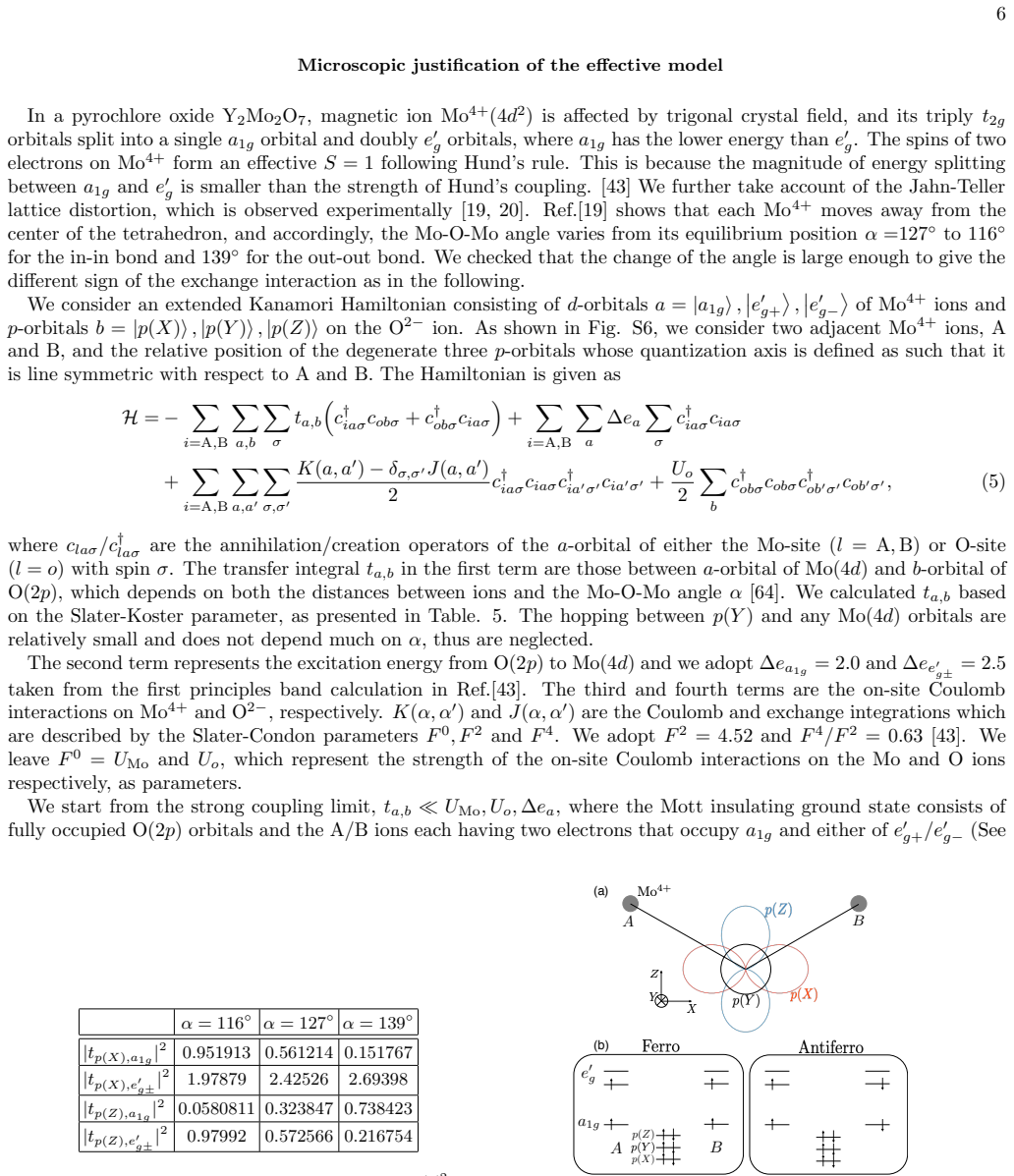
Summary. The paper introduces a disorder-free classical spin-orbital model on the pyrochlore lattice, Eqs. (1)-(2), in which Heisenberg spins S_i are coupled to lattice-displacement/orbital variables σ_i through a σ-dependent exchange constant that can change sign, plus an ice-rule elastic term. Using extensive Monte Carlo simulations with replica exchange, loop updates, and single-spin-flip dynamics, the authors report a power-law divergence of both spin and orbital relaxation times at a common temperature T_c ≈ 0.07 (for ε = 0.6) and at T_c ≈ 0.086 (for ε = 0.65), scaling collapse of the autocorrelation functions, and a negative divergence of both the nonlinear magnetic susceptibility χ3 and the nonlinear dielectric susceptibility χ3^σ. They interpret these results as a simultaneous thermodynamic spin-orbital glass transition, proposing that the two degrees of freedom act as self-generated dynamical disorder for each other, thereby resolving the long-standing puzzle of the disorder-free spin glass in Y2Mo2O7.
Significance. If the central claim holds, this is the first demonstration of a thermodynamic glass transition without quenched disorder in a finite-dimensional periodic lattice, which would be a major conceptual advance. The numerical work is substantial: 120 independent runs for L = 4, 5, 6, 8, replica-exchange equilibration with loop updates, two values of ε, scaling collapse of autocorrelation functions, and the observation of negative diverging nonlinear susceptibilities. The effective exchange interaction is derived from a microscopic Kanamori-type calculation, supporting the realism of the model. The prediction of a diverging nonlinear dielectric susceptibility is a falsifiable experimental signature that could be tested in pyrochlore oxides. The paper is likely to be influential if the thermodynamic interpretation survives scrutiny.
major comments (3)
- [Main text, Fig. 4 and final paragraph] The central claim of a thermodynamic spin-orbital glass transition presumes that the σ variables remain dynamically active at T_c and freeze cooperatively with the spins. The only equilibrium static probe of the σ subsystem is the nonlinear dielectric susceptibility χ3^σ in Fig. 4(b); no spin-glass correlation function or correlation length for the σ variables is presented, and χ3^σ is not analyzed with a finite-size scaling collapse. The authors themselves note in the final paragraph that if the orbitals froze at a higher temperature, the model would reduce to the Edwards-Anderson random-bond Heisenberg model of Refs. [61,62]. To exclude this scenario, please provide a finite-size scaling analysis of χ3 and χ3^σ (e.g., χ3 L^{-γ/ν} versus (T-T_c)L^{1/ν}) with a common T_c, or a static spin-glass correlation function for σ whose correlation length diverges at T_c. Without this, the simultaneous power-law divergence of τ_s and τ_σ, while suggestive, does not by itself distinguish a cooperative glass transition from a conventional quenched-disorder spin glass in which the orbital variables are merely slow.
- [Fig. 2(b,d) and SI] The power-law fits τ = A (T-T_c)^{-zν} for spins and orbitals are based on data at a single system size (L=6 in the main text; L=5 at ε=0.65 in the SI) and involve three free parameters. The text does not specify the temperature range used in the fits, the number of points, or the sensitivity of the fitted T_c to the fitting window. The assertion 'We checked that there is no finite size effect within the time scale which we analyzed' is not documented. Please provide (i) the fit range and residuals, (ii) a table of T_c and zν with and without the lowest-temperature point, and (iii) a finite-size scaling plot of τ(L,T) (e.g., τ L^{-z} versus (T-T_c)L^{1/ν}) using L=4,5,6,8 to demonstrate that the power-law divergence is not an artifact of a single finite system.
- [Fig. 4 and Eqs. (3)-(8)] The conclusion that χ3 and χ3^σ diverge at T_c is based on the visual increase of the magnitude with L in Fig. 4. No scaling collapse or exponent estimates are given, and no direct comparison with the T_c extracted from the dynamics is made. A skeptic could interpret the growth as a finite-size precursor from a growing but finite correlation length. Please perform a scaling collapse of both susceptibilities to verify a divergence at the same T_c, and estimate the exponent γ. If the data range does not permit a reliable collapse, the claim should be softened accordingly.
minor comments (7)
- [Introduction, first paragraph] The word 'pyrhoclore' is a typo and should be 'pyrochlore'.
- [Introduction, second paragraph] The phrase 'In contrast,, any of the theories available at present' contains a double comma; also, the sentence is a fragment and should be rephrased.
- [Fig. 1(d) and SI] The caption of Fig. 1(d) does not specify the values of UMo and UO used for the plotted curves, nor the meaning of the shaded region; please clarify the parameters and the range of UO variation.
- [Structure factor definition] The definition of Sσ(k) in the main text, Sσ(k) = (4N)^{-1}|∑_{i=1}^{4} ∑_{j=1}^{N} e^{-ik·(r_j-r_i)} σ_i·σ_j|, appears to have a summation index that is not clearly defined; please spell out the sublattice convention used in the sum.
- [Conclusion] The statement 'our findings proved that the interplay of nearest-neighbor interactions and the dynamical JT distortions can solely drive the system to the glass transition' uses 'proved' too strongly for numerical evidence; consider replacing it with 'provide strong evidence' or 'indicate'.
- [SI, Heat capacity section] The sentence 'The 2ndary peak of the heat-capacity observed at large ϵ can be interpreted as due to the onset of the ice like structures' contains the typo '2ndary' and should be reworded to clarify that the feature is a crossover, not a thermodynamic transition.
- [Definition of nonlinear dielectric susceptibility] The paper defines χ3^σ as a response to a conjugate field Eν, but does not specify the physical coupling between σ_i and the electric field in the material. Please clarify how the dielectric polarization pν is related to the lattice displacement in Y2Mo2O7, so that the predicted divergence is meaningful as an experimentally measurable dielectric response.
Circularity Check
No significant circularity: transition temperature, exponents, and nonlinear susceptibilities are Monte Carlo outputs, not fitted inputs.
full rationale
The derivation chain is self-contained. The model Hamiltonian (Eqs. 1-2) is constructed from microscopic superexchange and Jahn-Teller arguments, with δ=1.5 and ε=0.6 chosen from the experimentally inferred range of Mo-O-Mo angles and elastic energy, not from the glass-transition data. The central quantities—T_c≈0.07, the exponents zν, and the negative divergences of χ3 and χ3^σ—are outputs of equilibrium Monte Carlo runs and fluctuation-formula measurements (Eqs. 6-8); they are not used to fit the model. The power-law fits to τ_s and τ_σ extract T_c from the same relaxation data, but that is a standard data-analysis procedure, not a constructional identity: the nonlinear susceptibilities provide an independent thermodynamic check, and the dielectric divergence is an untested prediction rather than a fitted result. The only self-citations (Yoshino, SciPost Phys. 4, 040 (2018) for infinite-component spin glasses; Yoshino and Takayama, EPL 22, 631 (1993) for Edwards-Anderson relaxation) are contextual and are not load-bearing. The skeptical concern that the σ variables may effectively quench as an artifact of single-spin-flip dynamics in the ice manifold is a correctness and quantitative-dynamics risk, not circularity: the paper explicitly addresses it by arguing that the ice-rule heat-capacity peak is a crossover and that orbitals remain fluctuating on the observation timescale. Whether that argument is adequate is an empirical question, not a reduction of the prediction to its inputs.
Assumptions & free parameters
free parameters (4)
- δ (displacement-exchange coupling) =
δ=1.5 (δ~≈1.225 in the paper's notation)
- ε (elastic/exchange ratio) =
ε=0.6, with ε=0.65 used as a consistency check
- T_c and zν power-law fit parameters =
T_c≈0.0695-0.0686, zν≈2.79-3.55
- UMo and UO (on-site Coulomb interactions) =
varied over roughly ±0.01 eV around values from Ref. [43]
assumptions (4)
- domain assumption Fourth-order strong-coupling perturbation theory in the Kanamori model yields the effective Heisenberg exchange J_eff S_A·S_B.
- domain assumption Classical Heisenberg spins describe the S=1 Mo moments, while quantum fluctuations, spin-orbit coupling, and longer-range interactions are neglected.
- domain assumption The Jahn-Teller distortion can be represented by two-state vectors σ_i, with a simplified elastic energy whose low-energy manifold obeys the ice rule.
- domain assumption The orbital variables σ_i remain in equilibrium and dynamically explore the ice-rule manifold at and above T_c.
Cite this review
Pith. "Pith review of Spin-orbital glass transition in a model of a frustrated pyrochlore magnet without quenched disorder." pith.science (2026). https://pith.science/paper/UJHJZ6UV
@misc{pith2026190805070,
  author       = {Pith},
  title        = {Pith review of: Spin-orbital glass transition in a model of a frustrated pyrochlore magnet without quenched disorder},
  year         = {2026},
  howpublished = {\url{https://pith.science/paper/UJHJZ6UV}},
  note         = {Machine review of arXiv:1908.05070}
}
read the original abstract
We show theoretically that spin and orbital degrees of freedom in the pyrochlore oxide Y2Mo2O7, which is free of quenched disorder, can exhibit a simultaneous glass transition, working as dynamical randomness to each other. The interplay of spins and orbitals is mediated by the Jahn-Teller lattice distortion that selects the choice of orbitals, which then generates variant spin exchange interactions ranging from ferromagnetic to antiferromagnetic ones. Our Monte Carlo simulations detect the power-law divergence of the relaxation times and the negative divergence of both the magnetic and dielectric non-linear susceptibilities, resolving the long-standing puzzle on the origin of the disorder-free spin glass.
Figures


Figures from the paper (5 more)


Reference graph
Works this paper leans on
-
[2]
L times loop update for lattice displacements
-
[4]
Sequential single-spin flip for all Heisenberg spins with the Metropolis Reflection method
-
[5]
The equilibrium states were realized by the replica exchange method
L times sequential single-spin flip for all Heisenberg spins with the over-relaxation method Here L is the system size defined in the main text. The equilibrium states were realized by the replica exchange method. [51, 52] We prepared 48 replicas forL = 4, 5, 6 and 72 replicas for L = 8. We determined the maximum temperature and the minimum temperature as T...
-
[6]
Sequential single-spin flip for all lattice displacements with the conventional Metropolis method
-
[7]
Calculating all the coupling constants Jσi,σj
-
[8]
Sequential single-spin flip for all Heisenberg spins with the Metropolis Reflection method 8 Definitions of the non-linear magnetic and dielectric susceptibilities Here we present the detailed definition of the non-linear susceptibilities we measured in our simulations. From fluctuation formulae we obtain the non-linear magnetic susceptibility as χ3 = 1 3 ∑ µ ...
- [9]
-
[10]
C. A. Angell, K. L. Ngai, G. B. McKenna, P. F. McMillan, and S. W. Martin, Journal of Applied Physics 88, 3113 (2000)
work page 2000
Show all 71 references
-
[11]
Sciortino and P
F. Sciortino and P. Tartaglia, Advances in Physics 54, 471 (2005). 12
2005
-
[12]
Cavagna, Physics Reports 476, 51 (2009)
A. Cavagna, Physics Reports 476, 51 (2009)
2009
-
[13]
Berthier and G
L. Berthier and G. Biroli, Reviews of Modern Physics 83, 587 (2011)
2011
-
[14]
Martinez, F
B. Martinez, F. Sandiumenge, A. Rouco, A. Labarta, J. Rodr´ ıguez-Carvajal, M. Tovar, M. Causa, S. Gali, and X. Obradors, Physical Review B 46, 10786 (1992)
1992
-
[15]
Ladieu, F
F. Ladieu, F. Bert, V. Dupuis, E. Vincent, and J. Hammann, Journal of Physics: Condensed Matter 16, S735 (2004)
2004
-
[16]
J. Hamp, R. Moessner, and C. Castelnovo, Physical Review B 98, 144439 (2018)
2018
-
[17]
L. F. Cugliandolo, L. Foini, and M. Tarzia, arXiv preprint arXiv:1909.12944 (2019)
2019 arXiv
-
[18]
S. K. Upadhyay, K. K. Iyer, and E. Sampathkumaran, Journal of Physics: Condensed Matter 29, 325601 (2017)
2017
-
[19]
M. Alba, J. Hammann, C. Jacoboni, and C. Pappa, Physics Letters A 89, 423 (1982)
1982
-
[20]
Greedan, M
J. Greedan, M. Sato, X. Yan, and F. Razavi, Solid state communications 59, 895 (1986)
1986
-
[21]
Reimers, J
J. Reimers, J. Greedan, R. Kremer, E. Gmelin, and M. Subramanian, Physical Review B 43, 3387 (1991)
1991
-
[22]
Gingras, C
M. Gingras, C. Stager, B. Gaulin, N. Raju, and J. Greedan, Journal of applied physics 79, 6170 (1996)
1996
-
[23]
Gingras, C
M. Gingras, C. Stager, N. Raju, B. Gaulin, and J. Greedan, Physical review letters 78, 947 (1997)
1997
-
[24]
Gardner and et al., Physical review letters 83, 211 (1999)
J. Gardner and et al., Physical review letters 83, 211 (1999)
1999
-
[25]
H. Zhou, C. Wiebe, A. Harter, N. Dalal, and J. Gardner, Journal of Physics: Condensed Matter 20, 325201 (2008)
2008
-
[26]
Taniguchi, T
T. Taniguchi, T. Munenaka, and H. Sato, in Journal of Physics: Conference Series , Vol. 145 (IOP Publishing, 2009) p. 012017
2009
-
[27]
Thygesen and et al., Physical review letters 118, 067201 (2017)
P. Thygesen and et al., Physical review letters 118, 067201 (2017)
2017
-
[28]
Booth and et al., Physical Review B 62, R755 (2000)
C. Booth and et al., Physical Review B 62, R755 (2000)
2000
-
[29]
Diep et al
H. Diep et al. , (World Scientific, 2013)
2013
-
[30]
Kauzmann, Chem Rev 43, 219 (1948)
W. Kauzmann, Chem Rev 43, 219 (1948)
1948
-
[31]
Parisi and F
G. Parisi and F. Zamponi, Reviews of Modern Physics 82, 789 (2010)
2010
-
[32]
Kurchan, G
J. Kurchan, G. Parisi, and F. Zamponi, Journal of Statistical Mechanics: Theory and Experiment 2012, P10012 (2012)
2012
-
[33]
Charbonneau, J
P. Charbonneau, J. Kurchan, G. Parisi, P. Urbani, and F. Zamponi, Nature communications 5 (2014)
2014
-
[34]
Yoshino, SciPost Physics 4, 040 (2018)
H. Yoshino, SciPost Physics 4, 040 (2018)
2018
-
[35]
J. A. Mydosh, Spin glasses: an experimental introduction (CRC Press, 2014)
2014
-
[36]
Binder and A
K. Binder and A. Young, Reviews of Modern physics 58, 801 (1986)
1986
-
[37]
Kawamura and T
H. Kawamura and T. Taniguchi, Handbook of Magnetic Materials , Vol. 24 (Elsevier, 2015) pp. 1–137
2015
-
[38]
Edwards and P
S. Edwards and P. Anderson, Journal of Physics F: Metal Physics 5, 965 (1975)
1975
-
[39]
M´ ezard, G
M. M´ ezard, G. Parisi, and M. Virasoro, Vol. 9 (World Scientific Publishing Company, 1987)
1987
-
[40]
Ogielski, Physical Review B 32, 7384 (1985)
A. Ogielski, Physical Review B 32, 7384 (1985)
1985
-
[41]
R. N. Bhatt and A. Young, Physical Review B 37, 5606 (1988)
1988
-
[42]
Kawashima and A
N. Kawashima and A. Young, Physical Review B 53, R484 (1996)
1996
-
[43]
Hukushima and H
K. Hukushima and H. Kawamura, Physical Review E 61, R1008 (2000)
2000
-
[44]
Lee and A
L. Lee and A. Young, Physical Review B 76, 024405 (2007)
2007
-
[45]
D. X. Viet and H. Kawamura, Physical review letters 102, 027202 (2009)
2009
-
[46]
Ogawa, K
T. Ogawa, K. Uematsu, and H. Kawamura, (2019), arXiv:1912.02502 [cond-mat.dis-nn]
2019 arXiv
-
[47]
Gaulin, J
B. Gaulin, J. Reimers, T. Mason, J. Greedan, and Z. Tun, Physical review letters 69, 3244 (1992)
1992
-
[48]
Dunsiger and et al., Physical Review B 54, 9019 (1996)
S. Dunsiger and et al., Physical Review B 54, 9019 (1996)
1996
-
[49]
K´ ezsm´ arki and et al., Physical review letters93, 266401 (2004)
I. K´ ezsm´ arki and et al., Physical review letters93, 266401 (2004)
2004
-
[50]
Hanasaki and et al., Physical review letters 99, 086401 (2007)
N. Hanasaki and et al., Physical review letters 99, 086401 (2007)
2007
-
[51]
Solovyev, Physical Review B 67, 174406 (2003)
I. Solovyev, Physical Review B 67, 174406 (2003)
2003
-
[52]
Reimers, A
J. Reimers, A. Berlinsky, and A. Shi, Physical Review B 43, 865 (1991)
1991
-
[53]
Moessner and J
R. Moessner and J. Chalker, Physical review letters 80, 2929 (1998)
1998
-
[54]
We give a more detailed analysis by considering the dominant superexchange interactions for the insulating Y 2Mo2O7
The evaluation of the direct exchange interactions between Mo spins can be done based on the Hartree-Fock approach by assuming the orbital ordering, which gives a rough estimate of the sign of the interactions. We give a more detailed analysis by considering the dominant super...
-
[55]
Pauling, Vol
L. Pauling, Vol. 260 (Cornell university press Ithaca, NY, 1960)
1960
-
[56]
Bramwell and M
S. Bramwell and M. Gingras, Science 294, 1495 (2001)
2001
-
[57]
Shinaoka, Y
H. Shinaoka, Y. Motome, T. Miyake, and S. Ishibashi, Physical Review B 88, 174422 (2013)
2013
-
[58]
This term is the simplified description of the energies of the classical elastic model whose lattice sites are connected by springs, for which one can easily find that the two-in two-out configurations give the lowest energy, consistent with the experimental findings
-
[59]
Hukushima and K
K. Hukushima and K. Nemoto, Journal of the Physical Society of Japan 65, 1604 (1996)
1996
-
[60]
Hukushima, Physical Review E 60, 3606 (1999)
K. Hukushima, Physical Review E 60, 3606 (1999)
1999
-
[61]
Melko, B
R. Melko, B. den Hertog, and M. Gingras, Physical review letters 87, 067203 (2001)
2001
-
[62]
Pawig and K
S. Pawig and K. Pinn, International Journal of Modern Physics C 9, 727 (1998)
1998
-
[63]
Alonso and et al., Physical Review B 53, 2537 (1996)
J. Alonso and et al., Physical Review B 53, 2537 (1996)
1996
-
[64]
Yoshino and H
H. Yoshino and H. Takayama, EPL (Europhysics Letters) 22, 631 (1993)
1993
-
[65]
Bray, Physical review letters 60, 720 (1988)
A. Bray, Physical review letters 60, 720 (1988)
1988
-
[66]
Note however that here we don’t multiply any scattering factor |f(k)| to the structure factor
-
[67]
Fisher and D
D. Fisher and D. Huse, Physical Review B 38, 386 (1988)
1988
-
[68]
Fichtl and et al., Physical review letters 94, 027601 (2005)
R. Fichtl and et al., Physical review letters 94, 027601 (2005)
2005
-
[69]
Saunders and J
T. Saunders and J. Chalker, Physical review letters 98, 157201 (2007). 13
2007
-
[70]
Shinaoka, Y
H. Shinaoka, Y. Tomita, and Y. Motome, Physical review letters 107, 047204 (2011)
2011
-
[71]
Jaubert and P
L. Jaubert and P. Holdsworth, Nature Physics 5, 258 (2009)
2009
-
[72]
Harrison, (Courier Corporation, 2012)
W. Harrison, (Courier Corporation, 2012)
2012
-
[73]
N. Raju, E. Gmelin, and R. Kremer, Physical Review B 46, 5405 (1992)
1992
Reviewed August 14, 2026 · model on record in the stance chip above.
Discussion (0). Continue with ORCID to comment.