REVIEW 2 major objections 4 minor 9 references
Improved Concentration for Mean Estimators via Shrinkage
T0 review · 2 major / 4 minor · reviewed 2026-08-03 · deepseek-v4-flash
Pith's one-line read This paper proves that estimators formed by adding to a base location estimate a shrinkage-weighted average of deviations from it achieve near-optimal concentration bounds, improving on the base estimate whenever the latter is not already o
desk verdict A genuinely broader shrinkage framework for robust mean estimation, held back by the load-bearing independence assumption on the base estimator that the abstract and full-sample experiments ignore. read the letter →
The pith
A machine-rendered reading of the paper's core claim, the machinery that carries it, and where it could break.
The reading
What carries the argument
The estimator itself and its adaptive scaling rule: μ̂(κ̂) = κ̂ + (1/n)∑(X_i−κ̂)w(α̂|X_i−κ̂|), with α̂ defined by ∑ w(α̂|X_i−κ̂|) ≤ n−η, where η is the 'shrinkage level'. The load-bearing quantity is m(α) = sup_x |x w(α|x|)| = c_w α^{-1}, which bounds every sample point's contribution; combined with a Bennett-type concentration inequality for suprema of empirical processes over the class F_κ = {x↦κ+(x−κ)w(α|x−κ|)−μ : α in a high-probability interval I_α(κ)}, it yields a clean bias–variance decomposition. The VC-subgraph dimension of this class is 1, which keeps the empirical-process bound tight.
What would settle it
On a heavy-tailed distribution (e.g., Student-t with 2.01 degrees of freedom) with one injected outlier, compute the empirical (1−δ)-quantile of |μ̂−μ| for n=500 and δ=0.05, using the sample median of the same sample as κ̂; if this quantile exceeds the right-hand side of inequality (11) plus a small margin across many trials, Assumption 4 is not removable. Alternatively, a direct calculation of sup_κ P(|μ̂(κ)−μ| > bound) over data-dependent κ (like the median) that exceeds δ would falsify the claim.
Extended reading notes
Core claim
The central claim is Theorem 3.1: for any non-increasing weight function w satisfying mild decay and regularity conditions, the shrinkage estimator μ̂ = κ̂ + (1/n)∑(X_i−κ̂)w(α̂|X_i−κ̂|) obeys, with probability at least 1−δ, an error bound of the form C[ inf_q (ν_q + ν_q^{q/2} R_κ̂(δ/4)^{1−q/2})(n^{-1} ln(4/δ))^{1−1/q} + inf_q (ν_q + R_κ̂(δ/4)) (n^{-1} ln(4/δ)+ε)^{1−1/q} ] for all ε-contaminated samples, where R_κ̂ is the base estimator's δ-quantile error and ν_q are centered L_q moments. When the base estimator concentrates to O(ν_p), this yields the near-optimal rate ν_p[ (n^{-1} ln(1/δ))^{1−1/p} + ε^{1−1/p} ] with sub-Gaussian tails. The proof decomposes the error into a bias term and an e
Load-bearing premise
The load-bearing premise is Assumption 4: the base estimator κ̂ must be independent of the sample X_{1:n} used in the shrinkage correction; the theorem's probability guarantee has no proof when κ̂ is computed from the same sample, and the paper itself calls this 'likely just a proof artifact'.
Editorial extensions
If this is right
- If the base estimator's error is bounded by a constant multiple of the p-th centered moment (R_κ̂ = O(ν_p)), the shrinkage estimator attains the optimal concentration rate for adversarial contamination, including the ε^{1−1/p} contamination term.
- Special choices of w recover the trimmed mean, the Winsorized mean, and the (1−t^p)_+ reweighting estimator, so Theorem 3.1 provides a unified concentration guarantee for all of them.
- The estimator inherits affine equivariance, asymptotic normality with √n rate, and a breakdown point at least as high as that of the base estimator when η is chosen large enough.
- Even when the base estimator concentrates poorly, having p>2 moments can preserve light tails (e.g., sub-Gaussian rate) in the shrinkage estimator.
- The normalized W-estimator variant, which divides by the sum of weights, satisfies the same concentration bounds.
Reading between the lines
- If Assumption 4 is indeed a proof artifact as the paper conjectures, the same-sample usage—which the experiments show to perform best—would be covered by the theorem, removing the need for sample splitting in practice.
- The flexibility of w suggests an adaptive design: choosing w to interpolate between hard trimming and gentle downweighting could trade robustness for efficiency, and the theory provides a way to certify such designs.
- The VC-dimension-1 structure of the function class hints that the proof technique may extend to multivariate shrinkage, where similar uniform deviation bounds hold for norm-based shrinkers.
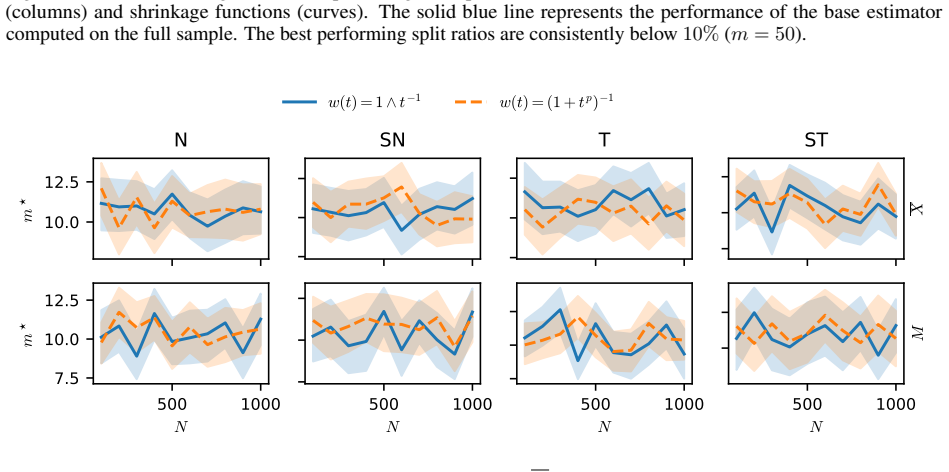
- The empirical finding that the optimal base-sample size m* stays roughly constant as n grows suggests that only a small subsample is needed to set κ̂, aligning with the theory's requirement that R_κ̂ be O(ν_p) rather than vanishing.
Editorial analysis
A structured set of objections, weighed in public.
Referee Report
Summary. The manuscript studies estimators of the form \hat\mu = \hat\kappa + n^{-1} \sum_i (X_i - \hat\kappa) w(\hat\alpha |X_i-\hat\kappa|), where \hat\kappa is a base location estimator and \hat\alpha is a data-dependent scale defined by a Z-estimator. The main result (Theorem 3.1) gives, under four assumptions including independence of \hat\kappa from the sample, a high-probability bound under adversarial contamination that involves the concentration function R_{\hat\kappa} of the base estimator and the centered moments \nu_p of the distribution. In the regime R_{\hat\kappa}=O(1), the bound attains the near-optimal rate \nu_p\{(n^{-1}\ln(1/\delta))^{1-1/(2\wedge p)} + \epsilon^{1-1/p}\}. The paper also establishes structural properties (affine equivariance, asymptotic distribution, breakdown point), specializes the framework to the trimmed mean, Winsorized mean, Lee--Valiant estimator and a W-estimator, and reports numerical experiments.
Significance. The framework is appealing and potentially useful: it unifies several known robust estimators under a single reweighting scheme and relaxes the requirement that the base estimator be sub-Gaussian. The proofs are detailed and structured around a bias-variance decomposition (Theorem 3.3), an \alpha-interval sandwich (Lemma 3.4), and a contamination-error bound (Lemma 3.6); the empirical-process argument with VC dimension is appropriate, and the paper provides reproducible code. The main caveat is that the advertised full-sample use is not covered by the theory: the independence assumption is explicitly acknowledged by the authors as a possible proof artifact, but no same-sample theorem is given. With this caveat properly addressed, or the abstract restricted to the independent-base regime, the result would be a solid contribution to robust mean estimation.
major comments (2)
- [Section 2.2, Theorem 3.3, Section 6.2] Theorem 3.1 is proved only under Assumption 4, which requires \hat\kappa to be independent of X_{1:n}. The proof of Theorem 3.3 (Appendix B) states: 'The result then follows by integrating over \hat\kappa.' This integration step is valid only if the conditional distribution of X_{1:n} given \hat\kappa remains P^{\otimes n}; without independence, the high-probability event (17) for \hat\alpha(\kappa), established for each fixed \kappa in Lemma 3.4, cannot be lifted to the random \kappa=\hat\kappa. Thus the probability guarantee of Theorem 3.1 has no proof for the same-sample regime in which \hat\kappa and \hat\mu are computed on the same data. The paper explicitly says in Section 1.1.3 that Assumption 4 is 'ultimately just a proof artifact', and Section 6.2 evaluates full-sample use only empirically (the 'NA' columns in Table 2). Because the abstract and the experiments emphasize a data-d
- [Theorem 1.1, Remark 2] The informal Theorem 1.1 displays bound (6) with infima over all p>1 and describes the conditions as 'mild assumptions on w'. In the formal Theorem 3.1, however, the first infimum is over 1<q\le 2\wedge p and the second over 1<q\le p, where p is the exponent appearing in Assumption 3. Since Assumption 3 holds for a fixed p and then for all q\le p, the unrestricted infima in the informal statement require a function w that satisfies Assumption 3 for every p>1, e.g., w(t)=1_{t<1}. The phrase 'mild assumptions over w' (also used in the abstract) is therefore misleading if Theorem 1.1 is read as a corollary for the whole class. Please either state the extra condition on w explicitly in the informal statement or align the displayed rates with the p-dependent infima of Theorem 3.1.
minor comments (4)
- [Abstract] The abstract claims the framework 'can also be generalized to the multivariate setting', but the manuscript contains no multivariate results. This overclaim should either be removed or supported by at least a sketch or reference.
- [Appendix B, Lemma B.2 proof] The proof of Lemma B.2 handles the same-sign case (x1 x2 > 0) with 'Analogously to the first case' but does not spell out the contradiction. Please expand this step. Also, in the proof of Theorem 3.3 (Appendix B), 'Theorem B.2' should be 'Lemma B.2'.
- [Section 1.1.3] The statement that the rate condition (\hat\kappa_n - \mu)n^{-1/2}\to 0 'holds for any constant base estimator' is inaccurate: a constant sequence converges to \mu at this rate only if it equals \mu. Please rephrase to avoid this error.
- [Throughout] There are several typos and small issues: 'ommit' in the proof of Lemma 3.6, 'Is is noteworthy' in Section 6.3, 'whos results' in Section 6.4. In Table 2, the column label 'NA' should be defined in the caption (it means no split / full-sample use). In Theorem 3.1, the constants c and \bar c introduced in Lemma 3.4 are not related to the displayed c = 16 + 4\xi^{-1}; a brief comment would help readability.
Circularity Check
No circularity: Theorem 3.1 is a genuine derivation from stated assumptions; the shrinkage level is an a priori parameter and no load-bearing result reduces to a fit or to the authors' own prior work.
full rationale
The paper's central claim is a non-asymptotic concentration bound for a class of shrinkage estimators. The derivation is self-contained: Theorem 3.3 applies a Bennett-type empirical-process inequality (Lemma A.3) to the bias-variance decomposition (14), Lemma 3.4 constructs the interval I_alpha(kappa) from the definition of the Z-estimator and Bernstein's inequality, and Lemma 3.5 bounds the bias/variance terms directly from Assumptions 1-3. The shrinkage level eta = ln(4/delta) + (1+xi)epsilon n is fixed before the bound is proved; it is not tuned to make the final error small, and the bound holds uniformly for all w in the class. The dependence on the base estimator enters through R_bkappa(delta/4), which is an input quantile of the base estimator, not a fitted quantity. The lower-bound optimality is imported from Devroye et al. and Minsker, which are external to this paper. The only self-citations (Oliveira, Orenstein, Rico 2025; Oliveira and Rico 2022) are used as examples/context and are not load-bearing for Theorem 3.1. Assumption 4 (independence of bkappa from X_{1:n}) is an honest, explicitly stated restriction; the paper even flags 'we believe it is ultimately just a proof artifact' and only evaluates full-sample use empirically. Failure to remove this assumption is a scope/limitation gap, not a circular reduction: no 'prediction' is defined in terms of the theorem's output, and no result is forced by a self-citation chain.
Assumptions & free parameters
free parameters (2)
- eta (shrinkage level) =
ln(4/delta) + (1+xi) epsilon n
- xi =
any xi > 0; constants C_{w,xi} depend on it
assumptions (6)
- domain assumption P is atom-free (Assumption 1).
- domain assumption w is right-continuous non-increasing, w(0)=1, lim_{t->inf} w(t)=0, and sup_{t>=0} t w(t) < infinity (Assumption 2).
- domain assumption w(t) >= (1-t^p)_+ for all t>=0 (Assumption 3).
- domain assumption bkappa is independent of X_{1:n} (Assumption 4).
- domain assumption P has finite p-th moment, p>1 (and p+gamma for Proposition 4.2).
- standard math Empirical-process concentration results (Bousquet, Dudley, Vershynin VC bounds) are valid.
Cite this review
Pith. "Pith review of Improved Concentration for Mean Estimators via Shrinkage." pith.science (2026). https://pith.science/paper/UJSMQZ6P
@misc{pith2026251212750,
  author       = {Pith},
  title        = {Pith review of: Improved Concentration for Mean Estimators via Shrinkage},
  year         = {2026},
  howpublished = {\url{https://pith.science/paper/UJSMQZ6P}},
  note         = {Machine review of arXiv:2512.12750}
}
abstract
We study a class of robust mean estimators $\widehat{\mu}$ obtained by adaptively shrinking the weights of sample points far from a base estimator $\widehat{\kappa}$. Given a data-dependent scaling factor $\widehat{\alpha}$ and a weighting function $w:[0, \infty) \to [0,1]$, we let $\widehat{\mu}=\widehat{\kappa} + \frac{1}{n}\sum_{i=1}^n(X_i - \widehat{\kappa})w(\widehat{\alpha}|X_i-\widehat{\kappa}|)$. We prove that, under mild assumptions over $w$, these estimators achieve stronger concentration bounds than the base estimate $\widehat{\kappa}$, including sub-Gaussian guarantees. This framework unifies and extends several existing approaches to robust mean estimation in $\R$, and can also be generalized to the multivariate setting. Through numerical experiments, we show that our shrinking approach translates to faster concentration, even for small sample sizes.
Figures


Reference graph
Works this paper leans on
-
[9]
URLhttps://doi.org/10.1214/19-AOS1843
doi: 10.1214/19-AOS1843. URLhttps://doi.org/10.1214/19-AOS1843. Olivier Bousquet. A bennett concentration inequality and its application to suprema of empirical processes.Comptes Rendus Mathematique, 334(6):495–500,
-
[1991]
Mean estimation and regression under heavy-tailed distributions: A survey
Gábor Lugosi and Shahar Mendelson. Mean estimation and regression under heavy-tailed distributions: A survey. Foundations of Computational Mathematics, 19(5):1145–1190, 2019a. Matthieu Lerasle and Roberto I Oliveira. Robust empirical mean estimators.arXiv preprint arXiv:1112.3914,
-
[1992]
URL https://doi.org/10.1214/aos/1176348890
doi: 10.1214/aos/1176348890. URL https://doi.org/10.1214/aos/1176348890. Gábor Lugosi and Shahar Mendelson. Sub-gaussian estimators of the mean of a random vector.The Annals of Statistics, 47(2):783–794, 2019b. Jean-Yves Audibert and Olivier Catoni. Robust linear least squares regression.Annals of Statistics, 39(5):2766–2794,
-
[2011]
Roberto I Oliveira and Zoraida F Rico. Improved covariance estimation: optimal robustness and sub-gaussian guarantees under heavy tails.arXiv preprint arXiv:2209.13485,
-
[2012]
URL https: //doi.org/10.1214/11-AIHP454
doi: 10.1214/11-AIHP454. URL https: //doi.org/10.1214/11-AIHP454. OV Lepskii. On a problem of adaptive estimation in gaussian white noise.Theory of Probability & Its Applications, 35 (3):454–466,
-
[2013]
Finite-sample properties of the trimmed mean.arXiv preprint arXiv:2501.03694,
Roberto I Oliveira, Paulo Orenstein, and Zoraida F Rico. Finite-sample properties of the trimmed mean.arXiv preprint arXiv:2501.03694,
-
[2016]
URL https://doi.org/10.1214/16-AOS1440
doi: 10.1214/16-AOS1440. URL https://doi.org/10.1214/16-AOS1440. Stanislav Minsker. Uniform bounds for robust mean estimators,
-
[2019]
URL https://arxiv.org/abs/1812.03523. Olivier Catoni. Challenging the empirical mean and empirical variance: A deviation study.Annales de l’Institut Henri Poincaré, Probabilités et Statistiques, 48(4):1148 – 1185,
Show all 9 references
-
[2020]
URL https://doi.org/10.1214/19-AOS1828
doi: 10.1214/19-AOS1828. URL https://doi.org/10.1214/19-AOS1828. F. Mosteller and J.W. Tukey.Data Analysis and Regression: A Second Course in Statistics. Addison-Wesley series in behavioral science. Addison-Wesley Publishing Company,
Reviewed August 3, 2026 · model on record in the stance chip above.
Discussion (0). Continue with ORCID to comment.