REVIEW 5 major objections 6 minor 51 references
PPTNet: A Hybrid Periodic Pattern-Transformer Architecture for Traffic Flow Prediction and Congestion Identification
T0 review · 5 major / 6 minor · reviewed 2026-08-15 · deepseek-v4-flash
Pith's one-line read PPTNet couples Fourier-discovered periods with a Transformer decoder to predict congested-highway traffic, then maps forecasts to congestion probabilities via Mamdani fuzzy rules.
desk verdict Useful dataset and coherent hybrid model, but the paper's own Table II contradicts its claim of superiority at all horizons, so the evaluation needs major revision before the numbers can be trusted. read the letter →
The pith
A machine-rendered reading of the paper's core claim, the machinery that carries it, and where it could break.
The reading
What carries the argument
The load-bearing mechanism is the Periodic Block. It turns the input sequence into a set of frequency-selected 2D tensors: FFT gives amplitudes $A(f)$, the $k$ largest frequencies provide periods $p_i = \lfloor T/f_i \rfloor$, zero-padding to length $L$ with $L \bmod p_i = 0$ allows a clean reshape, and 2D Inception convolutions with kernel sizes $r \in R$ are averaged into $Y^{(i)}_{2D}$. The block then weights each period branch by $w_i = a_i\alpha_i/\sum_j a_j\alpha_j$, where $a_i$ is the FFT amplitude and $\alpha_i$ is a learned attention score, and adds a residual connection. This lets the model discover several cycle lengths and let the context decide how much each matters, with the Transformer decoder handling the non-periodic temporal residual.
What would settle it
Run a fixed protocol on TF4CHE with the same twelve input features and the same 7:2:1 split, tune each baseline (especially TimesNet, FEDformer, and LSTNet) by grid search over its standard hyperparameters, and repeat with at least five random seeds; if the tuned baselines match or beat PPTNet's reported MSE and RMSE within the run-to-run variance, the claimed advantage would not hold.
Extended reading notes
Core claim
On its own terms, the paper's discovery is that periodic structure in congested traffic can be made into a differentiable, adaptive computation rather than a fixed seasonal assumption. The Periodic Block estimates the $k$ largest periods $p_i=\lfloor T/f_i\rfloor$ from FFT amplitudes, pads and reshapes the input into 2D tensors so that 2D Inception convolutions of several kernel sizes extract features both inside a cycle and across cycles, and fuses the branches with attention weights $w_i = a_i\alpha_i/\sum_j a_j\alpha_j$ that combine FFT amplitude strength with a learned context score. A causal Transformer decoder then generates density and speed forecasts horizon by horizon. The authors argue that this combination outperforms fourteen RNN, CNN, and Transformer baselines on TF4CHE, with the clearest reported gains in MSE and RMSE at the 30-second horizon (MAE 0.0512, MSE 0.0033, RMSE 0.0574 versus LSTNet's 0.0523, 0.0040, and 0.0633), and that the Mamdani fuzzy module converts these forecasts into congestion probabilities whose categorical distribution matches the true congestion levels on the test segments.
Load-bearing premise
The claimed advantage in Table II depends on the fourteen baseline models being configured as fairly as PPTNet, but the paper reports no baseline hyperparameters, random seeds, or run-to-run variance, so if the baselines were undertuned the reported gap would be an artifact rather than a real superiority.
Editorial extensions
If this is right
- Traffic operators could use PPTNet's 15-45 second lookahead on density and speed to trigger congestion warnings or adjust control measures before a jam fully forms.
- Because the fuzzy module needs only density and speed forecasts, it can sit on top of any forecaster that produces those two variables, not only PPTNet.
- TF4CHE gives the community a benchmark of twelve-dimensional, one-second-resolution traffic series from congested Chinese expressways, where average speeds are far lower than in comparable drone datasets such as HighD.
- The reported 17.5% MSE improvement over LSTNet at the 30-second horizon is the largest relative gain in the table, suggesting the periodic-Transformer hybrid matters most at intermediate lookaheads.
- The ablation results show that each component contributes alone and that the full model beats either component, supporting the claimed synergy between periodic extraction and temporal attention.
Reading between the lines
- A natural extension the paper does not pursue is applying PPTNet to non-drone traffic data, such as loop-detector or GPS-probe series with weaker periodicity; if the Fourier-based periodic block still helps there, the mechanism generalizes beyond congested highway scenes.
- The discovered periods $p_i$ are interpretable by-products of the FFT step; reporting them would let a reader check whether they correspond to known signal cycles, ramp-meter intervals, or platoon rhythms, turning attention weights into a traffic diagnosis.
- The fuzzy membership centers are fixed from data minima and maxima; making them learnable or per-segment adaptive is a cheap, testable change that could tighten the match between predicted and observed congestion probabilities.
- A useful follow-up for the community would be to report variance across random seeds and the tuned configurations of the baselines, because the current tables give point estimates only.
Signed reviews
Editorial analysis
A structured set of objections, weighed in public.
Referee Report
Summary. The manuscript proposes PPTNet, a hybrid architecture for short-term traffic flow prediction on congested Chinese highways, combining an FFT-based periodic pattern extraction block with 2D Inception convolutions and a Transformer decoder. It also introduces a new dataset, TF4CHE, derived from drone aerial trajectories from the AD4CHE dataset, and a Mamdani fuzzy inference module that maps predicted traffic density and average speed to a continuous congestion probability. The model is evaluated on TF4CHE at 15, 30, and 45 second horizons against 14 baseline models, with additional ablation studies and congestion identification visualizations. The central claim is that PPTNet demonstrates a significant advantage over mainstream baselines across all prediction time horizons.
Significance. If the claims were fully supported, the paper would provide a useful congested-highway dataset, a reasonable hybrid prediction architecture, and an interpretable fuzzy congestion identification module. The strengths of the paper include the detailed dataset construction from drone trajectories, the explicit formulation of the periodic block and Transformer decoder, the inclusion of ablation studies, and the provision of a project page for reproducibility. However, the central claim of universal superiority is contradicted by the paper's own Table II, and the evaluation lacks statistical rigor, so the significance is currently conditional on correction of these issues.
major comments (5)
- [VI-C, Table II] Section VI-C states that 'PPTNet demonstrates a significant advantage across all prediction time horizons,' but Table II reports MAE of 0.0821 for PPTNet versus 0.0778 for TimesNet at H=15 and MAE of 0.0660 for PPTNet versus 0.0615 for TimesNet at H=45; the Improvement row itself marks these as -5.53% and -7.32% degradations. The claim is therefore internally contradicted by the evidence in the same table. Please either restrict the claim to the metrics and horizons where PPTNet actually leads, such as MSE/RMSE at all horizons and MAE at H=30, or correct the results.
- [VI-B, VI-C, Table II] All performance comparisons are single-run point estimates: no standard deviations over multiple seeds, no error bars, and no statistical significance tests are reported, so the word 'significant' is not supported in a statistical sense. In addition, Section VI-B does not report the hyperparameters, tuning procedures, or training budgets for the 14 baseline models, leaving open the possibility that the baselines are not comparably configured. Please add multi-seed results with variance and describe the baseline configurations in sufficient detail to support fair comparison.
- [IV-D, Eqs. (6)-(8)] The 2D reshape operation is not consistently defined: Eq. (6) gives the output as R^{B x L x d_model}, which is still a three-dimensional tensor, whereas the text describes a 2D tensor whose columns and rows represent within-period and cross-period variations; Eq. (8) then outputs Y^(i) in R^{B x (T+H) x d_model} without explaining how the padded length L is reduced to T+H after inverse reshaping. Please clarify the exact reshape, padding, and truncation operations, since this is central to the reproducibility of the periodic block.
- [V-A, VI-E, Eqs. (17)-(18)] The Gaussian membership centers and width are computed from x_min and x_max of the data, but the paper does not state whether these statistics are computed on the training split only or on the full dataset. If the full dataset is used, the congestion identification evaluation in Section VI-E leaks test-set information into the construction of the fuzzy sets. Please specify the fitting procedure and refit the membership parameters on training data only if that is not already the case.
- [VI-E, Table I] The congestion identification module is validated only by comparing the congestion probability computed from predicted density and speed with the congestion probability computed from ground-truth density and speed through the same Mamdani module. This does not validate the fuzzy rule base against any independent ground-truth congestion label, so the claim that the module 'effectively identifies real-time road congestion states' is not supported. In addition, the rules in Table I are asserted without domain justification; for example, Rule 1 maps low density and low speed to medium congestion, which is not the standard free-flow relation. Please provide independent congestion labels or otherwise justify and validate the rule base.
minor comments (6)
- [VI-B] The dataset name is written as 'TF4CEH' in Section VI-B but as 'TF4CHE' elsewhere; please correct the typo.
- [III] The text describes AD4CHE as focusing on 'four cities in China' and immediately afterward says the data come from '11 distinct road segments in five cities'; please reconcile the city count.
- [IV-D, Eq. (5)] The FFT spectrum is denoted inconsistently as X_f in the text and Xf in the amplitude equation; please unify the notation.
- [V-A, Eq. (15)] The notation x_i in N is not appropriate for real-valued traffic density and speed; this should presumably be x_i in R or an equivalent real-valued domain.
- [Fig. 1, Section II heading] The caption of Figure 1 contains the typo 'dentification' and the Section II heading reads 'RELATEWORK'; both should be corrected.
- [VI-C, Fig. 9] The qualitative comparison in Fig. 9 contrasts PPTNet with ConvLSTM, which is not among the strongest baselines; comparing against TimesNet or LSTNet would more directly support the claimed advantage.
Circularity Check
Traffic-flow forecasting is non-circular, but the congestion-identification validation is self-definitional: the "true" congestion probability is generated by the same Mamdani fuzzy system being validated.
-
self definitional
[Section VI-E (Congestion Identification Study), Fig. 11 discussion]
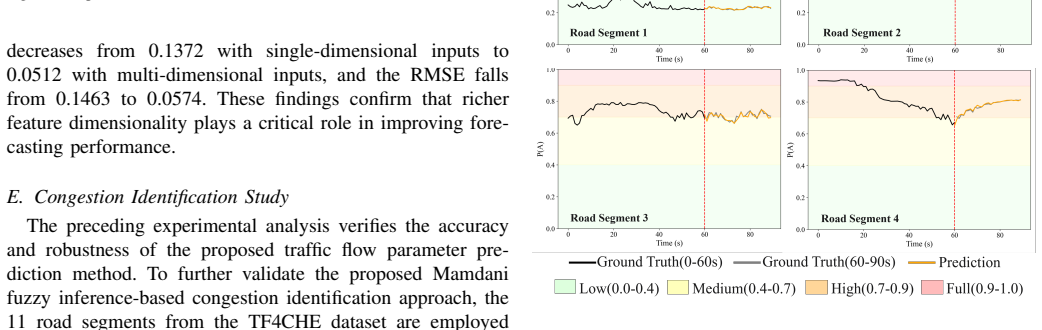
"Based on the proposed congestion identification method, the true and predicted congestion probabilities P(t) over the 30 s prediction horizon are computed separately using density and speed. ... The results of congestion probability prediction indicate that the predicted and actual congestion levels, obtained through the proposed congestion identification method, exhibit consistent categorical distributions and closely aligned numerical curves."
The "true" congestion probability P(t) is not an external ground-truth label; it is the output of the same Mamdani fuzzy inference system applied to the true density and speed values. The "predicted" P(t) is the same deterministic function applied to PPTNet's predicted density and speed. Therefore the reported agreement between the two curves is a composition of the fuzzy map with the prediction error; it is guaranteed to be consistent to whatever extent k and v are accurately predicted. The experiment does not test whether the fuzzy rule base correctly identifies congestion, since both curves are generated by that same rule base.
full rationale
The core PPTNet traffic-flow prediction chain is not circular: the forecasting targets are the ground-truth future density and speed values, the loss is computed directly against those targets, and no fitted parameter is later renamed as a prediction. The FFT period selection, 2D Inception convolutions, adaptive aggregation, and Transformer decoder are all standard architectural components trained on the prediction objective. The fuzzy congestion module is also not used in the prediction loss, so the forecasting results do not reduce to the fuzzy rules. The circularity is confined to the congestion-identification validation in Section VI-E: the "actual" congestion probability is computed by applying the proposed Mamdani system to the true inputs, so comparing it to the "predicted" congestion probability merely propagates the already-measured prediction error through a fixed nonlinear map. It does not validate the fuzzy rule base or the congestion-identification claim against any independent congestion labels. A secondary data-leakage concern is that the Gaussian membership centers and widths in Section V-A are computed from the minimum and maximum of the original data without stating whether the test split is excluded; if the test distribution is included, the fuzzy calibration can see the evaluation range. This is a correctness/robustness issue rather than a circular derivation, but it compounds the self-comparison problem. The self-citation of the AD4CHE dataset [39] is an external data source and is not load-bearing for the derivation. The internal inconsistency in Table II, where PPTNet has higher MAE than TimesNet at 15s and 45s horizons despite the claim of superiority across all horizons, is a correctness issue, not a circularity issue.
Assumptions & free parameters
free parameters (3)
- Number of periodic patterns K =
6
- Gaussian membership centers mu_i =
x_min + (i-1)/(M-1) * (x_max - x_min), M=3
- Gaussian membership standard deviation sigma =
(x_max - x_min) / (2M)
assumptions (4)
- domain assumption Traffic flow time series on congested highways have stable, discoverable periodic patterns.
- domain assumption Density and average speed distributions are approximately Gaussian.
- ad hoc to paper The nine if-then rules in Table I correctly map density and speed to congestion level.
- domain assumption Vehicle conversion factors alpha_bus=2.0 and alpha_truck=2.5 from regulation [40] apply to drone-derived counts.
Cite this review
Pith. "Pith review of PPTNet: A Hybrid Periodic Pattern-Transformer Architecture for Traffic Flow Prediction and Congestion Identification." pith.science (2026). https://pith.science/paper/UK4AAZXG
@misc{pith2026250513047,
  author       = {Pith},
  title        = {Pith review of: PPTNet: A Hybrid Periodic Pattern-Transformer Architecture for Traffic Flow Prediction and Congestion Identification},
  year         = {2026},
  howpublished = {\url{https://pith.science/paper/UK4AAZXG}},
  note         = {Machine review of arXiv:2505.13047}
}
read the original abstract
Accurate prediction of traffic flow parameters and real time identification of congestion states are essential for the efficient operation of intelligent transportation systems. This paper proposes a Periodic Pattern Transformer Network (PPTNet) for traffic flow prediction, integrating periodic pattern extraction with the Transformer architecture, coupled with a fuzzy inference method for real-time congestion identification. Firstly, a high-precision traffic flow dataset (Traffic Flow Dataset for China's Congested Highways and Expressways, TF4CHE) suitable for congested highway scenarios in China is constructed based on drone aerial imagery data. Subsequently, the proposed PPTNet employs Fast Fourier Transform to capture multi-scale periodic patterns and utilizes two-dimensional Inception convolutions to efficiently extract intra and inter periodic features. A Transformer decoder dynamically models temporal dependencies, enabling accurate predictions of traffic density and speed. Finally, congestion probabilities are calculated in real-time using the predicted outcomes via a Mamdani fuzzy inference-based congestion identification module. Experimental results demonstrate that the proposed PPTNet significantly outperforms mainstream traffic prediction methods in prediction accuracy, and the congestion identification module effectively identifies real-time road congestion states, verifying the superiority and practicality of the proposed method in real-world traffic scenarios. Project page: https://github.com/ADSafetyJointLab/PPTNet.
Figures


Figures from the paper (7 more)


Reference graph
Works this paper leans on
-
[1]
An adaptive composite time series forecasting model for short-term traffic flow,
Q. Shao, X. Piao, X. Yao, Y . Kong, Y . Hu, B. Yin, and Y . Zhang, “An adaptive composite time series forecasting model for short-term traffic flow,”Journal of Big Data, vol. 11, no. 1, p. 102, 2024
work page 2024
-
[2]
Freeway performance measurement system: mining loop detector data,
C. Chen, K. Petty, A. Skabardonis, P. Varaiya, and Z. Jia, “Freeway performance measurement system: mining loop detector data,”Trans- portation research record, vol. 1748, no. 1, pp. 96–102, 2001
work page 2001
-
[3]
Citywide traffic volume inference with surveillance camera records,
Y . Yu, X. Tang, H. Yao, X. Yi, and Z. Li, “Citywide traffic volume inference with surveillance camera records,”IEEE Transactions on Big Data, vol. 7, no. 6, pp. 900–912, 2019
work page 2019
-
[4]
G. Li, S. E. Li, R. Zou, Y . Liao, and B. Cheng, “Detection of road traffic participants using cost-effective arrayed ultrasonic sensors in low-speed traffic situations,”Mechanical Systems and Signal Processing, vol. 132, pp. 535–545, 2019
work page 2019
-
[5]
The highd dataset: A drone dataset of naturalistic vehicle trajectories on german highways for validation of highly automated driving systems,
R. Krajewski, J. Bock, L. Kloeker, and L. Eckstein, “The highd dataset: A drone dataset of naturalistic vehicle trajectories on german highways for validation of highly automated driving systems,” in2018 21st international conference on intelligent transportation systems (ITSC). IEEE, 2018, pp. 2118–2125
2018
-
[6]
Urban traffic flow prediction techniques: A review,
B. Medina-Salgado, E. S ´anchez-DelaCruz, P. Pozos-Parra, and J. E. Sierra, “Urban traffic flow prediction techniques: A review,”Sustainable Computing: Informatics and Systems, vol. 35, p. 100739, 2022
2022
-
[7]
B. D. Greenshields, J. R. Bibbins, W. Channing, and H. H. Miller, “A study of traffic capacity,” inHighway research board proceedings, vol. 14, no. 1. Washington, DC, 1935, pp. 448–477
work page 1935
-
[8]
Short-term traffic flow prediction using seasonal arima model with limited input data,
S. V . Kumar and L. Vanajakshi, “Short-term traffic flow prediction using seasonal arima model with limited input data,”European Transport Research Review, vol. 7, pp. 1–9, 2015
work page 2015
Show all 51 references
-
[9]
Traffic flow forecasting with particle swarm optimization and support vector regression,
J. Hu, P. Gao, Y . Yao, and X. Xie, “Traffic flow forecasting with particle swarm optimization and support vector regression,” in17th international ieee conference on intelligent transportation systems (itsc). IEEE, 2014, pp. 2267–2268
2014
-
[10]
Research on travel time prediction model of freeway based on gradient boosting decision tree,
J. Cheng, G. Li, and X. Chen, “Research on travel time prediction model of freeway based on gradient boosting decision tree,”IEEE access, vol. 7, pp. 7466–7480, 2018
2018
-
[11]
Modeling spatial non- stationarity via deformable convolutions for deep traffic flow prediction,
W. Zeng, C. Lin, K. Liu, J. Lin, and A. K. Tung, “Modeling spatial non- stationarity via deformable convolutions for deep traffic flow prediction,” IEEE Transactions on Knowledge and Data Engineering, 2021
2021
-
[12]
A recurrent neural network for urban long-term traffic flow forecasting,
A. Belhadi, Y . Djenouri, D. Djenouri, and J. C.-W. Lin, “A recurrent neural network for urban long-term traffic flow forecasting,”Applied Intelligence, vol. 50, pp. 3252–3265, 2020
2020
-
[13]
Traffic flow prediction using lstm with feature enhancement,
B. Yang, S. Sun, J. Li, X. Lin, and Y . Tian, “Traffic flow prediction using lstm with feature enhancement,”Neurocomputing, vol. 332, pp. 320–327, 2019
2019
-
[14]
Spatio-temporal graph convolutional networks: A deep learning framework for traffic forecasting,
B. Yu, H. Yin, and Z. Zhu, “Spatio-temporal graph convolutional networks: A deep learning framework for traffic forecasting,”arXiv preprint arXiv:1709.04875, 2017
2017 arXiv
-
[15]
Attention is all you need,
A. Vaswani, N. Shazeer, N. Parmar, J. Uszkoreit, L. Jones, A. N. Gomez, Ł. Kaiser, and I. Polosukhin, “Attention is all you need,”Advances in neural information processing systems, vol. 30, 2017
2017
-
[16]
Traffic congestion measurement based on inflow and outflow rates,
L. Liu and Y . Ma, “Traffic congestion measurement based on inflow and outflow rates,”Gonglu Jiaotong Keji/ Journal of Highway and Transportation Research and Development, vol. 30, no. 3, 2013
2013
-
[17]
Research on vehicle congestion group identification for evaluation of traffic flow parameters,
M. Drliciak, M. Cingel, J. Celko, and Z. Panikova, “Research on vehicle congestion group identification for evaluation of traffic flow parameters,” Sustainability, vol. 16, no. 5, p. 1861, 2024
2024
-
[18]
Traffic congestion evaluation of urban streets based on fuzzy inference system and gis application,
Z. A. Alkaissi, “Traffic congestion evaluation of urban streets based on fuzzy inference system and gis application,”Ain Shams Engineering Journal, vol. 15, no. 6, p. 102725, 2024
2024
-
[19]
Predictions of freeway traffic speeds and volumes using vector autoregressive models,
S. R. Chandra and H. Al-Deek, “Predictions of freeway traffic speeds and volumes using vector autoregressive models,”Journal of Intelligent Transportation Systems, vol. 13, no. 2, pp. 53–72, 2009
2009
-
[20]
Dynamic prediction of traffic vol- ume through kalman filtering theory,
I. Okutani and Y . J. Stephanedes, “Dynamic prediction of traffic vol- ume through kalman filtering theory,”Transportation Research Part B: Methodological, vol. 18, no. 1, pp. 1–11, 1984
1984
-
[21]
A spatiotemporal correlative k-nearest neighbor model for short-term traffic multistep forecasting,
P. Cai, Y . Wang, G. Lu, P. Chen, C. Ding, and J. Sun, “A spatiotemporal correlative k-nearest neighbor model for short-term traffic multistep forecasting,”Transportation Research Part C: Emerging Technologies, vol. 62, pp. 21–34, 2016
2016
-
[22]
Long short-term memory neural network for traffic speed prediction using remote microwave sensor data,
X. Ma, Z. Tao, Y . Wang, H. Yu, and Y . Wang, “Long short-term memory neural network for traffic speed prediction using remote microwave sensor data,”Transportation Research Part C: Emerging Technologies, vol. 54, pp. 187–197, 2015
2015
-
[23]
Using lstm and gru neural network methods for traffic flow prediction,
R. Fu, Z. Zhang, and L. Li, “Using lstm and gru neural network methods for traffic flow prediction,” in2016 31st Youth academic annual conference of Chinese association of automation (YAC). IEEE, 2016, pp. 324–328
2016
-
[24]
An empirical evaluation of generic convolutional and recurrent networks for sequence modeling,
S. Bai, J. Z. Kolter, and V . Koltun, “An empirical evaluation of generic convolutional and recurrent networks for sequence modeling,”arXiv preprint arXiv:1803.01271, 2018
2018 arXiv
-
[25]
Informer: Beyond efficient transformer for long sequence time-series forecasting,
H. Zhou, S. Zhang, J. Peng, S. Zhang, J. Li, H. Xiong, and W. Zhang, “Informer: Beyond efficient transformer for long sequence time-series forecasting,” inProceedings of the AAAI conference on artificial intel- ligence, vol. 35, no. 12, 2021, pp. 11 106–11 115
2021
-
[26]
Graph wavenet for deep spatial-temporal graph modeling,
Z. Wu, S. Pan, G. Long, J. Jiang, and C. Zhang, “Graph wavenet for deep spatial-temporal graph modeling,”arXiv preprint arXiv:1906.00121, 2019
1906 arXiv
-
[27]
Timesnet: Temporal 2d-variation modeling for general time series analysis,
H. Wu, T. Hu, Y . Liu, H. Zhou, J. Wang, and M. Long, “Timesnet: Temporal 2d-variation modeling for general time series analysis,”arXiv preprint arXiv:2210.02186, 2022
2022 arXiv
-
[28]
Freeway traffic stream modeling based on principal curves and its analysis,
D. Chen, J. Zhang, S. Tang, and J. Wang, “Freeway traffic stream modeling based on principal curves and its analysis,”IEEE Transactions on Intelligent Transportation Systems, vol. 5, no. 4, pp. 246–258, 2004
2004
-
[29]
The highway capacity manual 6th edition: A guide for multimodal mobility analysis,
L. A. Elefteriadou, “The highway capacity manual 6th edition: A guide for multimodal mobility analysis,”Ite journal, vol. 86, no. 4, 2016
2016
-
[30]
Lane-changes prediction based on adaptive fuzzy neural network,
J. Tang, F. Liu, W. Zhang, R. Ke, and Y . Zou, “Lane-changes prediction based on adaptive fuzzy neural network,”Expert systems with applica- tions, vol. 91, pp. 452–463, 2018
2018
-
[31]
Wavelet packet-autocorrelation function method for traffic flow pattern analysis,
X. Jiang and H. Adeli, “Wavelet packet-autocorrelation function method for traffic flow pattern analysis,”Computer-Aided Civil and Infrastruc- ture Engineering, vol. 19, no. 5, pp. 324–337, 2004
2004
-
[32]
Data- driven intelligent transportation systems: A survey,
J. Zhang, F.-Y . Wang, K. Wang, W.-H. Lin, X. Xu, and C. Chen, “Data- driven intelligent transportation systems: A survey,”IEEE Transactions on Intelligent Transportation Systems, vol. 12, no. 4, pp. 1624–1639, 2011
2011
-
[33]
Driving with knowledge from the physical world,
J. Yuan, Y . Zheng, X. Xie, and G. Sun, “Driving with knowledge from the physical world,” inProceedings of the 17th ACM SIGKDD international conference on Knowledge discovery and data mining, 2011, pp. 316–324
2011
-
[34]
Microscopic traffic simulation using sumo,
P. A. Lopez, M. Behrisch, L. Bieker-Walz, J. Erdmann, Y .-P. Fl ¨otter¨od, R. Hilbrich, L. L ¨ucken, J. Rummel, P. Wagner, and E. Wießner, “Microscopic traffic simulation using sumo,” in2018 21st international SUBMISSION TO IEEE TRANSACTIONS ON INTELLIGENT TRANSPORTATION SYSTE...
2018
-
[35]
On the assessment of vehicle trajectory data accuracy and application to the next generation simulation (ngsim) program data,
V . Punzo, M. T. Borzacchiello, and B. Ciuffo, “On the assessment of vehicle trajectory data accuracy and application to the next generation simulation (ngsim) program data,”Transportation Research Part C: Emerging Technologies, vol. 19, no. 6, pp. 1243–1262, 2011
2011
-
[36]
The ind dataset: A drone dataset of naturalistic road user trajectories at german intersections,
J. Bock, R. Krajewski, T. Moers, S. Runde, L. Vater, and L. Eckstein, “The ind dataset: A drone dataset of naturalistic road user trajectories at german intersections,” in2020 IEEE Intelligent Vehicles Symposium (IV). IEEE, 2020, pp. 1929–1934
2020
-
[37]
Driving data distribution of human drivers in urban driving condition,
R. Liu and X. Zhu, “Driving data distribution of human drivers in urban driving condition,” in2017 IEEE 20th International Conference on Intelligent Transportation Systems (ITSC). IEEE, 2017, pp. 1–6
2017
-
[38]
Sind: A drone dataset at signalized intersection in china,
Y . Xu, W. Shao, J. Li, K. Yang, W. Wang, H. Huang, C. Lv, and H. Wang, “Sind: A drone dataset at signalized intersection in china,” in 2022 IEEE 25th International Conference on Intelligent Transportation Systems (ITSC). IEEE, 2022, pp. 2471–2478
2022
-
[39]
The ad4che dataset and its application in typical congestion scenarios of traffic jam pilot systems,
Y . Zhang, C. Wang, R. Yu, L. Wang, W. Quan, Y . Gao, and P. Li, “The ad4che dataset and its application in typical congestion scenarios of traffic jam pilot systems,”IEEE Transactions on Intelligent Vehicles, vol. 8, no. 5, pp. 3312–3323, 2023
2023
-
[40]
of Housing and U.-R
M. of Housing and U.-R. D. of the People’s Republic of China, Code for Design of Urban Road Engineering (CJJ37-2012). Beijing: China Architecture & Building Press, 2012, page 8, Vehicle Conversion Factors
2012
-
[41]
N-beats: Neural basis expansion analysis for interpretable time series forecasting,
B. N. Oreshkin, D. Carpov, N. Chapados, and Y . Bengio, “N-beats: Neural basis expansion analysis for interpretable time series forecasting,” arXiv preprint arXiv:1905.10437, 2019
1905 arXiv
-
[42]
An experiment in linguistic synthesis with a fuzzy logic controller,
E. H. Mamdani and S. Assilian, “An experiment in linguistic synthesis with a fuzzy logic controller,”International journal of man-machine studies, vol. 7, no. 1, pp. 1–13, 1975
1975
-
[43]
A short-term traffic flow prediction model based on an improved gate recurrent unit neural network,
W. Shu, K. Cai, and N. N. Xiong, “A short-term traffic flow prediction model based on an improved gate recurrent unit neural network,”IEEE Transactions on Intelligent Transportation Systems, vol. 23, no. 9, pp. 16 654–16 665, 2021
2021
-
[44]
Self-attention convlstm for spatiotemporal prediction,
Z. Lin, M. Li, Z. Zheng, Y . Cheng, and C. Yuan, “Self-attention convlstm for spatiotemporal prediction,” inProceedings of the AAAI conference on artificial intelligence, vol. 34, no. 07, 2020, pp. 11 531–11 538
2020
-
[45]
Short-term traffic flow prediction for urban road sections based on time series analysis and lstm bilstm method,
C. Ma, G. Dai, and J. Zhou, “Short-term traffic flow prediction for urban road sections based on time series analysis and lstm bilstm method,” IEEE Transactions on Intelligent Transportation Systems, vol. 23, no. 6, pp. 5615–5624, 2021
2021
-
[46]
Deep learning,
Y . LeCun, Y . Bengio, and G. Hinton, “Deep learning,”nature, vol. 521, no. 7553, pp. 436–444, 2015
2015
-
[47]
Deep learning for precipitation nowcasting: A benchmark and a new model,
X. Shi, Z. Gao, L. Lausen, H. Wang, D.-Y . Yeung, W.-k. Wong, and W.-c. Woo, “Deep learning for precipitation nowcasting: A benchmark and a new model,”Advances in neural information processing systems, vol. 30, 2017
2017
-
[48]
Combining recurrent, convolutional, and continuous-time models with linear state space layers,
A. Gu, I. Johnson, K. Goel, K. Saab, T. Dao, A. Rudra, and C. R ´e, “Combining recurrent, convolutional, and continuous-time models with linear state space layers,”Advances in neural information processing systems, vol. 34, pp. 572–585, 2021
2021
-
[49]
Reformer: The efficient trans- former,
N. Kitaev, Ł. Kaiser, and A. Levskaya, “Reformer: The efficient trans- former,”arXiv preprint arXiv:2001.04451, 2020
2001 arXiv
-
[50]
Fedformer: Frequency enhanced decomposed transformer for long-term series fore- casting,
T. Zhou, Z. Ma, Q. Wen, X. Wang, L. Sun, and R. Jin, “Fedformer: Frequency enhanced decomposed transformer for long-term series fore- casting,” inInternational conference on machine learning. PMLR, 2022, pp. 27 268–27 286
2022
-
[51]
Modeling long-and short-term temporal patterns with deep neural networks,
G. Lai, W.-C. Chang, Y . Yang, and H. Liu, “Modeling long-and short-term temporal patterns with deep neural networks,” inThe 41st international ACM SIGIR conference on research & development in information retrieval, 2018, pp. 95–104
2018
Reviewed August 15, 2026 · model on record in the stance chip above.
Discussion (0). Continue with ORCID to comment.