REVIEW 3 major objections 4 minor 1 cited by
$P_c(4440)$ and $P_c(4457)$ decay into $\bar{D}\Sigma_c$ and $\bar{D}\Lambda_c$ and the spin of the $P_c$ states
T0 review · 3 major / 4 minor · reviewed 2026-08-11 · deepseek-v4-flash
Pith's one-line read The paper argues that the spin assignments 1/2- for Pc(4440) and 3/2- for Pc(4457) are favored by pion-exchange triangle-diagram width calculations, and that measuring Dbar Sigma_c and Dbar Lambda_c decays would settle the spins.
desk verdict A serious, clearly written calculation of Pc(4440)/Pc(4457) partial widths into DbarSigma_c and DbarLambda_c that gives a plausible but not rock-solid preference for the 1/2^-/3/2^- spin order; the main missing piece is a regulator-dependence study of the discriminating ratios. read the letter →
The pith
A machine-rendered reading of the paper's core claim, the machinery that carries it, and where it could break.
The reading
What carries the argument
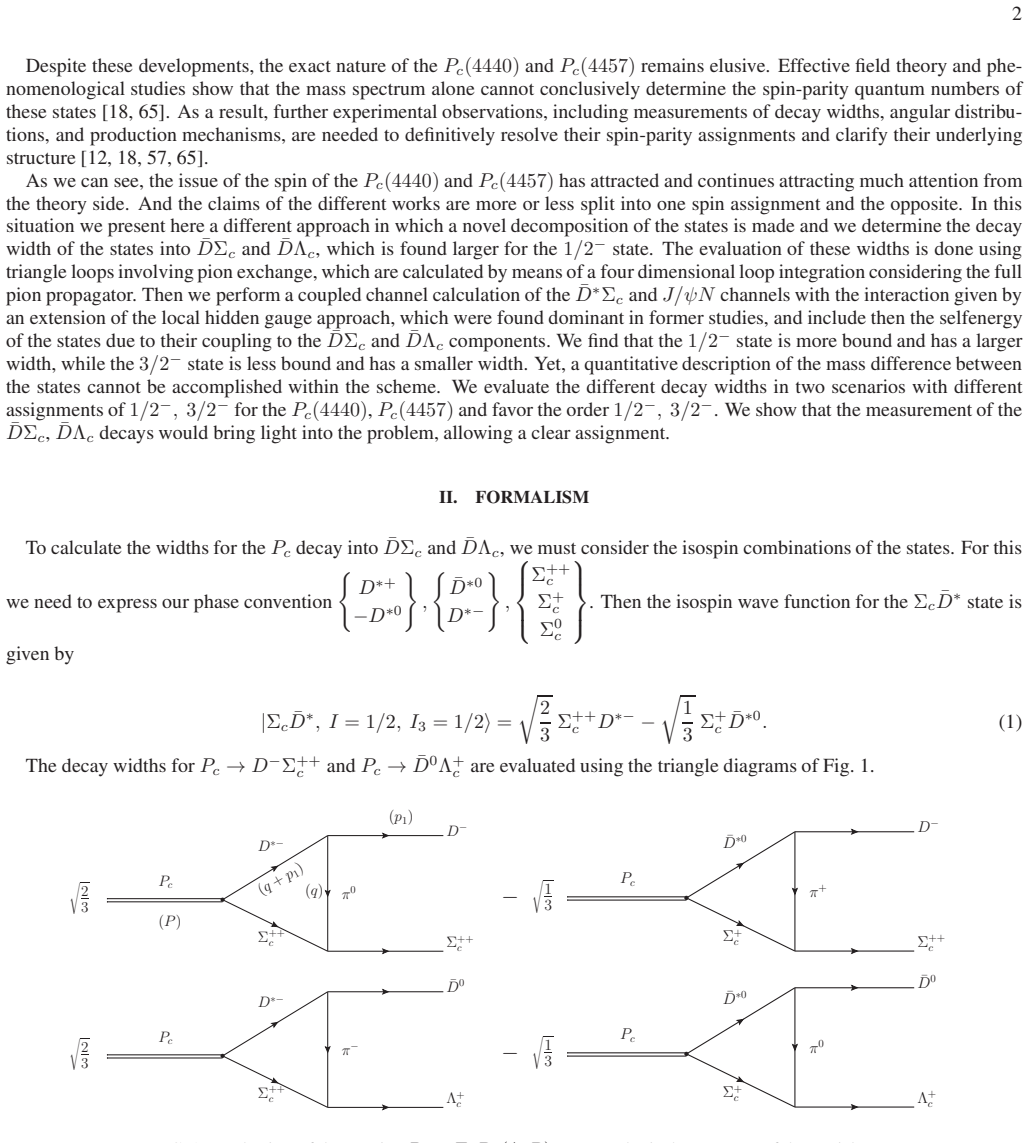
The machinery is a pair of spin projectors $P(3/2)=\vec{S}\cdot\vec{\epsilon}'\;\vec{S}_+\cdot\vec{\epsilon}$ and $P(1/2)=\tfrac{1}{3}\vec{\sigma}\cdot\vec{\epsilon}'\;\vec{\sigma}\cdot\vec{\epsilon}$, applied to the $\bar{D}^*\Sigma_c$ coupling, together with triangle diagrams in which pion exchange converts the $\bar{D}^*$ into $\bar{D}$ and the $\Sigma_c$ into $\Sigma_c$ or $\Lambda_c$. The pion propagator is kept dynamical and the loop is integrated over four dimensions, retaining only the positive-energy part of the $\bar{D}^*$ propagator. The loop integrals carry the same $q_{\mathrm{max}}$ cutoff used in the coupled-channel $G$ function plus a Gaussian form factor $\mathrm{FF}(q)=e^{-\vec{q}^{\,2}/\Lambda^2}$ with $\Lambda=950$ MeV, chosen so the largest computed width reproduces the Pc(4440) width. This machinery breaks the spin degeneracy left by vector-meson exchange: the $1/2^-$ channel gets an S-wave piece proportional to $|c-a+3b|^2$ and the $3/2^-$ channel only a D-wave piece proportional to $|c-a|^2$, which is why the $1/2^-$ width comes out larger.
What would settle it
Measure the partial widths of Pc(4440) and Pc(4457) into Dbar Sigma_c, or the ratio of their total widths. If Gamma(Pc(4440)->Dbar Sigma_c)/Gamma(Pc(4457)->Dbar Sigma_c) comes out near 1 instead of about 2.5, or the total widths land near 14.0 and 9.6 MeV instead of 20.5 and 7.8 MeV, the paper's favored spin assignment would be refuted.
Extended reading notes
Core claim
The central claim is that the 1/2^- and 3/2^- assignments of Pc(4440) and Pc(4457) are distinguishable through their partial decay widths, and that the data already prefer 1/2^- for Pc(4440) and 3/2^- for Pc(4457). The authors reconstruct both states from the same Dbar* Sigma_c coupled-channel interaction, then let pion exchange generate the Dbar Sigma_c and Dbar Lambda_c decay modes. In that setup the 1/2^- state has larger partial widths into Dbar Sigma_c and Dbar Lambda_c than the 3/2^- state, and this pushes its total width higher. The predicted ratio Gamma(Pc(4440))/Gamma(Pc(4457)) is 2.64 in the favored scenario versus 3.22 measured, compared with 1.46 in the reversed assignment. The computation also yields a small mass splitting that puts the 1/2^- state lower, in the right direction but far too small to account for the 17 MeV separation.
Load-bearing premise
The states are essentially Dbar* Sigma_c molecules, and the pion-exchange triangle diagrams with the Gaussian cutoff set to 950 MeV are the dominant spin-dependent decay mechanism; if either premise fails, the predicted ratios lose their power to discriminate the spins.
Editorial extensions
If this is right
- Under the favored assignment Pc(4440) should have total width about 20.5 MeV and Pc(4457) about 7.8 MeV, matching the measured 20.6 and 6.4 MeV pattern within errors.
- The Dbar Sigma_c channel alone discriminates: the predicted ratio Gamma(Pc(4440)->Dbar Sigma_c)/Gamma(Pc(4457)->Dbar Sigma_c) is about 2.5 in scenario 1 versus 0.96 in scenario 2.
- The Dbar Lambda_c channel also discriminates: the predicted ratio is about 2.8 in scenario 1 versus 1.8 in scenario 2.
- The pion-exchange self-energy pulls the 1/2^- state down relative to the 3/2^- state, so the same mechanism that sets the widths also points to the same spin ordering.
- A measurement of these partial widths would remove the present ambiguity between the two assignments.
Reading between the lines
- Beyond the paper, if the spin ordering is confirmed, Pc(4440) and Pc(4457) become a clean spin-partner pair of the same Dbar* Sigma_c molecular configuration, which would strengthen the molecular interpretation over compact pentaquark models.
- Beyond the paper, the smallness of the computed mass splitting suggests that the remaining 17 MeV separation must come from dynamics the present two-channel calculation omits, such as additional coupled channels or mass-dependent interactions, and pinning that down would be a direct test of the molecular picture.
- Beyond the paper, the same triangle-diagram-with-pion-exchange technique could be applied to other near-threshold molecular candidates where vector exchange alone leaves spin degeneracy, producing spin-discriminating width predictions for those states as well.
Editorial analysis
A structured set of objections, weighed in public.
Referee Report
Summary. This paper addresses the spin-parity assignment of the Pc(4440) and Pc(4457) pentaquark states in a molecular picture. The J/psi N width is obtained from a two-channel (Dbar* Sigma_c, J/psi N) unitarized scattering amplitude with vector-meson exchange, while the Dbar Sigma_c and Dbar Lambda_c widths are computed from pion-exchange triangle diagrams using four-dimensional loop integrals and spin projectors for J^P = 1/2^- and 3/2^-. Two spin scenarios are compared. The authors find total widths of 20.5 MeV and 7.8 MeV for Pc(4440) and Pc(4457) under the assignment (1/2^-, 3/2^-), versus 14.0 MeV and 9.6 MeV for the reversed assignment, and conclude that the (1/2^-, 3/2^-) order is preferred. They also predict separate Dbar Sigma_c and Dbar Lambda_c partial widths and argue that future measurements of these channels would unambiguously determine the spins. The mass splitting due to the same pion-exchange mechanism is computed but found to be only about 0.6 MeV, far below the empirical 17 MeV splitting, a limitation the authors explicitly acknowledge.
Significance. The spin assignment of Pc(4440) and Pc(4457) is a long-standing ambiguity, and a calculation that produces testable partial-width ratios for the two assignments would be a useful contribution. The paper is transparent in laying out the formalism: the spin projectors in Eqs. (25)-(26), the triangle-loop reduction in Eqs. (34)-(40), and the self-energy calculation in Section III.B are clearly presented. The authors also honestly flag the failure to reproduce the mass splitting quantitatively, and they provide separate predictions for Dbar Sigma_c and Dbar Lambda_c decay widths that could, in principle, be measured. If the ratios in Tables V and VI were shown to be robust against regulator variation and assigned realistic uncertainties, the paper would offer a concrete way to discriminate the spin scenarios. At present, however, the central 'unambiguous' claim is not yet supported because the key observable is the pattern of ratios, and the manuscript does not demonstrate that this pattern is stable under the tuned regulator or under the other model choices.
major comments (3)
- [Section III.A, Eq. (44)] The preference for Scenario 1 is not parameter-free: Lambda is chosen (Lambda ≈ 950 MeV) so that the largest computed total width, which is the Pc(4440) width in the 1/2^- assignment, equals about 20.5 MeV and thereby matches the experimental central value. Because Scenario 1 is exactly the assignment that makes Pc(4440) the 1/2^- state, the tuning is correlated with the conclusion. The manuscript only documents the Lambda dependence of this single number (22.2 MeV at Lambda = 1000 MeV) and not the dependence of the partial widths or the ratios in Tables V and VI. Since the S-wave and D-wave decay amplitudes enter through different combinations of the integrals a, b, c in Eq. (40), the regulator can reweight the two spin channels differently. I do not regard the procedure as strictly circular, because the tuning fixes an absolute scale rather than directly fixing the ratios, but without a sensitivity scan over Lambda (for example 800-1100 MeV) and at least one alternative functional form for FF(q), the claim that the ratios discriminate the scenarios is not established.
- [Tables IV-VI and Eq. (8)] All predicted widths are central values with no uncertainty estimates. The experimental widths in Eq. (8) have large asymmetric errors, and the text itself states that both scenarios are compatible with the data within errors. The subsequent statement that Scenario 1 is 'clearly' preferable therefore rests entirely on a comparison of central-value ratios. The paper should propagate the theoretical uncertainties from Lambda, qmax, the fitted couplings gPc,Dbar*Sigma_c, and the on-shell approximation for the Pc -> DbarSigma_c amplitude used in Section III.B, and should state whether the separation between the scenario-defining ratios (for example 2.5 versus 0.96 for the Dbar Sigma_c channel in Table V) survives once these uncertainties and the experimental errors are included.
- [Section III.B, Eq. (50)] The paper acknowledges that the pion-exchange self-energy produces a mass splitting of only about 0.6 MeV, far below the empirical 17 MeV splitting. This is an admitted limitation, but it has consequences for the width calculation: the masses of the two states are reproduced by choosing two different values of qmax (580 MeV and 450 MeV in Table I), so the couplings entering the triangle diagrams are effectively fitted to the masses rather than predicted by a single common model. The paper should clarify what predictive content remains after this per-state tuning, for example by showing the widths and scenario ratios for a common qmax or by quantifying how the comparison in Table IV changes when qmax is varied within a reasonable range. Without this, the conclusion that the width pattern favors Scenario 1 is weakened by the fact that the model cannot explain why the two states should have different regulators.
minor comments (4)
- [Eq. (4)] The C matrix is preceded by a stray '1' in the displayed equation, and the matrix formatting should be cleaned up.
- [Section III.A, paragraph after Table IV] The sentence 'It is clear that the scenario 1 is preferable' should be softened or accompanied by a quantitative statement about the separation in units of the relevant uncertainties, since the preceding sentence notes that both scenarios are compatible with the data within errors.
- [Eq. (39)] The notation with overline and double summation in the spin sums is not defined explicitly; the reader has to infer that it means an average over initial spin projections and a sum over final spin projections.
- [Section III.B, after Eq. (50)] The value of the cutoff for the DbarSigma_c and DbarLambda_c self-energy loops is stated only as 'of the order of 1 GeV'; it would be helpful to give the precise value and to comment on the sensitivity of the resulting mass shift to this choice.
Circularity Check
Scenario preference rests on a width that was tuned by Λ; the separate partial-width ratios are genuine but regulator-robustness is not demonstrated.
-
fitted input called prediction
[Sec. III.A, Eq. (44) and Table IV]
"We take here Λ ≈ 950 MeV, by means of which we obtain the largest width around 20.5 MeV, close to the experiment."
Λ is adjusted so that the 1/2− decay width of Pc(4440) becomes 20.5 MeV, matching the experimental central value of 20.6 MeV. Table IV then reports 20.52 MeV as the Pc(4440) width in Scenario 1, and the text uses the comparison 'a ratio 2.64 for the first scenario and 1.46 for the second scenario, compared with the experimental ratio 3.22' to prefer Scenario 1. Because the largest number anchoring that preference is the very value used to fix Λ, the main evidence for the 1/2−, 3/2− order is not an independent prediction but a calibrated fit. The other partial widths inherit the tuned Λ and the fitted couplings, so the discriminating power is only as strong as the regulator stability, which is not demonstrated.
full rationale
The paper is largely self-contained: the spin projectors and triangle-loop formulas are derived, and the separate J/ψN, D̄Σc, and D̄Λc widths are genuinely computed. The authors honestly acknowledge that Λ in the pion form factor is tuned 'to get the precise strength of the largest width' and that 'all the other widths evaluated are predictions.' However, the central conclusion favoring Scenario 1 is based on comparing total widths in Table IV, where the Pc(4440) width of 20.52 MeV is the fitted value. Thus the headline preference is partially circular: it would be surprising if the spin assignment that attaches the tuned width to the state with the larger experimental width were not preferred. The genuinely predictive content lies in the ratios of the D̄Σc and D̄Λc widths in Tables V and VI, which are not directly fitted and could discriminate the spins. The paper does not show these ratios are stable under reasonable variation of Λ or the regulator shape, which is a robustness concern rather than circularity. Overall, the derivation chain is not equivalent to its inputs, but one key piece of evidence reduces to a fit, warranting a partial circularity score of 6.
Assumptions & free parameters
free parameters (4)
- qmax for Pc(4440) =
580 MeV
- qmax for Pc(4457) =
450 MeV
- Lambda (pion form factor cutoff) =
950 MeV
- Self-energy loop cutoff for DbarSigma_c and DbarLambda_c =
1 GeV
assumptions (6)
- domain assumption The Pc(4440) and Pc(4457) are molecular states of Dbar* Sigma_c with spin-parity 1/2- or 3/2-
- domain assumption The Dbar* Sigma_c interaction is dominated by vector meson exchange described by the local hidden gauge approach, with spin-independent potential of Eq. (3)
- domain assumption The pion-baryon-baryon vertices are computed from quark model wave functions with the charmed quark as a spectator, giving the factors in Eqs. (19)
- standard math The spin projectors P(3/2) and P(1/2) of Eq. (25) correctly separate the amplitudes
- domain assumption The positive-energy part of the D* propagator dominates and the pion propagator is kept fully off shell
- ad hoc to paper The loop integrals are regularized by a sharp cutoff qmax and a Gaussian form factor FF(q) = exp(-q^2/Lambda^2)
Cite this review
Pith. "Pith review of $P_c(4440)$ and $P_c(4457)$ decay into $\bar{D}\Sigma_c$ and $\bar{D}\Lambda_c$ and the spin of the $P_c$ states." pith.science (2026). https://pith.science/paper/UKBTX626
@misc{pith2026241215731,
  author       = {Pith},
  title        = {Pith review of: $P_c(4440)$ and $P_c(4457)$ decay into $\barD\Sigma_c$ and $\barD\Lambda_c$ and the spin of the $P_c$ states},
  year         = {2026},
  howpublished = {\url{https://pith.science/paper/UKBTX626}},
  note         = {Machine review of arXiv:2412.15731}
}
abstract
We address the issue of the width and spin assignment of the $P_c(4440)$ and $P_c(4457)$ pentaquark states. We calculate the partial decays widths of the particles into $J/\psi N$, $\bar{D} \Sigma_c$ and $\bar{D} \Lambda_c$ with the first one obtained within a unitary approach with the coupled channels of $J/\psi N$ and $\bar{D}^* \Sigma_c$ with the interaction driven by vector meson exchange, and the last two by means of triangle diagrams involving pion exchange which break the spin degeneracy of the vector meson exchange. The widths obtained depend much on the spin of the particles and we study the possible scenarios for spin assignment, favoring the $1/2^-$ , $3/2^-$ order. We predict values for decays in different channels and show that their determination would allow to decide unambiguously the spin of the states.
Figures


Figures from the paper (1 more)

Forward citations
Cited by 1 Pith paper
-
Exploring the two-body strong decay properties of the possible $\Lambda_cK^{*}$ and $\Sigma_cK^{(*)}$ molecules
Predicted charm-strange hadronic molecules decay with widths from a few to about two hundred MeV, dominated by specific two-body channels.
Reference graph
Works this paper leans on
-
[1]
Aaij et al
R. Aaij et al. (LHCb), Phys. Rev. Lett. 115, 072001 (2015)
2015
-
[2]
Aaij et al
R. Aaij et al. (LHCb), Phys. Rev. Lett. 122, 222001 (2019)
2019
-
[3]
J.-J. Wu, R. Molina, E. Oset, and B. S. Zou, Phys. Rev. Lett . 105, 232001 (2010)
2010
-
[4]
J.-J. Wu, R. Molina, E. Oset, and B. S. Zou, Phys. Rev. C 84, 015202 (2011)
2011
-
[5]
W. L. Wang, F. Huang, Z. Y . Zhang, and B. S. Zou, Phys. Rev. C 84, 015203 (2011)
2011
-
[6]
Z.-C. Yang, Z.-F. Sun, J. He, X. Liu, and S.-L. Zhu, Chin. P hys. C 36, 6 (2012)
work page 2012
-
[7]
J.-J. Wu, T. S. H. Lee, and B. S. Zou, Phys. Rev. C 85, 044002 (2012)
work page 2012
-
[8]
C. W. Xiao, J. Nieves, and E. Oset, Phys. Rev. D 88, 056012 (2013)
work page 2013
Show all 85 references
-
[9]
Li and X
X.-Q. Li and X. Liu, Eur. Phys. J. C 74, 3198 (2014)
2014
-
[10]
R. Chen, X. Liu, X.-Q. Li, and S.-L. Zhu, Phys. Rev. Lett. 115, 132002 (2015)
2015
-
[11]
Karliner and J
M. Karliner and J. L. Rosner, Phys. Rev. Lett. 115, 122001 (2015)
2015
-
[12]
Zhang, J
Z. Zhang, J. Liu, J. Hu, Q. Wang, and U.-G. Meißner, Sci. B ull. 68, 981 (2023)
2023
-
[13]
Liu, Y .-W
M.-Z. Liu, Y .-W. Pan, F.-Z. Peng, M. S´ anchez S´ anchez,L.-S. Geng, A. Hosaka, and M. Pavon V alderrama, Phys. Rev. Lett. 122, 242001 (2019)
2019
-
[14]
H.-X. Chen, W. Chen, X. Liu, and S.-L. Zhu, Phys. Rept. 639, 1 (2016), 1601.02092
2016 arXiv
-
[15]
M.-L. Du, V . Baru, F.-K. Guo, C. Hanhart, U.-G. Meißner, J. A. Oller, and Q. Wang, JHEP 08, 157 (2021)
2021
-
[16]
M.-L. Du, V . Baru, F.-K. Guo, C. Hanhart, U.-G. Meißner, J. A. Oller, and Q. Wang, Phys. Rev. Lett. 124, 072001 (2020)
2020
-
[17]
H.-X. Chen, W. Chen, and S.-L. Zhu, Phys. Rev. D 100, 051501 (2019), 1903.11001
2019 arXiv
-
[18]
Chen, Z.-F
R. Chen, Z.-F. Sun, X. Liu, and S.-L. Zhu, Phys. Rev. D 100, 011502 (2019)
2019
-
[19]
Guo, H.-J
F.-K. Guo, H.-J. Jing, U.-G. Meißner, and S. Sakai, Phys . Rev. D 99, 091501 (2019)
2019
-
[20]
J. He, Eur. Phys. J. C 79, 393 (2019)
2019
-
[21]
Guo and J
Z.-H. Guo and J. Oller, Phys. Lett. B 793, 144 (2019)
2019
- [22]
-
[23]
C.-J. Xiao, Y . Huang, Y .-B. Dong, L.-S. Geng, and D.-Y . Chen, Phys. Rev. D 100, 014022 (2019)
2019
-
[24]
C. W. Xiao, J. Nieves, and E. Oset, Phys. Rev. D 100, 014021 (2019)
2019
-
[25]
F.-L. Wang, R. Chen, Z.-W. Liu, and X. Liu, Phys. Rev. C 101, 025201 (2020)
2020
-
[26]
L. Meng, B. Wang, G.-J. Wang, and S.-L. Zhu, Phys. Rev. D 100, 014031 (2019)
2019
-
[27]
J.-J. Wu, T. S. H. Lee, and B.-S. Zou, Phys. Rev. C 100, 035206 (2019)
2019
-
[28]
C. W. Xiao, J. Nieves, and E. Oset, Phys. Lett. B 799, 135051 (2019)
2019
-
[29]
M. B. V oloshin, Phys. Rev. D 100, 034020 (2019)
2019
-
[30]
Sakai, H.-J
S. Sakai, H.-J. Jing, and F.-K. Guo, Phys. Rev. D 100, 074007 (2019)
2019
-
[31]
Wang and X
Z.-G. Wang and X. Wang, Chin. Phys. C 44, 103102 (2020)
2020
-
[32]
Yamaguchi, H
Y . Yamaguchi, H. Garc´ ıa-Tecocoatzi, A. Giachino, A. Hosaka, E. Santopinto, S. Takeuchi, and M. Takizawa, Phys. Re v. D 101, 091502 (2020). 14
2020
-
[33]
Liu, T.-W
M.-Z. Liu, T.-W. Wu, M. S´ anchez S´ anchez, M. P . V alderrama, L.-S. Geng, and J.-J. Xie, Phys. Rev. D 103, 054004 (2021)
2021
-
[34]
Lin and B.-S
Y .-H. Lin and B.-S. Zou, Phys. Rev. D 100, 056005 (2019)
2019
-
[35]
B. Wang, L. Meng, and S.-L. Zhu, JHEP 11, 108 (2019)
2019
-
[36]
Gutsche and V
T. Gutsche and V . E. Lyubovitskij, Phys. Rev. D 100, 094031 (2019)
2019
-
[37]
T. J. Burns and E. S. Swanson, Phys. Rev. D 100, 114033 (2019)
2019
-
[38]
Wang, L.-Y
G.-J. Wang, L.-Y . Xiao, R. Chen, X.-H. Liu, X. Liu, and S. -L. Zhu, Phys. Rev. D 102, 036012 (2020)
2020
-
[39]
H. Xu, Q. Li, C.-H. Chang, and G.-L. Wang, Phys. Rev. D 101, 054037 (2020)
2020
-
[40]
Kuang, L.-Y
S.-Q. Kuang, L.-Y . Dai, X.-W. Kang, and D.-L. Yao, Eur. P hys. J. C 80, 433 (2020)
2020
-
[41]
Peng, M.-Z
F.-Z. Peng, M.-Z. Liu, M. S´ anchez S´ anchez, and M. Pavon V alderrama, Phys. Rev. D102, 114020 (2020)
2020
-
[42]
Peng, J.-X
F.-Z. Peng, J.-X. Lu, M. S´ anchez S´ anchez, M.-J. Yan, and M. Pavon V alderrama, Phys. Rev. D103, 014023 (2021)
2021
-
[43]
C. W. Xiao, J. X. Lu, J. J. Wu, and L. S. Geng, Phys. Rev. D 102, 056018 (2020)
2020
-
[44]
Dong, F.-K
X.-K. Dong, F.-K. Guo, and B.-S. Zou, Progr. Phys. 41, 65 (2021)
2021
-
[45]
F.-Z. Peng, M. S´ anchez S´ anchez, M.-J. Yan, and M. Pavon V alderrama, Phys. Rev. D105, 034028 (2022)
2022
-
[46]
Ali and A
A. Ali and A. Y . Parkhomenko, Phys. Lett. B 793, 365 (2019)
2019
-
[47]
R. Zhu, X. Liu, H. Huang, and C.-F. Qiao, Phys. Lett. B 797, 134869 (2019)
2019
-
[48]
Wang, Int
Z.-G. Wang, Int. J. Mod. Phys. A 35, 2050003 (2020)
2020
-
[49]
J. F. Giron, R. F. Lebed, and C. T. Peterson, JHEP 05, 061 (2019)
2019
-
[50]
Cheng and Y .-R
J.-B. Cheng and Y .-R. Liu, Phys. Rev. D 100, 054002 (2019)
2019
-
[51]
Stancu, Eur
F. Stancu, Eur. Phys. J. C 79, 957 (2019)
2019
-
[52]
M. I. Eides, V . Y . Petrov, and M. V . Polyakov, Phys. Rev. D93, 054039 (2016)
2016
-
[53]
M. I. Eides, V . Y . Petrov, and M. V . Polyakov, Mod. Phys. Lett. A 35, 2050151 (2020)
2020
-
[54]
Ferretti, E
J. Ferretti, E. Santopinto, M. Naeem Anwar, and M. A. Bed olla, Phys. Lett. B 789, 562 (2019)
2019
-
[55]
Du, Z.-H
M.-L. Du, Z.-H. Guo, and J. A. Oller, Phys. Rev. D 104, 114034 (2021)
2021
-
[56]
Pan, M.-Z
Y .-W. Pan, M.-Z. Liu, F.-Z. Peng, M. S´ anchez S´ anchez,L.-S. Geng, and M. Pavon V alderrama, Phys. Rev. D 102, 011504 (2020)
2020
-
[57]
Pavon V alderrama, Phys
M. Pavon V alderrama, Phys. Rev. D 100, 094028 (2019)
2019
-
[58]
Peng, M.-J
F.-Z. Peng, M.-J. Yan, M. S´ anchez S´ anchez, and M. P . V alderrama, Eur. Phys. J. C 81, 666 (2021)
2021
-
[59]
Liu, Y .-W
M.-Z. Liu, Y .-W. Pan, and L.-S. Geng, Phys. Rev. D 103, 034003 (2021)
2021
-
[60]
Yalikun, Y .-H
N. Yalikun, Y .-H. Lin, F.-K. Guo, Y . Kamiya, and B.-S. Zou, Phys. Rev. D 104, 094039 (2021)
2021
-
[61]
K. Chen, R. Chen, L. Meng, B. Wang, and S.-L. Zhu, Eur. Phy s. J. C 82, 581 (2022)
2022
-
[62]
H. Xing, J. Liang, L. Liu, P . Sun, and Y .-B. Yang (2022), 2 210.08555
2022
-
[63]
Yang, F.-Z
Z.-Y . Yang, F.-Z. Peng, M.-J. Yan, M. S´ anchez S´ anchez, and M. Pavon V alderrama (2022), 2211.08211
2022 arXiv
-
[64]
Lin, J.-B
Z.-Y . Lin, J.-B. Cheng, B.-L. Huang, and S.-L. Zhu, Phys . Rev. D 108, 114014 (2023)
2023
-
[65]
Liu, J.-X
Z.-W. Liu, J.-X. Lu, M.-Z. Liu, and L.-S. Geng, Phys. Rev . D 108, L031503 (2023)
2023
-
[66]
Peng, L.-S
F.-Z. Peng, L.-S. Geng, and J.-J. Xie (2024), 2410.2189 1
2024
- [67]
-
[68]
P .-P . Shi, F. Huang, and W.-L. Wang, Eur. Phys. J. A57, 237 (2021)
2021
-
[69]
Wang, Int
Z.-G. Wang, Int. J. Mod. Phys. A 36, 2150071 (2021)
2021
-
[70]
Azizi, Y
K. Azizi, Y . Sarac, and H. Sundu, Phys. Rev. D 103, 094033 (2021)
2021
-
[71]
Bando, T
M. Bando, T. Kugo, S. Uehara, K. Yamawaki, and T. Yanagid a, Physical Review Letters 54, 1215 (1985)
1985
-
[72]
Bando, T
M. Bando, T. Kugo, and K. Yamawaki, Physics Reports 164, 217 (1988)
1988
-
[73]
Harada and K
M. Harada and K. Yamawaki, Physics Reports 381, 1 (2003)
2003
-
[74]
Meissner, Physics Reports 161, 213 (1988)
U.-G. Meissner, Physics Reports 161, 213 (1988)
1988
-
[75]
Nagahiro, L
H. Nagahiro, L. Roca, A. Hosaka, and E. Oset, Phys. Rev. D 79, 014015 (2009)
2009
-
[76]
Capstick and N
S. Capstick and N. Isgur, Phys. Rev. D 34, 2809 (1986)
1986
-
[77]
Roberts and M
W. Roberts and M. Pervin, Int. J. Mod. Phys. A 23, 2817 (2008)
2008
-
[78]
W.-F. Wang, A. Feijoo, J. Song, and E. Oset, Phys. Rev. D 106, 116004 (2022)
2022
-
[79]
J. Song, L. R. Dai, and E. Oset, Eur. Phys. J. A 58, 133 (2022)
2022
-
[80]
Uchino, W.-H
T. Uchino, W.-H. Liang, and E. Oset, Eur. Phys. J. A 52, 43 (2016)
2016
-
[81]
F. E. Close, An Introduction to Quarks and Partons (1979), ISBN 978-0-12-175152-4
1979
-
[82]
Gamermann, J
D. Gamermann, J. Nieves, E. Oset, and E. Ruiz Arriola, Ph ys. Rev. D 81, 014029 (2010)
2010
-
[83]
Molina and E
R. Molina and E. Oset, Phys. Lett. B 811, 135870 (2020), [Erratum: Phys.Lett.B 837, 137645 (2023)]
2020
-
[84]
Hyodo, Int
T. Hyodo, Int. J. Mod. Phys. A 28, 1330045 (2013)
2013
-
[85]
Aceti, L
F. Aceti, L. R. Dai, L. S. Geng, E. Oset, and Y . Zhang, Eur. Phys. J. A 50, 57 (2014)
2014
Reviewed August 11, 2026 · model on record in the stance chip above.
Discussion (0). Continue with ORCID to comment.