REVIEW 3 major objections 5 minor 44 references
Probing the non-Planckian spectrum of thermal radiation in a micron-sized cavity with a spin-polarized atomic beam
T0 review · 3 major / 5 minor · reviewed 2026-08-14 · deepseek-v4-flash
Pith's one-line read A micron-sized metallic cavity with dissipative mirrors is predicted to be filled with TE-polarized, non-Planckian thermal radiation whose room-temperature energy density exceeds black-body density by orders of magnitude.
desk verdict A careful, honest theoretical proposal for a cavity experiment that would discriminate Drude from plasma models of thermal TE noise; the catch, which the paper itself documents, is that the predicted signal is exactly the contested model's output. read the letter →
The pith
A machine-rendered reading of the paper's core claim, the machinery that carries it, and where it could break.
The reading
What carries the argument
The carrier of the argument is the thermal magnetic Green function of the planar cavity, obtained by decomposing the field correlator into a free-space part and a scattering part built from Fresnel reflection coefficients (Eqs. (A.5)-(A.6), with $s$ and $p$ reflection coefficients interchanged for the magnetic tensor). In the Drude model, the imaginary part of the permittivity is nonzero at low frequencies, so the fluctuation-dissipation theorem gives a large magnetic noise power in evanescent TE modes. The cavity width $a$ sets the scale through the characteristic frequency $\omega_c = c/2a$, and the universal formula (13) emerges when the metal's plasma length is much smaller than both $a$ and the thermal wavelength. The same Green function enters the hyperfine transition rate formula (20), so a single theoretical object connects the predicted radiation, the Casimir pressure, and the proposed atomic-beam measurement.
What would settle it
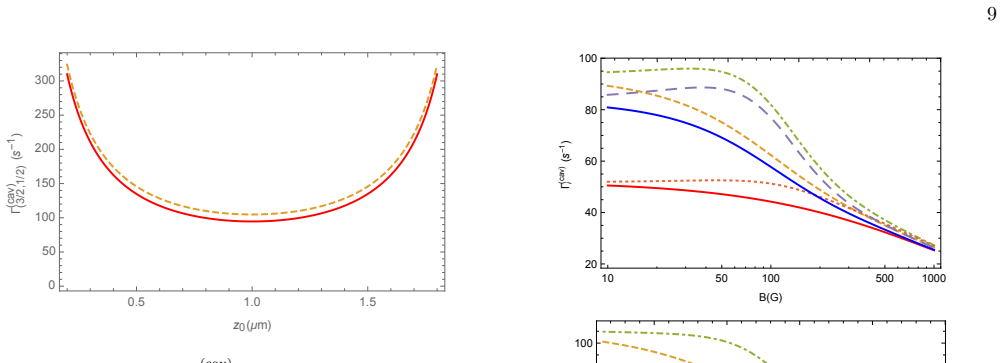
Send a spin-polarized deuterium beam through a 2 µm gold cavity at 300 K with a 10 G field and count atoms exiting in each hyperfine state. The Drude model predicts a total transition probability near 5% (rates of order tens per second); the plasma model predicts rates below $10^{-12}\,\mathrm{s}^{-1}$. Observing no transitions beyond the free-space and collisional background would refute the paper's central prediction.
Extended reading notes
Core claim
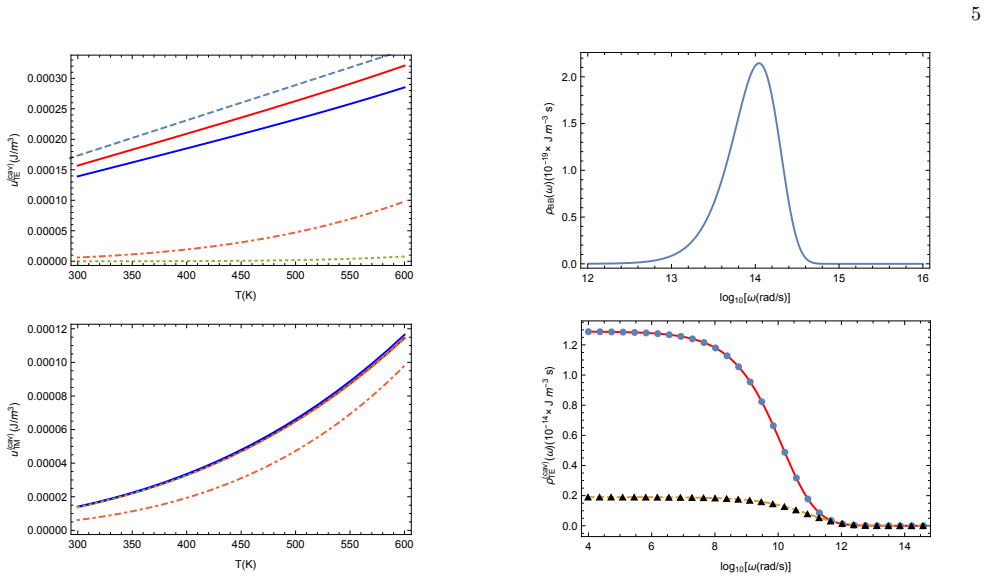
The central discovery is that dissipation changes the thermal content of a narrow cavity in a qualitative way, not a perturbative one. Within fluctuational electrodynamics, for a planar cavity of width $a$ with thick mirrors satisfying $w \gg \lambda_p$ and $\lambda_p \ll a \ll \lambda_T$, the TE-polarized energy density at height $z$ above one mirror has the universal, material-independent form $\tilde{u}_{\rm TE}^{\rm(cav)}(z) = (k_B T / 16\pi a^3)\left[\zeta(3,z/a)+\zeta(3,1-z/a)\right]$, where $\zeta(s,x)$ is the generalized Riemann zeta function. This energy grows linearly with temperature, unlike the $T^4$ black-body law, and is carried mainly by evanescent magnetic fields whose frequencies extend up to $\tilde{\omega} \sim \omega_c^2/(4\pi\sigma)$. The same magnetic fields, viewed through the Maxwell stress tensor, produce the repulsive thermal correction to the Casimir force predicted by the Drude-based Lifshitz theory, so measuring the cavity spectrum is a direct probe of the disputed thermal Casimir force.
Load-bearing premise
The prediction assumes that real metals dissipate low-frequency electric currents in the way captured by the standard Drude model; if the true response is almost lossless, as the plasma model assumes, the TE radiation essentially vanishes and the predicted atomic transition rates drop below $10^{-12}\,\mathrm{s}^{-1}$.
Editorial extensions
If this is right
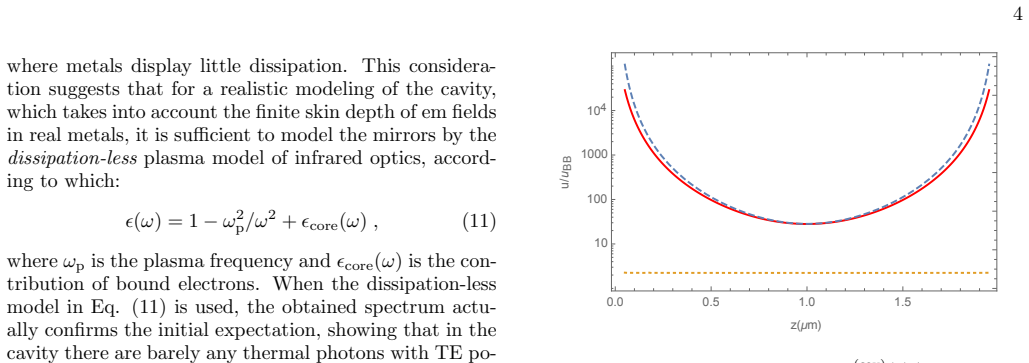
- Inside a 2 µm gold cavity at 300 K, the TE energy density should exceed black-body density by orders of magnitude and grow approximately linearly with $T$, a clear departure from Planck's law.
- A spin-polarized deuterium beam crossing the gap should show hyperfine transition probabilities of about 5% under the Drude model, versus no measurable signal under the plasma model—a difference of more than thirteen orders of magnitude.
- Tuning the external magnetic field selects different Larmor and hyperfine frequencies, scanning a large portion of the spectrum that contributes to the thermal Casimir force.
- A measured spectrum would discriminate between the lossy Drude and lossless plasma descriptions of conduction electrons, and so bear directly on why precision Casimir experiments have not seen the repulsive thermal force.
- Because Eq. (13) is independent of the mirror material, gold and platinum cavities of the same width should show the same central energy density despite different conductivities.
Reading between the lines
- If the Drude prediction is confirmed, the same thermal magnetic noise should also affect other precision experiments near metals, such as atom-chip magnetometry and near-field heat-transfer measurements, at frequencies beyond those probed by trapped-atom lifetime studies.
- If the experiment sees only plasma-model-level rates, the natural reading is that the low-frequency evanescent response of metals is not captured by the bulk Drude conductivity, which would push theory toward nonlocal or surface-response descriptions of the mirrors.
- The proposal could be extended to other alkali atoms whose hyperfine splittings cover higher or lower frequencies, effectively building a tunable spectrometer for the cavity's magnetic noise; the paper already identifies Na and Rb as frequency landmarks.
- A practical concern the paper leaves implicit is that mirror edges, finite beam size, and stray electric fields near the cavity entrance and exit could produce background transitions; the cleanest control would be a same-geometry non-metallic cavity whose only difference is the absence of metallic magnetic noise.
Signed reviews
Editorial analysis
A structured set of objections, weighed in public.
Referee Report
Summary. The paper uses fluctuational electrodynamics to compute the thermal electromagnetic energy density inside a planar metallic cavity with width a = 2 μm. It claims that if the mirrors are described by the lossy Drude permittivity (Eq. (12)), the cavity is filled with evanescent TE-polarized thermal noise whose energy density is orders of magnitude above the black-body value and obeys a near-universal, material-independent formula (Eq. (13)) for λp << a << λT. It further proposes an experiment in which a spin-polarized beam of D atoms traverses the cavity, with magnetic-dipole hyperfine transitions driven by the magnetic part of this noise; the calculated Drude-model transition rates are tens per second, whereas the plasma-model rates are below 10^-12 s^-1. The paper positions the proposed measurement as a direct test of the competing Drude and plasma descriptions, with direct bearing on the long-standing discrepancy between Casimir experiments and Lifshitz-theory predictions.
Significance. If the predicted TE thermal noise and transition rates are correct, the proposed experiment would provide a new, quantitative probe of sub-wavelength thermal radiation and could help resolve the Drude-versus-plasma controversy in Casimir physics. The calculation is a standard application of the fluctuation-dissipation theorem, and the paper gives concrete experimental parameters: cavity width, magnetic field range, atomic velocity, and expected signal levels. The open acknowledgment of the controversy (Sec. III) is a strength, as is the explicit comparison of Drude and plasma predictions. However, the central quantitative anchor, Eq. (13), is not derived, and the predicted signal is heavily model-dependent, so the proposal is best viewed as a model-discrimination experiment rather than a definitive statement about real gold cavities.
major comments (3)
- [Section II, Eq. (13)] The universal energy-density formula (13) is asserted with the phrase 'it can be shown' and no derivation is given in the main text or the appendix. Since this formula is the quantitative anchor for the central claim of the paper, the derivation must be supplied (or a precise reference provided) along with a careful statement of the validity conditions. In particular, the stated condition w >> λp, where w is the mirror thickness, is not obviously sufficient: for Au at GHz frequencies the skin depth δ = sqrt(2/(μ0 σ ω)) is about 3 μm (using σ ≈ 4.5×10^7 S/m and ω ≈ 10^10 rad/s), which is larger than the 2 μm gap considered and likely comparable to or larger than realistic mirror thicknesses. The half-space thick-mirror limit that underlies Eq. (13) therefore needs explicit verification; otherwise the 'universal' value may not be realized in the proposed geometry.
- [Abstract and Conclusions] The abstract and the concluding paragraph state without qualification that a micron-sized metallic cavity 'is filled with' non-resonant TE radiation whose density is orders of magnitude above the black-body value. The calculation, however, produces this result only if the lossy Drude permittivity of Eq. (12) is used; the dissipationless plasma model of Eq. (11), which the paper itself notes is supported by two series of Casimir experiments (Sec. III, Refs. [17–23]), yields a TE energy density roughly 700 times smaller at the cavity center and hyperfine transition rates below 10^-12 s^-1. The wording should be changed to make the model-dependence explicit, for example by stating that the prediction follows from the Drude model and that the proposed measurement is designed to discriminate between the Drude and plasma descriptions.
- [Section IV, Figs. 7–9] The numerical results for the transition rates (Figs. 7–9) depend on the specific Drude parameters of Au (and Pt): the plasma frequency ωp, the relaxation frequency γ, and the core permittivity ε_core, as well as the temperature dependence of γ. None of these parameters are stated in the paper. Because the predicted rates are central to the feasibility of the experiment and because the low-frequency value of γ is precisely the contested quantity, the paper should provide the full parameter sets used (in a table or in the text) so that the calculations can be reproduced and the sensitivity to γ can be assessed.
minor comments (5)
- [Section V] The plan of the paper in the Introduction says 'Finally in Sec. IV we present our conclusions', but the conclusions are actually in Sec. V; the section numbering should be corrected.
- [Section V] The sentence 'an that no such radiation exists in an ideal cavity with no losses' contains a typo: 'an' should be 'and'.
- [Appendix, Eq. (A.5)] The reflection-coefficient notation in Eqs. (A.5)–(A.6) is cumbersome: superscripts denote the mirror number and subscripts denote polarization, but in the text the same quantities are written as R(k)_α. A brief explanation of the notation would improve readability.
- [Section IV, Figs. 8–9] The text says 'Figres 8 and 9' (typo for 'Figures'), and the description of the line styles in Fig. 8 is repeated verbatim for Fig. 9 even though the two figures have different panel structures; the captions could be made self-contained.
- [Section II, Eq. (13)] The condition d >> λp for the distance of the field point from the mirrors is introduced verbally but is not stated in the line containing Eq. (13) itself; incorporating it explicitly into the display equation or its surrounding text would avoid ambiguity.
Circularity Check
Derivation is self-contained; no circular step found.
full rationale
The paper's central claims are derived from the fluctuation-dissipation theorem in Eq. (1), the assumed Drude permittivity in Eq. (12), and the cavity Green functions in the Appendix. No parameter is fitted to the predicted TE energy density, the universal formula in Eq. (13), or the D-atom transition rates in Eqs. (20)-(21). The Drude model is an explicit physical input, and the plasma model in Eq. (11) is presented as an alternative input; neither is an output of the calculation, so the model-dependence of the prediction is a scientific assumption, not circularity. Equation (13) is stated as a derived consequence ('it can be shown') under stated conditions; even though the derivation is compressed, it is not equivalent to the input by construction. The author's review of conflicting Casimir experiments is framed as motivation and as an indication that the Drude model is disputed, not as evidence that the prediction follows from the data. The self-citations [3,4,27,30,33] are contextual, historical, or interpretive and are not load-bearing for the main derivation. The reader's concern about the correctness of the Drude input is a model-validity issue, not a circularity issue.
Assumptions & free parameters
free parameters (2)
- Au Drude parameters (ωp, γ, ε_core) =
not stated in text; λp = c/ωp = 22 nm for Au is quoted
- Pt Drude parameters (ωp, γ, ε_core) =
not stated in text
assumptions (4)
- domain assumption The fluctuational-electrodynamics correlator formula (Eq. (1)) is valid for thermal fields in the cavity.
- domain assumption The Drude dielectric function (Eq. (12)) correctly describes the conduction-electron response of Au and Pt at the low infrared and GHz frequencies relevant for the cavity.
- domain assumption Local frequency-dependent dielectric response, without spatial dispersion, applies at the distances and wavevectors involved.
- domain assumption The D-atom transition rates are governed by magnetic-dipole coupling to the cavity field; electric noise and collisions are negligible or subtractable.
Cite this review
Pith. "Pith review of Probing the non-Planckian spectrum of thermal radiation in a micron-sized cavity with a spin-polarized atomic beam." pith.science (2026). https://pith.science/paper/UKL3ZE7H
@misc{pith2026190808756,
  author       = {Pith},
  title        = {Pith review of: Probing the non-Planckian spectrum of thermal radiation in a micron-sized cavity with a spin-polarized atomic beam},
  year         = {2026},
  howpublished = {\url{https://pith.science/paper/UKL3ZE7H}},
  note         = {Machine review of arXiv:1908.08756}
}
abstract
It is commonly thought that thermal photons with transverse electric polarization cannot exist in a planar metallic cavity whose size $a$ is smaller than the thermal wavelength $\lambda_T$, due to absence of modes with $\lambda < 2a$. Computations based on a realistic model of the mirrors contradict this expectation, and show that a micron-sized metallic cavity is filled with non-resonant radiation having transverse electric polarization, following a non-Planckian spectrum, whose average density at room temperature is orders of magnitudes larger than that of a black-body. We show that the spectrum of this radiation can be measured by observing the transition rates between hyperfine ground-state sub-levels $1S_{1/2}(F,m_F) \rightarrow 1S_{1/2}(F',m'_F)$ of D atoms passing in the gap between the mirrors of a Au cavity. Such a measurement would also shed light on a puzzle in the field of dispersion forces, regarding the sign and magnitude of the thermal Casimir force. Recent experiments with Au surfaces led to contradictory results, whose interpretation is much controversial.
Figures

Figures from the paper (5 more)




Reference graph
Works this paper leans on
- [1]
-
[2]
S.M. Rytov, Theory of Electrical Fluctuations and Ther- mal Radiation, Publishing House, Academy os Sciences, USSR (1953)
work page 1953
-
[3]
M. Kr¨ uger, G. Bimonte, T. Emig and M. Kardar, Phys. Rev. B 86, 115423 (2012)
work page 2012
-
[4]
Bimonte, T
G. Bimonte, T. Emig, M. Kardar, and M. Kr¨ uger, Ann. Rev. Cond. Matt. Phys. 8, 119 (2017)
2017
-
[5]
G. S. Agarwal, Phys. Rev. A 11, 230 (1975)
work page 1975
-
[6]
J. M. Wylie and J. E. Sipe, Phys. Rev. A 30, 1185 (1984)
1984
-
[7]
E. M. Lifshitz, Zh. Eksp. Teor. Fiz. 29, 94 (1955) [Sov. Phys. JETP 2, 73 (1956)]
1955
-
[8]
H. B. G. Casimir, Proc. K. Ned. Akad. Wet., 51, 793 (1948)
work page 1948
Show all 44 references
-
[9]
Sandoghdar, C
V. Sandoghdar, C. I. Sukenik, E. A. Hinds, and S. Haroche, Phys. Rev. Lett. 68, 3432 (1992)
1992
-
[10]
S. Y. Buhmann, Dispersion Forces I: Macroscopic Quantum Electrodynamics and Ground-State Casimir, Casimir-Polder, and van der Waals Forces (Springer, Berlin, 2012)
2012
-
[11]
Haroche and D
S. Haroche and D. Kleppner, Phys. Today 42, 24 (1989)
1989
-
[12]
W. Jhe, A. Anderson, E. A. Hinds, D. Meschede, L. Moi, and S. Haroche, Phys. Rev. Lett. 58, 666 (1987)
1987
-
[13]
Henkel, S
C. Henkel, S. P¨ otting, and M. Wilkens, Appl. Phys. B 69, 379 (1999)
1999
-
[14]
Henkel, P
C. Henkel, P. Kr¨ uger, R. Folman, and J. Schmiedmayer, Appl. Phys. B 76, 173 (2003)
2003
-
[15]
D. M. Harber, J. M. McGuirk, J. M. Obrecht, and E. A. Cornell, J. Low Temp. Phys. 133, 229 (2003)
2003
-
[16]
B¨ ostrom and B.E
M. B¨ ostrom and B.E. Sernelius, Phys. Rev. Lett. 84, 4757 (2000)
2000
-
[17]
R. S. Decca, E. Fischbach, G. L. Klimchitskaya, D. E. Krause, D. L´ opez, and V. M. Mostepanenko, Phys. Rev. D 68, 116003 (2003)
2003
-
[18]
R. S. Decca, D. L´ opez, E. Fischbach, G. L. Klimchit- skaya, D. E. Krause, and V. M. Mostepanenko, Ann. Phys. (N.Y.) 318, 37 (2005)
2005
-
[19]
R. S. Decca, D. L´ opez, E. Fischbach, G. L. Klimchit- skaya, D. E. Krause, and V. M. Mostepanenko, Phys. Rev. D 75, 077101 (2007)
2007
-
[20]
R. S. Decca, D. L´ opez, E. Fischbach, G. L. Klimchit- skaya, D. E. Krause, and V. M. Mostepanenko, Eur. Phys. J. C 51, 963 (2007)
2007
-
[21]
Chang, A
C.-C. Chang, A. A. Banishev, R. Castillo-Garza, G. L. Klimchitskaya, V. M. Mostepanenko, and U. Mo- hideen, Phys. Rev. B 85, 165443 (2012)
2012
-
[22]
A. A. Banishev, G. L. Klimchitskaya, V. M. Mostepa- nenko, and U. Mohideen, Phys. Rev. Lett. 110, 137401 (2013)
2013
-
[23]
A. A. Banishev, G. L. Klimchitskaya, V. M. Mostepa- nenko, and U. Mohideen, Phys. Rev. B 88, 155410 (2013)
2013
-
[24]
Bordag, G
M. Bordag, G. L. Klimchitskaya, U. Mohideen and V. M. Mostepanenko, Advances in the Casimir Effect (Oxford University Press, 2009)
2009
-
[25]
B. E. Sernelius, Phys. Rev. A 80, 043828 (2009)
2009
-
[26]
A. O. Sushkov, W. J. Kim, D. A. R. Dalvit, and S. K. Lamoreaux, Nature Phys. 7, 230 (2011)
2011
-
[27]
Antonini, G
P. Antonini, G. Bimonte, G. Bressi, G. Carugno, G. Galeazzi, G. Messineo, and G. Ruoso, J. Phys. Conf. Ser. 161, 012006 (2009)
2009
-
[28]
G. L. Klimchitskaya, V. M. Mostepanenko, R. I. P. Sed- mik, and H. Abele, Symmetry 11, 407 (2019)
2019
-
[29]
L. D. Landau and E. M. Lifshitz, Statistical Physics, Part 2, Pergamon Press, England (1980)
1980
-
[30]
Bimonte, New J
G. Bimonte, New J. Phys. 9, 281 (2007)
2007
-
[31]
Intravaia and C
F. Intravaia and C. Henkel, Phys. Rev. Lett. 103, 130405 (2009)
2009
-
[32]
J. R. Torgerson and S. K. Lamoreaux, Phys. Rev. E 70, 047102 (2004)
2004
-
[33]
V. B. Bezerra, G. Bimonte, G. L. Klimchitskaya, V. M. Mostepanenko, and C. Romero, Eur. Phys. J. C 52, 701 (2007)
2007
-
[34]
Haakh, F
H. Haakh, F. Intravaia, C. Henkel, S. Spagnolo, R Pas- sante, B. Power, and F. Sols, Phys. Rev. A 80, 062905 (2009)
2009
-
[35]
N. F. Ramsey, Molecular Beams (Oxford Clarendon Press, UK, 1956)
1956
-
[36]
M. A. Cebim, M. Masimi and J. J. De Groote, Few-Body Syst. 46, 75 (2009)
2009
-
[37]
S. Y. Buhmann and S. Scheel, Phys. Rev. Lett. 100, 253201 (2008)
2008
-
[38]
B. P. Masterson, C. Tanner, H. Patrick, and C. E. Wie- man, Phys. Rev. A 47, 2139 (1993)
1993
-
[39]
Szczerba, L.D
D. Szczerba, L.D. van Buuren, J. F. J van den Brand, H. J Bulten, M. Ferro-Luzzi, S. Klous. H. Kolster, J. Lang, F. Mul, H. R. Poolman, and M. C. Simani, Nucl. Instr. and Meth. A 455, 769 (2000)
2000
-
[40]
B. Wang, Y. Han, J. Xiao, X. Yang, C. Zhang, H. Wang, M. Xiao, and K. Peng, Phys. Rev. A 75, 051801(R) (2007)
2007
-
[41]
The correlators for different orderings of the operators can be expressed in terms of the symmetrized one [5]
-
[42]
The angular-frequency spectrum of the energy density (and of any other quantity) is defined such that u(cav) =∫∞ 0 dω/2π ρ(cav)(ω)
-
[43]
With respect to the quantization axis provided by the magnetic field, the 2(2I + 1) non-degenerate Zeeman hy- perfine sublevels are labelled, as usual, by the quantum numbers (F,m F ) of the limiting zero-field states [35]
-
[44]
The data reported in the exper- iment [12] show that atomic collisions have a small effect on hyperfine transitions in a high vacuum
In our analysis we neglect the contribution Γ (coll) fi of atomic collisions, which depends on the residual pressure of the vacuum chamber. The data reported in the exper- iment [12] show that atomic collisions have a small effect on hyperfine transitions in a high vacuum. The ra...
Reviewed August 14, 2026 · model on record in the stance chip above.
Discussion (0). Continue with ORCID to comment.