Finite Temperature Stacking Fault Stability in Random and Locally Ordered CoCrNi beyond the Harmonic Approximation
Pith reviewed 2026-06-29 21:01 UTC · model grok-4.3
The pith
Anharmonic calculations show random CoCrNi stacking faults remain unstable at high temperatures while local chemical order stabilizes them.
A machine-rendered reading of the paper's core claim, the machinery that carries it, and where it could break.
Core claim
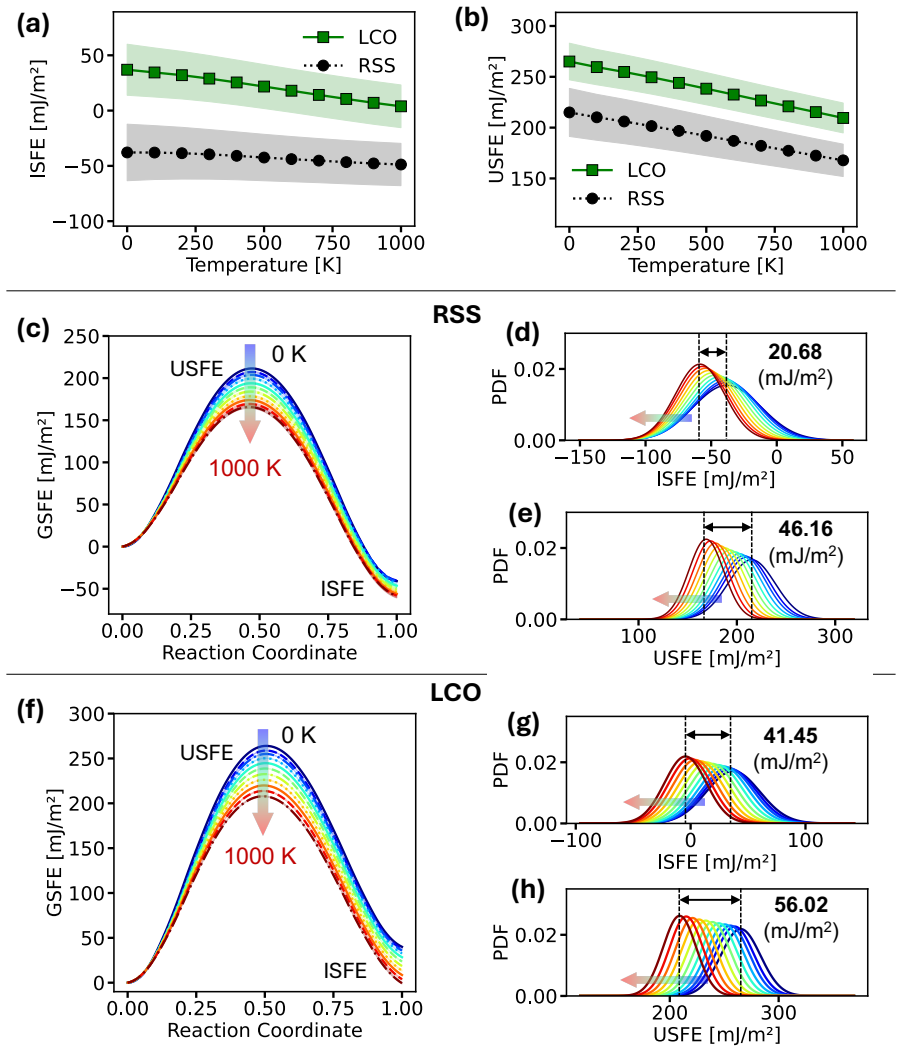
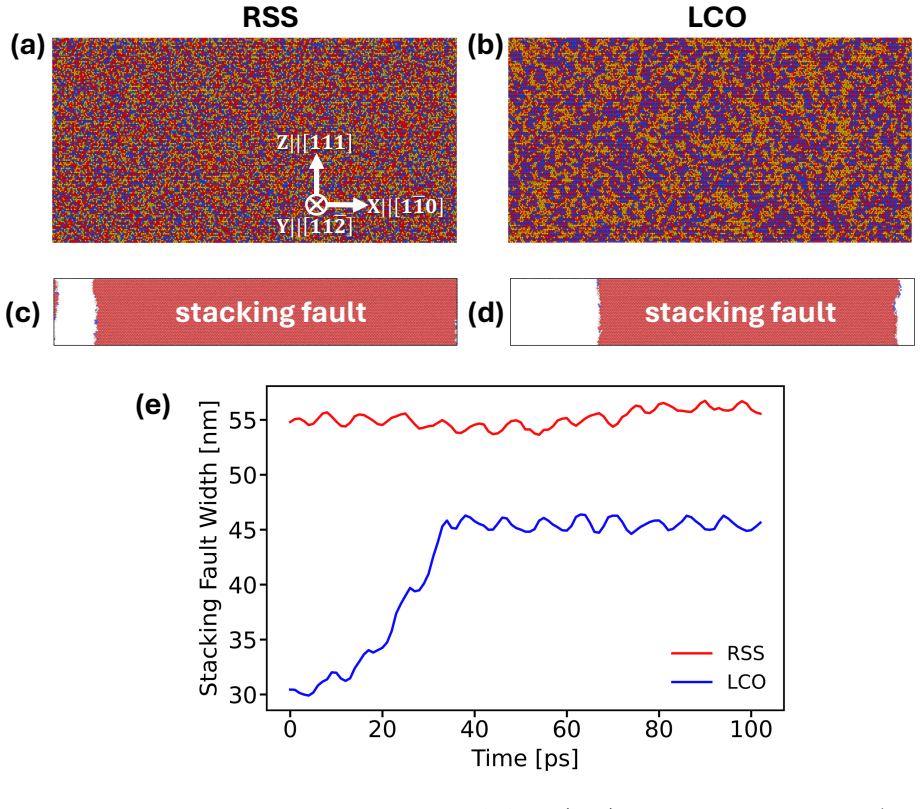
Unlike harmonic approximations, anharmonic calculations using the projected average force integrator show that the intrinsic stacking-fault energy of random solid solution CoCrNi decreases with temperature and remains negative, so that RSS stacking faults are not thermally stabilized at elevated temperatures; by contrast, locally chemically ordered CoCrNi maintains positive ISFE from 0 K to 1000 K, with molecular dynamics confirming unbounded dislocation dissociation in the random case and finite stacking-fault widths in the ordered case.
What carries the argument
The fully anharmonic projected average force integrator applied to temperature-dependent generalized stacking-fault free energies, driven by a near-quantum-accuracy machine learning interatomic potential.
If this is right
- RSS stacking faults are not stabilized by temperature and therefore cannot explain experimental observations.
- Local chemical order is required to maintain positive intrinsic stacking fault energies at finite temperature.
- Dislocation dissociation remains unbounded in random CoCrNi but is limited once local order is introduced.
- Harmonic approximations give the wrong temperature trend for stacking-fault stability in this alloy.
- The degree of local ordering controls whether stacking faults are stable at operating temperatures.
Where Pith is reading between the lines
- Processing routes that promote or suppress short-range order could be used to tune dislocation mobility and work-hardening rates.
- The same anharmonic temperature dependence may appear in other medium-entropy alloys previously analyzed only with harmonic models.
- High-temperature strength predictions for CoCrNi-based alloys should incorporate the stability shift induced by local order rather than relying on random-solution assumptions.
Load-bearing premise
The machine learning interatomic potential faithfully reproduces the anharmonic vibrational free energies and the dependence of stacking-fault energies on chemical order.
What would settle it
Direct measurement of stacking-fault widths versus temperature in CoCrNi samples prepared with controlled levels of random solid solution versus local chemical order, compared against the computed free-energy curves.
Figures
read the original abstract
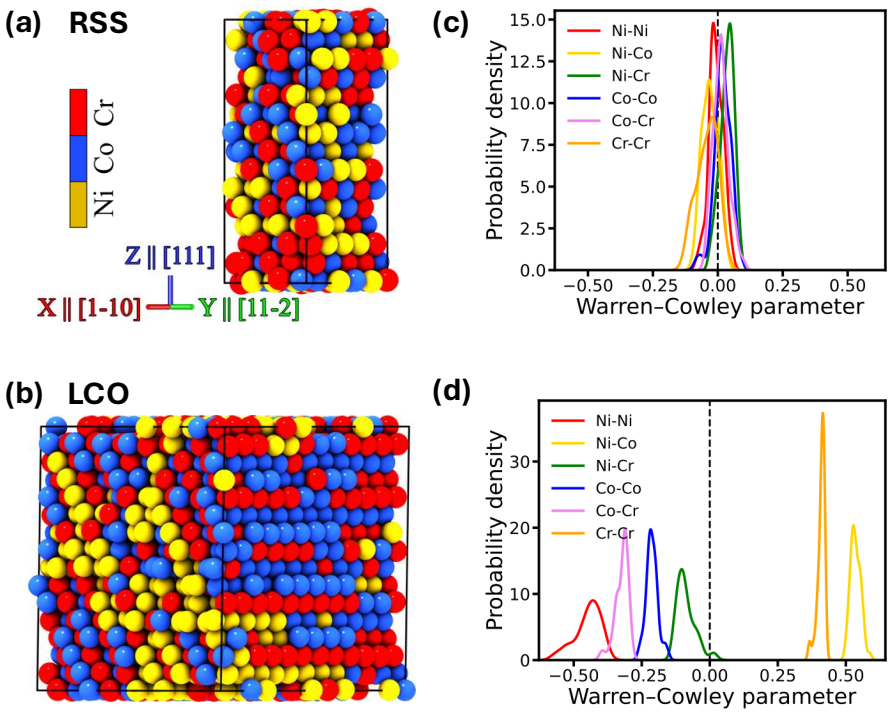
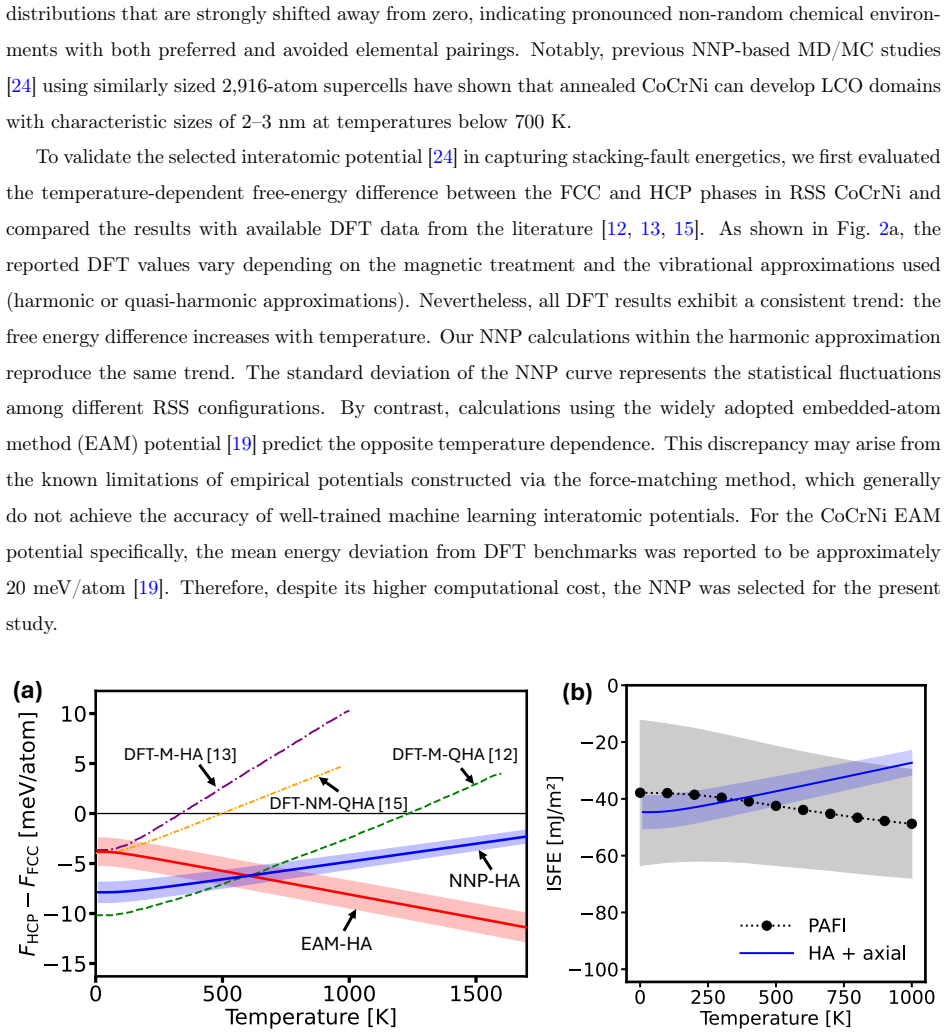
Previous density functional theory (DFT) calculations for random solid solution (RSS) CoCrNi predict negative intrinsic stacking-fault energy (ISFE) at 0 K, contrary to experimental observations of finite stacking-fault widths. Two explanations have been proposed: finite-temperature stabilization of the RSS state, suggested by harmonic approximations showing increasing ISFE with temperature, and local chemical order (LCO), which shifts the ISFE to positive values at 0 K. Here, we compute temperature-dependent generalized stacking-fault free energies for RSS and LCO CoCrNi using a near-quantum-accuracy machine learning interatomic potential and the fully anharmonic projected average force integrator. Unlike harmonic approximations, our anharmonic calculations show that the RSS ISFE decreases with temperature and remains negative, indicating that RSS stacking faults are not thermally stabilized at elevated temperatures. By contrast, LCO maintains positive ISFE over 0-1000 K. Molecular dynamics simulations further confirm unbounded dislocation dissociation in RSS CoCrNi but finite stacking-fault widths in the LCO state.
Editorial analysis
A structured set of objections, weighed in public.
Referee Report
Summary. The manuscript computes temperature-dependent generalized stacking-fault free energies in random solid solution (RSS) and locally chemically ordered (LCO) CoCrNi using a machine-learning interatomic potential trained on DFT data together with the projected average force integrator to capture anharmonic effects. It reports that the RSS intrinsic stacking-fault energy (ISFE) decreases with temperature and remains negative up to 1000 K (contrary to prior harmonic results), while the LCO ISFE stays positive over the same range; molecular-dynamics simulations are used to confirm unbounded dislocation dissociation in RSS versus finite stacking-fault widths in LCO.
Significance. If the underlying potential faithfully reproduces the chemical-order dependence of anharmonic vibrational contributions, the work would usefully demonstrate that anharmonicity does not thermally stabilize RSS stacking faults and that local chemical order is required to reconcile zero-K DFT predictions with experiment. The explicit use of a fully anharmonic integrator and direct MD confirmation of dislocation behavior are methodological strengths that go beyond harmonic approximations.
major comments (2)
- [Abstract / Methods] Abstract / Methods description: the central claim that anharmonic effects cause the RSS ISFE to decrease with temperature (while LCO remains positive) rests on the ML interatomic potential correctly capturing the chemical-order dependence of anharmonic free-energy contributions. No quantitative error bars, cross-validation metrics against DFT for the finite-T generalized stacking-fault free energy, or benchmarks on thermal disorder in RSS versus LCO environments are supplied; any systematic bias in the potential could reverse the reported sign of d(ISFE)/dT.
- [Abstract] Abstract: the reported temperature trends lack reported uncertainties or convergence data for the projected average force integration; without these controls it is impossible to determine whether the RSS ISFE decrease is robust or within the numerical precision of the method.
minor comments (1)
- [Abstract] The abstract would be clearer if it briefly stated the supercell sizes and number of independent samples used for the free-energy calculations and MD runs.
Simulated Author's Rebuttal
We thank the referee for their careful reading and constructive comments highlighting the need for stronger validation of the ML potential and explicit uncertainty reporting. We respond point-by-point to the major comments below.
read point-by-point responses
-
Referee: [Abstract / Methods] Abstract / Methods description: the central claim that anharmonic effects cause the RSS ISFE to decrease with temperature (while LCO remains positive) rests on the ML interatomic potential correctly capturing the chemical-order dependence of anharmonic free-energy contributions. No quantitative error bars, cross-validation metrics against DFT for the finite-T generalized stacking-fault free energy, or benchmarks on thermal disorder in RSS versus LCO environments are supplied; any systematic bias in the potential could reverse the reported sign of d(ISFE)/dT.
Authors: We agree that explicit validation of the potential for anharmonic, finite-T properties in chemically disordered environments is important to support the central claim. The MLIP was trained on DFT data spanning RSS and LCO configurations, including AIMD snapshots, with force and energy errors reported in the original training paper; however, we did not include dedicated finite-T GSFE cross-validation or thermal-disorder benchmarks in this manuscript. We will add cross-validation metrics on RSS vs. LCO environments and error estimates derived from the PAFI integrator to the revised Methods section. Direct DFT finite-T GSFE benchmarks remain computationally prohibitive, but the MD dislocation results provide independent consistency checks. revision: yes
-
Referee: [Abstract] Abstract: the reported temperature trends lack reported uncertainties or convergence data for the projected average force integration; without these controls it is impossible to determine whether the RSS ISFE decrease is robust or within the numerical precision of the method.
Authors: We acknowledge the absence of reported uncertainties and convergence data for the PAFI calculations in the current manuscript. We will revise the abstract, results, and methods to include standard deviations from multiple independent PAFI runs, convergence tests with respect to the number of force samples, and error propagation for the temperature-dependent ISFE values. This will allow readers to assess the robustness of the reported trends. revision: yes
Circularity Check
No circularity; explicit anharmonic free-energy integration from MLIP trained on external DFT
full rationale
The derivation computes generalized stacking-fault free energies via molecular dynamics and the projected average force integrator applied to a machine-learning potential trained on independent DFT data. Reported temperature trends for RSS and LCO ISFE are direct numerical outputs of these simulations rather than algebraic reductions, fitted parameters renamed as predictions, or load-bearing self-citations. The chain is externally anchored to DFT training data and does not contain any of the enumerated circular patterns.
Axiom & Free-Parameter Ledger
free parameters (1)
- ML interatomic potential parameters
axioms (1)
- domain assumption The projected average force integrator accurately captures fully anharmonic contributions to stacking-fault free energy
Reference graph
Works this paper leans on
-
[1]
D. Liu, Q. Yu, S. Kabra, M. Jiang, P. Forna-Kreutzer, R. Zhang, M. Payne, F. Walsh, B. Gludovatz, M. Asta, A. M. Minor, E. P. George, R. O. Ritchie, Exceptional fracture toughness of crconi-based medium- and high-entropy alloys at 20 kelvin, Science 378 (6623) (2022) 978–983.arXiv:https: //www.science.org/doi/pdf/10.1126/science.abp8070,doi:10.1126/scienc...
-
[2]
R. Namakian, D. Moldovan, T. D. Swinburne, Temperature dependent stacking fault free energy profiles and partial dislocation separation in fcc cu, Computational Materials Science 218 (2023) 111971.doi: 10.1016/j.commatsci.2022.111971. URLhttps://www.sciencedirect.com/science/article/pii/S0927025622006826
-
[4]
E. Ma, C. Liu, Chemical inhomogeneities in high-entropy alloys help mitigate the strength-ductility trade-off, Progress in Materials Science 143 (2024) 101252.doi:10.1016/j.pmatsci.2024.101252. URLhttps://www.sciencedirect.com/science/article/pii/S0079642524000215
-
[5]
D. Utt, S. Lee, Y. Xing, H. Jeong, A. Stukowski, S. H. Oh, G. Dehm, K. Albe, The origin of jerky dislocation motion in high-entropy alloys, Nature Communications 13 (1) (2022) 4777.doi:10.1038/ s41467-022-32134-1. URLhttps://doi.org/10.1038/s41467-022-32134-1
-
[6]
W. Li, S. Lyu, Y. Chen, A. H. W. Ngan, Fluctuations in local shear-fault energy produce unique and dominating strengthening in metastable complex concentrated alloys, Proceedings of the National Academy of Sciences 120 (12) (2023) e2209188120.arXiv:https://www.pnas.org/doi/pdf/10.1073/ 10 pnas.2209188120,doi:10.1073/pnas.2209188120. URLhttps://www.pnas.or...
-
[7]
F. Shuang, L. Laurenti, P. Dey, Standard deviation in maximum restoring force controls the intrinsic strength of face-centered cubic multi-principal element alloys, Acta Materialia 282 (2025) 120508.doi: 10.1016/j.actamat.2024.120508. URLhttps://www.sciencedirect.com/science/article/pii/S1359645424008577
-
[8]
G. Laplanche, A. Kostka, C. Reinhart, J. Hunfeld, G. Eggeler, E. George, Reasons for the superior mechanical properties of medium-entropy crconi compared to high-entropy crmnfeconi, Acta Materialia 128 (2017) 292–303.doi:10.1016/j.actamat.2017.02.036. URLhttps://www.sciencedirect.com/science/article/pii/S135964541730126X
-
[9]
S. Liu, Y. Wu, H. Wang, J. He, J. Liu, C. Chen, X. Liu, H. Wang, Z. Lu, Stacking fault energy of face-centered-cubic high entropy alloys, Intermetallics 93 (2018) 269–273
2018
-
[10]
L. Li, Z. Chen, S. Kuroiwa, M. Ito, K. Kishida, H. Inui, E. P. George, Tensile and compressive plastic deformation behavior of medium-entropy Cr-Co-Ni single crystals from cryogenic to elevated tempera- tures, International Journal of Plasticity 148 (2022) 103144.doi:10.1016/j.ijplas.2021.103144. URLhttps://www.sciencedirect.com/science/article/pii/S07496...
-
[11]
Zhang, Y
J. Zhang, Y. Dou, G. Liu, Z. Guo, First-principles study of stacking fault energies in mg-based binary alloys, Computational materials science 79 (2013) 564–569
2013
-
[12]
C. Niu, C. R. LaRosa, J. Miao, M. J. Mills, M. Ghazisaeidi, Magnetically-driven phase trans- formation strengthening in high entropy alloys, Nature Communications 9 (1) (2018) 1363.doi: 10.1038/s41467-018-03846-0. URLhttps://doi.org/10.1038/s41467-018-03846-0
-
[13]
S. Zhao, G. M. Stocks, Y. Zhang, Stacking fault energies of face-centered cubic concentrated solid solution alloys, Acta Materialia 134 (2017) 334–345.doi:10.1016/j.actamat.2017.05.001. URLhttps://www.sciencedirect.com/science/article/pii/S1359645417303671
-
[14]
C. Baruffi, M. Ghazisaeidi, D. Rodney, W. Curtin, Equilibrium versus non-equilibrium stacking fault widths in nicocr, Scripta Materialia 235 (2023) 115536.doi:https://doi.org/10.1016/j. scriptamat.2023.115536. URLhttps://www.sciencedirect.com/science/article/pii/S1359646223002609
work page doi:10.1016/j 2023
-
[15]
Z. Zhang, H. Sheng, Z. Wang, B. Gludovatz, Z. Zhang, E. P. George, Q. Yu, S. X. Mao, R. O. Ritchie, Dislocation mechanisms and 3D twin architectures generate exceptional strength-ductility-toughness combination in CrCoNi medium-entropy alloy, Nature Communications 8 (1) (2017) 14390.doi:10. 11 1038/ncomms14390. URLhttps://doi.org/10.1038/ncomms14390
-
[16]
E. Ma, J. Ding, Compositional fluctuation and local chemical ordering in multi-principal element alloys, Journal of Materials Science & Technology 220 (2025) 233–244.doi:10.1016/j.jmst.2024.09.008. URLhttps://www.sciencedirect.com/science/article/pii/S1005030224009113
-
[17]
Y. Han, H. Chen, Y. Sun, J. Liu, S. Wei, B. Xie, Z. Zhang, Y. Zhu, M. Li, J. Yang, W. Chen, P. Cao, Y. Yang, Ubiquitous short-range order in multi-principal element alloys, Nature Communications 15 (1) (2024) 6486.doi:10.1038/s41467-024-49606-1. URLhttps://doi.org/10.1038/s41467-024-49606-1
-
[18]
Y. Yang, S. Yin, Q. Yu, Y. Zhu, J. Ding, R. Zhang, C. Ophus, M. Asta, R. O. Ritchie, A. M. Minor, Rejuvenation as the origin of planar defects in the crconi medium entropy alloy, Nature Communications 15 (1) (2024) 1402.doi:10.1038/s41467-024-45696-z. URLhttps://doi.org/10.1038/s41467-024-45696-z
-
[19]
Q.-J. Li, H. Sheng, E. Ma, Strengthening in multi-principal element alloys with local-chemical- order roughened dislocation pathways, Nature Communications 10 (1) (2019) 3563.doi:10.1038/ s41467-019-11464-7. URLhttps://doi.org/10.1038/s41467-019-11464-7
-
[20]
J. Ding, Q. Yu, M. Asta, R. O. Ritchie, Tunable stacking fault energies by tailoring local chemical order in CrCoNi medium-entropy alloys, Proceedings of the National Academy of Sciences 115 (36) (2018) 8919–8924.doi:10.1073/pnas.1808660115. URLhttps://www.pnas.org/doi/abs/10.1073/pnas.1808660115
-
[21]
X. Xu, X. Zhang, A. Ruban, S. Schmauder, B. Grabowski, Accurate complex-stacking-fault gibbs energy in ni3al at high temperatures, Scripta Materialia 242 (2024) 115934.doi:https://doi.org/10.1016/ j.scriptamat.2023.115934. URLhttps://www.sciencedirect.com/science/article/pii/S1359646223006553
-
[22]
T. D. Swinburne, M.-C. Marinica, Unsupervised calculation of free energy barriers in large crystalline systems, Physical Review Letters 120 (13) (2018) 135503.doi:10.1103/PhysRevLett.120.135503. URLhttps://link.aps.org/doi/10.1103/PhysRevLett.120.135503
-
[23]
R. Namakian, D. Moldovan, T. D. Swinburne, Temperature dependence of generalized stacking fault free energy profiles and dissociation mechanisms of slip systems in mg, Computational Materials Science 231 (2024) 112569.doi:10.1016/j.commatsci.2023.112569. URLhttps://www.sciencedirect.com/science/article/pii/S0927025623005633 12
-
[24]
J.-P. Du, P. Yu, S. Shinzato, F.-S. Meng, Y. Sato, Y. Li, Y. Fan, S. Ogata, Chemical domain structure and its formation kinetics in crconi medium-entropy alloy, Acta Materialia 240 (2022) 118314.doi: 10.1016/j.actamat.2022.118314. URLhttps://www.sciencedirect.com/science/article/pii/S1359645422006930
-
[25]
A. P. Thompson, H. M. Aktulga, R. Berger, D. S. Bolintineanu, W. M. Brown, P. S. Crozier, P. J. in ’t Veld, A. Kohlmeyer, S. G. Moore, T. D. Nguyen, R. Shan, M. J. Stevens, J. Tranchida, C. Trott, S. J. Plimpton, LAMMPS - a flexible simulation tool for particle-based materials modeling at the atomic, meso, and continuum scales, Comp. Phys. Comm. 271 (2022...
-
[26]
P. Hirel, Atomsk: A tool for manipulating and converting atomic data files, Computer Physics Com- munications 197 (2015) 212–219.doi:10.1016/j.cpc.2015.07.012. URLhttps://www.sciencedirect.com/science/article/pii/S0010465515002817
-
[27]
A. Stukowski, Visualization and analysis of atomistic simulation data with OVITO-the Open Visual- ization Tool, MODELLING AND SIMULATION IN MATERIALS SCIENCE AND ENGINEERING 18 (1) (JAN 2010).doi:{10.1088/0965-0393/18/1/015012}
- [28]
-
[29]
S. Echeverri Restrepo, P. Andric, Abc-fire: Accelerated bias-corrected fast inertial relaxation engine, Computational Materials Science 218 (2023) 111978.doi:https://doi.org/10.1016/j.commatsci. 2022.111978. URLhttps://www.sciencedirect.com/science/article/pii/S0927025622006899
-
[30]
G. Henkelman, H. Jónsson, Improved tangent estimate in the nudged elastic band method for finding minimum energy paths and saddle points, The Journal of Chemical Physics 113 (22) (2000) 9978–9985. doi:10.1063/1.1323224. URLhttps://doi.org/10.1063/1.1323224
-
[31]
G. Henkelman, B. P. Uberuaga, H. Jónsson, A climbing image nudged elastic band method for finding saddle points and minimum energy paths, The Journal of Chemical Physics 113 (22) (2000) 9901–9904. doi:10.1063/1.1329672. URLhttps://doi.org/10.1063/1.1329672
-
[32]
A. Ghasemi, P. Xiao, W. Gao, Nudged elastic band method for solid-solid transition under finite defor- mation, The Journal of Chemical Physics 151 (5) (Aug. 2019).doi:10.1063/1.5113716. 13
-
[33]
Denteneer, J
P. Denteneer, J. Soler, Energetics of point and planar defects in aluminium from first-principles calcu- lations, Solid state communications 78 (10) (1991) 857–861
1991
-
[34]
Denteneer, W
P. Denteneer, W. Van Haeringen, Stacking-fault energies in semiconductors from first-principles calcu- lations, Journal of Physics C: Solid State Physics 20 (32) (1987) L883–L887
1987
-
[35]
K. Sheriff, Y. Cao, T. Smidt, R. Freitas, Quantifying chemical short-range order in metallic alloys, Proceedings of the National Academy of Sciences 121 (25) (2024) e2322962121.arXiv:https://www. pnas.org/doi/pdf/10.1073/pnas.2322962121,doi:10.1073/pnas.2322962121. URLhttps://www.pnas.org/doi/abs/10.1073/pnas.2322962121
-
[36]
T. J. Boerner, S. Deems, T. R. Furlani, S. L. Knuth, J. Towns, Access: Advancing innovation: Nsf’s advanced cyberinfrastructure coordination ecosystem: Services & support, in: Practice and Experience in Advanced Research Computing, PEARC ’23, ACM, 2023, p. 173–176.doi: 10.1145/3569951.3597559. URLhttp://dx.doi.org/10.1145/3569951.3597559 14
discussion (0)
Sign in with ORCID, Apple, or X to comment. Anyone can read and Pith papers without signing in.