REVIEW 4 major objections 5 minor 91 references
Probing the existence of a minimal length through compact binary inspiral
T0 review · 4 major / 5 minor · reviewed 2026-08-07 · deepseek-v4-flash
Pith's one-line read A minimal spacetime length would make black holes reflect low-frequency gravitational waves, shifting binary inspiral phases at 2.5 post-Newtonian order.
desk verdict A well-built phenomenological bridge from minimal length to GW phasing, but the load-bearing reflectivity rule is asserted rather than derived, so the headline constraints are conditional on an unproven step. read the letter →
The pith
A machine-rendered reading of the paper's core claim, the machinery that carries it, and where it could break.
The reading
What carries the argument
The key object is the qmetric, an effective metric built from bi-tensors that keeps the geodesic interval from shrinking below ℓ0², which forces a lower bound of 4πℓ0² on horizon area changes; combined with the first law of black-hole mechanics ΔM = (κ/8π)ΔA + Ωh ΔJ and the choice Δj = 2, this yields the step reflectivity |R(f)|² = 1 for f < fmin and 0 for f ≥ fmin, and the tidal-heating phase δϕQBH of Eq. (19), controlled by the minimum velocity vmin = (Mωmin/2)^{1/3}.
What would settle it
Look at a gravitational-wave event from a high-spin, nearly extremal binary, or an EMRI with a rapidly spinning primary: if the inspiral waveform shows the standard classical tidal-heating phase at frequencies far below the predicted fmin, meaning the holes absorb rather than reflect low-frequency radiation, the perfect-reflection step and the formula ωmin = κβ²/2 + 2Ωh are ruled out. Concretely, a matched-filter search for the δϕQBH term of Eq. (19) in a χ ≳ 0.25 event should find zero absorption if the paper is right; finding absorption with |R|² ≈ 0 at those frequencies falsifies the central claim.
Extended reading notes
Core claim
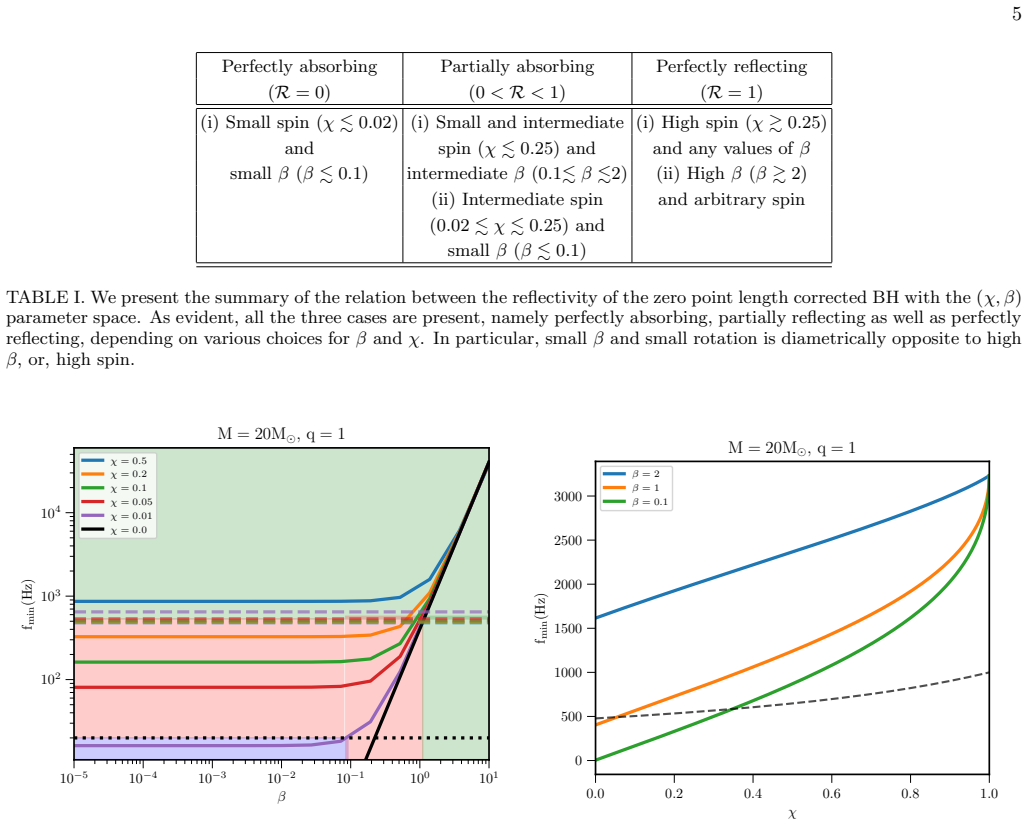
Within the qmetric description of quantum spacetime, the authors show that the zero-point length ℓ0 translates into a minimum area increment ΔA0 = 4πℓ0² for black-hole horizons. Using the first law of black-hole mechanics and assuming angular momentum changes by Δj = 2 (spin-2 gravitons), this yields a minimum absorption frequency ωmin = κβ²/2 + 2Ωh; below it the horizon is perfectly reflecting, above it the hole behaves classically. Inserting this step-function reflectivity into the tidal-heating flux gives a closed 2.5PN phasing correction whose dephasing against classical black holes is controlled by β. The observational punchline is that a detection of highly spinning, almost perfectly absorbing black holes would be in tension with the quantum picture, and if future detectors see no strongly reflecting black holes, the zero-point length must be at most about the Planck length, with the most promising window for bounding β at low spins and 0.1 ≲ β ≲ 2.
Load-bearing premise
If a black-hole horizon area cannot change by less than 4πℓ0², incoming waves that would cause a smaller area increase are reflected rather than absorbed—this step-function transition is assumed, not derived, and every waveform prediction in the paper hangs on it.
Editorial extensions
If this is right
- High-spin black holes (χ ≳ 0.25) are predicted to be perfectly reflecting throughout the inspiral band, so a detection of a high-spin binary with classically absorbing behaviour would be in direct tension with the minimal-length and angular-momentum-quantization picture.
- If the zero-point length exceeds the Planck length by β ≳ 2, black holes are perfectly reflecting up to the ISCO for all spins; observing absorbing black holes would therefore rule out models with ℓ0 much larger than ℓp, including the β ≈ 10^4 value suggested by a 4π cosmological-information argument.
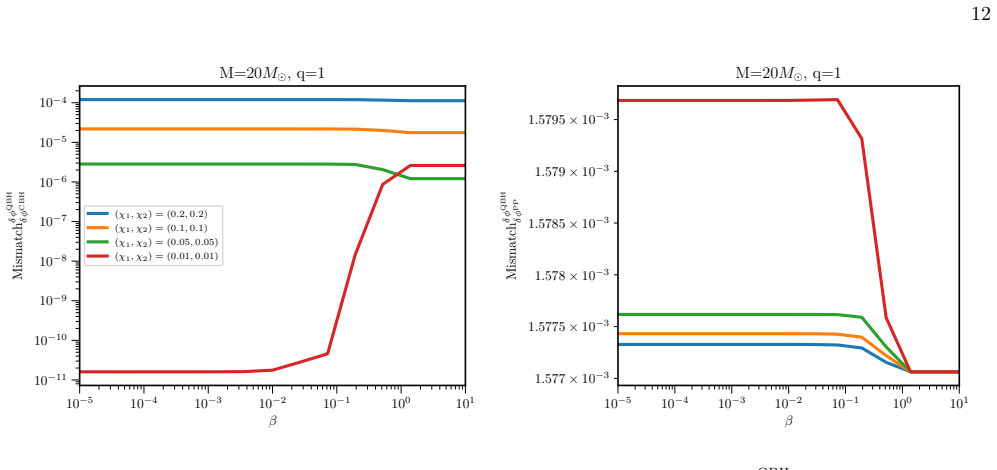
- The inspiral waveform carrying δϕQBH differs from both classical-black-hole and point-particle templates, and the mismatch analysis identifies low-spin, asymmetric-mass binaries as the best case for constraining β, though the single-event effect for current ground-based detectors is small.
- For extreme-mass-ratio inspirals, the number of cycles accumulated from tidal heating is at least about one for β ≲ 4, giving a realistic route to bounding the zero-point length with a future space-based detector.
- If the minimum frequency fmin lies below the detector cutoff (20 Hz for current ground-based detectors, 0.5 mHz for a space-based mission), the quantum-corrected black holes are indistinguishable from classical ones, so the constraints come from the parameter regions where fmin exceeds the detector band.
Reading between the lines
- The step-function reflectivity is the load-bearing phenomenological input; if instead reflectivity ramps smoothly over a frequency window, the sharp threshold and the logarithmic terms in Eq. (19) would be replaced by integrals, but the qualitative dephasing at low spin and β ~ 1 should survive.
- The same minimal-area logic should also apply to single black-hole ringdown and echo searches, not just tidal heating; echoes at frequencies below fmin are a direct corollary the paper mentions but does not quantify.
- The constraint β ≲ 2 from 'no perfectly reflecting black holes' can be viewed as a bound on the minimal length itself, ℓ0 ≲ 2ℓp, which would connect to other quantum-gravity phenomenology that places similar upper limits on a fundamental length scale.
- A testable extension is to stack many low-spin, asymmetric-mass binary events and look for a collective 2.5PN tidal-heating dephasing, which could overcome the O(10^-4) single-event mismatch the paper finds.
Editorial analysis
A structured set of objections, weighed in public.
Referee Report
Summary. The paper argues that a minimal (zero-point) length ℓ₀, treated through the qmetric construction, endows black-hole horizons with a minimum area increment ΔA₀ = 4πℓ₀², which translates into a minimum absorption frequency ω_min below which the hole is perfectly reflecting and above which it behaves classically. This frequency-dependent reflectivity is then inserted into the tidal-heating contribution to the inspiral phasing of binary black holes, giving a closed-form 2.5PN phase correction δϕ_QBH. The authors study mismatches for comparable-mass binaries with TaylorF2-type waveforms and compute accumulated cycles for extreme mass-ratio inspirals, concluding that β ≳ 2 and highly spinning absorbing black holes would be in tension with the minimal-length picture, while 0.1 ≲ β ≲ 2 is the most promising window for future LISA constraints.
Significance. If the central physical input were derived, the paper would identify a genuinely new observational channel for minimal-length physics: tidal heating is a low-order PN effect, and the predicted frequency threshold is in principle within the band of current and future detectors. The paper is also commendably explicit about its limitations: it reports that the comparable-mass Bayesian posterior for β is unconstrained and it provides closed-form phase expressions that can be reused or falsified. The main conceptual value is therefore the proposal of a concrete, testable phenomenological rule connecting a minimal area to GW phasing. However, the significance is presently conditional, because the perfect-reflection threshold is asserted rather than derived from the qmetric framework, and the high-spin conclusions rely on a separate angular-momentum quantization rule.
major comments (4)
- [Sec. II, closing paragraph and Eq. (10)] The step-function reflectivity |R(f)|² = 1 for f < f_min and 0 for f ≥ f_min is the load-bearing bridge of the paper, but it is not derived from the qmetric framework. The qmetric construction in Sec. II yields a limiting area in the coincidence limit; it does not imply that horizon area changes are discrete or that sub-threshold energy is forbidden to be absorbed. Appendix A confirms this reading: it derives only the lower bound ΔA ≳ 4πℓ_p² in Eq. (A6), and then adds a separate postulate that a quantum is either entirely engulfed or not engulfed at all. That postulate is exactly the step-function reflectivity, not a consequence of the preceding calculation. Since every β constraint in Eqs. (19)-(24) and the phase diagram in Table I depends on a sharp threshold, the central claim is currently conditional on an unproven assumption.
- [Eq. (8) and Sec. III] The minimum frequency ω_min = κβ²/2 + 2Ω_h contains two independent ingredients: the minimal-area threshold from ℓ₀ and angular-momentum quantization with Δj = 2. The latter is an input, not an output, of the minimal-length model. Consequently the high-spin branch (χ ≳ 0.25), for which f_min exceeds the ISCO frequency independently of β, is driven entirely by the term 2Ω_h and by the assumed Δj = 2 selection rule. The abstract and Sec. VI describe this as tension between absorbing high-spin black holes and 'the quantum properties of BH geometries,' but the tension is really with the added quantization postulate, not with the minimal length itself. This should be stated clearly and the conclusions re-scaled accordingly.
- [Eqs. (4)-(6)] The evaluation of the limiting area ΔA₀ = 4πℓ₀² assumes Δ_ℓ₀ ≈ 1 in all directions, justified by the condition ℓ₀ ≪ 1/√R. For vacuum Kerr spacetime the Ricci tensor vanishes, so this condition is vacuous and gives no license to set the van Vleck determinant to unity; the van Vleck determinant encodes nonlocal geodesic focusing and is not controlled by the local Ricci tensor alone. Since ΔA₀ is the input to Eq. (7) and hence to f_min, the quantitative value of the threshold is not established for the Kerr backgrounds used throughout the paper.
- [Sec. V and Eq. (24)] The EMRI 'golden window' claim (0.1 ≲ β ≲ 2, and β ≲ 4 being constrainable) is based on the number of accumulated cycles |N_cycles| plotted in Fig. 12. The number of cycles is not a detection or measurement criterion: it does not include SNR, detector noise, confusion noise, or a parameter-estimation covariance. The paper itself reports in Sec. IV that a comparable-mass Bayesian analysis yields an unconstrained posterior for β, and the mismatch in Figs. 10-11 is only O(10⁻⁴). Without a noise-weighted Fisher or Bayesian treatment for LISA EMRIs, the statement that β can be 'well constrained' by EMRIs is not supported by the analysis presented.
minor comments (5)
- [Eq. (8)] The quantity β² appears inside the surface-gravity term of ω_min; since β is defined as a ratio of lengths, it may be worth stating explicitly whether natural units with ℓ_p = 1 are being used, so that the dimensions of the expression are transparent.
- [Sec. III, footnote 1] The footnote's explanation that 'the magnetic part of the total angular momentum must reach till (j+2)' is too terse to be checkable; a few equations defining the quantum numbers j, m and the allowed Δm for quadrupolar radiation would remove ambiguity.
- [Sec. III, paragraph after Eq. (16)] The statement that 'the requirement of the cosmological information being 4π' yields β = 10⁴ is asserted without a derivation or a precise reference; please supply the argument or move this remark to a footnote with a full derivation.
- [Fig. 10] The right panel of Fig. 10 has a very narrow y-axis range (1.577×10⁻³ to 1.579×10⁻³), which visually exaggerates the β-dependence of the mismatch; a linear scale from zero would better represent the small magnitude of the effect.
- [References] Reference [50] is listed as 'Work in Progress (2025)' and should be replaced by a published preprint or removed, since it does not allow the reader to verify the claimed connection.
Circularity Check
Appendix A's heuristic 'derivation' of the minimal area is a self-definitional restatement of the all-or-nothing engulfment postulate, so the step-function reflectivity that drives all waveform predictions is an input rather than a derived consequence.
-
self definitional
[Appendix A, Eqs. (A5)-(A6), used to justify the reflectivity assigned in Eq. (10) and the minimum frequency in Eq. (8)]
"As a basic tenet of quantum physics we assume that a quantum of energy is either entirely engulfed by the horizon or it is not engulfed at all; that is we forbid that, e.g. a photon, can be in a situation in which it is only partially engulfed. ... Using this in Eq. (A4) we obtain, ∆A ≳ 4πℓ2p."
The appendix presents this as a heuristic derivation of the limiting area increment from quantum principles. But the 'basic tenet' introduced here is exactly the threshold behavior later asserted in the main text: Eq. (10) sets |R(f)|^2 = 1 for f < fmin and 0 for f ≥ fmin, i.e., a GW quantum is either wholly absorbed or wholly reflected. The uncertainty-principle chain (A5)-(A6) only converts this all-or-nothing engulfment postulate into an area lower bound; it adds no independent evidence for the cutoff. Thus the claimed derivation of ΔAmin, and hence of ωmin in Eq. (8) and the reflectivity that enters every waveform prediction (Eqs. 19 and 24), reduces to the model's own input.
full rationale
The main-text chain is not circular in the simple fitting sense: Eq. (6) is a genuine qmetric limit-area result, and Eq. (8) follows from standard BH mechanics once a minimal area and angular-momentum quantization are assumed. The defect is at the crucial bridge from minimal area to perfect reflection. The paper states, without derivation from the qmetric, that an area change smaller than ΔA0 causes the incident energy to be reflected. Appendix A attempts to justify the corresponding area bound, but its 'basic tenet of quantum physics' is the all-or-nothing engulfment assumption, which is logically equivalent to the step-function reflectivity of Eq. (10). Consequently the headline prediction—a minimum absorption frequency and the resulting tidal-heating dephasing—is a recoding of the threshold input together with the standard tidal-heating calculus. The self-citations to [75] (qmetric area) and [81] (tidal-heating phase) are load-bearing but appear to be prior independent derivations, so I treat them as support rather than circularity; they do, however, make the observable forecast heavily dependent on the authors' earlier framework. The high-spin, β-independent conclusions additionally require the separate Δj = 2 quantization assumption stated in Sec. II, which is an input rather than an output of the minimal-length model. Overall, partial circularity is present at the reflectivity step, but the central minimal-area result retains independent content.
Assumptions & free parameters
free parameters (1)
- beta = ell_0 / ell_p
assumptions (5)
- domain assumption The qmetric construction with a minimal length ell_0 yields a finite transverse area in the coincidence limit.
- ad hoc to paper The van Vleck determinant in the coincidence limit is approximately unity (Delta_ell0 ~ 1).
- ad hoc to paper Black hole angular momentum is quantized, J^2 ~ hbar^2*j*(j+1), and absorption occurs via Delta_j = 2.
- ad hoc to paper An incident GW quantum whose associated area change is below Delta_A0 is perfectly reflected.
- standard math Standard first law of BH mechanics and stationary phase approximation for GW phasing.
Cite this review
Pith. "Pith review of Probing the existence of a minimal length through compact binary inspiral." pith.science (2026). https://pith.science/paper/ULJOXKHF
@misc{pith2026250522877,
  author       = {Pith},
  title        = {Pith review of: Probing the existence of a minimal length through compact binary inspiral},
  year         = {2026},
  howpublished = {\url{https://pith.science/paper/ULJOXKHF}},
  note         = {Machine review of arXiv:2505.22877}
}
read the original abstract
Existence of a minimal length in spacetime geometries avoids several singular situations involving quantum theory and gravity. In this work, we show that the existence of such a minimal length also affects the gravitational wave (GW) waveform of any inspiraling binary black hole (BH) system by introducing a minimum frequency, below which the BHs behave as perfectly reflecting compact objects, while above they are identical to classical BHs. This leads to a significant imprint on the tidal heating term, appearing in the GW waveform at 2.5 post Newtonian order. Based on these modifications to the inspiraling waveform, it turns out that the detection of highly spinning and highly absorbing, almost classical BH like compact objects, inspiraling around each other, would be in tension with the quantum properties of BH geometries. The same would also be true if the zero point length exceeds the Planck length by a significant amount, suggesting that the zero point length, if it exists, must be of the same order as the Planck length, or smaller, purely from GW observations.
Figures


Figures from the paper (9 more)




Reference graph
Works this paper leans on
-
[1]
v3 − v3 v4 Ψ5 4 + 995 168 + 952 168 η v3 − v3 v2 Ψ5 4 − v3 − v3 v Ψ8 2 + Ψ5 2 (4π + FSO) # = 10 32η 2X i=1
Using the laws of BH mechanics for a rotating BH of mass M and angular momentum J, the above minimum area change can be translated to a minimum change of BH mass as, ∆Mmin = κ 8π 4πβ 2ℓ2 p + ∆J 2 4M M 2 + √ M 4 − J 2 . (7) Here we have defined the parameter β ≡ (ℓ0/ℓp), where, ℓp is the Planck length, and is a free parameter of the problem. Moreover, the ...
-
[2]
B. P. Abbott et al. (LIGO Scientific, Virgo), Phys. Rev. Lett. 116, 061102 (2016), arXiv:1602.03837 [gr-qc]
arXiv 2016
-
[3]
B. P. Abbott et al. (LIGO Scientific, Virgo), Phys. Rev. D 100, 104036 (2019), arXiv:1903.04467 [gr-qc]
arXiv 2019
-
[4]
R. Abbott et al. (LIGO Scientific, Virgo), Phys. Rev. D 103, 122002 (2021), arXiv:2010.14529 [gr-qc]
arXiv 2021
-
[5]
R. Abbott et al. (LIGO Scientific, VIRGO, KAGRA), (2021), arXiv:2112.06861 [gr-qc]
arXiv 2021
-
[6]
R. Abbott et al. (LIGO Scientific, VIRGO, KAGRA), Astron. Astrophys. 659, A84 (2022), arXiv:2105.15120 [astro-ph.HE]
arXiv 2022
-
[7]
A. H. Nitz, S. Kumar, Y.-F. Wang, S. Kastha, S. Wu, M. Sch¨ afer, R. Dhurkunde, and C. D. Capano, Astro- phys. J. 946, 59 (2023), arXiv:2112.06878 [astro-ph.HE]
arXiv 2023
-
[8]
R. Abbott et al. (LIGO Scientific, VIRGO), Phys. Rev. D 109, 022001 (2024), arXiv:2108.01045 [gr-qc]
arXiv 2024
Show all 91 references
-
[9]
Abbott et al
R. Abbott et al. (LIGO Scientific, Virgo), Phys. Rev. X 11, 021053 (2021), arXiv:2010.14527 [gr-qc]
2021 arXiv
-
[10]
Olsen, T
S. Olsen, T. Venumadhav, J. Mushkin, J. Roulet, B. Za- ckay, and M. Zaldarriaga, Phys. Rev. D 106, 043009 (2022), arXiv:2201.02252 [astro-ph.HE]
2022 arXiv
-
[11]
C. M. Will, Living Rev. Rel. 17, 4 (2014), arXiv:1403.7377 [gr-qc]
2014 arXiv
-
[12]
B. S. Sathyaprakash et al. , (2019), arXiv:1903.09221 [astro-ph.HE]
2019
-
[13]
Berti, A
E. Berti, A. Sesana, E. Barausse, V. Cardoso, and K. Belczynski, Phys. Rev. Lett. 117, 101102 (2016), arXiv:1605.09286 [gr-qc]
2016 arXiv
-
[14]
Dreyer, B
O. Dreyer, B. J. Kelly, B. Krishnan, L. S. Finn, D. Garri- son, and R. Lopez-Aleman, Class. Quant. Grav. 21, 787 (2004), arXiv:gr-qc/0309007
2004 arXiv
-
[15]
Berti, K
E. Berti, K. Yagi, and N. Yunes, Gen. Rel. Grav. 50, 46 (2018), arXiv:1801.03208 [gr-qc]
2018 arXiv
-
[16]
Berti, K
E. Berti, K. Yagi, H. Yang, and N. Yunes, Gen. Rel. Grav. 50, 49 (2018), arXiv:1801.03587 [gr-qc]
2018 arXiv
-
[17]
Barack et al
L. Barack et al. , Class. Quant. Grav. 36, 143001 (2019), arXiv:1806.05195 [gr-qc]
2019 arXiv
-
[18]
B. S. Sathyaprakash and B. F. Schutz, Living Rev. Rel. 12, 2 (2009), arXiv:0903.0338 [gr-qc]
2009 arXiv
-
[19]
Agullo, V
I. Agullo, V. Cardoso, A. del Rio, M. Maggiore, and J. Pullin, Phys. Rev. Lett. 126, 041302 (2021), arXiv:2007.13761 [gr-qc]
2021 arXiv
-
[20]
Cardoso, V
V. Cardoso, V. F. Foit, and M. Kleban, J. Cosmol. As- tropart. Phys. 08, 006 (2019), arXiv:1902.10164 [hep-th]
2019 arXiv
-
[21]
Cardoso and P
V. Cardoso and P. Pani, Living Rev. Rel. 22, 4 (2019), arXiv:1904.05363 [gr-qc]
2019 arXiv
-
[22]
P. Pani, E. Berti, V. Cardoso, Y. Chen, and R. Norte, Phys. Rev. D 80, 124047 (2009), arXiv:0909.0287 [gr-qc]
2009 arXiv
-
[23]
Poisson, Phys
E. Poisson, Phys. Rev. D70, 084044 (2004), arXiv:gr- qc/0407050 [gr-qc]
2004
-
[24]
Alvi, Phys
K. Alvi, Phys. Rev. D 64, 104020 (2001), arXiv:gr- qc/0107080
2001
-
[25]
Chakraborty, S
S. Chakraborty, S. Datta, and S. Sau, Phys. Rev. D 104, 104001 (2021), arXiv:2103.12430 [gr-qc]
2021 arXiv
- [26]
-
[27]
Datta, R
S. Datta, R. Brito, S. Bose, P. Pani, and S. A. Hughes, Phys. Rev. D 101, 044004 (2020), arXiv:1910.07841 [gr- qc]
2020 arXiv
-
[28]
Chatziioannou, E
K. Chatziioannou, E. Poisson, and N. Yunes, Phys. Rev. D 87, 044022 (2013), arXiv:1211.1686 [gr-qc]
2013 arXiv
-
[29]
M. V. S. Saketh, J. Steinhoff, J. Vines, and A. Buonanno, Phys. Rev. D 107, 084006 (2023), arXiv:2212.13095 [gr- qc]
2023 arXiv
-
[30]
Chakraborty, G
S. Chakraborty, G. Comp` ere, and L. Machet, (2024), arXiv:2412.14831 [gr-qc]. 17
2024 arXiv
-
[31]
Chakraborty, E
S. Chakraborty, E. Maggio, M. Silvestrini, and P. Pani, Phys. Rev. D 110, 084042 (2024), arXiv:2310.06023 [gr- qc]
2024 arXiv
-
[32]
Cardoso, E
V. Cardoso, E. Franzin, A. Maselli, P. Pani, and G. Ra- poso, Phys. Rev. D 95, 084014 (2017), [Addendum: Phys.Rev.D 95, 089901 (2017)], arXiv:1701.01116 [gr-qc]
2017 arXiv
-
[33]
Creci, T
G. Creci, T. Hinderer, and J. Steinhoff, Phys. Rev. D 104, 124061 (2021), [Erratum: Phys.Rev.D 105, 109902 (2022)], arXiv:2108.03385 [gr-qc]
2021 arXiv
-
[34]
Chakravarti, S
K. Chakravarti, S. Chakraborty, S. Bose, and S. SenGupta, Phys. Rev. D 99, 024036 (2019), arXiv:1811.11364 [gr-qc]
2019 arXiv
-
[35]
Binnington and E
T. Binnington and E. Poisson, Phys. Rev. D80, 084018 (2009), arXiv:0906.1366 [gr-qc]
2009 arXiv
-
[36]
Nagar and S
A. Nagar and S. Akcay, Phys. Rev. D85, 044025 (2012), arXiv:1112.2840 [gr-qc]
2012 arXiv
-
[37]
R. F. Rosato, S. Biswas, S. Chakraborty, and P. Pani, Phys. Rev. D 111, 084051 (2025), arXiv:2501.16433 [gr- qc]
2025 arXiv
-
[38]
Abedi, N
J. Abedi, N. Afshordi, N. Oshita, and Q. Wang, Universe 6, 43 (2020), arXiv:2001.09553 [gr-qc]
2020 arXiv
-
[39]
Q. Wang, N. Oshita, and N. Afshordi, Phys. Rev. D 101, 024031 (2020), arXiv:1905.00446 [gr-qc]
2020 arXiv
-
[40]
Z. Mark, A. Zimmerman, S. M. Du, and Y. Chen, Phys. Rev. D96, 084002 (2017), arXiv:1706.06155 [gr-qc]
2017 arXiv
-
[41]
Pani and V
P. Pani and V. Ferrari, Class. Quant. Grav. 35, 15LT01 (2018), arXiv:1804.01444 [gr-qc]
2018 arXiv
-
[42]
R. A. Konoplya and A. Zhidenko, Rev. Mod. Phys. 83, 793 (2011), arXiv:1102.4014 [gr-qc]
2011 arXiv
-
[43]
K. D. Kokkotas and B. G. Schmidt, Living Rev. Rel. 2, 2 (1999), arXiv:gr-qc/9909058 [gr-qc]
1999 arXiv
-
[44]
Biswas, M
S. Biswas, M. Rahman, and S. Chakraborty, Phys. Rev. D 106, 124003 (2022), arXiv:2205.14743 [gr-qc]
2022 arXiv
-
[45]
Chakraborty, E
S. Chakraborty, E. Maggio, A. Mazumdar, and P. Pani, Phys. Rev. D 106, 024041 (2022), arXiv:2202.09111 [gr- qc]
2022 arXiv
-
[46]
M. A. Scheel et al. , (2025), arXiv:2505.13378 [gr-qc]
2025
-
[47]
K. Paul, A. Maurya, Q. Henry, K. Sharma, P. Satheesh, Divyajyoti, P. Kumar, and C. K. Mishra, Phys. Rev. D 111, 084074 (2025), arXiv:2409.13866 [gr-qc]
2025 arXiv
-
[48]
Datta and K
S. Datta and K. S. Phukon, Phys. Rev. D 104, 124062 (2021), arXiv:2105.11140 [gr-qc]
2021 arXiv
-
[49]
Chakravarti, R
K. Chakravarti, R. Ghosh, and S. Sarkar, Phys. Rev. D 104, 084049 (2021), arXiv:2108.02444 [gr-qc]
2021 arXiv
-
[50]
Chakravarti, R
K. Chakravarti, R. Ghosh, and S. Sarkar, Phys. Rev. D 105, 044046 (2022), arXiv:2112.10109 [gr-qc]
2022 arXiv
-
[51]
Krishnendu, R
N. Krishnendu, R. Ghosh, S. Datta, S. Chakraborty, and P. Ajith, Work in Progress (2025)
2025
-
[52]
J. D. Bekenstein, Lett. Nuovo Cimento 11, 467 (1974)
1974
- [53]
-
[54]
Chakraborty and K
S. Chakraborty and K. Lochan, Phys. Lett. B 789, 276 (2019), arXiv:1711.10660 [gr-qc]
2019 arXiv
-
[55]
Lochan and S
K. Lochan and S. Chakraborty, Phys. Lett. B 755, 37 (2016), arXiv:1509.09010 [gr-qc]
2016 arXiv
-
[56]
Hod, Phys
S. Hod, Phys. Rev. Lett. 81, 4293 (1998), arXiv:gr- qc/9812002
1998
-
[57]
V. F. Mukhanov, JETP Letters 44, 63 (1986)
1986
-
[58]
J. F. Barbero G., J. Lewandowski, and E. J. S. Vil- lase˜ nor, Phys. Rev. D80, 044016 (2009), arXiv:0905.3465 [gr-qc]
2009 arXiv
-
[59]
Padmanabhan, Gen
T. Padmanabhan, Gen. Rel. Grav. 17, 215 (1985)
1985
-
[60]
Padmanabhan, Annals Phys
T. Padmanabhan, Annals Phys. 165, 38 (1985)
1985
-
[61]
L. J. Garay, Int. J. Mod. Phys. A 10, 145 (1995), arXiv:gr-qc/9403008
1995 arXiv
- [62]
-
[63]
Padmanabhan, Phys
T. Padmanabhan, Phys. Rev. Lett. 78 (1997), arXiv:hep- th/9608182
1997
-
[64]
Fontanini, E
M. Fontanini, E. Spallucci, and T. Padmanabhan, Phys. Lett. B 633, 627 (2006), arXiv:hep-th/0509090
2006 arXiv
-
[65]
Bishop, J
M. Bishop, J. Contreras, P. Martin, P. Nicolini, and D. Singleton, Phys. Lett. B 847, 138263 (2023), arXiv:2307.05367 [quant-ph]
2023 arXiv
- [66]
-
[67]
Kothawala and T
D. Kothawala and T. Padmanabhan, Phys. Rev. D 90, 124060 (2014), arXiv:1405.4967 [gr-qc]
2014 arXiv
-
[68]
D. J. Stargen and D. Kothawala, Phys. Rev. D92, 024046 (2015), arXiv:1503.03793 [gr-qc]
2015 arXiv
- [69]
-
[70]
Padmanabhan, Int
T. Padmanabhan, Int. J. Mod. Phys. D 29, 2030001 (2020), arXiv:1909.02015 [gr-qc]
2020 arXiv
-
[71]
Padmanabhan, S
T. Padmanabhan, S. Chakraborty, and D. Kothawala, Gen. Rel. Grav. 48, 55 (2016), arXiv:1507.05669 [gr-qc]
2016 arXiv
-
[72]
Chakraborty, D
S. Chakraborty, D. Kothawala, and A. Pesci, Phys. Lett. B 797, 134877 (2019), arXiv:1904.09053 [gr-qc]
2019 arXiv
-
[73]
Chatziioannou, E
K. Chatziioannou, E. Poisson, and N. Yunes, Phys. Rev. D 94, 084043 (2016), arXiv:1608.02899 [gr-qc]
2016 arXiv
-
[74]
J. B. Hartle, Phys. Rev. D 8, 1010 (1973)
1973
- [75]
-
[76]
Pesci, Class
A. Pesci, Class. Quant. Grav. 36, 075009 (2019), [Erratum: Class.Quant.Grav. 36, 229501 (2019)], arXiv:1812.01275 [gr-qc]
2019 arXiv
-
[77]
J. H. Van Vleck, Proceedings of the National Academy of Science 14, 178 (1928)
1928
-
[78]
Morette, Phys
C. Morette, Phys. Rev. 81, 848 (1951)
1951
-
[79]
B. S. DeWitt and R. W. Brehme, Annals Phys. 9, 220 (1960)
1960
-
[80]
B. S. DeWitt, Conf. Proc. C 630701, 585 (1964)
1964
-
[81]
Padmanabhan, Entropy 17, 7420 (2015), arXiv:1508.06286 [gr-qc]
T. Padmanabhan, Entropy 17, 7420 (2015), arXiv:1508.06286 [gr-qc]
2015 arXiv
-
[82]
N. V. Krishnendu and S. Chakraborty, Phys. Rev. D109, 124047 (2024), arXiv:2402.15336 [gr-qc]
2024 arXiv
-
[83]
Padmanabhan and H
T. Padmanabhan and H. Padmanabhan, Phys. Lett. B 773, 81 (2017), arXiv:1703.06144 [gr-qc]
2017 arXiv
-
[84]
Tichy, E
W. Tichy, E. E. Flanagan, and E. Poisson, Phys. Rev. D 61, 104015 (2000), arXiv:gr-qc/9912075
2000 arXiv
-
[85]
S. Nair, S. Chakraborty, and S. Sarkar, Phys. Rev. D 107, 124041 (2023), arXiv:2208.06235 [gr-qc]
2023 arXiv
-
[86]
Ajith et al
P. Ajith et al. , J. Astrophys. Astron. 46, 6 (2025), arXiv:2501.04333 [astro-ph.IM]
2025 arXiv
-
[87]
Borhanian and B
S. Borhanian and B. S. Sathyaprakash, Phys. Rev. D110, 083040 (2024), arXiv:2202.11048 [gr-qc]
2024 arXiv
-
[88]
Maggiore et al
M. Maggiore et al. (ET), JCAP 03, 050 (2020), arXiv:1912.02622 [astro-ph.CO]
2020 arXiv
-
[89]
Padmanabhan, Gravitation: Foundations and fron- tiers (Cambridge University Press, 2010)
T. Padmanabhan, Gravitation: Foundations and fron- tiers (Cambridge University Press, 2010)
2010
-
[90]
Jacobson, Phys
T. Jacobson, Phys. Rev. Lett. 75, 1260 (1995), arXiv:gr- qc/9504004
1995
-
[91]
Pesci, Entropy 17, 5799 (2015), arXiv:1404.7631 [gr- qc]
A. Pesci, Entropy 17, 5799 (2015), arXiv:1404.7631 [gr- qc]
2015 arXiv
Reviewed August 7, 2026 · model on record in the stance chip above.
Discussion (0). Sign in to comment.