REVIEW 3 major objections 5 minor 31 references
Towards Seamless Borders: A Method for Mitigating Inconsistencies in Image Inpainting and Outpainting
T0 review · 3 major / 5 minor · reviewed 2026-08-07 · deepseek-v4-flash
Pith's one-line read The paper argues that boundary artifacts in diffusion-based inpainting and outpainting come from a VAE and a training procedure mismatched to latent blending, and that fine-tuning the VAE on masked images plus a two-step training loss…
desk verdict The two training fixes are plausible and probably worth stealing, but Algorithm 1's timestep mismatch and the unfair baseline comparison make the current claims unverifiable as written. read the letter →
The pith
A machine-rendered reading of the paper's core claim, the machinery that carries it, and where it could break.
The reading
What carries the argument
The load-bearing object is the blending operation of Blended Latent Diffusion, $z_t = z_t * (1 - m_{\text{resized}}) + z_{\text{masked},t} * m_{\text{resized}}$, carried over into training. The refined VAE makes that blending well-posed by fine-tuning the encoder-decoder pair on the mixed input $E(x) * (1 - m) + E(x * m) * m$, eliminating the decoder's color seam. The two-step training paradigm makes the denoiser consistent with inference by feeding its own blended prediction back through the noise schedule and adding a second velocity-matching loss with a corrected noise target.
What would settle it
Train or fine-tune at least two released baselines (for example, PowerPaint and BrushNet) on the same filtered LAION-Aesthetic subset, with the same mask generation, resolution, and step count, then compare color distance and FID on BrushBench; if the gap shrinks to noise, the benefit comes from extra training data rather than from the refined VAE and two-step loss. A second direct check is to run the proposed two-step training without the refined VAE on solid-color-background masks, where the paper's ablations predict visible color seams should reappear.
Extended reading notes
Core claim
In the standard Blended Latent Diffusion pipeline, the denoising loop replaces $z_t$ with $z_t * (1 - m_{\text{resized}}) + z_{\text{masked},t} * m_{\text{resized}}$ at each step, and the final image is pasted similarly. The paper's diagnosis is that the VAE maps masked images to a different part of latent space than it maps complete images, so the blended latent decodes with a color seam; and because training never applies this blending, the denoiser learns an objective that differs from inference. It fixes the first by fine-tuning the VAE with the reconstruction target $\hat{x} = D(E(x) * (1 - m_{\text{resized}}) + E(x * m) * m_{\text{resized}})$, so the latent space becomes continuous across the mask. It fixes the second with a two-step loss: predict $v$, recover $\hat{z}_0$, blend it with the masked latent, noisify to the next timestep, compute the true noise for that updated latent, and optimize $L_1 + \lambda L_2$ against both targets. With both changes, the generated region matches the original in color and structure at the boundary while the unmasked pixels remain exactly the original pixels.
Load-bearing premise
The comparison fine-tunes the proposed model on a large filtered LAION-Aesthetic subset while all baselines are evaluated from released checkpoints with no additional fine-tuning, so if the baselines were trained on the same data the reported improvements could shrink or disappear.
Editorial extensions
If this is right
- Users can edit or extend images without the usual trade-off between preserving the unmasked region and avoiding a visible border.
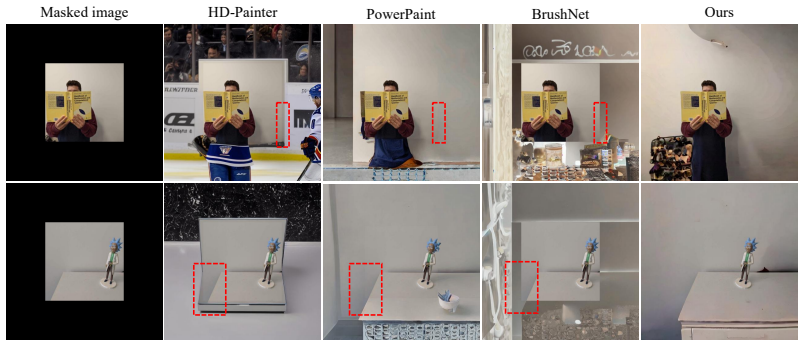
- The approach works for both inpainting and outpainting from the same recipe, since only the mask distribution differs during training.
- Color distance at the mask boundary drops substantially relative to released baselines, indicating the seam is measurable and not just perceptual.
- Each component contributes separately: the refined VAE carries the color continuity, the two-step training carries the structural coherence, and their combination is additive.
- The small loss weight $\lambda$ allows the second training step to act as a regularizer rather than a second training regime, so it can be added to existing diffusion fine-tuning schedules.
Reading between the lines
- If the refined VAE is the main carrier of color continuity, it should reduce boundary artifacts when attached to other latent-diffusion inpainting systems, a transfer the paper does not report.
- The two-step loss is effectively a self-consistency regularizer on the blending loop; extending it to more than two steps, or to classifier-free guidance at the predicted step, is a natural next test.
- Because the VAE refinement is stated as a generic masked-reconstruction objective, it could be applied to other masked-image tasks such as object removal or redaction, where boundary color is also critical.
- Readers should be careful about attribution: the comparison fine-tunes the proposed model on a large filtered dataset while baselines run from released checkpoints, so a same-data control is needed to separate the method's contribution from the extra training data.
Editorial analysis
A structured set of objections, weighed in public.
Referee Report
Summary. The paper addresses boundary inconsistencies in diffusion-based image inpainting and outpainting. It proposes two modifications: (1) a refined VAE that is fine-tuned to reconstruct masked-image blends via a modified objective (Eq. 6), reducing color discontinuities at mask boundaries, and (2) a two-step training paradigm (Algorithm 1) that simulates the inference-time blending operation by predicting z0, blending it with the masked latent, re-noising, and computing a second loss. The method is evaluated on BrushBench against BLD, HD-Painter, PowerPaint, and BrushNet, reporting FID, aesthetic score, a color-distance metric, a 20-participant user study, and ablations. The central claim is that the combination of the refined VAE and two-step training effectively mitigates discontinuities and improves perceptual quality.
Significance. If the central claim is supported, the paper offers a simple and potentially practical way to reduce boundary artifacts in diffusion inpainting/outpainting without changing the base architecture. The VAE fine-tuning objective directly targets a known inconsistency, and the two-step training idea is clearly motivated. The paper is generally clearly written and the problem is well-motivated. However, the significance is moderated by the lack of released code, the confounded experimental comparison, and the limited quantitative evidence (no error bars, small user study). The claimed benefits are plausible but not yet convincingly established.
major comments (3)
- [Algorithm 1, line 9 (Sec. 3.4)] The second loss term conditions the denoiser on timestep t while the input latent z_{t-1} is at noise level t-1. In line 6, z_{t-1} is built from z0_hat using sqrt(alpha_{t-1}), and the v-prediction target v2 in line 8 is defined for timestep t-1 via Eq. (3). Feeding (z_{t-1}, t) to v_theta mis-specifies the noise level of the input, so the training objective does not simulate the inference-time process, where the model is invoked with matching (z_s, s). A reader implementing Algorithm 1 exactly would train with this mismatch. If the intended conditioning is t-1, this is a typo that should be fixed; if t is intentional, the paper must justify it. Because the central claim rests on the two-step training paradigm, this point is load-bearing.
- [Section 4, Dataset and Tables 1-2] The proposed model is fine-tuned on a large filtered LAION-Aesthetic subset, while all baselines are evaluated from their released checkpoints with no additional fine-tuning. This confounds the comparison: the reported gains in FID, AS, and CD could result from the extra training data rather than from the VAE refinement and two-step loss. To support the claim that the method itself is responsible for the improvements, the authors should fine-tune at least one strong baseline (e.g., SD-Inpainting or PowerPaint) on the same data and training budget, or otherwise control for data and compute.
- [Section 4, Evaluation metrics and Sec. 4.3] The CD metric measures exactly the color discontinuity at the mask boundary that the refined VAE is trained to minimize (Eq. 6), so the large CD improvements in Tables 1-2 and 4 are partly an expected consequence of the training objective rather than independent evidence of general improvement. The paper should explicitly acknowledge this circularity and provide additional metrics that are not directly optimized, such as LPIPS or user-rated structure coherence, and report error bars or significance tests for the quantitative results. The user study in Sec. 4.3 involves only 20 participants, which is a weak basis for the claim that results are preferred most frequently.
minor comments (5)
- [Sec. 1] There is a typo: 'diffussion' should be 'diffusion'.
- [Sec. 3.3 and Fig. 2 caption] The word 'opreation' should be 'operation'.
- [Sec. 4.2] 'Quantitive evaluation' should be 'Quantitative evaluation'.
- [Sec. 4, Evaluation metrics] The definition of CD is vague; the paper should specify exactly which boundary pixels and neighboring pixels are used and how their L2 distance is aggregated.
- [Sec. 4.3] The user study description is unclear about whether all 20 participants evaluated the same 100 images; please clarify the protocol and report participant-level agreement or variance.
Circularity Check
No significant circularity: the proposed losses are training objectives, not fitted inputs renamed as predictions, and the headline CD gain is not forced by construction.
full rationale
The paper's contribution is a training recipe (refined VAE objective in Eq. 6 plus a two-step denoiser loss in Algorithm 1), not a derivation that reduces to its inputs. The refined VAE is trained to reconstruct the blended latent, which is a legitimate training objective; the CD metric is evaluated on the separate BrushBench benchmark, and Table 4 shows that fine-tuning the VAE alone yields CD 15.354, nearly the same as BLD's 15.735, so the large reported CD improvement (8.538) is not a direct consequence of the VAE's training objective alone. The two-step loss constructs a target v2 from the true z0 and the blended estimate, which is a valid supervised target, not a circularly defined prediction. No self-citation is load-bearing, no uniqueness theorem is imported from the authors' prior work, and no known result is merely renamed. The Algorithm 1 line 9 timestep mismatch (conditioning on t while the latent is at level t-1) is a technical correctness concern, not a circularity, and the evaluation-fairness issue about baselines not being fine-tuned is a comparison-validity concern rather than a circular derivation. The central method has independent empirical content, so the circularity score is 0.
Assumptions & free parameters
free parameters (7)
- lambda (two-step loss weight) =
0.5
- denoising steps =
50 (stride 20 over 1000)
- guidance scale =
3
- aesthetic score threshold =
6.0
- image resolution threshold =
512x512
- inpainting mask generation =
random masks within U2Net background
- outpainting mask generation =
mask around edges, central portion retained
assumptions (5)
- standard math DDPM v-prediction training objective (Eq. 2, 3) and the stable diffusion latent space are taken as given.
- domain assumption Blending in latent space and then decoding (Eq. 6) is a valid approximation for image-space blending of masked and unmasked content.
- domain assumption The same noise realization is used for the masked latent and the generated latent during the two-step training, making blending-before-noise equivalent to blending-after-noise.
- domain assumption The fine-tuned VAE trained at 256x256 generalizes to all evaluation resolutions in BrushBench.
- domain assumption Color Distance computed as the L2 RGB distance between boundary and neighboring pixels is a valid measure of visual seamlessness.
Cite this review
Pith. "Pith review of Towards Seamless Borders: A Method for Mitigating Inconsistencies in Image Inpainting and Outpainting." pith.science (2026). https://pith.science/paper/ULZ75KBF
@misc{pith2026250612530,
  author       = {Pith},
  title        = {Pith review of: Towards Seamless Borders: A Method for Mitigating Inconsistencies in Image Inpainting and Outpainting},
  year         = {2026},
  howpublished = {\url{https://pith.science/paper/ULZ75KBF}},
  note         = {Machine review of arXiv:2506.12530}
}
read the original abstract
Image inpainting is the task of reconstructing missing or damaged parts of an image in a way that seamlessly blends with the surrounding content. With the advent of advanced generative models, especially diffusion models and generative adversarial networks, inpainting has achieved remarkable improvements in visual quality and coherence. However, achieving seamless continuity remains a significant challenge. In this work, we propose two novel methods to address discrepancy issues in diffusion-based inpainting models. First, we introduce a modified Variational Autoencoder that corrects color imbalances, ensuring that the final inpainted results are free of color mismatches. Second, we propose a two-step training strategy that improves the blending of generated and existing image content during the diffusion process. Through extensive experiments, we demonstrate that our methods effectively reduce discontinuity and produce high-quality inpainting results that are coherent and visually appealing.
Figures


Figures from the paper (5 more)




Reference graph
Works this paper leans on
-
[1]
Omri Avrahami, Ohad Fried, and Dani Lischinski. Blended latent diffusion. ACM transactions on graphics (TOG) , 42 (4):1–11, 2023. 2, 3, 6, 8
work page 2023
-
[2]
Generative adversarial nets
Ian Goodfellow, Jean Pouget-Abadie, Mehdi Mirza, Bing Xu, David Warde-Farley, Sherjil Ozair, Aaron Courville, and Yoshua Bengio. Generative adversarial nets. Advances in neural information processing systems, 27, 2014. 2
2014
-
[3]
Gans trained by a two time-scale update rule converge to a local nash equilib- rium
Martin Heusel, Hubert Ramsauer, Thomas Unterthiner, Bernhard Nessler, and Sepp Hochreiter. Gans trained by a two time-scale update rule converge to a local nash equilib- rium. Advances in neural information processing systems , 30, 2017. 6
2017
-
[4]
Denoising dif- fusion probabilistic models
Jonathan Ho, Ajay Jain, and Pieter Abbeel. Denoising dif- fusion probabilistic models. Advances in neural information processing systems, 33:6840–6851, 2020. 2, 3
2020
-
[5]
Zheng Hui, Jie Li, Xiumei Wang, and Xinbo Gao. Image fine-grained inpainting. arXiv preprint arXiv:2002.02609 ,
work page Pith review arXiv 2002
-
[6]
Brushnet: A plug-and-play image inpaint- ing model with decomposed dual-branch diffusion
Xuan Ju, Xian Liu, Xintao Wang, Yuxuan Bian, Ying Shan, and Qiang Xu. Brushnet: A plug-and-play image inpaint- ing model with decomposed dual-branch diffusion. arXiv preprint arXiv:2403.06976, 2024. 2, 3, 6, 8
arXiv 2024
-
[7]
Analyzing and improv- ing the image quality of stylegan
Tero Karras, Samuli Laine, Miika Aittala, Janne Hellsten, Jaakko Lehtinen, and Timo Aila. Analyzing and improv- ing the image quality of stylegan. In Proceedings of the IEEE/CVF conference on computer vision and pattern recognition, pages 8110–8119, 2020. 2
2020
-
[8]
Auto-encoding varia- tional bayes
Diederik P Kingma and Max Welling. Auto-encoding varia- tional bayes. arXiv preprint arXiv:1312.6114, 2013. 2, 3
arXiv 2013
Show all 31 references
-
[9]
Rethinking image inpainting via a mutual encoder- decoder with feature equalizations
Hongyu Liu, Bin Jiang, Yibing Song, Wei Huang, and Chao Yang. Rethinking image inpainting via a mutual encoder- decoder with feature equalizations. In Computer Vision– ECCV 2020: 16th European Conference, Glasgow, UK, Au- gust 23–28, 2020, Proceedings, Part II 16 , pages 725–7...
2020
-
[10]
Repaint: Inpainting using denoising diffusion probabilistic models
Andreas Lugmayr, Martin Danelljan, Andres Romero, Fisher Yu, Radu Timofte, and Luc Van Gool. Repaint: Inpainting using denoising diffusion probabilistic models. In Proceed- ings of the IEEE/CVF conference on computer vision and pattern recognition, pages 11461–11471, 2022. 2
2022
-
[11]
Hd-painter: high-resolution and prompt-faithful text-guided image inpainting with diffusion models
Hayk Manukyan, Andranik Sargsyan, Barsegh Atanyan, Zhangyang Wang, Shant Navasardyan, and Humphrey Shi. Hd-painter: high-resolution and prompt-faithful text-guided image inpainting with diffusion models. arXiv preprint arXiv:2312.14091, 2023. 2, 3, 6, 8
2023 arXiv
-
[12]
Aim 2020 challenge on image extreme inpainting
Evangelos Ntavelis, Andr ´es Romero, Siavash Bigdeli, Radu Timofte, Zheng Hui, Xiumei Wang, Xinbo Gao, Chajin Shin, Taeoh Kim, Hanbin Son, et al. Aim 2020 challenge on image extreme inpainting. In Computer Vision–ECCV 2020 Work- shops: Glasgow, UK, August 23–28, 2020, Proceedi...
2020
-
[13]
Scalable diffusion models with transformers
William Peebles and Saining Xie. Scalable diffusion models with transformers. In Proceedings of the IEEE/CVF Inter- national Conference on Computer Vision, pages 4195–4205,
-
[14]
Gen- erating diverse structure for image inpainting with hierar- chical vq-vae
Jialun Peng, Dong Liu, Songcen Xu, and Houqiang Li. Gen- erating diverse structure for image inpainting with hierar- chical vq-vae. In Proceedings of the IEEE/CVF conference on computer vision and pattern recognition , pages 10775– 10784, 2021. 2
2021
-
[15]
U2-net: Go- ing deeper with nested u-structure for salient object detec- tion
Xuebin Qin, Zichen Zhang, Chenyang Huang, Masood De- hghan, Osmar R Zaiane, and Martin Jagersand. U2-net: Go- ing deeper with nested u-structure for salient object detec- tion. Pattern recognition, 106:107404, 2020. 5
2020
-
[16]
High-resolution image synthesis with latent diffusion models
Robin Rombach, Andreas Blattmann, Dominik Lorenz, Patrick Esser, and Bj ¨orn Ommer. High-resolution image synthesis with latent diffusion models. In Proceedings of the IEEE/CVF Conference on Computer Vision and Pattern Recognition (CVPR), pages 10684–10695, 2022. 2, 3
2022
-
[17]
Palette: Image-to-image diffusion models
Chitwan Saharia, William Chan, Huiwen Chang, Chris Lee, Jonathan Ho, Tim Salimans, David Fleet, and Mohammad Norouzi. Palette: Image-to-image diffusion models. In ACM SIGGRAPH 2022 conference proceedings, pages 1–10,
2022
-
[18]
Progressive distillation for fast sampling of diffusion models
Tim Salimans and Jonathan Ho. Progressive distillation for fast sampling of diffusion models. arXiv preprint arXiv:2202.00512, 2022. 3
2022 arXiv
-
[19]
Mi-gan: A simple baseline for image in- painting on mobile devices
Andranik Sargsyan, Shant Navasardyan, Xingqian Xu, and Humphrey Shi. Mi-gan: A simple baseline for image in- painting on mobile devices. InProceedings of the IEEE/CVF International Conference on Computer Vision, pages 7335– 7345, 2023. 2
2023
-
[20]
Laion-5b: An open large-scale dataset for training next generation image-text models
Christoph Schuhmann, Romain Beaumont, Richard Vencu, Cade Gordon, Ross Wightman, Mehdi Cherti, Theo Coombes, Aarush Katta, Clayton Mullis, Mitchell Worts- man, et al. Laion-5b: An open large-scale dataset for training next generation image-text models. Advances in Neural In- f...
2022
-
[21]
Denoising diffusion implicit models
Jiaming Song, Chenlin Meng, and Stefano Ermon. Denoising diffusion implicit models. arXiv preprint arXiv:2010.02502, 2020. 2
2010 arXiv
-
[22]
Resolution-robust large mask inpainting with fourier convolutions
Roman Suvorov, Elizaveta Logacheva, Anton Mashikhin, Anastasia Remizova, Arsenii Ashukha, Aleksei Silvestrov, Naejin Kong, Harshith Goka, Kiwoong Park, and Victor Lempitsky. Resolution-robust large mask inpainting with fourier convolutions. InProceedings of the IEEE/CVF winter...
2022
-
[23]
Smartbrush: Text and shape guided object inpainting with diffusion model
Shaoan Xie, Zhifei Zhang, Zhe Lin, Tobias Hinz, and Kun Zhang. Smartbrush: Text and shape guided object inpainting with diffusion model. In Proceedings of the IEEE/CVF Con- ference on Computer Vision and Pattern Recognition, pages 22428–22437, 2023. 3
2023
-
[24]
Image completion with heterogeneously filtered spectral hints
Xingqian Xu, Shant Navasardyan, Vahram Tadevosyan, An- dranik Sargsyan, Yadong Mu, and Humphrey Shi. Image completion with heterogeneously filtered spectral hints. In Proceedings of the IEEE/CVF Winter Conference on Appli- cations of Computer Vision, pages 4591–4601, 2023. 2
2023
-
[25]
A review of image in- painting methods based on deep learning
Zishan Xu, Xiaofeng Zhang, Wei Chen, Minda Yao, Jueting Liu, Tingting Xu, and Zehua Wang. A review of image in- painting methods based on deep learning. Applied Sciences, 13(20):11189, 2023. 2
2023
-
[26]
Diffusion models: A comprehensive survey of methods and applications
Ling Yang, Zhilong Zhang, Yang Song, Shenda Hong, Run- sheng Xu, Yue Zhao, Wentao Zhang, Bin Cui, and Ming- Hsuan Yang. Diffusion models: A comprehensive survey of methods and applications. ACM Computing Surveys, 56(4): 1–39, 2023. 2
2023
-
[27]
Uctgan: Diverse image inpainting based on unsupervised cross-space translation
Lei Zhao, Qihang Mo, Sihuan Lin, Zhizhong Wang, Zhiwen Zuo, Haibo Chen, Wei Xing, and Dongming Lu. Uctgan: Diverse image inpainting based on unsupervised cross-space translation. In Proceedings of the IEEE/CVF conference on computer vision and pattern recognition, pages 5741–5750,
-
[28]
Large scale image comple- tion via co-modulated generative adversarial networks.arXiv preprint arXiv:2103.10428, 2021
Shengyu Zhao, Jonathan Cui, Yilun Sheng, Yue Dong, Xiao Liang, Eric I Chang, and Yan Xu. Large scale image comple- tion via co-modulated generative adversarial networks.arXiv preprint arXiv:2103.10428, 2021. 2
2021 arXiv
-
[29]
Pluralistic image completion
Chuanxia Zheng, Tat-Jen Cham, and Jianfei Cai. Pluralistic image completion. In Proceedings of the IEEE/CVF Con- ference on Computer Vision and Pattern Recognition, pages 1438–1447, 2019. 2
2019
-
[30]
Cm-gan: Image inpainting with cascaded modulation gan and object-aware training
H Zheng, Z Lin, J Lu, S Cohen, E Shechtman, C Barnes, J Zhang, N Xu, S Amirghodsi, and J Luo. Cm-gan: Image inpainting with cascaded modulation gan and object-aware training. arxiv 2022.arXiv preprint arXiv:2203.11947, 2022. 2
2022 arXiv
-
[31]
A task is worth one word: Learning with task prompts for high-quality versatile image inpainting
Junhao Zhuang, Yanhong Zeng, Wenran Liu, Chun Yuan, and Kai Chen. A task is worth one word: Learning with task prompts for high-quality versatile image inpainting. arXiv preprint arXiv:2312.03594, 2023. 1, 2, 3, 6, 8 10
2023 arXiv
Reviewed August 7, 2026 · model on record in the stance chip above.
Discussion (0). Sign in to comment.