REVIEW 4 major objections 5 minor 46 references
Representation gaps of rigid planar diagram monoids
T0 review · 4 major / 5 minor · reviewed 2026-08-15 · deepseek-v4-flash
Pith's one-line read This paper claims that rigid, non-pivotal versions of the Temperley–Lieb, Motzkin, and planar rook monoids have representation gaps exponentially smaller than their pivotal counterparts, making them generally worse for cryptographic…
desk verdict New rigid diagram monoids with a solid TL/planar-rook analysis, but the Motzkin comparison has a load-bearing inconsistency and an unavailable key reference. read the letter →
The pith
A machine-rendered reading of the paper's core claim, the machinery that carries it, and where it could break.
The reading
What carries the argument
The machinery is cell theory for finite monoids, using Green's relations to decompose diagrams by the number of through strands. For the rigid Temperley–Lieb monoid $\mathrm{rTL}_n$, every diagram factors as $\tau \circ 1_k \circ \beta$ with $k$ even through strands, giving right cells of size $\binom{n-1}{(2n-k)/2}$ and explicit simple-representation dimensions. For the rigid Motzkin monoid, through-strand sequences form a poset and right-cell sizes are computed via Catalan $k$-fold convolutions, simplified with a hypergeometric Chu–Vandermonde identity. For the rigid planar rook monoid, the same sequence combinatorics gives binomial cell sizes and proves the monoid is semisimple over any field. Truncation, by taking Rees quotients that keep only the dominant through-strand interval, is used so that the smallest nontrivial simple representation determines the gap.
What would settle it
Compute the smallest nontrivial simple representation of the pivotal Motzkin monoid $\mathrm{Mo}_n$ for $n = 10$ through $20$ by direct Gram-matrix rank calculation: if the exponential growth factor is below $9^n$, then Corollary 5C.8's comparison collapses.
Extended reading notes
Core claim
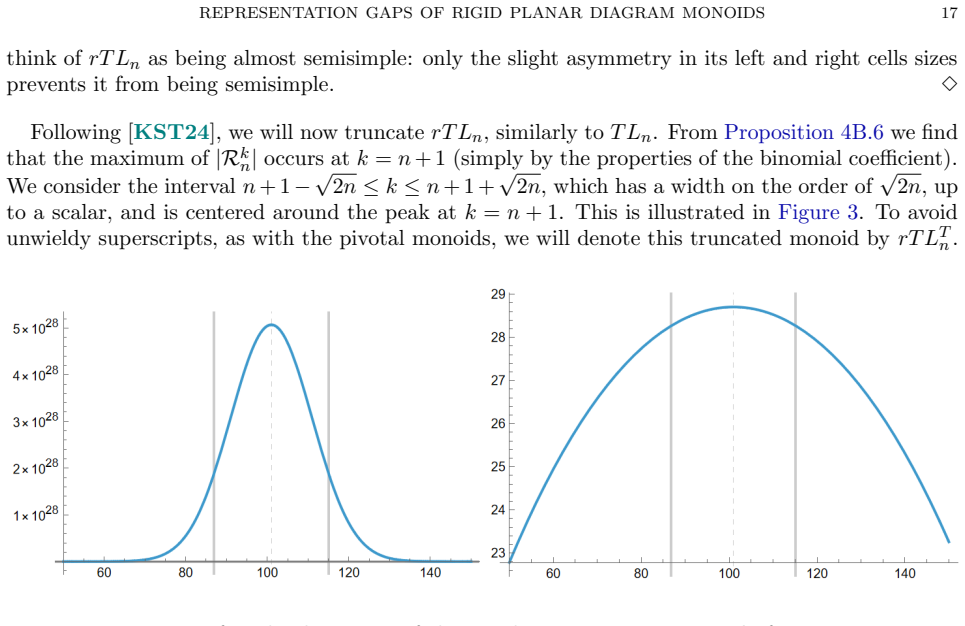
On the paper's own terms, the discovery is that passing from a pivotal to a non-pivotal rigid planar diagram monoid lowers the exponential growth of the RepGap. For the rigid Temperley–Lieb monoid, the gap lies between $\Omega(n^{-1/2} 2^n)$ and $O(n^{-1/2} 2^n)$, whereas the pivotal TL monoid has gap between $\Omega(n^{-5/2} 4^n)$ and $O(n^{-3/2} 4^n)$. For the rigid Motzkin monoid, the semisimple gap lies between $\Omega(n^{-3/2} 4^n)$ and $O(n^{-1} 4^n)$, while the pivotal Motzkin gap has a lower bound of $\Omega(9^n)$. For the rigid planar rook monoid, the gap is $O(n^{-1/2} 2^n)$ versus a pivotal lower bound of $\Omega(n^{-1/2} 4^n)$, and its gap ratio decays at most like $0.87^n$. These comparisons support the paper's conclusion that the rigid non-pivotal monoids are generally worse for cryptographic purposes, despite the rigid Temperley–Lieb monoid having a slightly better gap ratio.
Load-bearing premise
The comparison depends on the unpublished lower bound that the pivotal Motzkin monoid's RepGap grows like $9^n$; if that bound is wrong or overstated, the paper's main conclusion for the Motzkin case loses its support.
Editorial extensions
If this is right
- If the bounds are correct, a cryptosystem built on the rigid Temperley–Lieb monoid can be reduced to linear algebra of dimension at most $O(n^{-1/2} 2^n)$, while the pivotal version offers dimension at least $\Omega(n^{-5/2} 4^n)$; the rigid version is exponentially easier to attack.
- For the Motzkin monoid, even the semisimple dimension, which is an upper bound for the true simple dimension, grows only like $4^n$ in exponential base for the rigid version, compared with a $9^n$ lower bound for the pivotal version, so the rigid version cannot offer comparable security.
- For the planar rook monoid, the rigid gap ratio decays like $0.87^n$, meaning the gap becomes exponentially small relative to the square root of the monoid size, the weakest profile among the monoids studied.
- The three cases together support the paper's general statement that pivotal planar diagram monoids are better suited than their non-pivotal analogs for the cryptographic applications considered.
- The comparison uses the paper's more generous RepGap definition, which agrees with the earlier definition on the reference monoids, so the conclusion is not an artifact of a stricter gap definition.
Reading between the lines
- Editorial inference: the recurring $2^n$-versus-$4^n$ pattern suggests a broader principle—breaking pivotal symmetry may halve the exponential base of the smallest simple representation, so other two-colour or oriented diagram monoids could show similar drops if constructed along the same lines.
- One stress test is to compute RepGaps for the full untruncated monoids or for different truncation widths; the paper's conclusions are stated for the chosen truncations, and it is not yet known whether the exponential separation survives under all reasonable truncation choices.
- Because the rigid Temperley–Lieb monoid is characteristic-free while the pivotal one changes dramatically in prime characteristic, the cryptographic ranking drawn in characteristic zero may not transfer to protocols over finite fields; positive-characteristic analysis would settle that.
- If the unpublished $9^n$ Motzkin bound is independently verified, the same cell-size formulas could be sharpened to give explicit constants, turning the asymptotic $\Omega$ and $O$ bounds into $\Theta$ estimates.
Signed reviews
Editorial analysis
A structured set of objections, weighed in public.
Referee Report
Summary. The paper defines rigid, non-pivotal analogues of the Temperley–Lieb, Motzkin, and planar rook monoids, computes bounds on the sizes of their simple (or cell) representations, and compares the resulting representation gaps and gap ratios with the pivotal versions. It concludes that the non-pivotal monoids are generally worse for cryptographic purposes.
Significance. If the technical claims are correct, the paper provides the first systematic comparison of pivotal versus non-pivotal planar diagram monoids from the point of view of representation gaps, with explicit cell-size formulas and concrete asymptotic bounds. The rTL and rpRo legs rest on self-contained derivations, and the paper ships reproducible code on GitHub for the computer-assisted parts. However, the Motzkin comparison depends on an unpublished thesis, and the headline claims about the rigid Motzkin monoid are stated for the RepGap while only semisimple bounds are proved.
major comments (4)
- [§3A, Theorem 3A.3] The two displayed bounds for Gap_K(MoT_n), namely f(n)·9^n ≤ Gap_K(MoT_n) ≤ 2^{-3/2} n^{-3/2} 4^n, are mutually incompatible for large n because (9/4)^n grows exponentially. As written, at least one of the bounds is wrong or mis-stated; this directly affects Corollary 5C.8 and the Motzkin row of the table in the introduction.
- [§3A, proof of Theorem 3A.3] The pivotal Motzkin lower bound is cited to [Ar25], an unpublished honours thesis with no public text. This bound is load-bearing for the paper's central comparison, so the authors should either give a self-contained proof of the 9^n exponential growth or make the thesis available and ensure the quoted statement is correct, especially in light of the inconsistency noted above.
- [§1B and §5C] The abstract and Table 1 report Gap^{1/n}→4 and Ratio^{1/n}→1 for the rigid Motzkin monoid, but Theorem 3B.6 and Theorem 5C.6 only establish bounds on the semisimple gap ssGap. Since Gap ≤ ssGap by Lemma 2A.10, these bounds do not determine the exponential growth of the actual RepGap; the claims must be rephrased as semisimple-gap statements or supplemented with genuine RepGap bounds.
- [§4C, Proposition 4C.1] The proof that the right cell representations of rTL_n are simple is sketched and contains an internal inconsistency: the text first states that wx ∉ W for a suitable x, but the displayed computation proves xw ∉ W. The proof also assumes without justification that a nontrivial invariant subspace W contains an element with at least one cap. Because this proposition underpins the rTL gap bounds, a complete and correct proof is needed.
minor comments (5)
- [§5C, Corollary 5C.8] The notation '∋ Ratio_K MoT_n' is non-standard and should be replaced by an explicit statement such as 'Ratio_K(MoT_n) ∈ [Ω((1−ε)^n), O((1+ε)^n)]'.
- [§6B, Proposition 6B.1] In the displayed formula for |rpRo_n|, the factor 'binom{n+j}{2}^2' should read 'binom{n+j}{k}^2'.
- [§6C, Theorem 6C.4] The upper bound for the gap ratio is typeset as '23n/233n/45−5n/4'; this should be 2^{3n/2}3^{3n/4}5^{-5n/4}.
- [Remark 3B.5] There is a typo: 'the difference wll not play a role' should be 'will not play a role'.
- [References] The bibliography entry [CG23] lists the authors as 'S. Doty and A. Giaquinto', but the citation key begins with 'C'; this mismatch should be fixed.
Circularity Check
No circularity: the non-pivotal RepGap bounds are derived from explicit cell counts and Stirling asymptotics, while the pivotal benchmarks are external prior results; no prediction is equivalent to its input by construction.
full rationale
The non-pivotal bounds in Theorems 4C.3, 5C.6, and 6C.4 are derived from independently computed cell sizes (e.g. Proposition 4B.6: |R_k^n| = binom(n-1,(2n-k)/2), and Proposition 5B.13 for the Motzkin cells), followed by Stirling asymptotics and explicit Catalan/hypergeometric identities. These quantities are not fitted to the pivotal comparison and do not presuppose the paper's conclusion. The pivotal benchmarks are quoted from prior published work [KST24] for TL and pRo, and from the unpublished honours thesis [Ar25] for the Motzkin 9^n lower bound; even though [KST24] shares an author, it is external published support rather than a self-imported uniqueness principle, and the non-pivotal computations do not reduce to those citations. The [Ar25] dependence is a verifiability risk, not a circular step, because the paper does not define its own Motzkin gap in terms of that thesis or fit anything to it. One genuine non-circular correctness concern: Theorem 3A.3 as printed asserts both f(n) 9^n <= Gap_K(MoT_n) and Gap_K(MoT_n) <= 2^{-3/2} n^{-3/2} 4^n, which are incompatible for large n since (9/4)^n grows exponentially; this suggests a typographical or attribution error in the theorem, but it is an internal consistency issue rather than a circular derivation. Since no load-bearing step exhibits a definitional reduction, a fitted input renamed as a prediction, or a self-citation chain that forces the result, the circularity score is 0.
Assumptions & free parameters
free parameters (1)
- truncation cutoff width =
2√(2n) for rMo; n/2 ± √(2n) for rpRo; n+1 ± √(2n) for rTL
assumptions (5)
- standard math Clifford-Munn-Ponizovskii theorem (Theorem 2A.9): simple M-representations correspond 1:1 to idempotent J-cells for monoids with trivial H-cells.
- standard math Lemma 2A.10: dim(L_J) <= |L| for any left cell L in a J-cell.
- standard math Catalan k-fold convolution formula ([LS25, Proposition 1.2]) for sums of products of Catalan numbers.
- standard math Stirling approximation and Mathematica asymptotic expansions for binomial coefficients and Gamma functions.
- standard math Motzkin number asymptotic |Mo_n| ~ (3^{4n+3/2})/(16√π n^{3/2}) from [Ko12].
Cite this review
Pith. "Pith review of Representation gaps of rigid planar diagram monoids." pith.science (2026). https://pith.science/paper/UM2PPUMB
@misc{pith2026250505846,
  author       = {Pith},
  title        = {Pith review of: Representation gaps of rigid planar diagram monoids},
  year         = {2026},
  howpublished = {\url{https://pith.science/paper/UM2PPUMB}},
  note         = {Machine review of arXiv:2505.05846}
}
read the original abstract
We define non-pivotal analogs of the Temperley-Lieb, Motzkin, and planar rook monoids, and compute bounds for the sizes of their nontrivial simple representations. From this, we assess the two types of monoids in their relative suitability for use in cryptography by comparing their representation gaps and gap ratios. We conclude that the non-pivotal monoids are generally worse for cryptographic purposes.
Figures


Figures from the paper (9 more)




Reference graph
Works this paper leans on
- [1]
-
[2]
H.H. Andersen, C. Stroppel, and D. Tubbenhauer. Cellular structures using U_q -tilting modules. Pacific J. Math. , 292(1):21--59, 2018. URL: https://arxiv.org/abs/1503.00224, https://doi.org/10.2140/pjm.2018.292.21 doi:10.2140/pjm.2018.292.21
arXiv 2018
-
[3]
GE. Andrews, R. Askey and R. Roy. Special Functions. Cambridge University Press , 1999. URL: https://doi.org/10.1017/CBO9781107325937 doi:10.1017/CBO9781107325937
-
[4]
K. Arms. Representation gaps of the Motzkin monoid. 2025 (to appear). University of Sydney: Bachelor of Science (Advanced) (Honours)
work page 2025
-
[5]
R. Askey and J. Wilson. Some basic hypergeometric orthogonal polynomials that generalize Jacobi polynomials. Memoirs of the American Mathematical Society 54(319), 1985. URL: https://doi.org/10.1090/memo/0319 doi:10.1090/memo/0319
-
[6]
G. Benkart and T. Halverson. Motzkin algebras. European J. Combin. , 36 (2014), 473--502. URL: https://arxiv.org/abs/1106.5277, https://doi.org/10.1016/j.ejc.2013.09.010 doi:10.1016/j.ejc.2013.09.010
arXiv 2014
-
[7]
F. Bernhart. Catalan, Motzkin, and Riordan numbers. Discrete Mathematics 204(1--3):73--112, 1999. URL: https://doi.org/10.1016/S0012-365X(99)00054-0 doi:10.1016/S0012-365X(99)00054-0
-
[8]
M. B\' o na. A Walk Through Combinatorics: An Introduction to Enumeration and Graph Theory, 4th Edition. World Scientific , 2016. URL: https://doi.org/10.1142/10258 doi:10.1142/10258
Show all 46 references
-
[9]
Bourgain and A
J. Bourgain and A. Gamburd. Uniform expansion bounds for C ayley graphs of SL_ 2 ( F _ p ) . Ann. of Math. (2) , 167(2):625--642, 2008. URL: https://doi.org/10.4007/annals.2008.167.625 doi:10.4007/annals.2008.167.625
2008 doi
-
[10]
Coulembier, V
K. Coulembier, V. Ostrik, and D. Tubbenhauer. Growth rates of the number of indecomposable summands in tensor powers. Algebr. Represent. Theory 27 (2024), no. 2, 1033--1062. URL: https://arxiv.org/abs/2301.00885, https://doi.org/10.1007/s10468-023-10245-7 doi:10.1007/s10468-02...
2024 arXiv
-
[11]
Coulembier, R
K. Coulembier, R. Street, and M. van de Bergh. Freely Adjoining Dual Modules. Math. Struct. Comp. Sci. , 31:748--768, 2021. URL: https://arxiv.org/abs/2004.09697, https://doi.org/10.1017/S0960129520000274 doi:10.1017/S0960129520000274
2021 arXiv
-
[12]
A. Cox, M. de Visscher, and P. Martin. The blocks of the Brauer algebra in characteristic zero. Represent. Theory , 13 (2009), 272–-308. URL: https://arxiv.org/abs/math/0601387, https://doi.org/10.1090/S1088-4165-09-00305-7 doi:10.1090/S1088-4165-09-00305-7
2009 arXiv
-
[13]
Doran, D.B
W.F. Doran, D.B. Wales, and P.J. Hanlon. On the semisimplicity of the Brauer centralizer algebras. J. Algebra , 211 (1999), no. 2, 647-–685. URL: https://doi.org/10.1006/jabr.1998.7592 doi:10.1006/jabr.1998.7592
1999
-
[14]
Doty, and A
S. Doty, and A. Giaquinto. The partial Temperley--Lieb algebra and its representations. J. Comb. Algebra , 7 (2023), no. 3-4, 401--439. URL: https://arxiv.org/abs/2208.04296, https://doi.org/10.4171/jca/74 doi:10.4171/jca/74
2023 arXiv
-
[15]
K. Erdmann. Tensor products and dimensions of simple modules for symmetric groups. Manuscripta Math. , 88(3):357--386, 1995. http://dx.doi.org/10.1007/BF02567828 doi:10.1007/BF02567828
1995 doi
-
[16]
Etingof, S
P. Etingof, S. Gelaki, D. Nikshych, and V. Ostrik. Tensor Categories. American Mathematical Society: Mathematical Surveys and Monographs , Online Ed. 2331-7159, v. 205, 2015. ISBN: 978-1-4704-2024-6 978-1-4704-2349-0. URL: https://math.mit.edu/ etingof/egnobookfinal.pdf math.m...
2015
-
[17]
Flajolet and R
P. Flajolet and R. Sedgewick. Analytic Combinatorics. Cambridge University Press , 2009. ISBN: ISBN 978-0-521-89806-5. URL: https://ac.cs.princeton.edu/home/AC.pdf ac.cs.princeton.edu/home/AC.pdf
2009
-
[18]
W.T. Gowers. Quasirandom groups. Combin. Probab. Comput. , 17(3):363--387, 2008. URL: https://arxiv.org/pdf/0710.3877.pdf, https://doi.org/10.1017/S0963548307008826 doi:10.1017/S0963548307008826
2008 arXiv
-
[19]
Graham and G
J.J. Graham and G. Lehrer. Cellular algebras. Invent. Math. , 123(1):1--34, 1996. https://doi.org/10.1007/BF01232365 doi:10.1007/BF01232365
1996 doi
-
[20]
J.A. Green. On the structure of semigroups. Ann. of Math. (2) , 54:163--172, 1951. URL: https://doi.org/10.2307/1969317 doi:10.2307/1969317
1951 doi
-
[21]
F. Grondin. Hypergeometric series with negative integer at the denominator. 2017. URL: http://dx.doi.org/10.13140/RG.2.2.11546.03529 doi:10.13140/RG.2.2.11546.03529
2017
-
[22]
Gruber, and D
J. Gruber, and D. Tubbenhauer. Growth problems in diagram categories 2025. URL: https://arxiv.org/abs/2503.00685
2025 arXiv
-
[23]
Halverson and A
T. Halverson and A. Ram. Partition algebras. European J. Combin. , 26(6):869--921, 2005. URL: https://arxiv.org/abs/math/0401314, https://doi.org/10.1016/j.ejc.2004.06.005 doi:10.1016/j.ejc.2004.06.005
2005 arXiv
-
[24]
M. Hu. Presentations of diagram categories. PUMP Undergrad. Research 3:1--25, 2019. URL: https://arxiv.org/abs/1910.11784, https://journals.calstate.edu/pump/article/view/2256
2019 arXiv
-
[25]
V.F.R. Jones. The Potts model and the symmetric group. Subfactors (Kyuzeso, 1993), 259--267. World Scientific Publishing Co., Inc., River Edge, NJ, 1994
1993
-
[26]
Khovanov and R
M. Khovanov and R. Sazdanovic. Categorifications of the polynomial ring. Fund. Math. , 230(3):251--280, 2015. URL: https://arxiv.org/abs/1101.0293, https://doi.org/10.4064/fm230-3-3 doi:10.4064/fm230-3-3
2015 arXiv
-
[27]
Khovanov, M
M. Khovanov, M. Sitaraman, and D. Tubbenhauer. Monoidal Categories, representation Gap and cryptography. Trans. Amer. Math. Soc. Ser. B , 11:329--395, 2024. URL: https://arxiv.org/abs/2201.01805, https://doi.org/10.1090/btran/151 doi:10.1090/btran/151
2024 arXiv
-
[28]
J. Kock. Frobenius algebras and 2D topological quantum field theories. London Math. Soc. Stud. Texts , 59 Cambridge University Press, Cambridge, 2004. xiv+240 pp. URL: https://mat.uab.es/ kock/TQFT.html
2004
-
[29]
K \"o nig and C
S. K \"o nig and C. Xi. Affine cellular algebras. Adv. Math. , 229(1):139--182, 2012. https://doi.org/10.1016/j.aim.2011.08.010 doi:10.1016/j.aim.2011.08.010
2012 doi
-
[30]
Kotesovec
V. Kotesovec. OEIS, The on-Line encyclopedia of integer sequences: Sequence A026945. Asymptotic formula on this page. URL: https://oeis.org/A026945. Accessed: 2025-04-28
2025
-
[31]
Krawtchouk
M. Krawtchouk. Sur une g \'e n \'e ralisation des polynomes d'Hermite. Comptes Rendus de L'Acad \'e mie des Sciences, Paris 189:620--622, 1929. In French
1929
-
[32]
Li and S
T. Li and S. Starr. Multifold Convolutions, Generating Functions and 1d Random Walks. 2025. URL: https://arxiv.org/abs/2410.22486
2025 arXiv
-
[33]
P. Martin. Potts models and related problems in statistical mechanics. Ser. Adv. Statist. Mech. , 5 World Scientific Publishing Co., Inc., Teaneck, NJ, 1991. xiv+344 pp. URL: https://doi.org/10.1142/0983 doi:10.1142/0983
1991 doi
-
[34]
Myasnikov and V
A. Myasnikov and V. Roman'kov. A linear decomposition attack. Groups Complex. Cryptol. , 7(1):81--94, 2015. URL: https://arxiv.org/abs/1412.6401, https://doi.org/10.1515/gcc-2015-0007 doi:10.1515/gcc-2015-0007
2015 arXiv
-
[35]
u r die V alenztheorie geeignete B asis der bin \
G. Rumer, E. Teller, and H. Weyl. Eine f \"u r die V alenztheorie geeignete B asis der bin \"a ren V ektorinvarianten. Nachrichten von der Ges. der Wiss. Zu G \"o ttingen. Math.-Phys. Klasse , pages 498--504, 1932. In German
1932
-
[36]
D. Sills. Hypergeometric series. Rutgers University: Introductory Theory of Functions of a Complex Variable , Second Supplement, 2005. URL: http://home.dimacs.rutgers.edu/ asills/teach/spr05/hypergeom.pdf, http://home.dimacs.rutgers.edu/ asills/teach/spr05/ home.dimacs.rutgers...
2005
-
[37]
W. Soergel. Character formulas for tilting modules over quantum groups at roots of one. In Current developments in mathematics, 1997 ( C ambridge, MA ) , pages 161--172. Int. Press, Boston, MA, 1999
1997
-
[38]
L. Solomon. Representations of the rook monoid. J. Algebra. 256 (2002), no. 2, 309--342. URL: https://doi.org/10.1016/S0021-8693(02)00004-2 doi:10.1016/S0021-8693(02)00004-2
2002 doi
-
[39]
R.A. Spencer. The modular T emperley-- L ieb algebra. Rocky Mountain J. Math. 53 (2023), no. 1, 177--208. URL: https://arxiv.org/abs/2011.01328, https://doi.org/10.1216/rmj.2023.53.177 doi:10.1216/rmj.2023.53.177
2023 arXiv
-
[40]
Steinberg
B. Steinberg. Representation theory of finite monoids . Universitext. Springer, Cham, 2016. https://doi.org/10.1007/978-3-319-43932-7 doi:10.1007/978-3-319-43932-7
2016 doi
-
[41]
W. Stewart. GitHub page for the code used in the paper ``Representations gaps of rigid planar diagram monoids.'' 2025. URL: https://github.com/WillowStewart/RepGapsRigidPlanar
2025
-
[42]
W. Stewart. Ideals in the free rigid monoidal category. 2021. University of Sydney: Bachelor of Science (Advanced) (Honours)
2021
-
[43]
Sutton, D
L. Sutton, D. Tubbenhauer, P. Wedrich, and J. Zhu. SL2 tilting modules in the mixed case. Selecta Math. (N.S.) 29 (2023), no. 3, Paper No. 39, 40 pp. URL: https://arxiv.org/abs/2105.07724, https://doi.org/10.1007/s00029-023-00835-0 doi:10.1007/s00029-023-00835-0
2023 arXiv
-
[44]
Tubbenhauer
D. Tubbenhauer. Quantum topology without topology. 2022. URL: https://www.dtubbenhauer.com/qinvariants.pdf
2022
-
[45]
Tubbenhauer
D. Tubbenhauer. Sandwich cellularity and a version of cell theory. Rocky Mountain J. Math. , 54(6):1733--1773, 2024. URL: https://arxiv.org/abs/2206.06678, https://doi.org/10.1216/rmj.2024.54.1733 doi:10.1216/rmj.2024.54.1733
2024 arXiv
-
[46]
Tubbenhauer and P
D. Tubbenhauer and P. Vaz. Handlebody diagram algebras. Rev. Mat. Iberoam. , 39(3):845--896, 2023. URL: https://arxiv.org/abs/2105.07049, https://doi.org/10.4171/rmi/1356 doi:10.4171/rmi/1356
2023 arXiv
Reviewed August 15, 2026 · model on record in the stance chip above.
Discussion (0). Continue with ORCID to comment.