REVIEW 3 major objections 4 minor 2 cited by
Bayesian pulsar timing and noise analysis with Vela.jl: the wideband paradigm
T0 review · 3 major / 4 minor · reviewed 2026-08-15 · deepseek-v4-flash
Pith's one-line read This paper presents Vela.jl as the first public software package to perform full non-linear Bayesian pulsar timing and noise analysis on wideband datasets, where each observation yields a time-of-arrival and dispersion-measure pair.
desk verdict A genuinely useful software contribution with a plausible first-implementation claim, but the paper stops short of proving the implementation is correct; it deserves peer review with a request for independent validation. read the letter →
The pith
A machine-rendered reading of the paper's core claim, the machinery that carries it, and where it could break.
The reading
What carries the argument
The central object is the joint wideband likelihood built from a $2n_{\rm toa}$-dimensional vector $y$ that stacks the timing residual and dispersion-measure residual of each observation against a covariance matrix $N$; time-correlated processes enter as reduced-rank Gaussian processes, so the marginalized covariance becomes $C = N + U\Phi U^T$. The package realizes this with two kernels, the WhiteNoiseKernel for a diagonal $N$ and the WoodburyKernel for the reduced-rank case, with the Woodbury identity supplying the matrix inverse. Analytic marginalization over the Gaussian-process amplitudes and over nearly linear timing parameters is what keeps the remaining sampling problem low-dimensional, and the WidebandTOA type bundles the TOA, DM, uncertainties, and observing metadata so narrowband and wideband data share one workflow.
What would settle it
A direct estimate of the TOA–DM noise correlation in a wideband observation, computed without applying the zero-covariance-frequency adjustment, would be the decisive check: if that correlation is large relative to the quoted uncertainties and re-analyzing PSR J1923+2515 with it shifts the reported DM-noise amplitude beyond its posterior uncertainty, the paper's diagonal-covariance assumption is falsified.
Extended reading notes
Core claim
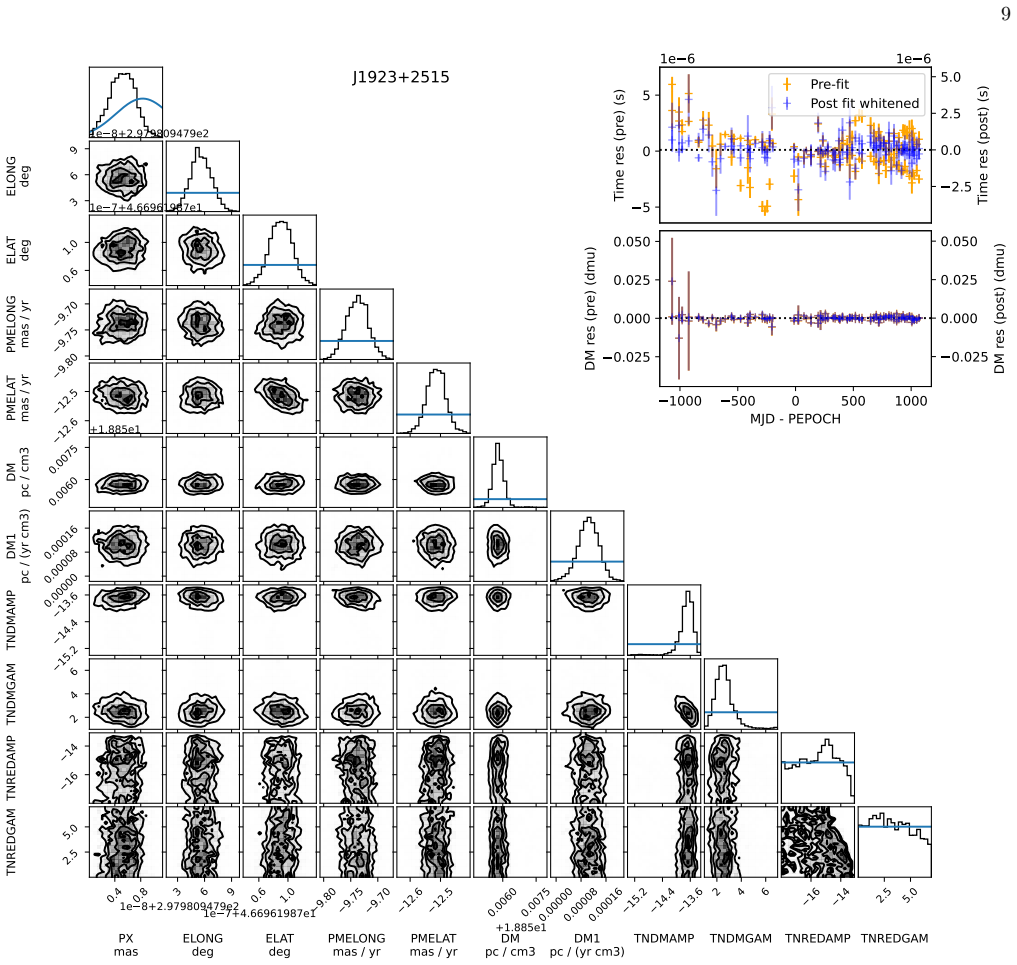
The central claim is that the full non-linear wideband timing model—including the joint likelihood of timing and dispersion-measure (DM) residuals, white-noise parameters, and Fourier-domain Gaussian processes for spin and DM noise—can be implemented in a public Bayesian inference package with support for arbitrary deterministic and stochastic dispersion-measure models, and that Vela.jl is the first such implementation. The paper demonstrates that the likelihood can be computed with either a diagonal noise covariance or a reduced-rank covariance using the Woodbury identity, and that Gaussian-process amplitudes and approximately linear timing parameters can be marginalized analytically. Applying the workflow to the 12.5-year dataset of PSR J1923+2515, the paper reports a detection of dispersion-measure noise with spectral index $2.7 \pm 0.8$, a 95.45% upper limit of $-13.7$ on the log-amplitude of achromatic red noise (the slow, frequency-independent part of the timing residuals), a proper-motion measurement, and a parallax consistent with zero at $3\sigma$.
Load-bearing premise
The load-bearing assumption is that the noise in each wideband observation's TOA and DM is uncorrelated, so the covariance matrix $N$ is diagonal; public wideband datasets provide no estimate of the TOA–DM covariance, and if that covariance is not negligible for jitter-dominated data, every reported posterior is mis-specified.
Editorial extensions
If this is right
- Wideband pulsar-timing-array datasets can be analyzed with a full non-linear timing model in a Bayesian framework, rather than only with a linearized approximation.
- Dispersion-measure variability can be modeled as a Gaussian process instead of only as piecewise-constant DMX steps, enabling searches for smooth DM-variation signals.
- Analytic marginalization over noise amplitudes and nearly linear timing parameters lowers the dimensionality so generic ensemble and nested samplers can be used.
- The same Python interface handles narrowband and wideband data, so existing Vela.jl workflows extend to wideband without new analysis patterns.
- The command-line interface makes standard wideband Bayesian analysis possible without writing sampler code.
Reading between the lines
- The paper leaves the TOA–DM noise correlation unmodeled because public data do not constrain it; the same Woodbury machinery would accept such a covariance if future data releases measured it, so re-running demonstrations like J1923+2515 with measured covariances is a natural next test.
- The Gaussian-process DM model could also be applied to multi-band wideband observations to separate solar-wind dispersion from interstellar dispersion, a separation this paper does not attempt.
- If jitter-induced TOA–DM correlation is substantial, part of the reported DM-noise signal could be a noise-model artifact; comparing the same data against a correlated-noise alternative would settle how much of the detection is real.
Signed reviews
Editorial analysis
A structured set of objections, weighed in public.
Referee Report
Summary. The paper describes the implementation of wideband pulsar timing and noise analysis in the Vela.jl package. It introduces a WidebandTOA data type, extends the TimingModel with wideband support, and provides two likelihood kernels: a WhiteNoiseKernel for Eq. (6) and a WoodburyKernel for the analytically marginalized likelihood in Eq. (12). The paper demonstrates the package on the NANOGrav 12.5-year wideband dataset for PSR J1923+2515, reporting timing parameters, DM noise detection, and an upper limit on achromatic red noise. The central claim, made in Sections I and V and in the abstract, is that Vela.jl is the first software package to provide full non-linear wideband Bayesian timing and noise analysis.
Significance. If the implementation is correct, this fills a genuine gap in the pulsar timing software ecosystem: ENTERPRISE offers wideband noise analysis only with a linearized timing model, and TEMPONEST handles non-linear timing models but only for narrowband data. The software is publicly available with a Python interface, and the demonstration runs on real, publicly released data. The analytic marginalization of Gaussian-process noise amplitudes follows published derivations and, as implemented, should improve sampling efficiency. The paper also contributes a command-line interface and a performance benchmark. The main risk to the significance claim is the absence of a numerical cross-check demonstrating that the implementation actually computes the wideband likelihood and posterior correctly.
major comments (3)
- [Section IV and Section V] The central claim that Vela.jl is the first public implementation of full non-linear wideband Bayesian timing and noise analysis is not supported by any independent numerical validation. The demonstration on PSR J1923+2515 uses real data without known ground truth, so a bug in the Gaussian-process marginalization or the wideband residual calculation could produce the same qualitative output. The authors should add a synthetic-data injection test (simulate wideband TOA/DM datasets with known parameters and noise, then verify recovery) or a numerical comparison against an independent implementation such as ENTERPRISE's linearized wideband mode on the same dataset. The code is public, so such a test is straightforward and would substantially strengthen the paper's load-bearing claim.
- [Section II and Section IV] The diagonal approximation of the TOA-DM covariance matrix N is explicitly acknowledged in Section II, but the DM noise detection presented in Section IV relies on this approximation. If the zero-covariance frequency is inaccurate for the L-wide or 430 MHz data, or if pulse jitter introduces frequency-correlated noise, the recovered DM noise parameters could be biased. The paper notes that public datasets do not provide covariance estimates, but it should either justify the approximation for PSR J1923+2515 (e.g., using the Hessian-based estimate from PulsePortraiture, if available) or perform a sensitivity analysis by adding simulated nonzero covariances. Without this, the robustness of the demonstrated DM noise detection is unclear.
- [Section IV and Table I] The analysis uses 'cheat priors' centered on frequentist PINT estimates with a width of 100 times the frequentist uncertainty for several parameters. The paper states that increasing the prior widths has 'no discernible impact' on the posterior, but no quantitative evidence is provided. Because these priors are informative and derived from the same dataset, the posterior distributions could be artificially narrowed. The authors should show a comparison of the posterior distributions obtained with different prior widths, or at least report the numerical differences in the parameter estimates, to support the robustness claim.
minor comments (4)
- [Section II, Eq. (6)] The notation '2ntoa' is ambiguous; it should be typeset as 2 n_toa or with a defined symbol to avoid confusion between a product and a subscript.
- [Figure 4 caption] The benchmark is computed for a simulated narrowband dataset, but the text claims that wideband execution times are similar. Either provide a wideband benchmark or explicitly qualify that this is an order-of-magnitude expectation not measured for wideband data.
- [Section IV] The actual MCMC settings for the analysis (number of walkers, total iterations, burn-in, thinning) are not stated; the script in Figure 3 is illustrative. The authors should report these settings or point to a configuration file in the repository, to enable reproducibility of the presented posterior distributions.
- [Table I] The prior for TNREDGAM (spectral index) is listed as Uniform[0, 7] and the posterior is 'consistent with its prior', but this is noted only in a table footnote. It would be clearer to state this directly in the text or to show the posterior-prior comparison in Figure 5.
Circularity Check
No circularity: the wideband likelihood and GP-marginalization steps are standard mathematical identities, the implementation claim is externally checkable against public code and data, and self-citations function as provenance rather than as forced inputs.
full rationale
The paper's central claim is that Vela.jl is the first public implementation of the full non-linear wideband Bayesian timing and noise model. This is a software-functionality claim, not a derived physical prediction, and the paper's own equations (6) and (12) are presented as standard likelihood and analytic-marginalization identities, with Eq. (12) following the derivation in Susobhanan & van Haasteren (2025), an independent methodological paper. No equation reduces by construction to an input: the likelihood is the usual Gaussian form in the residuals y = (r_i, δ_i); the covariance N is taken diagonal only as an acknowledged approximation because public datasets lack TOA-DM covariances; and the GP/marginalization step follows the Woodbury identity rather than assuming the result. The 'cheat priors' are centered on external PINT frequentist estimates, which is conditioning on external data rather than renaming a fitted quantity as a prediction, and the paper states that increasing their width has no discernible effect on the posterior. The demonstration on PSR J1923+2515 is a real-data example, so the absence of synthetic-injection or cross-code validation bears on implementation-correctness risk, not on circularity. The repeated citations to the author's prior papers [34,35] are provenance for the narrowband machinery and for the analytic-marginalization method; they are not invoked as a uniqueness theorem or as a substitute for the implementation itself. Consequently, no self-definitional, fitted-input-as-prediction, or self-citation-chain step can be exhibited, and the appropriate score is 0.
Assumptions & free parameters
free parameters (6)
- DM noise harmonic count =
16
- Achromatic red noise harmonic count =
16
- Fundamental frequency of Gaussian process harmonics =
5.42 nHz
- Parallax prior mean and standard deviation =
0.83 +- 0.415 mas (truncated normal)
- Cheat prior scale =
100
- White-noise parameters (EFAC, EQUAD, DMEFAC) per receiver-backend =
Not listed in Table I
assumptions (6)
- domain assumption Wideband likelihood with Gaussian residuals y and covariance N (Eq 6)
- ad hoc to paper TOA-DM covariance is zero, so N is diagonal (Section II, 'we treat N as a diagonal matrix in this paper')
- domain assumption Effect of correlated noise on timing residuals is linear, y = y' + U alpha (Eq 9)
- ad hoc to paper Fourier-domain GP with 16 harmonics plus 4 sub-fundamental harmonics adequately represents DM and spin noise (Section IV)
- domain assumption Interstellar scattering can be neglected or approximated (footnote 1)
- domain assumption Cheat priors centered at PINT frequentist estimates do not materially influence posteriors (Section IV)
Cite this review
Pith. "Pith review of Bayesian pulsar timing and noise analysis with Vela.jl: the wideband paradigm." pith.science (2026). https://pith.science/paper/UMUXC4X7
@misc{pith2026250510141,
  author       = {Pith},
  title        = {Pith review of: Bayesian pulsar timing and noise analysis with Vela.jl: the wideband paradigm},
  year         = {2026},
  howpublished = {\url{https://pith.science/paper/UMUXC4X7}},
  note         = {Machine review of arXiv:2505.10141}
}
read the original abstract
Vela is a package for performing Bayesian pulsar timing & noise analysis written in Julia and Python. In the wideband paradigm of pulsar timing, simultaneous time of arrival and dispersion measure measurements are derived from a radio observation using frequency-resolved integrated pulse profiles and templates without splitting the observation into multiple frequency sub-bands. We describe the implementation of the wideband timing paradigm in Vela, and demonstrate its usage using the NANOGrav 12.5-year wideband data of PSR J1923+2515. Vela is the first software package to provide this functionality.
Figures


Figures from the paper (3 more)


Forward citations
Cited by 2 Pith papers
-
PSRDISP: A novel approach to modeling dispersive processes in single-pulsar noise analysis using epoch-wise dispersion measures
PSRDISP is a Gaussian-process framework that fits dispersion-measure and solar-wind noise directly to epoch-wise dispersion measures, recovering injected signals in simulated pulsar data.
-
Gaussian process representation of dispersion measure noise in pulsar wideband datasets
The authors derive a marginalized Gaussian-process likelihood for wideband pulsar timing that models dispersion measure noise with arbitrary variability models, generalizing the existing piecewise-constant approach.
Reference graph
Works this paper leans on
-
[1]
A clock-corrected wideband TOA and DM mea- surement is represented using the WidebandTOA type
-
[2]
are represented by subtypes of DispersionComponent, which in turn is a subtype of Component. These types are also used for represent- ing the timing and noise model in the narrowband case [ 35], and we have extended the relevant functions such as correct_toa() to handle wideband data. See Table 2 and Figure 9 of Susobhanan [ 35] for a list of available Co...
-
[3]
The pyvela Python interface retains the same in- terface as in narrowband timing, but now also han- dles wideband datasets. The planned future developments in Vela.jl include the implementation of photon-domain timing for high- energy observations [ 48], the implementation of a sampler optimized for single-pulsar noise & timing analysis [e.g., following 4...
-
[4]
A timing and noise model is represented using the TimingModel type. Its structure remains the same as in the narrowband case, but we have extended the various functions operating on TimingModel and its constituents to handle WidebandTOAs
-
[5]
R. T. Edwards, G. B. Hobbs, and R. N. Manchester, tempo2, a new pulsar timing package – II. The timing model and precision estimates, Monthly Notices of the Royal Astronomical Society 372, 1549 (2006)
work page 2006
-
[6]
and ( 12). In the wideband case, two types of Kernel are available. The WhiteNoiseKernel implements equa- tion (6) and is applicable when the TOA and DM covari- ance matrix is diagonal. The WoorburyKernel imple- ments equation ( 12) and is applicable to a more general class of covariance matrices which can be expressed in the reduced-rank form C = N + UΦ ...
-
[7]
D. R. Lorimer and M. Kramer, Handbook of Pulsar As- tronomy (Cambridge University Press, 2012)
work page 2012
-
[8]
S. C. Susarla, A. Chalumeau, C. Tiburzi, E. F. Keane, J. P. W. Verbiest, et al. , Exploring the time variability of the solar wind using LOF AR pulsar data, Astronomy & Astrophysics 692, A18 (2024)
work page 2024
Show all 65 references
-
[9]
Agazie, J
G. Agazie, J. Antoniadis, A. Anumarlapudi, A. M. Archibald, P. Arumugam, et al. , Comparing Recent Pul- sar Timing Array Results on the Nanohertz Stochastic Gravitational-wave Background, The Astrophysical Jour- nal 966, 105 (2024)
2024
-
[10]
G. B. Hobbs, R. T. Edwards, and R. N. Manchester, TEMPO2, a new pulsar-timing package - I. An overview, Monthly Notices of the Royal Astronomical Society 369, 655 (2006)
2006
-
[11]
A. W. Hotan, W. van Straten, and R. N. Manchester, PSRCHIVE and PSRFITS: An Open Approach to Radio Pulsar Data Storage and Analysis, Publications of the Astronomical Society of Australia 21, 302 (2004)
2004
-
[12]
J. H. Taylor, Pulsar timing and relativistic gravity, Philo- sophical Transactions of the Royal Society of London. Series A: Physical and Engineering Sciences 341, 117 (1992)
1992
-
[13]
Tarafdar, K
P. Tarafdar, K. Nobleson, P. Rana, J. Singha, M. A. Kr- ishnakumar, et al. , The indian pulsar timing array: First data release, Publications of the Astronomical Society of Australia 39, e053 (2022)
2022
-
[14]
P. B. Demorest, R. D. Ferdman, M. E. Gonzalez, D. Nice, S. Ransom, et al. , Limits on the stochastic gravitational wave background from the north american nanohertz 9 3 6 9 ELONG deg 1e 8+2.979809479e2 0.6 1.0 ELAT deg 1e 7+4.66961987e1 9.80 9.75 9.70 PMELONG mas / yr 12.6 12....
2012
-
[15]
J. Wang, G. M. Shaifullah, J. P. W. Verbiest, C. Tiburzi, D. J. Champion, et al. , A comparative analysis of pulse time-of-arrival creation methods, Astronomy and As- trophysics 658, A181 (2022) , arXiv:2111.13482 [astro- ph.IM]
2022 arXiv
-
[16]
Hobbs, R
G. Hobbs, R. N. Manchester, A. Dunning, A. Jameson, P. Roberts, et al. , An ultra-wide bandwidth (704 to 4 032 MHz) receiver for the Parkes radio telescope, Publi- cations of the Astronomical Society of Australia 37, e012 (2020)
2020
-
[17]
H.-F. Liu, P. Jiang, C. He, F. Yang, H.-J. Liu, et al. , An Ultra-wide Bandwidth Low-frequency Radio Astronomi- cal Cryogenic Receiver for F AST Telescope, Research in Astronomy and Astrophysics 22, 115016 (2022)
2022
-
[18]
R. S. Foster and D. C. Backer, Constructing a Pul- sar Timing Array, The Astrophysical Journal 361, 300 (1990)
1990
-
[19]
B. B. P. Perera, M. E. DeCesar, P. B. Demorest, M. Kerr, L. Lentati, et al. , The International Pulsar Timing Ar- ray: second data release, Monthly Notices of the Royal Astronomical Society 490, 4666 (2019)
2019
-
[20]
T. H. Hankins and B. J. Rickett, Frequency Dependence 10 1000 500 0 500 1000 MJD - PEPOCH 0.0006 0.0004 0.0002 0.0000 0.0002 DM (pc/cm3) - 18.856 FIG. 6. Hundred random DM time series realizations of PSR J1923+2515. These were generated using parameters drawn from the posterio...
-
[21]
of Pulsar Profiles, The Astrophysical Journal 311, 684 (1986)
PEPOCH is the spin frequency epoch, and its value in MJD is 56859. of Pulsar Profiles, The Astrophysical Journal 311, 684 (1986)
1986
-
[22]
D. A. Hemberger and D. R. Stinebring, Time Variabil- ity of Interstellar Scattering and Improvements to Pulsar Timing, The Astrophysical Journall 674, L37 (2008)
2008
-
[23]
Agazie, M
G. Agazie, M. F. Alam, A. Anumarlapudi, A. M. Archibald, Z. Arzoumanian, et al. , The NANOGrav 15 yr Data Set: Observations and Timing of 68 Millisecond Pulsars, The Astrophysical Journall 951, L9 (2023)
2023
-
[24]
T. T. Pennucci, P. B. Demorest, and S. M. Ransom, Ele- mentary Wideband Timing of Radio Pulsars, The Astro- physical Journal 790, 93 (2014)
2014
-
[25]
K. Liu, G. Desvignes, I. Cognard, B. W. Stappers, J. P. W. Verbiest, K. J. Lee, D. J. Champion, M. Kramer, P. C. C. Freire, and R. Karuppusamy, Measuring pulse times of arrival from broad-band pulsar observations, Monthly Notices of the Royal Astronomical Society 443, 3752 (2014)
2014
-
[26]
T. T. Pennucci, Frequency-dependent template profiles for high-precision pulsar timing, The Astrophysical Jour- nal 871, 34 (2019)
2019
-
[27]
A. K. Paladi, C. Dwivedi, P. Rana, K. Nobleson, A. Su- sobhanan, et al. , Multiband extension of the wideband timing technique, Monthly Notices of the Royal Astro- nomical Society 527, 213 (2023)
2023
-
[28]
M. A. Krishnakumar, D. Mitra, A. Naidu, B. C. Joshi, and P. K. Manoharan, Scatter Broadening Measurements of 124 Pulsars At 327 Mhz, The Astrophysical Journal 804, 23 (2015)
2015
-
[29]
J. E. Turner, D. R. Stinebring, M. A. McLaughlin, A. M. Archibald, T. Dolch, and R. S. Lynch, Scattering De- lay Mitigation in High-accuracy Pulsar Timing: Cyclic Spectroscopy Techniques, Astrophys. J. 944, 191 (2023) , arXiv:2301.12089 [astro-ph.HE]
2023 arXiv
-
[30]
Young and M
O. Young and M. T. Lam, Redeveloping a clean deconvo- lution algorithm for scatter-broadened radio pulsar sig- nals, The Astrophysical Journal 962, 131 (2024)
2024
-
[31]
D. Nice, P. Demorest, I. Stairs, R. Manchester, J. Taylor, W. Peters, J. Weisberg, A. Irwin, N. Wex, and Y. Huang, Tempo: Pulsar timing data analysis, Astrophysics Source Code Library, record ascl:1509.002 (2015)
2015
-
[32]
J. Luo, S. Ransom, P. Demorest, P. S. Ray, A. Archibald, et al., PINT: A Modern Software Package for Pulsar Tim- ing, The Astrophysical Journal 911, 45 (2021)
2021
-
[33]
Susobhanan, D
A. Susobhanan, D. L. Kaplan, A. M. Archibald, J. Luo, P. S. Ray, et al. , Pint: Maximum-likelihood estimation of pulsar timing noise parameters, The Astrophysical Jour- nal 971, 150 (2024)
2024
-
[34]
J. A. Ellis, M. Vallisneri, S. R. Taylor, and P. T. Baker, Enterprise: Enhanced numerical toolbox enabling a ro- bust pulsar inference suite , Zenodo (2020)
2020
-
[35]
A. D. Johnson, P. M. Meyers, P. T. Baker, N. J. Cornish, J. S. Hazboun, et al. , NANOGrav 15-year gravitational- wave background methods, Physical Review D 109, 103012 (2024)
2024
-
[36]
Lentati, P
L. Lentati, P. Alexander, M. P. Hobson, F. Feroz, R. van Haasteren, K. J. Lee, and R. M. Shannon, TEMPON- EST: a Bayesian approach to pulsar timing analysis, Monthly Notices of the Royal Astronomical Society 437, 3004 (2014)
2014
-
[37]
M. F. Alam, Z. Arzoumanian, P. T. Baker, H. Blumer, K. E. Bohler, et al. , The NANOGrav 12.5 yr Data Set: Wideband Timing of 47 Millisecond Pulsars, The Astro- physical Journals 252, 5 (2021) , arXiv:2005.06495 [astro- ph.HE]
2021 arXiv
-
[38]
Curyło, T
M. Curyło, T. T. Pennucci, M. Bailes, N. D. R. Bhat, A. D. Cameron, et al. , Wide-band Timing of the Parkes Pulsar Timing Array UWL Data, The Astrophysical Journal 944, 128 (2023)
2023
-
[39]
Arzoumanian, A
Z. Arzoumanian, A. Brazier, S. Burke-Spolaor, S. Cham- berlin, S. Chatterjee, et al. , The nanograv nine-year data set: Observations, arrival time measurements, and anal- ysis of 37 millisecond pulsars, The Astrophysical Journal 813, 65 (2015)
2015
-
[40]
Susobhanan and R
A. Susobhanan and R. van Haasteren, Gaussian process representation of dispersion measure noise in pulsar wide- band datasets, arXiv e-prints , arXiv:2505.05274 (2025) , arXiv:2505.05274 [astro-ph.IM]
2025 arXiv
-
[41]
Susobhanan, Bayesian pulsar timing and noise analy- sis with vela.jl: An overview, The Astrophysical Journal 980, 165 (2025)
A. Susobhanan, Bayesian pulsar timing and noise analy- sis with vela.jl: An overview, The Astrophysical Journal 980, 165 (2025)
2025
-
[42]
Damour and N
T. Damour and N. Deruelle, General relativistic celes- tial mechanics of binary systems. II. The post-Newtonian timing formula., Annales de L’Institut Henri Poincare Section (A) Physique Theorique 44, 263 (1986)
1986
-
[43]
D. C. Backer and R. W. Hellings, Pulsar timing and gen- eral relativity., Annual Review of Astronomy and Astro- physics 24, 537 (1986)
1986
-
[44]
F. B. Estabrook and H. D. Wahlquist, Response of Doppler spacecraft tracking to gravitational radiation, General Relativity and Gravitation 6, 439 (1975)
1975
-
[45]
Parthasarathy, M
A. Parthasarathy, M. Bailes, R. M. Shannon, W. van Straten, S. Osłowski, et al. , Measurements of pulse jitter and single-pulse variability in millisecond pulsars using MeerKAT, Monthly Notices of the Royal Astronomical Society 502, 407 (2021)
2021
-
[46]
A. D. Kulkarni, R. M. Shannon, D. J. Reardon, M. T. Miles, M. Bailes, and M. Shamohammadi, An insight into chromatic behaviour of jitter in pulsars and its modelling: a case study of psr j0437-4715, Monthly Notices of the Royal Astronomical Society 528, 3658 (2024) , https://a...
2024
-
[47]
van Haasteren and M
R. van Haasteren and M. Vallisneri, Low-rank approxi- mations for large stationary covariance matrices, as used 11 in the Bayesian and generalized-least-squares analysis of pulsar-timing data, Monthly Notices of the Royal Astro- nomical Society 446, 1170 (2014)
2014
-
[48]
van Haasteren and Y
R. van Haasteren and Y. Levin, Understanding and analysing time-correlated stochastic signals in pulsar tim- ing, Monthly Notices of the Royal Astronomical Society 428, 1147 (2013)
2013
-
[49]
Foreman-Mackey, D
D. Foreman-Mackey, D. W. Hogg, D. Lang, and J. Good- man, emcee: The MCMC Hammer, Publications of the Astronomical Society of the Pacific 125, 306 (2013)
2013
-
[50]
R. S. Park, W. M. Folkner, J. G. Williams, and D. H. Boggs, The jpl planetary and lunar ephemerides de440 and de441, The Astronomical Journal 161, 105 (2021)
2021
-
[51]
J. M. Yao, R. N. Manchester, and N. Wang, A New Electron-density Model for Estimation of Pulsar and FRB Distances, The Astrophysical Journal 835, 29 (2017), arXiv:1610.09448 [astro-ph.GA]
2017 arXiv
-
[52]
Diaconis, The markov chain monte carlo revolu- tion, Bulletin of the American Mathematical Society 46, 179textendash205 (2009)
P. Diaconis, The markov chain monte carlo revolu- tion, Bulletin of the American Mathematical Society 46, 179textendash205 (2009)
2009
-
[53]
Ashton, N
G. Ashton, N. Bernstein, J. Buchner, X. Chen, G. Csányi, A. Fowlie, F. Feroz, M. Griffiths, W. Han- dley, M. Habeck, E. Higson, M. Hobson, A. Lasenby, D. Parkinson, L. B. Pártay, M. Pitkin, D. Schneider, J. S. Speagle, L. South, J. Veitch, P. Wacker, D. J. Wales, and D. Yallup, ...
2022
-
[54]
H. J. Pletsch and C. J. Clark, Gamma-Ray Timing of Redback PSR J2339-0533: Hints for Gravitational Quadrupole Moment Changes, The Astrophysical Jour- nal 807, 18 (2015) , arXiv:1504.07466 [astro-ph.HE]
2015 arXiv
-
[55]
N. Laal, W. G. Lamb, J. D. Romano, X. Siemens, S. R. Taylor, and R. van Haasteren, Exploring the capabilities of Gibbs sampling in pulsar timing arrays, Phys. Rev. D 108, 063008 (2023)
2023
-
[56]
Valtolina and R
S. Valtolina and R. van Haasteren, Regularizing the Pulsar Timing Array likelihood: A path towards Fourier Space, arXiv e-prints , arXiv:2412.11894 (2024) , arXiv:2412.11894 [astro-ph.IM]
2024 arXiv
-
[57]
D. C. Price, C. Flynn, and A. Deller, A comparison of Galactic electron density models using PyGEDM, Publi- cations of the Astronomical Society of Australia 38, e038 (2021), arXiv:2106.15816 [astro-ph.GA]
2021 arXiv
-
[58]
C. R. Harris, K. J. Millman, S. J. van der Walt, R. Gom- mers, P. Virtanen, et al. , Array programming with NumPy, Nature 585, 357 (2020)
2020
-
[59]
T. P. Robitaille, E. J. Tollerud, P. Greenfield, M. Droet- tboom, E. Bray, et al. , Astropy: A community Python package for astronomy, Astronomy & Astrophysics 558, A33 (2013)
2013
-
[60]
J. D. Hunter, Matplotlib: A 2d graphics environment, Computing in Science & Engineering 9, 90 (2007)
2007
-
[61]
Foreman-Mackey, corner.py: Scatterplot matrices in python, The Journal of Open Source Software 1, 24 (2016)
D. Foreman-Mackey, corner.py: Scatterplot matrices in python, The Journal of Open Source Software 1, 24 (2016)
2016
-
[62]
Sarnoff et al
J. Sarnoff et al. , DoubleFloats (2022)
2022
-
[63]
Besançon, T
M. Besançon, T. Papamarkou, D. Anthoff, A. Arslan, S. Byrne, D. Lin, and J. Pearson, Distributions.jl: Def- inition and modeling of probability distributions in the juliastats ecosystem, Journal of Statistical Software 98, 1 (2021)
2021
-
[64]
Rowley, Pythoncall.jl: Python and julia in harmony (2022)
C. Rowley, Pythoncall.jl: Python and julia in harmony (2022)
2022
-
[65]
Finnegan, L
R. Finnegan, L. White, et al. , invenia/jlso.jl (2022). Glossary of symbols Symbol Description Data D Dataset as a whole tarr Measured TOA d Measured DM Ã Measured TOA uncertainty ϵ Measured DM uncertainty ntoa Number of TOAs Timing and noise model M Timing and noise model as ...
2022
Reviewed August 15, 2026 · model on record in the stance chip above.
Discussion (0). Continue with ORCID to comment.