REVIEW 4 major objections 5 minor 13 references
An End-to-End Encrypted Neural Network for Gradient Updates Transmission in Federated Learning
T0 review · 4 major / 5 minor · reviewed 2026-08-14 · deepseek-v4-flash
Pith's one-line read This paper claims that an end-to-end encrypted neural network can compress and hide federated learning gradients from the server at a small accuracy cost.
desk verdict The 'encrypted' claim is unsupported and likely false; the real content is a learned lossy compression scheme with direct aggregate decoding, which has some merit as a baseline but fails to establish its stated contributions. read the letter →
The pith
A machine-rendered reading of the paper's core claim, the machinery that carries it, and where it could break.
The reading
What carries the argument
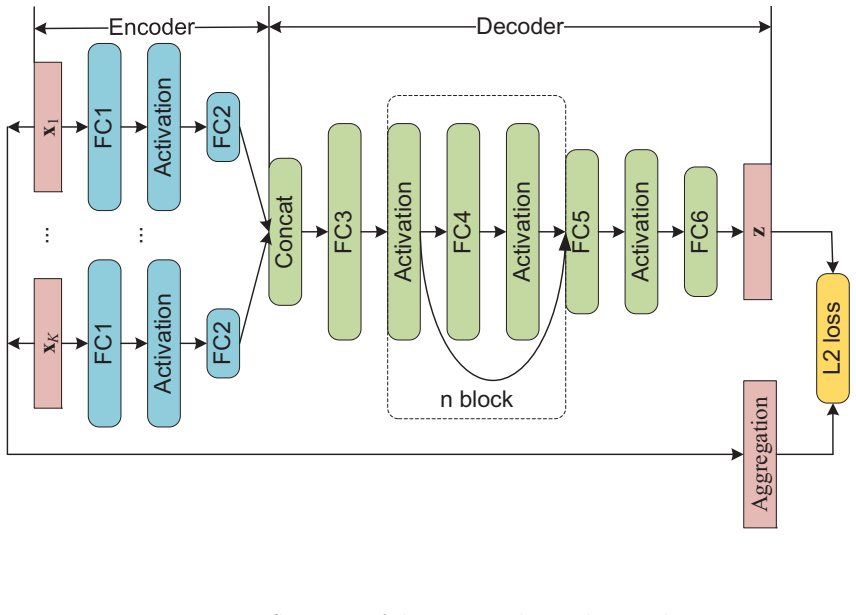
The central object is the end-to-end encrypted neural network (ENN), an autoencoder variant with two differences: the encoder is replicated across clients and the decoder accepts any number of client codes, outputting the aggregated gradient directly. The encoder uses two fully connected layers to map N-dimensional updates to M-dimensional codes (compression ratio r = N/M), while the decoder uses n residual blocks to map the concatenated K codes back to the N-dimensional average. The loss is the Euclidean distance between the decoder output and the true average, and the network is trained on synthetic Gaussian vectors with mean 0 and standard deviation 0.1. This design lets the server compute an approximation of the aggregate without ever reconstructing a client's update.
What would settle it
On the MNIST setup described in the paper, have the server (who holds the decoder) train an additional inversion decoder that maps transmitted codes back to individual gradients; if the recovered gradients correlate strongly with a client's local data (for example, revealing which three digit types it holds), the claimed privacy property is falsified. Alternatively, measure the mutual information between codes and local labels; privacy fails if codes are highly predictive of client-specific attributes.
Extended reading notes
Core claim
The authors claim that a single neural network, trained end-to-end on synthetic Gaussian data, can map each client's gradient update to a low-dimensional code such that the average of the original updates can be recovered directly from the concatenation of codes. The encoding sub-network is a two-layer fully-connected network; the decoding sub-network stacks residual blocks and is trained to minimize Euclidean distance between its output and the true average. After training, clients send only the codes, and the original gradients 'never appear' during transmission or after decoding, so the server learns only the aggregated model update and never sees individual updates. The paper treats this as a form of homomorphic encryption that is also a lossy compressor, trading a small accuracy drop for privacy and bandwidth savings.
Load-bearing premise
The privacy guarantee rests on the claim that the coding vector reflects no private information about local data, asserted without proof even though the encoder's input is the data-dependent gradient; if that claim fails, the 'encryption' is just lossy compression.
Editorial extensions
If this is right
- If the ENN works as claimed, federated learning can transmit low-dimensional codes instead of full gradients, cutting bandwidth by the compression ratio (for example, 5x).
- The server obtains an approximate aggregated gradient without seeing any individual update, reducing the incentive for server-side privacy attacks.
- The framework naturally extends to any number of clients by keeping encoder weights shared and concatenating codes on the decoder side.
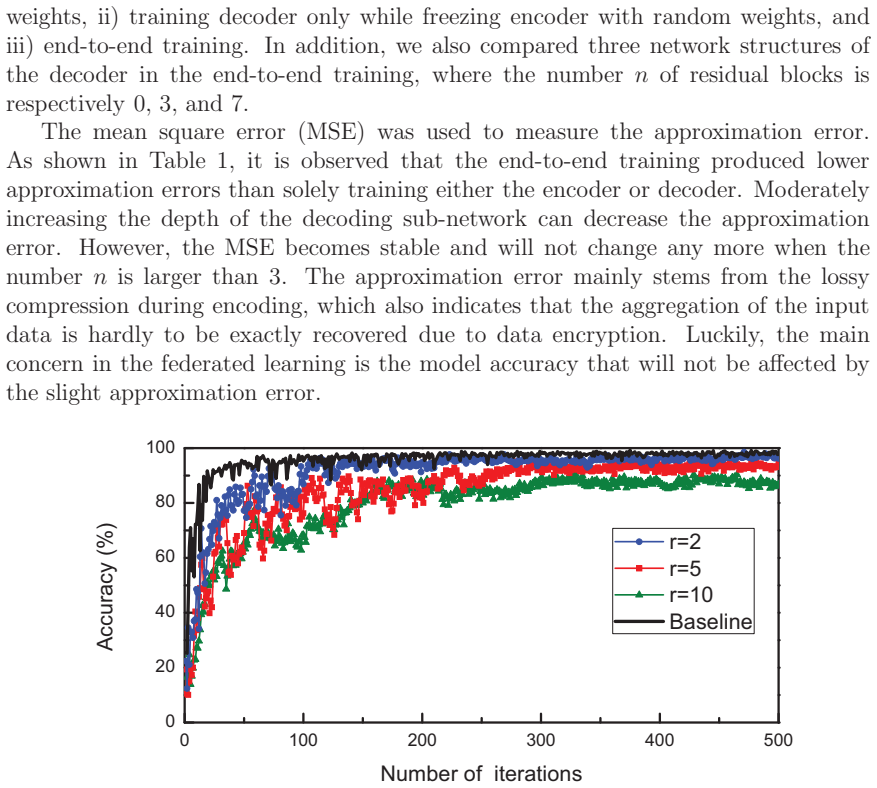
- Larger compression ratios reduce accuracy and slow convergence; the paper observes 5x as a practical balance between bandwidth savings and model quality.
Reading between the lines
- The privacy claim is weaker than the paper suggests: since the encoder is deterministic and the server holds the decoder, a malicious server could attempt to invert codes by training an additional decoder on real gradient distributions; whether this recovers meaningful client data is an open testable question.
- The training assumption that gradients follow a Gaussian distribution with fixed variance likely fails on real heterogeneous data; the paper admits this and attributes slower convergence to it, but the reconstruction error may be worse for heavy-tailed or skewed gradient updates.
- The scheme is best understood as a learned lossy compressor with a homomorphic flavor, not a cryptographically secure encryption; combining it with differential privacy noise on the codes might provide a formal privacy guarantee while retaining the bandwidth savings.
- The decoder's ability to aggregate without per-client reconstruction suggests a broader pattern: any permutation-invariant aggregation function could be learned end-to-end, possibly extending to secure weighted averaging or other federated statistics.
Signed reviews
Editorial analysis
A structured set of objections, weighed in public.
Referee Report
Summary. The manuscript proposes an end-to-end encrypted neural network (ENN) for federated learning. Each client compresses its gradient update xi through a deterministic encoder f: R^N -> R^M, and the server's decoder g maps the concatenation of K such codes directly to an approximation of the averaged update. The authors claim that the coding vectors reveal no private information, that client updates are unknown to the server, and that the scheme constitutes homomorphic encryption. The ENN is trained end-to-end on synthetic Gaussian gradients and evaluated on MNIST with 100 simulated clients and 9 participants per round; reported test accuracies are 98% for the baseline, near-baseline for r=2, 93.7% for r=5, and 87.5% for r=10.
Significance. The paper's narrow empirical finding is plausible and reproducible in principle: an autoencoder-style network can be trained to emit an approximate average from compressed per-client codes without the server explicitly reconstructing individual updates. If the privacy claim were supported, the scheme would be a useful communication-efficient primitive. However, the central advertised contribution is cryptographic/privacy, and the paper contains no security model, no secret key, no formal secrecy analysis, and no attack evaluation; the privacy assertion is a non-sequitur. The work is therefore best read as a proof-of-concept for lossy compressed aggregation, not as an end-to-end encrypted transmission scheme.
major comments (4)
- [Section 2, Framework for federated learning] The sentence "As the encoding network is unrelated with local data on clients, the coding vector reflects no private information involving local data" does not follow from anything in the paper. The encoder is a deterministic function f, so each transmitted code yi = f(xi) is a function of the client's gradient, which in turn depends on local data. Unless f is constant, yi carries information about xi, and lossy compression is not encryption. The server, which knows and may have trained f, can attempt inversion or membership attacks on the received codes. This unsupported assertion is the sole basis for the claim that updates are "unknown to the server," and it is load-bearing for the paper's central privacy contribution.
- [Section 2, Encrypted Neural Network] The claim that the ENN "is in essence a homomorphic encryption technique" is unsupported: no key material, security game, or hardness assumption is defined, and the decoder is a public function known to the server. Calling this scheme homomorphic encryption conflates lossy compression with cryptography and misuses the standard meaning of encryption, which requires a secret key and a formal secrecy notion. This is not a terminological quibble because the paper's stated contribution is an end-to-end encrypted transmission scheme.
- [Section 3, Fig. 3 and accuracy analysis] The abstract and conclusion claim that privacy and compression are achieved "under a little sacrifice of the model accuracy." The reported results contradict this reading: accuracy drops from 98% to 93.7% at r=5 and to 87.5% at r=10, and the r=5 curve also converges visibly slower. A 4.3 percentage-point drop at the recommended compression ratio and a 10.5 percentage-point drop at r=10 are substantial. The authors should either state an explicit accuracy/compression trade-off criterion or substantially soften the claim.
- [Section 2, Network structure (ENN training)] The ENN is trained on synthetic samples from a Gaussian distribution with mean 0 and standard deviation 0.1, and the authors admit "this assumption is problematic to some extent." The paper provides no sensitivity analysis and no theoretical justification for why an encoder trained on that distribution should transfer to real gradient distributions. The MNIST experiment is a single demonstration for one model and one data split; as a general method for federated learning, the dependence on this free parameter is a load-bearing unresolved issue.
minor comments (5)
- [Figure 2] Figure 2 is not legible in the provided manuscript; layer sizes, activation functions, and the exact decoder structure are impossible to verify. Please supply a clean figure with full architecture specifications.
- [Section 2, Network structure] The text says the decoder can accept coding vectors from "any number" of clients, but the network is defined for a fixed maximal K and the training loss uses exactly K codes. Please clarify how variable client participation is handled in practice.
- [Section 1, Introduction] The phrase "the original gradient updates will never appear both during transmission and after decoding" is ambiguous; it may be true by construction but does not by itself imply privacy. Please replace it with an explicit threat model and a precise statement of what information is and is not available to the server and to eavesdroppers.
- [References] The reference to Gentry's fully homomorphic encryption [12] is not appropriate for the proposed scheme, which has no encryption key and no security definition. Consider citing secure aggregation or gradient-compression literature for the comparisons actually made.
- [Section 3, Experimental setup] Hyperparameters for the ENN training (number of epochs, batch size, encoder and decoder widths) and for the MNIST federated simulation (learning rate, local epochs, batch size) are missing; please include them for reproducibility.
Circularity Check
No significant circularity: the ENN's accuracy and compression results are evaluated on MNIST after training on synthetic Gaussian data, an independent test, and no load-bearing step reduces to its own inputs by construction.
full rationale
The paper derives no formal result whose conclusion is assumed in its premises. The ENN is trained end-to-end on simulated Gaussian samples, and the approximation error is measured on the same synthetic distribution; this is an in-sample fit rather than an external prediction, but it is not circular because the paper does not claim to derive the MSE from the training objective alone. The MNIST accuracy experiment is genuinely external: an encoder/decoder trained on synthetic data is transferred to a federated CNN training task and compared with a baseline that does not use the ENN. No parameter is fitted to MNIST and then reported as a prediction. The privacy guarantee is asserted rather than proven ('As the encoding network is unrelated with local data on clients, the coding vector reflects no private information involving local data'); this is an unsupported assumption and a security/correctness flaw, not a circular reduction, because the assertion is not derived from the scheme's equations. The paper also candidly flags its Gaussian assumption as 'problematic to some extent.' There are no self-citations used as load-bearing evidence, no imported uniqueness theorem, and no known result renamed as new. Accordingly, no circular step satisfies the evidentiary bar of matching an equation or fitted parameter to the claimed output.
Assumptions & free parameters
free parameters (3)
- standard deviation of synthetic gradient distribution =
0.1
- number of residual blocks in decoder =
3 (chosen)
- compression ratio r =
5 (recommended)
assumptions (3)
- domain assumption Gradient updates are distributed as Gaussian with mean 0 and std 0.1
- domain assumption Aggregation uses averaging: a(x1,...,xK) = 1/K sum xi
- ad hoc to paper The server cannot infer private information from coding vectors
Cite this review
Pith. "Pith review of An End-to-End Encrypted Neural Network for Gradient Updates Transmission in Federated Learning." pith.science (2026). https://pith.science/paper/UMXCOWDP
@misc{pith2026190808340,
  author       = {Pith},
  title        = {Pith review of: An End-to-End Encrypted Neural Network for Gradient Updates Transmission in Federated Learning},
  year         = {2026},
  howpublished = {\url{https://pith.science/paper/UMXCOWDP}},
  note         = {Machine review of arXiv:1908.08340}
}
read the original abstract
Federated learning is a distributed learning method to train a shared model by aggregating the locally-computed gradient updates. In federated learning, bandwidth and privacy are two main concerns of gradient updates transmission. This paper proposes an end-to-end encrypted neural network for gradient updates transmission. This network first encodes the input gradient updates to a lower-dimension space in each client, which significantly mitigates the pressure of data communication in federated learning. The encoded gradient updates are directly recovered as a whole, i.e. the aggregated gradient updates of the trained model, in the decoding layers of the network on the server. In this way, gradient updates encrypted in each client are not only prevented from interception during communication, but also unknown to the server. Based on the encrypted neural network, a novel federated learning framework is designed in real applications. Experimental results show that the proposed network can effectively achieve two goals, privacy protection and data compression, under a little sacrifice of the model accuracy in federated learning.
Figures

Reference graph
Works this paper leans on
-
[1]
Fed- erated learning of deep networks using model averaging,
H. Brendan McMahan, Eider Moore, Daniel Ramage, and Blai se Ag¨ uera y Arcas, “Fed- erated learning of deep networks using model averaging,” CoRR, vol. abs/1602.05629, 2016
arXiv 2016
-
[2]
Privacy-preserving deep learning,
Reza Shokri and Vitaly Shmatikov, “Privacy-preserving deep learning,” in Proceedings of the 22Nd ACM SIGSAC Conference on Computer and Communications S ecurity, New York, NY, USA, 2015, CCS ’15, pp. 1310–1321, ACM
work page 2015
-
[3]
Frank Seide, Hao Fu, Jasha Droppo, Gang Li, and Dong Yu, “1 -bit stochastic gradient descent and application to data-parallel distributed trai ning of speech DNNs,” in Interspeech 2014, September 2014
work page 2014
-
[4]
Terngrad: Ternary gradients to reduce communication in di stributed deep learning,
Wei Wen, Cong Xu, Feng Yan, Chunpeng Wu, Yandan Wang, Yira n Chen, and Hai Li, “Terngrad: Ternary gradients to reduce communication in di stributed deep learning,” CoRR, vol. abs/1705.07878, 2017
arXiv 2017
-
[5]
Scalable distributed DNN training using c ommodity GPU cloud com- puting,
Nikko Strom, “Scalable distributed DNN training using c ommodity GPU cloud com- puting,” in Sixteenth Annual Conference of the International Speech Commu nication Association, 2015
work page 2015
-
[6]
Sparse communicat ion for distributed gradient descent,
Alham Fikri Aji and Kenneth Heafield, “Sparse communicat ion for distributed gradient descent,” CoRR, vol. abs/1704.05021, 2017
arXiv 2017
-
[7]
Federated learning: Strategies fo r improving communication efficiency,
Jakub Kone˘cn´ y, H. Brendan McMahan, Felix X. Yu, Peter Richt´ arik, Ananda Theertha Suresh, and Dave Bacon, “Federated learning: Strategies fo r improving communication efficiency,” CoRR, vol. abs/1610.05492, 2016
arXiv 2016
-
[8]
Differentia lly private federated learn- ing: A client level perspective,
Robin C. Geyer, Tassilo Klein, and Moin Nabi, “Differentia lly private federated learn- ing: A client level perspective,” CoRR, vol. abs/1712.07557, 2017
arXiv 2017
Show all 13 references
-
[9]
Autoencoder for words,
Cheng-Yuan Liou, Wei-Chen Cheng, Jiun-Wei Liou, and Daw -Ran Liou, “Autoencoder for words,” Neurocomputing, vol. 139, pp. 84 – 96, 2014
2014
-
[10]
Using very deep a utoencoders for content- based image retrieval,
Alex Krizhevsky and Geoffrey E. Hinton, “Using very deep a utoencoders for content- based image retrieval,” in ESANN 2011, 19th European Symposium on Artificial Neural Networks, Bruges, Belgium, April 27-29, 2011, Proceedings , 2011
2011
-
[11]
Ex- tracting and composing robust features with denoising auto encoders,
Pascal Vincent, Hugo Larochelle, Yoshua Bengio, and Pi erre-Antoine Manzagol, “Ex- tracting and composing robust features with denoising auto encoders,” in Proceedings of the 25th International Conference on Machine Learning , New York, NY, USA, 2008, ICML ’08, pp. 1096–1103, ACM
2008
-
[12]
Fully homomorphic encryption using ide al lattices,
Craig Gentry, “Fully homomorphic encryption using ide al lattices,” in Proceedings of the Forty-first Annual ACM Symposium on Theory of Computing , New York, NY, USA, 2009, STOC ’09, pp. 169–178, ACM
2009
-
[13]
Deep residual learning for image recognition,
Kaiming He, Xiangyu Zhang, Shaoqing Ren, and Jian Sun, “ Deep residual learning for image recognition,” CoRR, vol. abs/1512.03385, 2015
2015 arXiv
Reviewed August 14, 2026 · model on record in the stance chip above.
Discussion (0). Continue with ORCID to comment.