Symbolic Discovery of Iterative Algorithms: A Continuous Latent Space Bayesian Optimization Framework
Pith reviewed 2026-07-03 01:01 UTC · model grok-4.3
The pith
A variational autoencoder embeds discrete update functions into a continuous latent space where Bayesian optimization finds new symbolic iterative algorithms.
A machine-rendered reading of the paper's core claim, the machinery that carries it, and where it could break.
Core claim
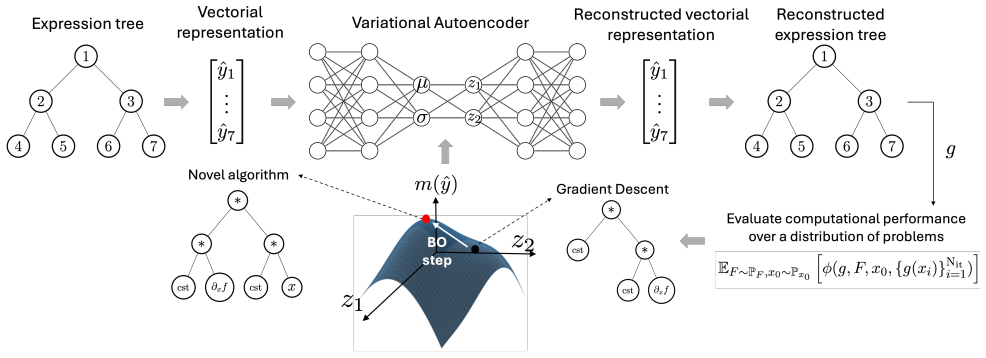
We formulate the algorithm discovery task as a discrete optimization problem and search for new update functions using latent space Bayesian Optimization. The proposed framework first learns a continuous representation of the discrete space of update functions using variational autoencoders, transforming the algorithm discovery task from a discrete to a continuous search problem. The continuous representation is subsequently used to search for new algorithms using Bayesian optimization. Application to two case studies shows that the proposed approach can discover new update functions in symbolic form without any assumptions on the functional form of the update function. Moreover, the computa
What carries the argument
The variational autoencoder that produces a continuous latent representation of discrete update functions, allowing Bayesian optimization to locate and decode new symbolic algorithms.
If this is right
- New update functions appear in explicit symbolic form for the optimization problems considered.
- No assumptions about the algebraic structure of the update functions are required in advance.
- The discovery process uses less computational time than mathematical programming methods that operate directly on discrete spaces.
- The same workflow applies across at least two distinct case studies in optimization.
Where Pith is reading between the lines
- The continuous embedding might let researchers interpolate between known algorithms to generate hybrid update rules.
- If the latent space organizes functions by performance traits, inspecting nearby points could suggest design principles for better algorithms.
- Applying the discovered functions to optimization problems outside the training cases would test whether the method produces generally useful rules.
Load-bearing premise
The latent space created by the variational autoencoder contains points that decode to update functions which are both novel and effective when applied to the original optimization problems.
What would settle it
Decoding the functions proposed by Bayesian optimization in the latent space and checking whether they actually solve the target optimization problems or reduce computation time relative to known methods.
Figures
read the original abstract
In this paper, we consider the automated discovery of iterative optimization algorithms. We formulate the algorithm discovery task as a discrete optimization problem and search for new update functions using latent space Bayesian Optimization. The proposed framework first learns a continuous representation of the discrete space of update functions using variational autoencoders, transforming the algorithm discovery task from a discrete to a continuous search problem. The continuous representation is subsequently used to search for new algorithms using Bayesian optimization. Application to two case studies shows that the proposed approach can discover new update functions in symbolic form without any assumptions on the functional form of the update function. Moreover, the computational time required to discover the new update functions is lower than existing mathematical programming-based approaches.
Editorial analysis
A structured set of objections, weighed in public.
Referee Report
Summary. The paper formulates discovery of iterative optimization algorithms as a discrete search over symbolic update functions. It trains a variational autoencoder on a pre-constructed corpus of such functions to obtain a continuous latent space, then runs Bayesian optimization in that space to identify new update rules. The method is applied to two case studies; the abstract claims that new functions are discovered in symbolic form without assumptions on functional form and that the approach is faster than existing mathematical-programming baselines.
Significance. If the latent-space search reliably yields update functions that are both novel relative to the training corpus and demonstrably effective on the target problems, the framework would offer a practical route to automated symbolic algorithm design. The combination of VAE embedding with BO is a reasonable way to convert a combinatorial search into a continuous one, but the significance hinges on whether the decoded functions outperform or meaningfully extend known methods and whether the computational savings are reproducible.
major comments (2)
- [Abstract] Abstract: the central claim that the method discovers update functions 'without any assumptions on the functional form' is not supported by the described procedure. The framework first constructs a discrete space of update functions and trains the VAE on it; this construction necessarily selects a finite vocabulary of operators, constants, and expression structures (via grammar or enumeration). Any function outside that pre-specified space cannot be discovered, so the 'no assumptions' phrasing is inaccurate and load-bearing for the paper's novelty argument.
- [Abstract] Abstract / method description: the weakest assumption—that the VAE latent space permits BO to locate update functions that are both novel and effective when decoded—receives no supporting evidence in the provided text. Without reported metrics on reconstruction fidelity, latent-space smoothness, or out-of-sample performance of the discovered rules on the original optimization problems, it is impossible to assess whether the continuous relaxation actually solves the discrete discovery task.
Simulated Author's Rebuttal
We thank the referee for the careful reading and constructive comments. We respond to each major comment below and will revise the manuscript accordingly to improve precision and add supporting evidence.
read point-by-point responses
-
Referee: [Abstract] Abstract: the central claim that the method discovers update functions 'without any assumptions on the functional form' is not supported by the described procedure. The framework first constructs a discrete space of update functions and trains the VAE on it; this construction necessarily selects a finite vocabulary of operators, constants, and expression structures (via grammar or enumeration). Any function outside that pre-specified space cannot be discovered, so the 'no assumptions' phrasing is inaccurate and load-bearing for the paper's novelty argument.
Authors: We agree that the abstract phrasing is imprecise and overstates the claim. The discrete corpus is generated from a finite grammar and vocabulary, which necessarily bounds the searchable space. We will revise the abstract to state that the method discovers new symbolic update functions within the space defined by the chosen grammar and operators, without presupposing any particular functional form (such as gradient-based or other parametric templates) for the discovered algorithms. This still differentiates the approach from prior work that restricts the search to specific algorithm families. revision: yes
-
Referee: [Abstract] Abstract / method description: the weakest assumption—that the VAE latent space permits BO to locate update functions that are both novel and effective when decoded—receives no supporting evidence in the provided text. Without reported metrics on reconstruction fidelity, latent-space smoothness, or out-of-sample performance of the discovered rules on the original optimization problems, it is impossible to assess whether the continuous relaxation actually solves the discrete discovery task.
Authors: The case studies demonstrate that the discovered functions are novel relative to the corpus and effective on the target problems. However, we acknowledge that the manuscript does not report explicit VAE diagnostics such as reconstruction fidelity or latent-space smoothness metrics. In the revision we will add: reconstruction error on held-out functions from the corpus, examples of smooth interpolation between latent points with corresponding decoded expressions, and explicit verification that the final decoded update rules were evaluated on the original optimization tasks. These additions will directly address whether the continuous relaxation is effective. revision: yes
Circularity Check
No circularity: method is an independent search over pre-specified symbolic space
full rationale
The paper frames algorithm discovery as a discrete optimization problem solved via VAE latent-space Bayesian optimization. No derivation chain reduces a claimed result to its own fitted inputs by construction, no self-citation is invoked as load-bearing uniqueness, and no prediction is statistically forced from a subset of the same data. The central procedure (train VAE on enumerated expressions, then BO in latent space) is self-contained and externally verifiable; any limitation on the explored function class arises from the initial grammar choice rather than from circular re-use of outputs as inputs.
Axiom & Free-Parameter Ledger
Reference graph
Works this paper leans on
-
[1]
Andrychowicz, M
M. Andrychowicz, M. Denil, S. Gomez, M. W. Hoffman, D. Pfau, T. Schaul, B. Shillingford, N. De Freitas, Learn- ing to learn by gradient descent by gradient descent, Adv. Neural Inf. Process. Syst. 29 (2016)
2016
-
[2]
T. Chen, X. Chen, W. Chen, H. Heaton, J. Liu, Z. Wang, W. Yin, Learning to optimize: A primer and a benchmark, J. Mach. Learn. Res. 23 (189) (2022) 1–59
2022
-
[3]
Mitsos, J
A. Mitsos, J. Najman, I. G. Kevrekidis, Optimal deter- ministic algorithm generation, J. Glob. Optim. 71 (2018) 891–913
2018
-
[4]
X. Chen, C. Liang, D. Huang, E. Real, K. Wang, H. Pham, X. Dong, T. Luong, C.-J. Hsieh, Y . Lu, et al., Symbolic discovery of optimization algorithms, Adv. Neural Inf. Process. Syst. 36 (2024)
2024
-
[5]
Romera-Paredes, M
B. Romera-Paredes, M. Barekatain, A. Novikov, M. Ba- log, M. P. Kumar, E. Dupont, F. J. Ruiz, J. S. Ellen- berg, P. Wang, O. Fawzi, et al., Mathematical discoveries from program search with large language models, Nature 625 (7995) (2024) 468–475
2024
-
[6]
Mitrai, N
I. Mitrai, N. Sahinidis, Automated discovery of optimiza- tion algorithms, in: 2025 AIChE Annual Meeting, AIChE, 2025
2025
-
[7]
D. P. Kingma, M. Welling, Auto-encoding variational bayes, arXiv preprint arXiv:1312.6114 (2013)
work page internal anchor Pith review Pith/arXiv arXiv 2013
-
[8]
E. M. Smith, C. C. Pantelides, A symbolic reformula- tion/spatial branch-and-bound algorithm for the global op- timisation of nonconvex minlps, Comput. Chem. Eng. 23 (4-5) (1999) 457–478
1999
-
[9]
Cozad, N
A. Cozad, N. V . Sahinidis, A global MINLP approach to symbolic regression, Math. Program. 170 (2018) 97–119
2018
-
[10]
J. Kim, S. Leyffer, P. Balaprakash, Learning symbolic ex- pressions: Mixed-integer formulations, cuts, and heuris- tics, INFORMS J. Comput. 35 (6) (2023) 1383–1403
2023
-
[11]
A constrained symbolic regression approach for Lyapunov function discovery
I. Mitrai, W. Tang, A constrained symbolic regression ap- proach for Lyapunov function discovery, arXiv preprint arXiv:2606.10045 (2026)
work page internal anchor Pith review Pith/arXiv arXiv 2026
-
[12]
M. J. Kusner, B. Paige, J. M. Hernández-Lobato, Gram- mar variational autoencoder, in: Int. Conf. Mach. Learn., PMLR, 2017, pp. 1945–1954
2017
-
[13]
D. P. Kingma, J. Ba, Adam: A method for stochastic opti- mization, arXiv preprint arXiv:1412.6980 (2014)
work page internal anchor Pith review Pith/arXiv arXiv 2014
-
[14]
W. E. Hart, C. D. Laird, J.-P. Watson, D. L. Woodruff, G. A. Hackebeil, B. L. Nicholson, J. D. Siirola, et al., Pyomo-optimization modeling in python, V ol. 67, Springer, 2017
2017
-
[15]
arXiv preprint arXiv:2402.17702 , year=
S. Bolusani, M. Besançon, K. Bestuzheva, A. Chmiela, J. Dionísio, T. Donkiewicz, J. van Doornmalen, L. Eifler, M. Ghannam, A. Gleixner, et al., The SCIP optimization suite 9.0, arXiv preprint arXiv:2402.17702 (2024)
-
[16]
Zhang, N
Y . Zhang, N. V . Sahinidis, Solving continuous and dis- crete nonlinear programs with baron, Comput. Optim. Appl. 92 (3) (2025) 1123–1161. 6
2025
discussion (0)
Sign in with ORCID, Apple, or X to comment. Anyone can read and Pith papers without signing in.