Resolving the CP Asymmetry Puzzle in B Decays with Unitarized Final-State Interactions
Pith reviewed 2026-06-27 06:27 UTC · model grok-4.3
The pith
A parameter-free unitarized FSI framework using gamma-gamma data predicts CP asymmetries in B decays including large effects in pure-annihilation channels.
A machine-rendered reading of the paper's core claim, the machinery that carries it, and where it could break.
Core claim
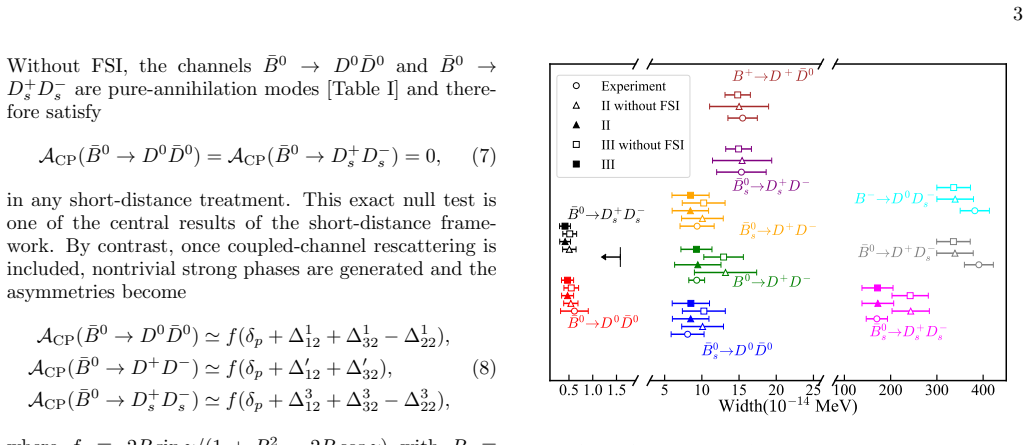
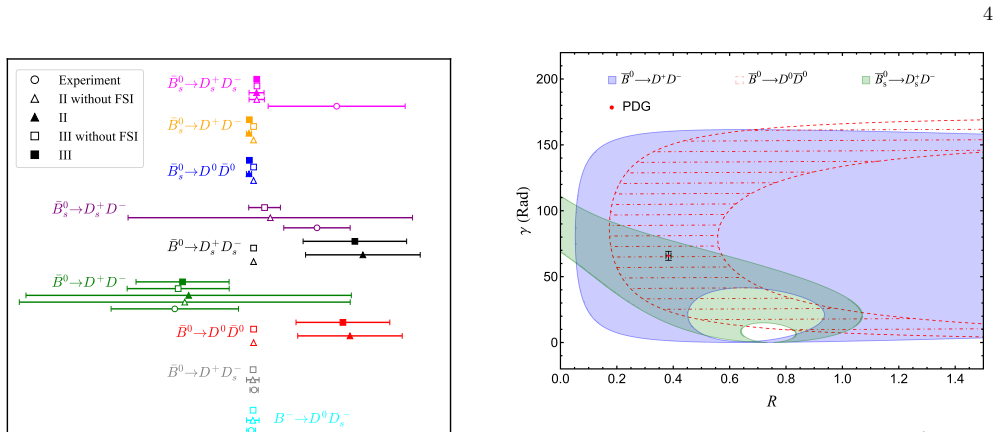
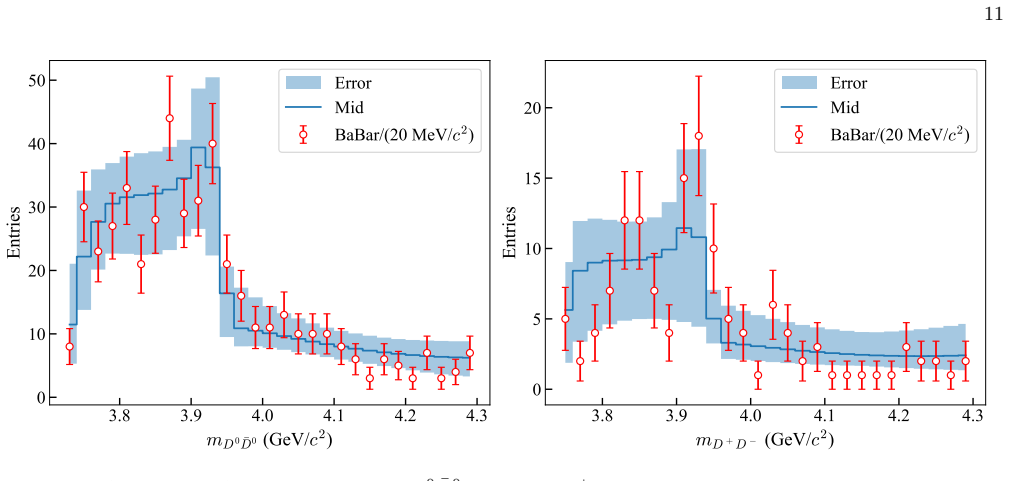
Using the coupled D Dbar system, the interaction kernel can be derived from chiral effective field theory constrained by heavy-quark spin symmetry, and low-energy constants are fixed by the gamma gamma to D Dbar cross-section data from BaBar, leaving no adjustable parameter in the FSI sector when applied to B decays. The resulting predictions for CP asymmetries and branching fractions show excellent agreement with the available experimental data. A defining consequence is that CP asymmetries in the pure-annihilation channels B0bar to D0 D0bar and B0bar to Ds+ Ds-, identically zero in any short-distance treatment, are dramatically enhanced by FSI.
What carries the argument
The unitarized final-state interaction framework based on the Lippmann-Schwinger equation solved to all orders in the coupled D Dbar system with a chiral EFT kernel fixed by gamma-gamma data.
If this is right
- CP asymmetries in the pure-annihilation channels B0bar to D0 D0bar and B0bar to Ds+ Ds- are dramatically enhanced by FSI.
- Predictions for CP asymmetries and branching fractions agree with available experimental data.
- Definite predictions are given for partial widths and CP asymmetries of all yet-unmeasured channels.
- A measured nonzero asymmetry in pure-annihilation modes serves as a direct signature of long-distance dynamics.
- The framework carries implications for CKM parameter extraction and searches for physics beyond the Standard Model.
Where Pith is reading between the lines
- The same unitarized approach may resolve analogous strong-phase puzzles in other nonleptonic heavy-meson decays.
- Future precision measurements in the pure-annihilation channels can distinguish the size of long-distance contributions from short-distance expectations.
- Incorporating these FSI effects could tighten constraints on CKM angles extracted from multiple B decay modes simultaneously.
Load-bearing premise
The low-energy constants determined from gamma-gamma to D Dbar data can be transferred without modification or additional intermediate states to describe final-state interactions in B decays.
What would settle it
A measurement of the CP asymmetry in B0bar to D0 D0bar that is consistent with zero within experimental precision would contradict the predicted dramatic enhancement from final-state interactions.
Figures
read the original abstract
A reliable description of direct CP asymmetries in hadronic $B$ decays, among the most sensitive probes of the CKM mechanism and of physics beyond the Standard Model, remains unresolved. Conventional factorization approaches adopt distinct treatments for the strong phases originating from long-distance QCD interactions, leading to predictions that differ by factors of several for identical decay channels. Existing final-state interaction (FSI) models are limited to one-loop approximations that break unitarity and rely on channel-specific phenomenological cutoffs, severely restricting the predictive capability. We introduce a unitarized FSI framework based on the Lippmann-Schwinger equation solved to all orders, restoring unitarity that is manifestly broken in one-loop treatments. Using the coupled $D\bar{D}$ system, we show that the interaction kernel can be derived from chiral effective field theory constrained by heavy-quark spin symmetry, and low-energy constants are fixed by the $\gamma\gamma\to D\bar{D}$ cross-section data from BaBar, leaving no adjustable parameter in the FSI sector when applied to $B$ decays. The resulting predictions for CP asymmetries and branching fractions show excellent agreement with the available experimental data. A defining consequence is that CP asymmetries in the pure-annihilation channels $\bar{B}^0\to D^0\bar{D}^0$ and $\bar{B}^0\to D_s^+D_s^-$, identically zero in any short-distance treatment, are dramatically enhanced by FSI, and a measured nonzero asymmetry in these modes is therefore a direct experimental signature of long-distance dynamics. We present definite predictions for the partial widths and CP asymmetries of all yet-unmeasured channels, establishing final-state interactions as a predictive, data-driven ingredient of the Standard Model with direct implications for CKM parameter extraction and BSM searches.
Editorial analysis
A structured set of objections, weighed in public.
Referee Report
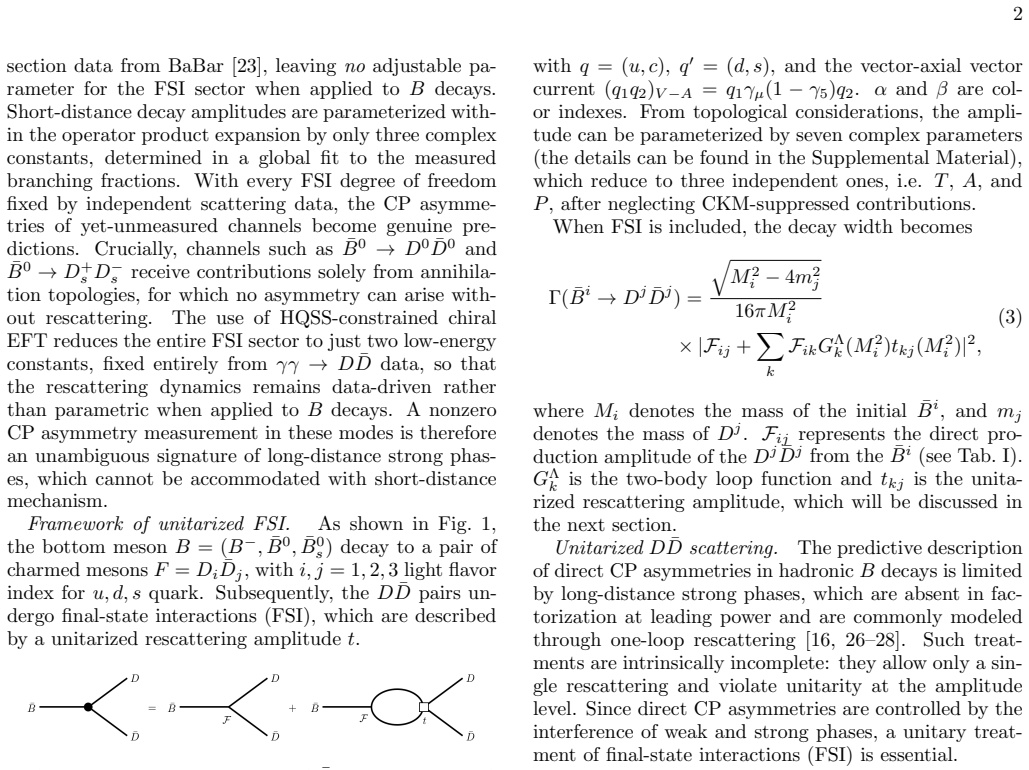
Summary. The manuscript introduces a unitarized final-state interaction (FSI) framework for hadronic B decays based on the Lippmann-Schwinger equation solved to all orders. The interaction kernel for the coupled D Dbar system is derived from chiral effective field theory constrained by heavy-quark spin symmetry; its low-energy constants are fixed exclusively by BaBar γγ → D Dbar cross-section data near threshold. No additional parameters are introduced when the resulting T-matrix is applied to B → D Dbar amplitudes at the B-meson mass shell. The approach is claimed to restore unitarity (broken in one-loop treatments), yield predictions for CP asymmetries and branching fractions in agreement with existing data, and generate large CP asymmetries in pure-annihilation channels (B0bar → D0 D0bar and B0bar → Ds+ Ds-) that vanish in short-distance treatments.
Significance. If the central results hold, the work would provide a parameter-free, data-driven method for incorporating long-distance strong phases in B decays, addressing long-standing discrepancies among factorization approaches. The explicit predictions for yet-unmeasured channels and the identification of nonzero CP asymmetries in annihilation modes as direct signatures of FSI would have implications for CKM extractions and BSM searches. The use of external γγ data to fix the kernel and the all-orders unitarization are notable strengths.
major comments (2)
- [framework application to B decays] The transfer of the interaction kernel (fixed by BaBar γγ → D Dbar data at √s ≲ 4.5 GeV) to B-decay kinematics at s = m_B² ≈ 28 GeV² is load-bearing for the 'no adjustable parameter' claim and the predicted CP asymmetries. The manuscript does not demonstrate that higher-order momentum dependence or additional coupled channels remain negligible over this factor-of-six increase in energy scale; uncontrolled corrections could alter the strong phases extracted from the Lippmann-Schwinger solution.
- [results and comparison with data] The abstract states that the resulting predictions show 'excellent agreement' with data, yet the manuscript provides no quantitative assessment (e.g., χ² per degree of freedom or explicit comparison tables) of how sensitive this agreement is to variations in the kernel at high s. Without such a test, the agreement cannot be distinguished from possible fine-tuning within the extrapolation uncertainty.
minor comments (1)
- [formalism] Notation for the coupled-channel T-matrix and the precise definition of the on-shell projection in the Lippmann-Schwinger equation should be clarified with an explicit equation reference.
Simulated Author's Rebuttal
We thank the referee for the thorough review and valuable comments on our manuscript. We address each major comment below in detail. Our responses aim to clarify the robustness of the framework while acknowledging areas where additional clarification or revision can strengthen the presentation.
read point-by-point responses
-
Referee: [framework application to B decays] The transfer of the interaction kernel (fixed by BaBar γγ → D Dbar data at √s ≲ 4.5 GeV) to B-decay kinematics at s = m_B² ≈ 28 GeV² is load-bearing for the 'no adjustable parameter' claim and the predicted CP asymmetries. The manuscript does not demonstrate that higher-order momentum dependence or additional coupled channels remain negligible over this factor-of-six increase in energy scale; uncontrolled corrections could alter the strong phases extracted from the Lippmann-Schwinger solution.
Authors: We appreciate the referee pointing out this critical aspect of the extrapolation. The interaction kernel is constructed from chiral effective field theory with constraints from heavy-quark spin symmetry, which provides a systematic expansion valid in the relevant kinematic regime. The low-energy constants are determined solely from the BaBar data near threshold, and the all-orders solution of the Lippmann-Schwinger equation generates the T-matrix at higher energies without introducing new parameters. While we recognize that an explicit demonstration of the suppression of higher-order terms over this energy range is not provided in the current manuscript, the framework's success in reproducing data in the D Dbar system and the resulting agreement in B decays support its applicability. We will add a paragraph discussing the expected magnitude of corrections based on the power counting of the EFT in the revision. revision: partial
-
Referee: [results and comparison with data] The abstract states that the resulting predictions show 'excellent agreement' with data, yet the manuscript provides no quantitative assessment (e.g., χ² per degree of freedom or explicit comparison tables) of how sensitive this agreement is to variations in the kernel at high s. Without such a test, the agreement cannot be distinguished from possible fine-tuning within the extrapolation uncertainty.
Authors: We agree that including a quantitative assessment would improve the clarity of the results section. Although the model has no adjustable parameters in the FSI sector, making fine-tuning unlikely, we will revise the manuscript to include explicit comparison tables of predicted versus measured branching fractions and CP asymmetries, along with a discussion of the sensitivity to reasonable variations in the kernel. This will include estimates of theoretical uncertainties arising from the extrapolation. revision: yes
Circularity Check
No significant circularity; LECs fixed by external BaBar data
full rationale
The paper states that the interaction kernel is derived from chiral EFT + HQSS and its low-energy constants are fixed solely by independent BaBar γγ→D Dbar cross-section data, with the resulting unitarized amplitudes then applied to B decays without further parameters. No self-citation load-bearing steps, self-definitional relations, or fitted inputs renamed as predictions appear in the abstract or described framework. The central claim rests on external experimental input rather than internal reduction, making the derivation self-contained against the stated benchmarks.
Axiom & Free-Parameter Ledger
axioms (3)
- domain assumption Heavy-quark spin symmetry constrains the interaction kernel in the coupled DDbar system
- standard math Solution of the Lippmann-Schwinger equation to all orders restores unitarity
- domain assumption The coupled DDbar system suffices to model the dominant FSI relevant to the B decays under study
Reference graph
Works this paper leans on
-
[1]
A. D. Sakharov, Violation of CP Invariance, C asymme- try, and baryon asymmetry of the universe, Pisma Zh. Eksp. Teor. Fiz.5, 32 (1967)
1967
-
[2]
M. Bona et al. (UTfit), New UTfit Analysis of the Unitarity Triangle in the Cabibbo-Kobayashi-Maskawa scheme, Rend. Lincei Sci. Fis. Nat.34, 37 (2023), arX- iv:2212.03894 [hep-ph]
arXiv 2023
-
[3]
M. Beneke, G. Buchalla, M. Neubert, and C. T. Sachrajda, QCD factorization for B —>pi pi decays: Strong phases and CP violation in the heavy quark limit, Phys. Rev. Lett.83, 1914 (1999), arXiv:hep-ph/9905312
Pith/arXiv arXiv 1914
-
[4]
M. Beneke, G. Buchalla, M. Neubert, and C. T. Sachrajda, QCD factorization for exclusive, nonlepton- ic B meson decays: General arguments and the case of heavy light final states, Nucl. Phys. B591, 313 (2000), arXiv:hep-ph/0006124
Pith/arXiv arXiv 2000
-
[5]
Y. Y. Keum, H.-N. Li, and A. I. Sanda, Penguin enhance- ment andB→Kπdecays in perturbative QCD, Phys. Rev. D63, 054008 (2001), arXiv:hep-ph/0004173
Pith/arXiv arXiv 2001
-
[6]
C.-D. Lu, K. Ukai, and M.-Z. Yang, Branching ratio and CP violation of B —>pi pi decays in perturbative QCD approach, Phys. Rev. D63, 074009 (2001), arXiv:hep- ph/0004213
arXiv 2001
-
[7]
C. W. Bauer, S. Fleming, D. Pirjol, and I. W. Stewart, An Effective field theory for collinear and soft gluons: Heavy to light decays, Phys. Rev. D63, 114020 (2001), arXiv:hep-ph/0011336
Pith/arXiv arXiv 2001
-
[8]
C. W. Bauer, D. Pirjol, I. Z. Rothstein, and I. W. Stewart,B→M 1M2: Factorization, charming penguins, strong phases, and polarization, Phys. Rev. D70, 054015 (2004), arXiv:hep-ph/0401188
Pith/arXiv arXiv 2004
-
[9]
M. Beneke and M. Neubert, QCD factorization forB→ P PandB→P Vdecays, Nucl. Phys. B675, 333 (2003), arXiv:hep-ph/0308039
Pith/arXiv arXiv 2003
-
[10]
H.-Y. Cheng and C.-K. Chua, QCD Factorization for Charmless HadronicB s Decays Revisited, Phys. Rev. D 80, 114026 (2009), arXiv:0910.5237 [hep-ph]
Pith/arXiv arXiv 2009
-
[11]
H.-Y. Cheng and C.-K. Chua, Revisiting Charmless HadronicB u,d Decays in QCD Factorization, Phys. Rev. D80, 114008 (2009), arXiv:0909.5229 [hep-ph]
Pith/arXiv arXiv 2009
-
[12]
J. Chai, S. Cheng, Y.-h. Ju, D.-C. Yan, C.-D. L¨ u, and Z.-J. Xiao, Charmless two-body B meson decays in the perturbative QCD factorization approach, Chin. Phys. C 46, 123103 (2022), arXiv:2207.04190 [hep-ph]
arXiv 2022
-
[13]
Z.-T. Zou, A. Ali, C.-D. Lu, X. Liu, and Y. Li, Improved Estimates of TheB (s) →V VDecays in Perturbative QCD Approach, Phys. Rev. D91, 054033 (2015), arX- iv:1501.00784 [hep-ph]
Pith/arXiv arXiv 2015
-
[14]
A. R. Williamson and J. Zupan, Two body B decays with isosinglet final states in SCET, Phys. Rev. D74, 014003 (2006), [Erratum: Phys.Rev.D 74, 03901 (2006)], arXiv:hep-ph/0601214
Pith/arXiv arXiv 2006
-
[15]
W. Wang, Y.-M. Wang, D.-S. Yang, and C.-D. Lu, Charmless Two-bodyB (s) →V Pdecays In Soft- Collinear-Effective-Theory, Phys. Rev. D78, 034011 (2008), arXiv:0801.3123 [hep-ph]
Pith/arXiv arXiv 2008
-
[16]
H.-Y. Cheng, C.-K. Chua, and A. Soni, Final state inter- actions in hadronic B decays, Phys. Rev. D71, 014030 (2005), arXiv:hep-ph/0409317
Pith/arXiv arXiv 2005
-
[17]
I. Bediaga and C. G¨ obel, DirectCPviolation in beauty and charm hadron decays, Prog. Part. Nucl. Phys.114, 103808 (2020), arXiv:2009.07037 [hep-ex]
arXiv 2020
-
[18]
A. Pich, E. Solomonidi, and L. Vale Silva, Final-state interactions in the CP asymmetries of charm-meson two- body decays, Phys. Rev. D108, 036026 (2023), arX- iv:2305.11951 [hep-ph]
arXiv 2023
-
[19]
I. Bediaga, T. Frederico, and P. C. Magalh˜ aes, Enhanced Charm CP Asymmetries from Final State Interactions, Phys. Rev. Lett.131, 051802 (2023), arXiv:2203.04056 [hep-ph]
arXiv 2023
-
[20]
A. F. Falk, A. L. Kagan, Y. Nir, and A. A. Petrov, Final state interactions and new physics inB→piKdecays, Phys. Rev. D57, 4290 (1998), arXiv:hep-ph/9712225
Pith/arXiv arXiv 1998
-
[21]
J. F. Donoghue, E. Golowich, A. A. Petrov, and J. M. Soares, Systematics of soft final state interactions in B decay, Phys. Rev. Lett.77, 2178 (1996), arXiv:hep- ph/9604283
arXiv 1996
-
[22]
Mohammadi and H
B. Mohammadi and H. Mehraban, Final state interaction inB 0 →D 0 ¯D0, JHEP07, 089
-
[23]
B. Aubert et al. (BaBar), Observation of theχ c2(2p) Meson in the Reactionγγ→D ¯Dat BaBar, Phys. Rev. D81, 092003 (2010), arXiv:1002.0281 [hep-ex]
Pith/arXiv arXiv 2010
-
[24]
A. J. Buras and L. Silvestrini, Nonleptonic two-body B decays beyond factorization, Nucl. Phys. B569, 3 (2000), arXiv:hep-ph/9812392
Pith/arXiv arXiv 2000
-
[25]
M. Ciuchini, E. Franco, G. Martinelli, and L. Silvestrini, Charming penguins in B decays, Nucl. Phys. B501, 271 (1997), arXiv:hep-ph/9703353
Pith/arXiv arXiv 1997
-
[26]
C.-Q. Geng, X.-N. Jin, and C.-W. Liu, Large CP asym- metries from final-state interactions in charmful baryonic decays of B0→Ξc+Ξ¯c- and Bs0→Λc+Λ¯c-, Phys. Rev. D112, 013001 (2025), arXiv:2502.12770 [hep-ph]
arXiv 2025
-
[27]
Z.-D. Duan, J.-P. Wang, R.-H. Li, C.-D. L¨ u, and F.-S. Yu, Final-state rescattering mechanism in bottom-baryon de- cays, JHEP09, 160, arXiv:2412.20458 [hep-ph]
-
[28]
I. Bediaga, T. Frederico, and P. C. Magalh˜ aes, Charm rescattering contribution in rareB + c →K +K −π+ decay, Phys. Lett. B785, 581 (2018), arXiv:1808.02945 [hep- ph]
Pith/arXiv arXiv 2018
-
[29]
S.-H. Zhou, Y.-B. Wei, Q. Qin, Y. Li, F.-S. Yu, and C.-D. Lu, Analysis of Two-body CharmedBMeson Decays in Factorization-Assisted Topological-Amplitude Approach, Phys. Rev. D92, 094016 (2015), arXiv:1509.04060 [hep- ph]
Pith/arXiv arXiv 2015
-
[30]
S.-H. Zhou, R.-H. Li, and X.-Y. L¨ u, Analysis of three- body decays B→D(V→)PP under the factorization- assisted topological-amplitude approach, Phys. Rev. D 110, 056001 (2024), arXiv:2406.00373 [hep-ph]
arXiv 2024
-
[31]
J. Ou-Yang, R.-H. Li, and S.-H. Zhou, Analysis of three- body charmed B meson decays B→D(V*→)VP, Phys. Rev. D112, 056005 (2025), arXiv:2506.14675 [hep-ph]
arXiv 2025
-
[32]
Y. Fu-Sheng, X.-X. Wang, and C.-D. Lu, Nonleptonic Two Body Decays of Charmed Mesons, Phys. Rev. D 84, 074019 (2011), arXiv:1101.4714 [hep-ph]
Pith/arXiv arXiv 2011
-
[33]
P. Colangelo, F. De Fazio, and T. N. Pham, Nonfactorizable contributions in B decays to charmoni- um: The Case ofB − →K −hc, Phys. Rev. D69, 054023 (2004), arXiv:hep-ph/0310084
Pith/arXiv arXiv 2004
-
[34]
P. Colangelo, F. De Fazio, and T. N. Pham,B − → K −χc0 decay from charmed meson rescattering, Phys. Lett. B542, 71 (2002), arXiv:hep-ph/0207061
Pith/arXiv arXiv 2002
-
[35]
M. Rohrken et al. (Belle), Measurements of Branching 6 Fractions and Time-dependent CP Violating Asymmetries inB 0 →D (∗)±D∓ Decays, Phys. Rev. D 85, 091106 (2012), arXiv:1203.6647 [hep-ex]
Pith/arXiv arXiv 2012
-
[36]
Zupanc et al., Improved measurement of ¯B0 →D − s D+ and search for ¯B0 →D + s D− s at Belle, Phys
A. Zupanc et al., Improved measurement of ¯B0 →D − s D+ and search for ¯B0 →D + s D− s at Belle, Phys. Rev. D75, 091102 (2007), arXiv:hep-ex/0703040
arXiv 2007
-
[37]
R. Aaij et al. (LHCb), First observations of ¯B0 s → D+D−,D + s D− andD 0 ¯D0 decays, Phys. Rev. D87, 092007 (2013), arXiv:1302.5854 [hep-ex]
Pith/arXiv arXiv 2013
-
[38]
F. Abudin´ enet al. (Belle-II), Measurement of theB 0 lifetime and flavor-oscillation frequency using hadronic decays reconstructed in 2019–2021 Belle II data, Phys. Rev. D107, L091102 (2023), arXiv:2302.12791 [hep-ex]
arXiv 2019
-
[39]
R. Aaij et al. (LHCb), Measurement ofB 0 s andD − s me- son lifetimes, Phys. Rev. Lett.119, 101801 (2017), arX- iv:1705.03475 [hep-ex]
Pith/arXiv arXiv 2017
-
[40]
R. Aaij et al. (LHCb), Measurements of theB +, B0, B0 s meson and Λ 0 b baryon lifetimes, JHEP04, 114, arX- iv:1402.2554 [hep-ex]
-
[41]
I. Adachi et al. (Belle-II), Measurement of the branching fractions of B→D (∗)K −K (∗)0 (S) and B→D (∗)D− s decays at Belle II, JHEP08, 206, arXiv:2406.06277 [hep-ex]
-
[42]
I. Adachi et al. (Belle), Measurement of the branch- ing fraction and charge asymmetry of the decayB + → D+ ¯D0 and search forB 0 →D 0 ¯D0, Phys. Rev. D77, 091101 (2008), arXiv:0802.2988 [hep-ex]
Pith/arXiv arXiv 2008
-
[43]
R. Aaij et al. (LHCb), Measurement of theCPasymme- try inB − →D − s D0 andB − →D −D0 decays, JHEP05, 160, arXiv:1803.10990 [hep-ex]
-
[44]
R. Aaij et al. (LHCb), Measurement of CP asymmetries in B 0 →D − s D+ and B 0 s →D + s D− decays, (2026), arX- iv:2603.28132 [hep-ex]
arXiv 2026
-
[45]
R. Aaij et al. (LHCb), Measurement of CP violation in B0 →D +D− andB 0 s →D + s D− s decays, JHEP01, 061, arXiv:2409.03009 [hep-ex]
-
[46]
M. B. Wise, Chiral perturbation theory for hadrons con- taining a heavy quark, Phys. Rev. D45, R2188 (1992)
1992
-
[47]
M. T. AlFiky, F. Gabbiani, and A. A. Petrov, X(3872): Hadronic molecules in effective field theory, Phys. Lett. B640, 238 (2006), arXiv:hep-ph/0506141
Pith/arXiv arXiv 2006
- [48]
-
[49]
F.-K. Guo and U.-G. Meissner, Where is theχ c0(2P)?, Phys. Rev. D86, 091501 (2012), arXiv:1208.1134 [hep- ph]
Pith/arXiv arXiv 2012
-
[50]
A. Gomez Nicola and J. R. Pelaez, Meson meson scat- tering within one loop chiral perturbation theory and its unitarization, Phys. Rev. D65, 054009 (2002), arXiv:hep-ph/0109056
Pith/arXiv arXiv 2002
-
[51]
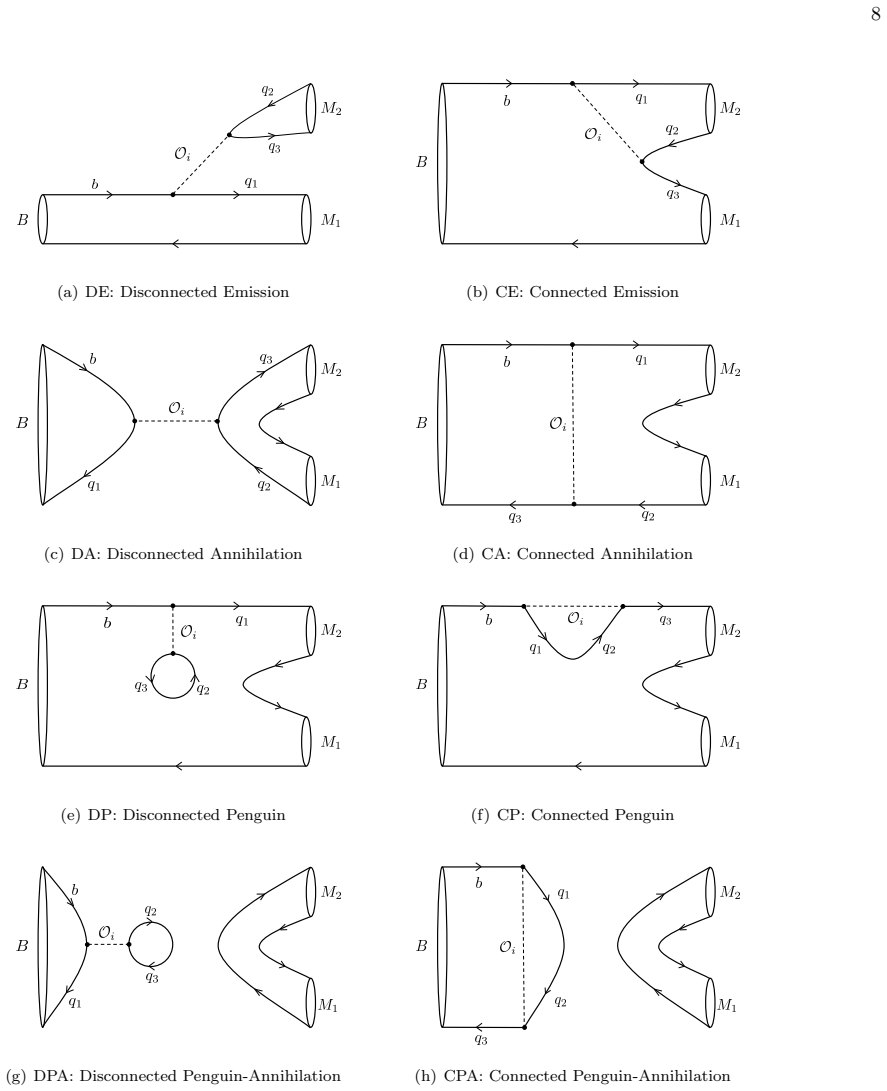
L. Zhang, X.-W. Kang, and X.-H. Guo, Composite nature ofZ b states from data analysis, Eur. Phys. J. C82, 375 (2022), arXiv:2203.02301 [hep-ph]. 7 SUPPLEMENTAL MATERIALS Appendix A: Topology Diagrams The current-current operators,O 1 andO 2, have the same chiral structure, but different color structures, which will be reflected in corresponding Wilson coe...
arXiv 2022
-
[52]
+O(· · ·), ∆2 =f(∆ ′ 12 + ∆′
-
[53]
+O(· · ·), ∆3 =f(δ p + ∆3 12 + ∆3 32 −∆ 3
-
[54]
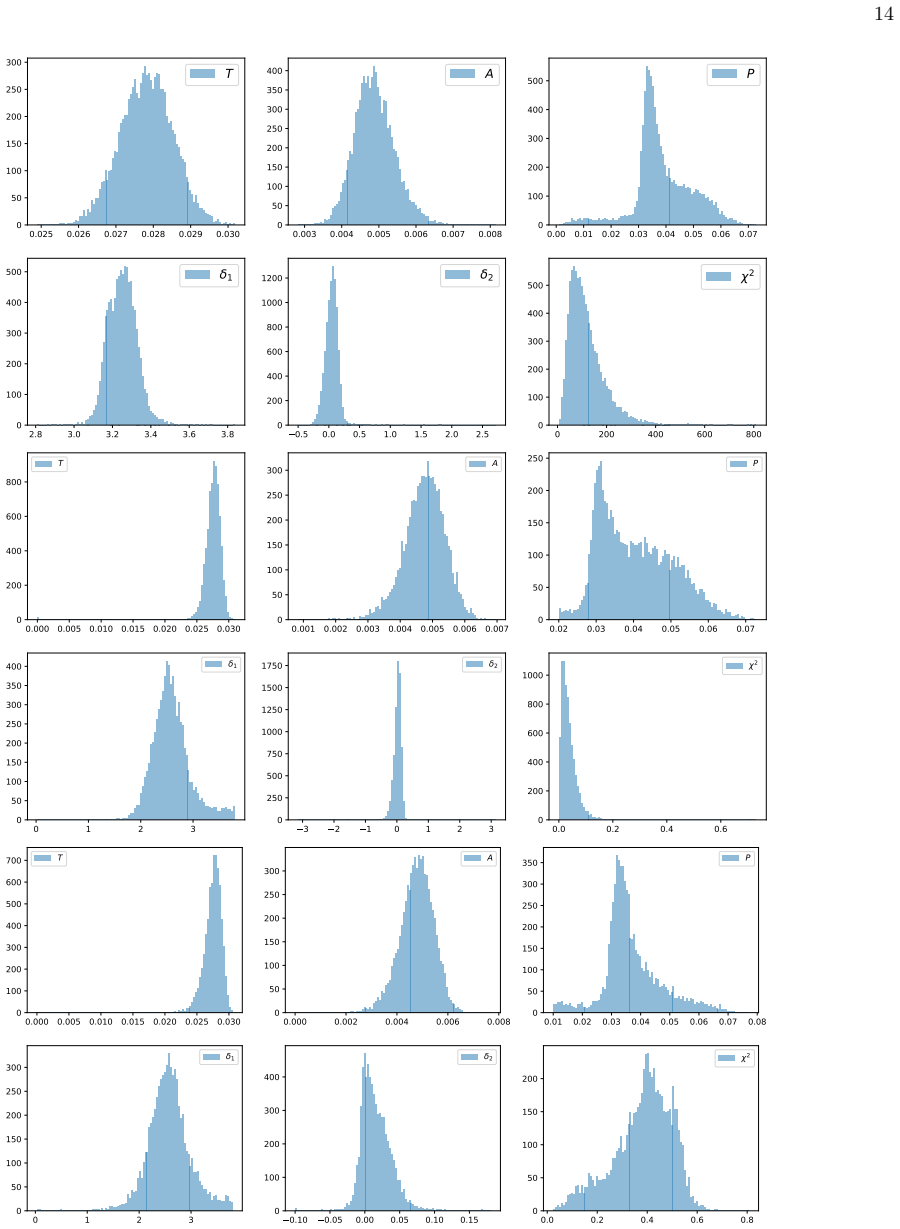
Appendix D: Bootstrap The errors of the fitted parameters are derived by making bootstrap from three fit schemes, respectively
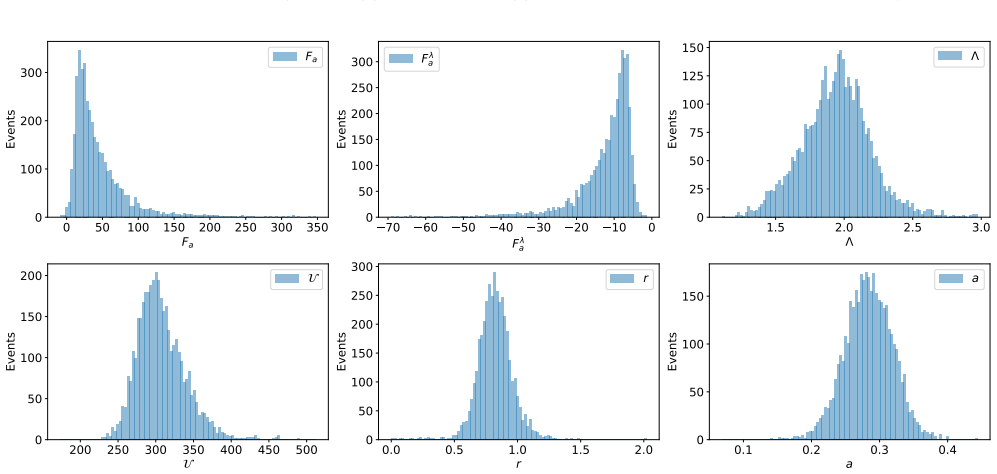
+O(· · ·), (C8) for each channel. Appendix D: Bootstrap The errors of the fitted parameters are derived by making bootstrap from three fit schemes, respectively. From the experimental data within the experimental error range, 10,000 sample sets are generated for each fit scheme and three fit schemes are performed to derive 10,000 sets of parameters for th...
discussion (0)
Sign in with ORCID, Apple, or X to comment. Anyone can read and Pith papers without signing in.