REVIEW 3 major objections 4 minor 24 references
Goal-Oriented Semantic Resource Allocation with Cumulative Prospect Theoretic Agents
T0 review · 3 major / 4 minor · reviewed 2026-08-07 · deepseek-v4-flash
Pith's one-line read The paper claims that power allocation for goal-oriented semantic networks with cumulative-prospect-theoretic agents is a concave problem with zero duality gap, solvable in closed form per agent as inverse water-filling in the gain domain…
desk verdict A sound but narrow KKT derivation is undermined by simulations that violate the paper's own parameter assumptions. read the letter →
The pith
A machine-rendered reading of the paper's core claim, the machinery that carries it, and where it could break.
The reading
What carries the argument
The central object is the single-outcome CPT objective $w(p_i)u(\mathrm{SNR}_i)$, assembled from a generalized Kobberling–Wakker utility function with separate gain and loss branches, together with a Prelec probability weighting function $w(p) = \exp(-\gamma(-\ln p)^\theta)$. The mechanism that carries the argument is Lagrangian dual analysis: because the utility is concave on each subdomain and the feasibility set is a simplex, the KKT stationarity condition factors into per-agent closed-form expressions, and a one-dimensional bisection on the dual variable $\mu$ sweeps the transition between gain and loss allocations.
What would settle it
Solve the KKT system directly for the six-agent setup with the paper's stated parameters ($\alpha=3$, $\beta=2$, $\lambda_1=2$, $\lambda_2=4$, $\gamma_1=\gamma_2=5$) and check whether the closed-form expressions are real, positive, and agree with the plotted curves; a mismatch would show the simulations do not instantiate the paper's analytical claims. Alternatively, repeat the simulation with $\gamma_1,\gamma_2<0$ and test whether the inverse-water-filling and inverse-U profiles still appear.
Extended reading notes
Core claim
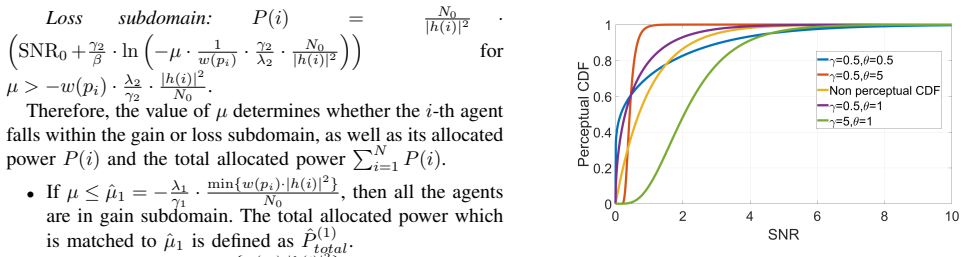
On the paper's own terms, the paper establishes that the goal-oriented power allocation problem with CPT agents can be solved analytically. For the proposed generalized Kobberling–Wakker utility with concave branches, the problem is concave and satisfies Slater's condition when the total power budget falls in certain intervals, so strong duality holds. The KKT stationarity condition separates cleanly into gain and loss subdomains, producing closed-form allocations of the form $P_i = \frac{N_0}{|h_i|^2}\left[\mathrm{SNR}_0 + \frac{\gamma_1}{\alpha}\ln\left(-\mu \, w(p_i)^{-1} \frac{\gamma_1}{\lambda_1} \frac{N_0}{|h_i|^2}\right)\right]$ in the gain case and a symmetric loss-branch expression. The sign of the dual variable $\mu$ relative to per-agent thresholds determines whether an agent is in gain or loss, and the resulting allocation profile transitions from inverse water-filling to an asymmetric inverse-U shape as the power budget shrinks. Loss aversion makes the all-gain total power threshold exceed the all-loss threshold, and the inverse-S Prelec weighting amplifies the influence of low-probability agents.
Load-bearing premise
The entire closed-form solution rests on the assumption that each agent's subjective evaluation is fully captured by a single-outcome CPT objective $w(p_i)u(\mathrm{SNR}_i)$ with a utility function that is concave and increasing on both the gain and loss branches; if the utility is not concave and increasing (for instance, with the positive gamma values used in the simulations), the claimed closed-form allocations and their shapes do not follow.
Editorial extensions
If this is right
- Per-agent power allocations can be computed from a KKT formula rather than by iterative solvers, reducing the optimization to a one-dimensional bisection on the dual variable.
- In the gain subdomain the allocation is an inverse water-filling profile, so agents with worse channels receive more power; in the loss subdomain the profile becomes an asymmetric inverse-U, with the peak shifting right as total power decreases.
- The Prelec weighting function acts as a per-agent priority weight: agents with smaller $w(p_i)$ are amplified, while more active agents have reduced influence.
- Strong loss aversion forces the all-gain total power threshold to exceed the all-loss threshold, so there is an intermediate budget region where gain and loss agents coexist and the allocation is neither pure water-filling nor pure equalization.
- The concavity and zero-duality-gap result legitimizes the use of standard dual methods for goal-oriented semantic resource allocation problems with this class of CPT utilities.
Reading between the lines
- The simulation section evaluates the utilities with $\gamma_1 = \gamma_2 = 5$, which violates the model's own requirement that both be negative for the closed-form log expressions to be defined; the plotted curves therefore cannot be direct evaluations of the paper's claimed formulas, and a corrected parameter choice would be needed to validate the inverse water-filling and inverse-U predictions.
- A natural extension, left implicit by the paper, is to apply the same dual decomposition to the full multi-outcome CPT prospect in Eq. (4); the single-outcome closed form here suggests the general problem may remain tractable when the rank-dependent weights are fixed.
- The claimed connection between CPT value and the semantic-of-information integral suggests that other goal-oriented metrics that can be written as a CPT integral would inherit the same concavity and closed-form structure, which is testable by substituting a different composite metric $M(y)$ into Eq. (5).
Editorial analysis
A structured set of objections, weighed in public.
Referee Report
Summary. The paper proposes a resource-allocation framework for goal-oriented semantic networks in which agents evaluate allocations through cumulative prospect theory (CPT). The authors introduce a generalized two-branch utility function, define a semantic-of-information metric through a probability-weighted integral of utility, and apply the framework to downlink power allocation over N orthogonal channels. The main analytical claim is that the resulting optimization problem is concave, has zero duality gap, and admits closed-form KKT power allocations in the gain and loss subdomains, giving inverse water-filling and inverse-U profiles. Simulation results with N = 6 agents are presented to illustrate these claims.
Significance. Should the main claims hold after correction, the paper would offer a tractable concave formulation of CPT-based power allocation, with explicit closed-form expressions and comparisons to standard water-filling. The KKT derivation is clean and internally consistent in the intended parameter regime, and the comparison against equal-power and water-filling baselines is a useful starting point. However, the numerical evidence is currently invalid because the simulations use parameter values outside the model's domain, and the semantic-of-information connection is definitional rather than derived. The value of the paper depends on repairing the numerical study and clarifying the status of Eq. (5). No code or machine-checked proofs are shipped, but the derivations are explicit enough to verify.
major comments (3)
- [Section V, first paragraph; Section IV, case study setup] The simulations set gamma1 = gamma2 = 5, in direct contradiction to Section IV's parameter choice gamma1, gamma2 < 0. Section IV requires negative gamma so that the utility in Eq. (6) is strictly increasing and concave on both subdomains and so that the logarithms in the closed-form gain/loss expressions are well defined. With gamma1 = gamma2 = 5 and alpha, beta, lambda1, lambda2 > 0, the derivative on the gain branch is u'(SNR) = -(lambda1/gamma1) exp(alpha(SNR - SNR0)/gamma1) < 0, and the analogous derivative on the loss branch is also negative. Consequently, the objective in Eq. (7) is decreasing in every P_i, the KKT log arguments are negative or undefined for feasible mu >= 0, and the reported positive power profiles cannot be KKT points. Under the printed parameters the global optimum of Eq. (7) is P_i = 0 for all i. The inverse water-filling and inverse-U shapes are therefore not demonstrated in the valid parameter regime.
- [Section III-A, Eq. (5)] The claimed relation between the semantic-of-information metric and the CPT value is achieved by definition: S(y) is set equal to u(M(y)) tilde f_Y(y), so the integral of S(y) equals the CPT perceptual utility. This makes the semantic bridge true by construction rather than the result of an independent derivation. The power-allocation results in Section IV do not depend on Eq. (5), so the technical core survives, but the framing claim should be softened or supported by a separate derivation.
- [Section IV, Eqs. (7)-(10)] The statement that Eq. (7) is concave and has zero duality gap 'when Ptotal falls within specific intervals' is not fully justified. Concavity of each term w(p_i) u(SNR_i) holds only under the parameter restrictions stated earlier in the section (gamma1, gamma2 < 0, mu1 = mu2 = 1), and for Ptotal > 0 the Slater condition appears to hold by choosing P_i = Ptotal/(2N). The paper should state the formal conditions that restrict the intervals or remove the qualification; otherwise the zero-duality-gap claim is not adequately supported.
minor comments (4)
- [Table II] The row labeled 'Convex' for the gain branch requires lambda1/gamma1 < 0 and 0 < alpha/gamma1 simultaneously; for positive lambda1 and alpha this is impossible because the two inequalities impose opposite signs on gamma1. Please correct the sign conditions or the stated parameter domains.
- [Section III-A, Eq. (5)] The notation tilde f_Y(y) = d tilde F_Y(y)/dy = d w(F_Y(y))/dy is ambiguous for a multivariate CDF; the chain-rule derivative would involve w'(F_Y(y)) f_Y(y) for a univariate CDF, and for a multivariate CDF the derivative is a gradient, not a density. Please clarify whether Eq. (5) is intended as a definition or as a derived identity.
- [Section V, Figs. 2 and 3] The figure captions and text do not state how the power profiles were computed (e.g., bisection on mu), nor do they list the exact parameter values and the Prelec PWF parameters used in each subfigure. This information is needed to reproduce the reported curves.
- [References] Reference [5] is incomplete ('Frontiers, vol. 2') and should be completed with the article title and page range; several other references similarly lack full bibliographic details.
Circularity Check
The semantic bridge in Eq. (5) is definitional: SoI is defined as the CPT integrand, making the claimed CPT–SoI relation true by construction; the KKT power-allocation derivation is otherwise self-contained.
-
self definitional
[Section III-A, Eq. (5)]
"“\tilde M = ∫_{ℝ^K_+} u(M(y)) \tilde f_Y(y)dy = ∫_{ℝ^K_+} S(y)dy, (5) where \tilde f_Y(y) is the perceptual multivariate PDF of Y, which is given by \tilde f_Y(y) = d\tilde F_Y(y)/dy = dw(F_Y(y))/dy, and S(y) represents the SoI metrics [1], [21].”"
Equation (5) defines S(y) as the integrand u(M(y))\tilde f_Y(y). The paper then asserts that this same S(y) “represents the SoI metrics,” citing self-authored works [1] and [21]. Thus the claimed “highly related” connection between CPT value and semantic information is an identity by construction, not a derived result: the semantic content is defined to be the CPT expectation integrand. This labeling step is used to motivate the framework, but the subsequent KKT power-allocation derivation in Section IV follows from the stated utility and constraints independently of this semantic identification, so the circularity is confined to the conceptual bridge rather than the mathematical allocation result.
full rationale
I examined the claimed derivation chain. The main mathematical claim—the concave power-allocation problem (7) and its KKT closed-form allocations—is derived from an explicit utility function and standard convex-optimization stationarity conditions; no fitted parameter is renamed as a prediction, no uniqueness theorem is imported from the authors, and no ansatz is smuggled in via citation. The only circularity found is the semantic bridge in Eq. (5), where the SoI metric S(y) is defined as the CPT integrand u(M(y))\tilde f_Y(y) and then said to “represent” the SoI, making the asserted CPT–SoI relation tautological. This is a self-definitional labeling step and is load-bearing only for the semantic framing, not for the KKT power-allocation formulas. I also note that the Section V simulation setting γ1 = γ2 = 5 contradicts Section IV’s requirement γ1, γ2 < 0; that is a correctness/consistency concern, not a circularity, and it does not change the score. On balance, the central resource-allocation derivation has independent mathematical content, so the circularity score is moderate rather than high.
Assumptions & free parameters
free parameters (7)
- alpha =
3
- beta =
2
- lambda1 =
2
- lambda2 =
4
- gamma1 and gamma2 =
5
- SNR0 =
7 dB
- Prelec PWF parameters theta and gamma =
varied
assumptions (6)
- domain assumption CPT agent preferences are represented by a value function u and probability weighting w plus and w minus as in Tversky and Kahneman [4].
- domain assumption The Prelec probability weighting function w(p) = exp(-gamma(-ln p)^theta) models probability distortion.
- domain assumption The perceptual multivariate CDF is tilde F_Y = w(F_Y) and the perceptual PDF is its derivative.
- ad hoc to paper Utility (6) is globally concave and strongly loss-averse for the chosen parameters.
- standard math Slater's condition and strong duality hold for problem (7).
- domain assumption The channels are orthogonal and the channel assignment is predetermined.
invented entities (2)
-
Perceptual multivariate PDF tilde f_Y(y) = d w(F_Y(y))/dy
-
Semantic-of-information metric S(y)
Cite this review
Pith. "Pith review of Goal-Oriented Semantic Resource Allocation with Cumulative Prospect Theoretic Agents." pith.science (2026). https://pith.science/paper/UNS7NO4W
@misc{pith2026250604947,
  author       = {Pith},
  title        = {Pith review of: Goal-Oriented Semantic Resource Allocation with Cumulative Prospect Theoretic Agents},
  year         = {2026},
  howpublished = {\url{https://pith.science/paper/UNS7NO4W}},
  note         = {Machine review of arXiv:2506.04947}
}
read the original abstract
We introduce a resource allocation framework for goal-oriented semantic networks, where participating agents assess system quality through subjective (e.g., context-dependent) perceptions. To accommodate this, our model accounts for agents whose preferences deviate from traditional expected utility theory (EUT), specifically incorporating cumulative prospect theory (CPT) preferences. We develop a comprehensive analytical framework that captures human-centric aspects of decision-making and risky choices under uncertainty, such as risk perception, loss aversion, and perceptual distortions in probability metrics. By identifying essential modifications in traditional resource allocation design principles required for agents with CPT preferences, we showcase the framework's relevance through its application to the problem of power allocation in multi-channel wireless communication systems.
Figures


Reference graph
Works this paper leans on
-
[1]
Semantics-empowered communication for networked intelligent systems,
M. Kountouris and N. Pappas, “Semantics-empowered communication for networked intelligent systems,” IEEE Communications Magazine , vol. 59, no. 6, pp. 96–102, June 2021
work page 2021
-
[2]
Goal-oriented and semantic communication in 6G AI-native networks: the 6G-GOALS approach,
E. C. Strinati et al., “Goal-oriented and semantic communication in 6G AI-native networks: the 6G-GOALS approach,” in European Conference on Networks and Communications & 6G Summit , June 2024
work page 2024
-
[3]
The role of fidelity in goal-oriented semantic communication: A rate distortion approach,
P. A. Stavrou and M. Kountouris, “The role of fidelity in goal-oriented semantic communication: A rate distortion approach,” IEEE Trans. Commun., vol. 71, no. 7, pp. 3918–3931, 2023
work page 2023
-
[4]
Advances in prospect theory: Cumula- tive representation of uncertainty,
A. Tversky and D. Kahneman, “Advances in prospect theory: Cumula- tive representation of uncertainty,” J. Risk Uncertain. , vol. 5, no. 4, pp. 297–323, 1992
work page 1992
-
[5]
Prospect theory for human-centric communications,
K. Luo et al., “Prospect theory for human-centric communications,” Frontiers, vol. 2, March 2021
work page 2021
-
[6]
A prospect theoretic look at a joint radar and communication system,
A. Garnaev et al., “A prospect theoretic look at a joint radar and communication system,” in Internet of Things, Smart Spaces, and Next Generation Networks and Systems . Cham: Springer International Publishing, 2018, pp. 483–495
work page 2018
-
[7]
Exploiting prospect theory and risk-awareness to protect UA V-assisted network operation,
P. Vamvakas et al., “Exploiting prospect theory and risk-awareness to protect UA V-assisted network operation,” Eurasip J. Wirel. Commun. Netw., vol. 2019, no. 1, pp. 1687–1499, Dec. 2019
work page 2019
-
[8]
T. Li and N. B. Mandayam, “When users interfere with protocols: prospect theory in wireless networks using random access and data pricing as an example,” IEEE Trans. Wirel. Commun. , vol. 13, no. 4, pp. 1888–1907, April 2014
work page 1907
Show all 24 references
-
[9]
Strategic communication between prospect theoretic agents over a Gaussian test channel,
V . S. S. Nadendla et al., “Strategic communication between prospect theoretic agents over a Gaussian test channel,” in IEEE Mil. Commun. Conf. (MILCOM) , 2017, pp. 109–114
2017
-
[10]
Cloud storage defense against advanced persistent threats: A prospect theoretic study,
L. Xiao et al., “Cloud storage defense against advanced persistent threats: A prospect theoretic study,” IEEE J. Sel. Areas Commun. , vol. 35, no. 3, pp. 534–544, March 2017
2017
-
[11]
Mobile data trading: behavioral economics analysis and algorithm design,
J. Yu et al., “Mobile data trading: behavioral economics analysis and algorithm design,” IEEE J. Sel. Areas Commun. , vol. 35, no. 4, pp. 994–1005, April 2017
2017
-
[12]
Mechanism design for cumulative prospect theoretic agents: A general framework and the revelation principle,
S. R. Phade and V . Anantharam, “Mechanism design for cumulative prospect theoretic agents: A general framework and the revelation principle,” 2021. [Online]. Available: https://arxiv.org/abs/2101.08722
2021 arXiv
-
[13]
Learning in games with cumulative prospect theoretic prefer- ences,
——, “Learning in games with cumulative prospect theoretic prefer- ences,” Dyn. Games Appl. , vol. 13, pp. 265–306, Mar. 2023
2023
-
[14]
Prospect theory: An analysis of decision under risk,
D. Kahneman and A. Tversky, “Prospect theory: An analysis of decision under risk,” Econom., vol. 47, no. 2, pp. 263–291, 1979
1979
-
[15]
P. P. Wakker, Prospect theory: for risk and ambiguity . Cambridge University Press, 2010
2010
-
[16]
A note on the utility function under prospect theory,
A. al-Nowaihi et al., “A note on the utility function under prospect theory,” Econ. Lett. , vol. 99, no. 2, pp. 337–339, 2008
2008
-
[17]
An index of loss aversion,
V . K ¨obberling and P. P. Wakker, “An index of loss aversion,” J. Econ. Theory, vol. 122, no. 1, pp. 119–131, 2005
2005
-
[18]
S. S. Dhami, The F oundations of Behavioral Economic Analysis . Boston: Oxford University Press, 2016
2016
-
[19]
Comparative risk sensitivity with reference-dependent Preferences,
W. S. Neilson, “Comparative risk sensitivity with reference-dependent Preferences,” J. Risk Uncertain. , vol. 24, no. 2, pp. 313–142, 2002
2002
-
[20]
The probability weighting function,
D. Prelec, “The probability weighting function,” Econometrica, vol. 66, no. 3, pp. 497–527, 1998
1998
-
[21]
Goal-oriented communication for real- time tracking in autonomous systems,
N. Pappas and M. Kountouris, “Goal-oriented communication for real- time tracking in autonomous systems,” in IEEE Int. Conf. Auton. Syst. (ICAS), 2021, pp. 1–5
2021
-
[22]
K. J. Arrow, Aspects of the Theory of Risk Bearing . Helsinki: Yrj ¨o Jahnssonin S ¨a¨ati¨o, 1965
1965
-
[23]
Risk aversion in the small and in the large,
J. W. Pratt, “Risk aversion in the small and in the large,” Econom., vol. 32, no. 1/2, p. 122, 1964
1964
-
[24]
Boyd and L
S. Boyd and L. Vandenberghe, Convex Optimization . Cambridge University Press, 2004
2004
Reviewed August 7, 2026 · model on record in the stance chip above.
Discussion (0). Sign in to comment.