REVIEW 4 major objections 4 minor 53 references
Continuous Automatic Polarization Channel Stabilization from Heterodyne Detection of Coexisting Dim Reference Signals
T0 review · 4 major / 4 minor · reviewed 2026-08-12 · deepseek-v4-flash
Pith's one-line read This paper claims that heterodyne detection of dim wavelength-multiplexed reference beams can stabilize the complete polarization channel of deployed fiber continuously, as demonstrated by 30 hours of metropolitan entanglement…
desk verdict A genuinely useful APC architecture, honestly described in most places, but the abstract's 'high-fidelity entanglement distribution' overstates a stability demonstration. read the letter →
The pith
A machine-rendered reading of the paper's core claim, the machinery that carries it, and where it could break.
The reading
What carries the argument
The central mechanism is a three-loop control system built on Poincaré-sphere geometry: a variable wave-plate rotates polarization along a great circle whose axis is the wave-plate's eigen-basis, so to control a wave-plate in basis 1 one measures a reference polarization in basis 3 along basis 2, with bases 1, 2, and 3 mutually unbiased. Two dim reference beams, one right-circular (R) and one vertical (V), are wavelength-multiplexed with the quantum signal; heterodyne detection of their projections onto the D, H, and R bases provides low-noise, high-bandwidth error signals even though the reference power is only about $-50$ dBm. Three independent PID loops actuate piezo fiber squeezers in the H/V, D/A, and R/L bases, and a finite-difference slope-sign correction to the error input lets the linear controller wrap around the Poincaré sphere, overcoming the $\pi$ retardance range limit of a single loop.
What would settle it
Take a deployed fiber longer than 10 km (or a spool under strong thermal gradients), place a test signal 10 or more 100-GHz channels away from the references, close the APC loop on the references, and monitor the stabilized test-signal Stokes drift or single-photon process fidelity. If the residual drift or fidelity loss exceeds the few-percent level observed here at 3–5 km, the PMD assumption behind the correction is falsified.
Extended reading notes
Core claim
The central discovery is that heterodyne detection of dim, wavelength-multiplexed reference signals can support continuous, high-bandwidth automatic polarization channel stabilization with 100% uptime. Two reference signals—one right-circularly polarized, one vertically polarized and frequency-shifted by 200 MHz—travel through the fiber with the quantum signal. At the receiver they are split and projected onto three measurement bases (diagonal, horizontal, and circular) through waveplates and polarizers, and each projection is measured by a balanced heterodyne receiver. The filtered RF power of each projection becomes the error signal for an independent PID controller, and each controller drives a piezo fiber squeezer whose retardance axis is in a mutually unbiased basis (H/V, D/A, R/L). Because the three loops are nearly orthogonal at the operating point, together they lock the full polarization transformation of the channel for any input polarization, not just one state of polarization. A slope-sign modification to the error signal extends control over the full Poincaré sphere, avoiding the $\pi$-range limit of ordinary linear control. The method is verified with classical test signals, entanglement-assisted process tomography over a 5-km fiber spool (average relative process fidelity $0.96\pm 0.01$ successive, $0.94\pm 0.03$ versus first), and a metropolitan entanglement distribution run with two independent APCs operating continuously for over 30 hours (average relative state fidelity $0.96\pm 0.02$ successive, $0.94\pm 0.03$ versus first).
Load-bearing premise
The entire correction rests on the assumption that the fiber's polarization transformation at the reference wavelengths is effectively the same as at the quantum-signal wavelength; if polarization-mode dispersion separates the two, the loop stabilizes a channel other than the one the quantum signal experiences.
Editorial extensions
If this is right
- Polarization-encoded quantum links over deployed fiber can run continuously at stable fidelity, with no time-multiplexing downtime and no reliance on application-specific feedback such as quantum bit error rates.
- The dim (about $-50$ dBm) references add no measurable photon-count noise to single-photon quantum signals after a single 100-GHz DWDM filter, so the method is compatible with coexistence on standard telecom infrastructure.
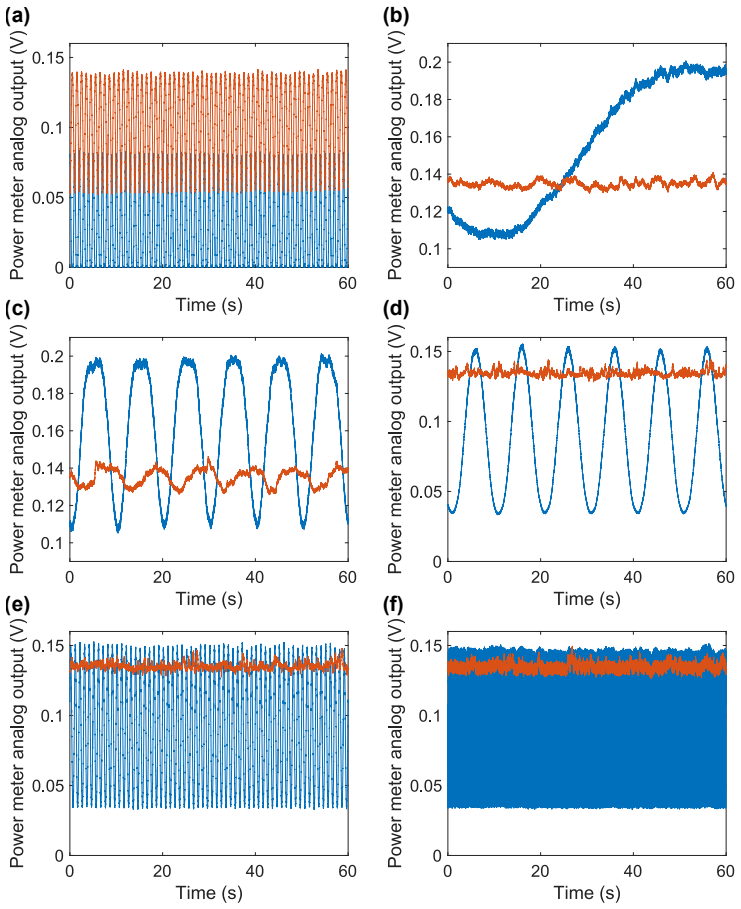
- Control bandwidth can be raised to track faster drifts: with a 1-kHz PID integration bandwidth the APC fully tracked induced 10-Hz polarization oscillations, and the same architecture can accept faster actuators.
- The method generalizes beyond single-mode fiber to free-space links and to classical or continuous-variable channels, where the reference-power constraints are more relaxed.
Reading between the lines
- The residual fidelity drift (0.94 versus first over 30 h) appears dominated by calibration drift of the passive measurement optics (3–5° waveplate shift per day) and by PMD, not by the control loop itself; automated recalibration or temperature stabilization of the receiver could push long-term fidelity higher. (My inference from the paper's logged calibration observations.)
- The PMD sensitivity measured here (slight residual tilt at 5–10 channel separation over about 3 km) suggests that for longer fibers the two-reference scheme would need either closer channel spacing or a pair of references straddling the signal wavelength with averaged corrections—an extension the authors hypothesize but do not demonstrate.
- Because the control algorithm only relies on mutual unbiasedness of three measurement bases, the same three-loop PID structure could be implemented with liquid-crystal or integrated-optic waveplates, trading speed and loss according to the actuator choice.
- The demonstration of 100 Hz tracking under induced drift suggests the method's bandwidth headroom is roughly two orders of magnitude above the drift rates observed on in-ground metropolitan fiber, leaving margin for aerial or more exposed fiber.
Editorial analysis
A structured set of objections, weighed in public.
Referee Report
Summary. The paper presents a method for automatic polarization compensation (APC) for quantum networks, based on heterodyne detection of dim, wavelength-multiplexed reference signals and a multi-axis PID control algorithm with a slope-sign variation for extended range. The authors characterize the method with classical test-signal experiments over deployed metropolitan fiber, with entanglement-assisted process tomography, and with a 30-hour entanglement distribution run in which they report an average relative state fidelity of 0.94±0.03. The central claims are that this enables continuous, high-bandwidth, low-noise automatic polarization channel stabilization with no downtime and that the method is suitable for high-fidelity entanglement distribution.
Significance. If the claims are properly supported, the work is significant for deployed quantum networks: it offers a path to continuous polarization stabilization without time-multiplexing downtime, using a self-contained geometric control approach and a detailed experimental characterization over real in-ground fiber. The paper is strong in its treatment of design trade-offs, in the careful physical modeling of the control loop, and in providing extensive characterization of polarization drift in the field. The simulations and experiments are described in enough detail to be reproduced by a capable group, though no data or code are released. The main reservation is that the headline 'high-fidelity entanglement distribution' is supported only by relative fidelity metrics, which are stability measures, not measures of closeness to an entangled target; this must be corrected.
major comments (4)
- [Abstract; Sec. 3.4, Fig. 12] The abstract's claim of 'continuous high-fidelity entanglement distribution' is not established by the reported metric. The 0.94±0.03 value is the 'relative generalized Uhlmann fidelity' between the first estimated state and successive states (Fig. 12), not the fidelity to the intended Bell state. Two identical mixed states, including the maximally mixed state, have relative fidelity 1, so high relative fidelity is compatible with zero entanglement. The authors should either report absolute fidelity to the expected Bell state (or an entanglement witness) for the same 30-hour run, or rephrase the claim as stability of the reconstructed state over time.
- [Sec. 3.4, Fig. 12] The statistical uncertainty of the plotted fidelities is not quantified. The text states an average of 310 coincidence counts per 36-setting tomography, i.e., about 8.6 counts per setting; the resulting per-tomography uncertainty is likely at the few-percent level, comparable to the observed drift in Fig. 12. Without error bars or credible intervals, it is difficult to separate genuine APC-induced drift from shot noise. The paper should provide confidence regions for the fidelities, for example using the Bayesian tomography methods already cited (Refs. [51,52]).
- [Sec. 2.1; Sec. 3.4] The claim of 'newly developed multi-axis (non-)linear control algorithm(s) for complete polarization channel stabilization with no downtime' conflates simulation with experiment. The slope-sign extended-range algorithm is demonstrated only in simulation (Figs. 3 and 4); the 30-hour experiment used the base algorithm without the slope sign, which has a π-range limitation and in fact relocked once (Sec. 3.4). The authors should clearly state that the no-downtime, complete-range property is a predicted capability supported by simulation, and should report the duration and effect of the observed relock on the entanglement distribution.
- [Sec. 3.2; Sec. 4, PMD discussion] The validity of using reference wavelengths a few 100-GHz channels away from the quantum signal rests on the assumption that polarization-mode dispersion does not substantially decorrelate the two wavelengths. The tests in Sec. 3.2 and Fig. 10 are qualitative: statements such as 'slightly increased polarization noise', 'a slight tilt', and 'sufficiently insensitive' are not backed by numerical metrics. To support the PMD-insensitivity claim, the authors should provide quantitative residual-error measures (for example, RMS deviation from the setpoint or extinction-ratio stability over time) for the test signals at each wavelength separation, with uncertainties.
minor comments (4)
- [Sec. 3.2; Sec. 4] The phrase 'PMD has only a minor affect' should be 'minor effect' in both occurrences.
- [Eq. (11); Sec. 3.4] The name 'Ulhmann' is misspelled; the correct spelling is 'Uhlmann' (also in the text accompanying Fig. 12).
- [Data Availability Statement] The data availability statement says the data are not publicly available; for a paper whose central claim is a 30-hour field demonstration, releasing at least the processed tomography data and analysis code would materially strengthen reproducibility and allow independent verification of the relative-fidelity statistics.
- [Eqs. (1)-(2)] The notation 'PUQWP1UHWP1UPCMUFSUCh' is difficult to parse; please clarify the order of the matrix products and define each symbol consistently, for example by stating that the transformations act in sequence from right to left.
Circularity Check
No significant circularity: the APC control derivation is self-contained and the headline fidelities are direct measurements, not fitted outputs.
full rationale
The paper's central claims are experimental demonstrations, and the derivation chain supporting the control method is self-contained. The multi-axis PID algorithm is derived from the geometric action of variable wave-plates on the Poincare sphere, using mutually unbiased H/V, D/A, and R/L bases, and its range limitation is attributed to an external reference [6], not to a prior result of the present authors. No fitted parameter is renamed as a prediction: PID gains and wave-plate calibrations are described as tunings, and the reported fidelities are measured from tomographic data rather than computed from those tunings. The self-citations that appear (Refs. [35], [41], [44], [47]) point to prior hardware, a prior source design, and an analysis tool; none is invoked as a uniqueness theorem or as the justification forbidding alternative control schemes, and the experimental results are independently measured. The simulations in Figs. 2-4 are used to illustrate algorithm behavior, not as evidence for the 30-hour field result. The abstract's 'high-fidelity' wording rests on the relative fidelity to the first measured state rather than an absolute fidelity to a Bell state, as shown in Sec. 3.4 and Fig. 12; that is a correctness/interpretation concern about what the metric establishes, not a circular derivation, so it does not raise the circularity score. The derivation chain is therefore not circular.
Assumptions & free parameters
free parameters (5)
- PID integration bandwidths and loop gains =
1 Hz (slow) and 1 kHz (fast); per-loop stagger e.g. 3/2/1 Hz or 1 kHz/800/600 Hz
- PID setpoints for each basis measurement =
50% of maximum detected RF power
- Received reference power =
-50 dBm
- Heterodyne frequency offsets =
X = 200 MHz, Y = 70 MHz
- Calibration waveplate angles =
Set within a few tenths of a degree by iterative optimization
assumptions (6)
- domain assumption A variable wave-plate rotates polarization along a great circle on the Poincare sphere about its eigenaxis.
- domain assumption Total reference power is approximately constant, so a single projection measurement can be read as a Stokes parameter.
- domain assumption The three control loops are nearly independent near the setpoint because the relevant great circles are orthogonal in the vicinity of the reference polarization.
- domain assumption Polarization-mode dispersion between the reference wavelengths and the quantum wavelength is small over the tested fiber lengths and channel spacings.
- domain assumption Spontaneous Raman scattering from the dim references is negligible after the additional 100-GHz DWDM filtering.
- domain assumption The calibration of measurement waveplates and the fiber between squeezer and measurement remains stable over the run (a few degrees over 24 hours with passive thermal isolation).
Cite this review
Pith. "Pith review of Continuous Automatic Polarization Channel Stabilization from Heterodyne Detection of Coexisting Dim Reference Signals." pith.science (2026). https://pith.science/paper/UNZN5557
@misc{pith2026241115135,
  author       = {Pith},
  title        = {Pith review of: Continuous Automatic Polarization Channel Stabilization from Heterodyne Detection of Coexisting Dim Reference Signals},
  year         = {2026},
  howpublished = {\url{https://pith.science/paper/UNZN5557}},
  note         = {Machine review of arXiv:2411.15135}
}
abstract
Quantum networking continues to encode information in polarization states due to ease and precision. The variable environmental polarization transformations induced by deployed fiber need correction for deployed quantum networking. Here we present a new method for automatic polarization compensation (APC) and demonstrate its performance on a metropolitan quantum network. Designing an APC involves many design decisions indicated by the diversity of previous solutions in the literature. Our design leverages heterodyne detection of wavelength-multiplexed dim classical references for continuous high-bandwidth polarization measurements used by newly developed multi-axis (non-)linear control algorithm(s) for complete polarization channel stabilization with no downtime. This enables continuous relatively high-bandwidth correction without significant added noise from classical reference signals. We demonstrate the performance of our APC using a variety of classical and quantum characterizations. Finally, we use C-band and L-band APC versions to demonstrate continuous high-fidelity entanglement distribution on a metropolitan quantum network with average relative fidelity of $0.94\pm0.03$ for over 30 hrs
Figures


Figures from the paper (12 more)




Reference graph
Works this paper leans on
-
[1]
Polarization stabilization on single-mode fiber,
R. Ulrich, “Polarization stabilization on single-mode fiber,” Appl. Phys. Lett.35, 840–842 (1979)
1979
-
[2]
Polarization-state control schemes for heterodyne or homodyne optical fiber communications,
T. Okoshi, “Polarization-state control schemes for heterodyne or homodyne optical fiber communications,” IEEE Trans. on Electron Devices32, 2624–2629 (1985)
work page 1985
-
[3]
N. Gisin, G. Ribordy, W. Tittel, and H. Zbinden, “Quantum cryptography,” Rev. Mod. Phys.74, 145–195 (2002)
work page 2002
-
[4]
Single-loop polarization stabilization for single-mode fiber,
E. Giese and K. Schatzel, “Single-loop polarization stabilization for single-mode fiber,” Opt. Lett. (1982)
work page 1982
-
[5]
Endless polarisation control for heterodyne/homodyne receivers,
R. Noe, “Endless polarisation control for heterodyne/homodyne receivers,” inFibre Optics ’86, vol. 0630 (SPIE, 1986), p. 150–154
work page 1986
-
[6]
Polarization stabilization in optical communications systems,
M. Martinelli, P. Martelli, and S. M. Pietralunga, “Polarization stabilization in optical communications systems,” J. Light. Technol.24(2006)
work page 2006
-
[7]
Nondeterministic endless control system for active polarization control,
T. Pikaar, K. van Bochove, A. van Rooyen,et al., “Nondeterministic endless control system for active polarization control,” J. Light. Technol.7, 1982–1987 (1989)
work page 1989
-
[8]
Polarization stabilizer using liquid crystal rotatable waveplates,
T. Chiba, Y. Ohtera, and S. Kawakami, “Polarization stabilizer using liquid crystal rotatable waveplates,” J. Light. Technol. 17, 885–890 (1999)
work page 1999
Show all 53 references
-
[9]
An endless polarization stabilizer based on DSP system,
X. Zhao, X. Weng, F. Tian, and X. Zhang, “An endless polarization stabilizer based on DSP system,” in2009 Asia Communications and Photonics conference and Exhibition (ACP), vol. 2009-Supplement (2009), p. 1–7
2009
-
[10]
A polarization stabilizer up to 12.6 krad/s with an additional function of stable state of polarization transformation,
Z. Xiao-Guang, F. Guang-Qing, Z. Xin-Yuan,et al., “A polarization stabilizer up to 12.6 krad/s with an additional function of stable state of polarization transformation,” Chin. Phys. B19, 044211 (2010)
2010
-
[11]
Optical polarisation control utilising an optical heterodyne detection scheme,
T. Imai, K. Nosu, and H. Yamaguchi, “Optical polarisation control utilising an optical heterodyne detection scheme,” Electron. Lett.21, 52–53 (1985)
1985
-
[12]
High-speed silicon integrated polarization stabilizer assisted by a polarimeter,
W. Liu, J. Liao, H. Cai,et al., “High-speed silicon integrated polarization stabilizer assisted by a polarimeter,” J. Light. Technol.40, 3794–3801 (2022)
2022
-
[13]
Continuous entanglement distribution over a transnational 248 km fiber link,
S. P. Neumann, A. Buchner, L. Bulla,et al., “Continuous entanglement distribution over a transnational 248 km fiber link,” Nat. Commun.13, 6134 (2022)
2022
-
[14]
Fibre polarisation state compensation in entanglement-based quantum key distribution,
Y. Shi, H. S. Poh, A. Ling, and C. Kurtsiefer, “Fibre polarisation state compensation in entanglement-based quantum key distribution,” Opt. Express29, 37075–37080 (2021)
2021
-
[15]
Full polarization random drift compensation method for quantum communication,
M. F. Ramos, N. A. Silva, N. J. Muga, and A. N. Pinto, “Full polarization random drift compensation method for quantum communication,” Opt. Express30, 6907–6920 (2022)
2022
-
[16]
A study of polarization compensation for quantum networks,
M. Peranić, M. Clark, R. Wang,et al., “A study of polarization compensation for quantum networks,” EPJ Quantum Technol. 10, 30 (2023)
2023
-
[17]
Field test of continuous-variable quantum key distribution with a true local oscillator,
B. P. Williams, B. Qi, M. Alshowkan,et al., “Field test of continuous-variable quantum key distribution with a true local oscillator,” Phys. Rev. Appl.21, 014056 (2024)
2024
-
[18]
Quantum teleportation across a metropolitan fibre network,
R. Valivarthi, M. l. G. Puigibert, Q. Zhou,et al., “Quantum teleportation across a metropolitan fibre network,” Nat. Photonics 10, 676–680 (2016)
2016
-
[19]
Dynamicpolarizationcontrolforfree-spacecontinuous-variablequantum key distribution,
S.Wang,P.Huang,T.Wang,andG.Zeng,“Dynamicpolarizationcontrolforfree-spacecontinuous-variablequantum key distribution,” Opt. Lett.45, 5921–5924 (2020)
2020
-
[20]
Stablequantumkeydistributionwithactivepolarizationcontrolbasedontime-division multiplexing,
J.Chen,G.Wu,L.Xu, et al.,“Stablequantumkeydistributionwithactivepolarizationcontrolbasedontime-division multiplexing,” New J. Phys.11, 065004 (2009)
2009
-
[21]
Active polarization stabilization in optical fibers suitable for quantum key distribution,
J. Chen, G. Wu, Y. Li,et al., “Active polarization stabilization in optical fibers suitable for quantum key distribution,” Opt. Express15, 17928–17936 (2007)
2007
-
[22]
Experimental polarization encoded quantum key distribution over optical fibres with real-time continuous birefringence compensation,
G. B. Xavier, N. Walenta, G. V. de Faria,et al., “Experimental polarization encoded quantum key distribution over optical fibres with real-time continuous birefringence compensation,” New J. Phys.11, 045015 (2009)
2009
-
[23]
Full polarization control for fiber optical quantum communication systems using polarization encoding,
G. B. Xavier, G. V. d. Faria, G. P. Temporão, and J. P. v. d. Weid, “Full polarization control for fiber optical quantum communication systems using polarization encoding,” Opt. Express16, 1867–1873 (2008)
2008
-
[24]
Automated distribution of polarization-entangled photons using deployed new york city fibers,
A. N. Craddock, A. Lazenby, G. B. Portmann,et al., “Automated distribution of polarization-entangled photons using deployed new york city fibers,” PRX Quantum5, 030330 (2024)
2024
-
[25]
Coexistent quantum channel characterization using spectrally resolved Bayesian quantum process tomography,
J. C. Chapman, J. M. Lukens, M. Alshowkan,et al., “Coexistent quantum channel characterization using spectrally resolved Bayesian quantum process tomography,” Phys. Rev. Appl.19, 044026 (2023)
2023
-
[26]
Densewavelengthmultiplexingof1550nmQKDwithstrongclassical channels in reconfigurable networking environments,
N.A.Peters,P.Toliver,T.E.Chapuran, et al.,“Densewavelengthmultiplexingof1550nmQKDwithstrongclassical channels in reconfigurable networking environments,” New J. Phys.11, 045012 (2009)
2009
-
[27]
Optical networking for quantum key distribution and quantum communications,
T. E. Chapuran, P. Toliver, N. A. Peters,et al., “Optical networking for quantum key distribution and quantum communications,” New J. Phys.11, 105001 (2009)
2009
-
[28]
Drop-incompatibleentanglementforoptical-fibernetworks,
M.A.Hall,J.B.Altepeter,andP.Kumar,“Drop-incompatibleentanglementforoptical-fibernetworks,”Opt.Express 17, 14558–14566 (2009)
2009
-
[29]
Designing noise-robust quantum networks coexisting in the classical fiber infrastructure,
J. M. Thomas, G. S. Kanter, and P. Kumar, “Designing noise-robust quantum networks coexisting in the classical fiber infrastructure,” Opt. Express31, 43035–43047 (2023)
2023
-
[30]
Goldberg,Genetic Algorithms in Search, Optimization, and Machine Learning, Addison Wesley series in artificial intelligence (Addison-Wesley, 1989)
D. Goldberg,Genetic Algorithms in Search, Optimization, and Machine Learning, Addison Wesley series in artificial intelligence (Addison-Wesley, 1989)
1989
-
[31]
Particle swarm optimization,
J. Kennedy and R. Eberhart, “Particle swarm optimization,” inProceedings of ICNN’95-international conference on neural networks,vol. 4 (IEEE, 1995), pp. 1942–1948
1995
-
[32]
Optimization by simulated annealing,
S. Kirkpatrick, C. D. Gelatt, and M. P. Vecchi, “Optimization by simulated annealing,” Science220, 671–680 (1983)
1983
-
[33]
Reversal operator to compensate polarization random drifts in quantum communications,
M. F. Ramos, N. A. Silva, N. J. Muga, and A. N. Pinto, “Reversal operator to compensate polarization random drifts in quantum communications,” Opt. Express28, 5035–5049 (2020)
2020
-
[34]
Entanglement-based quantum digital signatures over a deployed campus network,
J. C. Chapman, M. Alshowkan, N. A. Peters, and B. Qi, “Entanglement-based quantum digital signatures over a deployed campus network,” Opt. Express32, 7521–7539 (2024)
2024
-
[35]
Heterodyne spectrometer sensitivity limit for quantum networking,
J. C. Chapman and N. A. Peters, “Heterodyne spectrometer sensitivity limit for quantum networking,” Appl. Opt.61, 5002 (2022)
2022
-
[36]
Mathematica, Version 13, Wolfram Research, Inc., Champaign, IL, 2024
2024
-
[37]
An efficient PID-based optimizer loop and its application in De Jong’s functions minimization and quadratic regression problems,
B. B. Alagoz, F. N. Deniz, and M. Koseoglu, “An efficient PID-based optimizer loop and its application in De Jong’s functions minimization and quadratic regression problems,” Syst. & Control. Lett.159, 105090 (2022)
2022
-
[38]
Optical-fiber source of polarization-entangled photons in the 1550 nm telecom band,
X. Li, P. L. Voss, J. E. Sharping, and P. Kumar, “Optical-fiber source of polarization-entangled photons in the 1550 nm telecom band,” Phys. Rev. Lett.94, 053601 (2005)
2005
-
[39]
Bright phase-stable broadband fiber-based source of polarization-entangled photon pairs,
J. Fan, M. D. Eisaman, and A. Migdall, “Bright phase-stable broadband fiber-based source of polarization-entangled photon pairs,” Phys. Rev. A76, 043836 (2007)
2007
-
[40]
Fully guided-wave photon pair source for quantum applications,
P. Vergyris, F. Kaiser, E. Gouzien,et al., “Fully guided-wave photon pair source for quantum applications,” Quantum Sci. Technol.2, 024007 (2017)
2017
-
[41]
Broadband polarization-entangled source for c+l-band flex-grid quantum networks,
M. Alshowkan, J. M. Lukens, H.-H. Lu,et al., “Broadband polarization-entangled source for c+l-band flex-grid quantum networks,” Opt. Lett.47, 6480–6483 (2022)
2022
-
[42]
Generation and characterization of ultrabroadband polarization– frequency hyperentangled photons,
H.-H. Lu, M. Alshowkan, K. V. Myilswamy,et al., “Generation and characterization of ultrabroadband polarization– frequency hyperentangled photons,” Opt. Lett.48, 6031–6034 (2023)
2023
-
[43]
Reconfigurable quantum local area network over deployed fiber,
M. Alshowkan, B. P. Williams, P. G. Evans,et al., “Reconfigurable quantum local area network over deployed fiber,” PRX Quantum2, 040304 (2021)
2021
-
[44]
Advancedarchitecturesforhigh-performancequantumnetworking,
M.Alshowkan,P.G.Evans,B.P.Williams, et al.,“Advancedarchitecturesforhigh-performancequantumnetworking,” J. Opt. Commun. Netw.14, 493–499 (2022)
2022
-
[45]
Resiliententanglementdistributioninamultihopquantum network,
M.Alshowkan,J.M.Lukens,H.-H.Lu,andN.A.Peters,“Resiliententanglementdistributioninamultihopquantum network,” arXiv:2407.20443 (2024)
2024
-
[46]
Ancilla-assisted quantum process tomography,
J. B. Altepeter, D. Branning, E. Jeffrey,et al., “Ancilla-assisted quantum process tomography,” Phys. Rev. Lett.90, 193601 (2003)
2003
-
[47]
Deployedquantumlinkcharacterizationviabayesianancilla-assisted process tomography,
A.Rahman,N.Wasserbeck,Z.Goisman, et al.,“Deployedquantumlinkcharacterizationviabayesianancilla-assisted process tomography,” arXiv:2410.00892 (2024)
2024 arXiv
-
[48]
Prescription for experimental determination of the dynamics of a quantum black box,
I. L. Chuang and M. A. Nielsen, “Prescription for experimental determination of the dynamics of a quantum black box,” J. Mod. Opt.44, 2455–2467 (1997)
1997
-
[49]
Complete characterization of a quantum process: The two-bit quantum gate,
J. F. Poyatos, J. I. Cirac, and P. Zoller, “Complete characterization of a quantum process: The two-bit quantum gate,” Phys. Rev. Lett.78, 390–393 (1997)
1997
-
[50]
From classical to quantum shannon theory,
M. M. Wilde, “From classical to quantum shannon theory,” arXiv:1106.1445 (2011)
2011
-
[51]
A practical and efficient approach for bayesian quantum state estimation,
J. M. Lukens, K. J. H. Law, A. Jasra, and P. Lougovski, “A practical and efficient approach for bayesian quantum state estimation,” New J. Phys.22, 063038 (2020)
2020
-
[52]
Bayesian tomography of high-dimensional on-chip biphoton frequency combs with randomized measurements,
H.-H. Lu, K. V. Myilswamy, R. S. Bennink,et al., “Bayesian tomography of high-dimensional on-chip biphoton frequency combs with randomized measurements,” Nat. Commun.13, 4338 (2022)
2022
-
[53]
Two-mode squeezing over deployed fiber coexisting with conventional communications,
J. C. Chapman, A. Miloshevsky, H.-H. Lu,et al., “Two-mode squeezing over deployed fiber coexisting with conventional communications,” Opt. Express31, 26254–26275 (2023)
2023
Reviewed August 12, 2026 · model on record in the stance chip above.
Discussion (0). Continue with ORCID to comment.