REVIEW 2 major objections 4 minor 62 references
Switchable phonon diodes using nonlinear topological Maxwell lattices
T0 review · 2 major / 4 minor · reviewed 2026-08-14 · deepseek-v4-flash
Pith's one-line read Topological Maxwell lattices can act as switchable phonon diodes: nonlinear second-harmonic transmission is strongly one-way when linear modes are blocked by pinning, and directionality switches off via a Guest-mode lattice deformation.
desk verdict Solid analytics and a clever pinned-diode design, but the abstract overstates topology and the unpinned results ignore a DC zero-mode coupling that needs a real answer. read the letter →
The pith
A machine-rendered reading of the paper's core claim, the machinery that carries it, and where it could break.
The reading
What carries the argument
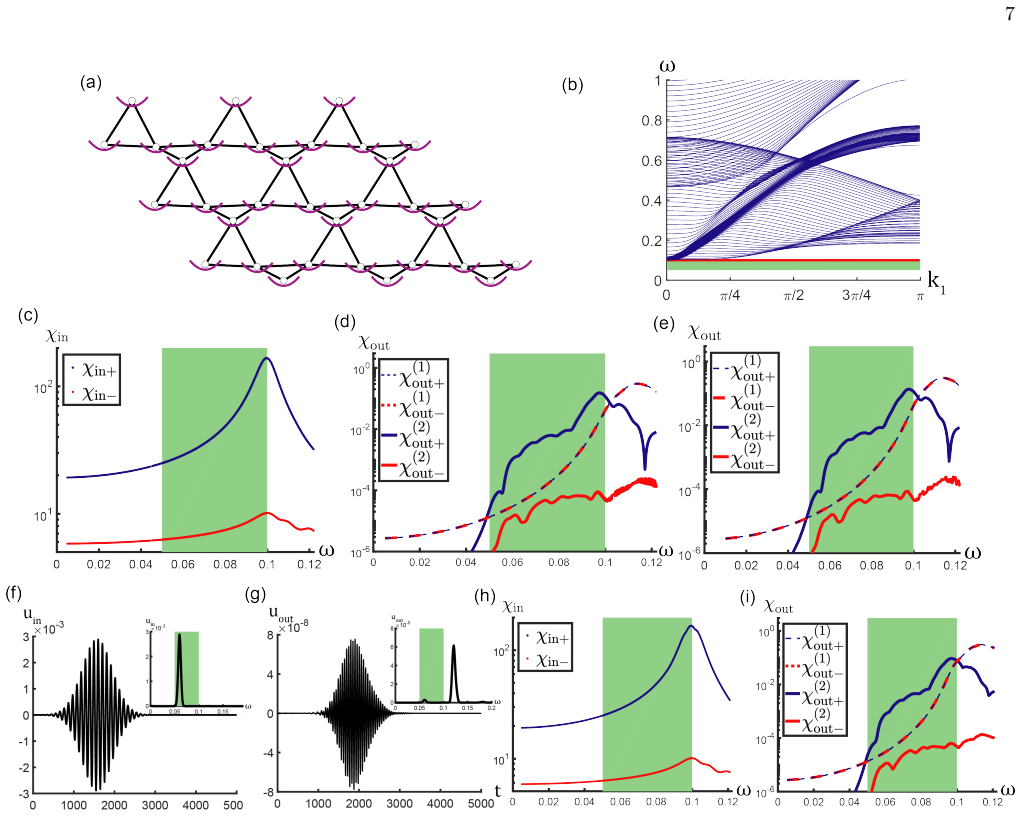
The load-bearing construction is the compatibility matrix $C(k_1)$ of a supercell strip, whose winding number sets the topological polarization and therefore which edge hosts the zero-frequency floppy modes. Nonlinearity enters through the geometric second-order bond tension $f^{(2)}(u^{(1)})$, quadratic in the linear displacement and acting as an effective driving force at $2\omega$. The on-site potential $V_i = \frac{1}{2}K' u_i^2$ shifts the band structure up by $\Delta'=\sqrt{K'/m}$, creating the window $\frac{1}{2}\Delta'<\omega<\Delta'$ in which linear modes are edge-localized while second harmonics are bulk-propagating. The Guest mode, a uniform soft strain with all bond lengths unchanged, rotates the lattice between topological and non-topological phases and thereby turns the nonreciprocity on and off.
What would settle it
A concrete test would be a molecular-dynamics simulation or tabletop experiment on the pinned $40\times39$ kagome lattice ($K'=K/100$): drive a single C-site on the soft edge with $F=10^{-4}$ at a frequency $\omega$ inside $(\frac{1}{2}\Delta',\Delta')$, wait for steady state, and measure the $2\omega$ displacement at the opposite edge; repeat driving the hard edge. The claim fails if the soft-to-hard $2\omega$ susceptibility is not clearly larger than the hard-to-soft one.
Extended reading notes
Core claim
The paper establishes that in a topological Maxwell lattice the second-harmonic response generated by a linear edge mode is strongly nonreciprocal: driving the soft (floppy) edge produces a much larger frequency-doubled bulk wave at the opposite edge than driving the hard edge does, even though first-harmonic transmission is exactly reciprocal by Maxwell-Betti symmetry. The mechanism is asymmetric boundary stiffness: the floppy edge deforms far more under the same force, its geometric nonlinear terms act as a much stronger effective drive at $2\omega$, and because $2\omega$ falls in the bulk band this second-harmonic wave propagates across the lattice. With a weak on-site pinning that opens a full low-frequency gap while preserving the stiffness contrast, the fundamental is blocked, and the soft-to-hard transmission at $2\omega$ exceeds both the reverse-direction transmission and the residual linear transmission, making the lattice a switchable phonon diode.
Load-bearing premise
The load-bearing premise is that second-order perturbation theory in the driving amplitude remains accurate while the nonlinear term is large enough to dominate: all displacements must stay small ($\delta\theta \ll 1$, $|u| \ll l_0$), yet at the chosen amplitude $F=10^{-4}$ the second-harmonic output scaling as $F^2$ must exceed the linear output scaling as $F$; the transfer-matrix solution also assumes a finite number of evanescent modes with open boundaries captures propagation across a finite lattice.
Editorial extensions
If this is right
- A pinned topological kagome lattice with $K'=K/100$ transmits a frequency-doubled wave mainly from the soft edge to the hard edge for point-like excitation, not only for special boundary wavenumbers.
- Because the fundamental is gap-blocked, the diode's output is not masked by reciprocal same-frequency transmission; the $2\omega$ signal is the leading transmitted channel.
- Switching is reversible and requires no disassembly: rotating the isosceles triangles by $30^\circ$ via the Guest mode restores near-reciprocal transmission, and rotating back restores diodicity.
- The same mechanism extends to higher harmonics: a linear edge mode at $\omega$ generates a bulk mode at $n\omega$ that transmits one way whenever $\frac{1}{n}\Delta<\omega<\frac{1}{n-1}\Delta$.
- The effect survives finite bending stiffness at the hinges and Gaussian tone-burst excitation, so it is a plausible basis for a passive elastic diode.
Reading between the lines
- I infer that the diode contrast should be amplitude-tunable: since the second-harmonic output scales as $F^2$ and the linear leakage as $F$, an optimal driving window should exist near the top of the pinning gap; the paper does not optimize this trade-off.
- I infer the recipe is general: any Maxwell lattice whose polarization concentrates floppy modes on one edge, not just kagome, should show nonreciprocal second-harmonic transmission after pinning, since the paper itself notes that only asymmetric boundary stiffness plus nonlinear elasticity is needed.
- I infer that weak disorder preserving the bulk gap should leave the diode direction intact because the edge-mode localization is topological, while strong disorder that closes the gap or couples edge modes to bulk channels at $2\omega$ would erode the contrast; the paper does not compute this robustness explicitly.
Signed reviews
Editorial analysis
A structured set of objections, weighed in public.
Referee Report
Summary. This manuscript proposes a mechanism for nonreciprocal elastic-wave transmission in topological Maxwell lattices. In a 1D topological chain and a 2D kagome lattice with topologically polarized floppy edge modes, the soft edge responds much more strongly to a low-frequency drive than the hard edge. The authors show analytically and by molecular dynamics that the second harmonic generated by this linear edge response is much larger when the drive is applied at the soft edge, so that the 2ω transmission is strongly directional. Because the linear response is reciprocal and dominates the total signal, they add a weak on-site pinning potential, which opens a low-frequency gap; in this pinned configuration the forward 2ω signal exceeds the linear signal, yielding a phonon diode. They further show that a Guest-mode deformation can switch the lattice between the topological (nonreciprocal) and non-topological (nearly reciprocal) states.
Significance. If the reported effects are correct, the paper offers a new, topologically protected route to switchable phonon diodes, with the important feature that the nonreciprocity is realized by geometric nonlinearity rather than by breaking time-reversal symmetry. The evidence is unusually strong for a theory paper: the analytic transfer-matrix calculation is carried through for both the linear and second-harmonic modes, and the results are checked against direct molecular-dynamics simulations for the 2D kagome lattice, including tone-burst and bending-stiffness variants. The switchability via the Guest mode is a clean prediction. The unresolved issue described below concerns the consistency of the second-order perturbation calculation for the unpinned lattices and should be addressed before the central claims can be accepted in full.
major comments (2)
- [§II, Eq. (2.2); Appendices B–C] The second-order calculation solves only for the 2ω component of u^(2), via u^(2)(2ω) = G(2ω) f^(2)(2ω). The quadratic nonlinearity f^(2)(u^(1)) also contains a DC component, and the corresponding static response u^(0) = G(0) f^(0) is not computed. For the unpinned Maxwell lattices of Sections II and III, D has zero eigenvalues (the topological floppy mode in the 1D chain, and the floppy/translational nullspace in the 2D strip), so G(0) is singular. Unless f^(0) has zero projection on that nullspace, the static response is not of order F^2 and the perturbation expansion u = u^(1) + u^(2) is uncontrolled. The paper contains no argument that the projection vanishes. This affects the unpinned nonreciprocity claims in Figs. 1(e) and 2(e). The pinned lattice of Section IV, with K' = K/100, regularizes G(0) and is less exposed, but the authors should either prove the orthogonality condition or explicitly bound the DC deformation in the simulations.
- [§II and §III, Figs. 1–3] The paper does not provide a quantitative check that the perturbation parameter is small in the same regime where the second harmonic dominates the linear transmission. The analytic results rely on |δθ_n| ≪ 1 and |u| ≪ l0, while the diode condition requires the 2ω output, which scales as F^2, to exceed the linear output, which scales as F. The chosen amplitudes F = 10^-5 and F = 10^-4 are stated, but the resulting maximal strain is not reported. A brief estimate using χ_in, or a supplemental figure showing the strain amplitude, would be needed to confirm that the perturbation expansion and the strong-nonlinearity requirement are simultaneously satisfied.
minor comments (4)
- [§III, definitions of χ_out±] The definitions of χ^(1)out− and χ^(2)out− are printed identically to the χ^(1)out+ and χ^(2)out+ expressions: both use |u_y,N2|/F_y1. The negative-direction susceptibilities should involve the displacement at the top boundary when driving at the bottom boundary, i.e., |u_y,1|/F_yN2. This typo obscures the reciprocity statement that follows.
- [§II, Eq. (2.2)] The sentence 'f^(2)(u^(1)_g) is the second harmonic effective driving force generated by the linear displacement u^(1)_g, as defined in Eq.(2.1)' is misleading, since Eq. (2.1) is the linear equation of motion; the definition of f^(2) is given only later in Appendix B.
- [§II, robustness claim] The paper asserts that topological protection makes the nonreciprocal effect robust against disorder, but no disorder-averaged simulation or analytic argument is presented. This is a motivation-level claim and should either be supported or softened.
- [Appendix D and Fig. 3] The simulation parameters are not fully specified in the main text: the damping coefficient η, spring constant K, mass m, and lattice length scale l0 are not given, although the analytic formulas depend on them. Reporting these values, or a reference to the SI, would improve reproducibility.
Circularity Check
No significant circularity: the second-harmonic diode response is computed from Green's functions and checked by simulations, not fitted or defined into existence.
full rationale
The paper's central claim is that second-harmonic modes generated in topological Maxwell lattices inherit a strong left-right asymmetry from the linear edge response. The derivation chain is explicit and self-contained: the linear response is solved from Newton's equation, Eq. (2.1), via the frequency-response function G(omega) = [D + (-m omega^2 + i eta omega)I]^{-1} in Appendix B and its kagome analogue in Appendix C. The second-harmonic source f^(2)(u^(1)) is computed as the quadratic term in the bond-tension expansion, Eqs. (B3)-(B5) and (C4)-(C5), and the second-harmonic field is then obtained as u^(2)(2 omega) = G(2 omega) f^(2)(u^(1)), Eqs. (B9), (B16) and (C8), (C13). The nonreciprocal output susceptibilities chi_out+^(2) and chi_out-^(2) are evaluated from these solutions, not imposed or fitted. The asymmetry enters because the quadratic source is larger when the topological floppy edge is driven, but this is a calculated consequence of the linear Green's function, not a restatement of the target result. The linear-response reciprocity chi_out+^(1) = chi_out-^(1), Eq. (B15) and Fig. 2(d), is derived and used as a contrast, showing that the second-harmonic nonreciprocity is a genuinely nonlinear prediction rather than a re-labeling of the reciprocal linear transmission. The claims are additionally checked against direct Newtonian-mechanics simulations in Figs. 1-3, which makes the derivation externally anchored rather than circular. The paper does cite prior work by overlapping authors, notably Refs. [13], [17] and [51], for the kagome polarization, the Guest-mode transformation, and asymmetric edge-wave response. These are published external inputs with independent content; they do not state or assume the current paper's second-harmonic diode result, and they are not invoked as uniqueness theorems or as a substitute for the present calculation. The switching claim in Section V relies on the Guest-mode result of Ref. [13], but that is a parameter-free geometric fact about kagome lattices, not a fitted or self-referential premise of the nonreciprocity mechanism. The reviewer-identified omission of the zero-frequency (DC) component of f^(2), and the possible singular G(0) in unpinned lattices, is a perturbation-theory validity concern rather than a circularity: even if the DC response were uncontrolled, that would not make the second-harmonic output equal to the input by construction.
Assumptions & free parameters
free parameters (3)
- on-site pinning strength K' =
K/100
- driving force amplitude F =
10^-4 (nonlinear), 10^-8 (linear)
- damping coefficient η =
not specified in text
assumptions (4)
- standard math Linear response of a time-reversal symmetric elastic lattice is reciprocal (Maxwell-Betti theorem).
- domain assumption Perturbation expansion of displacement in powers of the driving force F is convergent, with the quadratic term dominating third and higher terms.
- domain assumption Topological polarization and floppy-mode localization of the 1D chain and kagome lattice are as characterized by Kane-Lubensky and the authors' prior work.
- domain assumption The Guest mode deformation connects the topological and non-topological kagome phases without stretching bonds and preserves the number of floppy modes.
Cite this review
Pith. "Pith review of Switchable phonon diodes using nonlinear topological Maxwell lattices." pith.science (2026). https://pith.science/paper/UOQ2GWEO
@misc{pith2026190805716,
  author       = {Pith},
  title        = {Pith review of: Switchable phonon diodes using nonlinear topological Maxwell lattices},
  year         = {2026},
  howpublished = {\url{https://pith.science/paper/UOQ2GWEO}},
  note         = {Machine review of arXiv:1908.05716}
}
read the original abstract
Recent progress in topological mechanics have revealed a family of Maxwell lattices that exhibit topologically protected floppy edge modes. These modes lead to a strongly asymmetric elastic wave response. In this paper, we show how topological Maxwell lattices can be used to realize non-reciprocal transmission of elastic waves. Our design leverages the asymmetry associated with the availability of topological floppy edge modes and the geometric nonlinearity built in the mechanical systems response to achieve the desired non-reciprocal behavior, which can be further turned into strongly one-way phonon transport via the addition of on-site pinning potentials. Moreover, we show that the non-reciprocal wave transmission can be switched on and off via topological phase transitions, paving the way to the design of cellular metamaterials that can serve as tunable topologically protected phonon diodes.
Figures


Figures from the paper (1 more)

Reference graph
Works this paper leans on
-
[1]
R. S¨ usstrunk and S. D. Huber, Science349, 47 (2015). [2] C. Kane and T. Lubensky, Nature Physics 10, 39 (2014). 13
work page 2015
-
[2]
C6 = K 24m(5 + √ 2). (B6) We denote u = (u0,u 1,...,u N) as the angular displace- ment of the particles, and expand it in orders of λ, with u = u(1) + u(2) +O(λ3), where u(1) and u(2) are linear and second harmonic modes, respectively. We further denote Fext = (λF, 0,..., 0)T (Fext = (0, 0,...,λF )) as the external driving force driven at rotor g = 0 ( g ...
-
[3]
The twist angle of the isosceles triangle is 5 ◦ counterclockwise, which makes the longer edge of isosce- les triangle inclined by 5◦ relative to the bottom edge of equilateral triangle (marked AB in fig.2(a)). ⃗ a1 and ⃗ a2 are the lattice primitive vectors. The lattice, spanning the area|N1⃗ a1×(N2−1)⃗ a2| in real space, is composed of N1×(N2−1) unit cel...
-
[4]
R. K. Pal, M. Schaeffer, and M. Ruzzene, Journal of Applied Physics 119, 084305 (2016)
work page 2016
-
[5]
S. H. Mousavi, A. B. Khanikaev, and Z. Wang, Nature communications 6, 8682 (2015)
work page 2015
- [6]
-
[7]
L. M. Nash, D. Kleckner, A. Read, V. Vitelli, A. M. Turner, and W. T. Irvine, Proceedings of the National Academy of Sciences 112, 14495 (2015)
2015
-
[8]
N. P. Mitchell, L. M. Nash, D. Hexner, A. M. Turner, and W. T. Irvine, Nature Physics , 1 (2018)
work page 2018
Show all 62 references
-
[9]
N. P. Mitchell, L. M. Nash, and W. T. Irvine, Physical Review B 98, 174301 (2018)
2018
-
[10]
Zhang, Y
Z. Zhang, Y. Tian, Y. Cheng, X. Liu, and J. Christensen, Physical Review B 96, 241306 (2017)
2017
-
[11]
H. Dai, J. Jiao, B. Xia, T. Liu, S. Zheng, and D. Yu, Journal of Physics D: Applied Physics 51, 175302 (2018)
2018
-
[12]
Y. Guo, T. Dekorsy, and M. Hettich, Scientific reports 7, 18043 (2017)
2017
-
[13]
Z. Yang, F. Gao, X. Shi, X. Lin, Z. Gao, Y. Chong, and B. Zhang, Physical review letters 114, 114301 (2015)
2015
-
[14]
D. Z. Rocklin, S. Zhou, K. Sun, and X. Mao, Nature communications 8, 14201 (2017)
2017
-
[15]
Zhang and X
L. Zhang and X. Mao, New Journal of Physics 20, 063034 (2018)
2018
-
[16]
Paulose, A
J. Paulose, A. S. Meeussen, and V. Vitelli, Proceedings of the National Academy of Sciences 112, 7639 (2015)
2015
-
[17]
Abbaszadeh, A
H. Abbaszadeh, A. Souslov, J. Paulose, H. Schome- rus, and V. Vitelli, Physical review letters 119, 195502 (2017)
2017
-
[18]
D. Zhou, L. Zhang, and X. Mao, Physical review letters 120, 068003 (2018)
2018
-
[19]
D. Zhou, L. Zhang, and X. Mao, Physical Review X 9, 021054 (2019)
2019
-
[20]
A. S. Meeussen, J. Paulose, and V. Vitelli, Physical Re- view X 6, 041029 (2016)
2016
-
[21]
Paulose, B
J. Paulose, B. G.-g. Chen, and V. Vitelli, Nature Physics 11, 153 (2015)
2015
-
[22]
Maznev, A
A. Maznev, A. Every, and O. Wright, Wave Motion 50, 776 (2013)
2013
-
[23]
J. C. Maxwell, The London, Edinburgh, and Dublin Philosophical Magazine and Journal of Science 27, 294 (1864)
-
[24]
Betti, Il Nuovo Cimento (1869-1876) 7, 158 (1872)
E. Betti, Il Nuovo Cimento (1869-1876) 7, 158 (1872)
-
[25]
Charlton, Nature 187, 231 (1960)
T. Charlton, Nature 187, 231 (1960)
1960
-
[26]
P. Wang, L. Lu, and K. Bertoldi, Physical review letters 115, 104302 (2015)
2015
-
[27]
N. P. Mitchell, L. M. Nash, and W. T. Irvine, Physical Review B 97, 100302 (2018)
2018
-
[28]
Engheta, A
N. Engheta, A. Salandrino, and A. Al` u, Physical Review Letters 95, 095504 (2005)
2005
-
[29]
Souslov, K
A. Souslov, K. Dasbiswas, M. Fruchart, S. Vaikun- tanathan, and V. Vitelli, Physical Review Letters 122, 128001 (2019)
2019
-
[30]
Y. Wang, B. Yousefzadeh, H. Chen, H. Nassar, G. Huang, and C. Daraio, Physical review letters 121, 194301 (2018)
2018
-
[31]
M. B. Zanjani, A. R. Davoyan, A. M. Mahmoud, N. En- gheta, and J. R. Lukes, Applied Physics Letters 104, 081905 (2014)
2014
-
[32]
Trainiti and M
G. Trainiti and M. Ruzzene, New Journal of Physics 18, 083047 (2016)
2016
-
[33]
Nassar, X
H. Nassar, X. Xu, A. Norris, and G. Huang, Journal of the Mechanics and Physics of Solids 101, 10 (2017)
2017
-
[34]
Swinteck, S
N. Swinteck, S. Matsuo, K. Runge, J. Vasseur, P. Lu- cas, and P. A. Deymier, Journal of Applied Physics 118, 063103 (2015)
2015
-
[35]
Fleury, A
R. Fleury, A. B. Khanikaev, and A. Alu, Nature com- munications 7, 11744 (2016)
2016
-
[36]
Salerno, T
G. Salerno, T. Ozawa, H. M. Price, and I. Carusotto, Physical Review B 93, 085105 (2016)
2016
-
[37]
Chaunsali, F
R. Chaunsali, F. Li, and J. Yang, Scientific reports 6, 30662 (2016)
2016
-
[38]
Peano, C
V. Peano, C. Brendel, M. Schmidt, and F. Marquardt, Physical Review X 5, 031011 (2015)
2015
-
[39]
Fleury, D
R. Fleury, D. L. Sounas, C. F. Sieck, M. R. Haberman, and A. Al` u, Science343, 516 (2014)
2014
-
[40]
Souslov, B
A. Souslov, B. C. Van Zuiden, D. Bartolo, and V. Vitelli, Nature Physics 13, 1091 (2017)
2017
-
[41]
Devaux, V
T. Devaux, V. Tournat, O. Richoux, and V. Pagneux, Physical review letters 115, 234301 (2015)
2015
-
[42]
Merkel, V
A. Merkel, V. Tournat, and V. Gusev, Physical Review E 90, 023206 (2014)
2014
-
[43]
Cebrecos, N
A. Cebrecos, N. Jim´ enez, V. Romero-Garc´ ıa, R. Pic´ o, V. J. S´ anchez-Morcillo, and L. Garc´ ıa-Raffi, AIP Ad- vances 6, 121601 (2016)
2016
-
[44]
Nadkarni, A
N. Nadkarni, A. F. Arrieta, C. Chong, D. M. Kochmann, and C. Daraio, Physical review letters 116, 244501 (2016)
2016
-
[45]
Coulais, D
C. Coulais, D. Sounas, and A. Al` u, Nature 542, 461 (2017)
2017
-
[46]
Boechler, G
N. Boechler, G. Theocharis, and C. Daraio, Nature ma- terials 10, 665 (2011)
2011
-
[47]
Liang, X
B. Liang, X. Guo, J. Tu, D. Zhang, and J. Cheng, Nature materials 9, 989 (2010)
2010
-
[48]
C. Liu, Z. Du, Z. Sun, H. Gao, and X. Guo, Physical Review Applied 3, 064014 (2015)
2015
-
[49]
Z.-m. Gu, J. Hu, B. Liang, X.-y. Zou, and J.-c. Cheng, Scientific reports 6, 19824 (2016)
2016
-
[50]
D. Z. Rocklin, B. G.-g. Chen, M. Falk, V. Vitelli, and T. Lubensky, Physical review letters 116, 135503 (2016)
2016
-
[51]
Lubensky, C
T. Lubensky, C. Kane, X. Mao, A. Souslov, and K. Sun, Reports on Progress in Physics 78, 073901 (2015)
2015
-
[52]
J. Ma, D. Zhou, K. Sun, X. Mao, and S. Gonella, Phys- ical review letters 121, 094301 (2018)
2018
-
[53]
M. Deng, P. Wang, and X. Lv, Journal of Physics D: Applied Physics 38, 344 (2005)
2005
-
[54]
K. H. Matlack, J.-Y. Kim, L. J. Jacobs, and J. Qu, Journal of Applied Physics 109, 014905 (2011)
2011
-
[55]
Ganesh and S
R. Ganesh and S. Gonella, Physical review letters 114, 054302 (2015)
2015
-
[56]
Ganesh and S
R. Ganesh and S. Gonella, Journal of the Mechanics and Physics of Solids 99, 272 (2017)
2017
-
[57]
Jiao and S
W. Jiao and S. Gonella, Physical Review E 99, 042206 (2019)
2019
-
[58]
R. K. Pal, J. Vila, M. Leamy, and M. Ruzzene, Physical Review E 97, 032209 (2018)
2018
-
[59]
Jiao and S
W. Jiao and S. Gonella, Journal of the Mechanics and Physics of Solids 111, 1 (2018)
2018
-
[60]
Jiao and S
W. Jiao and S. Gonella, Physical Review Applied 10, 024006 (2018)
2018
-
[61]
B. G.-g. Chen, N. Upadhyaya, and V. Vitelli, Proceed- ings of the National Academy of Sciences 111, 13004 (2014)
2014
-
[62]
Guest and J
S. Guest and J. Hutchinson, Journal of the Mechanics and Physics of Solids 51, 383 (2003)
2003
Reviewed August 14, 2026 · model on record in the stance chip above.
Discussion (0). Continue with ORCID to comment.