REVIEW 4 major objections 4 minor 46 references
Wavelet Probabilistic Recurrent Convolutional Network for Multivariate Time Series Classification
T0 review · 4 major / 4 minor · reviewed 2026-08-07 · deepseek-v4-flash
Pith's one-line read The paper claims that adding an adaptive wavelet density-estimator module to an LSTM and a causal CNN raises multivariate time series classification to 76.9% average accuracy, ahead of all seven benchmark methods.
desk verdict Plausible, extensively evaluated architecture, but the central probabilistic module rests on a single-anchor density whose discriminative value for non-anchor classes is never shown. read the letter →
The pith
A machine-rendered reading of the paper's core claim, the machinery that carries it, and where it could break.
The reading
What carries the argument
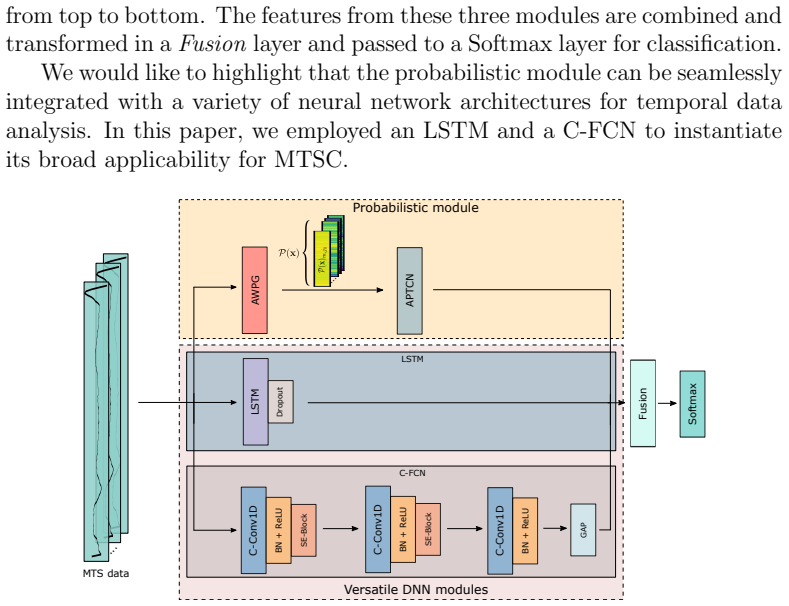
The load-bearing component is the multi-receptive-field wavelet probabilistic network (MRWPN), built on a radial B-spline wavelet density estimator whose coefficients update in closed form as $\hat{w} = (1-\alpha_\Gamma)\,\hat{w} + \alpha_\Gamma\, 2^{\frac{nj_0}{2}} \varphi\left(\|2^{j_0} x - k\| + \frac{m}{2}\right)$, where $\alpha_\Gamma$ is a set of forgetting factors that define different temporal receptive fields and $m$ and $j_0$ control smoothness and resolution. This one-pass update is what makes a density model cheap enough to sit inside a deep network. The adaptive wavelet probabilistic feature generator (AWPG) wraps this estimator in a GRU encoder-decoder to form a latent space, produces $|\Gamma|$ density views of one anchor class, and uses a softmax adaptive network to pick the view with the highest density; the resulting feature $P(x)_{m,j_0}$ aggregates every combination of $m$ and $j_0$. The channel-attention probabilistic temporal convolutional network (APTCN) then prunes the channels, enhances them with efficient channel attention, and models them with a dilated causal TCN.
What would settle it
Run the same 30-dataset benchmark with the AWPG trained on a different class, or on a mixture of all classes, instead of the first class; if average accuracy drops to the level of the module-free ablation, the improvement is an artifact of the anchor-class choice rather than a general property of the probability-domain features.
Extended reading notes
Core claim
The central claim is that the probability-domain representation generated by a wavelet density estimator carries class-discriminative structure that ordinary temporal features miss, and that this representation can be computed cheaply enough to fuse with deep sequence models. WPRCN realizes the claim with three parallel branches: the LSTM and C-FCN extract temporal features, while the probabilistic branch maps the multivariate input into a low-dimensional GRU latent space, fits an ensemble of wavelet density estimates with different forgetting factors and smoothness settings to that space, and uses a small adaptive network to select the most informative density view for each input. The selected features are then pruned, re-weighted by channel attention, and analyzed by a dilated causal temporal convolutional network, and all three branch outputs are concatenated for classification. On the 30 benchmark datasets, WPRCN reports 76.9% average accuracy and 2.5 average rank, beating every benchmark while winning or tying on 14 of the datasets and posting its largest margins on the smallest training sets. Ablation results are read as showing that the probabilistic module, not the LSTM and CNN backbones alone, produces most of the gain.
Load-bearing premise
The load-bearing premise is that the single class chosen to train the density estimator has a distribution that differs from the other classes in every dataset; if that anchor-class density does not systematically separate classes, the fused probabilistic features add no discriminative signal and the reported gain would disappear.
Editorial extensions
If this is right
- If the reported results hold, the wavelet probabilistic module can be attached to an existing multivariate time series classification model as a parallel branch and should improve accuracy without changing the host model's own feature extractors.
- Because the density estimator updates in one pass without backpropagation, the probabilistic features are inexpensive to add, pointing toward streaming or low-compute deployments.
- The module's smoothness and resolution parameters adapt to training-set size, so the method is specifically useful for small-sample classification problems.
- The architecture-agnostic design implies the same probabilistic features could be combined with backbones other than LSTM and C-FCN, such as transformers or graph networks.
Reading between the lines
- A cheap stress test the paper does not run is to vary the anchor class; if the 6.1-point ablation gain depends on which class is modelled, the method's robustness to class imbalance and label ordering is weaker than the headline accuracy suggests.
- The same ensemble of forgetting factors is naturally an online estimator, so the module could be applied to anomaly detection or forecasting on non-stationary streams, uses the paper mentions only briefly.
- The visualizations suggest the selected density view could serve as an interpretable summary of which temporal scale dominates each input, although the paper does not evaluate interpretability quantitatively.
Editorial analysis
A structured set of objections, weighed in public.
Referee Report
Summary. The paper proposes a Wavelet Probabilistic Recurrent Convolutional Network (WPRCN) for multivariate time series classification. The architecture runs in parallel an LSTM module, a causal fully convolutional network with squeeze-and-excitation, and a novel probabilistic module composed of an Adaptive Wavelet Probabilistic Feature Generator (AWPG) and a Channel Attention-based Probabilistic Temporal Convolutional Network (APTCN). AWPG maps the input to a latent space with a GRU encoder-decoder, estimates a wavelet density under multiple forgetting factors, and uses an adaptive network to select one view; APTCN prunes the channels, applies efficient channel attention, and processes the probabilistic features with a dilated causal TCN. The combined features are fused and classified by a softmax layer. The method is evaluated on 30 UEA datasets against seven benchmarks, reporting the best average accuracy (76.9%) and average rank (2.5). Ablations that remove the probabilistic module, the feature generator, and the channel attention report drops of 6.1, 5.8, and 4.3 percentage points, respectively.
Significance. If the central mechanism were validated, WPRCN would be a useful extension of wavelet density estimators to deep multivariate time series classification, and the proposed probabilistic module could be plugged into other architectures. The paper has clear strengths: evaluation on a large external benchmark (30 UEA datasets) against seven competitors, an ablation study, and a well-described modular design. These strengths make the empirical phenomenon worth investigating. However, the paper does not currently establish that the probabilistic features themselves carry class-discriminative information beyond the anchor class, and the ablation evidence is partly confounded by the fixed channel-pruning bottleneck. The statistical significance of the headline comparison is also not demonstrated. As a consequence, the significance would be moderate rather than transformative if the mechanism were verified; at present the claims outrun the evidence.
major comments (4)
- [Section 4.1.3] The paper explicitly states that the AWPG is trained in an unsupervised way, modelling one class of the data, and Eq. (5) optimises a one-class threshold beta. The probabilistic feature P(x)_{m,j0} is therefore the likelihood of the latent code under a density estimated from a single anchor class. For a fixed density, this likelihood can separate the anchor class from the rest, but it carries no information that distinguishes two non-anchor classes unless the anchor density is correlated with the true class-conditional densities in the learned latent space. Figures 3 and 5 only compare all classes against the anchor model; they do not show whether non-anchor classes are separated from each other. The adaptive network also selects I by maximising the anchor density, so for non-anchor inputs the selected view is not optimised for any class-specific criterion. The central claim that the wavelet probabilistic module drives the improvement therefore needs direct evidence. Concretely, I would like to see a measure of class separability of P(x) among non-anchor classes, an ablation in which the density is estimated on all classes or per class, and a comparison with a non-informative probabilistic feature of the same channel count.
- [Section 4.2 / Table 3] Ablation A2 removes only the AWPG but keeps the APTCN, which always reduces its input to Cout=5 channels in the channel pruning block (Section 4.2). When the APTCN receives raw source data rather than P(x), the fixed 5-channel pruning can discard discriminative information, especially for datasets with many input channels (for example, InsectWingbeat has n=200). The reported 5.8% drop between A2 and WPRCN is therefore confounded: it may reflect information lost by pruning the raw input rather than the value of the probabilistic features. A proper control should keep the APTCN architecture identical and compare P(x) against raw data with the same number of channels, or against probabilistic features produced by a trivial density estimator.
- [Section 5.1 / Fig. 6] The paper reports a single accuracy per dataset with no error bars, number of runs, or seeds. The CD diagram in Fig. 6 is presented without the critical difference value or significance bars; given 30 datasets and 8 algorithms, the standard Nemenyi CD is about 1.9, while the rank differences between WPRCN and OS-CNN (1.1) and between WPRCN and MLSTM-FCN (1.4) are smaller than that. Thus the claim that WPRCN statistically outperforms all benchmarks is not supported by the evidence as reported. Please report standard deviations over runs, the number of runs, and pairwise significance tests, or soften the claim accordingly.
- [Section 3.3 / Section 5] The paper repeatedly claims robustness to non-stationarity and noise, but the experimental protocol does not directly test either. The pool of forgetting factors alpha_Gamma={1,1/10,1/100,1/500,1/1000} is fixed and no justification is given that these five values cover the relevant rates of change across all datasets. The UEA benchmark is a static archive; no dataset with controlled non-stationarity or injected noise is used. Please add targeted experiments, or explicitly restrict the non-stationarity and noise claims to the physiological datasets and to the qualitative behaviour of Eq. (2).
minor comments (4)
- [Section 5.1] The first sentence of Section 5.1 contains the typo WRPCN; it should be WPRCN.
- [Section 5.2] The sentence ending with classification performance,e contains an extraneous e and should be corrected.
- [Fig. 6] In the manuscript text, Fig. 6 appears only as a placeholder sequence of rank labels and not as a rendered CD diagram; please include the actual figure with the CD value and the significance bars.
- [Section 4.2] The relationship between the channel pruning output Cout=5 and the later statement that the APTCN channel output is chosen between 20 and 25 is confusing; please clarify which hyperparameter each value refers to.
Circularity Check
No significant circularity: WPRCN is benchmarked on 30 external UEA datasets, and its probabilistic features are generated by an anchor-class density model rather than by fitting the target labels, so the central accuracy claims do not reduce to the model's own inputs.
full rationale
The central claim is an empirical accuracy comparison on 30 external UEA datasets (Table 2), which is held-out evaluation against seven published benchmarks; it is not a fitted parameter renamed as a prediction. The AWPG is trained unsupervised on one anchor class (Section 4.1.3: "The A WPG is trained in an unsupervised way, modelling one class of the data") and produces features P(x)_{m,j0} = \hat{p}_I(y_E), which are likelihoods under that anchor density. This is a feature extractor, not a label predictor, and the downstream classifier is trained on the actual training labels; therefore no equation reduces the reported accuracy to the feature-generation objective. The threshold \beta in Eq. (5) is used only for hyperparameter selection in a one-class auxiliary task, not as the final classification output, so it is not a fitted-input-called-prediction. The self-citations to [19] and [40] supply the wavelet density estimator; those are prior peer-reviewed mathematical results with stated assumptions, and the present contribution is integration and benchmarking, so the citations are not load-bearing circularity. A legitimate methodological concern is that the single-anchor density may not separate non-anchor classes, and the A2 ablation is confounded by the fixed 5-channel pruning in APTCN; however, these are correctness/robustness issues, not circular derivation. No specific step in the paper equates a claimed result to its own input by construction.
Assumptions & free parameters
free parameters (6)
- Receptive-field set Gamma =
{1, 1/10, 1/100, 1/500, 1/1000}
- B-spline order m and resolution j0 candidates =
m in {2,3,4}, j0 in {1,2,3,4,5}
- Loss weight lambda =
0.1
- Channel pruning output Cout =
5
- GRU latent dimension =
2
- One-class threshold beta =
optimized by F1
assumptions (5)
- domain assumption The radial B-spline WDE of [40] has closed-form solutions and constant time complexity, and is valid for density estimation in non-stationary settings.
- ad hoc to paper A fixed, hand-picked set of five forgetting factors covers relevant rates of non-stationarity in all 30 datasets.
- domain assumption The GRU autoencoder latent representation preserves class-discriminative information while compressing the original multivariate series.
- ad hoc to paper The index I predicted by the Adaptive Network on the one-class model remains optimal when generating features for all classes.
- domain assumption Benchmark accuracies in Table 2 were produced under protocols comparable to WPRCN (same splits, preprocessing, and tuning).
Cite this review
Pith. "Pith review of Wavelet Probabilistic Recurrent Convolutional Network for Multivariate Time Series Classification." pith.science (2026). https://pith.science/paper/UOQVWVKF
@misc{pith2026250517307,
  author       = {Pith},
  title        = {Pith review of: Wavelet Probabilistic Recurrent Convolutional Network for Multivariate Time Series Classification},
  year         = {2026},
  howpublished = {\url{https://pith.science/paper/UOQVWVKF}},
  note         = {Machine review of arXiv:2505.17307}
}
read the original abstract
This paper presents a Wavelet Probabilistic Recurrent Convolutional Network (WPRCN) for Multivariate Time Series Classification (MTSC), especially effective in handling non-stationary environments, data scarcity and noise perturbations. We introduce a versatile wavelet probabilistic module designed to extract and analyse the probabilistic features, which can seamlessly integrate with a variety of neural network architectures. This probabilistic module comprises an Adaptive Wavelet Probabilistic Feature Generator (AWPG) and a Channel Attention-based Probabilistic Temporal Convolutional Network (APTCN). Such formulation extends the application of wavelet probabilistic neural networks to deep neural networks for MTSC. The AWPG constructs an ensemble probabilistic model addressing different data scarcities and non-stationarity; it adaptively selects the optimal ones and generates probabilistic features for APTCN. The APTCN analyses the correlations of the features and forms a comprehensive feature space with existing MTSC models for classification. Here, we instantiate the proposed module to work in parallel with a Long Short-Term Memory (LSTM) network and a Causal Fully Convolutional Network (C-FCN), demonstrating its broad applicability in time series analysis. The WPRCN is evaluated on 30 diverse MTS datasets and outperforms all the benchmark algorithms on average accuracy and rank, exhibiting pronounced strength in handling scarce data and physiological data subject to perturbations and non-stationarities.
Figures


Figures from the paper (4 more)


Reference graph
Works this paper leans on
-
[1]
O. B. Sezer, M. U. Gudelek, A. M. Ozbayoglu, Financial time series fore- casting with deep learning : A systematic literature review: 2005–2019, Applied Soft Computing 90 (2020) 106181. doi:10.1016/j.asoc.202 0.106181
- [2]
-
[3]
T. M. Ingolfsson, X. Wang, M. Hersche, A. Burrello, L. Cavigelli, L. Benini, ECG-TCN: Wearable Cardiac Arrhythmia Detection with a Temporal Convolutional Network, in: 2021 IEEE 3rd International Con- ference on Artificial Intelligence Circuits and Systems (AICAS), IEEE, 2021, pp. 1–4. doi:10.1109/AICAS51828.2021.9458520
arXiv 2021
-
[4]
H. Ismail Fawaz, G. Forestier, J. Weber, L. Idoumghar, P. A. Muller, Deep learning for time series classification: a review, Data Mining and Knowledge Discovery 33 (4) (2019) 917–963. doi:10.1007/s10618-0 19-00619-1
-
[5]
I. Sutskever, O. Vinyals, Q. V. Le, Sequence to sequence learning with neural networks, Advances in Neural Information Processing Systems 4 (January) (2014) 3104–3112
work page 2014
-
[6]
K. He, X. Zhang, S. Ren, J. Sun, Deep Residual Learning for Image Recognition, in: 2016 IEEE Conference on Computer Vision and Pattern Recognition (CVPR), IEEE, 2016, pp. 770–778. doi:10.1109/CVPR.2 016.90
doi:10.1109/cvpr.2 2016
- [7]
-
[8]
W. Wang, Y. Yang, Development of convolutional neural network and its application in image classification: a survey, Optical Engineering 58 (04) (2019) 1. doi:10.1117/1.OE.58.4.040901. 29
Show all 46 references
-
[9]
Z. Wang, W. Yan, T. Oates, Time series classification from scratch with deep neural networks: A strong baseline, in: 2017 International Joint Conference on Neural Networks (IJCNN), IEEE, 2017, pp. 1578–1585. doi:10.1109/IJCNN.2017.7966039
2017
-
[10]
Ismail Fawaz, B
H. Ismail Fawaz, B. Lucas, G. Forestier, C. Pelletier, D. F. Schmidt, J. Weber, G. I. Webb, L. Idoumghar, P. A. Muller, F. Petitjean, Incep- tionTime: Finding AlexNet for time series classification, Data Mining and Knowledge Discovery 34 (6) (2020) 1936–1962. doi:10.1007/s106 ...
2020 doi
-
[11]
Karim, S
F. Karim, S. Majumdar, H. Darabi, S. Chen, LSTM Fully Convolutional Networks for Time Series Classification, IEEE Access 6 (2018) 1662–
2018
-
[12]
Karim, S
F. Karim, S. Majumdar, H. Darabi, S. Harford, Multivariate LSTM- FCNs for time series classification, Neural Networks 116 (2019) 237–245. doi:10.1016/j.neunet.2019.04.014. URL https://doi.org/10.1016/j.neunet.2019.04.014
2019 doi
-
[13]
Chaovalit, A
P. Chaovalit, A. Gangopadhyay, G. Karabatis, Z. Chen, Discrete wavelet transform-based time series analysis and mining, ACM Computing Sur- veys 43 (2) (2011) 1–37. doi:10.1145/1883612.1883613
2011
-
[14]
Zhang, T
H. Zhang, T. B. Ho, M. S. Lin, A Non-parametric Wavelet Feature Extractor for Time Series Classification, Lecture Notes in Computer Science (including subseries Lecture Notes in Artificial Intelligence and Lecture Notes in Bioinformatics) 3056 (2004) 595–603. doi:10.1007/ 978-...
2004 doi
-
[15]
J. Wang, Z. Wang, J. Li, J. Wu, Multilevel wavelet decomposition net- work for interpretable time series analysis, Proceedings of the ACM SIGKDD International Conference on Knowledge Discovery and Data Mining (2018) 2437–2446 doi:10.1145/3219819.3220060. URL https://dl.acm.org...
2018
-
[16]
Pancholi, A
S. Pancholi, A. Giri, A. Jain, L. Kumar, S. Roy, Source Aware Deep Learning Framework for Hand Kinematic Reconstruction Using EEG 30 Signal, IEEE Transactions on Cybernetics 53 (7) (2023) 4094–4106.doi: 10.1109/TCYB.2022.3166604
2023
-
[17]
Q. Li, L. Shen, S. Guo, Z. Lai, Wavelet Integrated CNNs for Noise- Robust Image Classification, Proceedings of the IEEE Computer Society Conference on Computer Vision and Pattern Recognition (2020) 7243– 7252doi:10.1109/CVPR42600.2020.00727
2020
-
[18]
E. S. Garc ´ ıa-Trevi˜ no, J. A. Barria, Structural generative descriptions for time series classification, IEEE Transactions on Cybernetics 44 (10) (2014) 1978–1991. doi:10.1109/TCYB.2014.2322310
2014
-
[19]
E. S. Garcia-Trevino, P. Yang, J. A. Barria, Wavelet Probabilistic Neural Networks, IEEE Transactions on Neural Networks and Learning Systems 35 (1) (2024) 376–389. doi:10.1109/TNNLS.2022.3174705
2024
-
[20]
AlZoubi, D
O. AlZoubi, D. Fossati, S. D’Mello, R. A. Calvo, Affect detection from non-stationary physiological data using ensemble classifiers, Evolving Systems 6 (2) (2015) 79–92. doi:10.1007/s12530-014-9123-z
2015 doi
-
[21]
R. Chen, X. Yan, S. Wang, G. Xiao, DA-Net: Dual-attention network for multivariate time series classification, Information Sciences 610 (2022) 472–487. doi:10.1016/j.ins.2022.07.178
2022 doi
-
[22]
Hajizadeh Tahan, M
M. Hajizadeh Tahan, M. Ghasemzadeh, S. Asadi, Development of fully convolutional neural networks based on discretization in time series classification, IEEE Transactions on Knowledge and Data Engineering (2022) 1–1doi:10.1109/tkde.2022.3177724
2022
-
[23]
F. He, T. y. Fu, W. C. Lee, Rel-CNN: Learning Relationship Features in Time Series for Classification, IEEE Transactions on Knowledge and Data Engineering 35 (7) (2023) 7412–7426. doi:10.1109/TKDE.2022. 3186963
2023 doi
-
[24]
W. Chen, K. Shi, Multi-scale Attention Convolutional Neural Network for time series classification, Neural Networks 136 (2021) 126–140. doi: 10.1016/j.neunet.2021.01.001
2021 doi
-
[25]
J. Yue, J. Wang, S. Zhang, Z. Ma, Y. Shi, Y. Lin, TV-Net: Temporal- Variable feature harmonizing Network for multivariate time series clas- sification and interpretation, Neural Networks 182 (2025). doi:10.101 6/j.neunet.2024.106896. 31
2025
-
[26]
Zhang, Y
X. Zhang, Y. Gao, J. Lin, C. T. Lu, TapNet: Multivariate time series classification with attentional prototypical network, AAAI 2020 - 34th AAAI Conference on Artificial Intelligence (2020) 6845–6852 doi:10.1 609/aaai.v34i04.6165
2020
-
[27]
W. Tang, G. Long, L. Liu, T. Zhou, M. Blumenstein, J. Jiang, Omni- Scale Cnns: a Simple and Effective Kernel Size Configuration for Time Series Classification, ICLR 2022 - 10th International Conference on Learning Representations (2022)
2022
-
[28]
M. H. Tahan, M. Ghasemzadeh, S. Asadi, A Novel Embedded Discretization-Based Deep Learning Architecture for Multivariate Time Series Classification, IEEE Transactions on Industrial Informatics 19 (4) (2023) 5976–5984. doi:10.1109/TII.2022.3188839
2023
-
[29]
H. Wu, T. Hu, Y. Liu, H. Zhou, J. Wang, M. Long, TimesNet: Temporal 2D-Variation Modeling for General Time Series Analysis (2022). URL http://arxiv.org/abs/2210.02186
2022 arXiv
-
[30]
F. J. Bald´ an, J. M. Ben ´ ıtez, Multivariate times series classifica- tion through an interpretable representation, Information Sciences 569 (2021) 596–614. doi:10.1016/j.ins.2021.05.024
2021 doi
-
[31]
A. v. d. Oord, S. Dieleman, H. Zen, K. Simonyan, O. Vinyals, A. Graves, N. Kalchbrenner, A. Senior, K. Kavukcuoglu, WaveNet: A Generative Model for Raw Audio (9 2016). URL https://arxiv.org/abs/1609.03499v2
2016 arXiv
-
[32]
S. Bai, J. Z. Kolter, V. Koltun, An Empirical Evaluation of Generic Convolutional and Recurrent Networks for Sequence Modeling (3 2018)
2018
-
[33]
Brauwers, F
G. Brauwers, F. Frasincar, A General Survey on Attention Mechanisms in Deep Learning, IEEE Transactions on Knowledge and Data Engi- neering (2021) 1–1 doi:10.1109/tkde.2021.3126456
2021
-
[34]
Vaswani, N
A. Vaswani, N. Shazeer, N. Parmar, J. Uszkoreit, L. Jones, A. N. Gomez, L. Kaiser, I. Polosukhin, Attention is all you need, Advances in Neural Information Processing Systems 2017-Decem (2017) 5999–6009
2017
-
[35]
S. Woo, J. Park, J. Y. Lee, I. S. Kweon, CBAM: Convolutional block at- tention module, Lecture Notes in Computer Science (including subseries 32 Lecture Notes in Artificial Intelligence and Lecture Notes in Bioinfor- matics) 11211 LNCS (2018) 3–19. doi:10.1007/978-3-030-01234-2 {\_}1
2018 doi
-
[36]
Q. Wang, B. Wu, P. Zhu, P. Li, W. Zuo, Q. Hu, ECA-Net: Efficient channel attention for deep convolutional neural networks, Proceedings of the IEEE Computer Society Conference on Computer Vision and Pattern Recognition (2020) 11531–11539 doi:10.1109/CVPR42600.20 20.01155
2020 doi
-
[37]
J. Hu, L. Shen, S. Albanie, G. Sun, E. Wu, Squeeze-and-Excitation Net- works, IEEE Transactions on Pattern Analysis and Machine Intelligence 42 (8) (2020) 2011–2023. doi:10.1109/TPAMI.2019.2913372
2020
-
[38]
Mallat, A Wavelet Tour of Signal Processing: The Sparse Way, A Wavelet Tour of Signal Processing: The Sparse Way (2008) 1–805 doi: 10.1016/B978-0-12-374370-1.X0001-8
S. Mallat, A Wavelet Tour of Signal Processing: The Sparse Way, A Wavelet Tour of Signal Processing: The Sparse Way (2008) 1–805 doi: 10.1016/B978-0-12-374370-1.X0001-8
2008 doi
-
[39]
M. Rhif, A. B. Abbes, I. R. Farah, B. Mart ´ ınez, Y. Sang, Wavelet trans- form application for/in non-stationary time-series analysis: A review (4 2019). doi:10.3390/app9071345
2019 doi
-
[40]
E. S. Garc ´ ıa Trevi˜ no, V. Alarc´ on Aquino, J. A. Barria, The radial wavelet frame density estimator, Computational Statistics and Data Analysis 130 (2019) 111–139. doi:10.1016/j.csda.2018.08.021. URL http://www.sciencedirect.com/science/article/pii/S016 7947318302044https...
2019 doi
-
[41]
J. J. Yu, Y. Hou, V. O. Li, Online False Data Injection Attack Detection with Wavelet Transform and Deep Neural Networks, IEEE Transactions on Industrial Informatics 14 (7) (2018) 3271–3280. doi:10.1109/TII. 2018.2825243
2018
-
[42]
Kanarachos, S
S. Kanarachos, S. R. G. Christopoulos, A. Chroneos, M. E. Fitzpatrick, Detecting anomalies in time series data via a deep learning algorithm combining wavelets, neural networks and Hilbert transform, Expert Sys- tems with Applications 85 (2017) 292–304. doi:10.1016/j.eswa.201 ...
2017 doi
-
[43]
Bagnall, H
A. Bagnall, H. A. Dau, J. Lines, M. Flynn, J. Large, A. Bostrom, P. Southam, E. Keogh, The UEA multivariate time series classification archive, 2018 (2018). URL http://arxiv.org/abs/1811.00075
2018 arXiv
-
[44]
Shokoohi-Yekta, J
M. Shokoohi-Yekta, J. Wang, E. Keogh, On the non-trivial generaliza- tion of Dynamic Time Warping to the multi-dimensional case, SIAM International Conference on Data Mining 2015, SDM 2015 (2015) 289– 297doi:10.1137/1.9781611974010.33
2015 doi
-
[45]
L. N. Smith, Cyclical learning rates for training neural networks, Pro- ceedings - 2017 IEEE Winter Conference on Applications of Computer Vision, W ACV 2017 (2017) 464–472doi:10.1109/WACV.2017.58. 34
2017 doi
-
[1669]
doi:10.1109/ACCESS.2017.2779939
2017
Reviewed August 7, 2026 · model on record in the stance chip above.
Discussion (0). Continue with ORCID to comment.