REVIEW 2 major objections 4 minor 52 references
SMA and NOEMA reveal asymmetric sub-structure in the protoplanetary disk of IRAS23077+6707
T0 review · 2 major / 4 minor · reviewed 2026-08-06 · deepseek-v4-flash
Pith's one-line read First sharp images of IRAS 23077+6707 show a disk up to 50% brighter in the north, pointing to an eccentric disk with eccentricity near 0.26.
desk verdict The first sub-arcsecond SMA/NOEMA maps are a real observational step, but the north-south asymmetry claim leans on an unquantified 'dynamic center' with an internal offset inconsistency; the paper is worth reviewing, but that analysis needs to be done before the asymmetry is taken as established. read the letter →
The pith
A machine-rendered reading of the paper's core claim, the machinery that carries it, and where it could break.
The reading
What carries the argument
The argument rests on two pieces of machinery. First, a 'dynamic center' for the disk, defined as the intersection of the continuum spine with the 1.8 km/s iso-velocity contour of C18O J=1–0 emission; every asymmetry measurement (180-degree self-subtraction, flux ratios, radial profiles) is made about this point, so its accuracy is load-bearing. Second, a toy model consisting of two top-hat surface-density rings placed on eccentric orbits with eccentricity declining as $e \sim a^{-1}$ and pericenter aligned with the disk spine, forward-modeled with a Monte Carlo radiative-transfer code to produce synthetic 1.33 mm images that are compared directly with the data. The model shows that eccentricity near 0.26 is required to produce the observed north-south intensity ratios along the disk spine, while a circular model does not.
What would settle it
Higher-resolution observations of a dense gas tracer such as C18O could measure the disk's velocity field: an eccentric disk with e≈0.26 predicts a characteristic asymmetry in the position-velocity diagram along the disk major axis, with the line-of-sight velocity deviating from circular Keplerian rotation by an amount that varies azimuthally; a velocity field that is symmetric and centered exactly on the dynamic center would rule out the eccentric interpretation.
Extended reading notes
Core claim
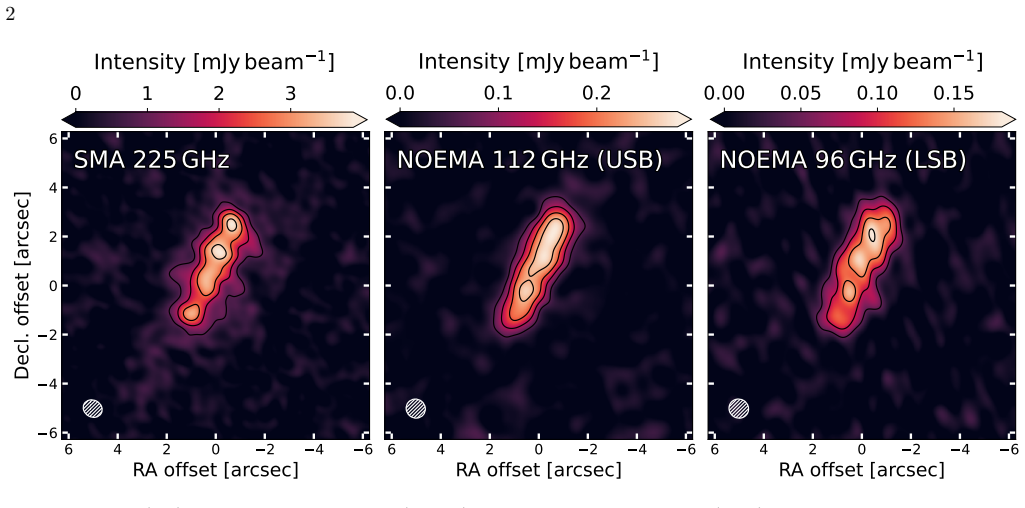
The paper's central claim is that IRAS 23077+6707's disk, resolved for the first time at roughly 0.8 arcsecond resolution, has a substantial north-south brightness asymmetry in its millimeter dust continuum, with emission in the north enhanced by up to 50% relative to the south. This asymmetry is seen consistently in three independent images (at 1.33, 2.7, and 3.1 mm), appears in both the integrated flux (north-to-south ratios of 1.14–1.35) and in image-plane self-subtraction maps, and is quantified by an asymmetry parameter A of roughly 0.14–0.22. The disk also shows multiple radial emission peaks and a central dip in the radial profile, consistent with rings and a cavity. The authors argue that an eccentric disk with eccentricity e≈0.26 can reproduce the bulk morphology and the north-south flux imbalance in a toy radiative-transfer model, and they discuss alternative origins such as a misaligned inner disk, a vortex arc, or a spiral, none of which can yet be excluded.
Load-bearing premise
The asymmetry measurements assume that the 'dynamic center' derived from the C18O kinematic map coincides with the true center of the disk, a point that cannot be directly verified because the central star is hidden behind the edge-on disk; any offset in this assumed center would systematically bias the self-subtraction residuals and the reported north-south brightness ratios.
Editorial extensions
If this is right
- If the disk is eccentric, IRAS 23077+6707 becomes one of the few known eccentric protoplanetary disks, comparable to IRS 48 and IRAS 04158+2805, suggesting that high eccentricities can persist in disks spanning hundreds of au.
- The measured spectral index of 3.2–3.9 indicates that the millimeter emission is optically thin, implying that the observed north-south asymmetry traces a real dust column-density asymmetry rather than a temperature contrast.
- The anti-alignment between the millimeter brightness peak in the north and the scattered-light asymmetry in the south implies that large and small grains occupy different regions of the disk, a pattern seen in other structured disks.
- The presence of multiple radial emission peaks and a central cavity, combined with the asymmetry, makes the disk a promising target for future gas kinematic studies to determine whether a companion or planet is shaping the disk.
- The disk's extreme radial extent (5.6–6.1 arcseconds, over 1000 au) and its asymmetry distinguish it from most edge-on disks studied to date, providing an extreme benchmark for models of disk evolution.
Reading between the lines
- If the eccentric model is correct, repeated high-resolution observations could measure apsidal precession of the rings, potentially constraining the mass of an unseen companion or the disk's self-gravity; this would be a testable prediction beyond the current paper.
- The apparent phase offset between the 1.33 mm and 3.1 mm radial profiles, which the authors attribute to imaging artifacts, could be checked with deeper, matched-resolution observations; if it persists, it would imply a wavelength-dependent shift of the emission peaks, a possible dust-trapping signature.
- The toy model assumes optically thin dust and a hot (8000 K) central star; fitting the spectral energy distribution from optical to millimeter wavelengths would test these assumptions, since a cooler star or optically thick dust would alter the predicted brightness distribution.
- Comparing the measured asymmetry parameter (A≈0.14–0.22) to outputs of hydrodynamical simulations of eccentric or vortex-bearing disks could distinguish geometric eccentricity from localized dust trapping in a turbulent eddy.
Editorial analysis
A structured set of objections, weighed in public.
Referee Report
Summary. This paper presents the first sub-arcsecond millimeter continuum images of the edge-on protoplanetary disk IRAS 23077+6707, combining SMA 1.33 mm data and NOEMA 2.7/3.1 mm data. The authors report a disk extent of 5.6–6.1 arcsec, a steep spectral index α = 3.2–3.9, multiple radial emission peaks suggestive of rings and a cavity, and a significant north–south brightness asymmetry (N/S flux ratios 1.14–1.35, asymmetry parameter A ≈ 0.14–0.22). They compare the millimeter asymmetry with scattered-light morphology and propose, as one of several hypotheses, an eccentric disk with e ≈ 0.26, illustrated with a simple RADMC-3D toy model. The eccentric model is explicitly labeled as a non-unique, forward-modeled interpretation rather than a fitted result.
Significance. If the asymmetry claims are robust, this is a valuable addition to the small sample of resolved, highly inclined protoplanetary disks and would make IRAS 23077+6707 one of the most radially extended disks known, with an unusually steep spectral index. The paper's strengths are the use of three independent data sets (SMA, NOEMA USB, NOEMA LSB), the transparent treatment of the spectral-index range including possible SMA flux discordance, the explicit toy-model status of the eccentricity interpretation, and the public release of the calibrated images on Zenodo. The central risk is that every quantitative asymmetry diagnostic is computed about a 'dynamic center' whose accuracy is never quantified; because the disk is edge-on and the star is occulted, the asymmetry measurements are only as reliable as that center determination.
major comments (2)
- [§3.1, §3.2, and Appendix B] All asymmetry diagnostics—the 180° self-subtraction residuals, the north/south aperture flux ratios, and the radial profile extraction—are computed about a 'dynamic center' whose declination offset is given as +0.52 arcsec in §3.1 and +0.58 arcsec in Appendix B, with no uncertainty quoted for either value. Because the disk is edge-on and the stellar position is not directly observable, this center is not independently verified. An error of order 0.1–0.2 arcsec along the disk spine would produce a dipole residual in the self-subtraction for a centrally peaked or ringed brightness distribution, and the measured asymmetry parameters (A ≈ 0.14–0.22, N/S ratios 1.14–1.35) are small enough that such a shift could contribute a substantial fraction of the reported signal. The footnote in §3.2 stating that rotation about the phase center gives stronger residuals only confirms that the phase center is not the disk center; it does not validate the adopted dynamic center. Please reconcile the +0.52 arcsec/+0.58 arcsec discrepancy, provide a quantitative uncertainty for the center, and demonstrate robustness by recomputing the N/S ratios, A, and the residual maps for a grid of plausible center offsets, or by deriving the center with an independent method (e.g., minimizing residual asymmetry or fitting the C18O velocity field).
- [Fig. 4 and §3.2] The abstract claims evidence for multiple radial emission peaks and troughs that may originate in rings and a central cavity, but the figure caption/text state that the peaks in the SMA and NOEMA LSB radial profiles are out of phase and attribute this to imaging artifacts, with the natural-weighted LSB image said to align more consistently. As presented, the two independent data sets do not reproduce the same peak locations in the displayed images, which weakens the substructure claim. Please quantify the peak positions and their uncertainties in a way that accounts for the different beam shapes and tapering (for example, by comparing natural-weighted and tapered images, or by fitting the profiles in the uv-plane), or soften the abstract's claim to explicitly present the radial substructure as tentative pending such an analysis.
minor comments (4)
- [Abstract] The abstract contains a duplicated article: 'hosting a a significant brightness asymmetry' should read 'hosting a significant brightness asymmetry.'
- [Table 2] The first NOEMA row is dated '2024 Dec 27' but appears in a sequence of 2024 February observations; this is presumably a typo for 2023 Dec 27 and should be corrected, since the observing campaign dates matter for the data-quality assessment.
- [Throughout] The notation for C18O is inconsistent (text uses 'C18O' while some contexts imply the isotopologue); the authors should use a uniform format such as C^18O throughout, including the figure caption for Fig. 5.
- [§2.1] The sentence describing the flagged BL Lac time range is placed in a footnote that appears to continue into a description of COMPASS; please check that the footnote formatting is correct and that the citation to Keating et al. (in prep.) is complete.
Circularity Check
No significant circularity: direct image measurements support the asymmetry/substructure claims, and the eccentricity inference is an explicitly labeled toy model, not a prediction forced by construction.
full rationale
The paper's load-bearing observational claims—extended emission, spectral index, radial peaks, and north-south asymmetry—are read directly from calibrated SMA/NOEMA continuum images, with no fitted parameter entering their definition. The 'dynamic center' used for self-subtraction and flux ratios is derived in Appendix B from C18O kinematics (the intersection of the continuum spine with the 1.8 km/s iso-velocity contour), an independent tracer; it is not defined in terms of the asymmetry it is used to measure. The eccentric-disk interpretation is explicitly introduced as a 'simple, toy model' whose parameters (top-hat radii/widths, inclination, PA, scale height, e=0.26) are set to match the data, and the paper states 'We avoid fitting this model to derive best-fit parameter estimations' and offers alternative scenarios. The statement that e≈0.2-0.3 is needed is therefore a conditional model inference, not a prediction that reduces to its inputs by construction. Self-citations (Lovell et al. 2021 for the self-subtraction procedure; Lynch & Lovell 2021 and Lovell & Lynch 2023 for the eccentric-dust model code) supply methods/models but do not carry the central observational derivation; no uniqueness theorem is imported and no ansatz is hidden behind a citation. The unquoted uncertainty on the dynamic center and the 0.52 arcsec vs 0.58 arcsec declination offset are robustness/calibration concerns, not circularity.
Assumptions & free parameters
free parameters (4)
- Eccentricity e =
0.26 (range 0.2-0.3)
- Ring radii and widths (two top-hats) =
Not specified numerically; 'fixed ... to match the peaks'
- Scale height H =
0.1 x r
- Inclination =
75 degrees
assumptions (4)
- domain assumption Dust emission is optically thin
- domain assumption Dust dynamics are independent of gas
- domain assumption Eccentricity profile e ~ a^-1
- standard math Radiative transfer via RADMC-3D
Cite this review
Pith. "Pith review of SMA and NOEMA reveal asymmetric sub-structure in the protoplanetary disk of IRAS23077+6707." pith.science (2026). https://pith.science/paper/UP3UYYVD
@misc{pith2026250700122,
  author       = {Pith},
  title        = {Pith review of: SMA and NOEMA reveal asymmetric sub-structure in the protoplanetary disk of IRAS23077+6707},
  year         = {2026},
  howpublished = {\url{https://pith.science/paper/UP3UYYVD}},
  note         = {Machine review of arXiv:2507.00122}
}
abstract
We present high-resolution data of IRAS 23077+6707 (`Dracula's Chivito') with the Submillimeter Array (SMA at 1.33 mm/225.5 GHz) and the Northern Extended Millimeter Array (NOEMA at 2.7 mm/111.7 GHz and 3.1 mm/96.2 GHz). IRAS 23077+6707 is a highly-inclined and newly discovered protoplanetary disk, first reported in 2024. We combine SMA baselines from the Compact, Extended and Very Extended arrays, and NOEMA baselines from its A and C configurations, and present continuum images with resolution ${\lesssim}0.8''$, which constitute the first sub-arcsecond resolution maps of IRAS 23077+6707. The images show extended linear emission that spans $5.6{-}6.1''$ as expected for a radially extended, highly-inclined protoplanetary disk. Accompanied with lower resolution data, we show that the disk has a steep spectral index, ranging from $\alpha=3.2{-}3.9$. We present evidence of multiple radial emission peaks and troughs in emission, which may originate in disk rings and a central cavity. We further present evidence that these radial structures are asymmetric; hosting a a significant brightness asymmetry, with emission enhanced by up to 50% in the north versus the south. We discuss hypotheses about the potential origins of these features, including the possibility that IRAS 23077+6707 hosts a rare example of an eccentric protoplanetary disk, which can induce these radially asymmetric structures. We present a simple eccentric continuum model of IRAS 23077+6707, and show for an eccentricity of $e \approx 0.26$, that this can reproduce the bulk morphology of the emission.
Figures


Figures from the paper (2 more)


Reference graph
Works this paper leans on
-
[1]
ALMA Partnership, Brogan, C. L., P´ erez, L. M., et al. 2015, ApJL, 808, L3, doi: 10.1088/2041-8205/808/1/L3
-
[2]
Andrews, S. M. 2020, ARA&A, 58, 483, doi: 10.1146/annurev-astro-031220-010302
-
[3]
Andrews, S. M., Liu, M. C., Williams, J. P., & Allers, K. N. 2008, ApJ, 685, 1039, doi: 10.1086/591417
doi:10.1086/591417 2008
-
[4]
Andrews, S. M., Wilner, D. J., Zhu, Z., et al. 2016, ApJL, 820, L40, doi: 10.3847/2041-8205/820/2/L40
-
[5]
Andrews, S. M., Huang, J., P´ erez, L. M., et al. 2018, ApJL, 869, L41, doi: 10.3847/2041-8213/aaf741 Astropy Collaboration, Robitaille, T. P., Tollerud, E. J., et al. 2013, A&A, 558, A33, doi: 10.1051/0004-6361/201322068 Astropy Collaboration, Price-Whelan, A. M., Sip˝ ocz, B. M., et al. 2018, AJ, 156, 123, doi: 10.3847/1538-3881/aabc4f
-
[6]
2015, A&A, 578, L6, doi: 10.1051/0004-6361/201526011
Benisty, M., Juhasz, A., Boccaletti, A., et al. 2015, A&A, 578, L6, doi: 10.1051/0004-6361/201526011
-
[7]
2017, A&A, 597, A42, doi: 10.1051/0004-6361/201629798
Benisty, M., Stolker, T., Pohl, A., et al. 2017, A&A, 597, A42, doi: 10.1051/0004-6361/201629798
-
[8]
DECaPS and SMA discovery of a highly-inclined class I YSO with an outflow: IRAS 08235-4316
Benisty, M., Bae, J., Facchini, S., et al. 2021, ApJL, 916, L2, doi: 10.3847/2041-8213/ac0f83 Bennett Lovell, J., Monsch, K., Keating, G. K., et al. 2024, arXiv e-prints, arXiv:2411.10518, doi: 10.48550/arXiv.2411.10518
work page Pith review arXiv doi:10.48550/arxiv.2411.10518 2021
Show all 52 references
-
[9]
T., Bayyari, A., Sitko, M
Berghea, C. T., Bayyari, A., Sitko, M. L., et al. 2024, ApJL, 967, L3, doi: 10.3847/2041-8213/ad43e3
2024 doi
-
[10]
H., & Schwab, F
Bridle, A. H., & Schwab, F. R. 1999, in Astronomical Society of the Pacific Conference Series, Vol. 180, Synthesis Imaging in Radio Astronomy II, ed. G. B
1999
-
[11]
F., Pinilla, P., et al
Cazzoletti, P., van Dishoeck, E. F., Pinilla, P., et al. 2018, A&A, 619, A161, doi: 10.1051/0004-6361/201834006
2018 doi
-
[12]
M., Gurwell, M
Chung, C.-Y., Andrews, S. M., Gurwell, M. A., et al. 2024, ApJS, 273, 29, doi: 10.3847/1538-4365/ad528b
2024 doi
-
[13]
2021, CARTA: The Cube Analysis and Rendering Tool for
Comrie, A., Kuo-Song Wang, Shou-Chieh Hsu, et al. 2021, CARTA: The Cube Analysis and Rendering Tool for
2021
-
[14]
Astronomy, Zenodo, doi: 10.5281/ZENODO.3377984
-
[15]
Conselice, C. J. 2003, ApJS, 147, 1, doi: 10.1086/375001
2003 doi
-
[16]
J., Bershady, M
Conselice, C. J., Bershady, M. A., & Jangren, A. 2000, ApJ, 529, 886, doi: 10.1086/308300
2000 doi
-
[17]
A., Gensior, J., Bureau, M., et al
Davis, T. A., Gensior, J., Bureau, M., et al. 2022, MNRAS, 512, 1522, doi: 10.1093/mnras/stac600
2022 doi
-
[18]
2018, ApJ, 860, 124, doi: 10.3847/1538-4357/aac6cb
Dong, R., Liu, S.-y., Eisner, J., et al. 2018, ApJ, 860, 124, doi: 10.3847/1538-4357/aac6cb
2018 doi
- [19]
-
[20]
P., Juhasz, A., Pohl, A., et al
Dullemond, C. P., Juhasz, A., Pohl, A., et al. 2012, ”Astrophysics Source Code Library”, ascl:1202.015. http://ascl.net/1202.015 13
2012
-
[21]
2018, MNRAS, 473, 4459, doi: 10.1093/mnras/stx2523
Facchini, S., Juh´ asz, A., & Lodato, G. 2018, MNRAS, 473, 4459, doi: 10.1093/mnras/stx2523
2018 doi
-
[22]
2021, A&A, 651, A90, doi: 10.1051/0004-6361/202141278
Fedele, D., Toci, C., Maud, L., & Lodato, G. 2021, A&A, 651, A90, doi: 10.1051/0004-6361/202141278
2021 doi
-
[23]
J., et al
Hammond, I., Christiaens, V., Price, D. J., et al. 2023, MNRAS, 522, L51, doi: 10.1093/mnrasl/slad027
2023 doi
-
[24]
M., et al
Hashimoto, J., Tsukagoshi, T., Brown, J. M., et al. 2015, ApJ, 799, 43, doi: 10.1088/0004-637X/799/1/43
2015 doi
-
[25]
J., Jacobs, D
Hazelton, B. J., Jacobs, D. C., Pober, J. C., & Beardsley, A. P. 2017, The Journal of Open Source Software, 2, 140, doi: 10.21105/joss.00140
2017 doi
-
[26]
Ho, P. T. P., Moran, J. M., & Lo, K. Y. 2004, ApJL, 616, L1, doi: 10.1086/423245
2004 doi
-
[27]
M., P´ erez, L
Huang, J., Andrews, S. M., P´ erez, L. M., et al. 2018, ApJL, 869, L43, doi: 10.3847/2041-8213/aaf7a0
2018 doi
-
[28]
2019, ApJL, 879, L25, doi: 10.3847/2041-8213/ab2a12
Isella, A., Benisty, M., Teague, R., et al. 2019, ApJL, 879, L25, doi: 10.3847/2041-8213/ab2a12
2019 doi
-
[29]
M., et al
Isella, A., Huang, J., Andrews, S. M., et al. 2018, ApJL, 869, L49, doi: 10.3847/2041-8213/aaf747
2018 doi
-
[30]
2025, The Journal of Open Source Software, 10, 7482, doi: 10.21105/joss.07482
Keating, G., Hazelton, B., Kolopanis, M., et al. 2025, The Journal of Open Source Software, 10, 7482, doi: 10.21105/joss.07482
2025 doi
-
[31]
2023, ApJ, 953, 190, doi: 10.3847/1538-4357/acdd7a
Kido, M., Takakuwa, S., Saigo, K., et al. 2023, ApJ, 953, 190, doi: 10.3847/1538-4357/acdd7a
2023 doi
-
[32]
J., Harsono, D., et al
Long, F., Herczeg, G. J., Harsono, D., et al. 2019, ApJ, 882, 49, doi: 10.3847/1538-4357/ab2d2d
2019 doi
-
[33]
Lovell, J. B. 2025, Dataset for: SMA and NOEMA reveal asymmetric sub-structure in the protoplanetary disk of IRAS 23077+6707, Zenodo, doi: 10.5281/ZENODO.15319178
2025 doi
-
[34]
B., & Lynch, E
Lovell, J. B., & Lynch, E. M. 2023, MNRAS, 525, L36, doi: 10.1093/mnrasl/slad083
2023 doi
-
[35]
B., Marino, S., Wyatt, M
Lovell, J. B., Marino, S., Wyatt, M. C., et al. 2021, MNRAS, 506, 1978, doi: 10.1093/mnras/stab1678
2021 doi
- [36]
-
[37]
A., Weinberger, A
MacGregor, M. A., Weinberger, A. J., Loyd, R. O. P., et al. 2021, ApJL, 911, L25, doi: 10.3847/2041-8213/abf14c
2021 doi
- [38]
-
[39]
2007, in Astronomical Society of the Pacific Conference Series, Vol
Golap, K. 2007, in Astronomical Society of the Pacific Conference Series, Vol. 376, Astronomical Data Analysis Software and Systems XVI, ed. R. A. Shaw, F. Hill, & D. J. Bell, 127
2007
-
[40]
B., Berghea, C
Monsch, K., Lovell, J. B., Berghea, C. T., et al. 2024, ApJL, 967, L2, doi: 10.3847/2041-8213/ad3bb0 P´ erez, L. M., Carpenter, J. M., Andrews, S. M., et al. 2016, Science, 353, 1519, doi: 10.1126/science.aaf8296 P´ erez, L. M., Benisty, M., Andrews, S. M., et al. 2018, ApJL, ...
2024 doi
-
[41]
A., Young, K
Primiani, R. A., Young, K. H., Young, A., et al. 2016, Journal of Astronomical Instrumentation, 5, 1641006, doi: 10.1142/S2251171716410063
2016 doi
-
[42]
2021, MNRAS, 507, 1157, doi: 10.1093/mnras/stab2179 Szil´ agyi, M., Kun, M., &´Abrah´ am, P
Ragusa, E., Fasano, D., Toci, C., et al. 2021, MNRAS, 507, 1157, doi: 10.1093/mnras/stab2179 Szil´ agyi, M., Kun, M., &´Abrah´ am, P. 2021, MNRAS, 505, 5164, doi: 10.1093/mnras/stab1496
2021 doi
-
[43]
2024, ApJ, 964, 24, doi: 10.3847/1538-4357/ad1f57
Takakuwa, S., Saigo, K., Kido, M., et al. 2024, ApJ, 964, 24, doi: 10.3847/1538-4357/ad1f57
2024 doi
-
[44]
J., Testi, L., et al
Tazzari, M., Clarke, C. J., Testi, L., et al. 2021, Monthly Notices of the Royal Astronomical Society, 506, 2804, doi: 10.1093/mnras/stab1808
2021 doi
-
[45]
2019, The Journal of Open Source Software, 4, 1632, doi: 10.21105/joss.01632
Teague, R. 2019, The Journal of Open Source Software, 4, 1632, doi: 10.21105/joss.01632
2019 doi
-
[46]
2018, Research Notes of the American Astronomical Society, 2, 173, doi: 10.3847/2515-5172/aae265
Teague, R., & Foreman-Mackey, D. 2018, Research Notes of the American Astronomical Society, 2, 173, doi: 10.3847/2515-5172/aae265
2018 doi
-
[47]
R., Haworth, T
Teague, R., Jankovic, M. R., Haworth, T. J., Qi, C., & Ilee, J. D. 2020, MNRAS, 495, 451, doi: 10.1093/mnras/staa1167 van der Marel, N., van Dishoeck, E. F., Bruderer, S., et al. 2013, Science, 340, 1199, doi: 10.1126/science.1236770 van der Marel, N., Birnstiel, T., Garufi, A...
2020 doi
-
[48]
Villenave, M., M´ enard, F., Dent, W. R. F., et al. 2020, A&A, 642, A164, doi: 10.1051/0004-6361/202038087
2020 doi
-
[49]
P., & Cieza, L
Williams, J. P., & Cieza, L. A. 2011, ARA&A, 49, 67, doi: 10.1146/annurev-astro-081710-102548
2011 doi
- [50]
-
[51]
Xu, W., Ohashi, S., Aso, Y., & Liu, H. B. 2023, ApJ, 954, 190, doi: 10.3847/1538-4357/aced4c
2023 doi
-
[52]
2023, ApJL, 948, L2, doi: 10.3847/2041-8213/acccf8
Yang, H., Fern´ andez-L´ opez, M., Li, Z.-Y., et al. 2023, ApJL, 948, L2, doi: 10.3847/2041-8213/acccf8
2023 doi
Reviewed August 6, 2026 · model on record in the stance chip above.
Discussion (0). Continue with ORCID to comment.