REVIEW 4 major objections 5 minor 54 references
Gate-based emulation of boson sampling using photonic qubits
T0 review · 4 major / 5 minor · reviewed 2026-08-11 · deepseek-v4-flash
Pith's one-line read The paper claims any two-photon N-mode boson-sampling interferometer can be rewritten as an N+1-qubit quantum circuit, and a four-mode version implemented on path-and-polarization qubits matches the theoretical probabilities to above…
desk verdict A correct and clean two-photon emulation scheme with a solid experiment, but the abstract's general-n-photon claim is a sketch and the circuit diagrams don't match the stated matrices. read the letter →
The pith
A machine-rendered reading of the paper's core claim, the machinery that carries it, and where it could break.
The reading
What carries the argument
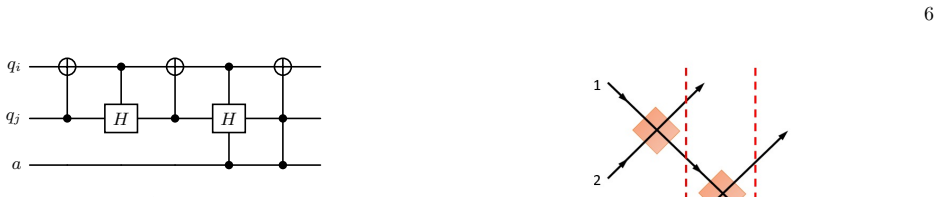
The load-bearing object is the repeating beam-splitter unit (Fig. 4): a fixed circuit block applied to the two mode-qubits (q_i, q_j) plus an ancilla, preceded by an ancilla-activation circuit that checks whether all spectator modes are empty. Only when the ancilla is active does the unit apply the encoded two-photon beam-splitter transformation, including the Hong–Ou–Mandel bunching rotation; all other computational basis states pass through unchanged. This construction is built from the three-qubit unified circuit (Fig. 3) that merges the single- and two-photon beam-splitter sectors, with the third qubit flagging the two-photon sector. The binary occupation encoding—a Fock state with two photons on a mode as a logical 1, and one photon in each of two modes as two logical 1s—makes the local interference subspace easy to test: every qubit outside the pair must be 0. The ancilla identification uses anti-controlled CNOT and Toffoli gates, with an O(N) gate count in the number of modes, which is the scaling argument underwriting the 'linear overhead' claim.
What would settle it
Compile a five-mode, two-photon interferometer from the repeating unit, simulate the circuit on a noiseless classical machine, and compare all columns of the resulting transition probability matrix with the exact permanent-based boson-sampling probabilities. If any entry deviates from the theoretical value, the claimed general two-photon construction fails; the paper reports agreement only for the four-mode case.
Extended reading notes
Core claim
The paper's central claim is that a two-photon, N-mode boson-sampling interferometer is exactly representable as a quantum circuit on N+1 qubits. The representation uses a binary occupation encoding—one qubit per mode records whether a mode holds photons—plus one ancilla that flags the local interference subspace of the beam splitter being simulated. Each optical beam splitter is replaced by the same repeating quantum-circuit unit, and the paper proves the encoding's uniqueness (up to bitwise complement) under the assumptions of one qubit per mode and a shared repeating unit. Attached to this is the experimental claim that a four-mode version, implemented with a single photon whose path and polarization carry four qubits, reproduces the theoretical two-photon boson-sampling probabilities: squared classical fidelity above 0.9994 and total variation distance below 0.02 for all six input configurations. The abstract further claims a scalable framework for n-photon, m-mode boson sampling, for which the paper provides a recursive construction sketch rather than a full derivation.
Load-bearing premise
The load-bearing premise is that the pattern seen in the two-photon case—repeating beam-splitter units with ancilla subspace identification—continues to work for arbitrary photon numbers, because the paper only derives the general construction for two photons and the appendix recipe for more photons explicitly says its encoding need not be scalable, with no proof or resource counts given.
Editorial extensions
If this is right
- Any two-photon N-mode interferometer can be compiled into a fixed N+1-qubit circuit that works for every input state at once, so a single compiled emulation replaces a family of input-specific optical experiments.
- Because the repeating unit is platform-independent, the same compiled circuits can in principle be run on superconducting, trapped-ion, or neutral-atom qubit hardware, not only photonic chips.
- The four-mode experimental result shows that a single photon in multiple degrees of freedom can emulate the statistics of a two-photon Fock-space process, extending single-photon multi-qubit logic to the simulation of bosonic interference.
- The recursive recipe is intended to provide gate circuits for arbitrary m-photon, n-mode sampling, which would place boson-sampling distributions within reach of gate-based quantum computers, including the linear-mode regime highlighted by recent hardness results.
- The same ancilla-identification pattern could be applied to any local photon-number subspace in a larger interferometer, so the construction is modular in the number of modes as long as the total photon number stays fixed.
Reading between the lines
- Editorial inference: The same ancilla-activation trick could be reused for other photon-number-preserving unitaries, not just beam splitters, whenever the operation should fire only on a local occupation subspace.
- Editorial inference: A direct two-photon version of the four-mode experiment, feeding actual Fock states through the interferometer rather than a single encoded photon, would be the natural stress test of the emulation claim.
- Editorial inference: Formalizing the recursive m-photon construction with explicit resource counts (qubits, gates, ancillas) would settle whether the promised scalability is real; the appendix currently leaves the encoding open and explicitly says it need not be scalable.
- Editorial inference: Because the overhead for subspace identification is only linear in the number of modes, the practical bottleneck for larger two-photon circuits is likely the multi-controlled gate depth rather than the qubit count.
Editorial analysis
A structured set of objections, weighed in public.
Referee Report
Summary. The manuscript proposes a gate-based qubit framework for emulating boson sampling. It constructs balanced beam-splitter circuits for the single-photon and two-photon sectors, combines them through an ancilla-assisted encoding, and claims a scalable repeating-unit architecture that maps a two-photon N-mode interferometer to an (N+1)-qubit circuit. A four-mode two-photon circuit is then developed, and input-specific optimized versions are implemented experimentally using a heralded single photon encoded in path and polarization. The experimental output distributions are compared with permanent-based theoretical predictions, reporting squared classical fidelities above 0.9994 and total variation distances below 0.02.
Significance. If the general framework were correct, it would provide a useful hardware-agnostic mapping from boson sampling to gate-based quantum circuits and could support practical studies of sampling problems on qubit platforms. The experimental portion is careful and credibly executed: the input-specific circuits are benchmarked against the standard permanent formula, no parameters are fitted to the data, and the reported bootstrap uncertainties are plausible. However, the central theoretical generalization is not merely underproved; the repeating-unit construction in Sec. IV has a concrete correctness flaw, and the scalable m-photon n-mode framework promised in the abstract is only sketched in Appendix F. The high experimental fidelities do not validate the general architecture because the experiment uses input-specific optimized circuits rather than the generalized repeating unit.
major comments (4)
- [Sec. IV.B, Eq. (IV B), Fig. 6] The ancilla condition a = AND_{k != i,j} NOT q_k activates the repeating unit only when all spectator modes are unoccupied. For a two-photon input with one photon in a spectator mode, such as |1010> at the first beam splitter B12, the local two-mode state is |1,0> and the true beam-splitter action must map that photon into a superposition involving mode 2. The ancilla is 0 because q3=1, so the repeating unit is inactive and the state |1010> passes through unchanged. Concretely, after the first stage B12 and B34, the correct evolution of |1010> is (|1010>+|1001>+|0110>+|0101>)/2, whereas the circuit described in Sec. IV and Fig. 6 leaves it as |1010>. The claimed input-independent (N+1)-qubit circuit therefore does not reproduce the two-photon evolution over the complete ten-dimensional Hilbert space.
- [Appendix F] The claimed generalization to arbitrary m-photon, n-mode boson sampling is not a derivation. The appendix explicitly states that the encoding chosen during the recursive construction 'need not be scalable' and gives no qubit counts, gate counts, or proof that the controlled operations implement the beam-splitter transformation on each photon-number sector. The abstract's assertion of a scalable quantum-circuit framework for n photons in m modes is therefore unsupported; the entire general claim rests on unverified extrapolation from the two-photon construction.
- [Sec. III.A, Fig. 1] The single-photon beam-splitter circuit as drawn has only one Hadamard gate on q0, but under the encoding |1,0> -> |10> and |0,1> -> |01>, H on q0 maps |10> to (|10>+|00>)/sqrt(2), not to (|10>+|01>)/sqrt(2). The required transformation given in Appendix VIII C is a two-qubit unitary. As drawn, Fig. 1 cannot implement the single-photon beam-splitter sector, and since this sector is used in the unified circuit of Sec. III.C, the error propagates to the repeating-unit construction.
- [Sec. VI, Fig. 7, Table VI] The experimental implementation uses input-specific optimized circuits (Fig. 7), not the generalized repeating-unit circuit (Fig. 6). Consequently, the high fidelities reported in Table VI validate only the optimized circuits and the underlying optical setup; they do not validate the general (N+1)-qubit architecture of Sec. IV. The experimental results are therefore consistent with the theory for the specific inputs, but they cannot compensate for the flaw in the general construction.
minor comments (5)
- [Sec. VI.E] The paragraph beginning 'Figure 11 presents' contains duplicated and garbled text ('Figure 11 presents the experimentally measured and theoretically predicted output probability distributions. reconstructed and theoretically predicted output probability distributions aforementioned...') and should be rewritten.
- [Sec. IV.B] The ancilla definition a = AND_{k != i,j} NOT q_k is not numbered and is referenced as 'Eq. (IV B)'; it should be given a proper equation number and a consistent label.
- [Fig. 6] The caption uses 'Psi1' and 'Psi2' without defining them, while the text uses psi_1 and psi_2 for the intermediate states; the notation should be unified.
- [Abstract and Sec. IV] The notation for the number of modes is inconsistent: the abstract uses m-mode, while Sec. IV uses N modes; the paper should settle on a single convention.
- [Table IV] Table IV lists ancilla values 'after Toffoli and CNOT' but the exact sequence of gates realizing the AND condition is not specified; a brief description or circuit snippet would improve reproducibility.
Circularity Check
No significant circularity: the circuit constructions are derived from the beam-splitter unitary and validated against the independent permanent-based boson-sampling formula.
full rationale
The paper's derivation chain starts from the standard balanced beam-splitter transformation (Eq. 1) and explicitly constructs single- and two-photon sector circuits (Figs. 1-3) that implement those transformations in an encoded qubit basis. The four-mode circuit (Fig. 6) is obtained by concatenating these repeating units according to the interferometer decomposition, and the theoretical transition probabilities (Eq. 3) are computed independently via the permanent formula (Eq. 2), not by reading off the circuit. The experimental comparison uses these externally computed probabilities as the benchmark: no parameter is fitted to the measured data, and the quoted fidelities are not used to define or adjust the circuit. The self-citations (Refs. 37 and 42) concern established single-photon multiqubit logic and path-encoding techniques; they support the experimental implementation but are not load-bearing for the central mapping from Fock-space beam splitters to qubit gates. The only self-referential aspect is that the experiment tests circuits specifically designed to produce the target two-photon statistics, which is a sanity check of the encoding rather than a circular reduction. A separate correctness concern noted by a skeptic - that the ancilla condition in Sec. IV.B only activates for states with both photons on the beam-splitter modes and leaves single-photon spectator components unchanged - is a potential validity issue for the input-independent N+1-qubit claim, but it is not a case of the conclusion being equivalent to the premises by construction, so it does not raise the circularity score.
Assumptions & free parameters
assumptions (5)
- domain assumption Balanced beam splitter acts as U_BS = 1/sqrt(2) [[1,1],[1,-1]] on mode operators
- standard math Transition amplitudes for boson sampling are given by the permanent formula of Aaronson and Arkhipov
- domain assumption Any passive linear-optical network decomposes into a sequence of balanced beam splitters and phase shifters
- ad hoc to paper The one-qubit-per-mode encoding with q_i=1 iff mode i is occupied, plus ancilla identification, is a valid representation of the two-photon Fock sector
- ad hoc to paper The recursive combination of photon-number sectors in Appendix F produces a correct scalable circuit for arbitrary m-photon, n-mode boson sampling
Cite this review
Pith. "Pith review of Gate-based emulation of boson sampling using photonic qubits." pith.science (2026). https://pith.science/paper/UP4WMYH7
@misc{pith2026260809509,
  author       = {Pith},
  title        = {Pith review of: Gate-based emulation of boson sampling using photonic qubits},
  year         = {2026},
  howpublished = {\url{https://pith.science/paper/UP4WMYH7}},
  note         = {Machine review of arXiv:2608.09509}
}
abstract
Boson sampling arising from multiphoton interference in linear-optical networks is a prominent non-universal model for quantum computation. Here, by encoding the multi-qubit state to bosonic Fock state, we present a scalable quantum-circuit framework for simulating boson sampling on a universal quantum computing platform. Beginning with balanced beam-splitter transformations on the single- and two-photon sectors, we derive equivalent quantum-circuit implementations and unify them within a common Hilbert-space representation using an ancilla-assisted encoding. This construction is then generalized to arbitrary interferometers by replacing each optical beam splitter with a repeating quantum-circuit unit that selectively acts only within the relevant local interference subspace, requiring $N+1$ qubits for a two-photon $N$-mode interferometer and a linear-overhead subspace-identification procedure. Using this framework, gate-based quantum circuit for a four-mode boson-sampling circuit is developed and experimentally implemented on a four-qubit gate-based photonic qubit system. The qubit framework for emulating boson sampling of $n-$photons in $m-$mode will be useful to solve a broad class of sampling complexity problem on a gate-based quantum computers.
Figures


Figures from the paper (10 more)


Reference graph
Works this paper leans on
-
[1]
Both photons occupying the same mode, |0, . . . ,2k, . . . ,0⟩, fork= 1, . . . , N
-
[2]
Photons occupying two distinct modes, |0, . . . ,1i, . . . ,1j, . . . ,0⟩, i̸=j. To encode these states, one qubit is assigned to each optical mode. The computational basis state |q1q2 . . . qN ⟩ records the set of occupied modes, where qi = ( 1,if modeiis occupied, 0,otherwise. 5 Since the construction is restricted to the two-photon sec- tor, it is suff...
-
[3]
For a fixed total photon numberN= 3, the allowed two- mode Fock states are {|3,0⟩,|0,3⟩,|2,1⟩,|1,2⟩}
Three-Photon Beam-Splitter Transformation We first consider the action of a balanced beam splitter on three photons distributed across two spatial modes. For a fixed total photon numberN= 3, the allowed two- mode Fock states are {|3,0⟩,|0,3⟩,|2,1⟩,|1,2⟩}. The corresponding Hilbert space is therefore four- dimensional and can be represented using two qubit...
-
[4]
One-, Two- and Three-Photon Inputs To extend the construction to a multimode interferom- eter, it is necessary to consider the complete local Hilbert space encountered by an individual beam splitter. Al- though the total photon number of the system is fixed at three, the two modes interacting at a given beam splitter may contain zero, one, two, or all thr...
-
[5]
All three photons occupy the same mode, |0, . . . ,3k, . . . ,0⟩, k= 1, . . . , n,
-
[6]
Two photons occupy one mode and one photon oc- cupies another, |0, . . . ,2i, . . . ,1j, . . . ,0⟩, i̸=j,
-
[7]
Each photon occupies a different mode, |0, . . . ,1i, . . . ,1j, . . . ,1k, . . . ,0⟩, i̸=j̸=k. To obtain an encoding that extends directly with the number of spatial modes, we assign a two-qubit register to each mode. Since each mode can contain 0, 1, 2, or 3 photons, ni ∈ {0,1,2,3}, its four possible occupation numbers are represented us- ing the Gray-c...
-
[8]
Simulating physics with computers,
R. P. Feynman, “Simulating physics with computers,” Int. J. Theor. Phys.21, 467–488 (1982)
work page 1982
Show all 54 references
-
[9]
Quantum theory, the Church–Turing prin- ciple and the universal quantum computer,
D. Deutsch, “Quantum theory, the Church–Turing prin- ciple and the universal quantum computer,” Proc. R. Soc. London A400, 97–117 (1985)
1985
-
[10]
Photonic implementation of boson sampling: a review,
D. J. Brod, E. F. Galv˜ ao, A. Crespi, R. Osellame, N. Spagnolo, and F. Sciarrino, “Photonic implementation of boson sampling: a review,” Advanced Photonics1, 034001 (2019)
2019
-
[11]
Aaronson and A
S. Aaronson and A. Arkhipov, The Computational Com- plexity of Linear Optics, Proceedings of the43rdAnnual ACM Symposium on Theory of Computing (STOC),333– 342, (2011)
2011
-
[12]
Experimental realization of any discrete unitary opera- tor,
M. Reck, A. Zeilinger, H. J. Bernstein, and P. Bertani, “Experimental realization of any discrete unitary opera- tor,” Phys. Rev. Lett.73, 58–61 (1994)
1994
-
[13]
Optimal design for universal multiport interferometers,
W. R. Clements, P. C. Humphreys, B. J. Metcalf, W. S. Kolthammer, and I. A. Walmsley, “Optimal design for universal multiport interferometers,” Optica3, 1460– 1465 (2016)
2016
-
[14]
The complexity of computing the perma- nent,
L. G. Valiant, “The complexity of computing the perma- nent,” Theoretical Computer Science 8, 189–201 (1979)
1979
-
[15]
Boson Sampling from a Gaussian State,
A. P. Lund, A. Laing, S. Rahimi-Keshari, T. Rudolph, J. L. O’Brien, and T. C. Ralph, “Boson Sampling from a Gaussian State,” Phys. Rev. Lett.113, 100502 (2014)
2014
-
[16]
Gaussian Boson Sampling,
C. S. Hamilton, R. Kruse, L. Sansoni, S. Barkhofen, C. Silberhorn, and I. Jex, “Gaussian Boson Sampling,”
-
[17]
Toward Scalable Boson Sampling with Photon Loss,
H. Wang, W. Li, X. Jiang, Y.-M. He, Y.-H. Li, X. Ding, M.-C. Chen, J. Qin, C.-Z. Peng, C. Schneider, M. Kamp, W.-J. Zhang, H. Li, L.-X. You, Z. Wang, J. P. Dowling, S. H¨ ofling, C.-Y. Lu, and J.-W. Pan, “Toward Scalable Boson Sampling with Photon Loss,” Phys. Rev. Lett. 120, ...
2018
-
[18]
BosonSampling is far from uniform,
S. Aaronson and A. Arkhipov, “BosonSampling is far from uniform,” Quantum Inf. Comput.14, 1383–1423 (2014)
2014
-
[19]
Bo- son sampling on a photonic chip,
J. B. Spring, B. J. Metcalf, P. C. Humphreys, W. S. Kolthammer, X.-M. Jin, M. Barbieri, A. Datta, N. Thomas-Peter, N. K. Langford, D. Kundys, J. C. Gates, B. J. Smith, P. G. R. Smith, and I. A. Walmsley, “Bo- son sampling on a photonic chip,” Science339, 798–801 (2013)
2013
-
[20]
Experimental boson sampling,
M. Tillmann, B. Daki´ c, R. Heilmann, S. Nolte, A. Sza- meit, and P. Walther, “Experimental boson sampling,” Nature Photonics7, 540–544 (2013)
2013
-
[21]
Photonic boson sampling in a tunable circuit,
M. A. Broome, A. Fedrizzi, S. Rahimi-Keshari, J. Dove, S. Aaronson, T. C. Ralph, and A. G. White, “Photonic boson sampling in a tunable circuit,” Science 339, 794– 798 (2013)
2013
-
[22]
Integrated multimode interfer- ometers with arbitrary designs for photonic boson sam- pling,
A. Crespi, R. Osellame, R. Ramponi, D. J. Brod, E. F. Galv˜ ao, N. Spagnolo, C. Vitelli, E. Maiorino, P. Mat- aloni, and F. Sciarrino, “Integrated multimode interfer- ometers with arbitrary designs for photonic boson sam- pling,” Nature Photonics 7, 545–549 (2013)
2013
-
[23]
Experimental validation of photonic boson sampling,
N. Spagnolo, C. Vitelli, M. Bentivegna, D. J. Brod, A. Crespi, F. Flamini, S. Giacomini, G. Milani, R. Ramponi, P. Mataloni, R. Osellame, E. F. Galv˜ ao, and F. Sciarrino, “Experimental validation of photonic boson sampling,” Nature Photonics8, 615–620 (2014)
2014
-
[24]
Experimental scattershot boson sampling,
M. Bentivegna, N. Spagnolo, C. Vitelli, F. Flamini, N. Viggianiello, L. Latmiral, P. Mataloni, D. J. Brod, E. F. Galv˜ ao, A. Crespi, R. Ramponi, R. Osellame, and F. Sciarrino, “Experimental scattershot boson sampling,” Science Advances1, e1400255 (2015)
2015
-
[25]
Quantum computational advantage with a programmable photonic processor,
L. S. Madsen, F. Laudenbach, M. F. Askarani, F. Rortais, T. Vincent, J. F. F. Bulmer, F. M. Miatto, L. Neuhaus, L. G. Helt, M. J. Collins, A. E. Lita, T. Gerrits, S. W. Nam, V. D. Vaidya, M. Menotti, I. Dhand, Z. Vernon, N. Que- sada, and J. Lavoie, “Quantum computational adva...
2022
-
[26]
Quantum computational advantage using photons,
H.-S. Zhong, H. Wang, Y.-H. Deng, M.-C. Chen, L.-C. Peng, Y.-H. Luo, J. Qin, D. Wu, X. Ding, Y. Hu, P. Hu, X.-Y. Yang, W.-J. Zhang, H. Li, Y. Li, X. Jiang, L. Gan, G. Yang, L. You, Z. Wang, L. Li, N.-L. Liu, C.-Y. Lu, and J.-W. Pan, “Quantum computational advantage using photo...
2020
-
[27]
Photonic quantum information processing: A review,
F. Flamini, N. Spagnolo, and F. Sciarrino, “Photonic quantum information processing: A review,” Reports on Progress in Physics82, 016001 (2019)
2019
-
[28]
Resource-efficient digital quantum simulation ofd-level systems for pho- tonic, vibrational, and spin-sHamiltonians,
N. P. D. Sawaya, T. Menke, T. H. Kyaw, S. Johri, A. Aspuru-Guzik, and G. G. Guerreschi, “Resource-efficient digital quantum simulation ofd-level systems for pho- tonic, vibrational, and spin-sHamiltonians,” npj Quan- tum Information6, 49 (2020)
2020
-
[29]
Quantum simulation of second-quantized Hamiltonians in compact encoding,
W. M. Kirby, S. Hadi, M. Kreshchuk, and P. J. Love, “Quantum simulation of second-quantized Hamiltonians in compact encoding,” Phys. Rev. A104, 042607 (2021)
2021
-
[30]
Digital quantum simulations of Hong–Ou– Mandel interference,
N. K. Mohan, R. Bhowmick, D. Kumar, and R. Chaurasiya, “Digital quantum simulations of Hong–Ou– Mandel interference,” Phys. Scr.100, 035118 (2025)
2025
-
[31]
Quantum simulation of partially distinguishable boson sampling,
A. E. Moylett and P. S. Turner, “Quantum simulation of partially distinguishable boson sampling,” Phys. Rev. A 97, 062329 (2018)
2018
-
[32]
Scalable implemen- tation of boson sampling with trapped ions,
C. Shen, Z. Zhang, and L.-M. Duan, “Scalable implemen- tation of boson sampling with trapped ions,” Phys. Rev. Lett.112, 050504 (2014)
2014
-
[33]
Efficient quantum simulation of fermionic and bosonic models in trapped ions,
L. Lamata, A. Mezzacapo, J. Casanova, and E. Solano, 19 “Efficient quantum simulation of fermionic and bosonic models in trapped ions,” EPJ Quantum Technology1, 9 (2014)
2014
-
[34]
Digital quantum sim- ulation of squeezed states via enhanced bosonic encod- ing and its demonstration with superconducting qubits,
H. Li, Y. Yang, Z. Wang, et al., “Digital quantum sim- ulation of squeezed states via enhanced bosonic encod- ing and its demonstration with superconducting qubits,” Ann. Phys.538, e00333 (2026)
2026
-
[35]
A scheme for efficient quantum computation with linear optics,
E. Knill, R. Laflamme, and G. J. Milburn, “A scheme for efficient quantum computation with linear optics,” Nature409, 46–52 (2001)
2001
-
[36]
Sampling of partially distinguishable bosons and the relation to the multidimensional perma- nent,
M. C. Tichy, “Sampling of partially distinguishable bosons and the relation to the multidimensional perma- nent,” Phys. Rev. A91, 022316 (2015)
2015
-
[37]
On the quantum evaluation of the determinant and the permanent of a matrix,
L. Troyansky and N. Tishby, “On the quantum evaluation of the determinant and the permanent of a matrix,” in Proceedings of the 4th Workshop on Physics and Compu- tation (PhysComp ’96), Boston, MA, USA, Nov. 22–24, 1996, article no. 96
1996
-
[38]
Permanents in linear optical networks,
S. Scheel, “Permanents in linear optical networks,”Acta Physica Slovaca, vol. 58, no. 5, pp. 675–809, 2008
2008
-
[39]
C. K. Hong, Z. Y. Ou, and L. Mandel, Measurement of subpicosecond time intervals between two photons by interference, Physical Review Letters,59, 18, 2044–2046, (1987)
1987
-
[40]
M. A. Nielsen and I. L. Chuang, Quantum Computation and Quantum Information, 10th Anniversary Edition, Cambridge University Press, Cambridge, 2010
2010
-
[41]
Single-particle entanglement,
S. Azzini, S. Mazzucchi, V. Moretti, D. Pastorello, and L. Pavesi, “Single-particle entanglement,”Adv. Quantum Technol.3, 2000014 (2020)
2020
-
[42]
Linear optical quantum computing with photonic qubits,
P. Kok, W. J. Munro, K. Nemoto, T. C. Ralph, J. P. Dowling, and G. J. Milburn, “Linear optical quantum computing with photonic qubits,”Rev. Mod. Phys.79, 135–174 (2007)
2007
-
[43]
Single-photon three-qubit quantum logic using spatial light modulators,
K. H. Kagalwala, G. Di Giuseppe, A. F. Abouraddy, and B. E. A. Saleh, “Single-photon three-qubit quantum logic using spatial light modulators,”Nat. Commun.8, 739 (2017)
2017
-
[44]
Experimental realization of univer- sal quantum gates and a six-qubit entangled state using a photonic quantum walk,
K. Sengupta, S. P. Dinesh, K. M. Shafi, S. Asokan, and C. M. Chandrashekar, “Experimental realization of univer- sal quantum gates and a six-qubit entangled state using a photonic quantum walk,”Phys. Rev. Applied24, 024012 (2025)
2025
-
[45]
Time-bin-encoded boson sampling with a single- photon device,
Y. He, Z.-E. Su, H.-L. Huang, X. Ding, J. Qin, C. Wang, S. Unsleber, C. Chen, H. Wang, Y.-M. He, X.-L. Wang, C. Schneider, M. Kamp, S. H¨ ofling, C.-Y. Lu, and J.-W. Pan, “Time-bin-encoded boson sampling with a single- photon device,” Physical Review Letters118, 190501 (2017)
2017
-
[46]
Phase-stable source of polarization-entangled photons using a polar- ization Sagnac interferometer,
T. Kim, M. Fiorentino, and F. N. C. Wong, “Phase-stable source of polarization-entangled photons using a polar- ization Sagnac interferometer,”Phys. Rev. A73, 012316 (2006)
2006
-
[47]
Fedrizzi, T
A. Fedrizzi, T. Herbst, A. Poppe, T. Jennewein, and A. Zeilinger, A wavelength-tunable fiber-coupled source of narrowband entangled photons,Opt. Express15, 15377– 15386 (2007)
2007
-
[48]
Broadband-laser-diode pumped periodically poled potassium titanyl phosphate-Sagnac polarization- entangled photon source,
N. Cai, W.-H. Cai, S. Wang, F. Li, R. Shimizu, and R.-B. Jin, “Broadband-laser-diode pumped periodically poled potassium titanyl phosphate-Sagnac polarization- entangled photon source,”J. Opt. Soc. Am. B39, 77–82 (2022)
2022
-
[49]
Multi-bit quan- tum random number generator from path-entangled sin- gle photons,
K. M. Shafi, P. Chawla, A. S. Hegde, R. S. Gayatri, A. Padhye, and C. M. Chandrashekar, “Multi-bit quan- tum random number generator from path-entangled sin- gle photons,”EPJ Quantum Technology10, 43 (2023)
2023
-
[50]
Error tolerance of the boson-sampling model for linear optics quantum comput- ing,
P. P. Rohde and T. C. Ralph, “Error tolerance of the boson-sampling model for linear optics quantum comput- ing,” Phys. Rev. A85, 022332 (2012)
2012
-
[51]
Efficient classical algorithm for boson sampling with partially dis- tinguishable photons,
J. J. Renema, A. Menssen, W. R. Clements, G. Trig- iner, W. S. Kolthammer, and I. A. Walmsley, “Efficient classical algorithm for boson sampling with partially dis- tinguishable photons,” Phys. Rev. Lett.120, 220502 (2018)
2018
-
[52]
Simulating boson sampling in lossy architectures,
R. Garc ´ ıa-Patr´ on, J. J. Renema, and V. Shchesnovich, “Simulating boson sampling in lossy architectures,” Quantum3, 169 (2019)
2019
-
[53]
Elementary gates for quantum computa- tion,
A. Barenco, C. H. Bennett, R. Cleve, D. P. DiVincenzo, N. Margolus, P. Shor, T. Sleator, J. A. Smolin, and H. Weinfurter, “Elementary gates for quantum computa- tion,” Phys. Rev. A52, 3457–3467 (1995)
1995
-
[54]
Complexity-theoretic foundations of BosonSampling with a linear number of modes,
A. Bouland, D. J. Brod, I. Datta, B. Fefferman, D. Grier, F. Hern´ andez, and M. Oszmaniec, “Complexity-theoretic foundations of BosonSampling with a linear number of modes,” Phys. Rev. X16, 021059 (2026)
2026
Reviewed August 11, 2026 · model on record in the stance chip above.
Discussion (0). Continue with ORCID to comment.