REVIEW 2 major objections 5 minor 40 references
On the distributed resistor-constant phase element transmission line in a reflective bounded domain
T0 review · 2 major / 5 minor · reviewed 2026-08-12 · deepseek-v4-flash
Pith's one-line read The bounded resistor-CPE transmission line has exact impedance $s_n^{-\alpha/2}\coth(s_n^{\alpha/2})$, derived from the time-fractional diffusion equation.
desk verdict The time-domain solution is solid, but the impedance is already known and the DRT derivation has a correctable algebraic error. read the letter →
The pith
A machine-rendered reading of the paper's core claim, the machinery that carries it, and where it could break.
The reading
What carries the argument
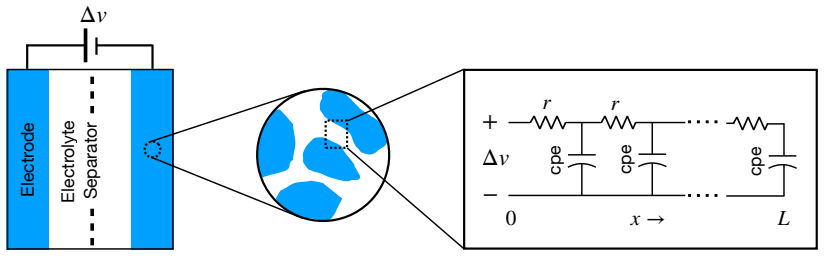
The load-bearing object is the time-fractional diffusion equation for the voltage $v(x,t)$, with the Caputo fractional derivative of order $\alpha$ replacing the ordinary time derivative; the constant-phase element (CPE, impedance $1/(c_\alpha s^\alpha)$) is the energy-storage element per unit length. The equation is solved by applying a finite Fourier cosine transform in space and a Laplace transform in time, which turns the problem into algebraic equations whose inversion uses Mittag-Leffler inverse Laplace formulas. The impedance is then the ratio of the Laplace-transformed surface voltage to the Laplace-transformed input current, and the reflection at the blocked end $x=L$ produces the hyperbolic cotangent, while the fractional CPE law produces the exponent $\alpha/2$.
What would settle it
Take a well-characterized uniform single pore with a blocked far end, measure its impedance over a wide frequency range, and independently fix $\alpha$ from the low-frequency slope; if the full spectrum deviates from $s_n^{-\alpha/2}\coth(s_n^{\alpha/2})$, or if the low-frequency real-axis intercept of the normalized impedance is not $1/3$, the central derivation is falsified. A galvanostatic step measured on the same pore should also match the Mittag-Leffler series solution for the voltage at $x=0$.
Extended reading notes
Core claim
The central claim is that the impedance of a bounded, one-dimensional resistor-CPE transmission line is exactly $$\frac{Z_{\mathrm{TL}}(s_n)}{r_0 L}=$s_n^{{-\alpha/2}}$\coth\!\left($s_n^{{\alpha/2}}$\right),$$ with dimensionless frequency $s_n=s\left(r c_\alpha L^2\right)^{1/\alpha}$, obtained by solving the Caputo time-fractional diffusion equation $${}_0D_t^\$\alpha$ v=\frac{1}{r c_\$\alpha$}\frac{\$partial^{2}$ v}{\partial $x^{2}$},\quad 0<x<L,$$ with the galvanostatic boundary condition $-r_0^{-1}\partial_x v|_{x=0}=i_0$ and the blocking condition $\partial_x v|_{x=L}=0$. The same solution gives the voltage as an infinite Mittag-Leffler series, the step response through one further time derivative, and an RC relaxation-time distribution $g(\tau)$ such that the impedance is the integral of $g(\tau)/(1+s\tau)$. For $\alpha=1$ the formulas reduce to the classical reflective finite-length Warburg impedance of an ideal RC line, and the paper notes that this limit corrects missing terms in earlier galvanostatic solutions.
Load-bearing premise
The derivation assumes the electrode pore is a single uniform tube whose electrical resistance per unit length and whose capacitive response, described by a constant-phase element with a fixed exponent $\alpha$, do not vary along its length, and whose far end blocks all current; if any of these vary with position or state of charge, the exact impedance formula and time-domain solution no longer apply.
Editorial extensions
If this is right
- The empirical fractional finite-length Warburg impedance now follows from a first-principles fractional diffusion equation, so porous-electrode fits using $s_n^{-\alpha/2}\coth(s_n^{\alpha/2})$ have a stated physical model behind them.
- The same dispersion exponent $\alpha$ governs both the high-frequency half-order CPE branch and the low-frequency $s_n^{-\alpha}$ branch, linking the two regions of a Nyquist plot to one parameter.
- The voltage solution gives the full galvanostatic charging curve, so chronopotentiometry and impedance spectroscopy can be analyzed with the same set of parameters $r$, $c_\alpha$, $L$, and $\alpha$.
- The analytical distribution of relaxation times makes it possible to compute the RC time-constant spectrum of a bounded CPE pore directly, without numerical deconvolution schemes.
- For $\alpha=1$, all derived formulas reduce to the classical reflective finite-length Warburg/RC transmission-line results, with the earlier ideal-capacitor galvanostatic solution corrected.
Reading between the lines
- A direct cross-check the paper does not perform: fix $\alpha$ from the low-frequency CPE slope of a uniform pore, then predict the whole impedance and step response with no additional free parameters and compare; agreement would be a strong test of the derivation.
- The same fractional diffusion equation with potentiostatic or permeable-end boundary conditions should produce analogous $\tanh$- or $\sinh$-type impedance forms, so the derivation likely extends beyond the perfectly blocking galvanostatic case.
- The natural time scale $t/(r c_\alpha L^2)^{1/\alpha}$ predicts that galvanostatic voltage curves for pores of different lengths or electrolyte conductivities collapse onto one master curve when rescaled, a testable scaling law.
- The model suggests interpreting $\alpha$ as a property of the distributed electrode/electrolyte interface rather than a pure fit parameter; one could test this by comparing $\alpha$ from impedance fits with $\alpha$ obtained from independent time-domain fractional-capacitance measurements on the same material.
Editorial analysis
A structured set of objections, weighed in public.
Referee Report
Summary. The paper derives the analytical solution of the time-fractional diffusion equation governing a finite-length resistor-CPE transmission line under galvanostatic charging. The main claimed result is the reduced impedance Z_TL(s_n)/(r_0 L)=s_n^{-alpha/2} coth(s_n^{alpha/2}) (Eq. 44), which the authors present as a physical derivation of Cabanel et al.'s empirical fractional finite-length Warburg impedance. The paper also gives an infinite-series expression for the voltage, a step-response formula, and a distribution of relaxation times g(tau) claimed to correspond to this impedance.
Significance. If the central derivation is correct, the paper provides a useful physical justification for a widely used empirical impedance model and supplies explicit closed-form series for the time-domain response of porous electrodes. The impedance part is based on standard Laplace and finite Fourier cosine transform steps and is likely sound once the r0=r issue is resolved. The distribution-of-relaxation-times part, however, contains an algebraic error that invalidates Eq. (53) as written. The paper's contribution is therefore significant but needs a substantive correction before the DRT claims can be accepted.
major comments (2)
- [Section II.C, Eq. (52)] The substitution stated in the text does not produce Eq. (52). Starting from Eq. (51) with x=b s^alpha and u=b^{-1/alpha}v gives b^{1-1/alpha}s^{alpha-1}E_{alpha,alpha}(-b s^alpha) = (sin(alpha pi)/pi) integral_0^infty [b v^alpha e^{-s v}]/[b^2+2b v^alpha cos(alpha pi)+v^{2alpha}] dv, so that s^{alpha-1}E_{alpha,alpha}(-b s^alpha) = (sin(alpha pi)/pi) integral_0^infty [b^{1/alpha} v^alpha e^{-s v}]/[b^2+2b v^alpha cos(alpha pi)+v^{2alpha}] dv. The denominator in Eq. (52) is b^{1/alpha-1} times this correct denominator, and the numerator lacks the b^{1/alpha} factor; the two expressions agree only when b=1. Consequently Eq. (53) is not the distribution of relaxation times corresponding to Eq. (44)/(46), and the agreement with Eq. (57) shown in Fig. 4(c) cannot validate Eq. (53). Please correct the substitution and Eq. (53), or remove the DRT claim.
- [Section II.A, Eqs. (9), (39), (40)] The model introduces r0 in the boundary condition Eq. (9) while the current-voltage relation Eq. (39) uses r, and the two are never related. Combining Eq. (40) at x=0 with Eq. (9) gives i(0,t)=(r0/r)i0, so the physical current at the pore mouth equals the applied current i0 only when r0=r. Since the impedance in Eq. (41) is defined through i0/s, the derivation of Eqs. (43)-(44) implicitly requires this equality. The paper should state r0=r explicitly or use a single resistance-per-unit-length parameter throughout.
minor comments (5)
- [Eq. (26)] For integer k, sin(k pi)=0, so the displayed expression can be simplified to the single term -r0 i0 L^2/(k^2 pi^2); presenting the simplification would make the k=0 case less opaque.
- [Fig. 4 caption and text] The caption groups magnitude and phase in panel (a) and labels the Nyquist plot as (b) and the DRT plot as (c), while the text refers to the phase plot as Fig. 4(b); these panel labels should be aligned.
- [Eq. (57)] The notation H_{p,q}^{m,n} is used without specifying p, q, m, and n; either define these parameters or explicitly state that the notation follows Ref. [39].
- [Reference [38]] Reference [38] is a bare URL without a full bibliographic entry; please supply author, title, and access date.
- [Title] The title as posted contains an OCR artifact ('transm ission') that should be corrected to 'transmission'.
Circularity Check
No significant circularity: the bounded R-CPE impedance is derived from the stated fractional diffusion problem, not assumed or fitted.
full rationale
The claimed derivation is not circular. The load-bearing result, Eq. 44, is obtained by solving the time-fractional diffusion initial-boundary-value problem (Eqs. 8–11) with constant r and c_alpha, taking the Laplace transform of v(0,t), and dividing by i0/s; the CPE parameters (c_alpha, alpha) are inputs of the constitutive model, and the impedance is a function of them rather than a quantity used to define them. The experimental fit in Fig. 1 is motivational, not a fitted parameter relabeled as a prediction. References [15] and [39] are prior work by co-authors, but they are used for context, for a dimensionless rescaling, and for an auxiliary H-function representation of g(tau); the central bounded-domain solution and the impedance expression are derived in this paper from standard transforms and the externally cited Prabhakar formula and Mittag-Leffler integral representation. The skeptic's algebraic objection to Eq. 52 is a correctness concern about an intermediate substitution, not a circularity: an incorrect denominator would make Eq. 53 wrong, but it would not make the result equivalent to its inputs. The uniformity assumption r,c_alpha = const is a modeling limitation, not a circular definition. Therefore, no circular step is present.
Assumptions & free parameters
free parameters (3)
- alpha (dispersion coefficient) =
0.94 (from supercapacitor fit in Fig. 1)
- c_alpha (pseudocapacitance per unit length) =
0.56 F s^{alpha-1} (Rs-CPE fit) or from Eq. 2 fit
- r (electrolyte resistance per unit length) =
Derived as R_d/L in fits, not independently measured
assumptions (5)
- domain assumption The energy storage element is a CPE with impedance z_c(s) = 1/(c_alpha s^alpha) with constant (c_alpha, alpha)
- standard math Caputo fractional derivative and its Laplace transform property L[D^alpha f] = s^alpha F(s) - s^{alpha-1} f(0)
- domain assumption The pore is homogeneous and one-dimensional; no Faradaic processes; zero initial voltage
- domain assumption Zero current at x=L (reflective boundary)
- standard math The series representation of coth(z) and the Prabhakar/Mittag-Leffler Laplace inversion formulas
Cite this review
Pith. "Pith review of On the distributed resistor-constant phase element transmission line in a reflective bounded domain." pith.science (2026). https://pith.science/paper/UP6RQTHO
@misc{pith2026241117368,
  author       = {Pith},
  title        = {Pith review of: On the distributed resistor-constant phase element transmission line in a reflective bounded domain},
  year         = {2026},
  howpublished = {\url{https://pith.science/paper/UP6RQTHO}},
  note         = {Machine review of arXiv:2411.17368}
}
abstract
In this work we derive and study the analytical solution of the voltage and current diffusion equation for the case of a finite-length resistor-constant phase element (CPE) transmission line (TL) network that can represent a model for porous electrodes in the absence of any Faradic processes. The energy storage component is considered to be an elemental CPE per unit length of impedance $z_c(s)={1}/{(c_{\alpha} s^{\alpha})}$ with constant parameters $(c_{\alpha},\alpha)$ instead of the ideal capacitor of impedance $z(s)={1}/{(c\, s)}$ usually assumed in TL modeling. The problem becomes a time-fractional diffusion equation for the voltage that we solve under galvanostatic charging, and derive from it a reduced impedance function of the form $z_{\alpha}(s_n)=s_n^{-\alpha/2}\coth({s_n^{\alpha/2}})$, where $s_n = j\omega_n$ is a normalized frequency. We also derive the system's step response, and the distribution function of relaxation times associated with it. The analysis can be viewed and used as a support for the fractal finite-length Warburg model.
Figures


Figures from the paper (1 more)

Reference graph
Works this paper leans on
-
[1]
J. Bisquert and A. Compte, Theory of the electrochem- ical impedance of anomalous diffusion, . Electroanal. Chem. 499, 112 (2001)
work page 2001
-
[2]
J. Bisquert, G. Garcia-Belmonte, F. Fabregat-Santiago, N. S. Ferriols, P. Bogdanoff, and E. C. Pereira, Doubling exponent models for the analysis of porous film electrodes 9 by impedance. relaxation of tio2 nanoporous in aqueous solution, J. Phys. Chem. B 104, 2287 (2000)
work page 2000
-
[3]
J. Song and M. Z. Bazant, Electrochemical impedance imaging via the distribution of diffusion times, Phys. Rev. Lett. 120, 116001 (2018)
work page 2018
-
[4]
A. A. Moya, Low-frequency approximations to the finite- length warburg diffusion impedance: The reflexive case, J. Energy Storage 97, 112911 (2024)
work page 2024
-
[5]
D. R. Franceschetti and J. R. Macdonald, Diffusion of neutral and charged species under small-signal ac con- ditions, J. Electroanal. Chem. Interfacial Electrochem. 101, 307 (1979)
work page 1979
-
[6]
C. Gabrielli, O. Haas, and H. Takenouti, Impedance anal- ysis of electrodes modified with a reversible redox poly- mer film, J. Appl. Electrochem. 17, 82 (1987)
work page 1987
- [7]
-
[8]
C. Ho, I. Raistrick, and R. Huggins, Application of a-c techniques to the study of lithium diffusion in tungsten trioxide thin films, J. Electrochem. Soc. 127, 343 (1980)
work page 1980
Show all 40 references
-
[9]
J. H. Xu, T. Schoetz, J. R. McManus, V. R. Subrama- nian, P. W. Fields, and R. J. Messinger, Tunable pseu- docapacitive intercalation of chloroaluminate anions int o graphite electrodes for rechargeable aluminum batteries, J. Electrochem. Soc. 168, 060514 (2021)
2021
-
[10]
Ohayon, G
D. Ohayon, G. Quek, B. R. P. Yip, F. Lopez-Garcia, P. R. Ng, R. J. V´ azquez, D. V. Andreeva, X. Wang, and G. C. Bazan, High-performance aqueous supercapacitors based on a self-doped n-type conducting polymer, Adv. Mater. , 2410512 (2024)
2024
-
[11]
Cabanel, G
R. Cabanel, G. Barral, J. P. Diard, B. Le Gorrec, and C. Montella, Determination of the diffusion coefficient of an inserted species by impedance spectroscopy: applica- tion to the h/h xnb2o5 system, J. Appl. Electrochem. 23, 93 (1993)
1993
-
[12]
Profatilova, E
I. Profatilova, E. De Vito, S. Genies, C. Vincens, E. Gutel, O. Fanget, A. Martin, M. Chandesris, M. Tu- lodziecki, and W. Porcher, Impact of silicon/graphite composite electrode porosity on the cycle life of 18650 lithium-ion cell, ACS Appl. Energy Mater. 3, 11873 (2020)
2020
-
[13]
De Levie, On porous electrodes in electrolyte solu- tions: I
R. De Levie, On porous electrodes in electrolyte solu- tions: I. capacitance effects, Electrochim. Acta 8, 751 (1963)
1963
-
[14]
Pedersen, T
C. Pedersen, T. Aslyamov, and M. Janssen, Equivalent circuit and continuum modeling of the impedance of electrolyte-filled pores, PRX Energy 2, 043006 (2023)
2023
-
[15]
Allagui and E
A. Allagui and E. H. Balaguera, On the semi-infinite distributed resistor-constant phase element transmissio n line, Electrochim. Acta 510, 145344 (2024)
2024
-
[16]
A. C. Lazanas and M. I. Prodromidis, Electrochemical impedance spectroscopy–a tutorial, ACS Meas. Sci. Au 3, 162 (2023)
2023
-
[17]
Allagui and A
A. Allagui and A. S. Elwakil, Tikhonov regularization for the deconvolution of capacitance from voltage-charge response of electrochemical capacitors, Electrochim. Act a , 142527 (2023)
2023
-
[18]
Allagui and H
A. Allagui and H. Benaoum, Power-law charge relaxation of inhomogeneous porous capacitive electrodes, J. Elec- trochem. Soc. 169, 040509 (2022)
2022
-
[19]
Allagui and A
A. Allagui and A. S. Elwakil, Possibility of information encoding/decoding using the memory effect in fractional- order capacitive devices, Sci. Rep. 11, 1 (2021)
2021
-
[20]
Allagui and M
A. Allagui and M. E. Fouda, Inverse problem of recon- structing the capacitance of electric double-layer capaci - tors, Electrochim. Acta , 138848 (2021)
2021
-
[21]
Allagui, A
A. Allagui, A. S. Elwakil, and C. Psychalinos, Decoupling the magnitude and phase in a constant phase element, J. Electroanal. Chem. 888, 115153 (2021)
2021
-
[22]
Huang, Diffusion impedance of electroactive materi- als, electrolytic solutions and porous electrodes: War- burg impedance and beyond, Electrochim
J. Huang, Diffusion impedance of electroactive materi- als, electrolytic solutions and porous electrodes: War- burg impedance and beyond, Electrochim. Acta 281, 170 (2018)
2018
-
[23]
Janssen, Transmission line circuit and equation for an electrolyte-filled pore of finite length, Phys
M. Janssen, Transmission line circuit and equation for an electrolyte-filled pore of finite length, Phys. Rev. Lett. 126, 136002 (2021)
2021
-
[24]
Gupta, P
A. Gupta, P. J. Zuk, and H. A. Stone, Charging dynamics of overlapping double layers in a cylindrical nanopore, Phys. Rev. Lett. 125, 076001 (2020)
2020
-
[25]
Janssen and J
M. Janssen and J. Bisquert, Locating the frequency of turnover in thin-film diffusion impedance, J. Phys. Chem. B 125, 15737 (2021)
2021
-
[26]
O. P. Agrawal, Solution for a fractional diffusion-wave equation defined in a bounded domain, Nonlinear Dy- namics 29, 145 (2002)
2002
-
[27]
Posey and T
F. Posey and T. Morozumi, Theory of potentiostatic and galvanostatic charging of the double layer in porous elec- trodes, J. Electrochem. Soc. 113, 176 (1966)
1966
-
[28]
Tomovski and T
ˇZ. Tomovski and T. Sandev, Exact solutions for frac- tional diffusion equation in a bounded domain with dif- ferent boundary conditions, Nonlinear Dynamics 71, 671 (2013)
2013
-
[29]
A. G. Strandhagen, Use of sine transform for non-simply supported beams, Q. Appl. Math. 1, 346 (1944)
1944
-
[30]
Roettinger, A generalization of the finite fourier trans- formation and applications, Q
I. Roettinger, A generalization of the finite fourier trans- formation and applications, Q. Appl. Math. 5, 298 (1947)
1947
-
[31]
Al-Khaled, Finite fourier transform for solving poten- tial and steady-state temperature problems, Adv
K. Al-Khaled, Finite fourier transform for solving poten- tial and steady-state temperature problems, Adv. Differ. Equations 2018, 1 (2018)
2018
-
[32]
T. R. Prabhakar, A singular integral equation with a gen- eralized mittag leffler function in the kernel, Yokohama Math. J. 19, 7 (1971)
1971
-
[33]
A. M. Mathai, R. K. Saxena, and H. J. Haubold, The H-function: theory and applications (Springer Science & Business Media, 2009)
2009
-
[34]
Luchko, Initial-boundary-value problems for the one- dimensional time-fractional diffusion equation, Fract
Y. Luchko, Initial-boundary-value problems for the one- dimensional time-fractional diffusion equation, Fract. Calc. Appl. Anal. 15, 141 (2012)
2012
-
[35]
Luchko, Some uniqueness and existence results for the initial-boundary-value problems for the generalized time - fractional diffusion equation, Comput
Y. Luchko, Some uniqueness and existence results for the initial-boundary-value problems for the generalized time - fractional diffusion equation, Comput. Math. Appl. 59, 1766 (2010)
2010
-
[36]
I. S. Gradshtein and D. Zwillinger, Table of integrals, se- ries, and products, eighth edition ed. (Elsevier, Academic Press, Amsterdam ; Boston, 2015)
2015
-
[37]
Giusti, I
A. Giusti, I. Colombaro, R. Garra, R. Garrappa, F. Polito, M. Popolizio, and F. Mainardi, A practical guide to prabhakar fractional calculus, Fract. Calc. Appl. Anal. 23, 9 (2020)
2020
-
[38]
Mathematica, https://functions.wolfram.com/introductions/pdf/elliptictheta3
-
[39]
Allagui and A
A. Allagui and A. S. Elwakil, Procedure for obtaining the analytical distribution function of relaxation times for t he analysis of impedance spectra using the fox h-function, J. Phys. Chem. C 128, 2788 (2024)
2024
-
[40]
Van Mieghem, The mittag-leffler function, arXiv preprint arXiv:2005.13330 (2020)
P. Van Mieghem, The mittag-leffler function, arXiv preprint arXiv:2005.13330 (2020)
2020 arXiv
Reviewed August 12, 2026 · model on record in the stance chip above.
Discussion (0). Continue with ORCID to comment.