Lie symmetries of a generalized Fisher equation in cylindrical coordinates
Pith reviewed 2026-05-22 03:28 UTC · model grok-4.3
The pith
The generalized Fisher equation in cylindrical coordinates admits additional Lie symmetries for specific source functions when the diffusion coefficient is exponential.
A machine-rendered reading of the paper's core claim, the machinery that carries it, and where it could break.
Core claim
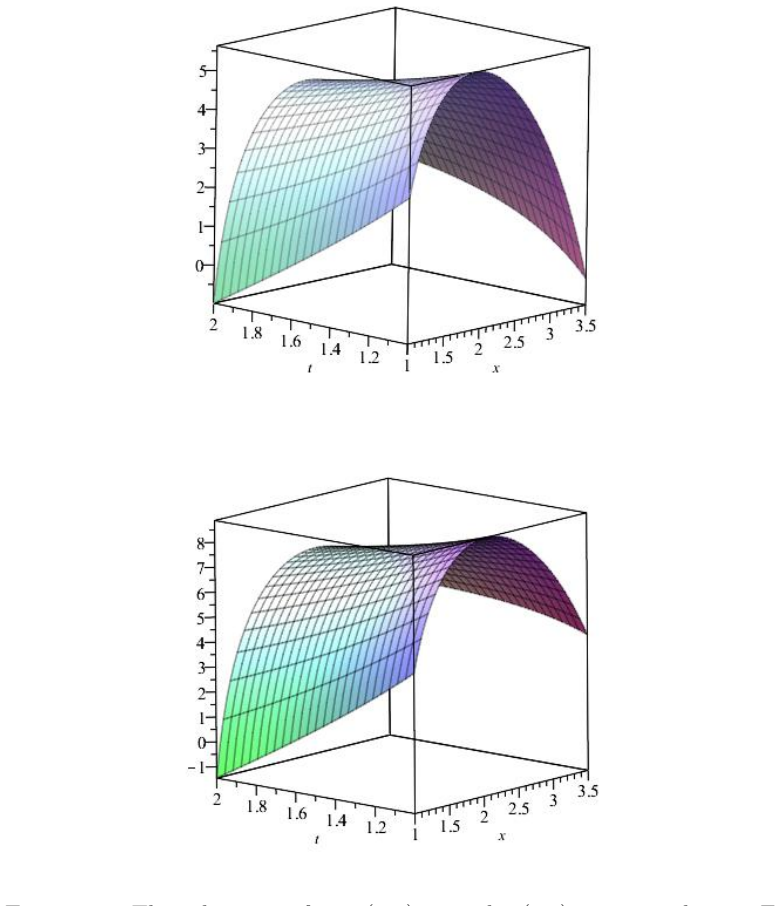
The authors determine for what type of source function the generalized Fisher equation has Lie symmetries other than time translation symmetry when the diffusion function is given by an exponential function. They also obtain the reduced ordinary differential equations corresponding to the Lie symmetries of the generalized Fisher equation.
What carries the argument
Lie symmetry classification of source functions for the PDE with exponential diffusion in cylindrical coordinates, which identifies the infinitesimal generators that leave the equation invariant and enables reduction to ordinary differential equations.
If this is right
- The original partial differential equation reduces to ordinary differential equations for each identified source function.
- Invariant solutions can be constructed explicitly by solving the reduced ordinary differential equations.
- The admitted symmetry group generates families of solutions from any particular solution.
Where Pith is reading between the lines
- The same classification technique could be applied to the equation in spherical coordinates to compare the admitted symmetries across geometries.
- The reduced ordinary differential equations may admit further exact solutions or phase-plane analysis that reveals long-term behavior of the diffusion process.
Load-bearing premise
The diffusion coefficient must be an exponential function of the dependent variable and the source term must depend only on that variable.
What would settle it
A direct computation of the Lie symmetry determining equations for a source function outside the classified family should produce only the time-translation generator, while a source inside the family should produce at least one additional generator.
Figures
read the original abstract
In this work we studied a generalized Fisher equation in cylindrical coordinate using Lie symmetry method. We have determined for what type of source function the generalized Fisher equation has Lie Symmetries other than time translation symmetry when the diffusion function is given by an exponential function. Also the reduced ordinary differential equations are obtained corresponding to Lie symmetries of the generalized Fisher equation.
Editorial analysis
A structured set of objections, weighed in public.
Referee Report
Summary. The manuscript applies Lie symmetry analysis to a generalized Fisher equation in cylindrical coordinates with an exponential diffusion coefficient. It classifies the source functions that admit Lie point symmetries beyond time translation and derives the corresponding reduced ordinary differential equations for each case.
Significance. If the classification is complete and the invariance conditions are verified, the work supplies explicit symmetry reductions for a nonlinear reaction-diffusion model in non-Cartesian geometry. This is useful for constructing exact solutions in applications such as population dynamics or combustion in cylindrical domains. The inclusion of the determining equations, their solution under the stated ansatz, and the list of admissible source functions together with the reduced ODEs constitutes a concrete, reproducible contribution.
minor comments (3)
- [Abstract] The abstract states that the diffusion function is exponential but does not write the precise form of the PDE (including the cylindrical Laplacian term) that is actually analyzed; adding this would improve readability.
- [Symmetry analysis] In the section presenting the determining equations, the notation for the infinitesimal generators and the independent variables (r, θ, t) should be introduced once and used consistently to avoid ambiguity when the symmetry vector fields are listed.
- [Reduced equations] The reduced ODEs are obtained but their explicit integration or first integrals are not discussed; a brief remark on whether any of them admit further quadrature would strengthen the utility of the reductions.
Simulated Author's Rebuttal
We thank the referee for the careful summary of our manuscript and for the positive assessment of its significance for applications in population dynamics and combustion. The recommendation of minor revision is noted. No specific major comments were provided in the report.
Circularity Check
No circularity: direct Lie invariance classification on stated PDE ansatz
full rationale
The paper starts from the generalized Fisher equation in cylindrical coordinates with diffusion fixed to an exponential form and source term an arbitrary function of the dependent variable. It applies the standard Lie symmetry invariance condition to obtain the determining equations, then solves that overdetermined PDE system for the infinitesimal generators and for the admissible source functions. No step reduces the output to a fitted input, self-citation, or definitional tautology; the admitted source forms and reduced ODEs are genuine solutions of the invariance equations under the given assumptions. The derivation is therefore self-contained and externally verifiable by repeating the symmetry calculation.
Axiom & Free-Parameter Ledger
axioms (2)
- domain assumption The generalized Fisher equation is posed with exponential diffusion and a source term f(u) in cylindrical coordinates.
- standard math Lie point symmetries exist and can be found by solving the invariance condition on the PDE.
Reference graph
Works this paper leans on
-
[1]
Oliver, Applications of Lie Group to Differential Equations, Graduate texts in Mathematics, vol
P.J. Oliver, Applications of Lie Group to Differential Equations, Graduate texts in Mathematics, vol. 107, Springer-Verlag, 1993
work page 1993
- [2]
-
[3]
N.H. Ibragimov, A Practical Course in Differential Equations and Mathematical Modelling, Higher Education Press, Beijing, World Scientific Publishing Co. Ptl. Ltd., 2010
work page 2010
-
[4]
M.J. Ablowitz, A. Zeppetella, Explicit solutions of Fisher’s equation for a special wave speed Bull Math Biol, 41 (1979), pp. 835–840
work page 1979
-
[5]
Britton, Aggregation and the competitive exclusion principle, J Theor Biol, 136 (1989), pp
N.F. Britton, Aggregation and the competitive exclusion principle, J Theor Biol, 136 (1989), pp. 57–66
work page 1989
-
[6]
Fitzhugh, Impulses and physiological states in theoretical models of nerve membrane, Biophys
R. Fitzhugh, Impulses and physiological states in theoretical models of nerve membrane, Biophys. J. (1961) p445-466
work page 1961
-
[7]
A.H. Bokhari, R.A.A. Al-Rubaee, F.D. Zaman, On a generalized Fisher equation, Commun. Nonlinear Sci. Numer. Simulat. 16 (2011) p2689-2695
work page 2011
-
[8]
A.L. Hodgkin, A.F. Huxley, A quantitative description of membranes current and applications to con- duction and excitation in nerve, J. Physiol. 117 (1952) p500-544
work page 1952
- [9]
-
[10]
J. D. Murray,Mathematical biology, Springer Verlag, 1991
work page 1991
-
[11]
L.V. Ovsiannikov, Group relations of the equation of nonlinear heat conductivity, Dokl Akad Nauk SSSR, 125 (1959), pp. 492–495
work page 1959
-
[12]
R. Cherniha, M. Serov, Symmetries, Anstzae and exact solutions of nonlinear second-order evolution equations with convection term, Eur J Appl Math, 9 (1998), pp. 527–542
work page 1998
-
[13]
R. Cherniha, M. Serov, Symmetries, Anstzae and exact solutions of nonlinear second-order evolution equations with convection term II, Eur J Appl Math, 17 (2006), pp. 597–605
work page 2006
-
[14]
R. Cherniha, M. Serov, I. Rassokha, Lie symmetries and form-preserving transformations of reac- tion–diffusion–convection equations, J Math Anal Appl, 342 (2008), pp. 136–1379
work page 2008
-
[15]
R.J. Moitsheki, O.D. Makinde, Classical Lie point symmetry analysis of nonlinear diffusion equations describing thermal energy storage, Appl Math Comput, 216 (2010), pp. 251–260
work page 2010
-
[16]
A.H. Bokhari, R.A.A. Al-Rubaee, F.D. Zaman, An exact solution of a quasilinear Fisher equation in cylindrical coordinates, Nonlinear analysis 69 (2008) p4803-4805
work page 2008
-
[17]
M. Rosa, M.S. Bruzon, M.L. Gandarias, Symmetry analysis and exact solutions for a generalized Fisher equation in cylindrical coordinates, Commun. Nonlinear Sci. Numer. Simulat. 25 (2015) p74-83. Department of Mathematics, National University of Mongolia, Ulaanbaatar, Mongolia Email address:bayarjargalb@num.edu.mn Department of Mathematics, National Univer...
work page 2015
discussion (0)
Sign in with ORCID, Apple, or X to comment. Anyone can read and Pith papers without signing in.