Post-Selection Probability and Fidelity of Bidirectional Teleportation
Pith reviewed 2026-06-27 03:17 UTC · model grok-4.3
The pith
The post-selection probability and fidelity of bidirectional teleportation are expressed using Loschmidt echoes, revealing initial-state dependence and stability in integrable models.
A machine-rendered reading of the paper's core claim, the machinery that carries it, and where it could break.
Core claim
The central claim is that the post-selection probability and fidelity of the bidirectional teleportation protocol can be expressed in terms of the Loschmidt echo and its subsystem variant. This expression unveils the initial-state dependence of the fidelity and the stability of the post-selection probability in integrable models, remaining valid with errors in time-reversed dynamics.
What carries the argument
The Loschmidt echo and its subsystem variant, which serve as the bridge connecting the teleportation protocol quantities to standard quantum dynamics diagnostics.
If this is right
- The fidelity of the teleportation depends on the choice of initial state.
- The post-selection probability remains stable when the underlying model is integrable.
- These quantities can be computed from Loschmidt echoes even in the presence of errors.
- Practical guidance emerges for implementing the protocol on quantum hardware.
Where Pith is reading between the lines
- Measuring Loschmidt echoes could provide a way to estimate teleportation performance without running the full protocol.
- The stability in integrable models might extend to other post-selection based protocols in quantum information.
- Testing in chaotic versus integrable regimes could distinguish the behaviors predicted here.
Load-bearing premise
The bidirectional teleportation protocol is implemented via chaotic Hamiltonian evolution combined with measurement and post-selection, and the claimed expressions remain valid when errors are present in the time-reversed dynamics.
What would settle it
Compute or measure the post-selection probability in both an integrable and a chaotic model under the protocol; if the probability changes substantially between them, the stability claim is false.
Figures
read the original abstract
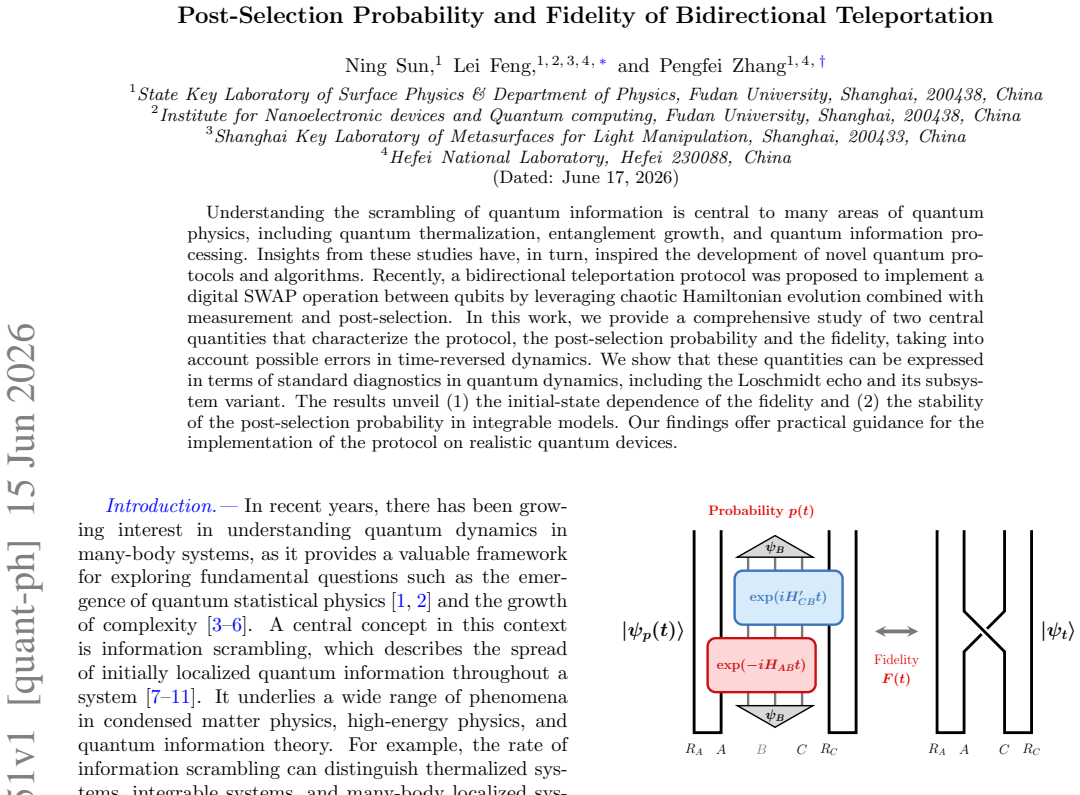
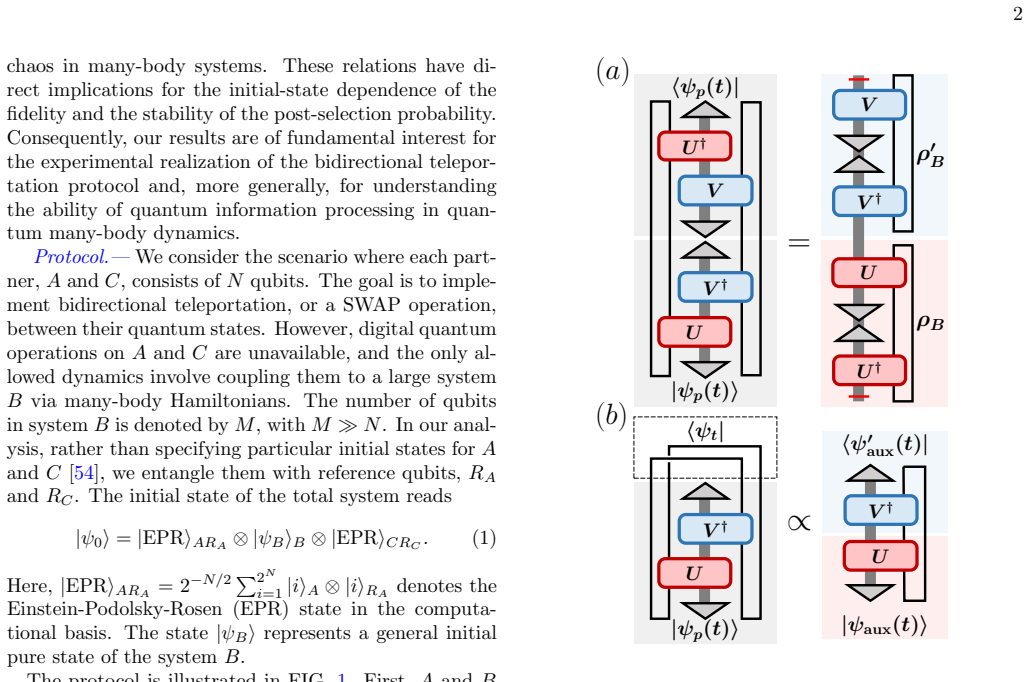
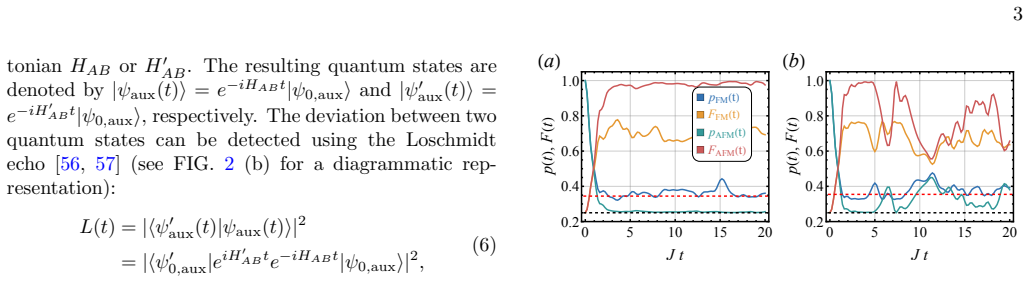
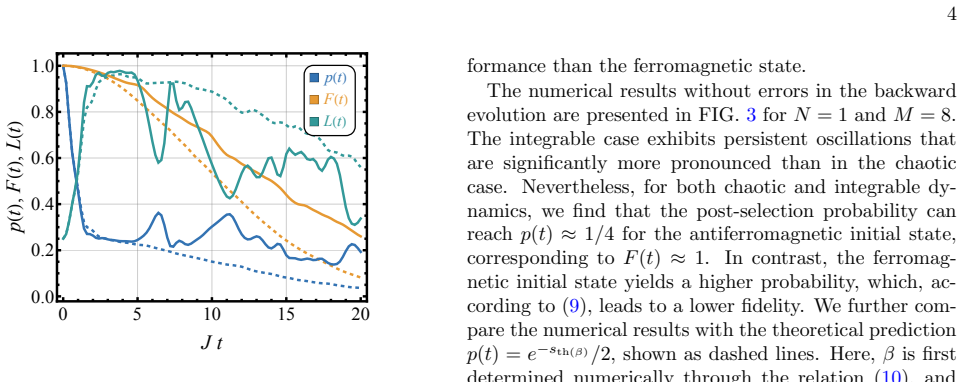
Understanding the scrambling of quantum information is central to many areas of quantum physics, including quantum thermalization, entanglement growth, and quantum information processing. Insights from these studies have, in turn, inspired the development of novel quantum protocols and algorithms. Recently, a bidirectional teleportation protocol was proposed to implement a digital SWAP operation between qubits by leveraging chaotic Hamiltonian evolution combined with measurement and post-selection. In this work, we provide a comprehensive study of two central quantities that characterize the protocol, the post-selection probability and the fidelity, taking into account possible errors in time-reversed dynamics. We show that these quantities can be expressed in terms of standard diagnostics in quantum dynamics, including the Loschmidt echo and its subsystem variant. The results unveil (1) the initial-state dependence of the fidelity and (2) the stability of the post-selection probability in integrable models. Our findings offer practical guidance for the implementation of the protocol on realistic quantum devices.
Editorial analysis
A structured set of objections, weighed in public.
Referee Report
Summary. The manuscript analyzes the post-selection probability and fidelity of a bidirectional teleportation protocol that employs chaotic Hamiltonian evolution together with measurement and post-selection. It derives exact expressions for these quantities in terms of the Loschmidt echo and its subsystem variant, including the case of errors in the time-reversed dynamics, and uses the expressions to identify the initial-state dependence of the fidelity and the stability of the post-selection probability in integrable models.
Significance. If the claimed mappings hold, the work supplies a direct link between a quantum-information protocol and standard diagnostics of quantum dynamics, thereby offering concrete guidance for experimental realization on noisy devices and clarifying state dependence and integrability effects.
minor comments (2)
- [§3] §3 (or wherever the error model is introduced): the precise form of the error operators in the time-reversed dynamics should be stated explicitly so that the reader can verify that the Loschmidt-echo mapping remains exact rather than approximate.
- The discussion of integrable models would benefit from a short statement of the specific Hamiltonians or conserved quantities used to demonstrate stability of the post-selection probability.
Simulated Author's Rebuttal
We thank the referee for their positive assessment of the manuscript, accurate summary of its contributions, and recommendation of minor revision. No specific major comments or points requiring clarification were provided in the report.
Circularity Check
No significant circularity
full rationale
The paper maps the post-selection probability and fidelity of the bidirectional teleportation protocol to the Loschmidt echo and its subsystem variant via explicit derivations from the protocol definition (chaotic Hamiltonian evolution plus measurement/post-selection). These are standard, independently defined diagnostics in quantum dynamics, not constructed from the protocol outputs. The initial-state dependence and stability results follow directly from applying the mappings to different Hamiltonians, without any reduction to fitted parameters, self-definitions, or load-bearing self-citations. The full derivations are self-contained against external benchmarks.
Axiom & Free-Parameter Ledger
Reference graph
Works this paper leans on
-
[1]
Srednicki, Chaos and quantum thermalization, Phys
M. Srednicki, Chaos and quantum thermalization, Phys. Rev. E50, 888 (1994)
1994
-
[2]
J. M. Deutsch, Quantum statistical mechanics in a closed system, Phys. Rev. A43, 2046 (1991)
2046
-
[3]
M. A. Nielsen, M. R. Dowling, M. Gu, and A. C. Doherty, Quantum Computation as Geometry, Science311, 1133 (2006), arXiv:quant-ph/0603161
Pith/arXiv arXiv 2006
-
[4]
Susskind, Computational Complexity and Black Hole Horizons, Fortsch
L. Susskind, Computational Complexity and Black Hole Horizons, Fortsch. Phys.64, 24 (2016), [Addendum: Fortsch.Phys. 64, 44–48 (2016)], arXiv:1403.5695 [hep- th]
Pith/arXiv arXiv 2016
-
[5]
A. R. Brown and L. Susskind, Second law of quan- tum complexity, Phys. Rev. D97, 086015 (2018), arXiv:1701.01107 [hep-th]
Pith/arXiv arXiv 2018
-
[6]
D. E. Parker, X. Cao, A. Avdoshkin, T. Scaffidi, and E. Altman, A universal operator growth hypothesis, Phys. Rev. X9, 041017 (2019)
2019
-
[7]
P. Hayden and J. Preskill, Black holes as mirrors: Quan- tum information in random subsystems, JHEP09, 120, arXiv:0708.4025 [hep-th]
-
[8]
Y. Sekino and L. Susskind, Fast Scramblers, JHEP10, 065, arXiv:0808.2096 [hep-th]
Pith/arXiv arXiv 2096
-
[9]
S. H. Shenker and D. Stanford, Stringy effects in scram- bling, JHEP05, 132, arXiv:1412.6087 [hep-th]
-
[10]
D. A. Roberts, D. Stanford, and L. Susskind, Localized shocks, JHEP03, 051, arXiv:1409.8180 [hep-th]
-
[11]
P. Hosur, X.-L. Qi, D. A. Roberts, and B. Yoshida, Chaos in quantum channels, JHEP02, 004, arXiv:1511.04021 [hep-th]
-
[12]
R. Fan, P. Zhang, H. Shen, and H. Zhai, Out-of- time-order correlation for many-body localization, Sci- ence Bulletin62, 707 (2017), arXiv:1608.01914 [cond- mat.quant-gas]
Pith/arXiv arXiv 2017
-
[13]
Y. Huang, Y.-L. Zhang, and X. Chen, Out-of-time- ordered correlators in many-body localized systems, An- nalen der Physik529, 1600318 (2017), arXiv:1608.01091 [cond-mat.dis-nn]
arXiv 2017
-
[14]
B. Swingle and D. Chowdhury, Slow scrambling in disor- dered quantum systems, Phys. Rev. B95, 060201 (2017), arXiv:1608.03280 [cond-mat.str-el]
Pith/arXiv arXiv 2017
-
[15]
He and Z.-Y
R.-Q. He and Z.-Y. Lu, Characterizing many-body local- ization by out-of-time-ordered correlation, Phys. Rev. B 95, 054201 (2017)
2017
-
[16]
Y. Chen, Universal Logarithmic Scrambling in Many Body Localization, arXiv e-prints , arXiv:1608.02765 (2016), arXiv:1608.02765 [cond-mat.dis-nn]
Pith/arXiv arXiv 2016
-
[17]
Slagle, Z
K. Slagle, Z. Bi, Y.-Z. You, and C. Xu, Out-of-time- order correlation in marginal many-body localized sys- tems, Phys. Rev. B95, 165136 (2017)
2017
-
[18]
J. Li, R. Fan, H. Wang, B. Ye, B. Zeng, H. Zhai, X. Peng, and J. Du, Measuring Out-of-Time-Order Correlators on a Nuclear Magnetic Resonance Quantum Simulator, Phys. Rev. X7, 031011 (2017), arXiv:1609.01246 [cond- mat.str-el]
Pith/arXiv arXiv 2017
-
[19]
K. X. Wei, P. Peng, O. Shtanko, I. Marvian, S. Lloyd, C. Ramanathan, and P. Cappellaro, Emergent prether- malization signatures in out-of-time ordered correlations, Phys. Rev. Lett.123, 090605 (2019)
2019
-
[20]
Nie, B.-B
X. Nie, B.-B. Wei, X. Chen, Z. Zhang, X. Zhao, C. Qiu, Y. Tian, Y. Ji, T. Xin, D. Lu, and J. Li, Experimen- tal Observation of Equilibrium and Dynamical Quantum Phase Transitions via Out-of-Time-Ordered Correlators, Phys. Rev. Lett.124, 250601 (2020)
2020
-
[21]
C. M. S´ anchez, A. K. Chattah, K. X. Wei, L. Buljuba- sich, P. Cappellaro, and H. M. Pastawski, Perturbation Independent Decay of the Loschmidt Echo in a Many- Body System, Phys. Rev. Lett.124, 030601 (2020), arXiv:1902.06628 [quant-ph]
arXiv 2020
-
[22]
F. D. Dom´ ınguez, M. C. Rodr´ ıguez, R. Kaiser, D. Suter, and G. A. ´Alvarez, Decoherence scaling transition in the dynamics of quantum information scrambling, Phys. Rev. A104, 012402 (2021), arXiv:2005.12361 [quant-ph]
arXiv 2021
-
[23]
C. M. S´ anchez, A. K. Chattah, and H. M. Pastawski, Emergent decoherence induced by quantum chaos in a many-body system: A Loschmidt echo observation through NMR, Phys. Rev. A105, 052232 (2022), arXiv:2112.00607 [quant-ph]
arXiv 2022
-
[24]
Li, T.-G
Y. Li, T.-G. Zhou, Z. Wu, P. Peng, S. Zhang, R. Fu, R. Zhang, W. Zheng, P. Zhang, H. Zhai, X. Peng, and J. Du, Emergent universal quench dynamics in randomly interacting spin models, Nat. Phys.20, 1966 (2024)
1966
-
[25]
M. G¨ arttner, J. G. Bohnet, A. Safavi-Naini, M. L. Wall, J. J. Bollinger, and A. M. Rey, Measuring out-of-time- order correlations and multiple quantum spectra in a trapped ion quantum magnet, Nature Phys.13, 781 (2017), arXiv:1608.08938 [quant-ph]
Pith/arXiv arXiv 2017
-
[27]
R. J. Lewis-Swan, A. Safavi-Naini, J. J. Bollinger, and A. M. Rey, Unifying scrambling, thermalization and en- tanglement through measurement of fidelity out-of-time- order correlators in the Dicke model, Nat. Commun.10, 1581 (2019)
2019
-
[28]
A. M. Green, A. Elben, C. H. Alderete, L. K. Joshi, N. H. Nguyen, T. V. Zache, Y. Zhu, B. Sundar, and N. M. Linke, Experimental Measurement of Out-of-Time- Ordered Correlators at Finite Temperature, Phys. Rev. Lett.128, 140601 (2022)
2022
-
[29]
X. Mi, P. Roushan, C. Quintana,et al., Informa- tion scrambling in quantum circuits, Science374, 1479 (2021)
2021
-
[30]
Wang, T.-Q
J.-H. Wang, T.-Q. Cai, X.-Y. Han, Y.-W. Ma, Z.-L. Wang, Z.-H. Bao, Y. Li, H.-Y. Wang, H.-Y. Zhang, L.-Y. Sun, Y.-K. Wu, Y.-P. Song, and L.-M. Duan, Informa- tion scrambling dynamics in a fully controllable quantum simulator, Phys. Rev. Research4, 043141 (2022)
2022
-
[31]
Braum¨ uller, A
J. Braum¨ uller, A. H. Karamlou, Y. Yanay, B. Kannan, D. Kim, M. Kjaergaard, A. Melville, B. M. Niedzielski, Y. Sung, A. Veps¨ al¨ ainen, R. Winik, J. L. Yoder, T. P. Orlando, S. Gustavsson, C. Tahan, and W. D. Oliver, Probing quantum information propagation with out-of- time-ordered correlators, Nat. Phys.18, 172 (2022)
2022
-
[32]
S. K. Zhao, Z.-Y. Ge, Z. Xiang, G. M. Xue, H. S. Yan, Z. T. Wang, Z. Wang, H. K. Xu, F. F. Su, Z. H. Yang, H. Zhang, Y.-R. Zhang, X.-Y. Guo, K. Xu, Y. Tian, H. F. Yu, D. N. Zheng, H. Fan, and S. P. Zhao, Probing Op- erator Spreading via Floquet Engineering in a Supercon- ducting Circuit, Phys. Rev. Lett.129, 160602 (2022)
2022
-
[33]
Google Quantum AI, Constructive interference at the edge of quantum ergodic dynamics (2025), arXiv:2506.10191
arXiv 2025
-
[34]
Colombo, E
S. Colombo, E. Pedrozo-Pe˜ nafiel, A. F. Adiyatullin, Z. Li, E. Mendez, C. Shu, and V. Vuleti´ c, Time-reversal-based quantum metrology with many-body entangled states, Nat. Phys.18, 925 (2022)
2022
-
[35]
Z. Li, S. Colombo, C. Shu, G. Velez, S. Pilatowsky- Cameo, R. Schmied, S. Choi, M. Lukin, E. Pedrozo- Pe˜ nafiel, and V. Vuleti´ c, Improving metrology with quan- tum scrambling, Science380, 1381 (2023)
2023
-
[36]
Pegahan, I
S. Pegahan, I. Arakelyan, and J. E. Thomas, Energy- Resolved Information Scrambling in Energy-Space Lat- tices, Phys. Rev. Lett.126, 070601 (2021)
2021
-
[37]
D.-S. Xiang, Y.-W. Zhang, H.-X. Liu, P. Zhou, D. Yuan, K. Zhang, S.-Y. Zhang, B. Xu, L. Liu, Y. Li, and L. Li, Observation of quantum information collapse-and-revival in a strongly-interacting Rydberg atom array (2024), arXiv:2410.15455
arXiv 2024
- [38]
-
[39]
Y.-C. Liet al., Error-resilient Reversal of Quan- tum Chaotic Dynamics Enabled by Scramblons (2025), arXiv:2506.19915 [cond-mat.str-el]
arXiv 2025
-
[40]
B. Yoshida and A. Kitaev, Efficient decoding for the Hayden-Preskill protocol (2017), arXiv:1710.03363 [hep- th]
Pith/arXiv arXiv 2017
-
[41]
Yoshida and N
B. Yoshida and N. Y. Yao, Disentangling scrambling and decoherence via quantum teleportation, Phys. Rev. X9, 011006 (2019)
2019
-
[42]
K. A. Landsman, C. Figgatt, T. Schuster, N. M. Linke, B. Yoshida, N. Y. Yao, and C. Monroe, Verified Quan- tum Information Scrambling, Nature567, 61 (2019), arXiv:1806.02807 [quant-ph]
Pith/arXiv arXiv 2019
-
[43]
Cheng, C
Y. Cheng, C. Liu, J. Guo, Y. Chen, P. Zhang, and H. Zhai, Realizing the hayden-preskill protocol with cou- pled dicke models, Phys. Rev. Res.2, 043024 (2020)
2020
- [44]
-
[45]
A. R. Brown, H. Gharibyan, S. Leichenauer, H. W. Lin, S. Nezami, G. Salton, L. Susskind, B. Swingle, and M. Walter, Quantum Gravity in the Lab. I. Teleporta- tion by Size and Traversable Wormholes, PRX Quantum 4, 010320 (2023), arXiv:1911.06314 [quant-ph]
arXiv 2023
- [46]
-
[47]
Schuster, B
T. Schuster, B. Kobrin, P. Gao, I. Cong, E. T. Khabi- boulline, N. M. Linke, M. D. Lukin, C. Monroe, B. Yoshida, and N. Y. Yao, Many-body quantum telepor- tation via operator spreading in the traversable wormhole protocol, Phys. Rev. X12, 031013 (2022)
2022
-
[48]
Jafferis, A
D. Jafferis, A. Zlokapa, J. D. Lykken, D. K. Kolch- meyer, S. I. Davis, N. Lauk, H. Neven, and M. Spiropulu, Traversable wormhole dynamics on a quantum processor, Nature612, 51 (2022)
2022
-
[49]
S. Zhou, P. Zhang, and Z. Yu, Environment-induced tran- sitions in many-body quantum teleportation, Phys. Rev. Res.8, L012007 (2026), arXiv:2406.02277 [quant-ph]
arXiv 2026
- [50]
-
[51]
P. Gao, D. L. Jafferis, and A. C. Wall, Traversable Worm- holes via a Double Trace Deformation, JHEP12, 151, arXiv:1608.05687 [hep-th]
-
[52]
J. Maldacena, D. Stanford, and Z. Yang, Diving into traversable wormholes, Fortsch. Phys.65, 1700034 (2017), arXiv:1704.05333 [hep-th]
Pith/arXiv arXiv 2017
-
[53]
J. Maldacena and X.-L. Qi, Eternal traversable wormhole (2018), arXiv:1804.00491 [hep-th]
Pith/arXiv arXiv 2018
- [54]
- [55]
-
[56]
Peres, Stability of quantum motion in chaotic and regular systems, Phys
A. Peres, Stability of quantum motion in chaotic and regular systems, Phys. Rev. A30, 1610 (1984)
1984
-
[57]
A. Goussev, R. A. Jalabert, H. M. Pastawski, and D. Wisniacki, Loschmidt echo, Scholarpedia7, 11687 (2012), arXiv:1206.6348 [nlin.CD]
Pith/arXiv arXiv 2012
-
[58]
Y. Chen, X.-L. Qi, and P. Zhang, Replica wormhole and information retrieval in the SYK model coupled to Ma- jorana chains, JHEP06, 121, arXiv:2003.13147 [hep-th]
arXiv 2003
-
[59]
S. Karchet al., Probing quantum many-body dy- namics using subsystem Loschmidt echos (2025), arXiv:2501.16995 [cond-mat.quant-gas]
arXiv 2025
-
[60]
D. A. Roberts and B. Yoshida, Chaos and complexity by design, JHEP04, 121, arXiv:1610.04903 [quant-ph]
-
[61]
M. A. Nielsen and I. L. Chuang, Quantum information and quantum computation (2000)
2000
-
[62]
B. Bertini, P. Kos, and T. Prosen, Operator Entangle- 7 ment in Local Quantum Circuits I: Chaotic Dual-Unitary Circuits, SciPost Phys.8, 067 (2020), arXiv:1909.07407 [cond-mat.stat-mech]
arXiv 2020
-
[63]
B. Bertini, P. Kos, and T. Prosen, Operator Entangle- ment in Local Quantum Circuits II: Solitons in Chains of Qubits, SciPost Phys.8, 068 (2020), arXiv:1909.07410 [cond-mat.stat-mech]
arXiv 2020
-
[64]
Bertini, P
B. Bertini, P. Kos, and T. c. v. Prosen, Exact correla- tion functions for dual-unitary lattice models in 1 + 1 dimensions, Phys. Rev. Lett.123, 210601 (2019)
2019
-
[65]
A. A. Akhtar, N. Anand, J. Marshall, and Y.-Z. You, Dual-unitary shadow tomography, Quantum9, 1816 (2025), arXiv:2404.01068 [quant-ph]
arXiv 2025
-
[66]
M. Song, Z. Zeng, T.-T. Wang, Y.-Z. You, Z. Y. Meng, and P. Zhang, Monte Carlo Simulation of Operator Dynamics and Entanglement in Dual-Unitary Circuits, Quantum9, 1681 (2025), arXiv:2410.00953 [quant-ph]
arXiv 2025
-
[67]
Y. Gu, A. Kitaev, and P. Zhang, A two-way ap- proach to out-of-time-order correlators, JHEP03, 133, arXiv:2111.12007 [hep-th]
-
[68]
D. Stanford, Z. Yang, and S. Yao, Subleading Wein- gartens, JHEP02, 200, arXiv:2107.10252 [hep-th]
discussion (0)
Sign in with ORCID, Apple, or X to comment. Anyone can read and Pith papers without signing in.