Epistemic Pairwise Maximin Share
Pith reviewed 2026-06-26 18:55 UTC · model grok-4.3
The pith
An epistemic relaxation of pairwise maximin share guarantees 4/5-EPMMS allocations for additive valuations of indivisible goods.
A machine-rendered reading of the paper's core claim, the machinery that carries it, and where it could break.
Core claim
EPMMS allocations exist and are efficiently computable for additive valuations at the 4/5 level; for bivalued valuations full EPMMS allocations exist and the stronger EGMMS guarantee also holds. These positive results extend to instances with three additive agents and instances with two types of additive agents, both of which are settings in which MMS allocations need not exist.
What carries the argument
Epistemic pairwise maximin share (EPMMS), the epistemic relaxation of PMMS under which each agent believes there exists an allocation satisfying the pairwise maximin condition.
If this is right
- 4/5-EPMMS allocations can be found in polynomial time for additive valuations.
- Full EPMMS (and EGMMS) allocations can be found in polynomial time for bivalued valuations.
- EPMMS allocations exist for every instance with three additive agents.
- EPMMS allocations exist for every instance with two distinct additive valuation types.
Where Pith is reading between the lines
- The same epistemic lens may be applied to other fairness notions whose existence is open for wider valuation classes.
- Efficient algorithms for EPMMS may serve as building blocks for approximation algorithms for stricter notions such as PMMS itself.
- The gap between EPMMS and MMS in the two-type and three-agent settings suggests that epistemic relaxations can recover existence precisely where deterministic maximin guarantees fail.
Load-bearing premise
The specific definition of the epistemic relaxation permits the existence and computation arguments to succeed for additive and bivalued valuations.
What would settle it
An explicit instance with additive valuations in which no allocation satisfies 4/5-EPMMS for every agent.
Figures

read the original abstract
We introduce epistemic pairwise maximin share (EPMMS), a new fairness notion for fair division of indivisible goods. Two fundamental notions in this setting are envy-freeness up to any item (EFX) and pairwise maximin share (PMMS), with PMMS being stronger than EFX. While EFX has been extensively studied, far less is known about PMMS. Recent work shows that relaxing EFX via an epistemic perspective leads to substantial progress on the EFX problem, raising the question of whether a similar approach can advance our understanding of PMMS. Motivated by this, we initiate the study of EPMMS, the epistemic relaxation of PMMS. EPMMS is more challenging than EEFX: the key approaches underlying recent progress on epistemic EFX inherently fail to extend to EPMMS. We establish the following results. (1) For additive valuations, $4/5$-EPMMS allocations exist and can be efficiently computed. (2) For bivalued valuations, EPMMS allocations exist and can be efficiently computed; in fact, we obtain the stronger guarantee of epistemic groupwise maximin share (EGMMS), which also strengthens the existence of MMS allocations for this setting. (3) We prove that EPMMS allocations exist in two settings where MMS allocations need not exist: instances with three additive agents or two types of additive agents.
Editorial analysis
A structured set of objections, weighed in public.
Referee Report
Summary. The paper introduces epistemic pairwise maximin share (EPMMS), an epistemic relaxation of pairwise maximin share (PMMS) for allocating indivisible goods. It proves that 4/5-EPMMS allocations exist and can be efficiently computed for additive valuations; that EPMMS allocations (in fact the stronger epistemic groupwise maximin share, EGMMS) exist and can be efficiently computed for bivalued valuations; and that EPMMS allocations exist in two settings with additive valuations (three agents, or two agent types) where MMS allocations need not exist.
Significance. If the stated existence and algorithmic results hold, the work meaningfully advances the study of PMMS by demonstrating that its epistemic relaxation yields existence guarantees (with efficient computation) in valuation classes and agent settings where MMS itself fails. The observation that standard EEFX techniques do not carry over to EPMMS is a useful negative result that clarifies the distinct technical challenges. The strengthening to EGMMS for bivalued valuations is a notable additional contribution.
minor comments (2)
- [Abstract] Abstract: the claim that 'standard EEFX techniques do not carry over' is stated without a forward reference to the section containing the argument; adding a pointer would improve readability.
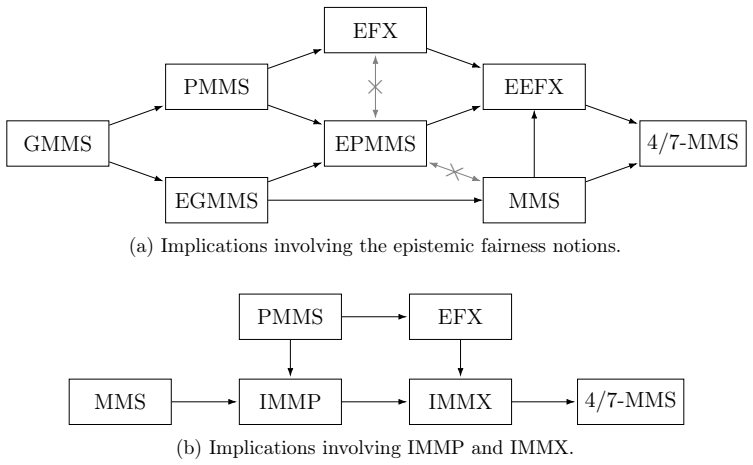
- The manuscript would benefit from an explicit comparison (perhaps as a table in the introduction) of the strength ordering and known existence results among MMS, PMMS, EFX, EEFX, EPMMS, and EGMMS.
Simulated Author's Rebuttal
We thank the referee for their careful reading and positive evaluation of our work. We are glad that the contribution of EPMMS as an epistemic relaxation of PMMS, along with the existence and algorithmic results for additive and bivalued valuations, is viewed as advancing the literature. Since the report contains no specific major comments or requested changes, we have no points to address point-by-point.
Circularity Check
No significant circularity identified
full rationale
The paper defines a new epistemic fairness notion EPMMS and establishes existence plus efficient algorithms for additive valuations (4/5-EPMMS), bivalued valuations (full EPMMS and stronger EGMMS), and two MMS-impossible settings. These results rest on direct constructive proofs that exploit the specific structure of the newly introduced definition together with the given valuation classes; no step reduces by construction to a fitted parameter, self-citation chain, or renamed input, and the derivation remains self-contained against external benchmarks.
Axiom & Free-Parameter Ledger
Reference graph
Works this paper leans on
-
[1]
Envy-free matchings in bipartite graphs and their applications to fair division.Inf
Elad Aigner-Horev and Erel Segal-Halevi. Envy-free matchings in bipartite graphs and their applications to fair division.Inf. Sci., 587:164–187, 2022
2022
-
[2]
Epistemic EFX allocations exist for monotone valuations
Hannaneh Akrami and Nidhi Rathi. Epistemic EFX allocations exist for monotone valuations. InAAAI, pages 13520–13528. AAAI Press, 2025
2025
-
[3]
Achieving maximin share and EFX/EF1 guarantees simultaneously
Hannaneh Akrami and Nidhi Rathi. Achieving maximin share and EFX/EF1 guarantees simultaneously. InAAAI, pages 13529–13537. AAAI Press, 2025
2025
-
[4]
EFX: A simpler approach and an (almost) optimal guarantee via rainbow cycle number.Oper
Hannaneh Akrami, Noga Alon, Bhaskar Ray Chaudhury, Jugal Garg, Kurt Mehlhorn, and Ruta Mehta. EFX: A simpler approach and an (almost) optimal guarantee via rainbow cycle number.Oper. Res., 73(2):738–751, 2025
2025
-
[5]
Achieving EF1 and epistemic EFX guarantees simultaneously.CoRR, abs/2602.11732, 2026
Hannaneh Akrami, Ryoga Mahara, Kurt Mehlhorn, and Nidhi Rathi. Achieving EF1 and epistemic EFX guarantees simultaneously.CoRR, abs/2602.11732, 2026
arXiv 2026
-
[6]
Hannaneh Akrami, Alexander Mayorov, Kurt Mehlhorn, Shreyas Srinivas, and Christoph Weidenbach. A counterexample to efx;n≥ 3agents, m≥n + 5items, monotone valuations; via sat-solving.CoRR, abs/2604.18216, 2026. 19
Pith/arXiv arXiv 2026
-
[7]
Approximation algorithms for computing maximin share allocations.ACM Trans
Georgios Amanatidis, Evangelos Markakis, Afshin Nikzad, and Amin Saberi. Approximation algorithms for computing maximin share allocations.ACM Trans. Algorithms, 13(4):52:1– 52:28, 2017
2017
-
[8]
Comparing approximate relaxations of envy-freeness
Georgios Amanatidis, Georgios Birmpas, and Vangelis Markakis. Comparing approximate relaxations of envy-freeness. InIJCAI, pages 42–48. ijcai.org, 2018
2018
-
[9]
Multiple birds with one stone: Beating 1/2 for EFX and GMMS via envy cycle elimination.Theor
Georgios Amanatidis, Evangelos Markakis, and Apostolos Ntokos. Multiple birds with one stone: Beating 1/2 for EFX and GMMS via envy cycle elimination.Theor. Comput. Sci., 841:94–109, 2020
2020
-
[10]
Voudouris
Georgios Amanatidis, Georgios Birmpas, Aris Filos-Ratsikas, Alexandros Hollender, and Alexandros A. Voudouris. Maximum nash welfare and other stories about EFX.Theor. Comput. Sci., 863:69–85, 2021
2021
-
[11]
Voudouris, and Xiaowei Wu
Georgios Amanatidis, Haris Aziz, Georgios Birmpas, Aris Filos-Ratsikas, Bo Li, Hervé Moulin, Alexandros A. Voudouris, and Xiaowei Wu. Fair division of indivisible goods: Recent progress and open questions.Artif. Intell., 322:103965, 2023
2023
-
[12]
EF2X exists for four agents
Arash Ashuri, Vasilis Gkatzelis, and Alkmini Sgouritsa. EF2X exists for four agents. In AAAI, pages 13555–13563. AAAI Press, 2025
2025
-
[13]
Knowl- edge, fairness, and social constraints
Haris Aziz, Sylvain Bouveret, Ioannis Caragiannis, Ira Giagkousi, and Jérôme Lang. Knowl- edge, fairness, and social constraints. InAAAI, pages 4638–4645. AAAI Press, 2018
2018
-
[14]
Near-optimal best-of-both-worlds fairness for few agents
Moshe Babaioff and Gefen Frosh. Near-optimal best-of-both-worlds fairness for few agents. CoRR, abs/2602.14668, 2026
arXiv 2026
-
[15]
Approximating nash social welfare under binary XOS and binary subadditive valuations
Siddharth Barman and Paritosh Verma. Approximating nash social welfare under binary XOS and binary subadditive valuations. InWINE, Lecture Notes in Computer Science, pages 373–390. Springer, 2021
2021
-
[16]
Groupwise maximin fair allocation of indivisible goods
Siddharth Barman, Arpita Biswas, Sanath Kumar Krishna Murthy, and Yadati Narahari. Groupwise maximin fair allocation of indivisible goods. InAAAI, pages 917–924. AAAI Press, 2018
2018
-
[17]
Fairness towards groups of agents in the allocation of indivisible items
Nawal Benabbou, Mithun Chakraborty, Edith Elkind, and Yair Zick. Fairness towards groups of agents in the allocation of indivisible items. InIJCAI, pages 95–101. ijcai.org, 2019
2019
-
[18]
Finding fair and efficient allocations when valuations don’t add up
Nawal Benabbou, Mithun Chakraborty, Ayumi Igarashi, and Yair Zick. Finding fair and efficient allocations when valuations don’t add up. InSAGT, Lecture Notes in Computer Science, pages 32–46. Springer, 2020
2020
-
[19]
Almost full EFX exists for four agents
Ben Berger, Avi Cohen, Michal Feldman, and Amos Fiat. Almost full EFX exists for four agents. InAAAI, pages 4826–4833. AAAI Press, 2022
2022
-
[20]
Characterizing conflicts in fair division of indivisible goods using a scale of criteria.Auton
Sylvain Bouveret and Michel Lemaître. Characterizing conflicts in fair division of indivisible goods using a scale of criteria.Auton. Agents Multi Agent Syst., 30(2):259–290, 2016
2016
-
[21]
The combinatorial assignment problem: approximate competitive equilibrium from equal incomes
Eric Budish. The combinatorial assignment problem: approximate competitive equilibrium from equal incomes. InBQGT, page 74:1. ACM, 2010. 20
2010
-
[22]
Probing EFX via PMMS: (non- )existence results in discrete fair division
Jaroslaw Byrka, Franciszek Malinka, and Tomasz Ponitka. Probing EFX via PMMS: (non- )existence results in discrete fair division. InAAAI, pages 16735–16742. AAAI Press, 2026
2026
-
[23]
Procaccia, Nisarg Shah, and Junxing Wang
Ioannis Caragiannis, David Kurokawa, Hervé Moulin, Ariel D. Procaccia, Nisarg Shah, and Junxing Wang. The unreasonable fairness of maximum nash welfare.ACM Trans. Economics and Comput., 7(3):12:1–12:32, 2019
2019
-
[24]
New fairness concepts for allocating indivisible items
Ioannis Caragiannis, Jugal Garg, Nidhi Rathi, Eklavya Sharma, and Giovanna Varricchio. New fairness concepts for allocating indivisible items. InIJCAI, pages 2554–2562. ijcai.org, 2023
2023
-
[25]
A little charity guarantees almost envy-freeness.SIAM J
Bhaskar Ray Chaudhury, Telikepalli Kavitha, Kurt Mehlhorn, and Alkmini Sgouritsa. A little charity guarantees almost envy-freeness.SIAM J. Comput., 50(4):1336–1358, 2021
2021
-
[26]
EFX exists for three agents.J
Bhaskar Ray Chaudhury, Jugal Garg, and Kurt Mehlhorn. EFX exists for three agents.J. ACM, 71(1):4:1–4:27, 2024
2024
-
[27]
Exact and approximate maximin share allocations in multi-graphs
George Christodoulou and Symeon Mastrakoulis. Exact and approximate maximin share allocations in multi-graphs. InAAAI, pages 16761–16769. AAAI Press, 2026
2026
-
[28]
The existence and efficiency of PMMS allocations.Theor
Sijia Dai, Xinru Guo, Huahua Miao, Guichen Gao, Yicheng Xu, and Yong Zhang. The existence and efficiency of PMMS allocations.Theor. Comput. Sci., 989:114388, 2024
2024
-
[29]
Maximin fair allocations with two item values.Preprint, 2022
Uriel Feige. Maximin fair allocations with two item values.Preprint, 2022. Version: February 22, 2022. Available athttps://www.wisdom.weizmann.ac.il/~feige/mypapers/ MMSab.pdf
2022
-
[30]
A tight negative example for MMS fair allocations
Uriel Feige, Ariel Sapir, and Laliv Tauber. A tight negative example for MMS fair allocations. InWINE, Lecture Notes in Computer Science, pages 355–372. Springer, 2021
2021
-
[31]
On optimal tradeoffs between EFX and nash welfare
Michal Feldman, Simon Mauras, and Tomasz Ponitka. On optimal tradeoffs between EFX and nash welfare. InAAAI, pages 9688–9695. AAAI Press, 2024
2024
-
[32]
Exploring relations among fairness notions in discrete fair division.CoRR, abs/2502.02815, 2025
Jugal Garg and Eklavya Sharma. Exploring relations among fairness notions in discrete fair division.CoRR, abs/2502.02815, 2025
arXiv 2025
-
[33]
(almost full) EFX for three (and more) types of agents
Pratik Ghosal, Vishwa Prakash HV, Prajakta Nimbhorkar, and Nithin Varma. (almost full) EFX for three (and more) types of agents. InAAAI, pages 13889–13896. AAAI Press, 2025
2025
-
[34]
Ordinal maximin share approximation for goods.J
Hadi Hosseini, Andrew Searns, and Erel Segal-Halevi. Ordinal maximin share approximation for goods.J. Artif. Intell. Res., 74, 2022
2022
-
[35]
Maximin shares in hereditary set systems.ACM Trans
Halvard Hummel. Maximin shares in hereditary set systems.ACM Trans. Economics and Comput., 13(3):12:1–12:33, 2025
2025
-
[36]
Maximin shares under cardinality constraints
Halvard Hummel and Magnus Lie Hetland. Maximin shares under cardinality constraints. Auton. Agents Multi Agent Syst., 40(1):9, 2026
2026
-
[37]
EFX exists for three types of agents
Vishwa Prakash HV, Pratik Ghosal, Prajakta Nimbhorkar, and Nithin Varma. EFX exists for three types of agents. InEC, pages 101–128. ACM, 2025
2025
-
[38]
Jiarong Jin and Biaoshuai Tao. On pareto-optimal and fair allocations with personalized bi-valued utilities.CoRR, abs/2507.18251, 2025. 21
arXiv 2025
-
[39]
H. W. Kuhn. On games of fair division. In Martin Shubik, editor,Essays in Mathemati- cal Economics in Honor of Oskar Morgenstern, pages 29–37. Princeton University Press, Princeton, NJ, 1967
1967
-
[40]
PhD thesis, Carnegie Mellon University, 2017
David Kurokawa.Fair Division in Game Theoretic Settings. PhD thesis, Carnegie Mellon University, 2017
2017
-
[41]
Procaccia, and Junxing Wang
David Kurokawa, Ariel D. Procaccia, and Junxing Wang. When can the maximin share guarantee be guaranteed? InAAAI, pages 523–529. AAAI Press, 2016
2016
-
[42]
Procaccia, and Junxing Wang
David Kurokawa, Ariel D. Procaccia, and Junxing Wang. Fair enough: Guaranteeing approximate maximin shares.J. ACM, 65(2):8:1–8:27, 2018
2018
-
[43]
Combinatorial auctions with decreasing marginal utilities.Games Econ
Benny Lehmann, Daniel Lehmann, and Noam Nisan. Combinatorial auctions with decreasing marginal utilities.Games Econ. Behav., 55(2):270–296, 2006
2006
-
[44]
Gross substitutability: An algorithmic survey.Games Econ
Renato Paes Leme. Gross substitutability: An algorithmic survey.Games Econ. Behav., 106:294–316, 2017
2017
-
[45]
The conference paper assignment problem: Using order weighted averages to assign indivisible goods
Jing Wu Lian, Nicholas Mattei, Renee Noble, and Toby Walsh. The conference paper assignment problem: Using order weighted averages to assign indivisible goods. InAAAI, pages 1138–1145. AAAI Press, 2018
2018
-
[46]
Lipton, Evangelos Markakis, Elchanan Mossel, and Amin Saberi
Richard J. Lipton, Evangelos Markakis, Elchanan Mossel, and Amin Saberi. On approxi- mately fair allocations of indivisible goods. InEC, pages 125–131. ACM, 2004
2004
-
[47]
Existence of EFX for two additive valuations.Discret
Ryoga Mahara. Existence of EFX for two additive valuations.Discret. Appl. Math., 340: 115–122, 2023
2023
-
[48]
Almost envy-freeness with general valuations.SIAM J
Benjamin Plaut and Tim Roughgarden. Almost envy-freeness with general valuations.SIAM J. Discret. Math., 34(2):1039–1068, 2020
2020
-
[49]
Harvard University Press, Cambridge, MA, 1971
John Rawls.A Theory of Justice. Harvard University Press, Cambridge, MA, 1971
1971
-
[50]
The problem of fair division.Econometrica, 16(1):101–104, 1948
Hugo Steinhaus. The problem of fair division.Econometrica, 16(1):101–104, 1948. A Separations between EPMMS and EEFX A.1 PMMS Is Not Preserved Under Envy-Cycle Elimination We begin by highlighting a fundamental difference between PMMS and EFX. The central operation of the Envy-Cycle Elimination algorithm (Algorithm 1) is the envy-cycle elimination step (L...
1948
-
[51]
Without loss of generality, suppose this holds forX′
-
[52]
Hence agent2PMMS-envies agent1, a contradiction
Then µ(2, X′ 1 ∪X ′ 2)≥µ(2,{3,3,3,3} ∪ {5,5}) = 11 = min{5 + 3 + 3,5 + 3 + 3}. Hence agent2PMMS-envies agent1, a contradiction. We conclude that MMS does not imply EPMMS. We now show that EPMMS is incomparable to EFX. 26 Observation A.8.Neither EPMMS nor EFX implies the other, even when agents have identical bivalued valuations (a special case of additive...
-
[53]
, ˆXn)for the identical rankings instance ˆI
Base Allocation:Compute the target allocation ˆX = ( ˆX1, . . . , ˆXn)for the identical rankings instance ˆI
-
[54]
, am)such that ak = i if the k-th item in the identical ranking is assigned to agentiinˆX
Picking Sequence:Define the sequence L = (a1, a2, . . . , am)such that ak = i if the k-th item in the identical ranking is assigned to agentiinˆX
-
[55]
Let X be the resulting allocation
Actual Allocation:Execute thePick( I, L)routine: in each step k, agent ak picks their favorite remaining item according to their original valuationvi. Let X be the resulting allocation. To analyze how values shift when translatingˆX to X, we rely on a structural lemma introduced by Caragiannis et al [24]. Lemma E.5(Lemma 2 in [24]).For every agent i∈ [n],...
-
[56]
Agent1is unenvied before this assignment since her bundle is empty
Agent1receives item g1. Agent1is unenvied before this assignment since her bundle is empty
-
[57]
Agent2receives items g2 and g3. Agent2is unenvied before each of these assignments: initially her bundle is empty, and after receivingg2, agent1values {g2} at2(equal to her own bundle) and agent3values{g 2}at0, so neither envies agent2
-
[58]
Before each assignment, agent3is unenvied since agents1and2value any subset of {g4, g5, g6} at no more than their own bundles (2and4, respectively)
Agent3receives items g4, g5, and g6. Before each assignment, agent3is unenvied since agents1and2value any subset of {g4, g5, g6} at no more than their own bundles (2and4, respectively). At this point, the envy graph, whose nodes are the agents and which contains an edgei→j wheneverv i(Xj)> v i(Xi), is as follows: 1 23 No agent has in-degree0, so the algor...
discussion (0)
Sign in with ORCID, Apple, or X to comment. Anyone can read and Pith papers without signing in.