REVIEW 3 major objections 2 minor 88 references
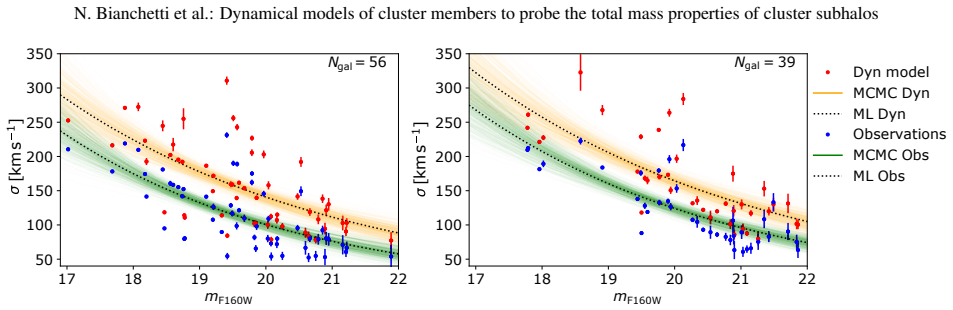
Dynamical models of galaxies in two galaxy clusters produce velocity dispersion profiles that fit observations better than those from strong lensing models.
Reviewed by Pith at T0; open to challenge. T0 means a machine referee read the full paper against a public rubric. the ladder, T0–T4 →
T0 review · grok-4.3
2026-06-28 05:08 UTC pith:UQNL6ALO
load-bearing objection New dynamical sigma0 and rt values for 109 members are reported, but the claim that these are more robust than SL models does not follow because the dynamical fits are tuned to the kinematics while SL predictions are not. the 3 major comments →
Dynamical models of cluster members to probe the total mass properties of cluster subhalos. I. A comparison with parametric strong lensing models
The pith
A machine-rendered reading of the paper's core claim, the machinery that carries it, and where it could break.
Core claim
By modeling cluster galaxies with dPIE total mass and Jaffe stellar density profiles fitted to MUSE kinematic data, the authors derive central velocity dispersions and truncation radii that yield superior matches to observed dispersion profiles compared to strong lensing reconstructions, and produce Faber-Jackson relations with systematically higher normalization.
What carries the argument
Spectral fitting pipeline for line-of-sight velocity dispersion profiles combined with dPIE and Jaffe density models to infer sigma_0 and r_t
Load-bearing premise
Previous kinematic estimates were biased by not accounting for the effects of the point spread function in the spectral measurements.
What would settle it
High-resolution kinematic observations of the same galaxies that avoid point spread function effects and yield velocity dispersions matching those from strong lensing models would falsify the claim of superior robustness.
If this is right
- The dynamical measurements should be used as improved initial prescriptions in future strong lensing models.
- Faber-Jackson scaling relations calibrated this way have higher normalization and compatible slope and scatter.
- The approach resolves biases in previous kinematic estimates due to PSF effects.
- This provides an independent probe of total mass properties of cluster subhalos.
Where Pith is reading between the lines
- Applying the same method to additional clusters could test whether the discrepancy with cosmological simulations on subhalo masses is resolved.
- Wider adoption might revise the inferred subhalo mass functions in strong lensing analyses of clusters.
- The higher central velocity dispersions could imply more massive subhalos, with consequences for models of galaxy quenching in dense environments.
Editorial analysis
A structured set of objections, weighed in public.
Referee Report
Summary. The manuscript develops dynamical models for 109 early-type cluster members in Abell 2744 and MACS J0416.1-2403 using MUSE spectroscopy and HFF photometry. Assuming dPIE total mass and Jaffe stellar density profiles, it measures central velocity dispersion σ₀ (accurately recovered for all) and truncation radius r_t (reliable for a subset with extended coverage), shows that the resulting models fit observed LOS velocity dispersion profiles better than predictions from strong-lensing (SL) models, calibrates Faber-Jackson relations with higher normalization than prior kinematic and SL works, and concludes that the new measurements are more robust (owing to PSF treatment) and should serve as improved priors for future SL modeling.
Significance. If the superiority claim survives a controlled comparison that avoids fitting bias, the work would supply observationally calibrated subhalo mass parameters that could reduce the reported tension between SL-derived subhalo masses and cosmological simulations. The independent MUSE dataset and explicit spectral-fitting pipeline constitute clear methodological assets.
major comments (3)
- [Abstract] Abstract: the statement that dynamical models 'predicted LOS velocity dispersion profiles that fit the measured ones better than those inferred from SL models' compares models whose parameters (σ₀, r_t) were optimized directly to the 109 MUSE profiles against unfitted extrapolations from SL constraints. This renders the reported improvement expected by construction and does not, by itself, establish greater robustness of the dynamical total-mass properties; a quantitative test (e.g., predictive residuals on held-out kinematic data or on an independent observable) is required.
- [Abstract] Abstract / Faber-Jackson section: the higher normalization reported for the new relations is derived from the fitted σ₀ values. Attribution of the offset solely to PSF correction (rather than to the adopted dPIE+Jaffe parametrization or other modeling choices) requires an explicit isolation of the PSF effect, for example by re-processing earlier kinematic catalogs with the new pipeline.
- [Results on r_t] Results on r_t: the abstract notes that r_t is reliably recovered only for the subset of galaxies with sufficiently extended radial coverage. The final claim that these values 'should therefore be adopted as improved initial prescriptions in future SL models' must be qualified by the fraction of the sample for which r_t is robust and by the propagated uncertainty on total subhalo mass.
minor comments (2)
- Provide explicit goodness-of-fit statistics (χ², rms residuals, or equivalent) for the dynamical versus SL profile comparisons rather than qualitative statements.
- State the precise number (and fraction) of galaxies with reliable r_t measurements and reference the corresponding table or figure.
Simulated Author's Rebuttal
We thank the referee for the constructive comments that help clarify the scope and limitations of our analysis. We respond to each major comment below and indicate where revisions will be made.
read point-by-point responses
-
Referee: [Abstract] Abstract: the statement that dynamical models 'predicted LOS velocity dispersion profiles that fit the measured ones better than those inferred from SL models' compares models whose parameters (σ₀, r_t) were optimized directly to the 109 MUSE profiles against unfitted extrapolations from SL constraints. This renders the reported improvement expected by construction and does not, by itself, establish greater robustness of the dynamical total-mass properties; a quantitative test (e.g., predictive residuals on held-out kinematic data or on an independent observable) is required.
Authors: We agree that the reported improvement is expected by construction because the dynamical models are optimized to the MUSE data while the SL extrapolations are not. The scientific value lies in demonstrating that SL-derived subhalo parameters systematically fail to reproduce independent kinematic observations, which bears on the reported tension with simulations. To address the concern, we will add a quantitative cross-validation test (e.g., predictive residuals on a held-out subset of the kinematic profiles) and revise the abstract to qualify the comparison accordingly. revision: yes
-
Referee: [Abstract] Abstract / Faber-Jackson section: the higher normalization reported for the new relations is derived from the fitted σ₀ values. Attribution of the offset solely to PSF correction (rather than to the adopted dPIE+Jaffe parametrization or other modeling choices) requires an explicit isolation of the PSF effect, for example by re-processing earlier kinematic catalogs with the new pipeline.
Authors: The offset in normalization arises from our σ₀ measurements, which incorporate a full treatment of the MUSE PSF during spectral fitting. While we cannot re-process the earlier catalogs (which are not publicly available in the required form), we will expand the discussion section to compare methodological differences explicitly, including the impact of PSF modeling versus profile assumptions, and will avoid claiming the offset is due solely to the PSF. revision: partial
-
Referee: [Results on r_t] Results on r_t: the abstract notes that r_t is reliably recovered only for the subset of galaxies with sufficiently extended radial coverage. The final claim that these values 'should therefore be adopted as improved initial prescriptions in future SL models' must be qualified by the fraction of the sample for which r_t is robust and by the propagated uncertainty on total subhalo mass.
Authors: We agree that the claim requires qualification. In the revised manuscript we will state the exact fraction of the 109 galaxies for which r_t is robustly recovered, report the associated uncertainties, and discuss how these propagate to total subhalo mass before recommending the values as priors for future SL modeling. revision: yes
Circularity Check
Dynamical models fitted to MUSE LOS profiles; claimed superior fit vs. SL predictions is by construction
specific steps
-
fitted input called prediction
[Abstract]
"Our dynamical models predicted LOS velocity dispersion profiles that fit the measured ones better than those inferred from SL models."
Galaxies are modeled with dPIE total mass + Jaffe stellar density and optimized to the MUSE LOS velocity dispersion profiles of 109 cluster members to infer σ0 and rt. The resulting models are then stated to fit the measured profiles better than SL-inferred profiles. Since the dynamical models are fitted to the data while SL models are not, superior fit quality is guaranteed by construction and does not independently demonstrate more robust total mass properties.
full rationale
The paper's key claim that dynamical models 'predicted LOS velocity dispersion profiles that fit the measured ones better than those inferred from SL models' reduces directly to the fact that the dPIE+Jaffe models are optimized to the same MUSE kinematic data used for the comparison, while SL models are not. This matches the fitted_input_called_prediction pattern. The subsequent Faber-Jackson calibration uses the fitted σ0 values. No self-citation load-bearing, ansatz smuggling, or other patterns are present; the MUSE spectroscopy itself is an independent input. The central robustness conclusion therefore inherits the tautology.
Axiom & Free-Parameter Ledger
read the original abstract
In this series of papers, we present dynamical models of cluster members in strong lensing (SL) galaxy clusters to independently probe the persistent discrepancy reported between SL models and cosmological simulations, in terms of total mass properties for the cluster subhalos. In this work, we focused our study on early-type galaxies within Abell 2744 ($z=0.309$) and MACS J0416.1-2403 ($z=0.397$). We took advantage of deep MUSE spectroscopic data, complemented with HFF photometry. We used a pipeline based on spectral fitting to perform kinematic measurements of the LOS velocity dispersion profiles of 109 cluster members. We modeled the galaxies assuming a dPIE total mass density distribution and a Jaffe stellar mass density distribution. From the models, we inferred the values of the central stellar velocity dispersion, $\sigma_0$, and the truncation radius, $r_t$, for the galaxies in our sample. We found that $\sigma_0$ is accurately recovered for all of the cluster members, while $r_t$ is reliably measured for a fraction of galaxies in our sample, with sufficiently extended radial kinematic coverage. Our dynamical models predicted LOS velocity dispersion profiles that fit the measured ones better than those inferred from SL models. We then exploited the $\sigma_0$ measurements obtained from the dynamical models to calibrate the Faber-Jackson scaling relations for the cluster members in both galaxy clusters. When comparing our relations to those obtained in previous kinematics and SL works, we found systematically higher normalization and compatible slope and scatter values. We conclude that our dynamical measurements of $\sigma_0$ and $r_t$, along with calibrated scaling relations, are more robust than previous kinematic estimates which are biased by not taking into account the effects of the PSF, and should therefore be adopted as improved initial prescriptions in future SL models.
Figures


Reference graph
Works this paper leans on
-
[1]
Simple methods , author=
Dynamical models of elliptical galaxies--I. Simple methods , author=. , volume=. 2014 , publisher=
2014
-
[2]
, volume=
Resolving the discrepancy between X-ray and gravitational lensing mass measurements for clusters of galaxies , author=. , volume=. 1998 , publisher=
1998
-
[3]
, volume=
Mass Profile Decomposition of the Frontier Fields Cluster MACS J0416-2403: Insights on the Dark-matter Inner Profile , author=. , volume=. 2017 , publisher=
2017
-
[4]
The panoramic integral-field spectrograph , author=
The SAURON project--I. The panoramic integral-field spectrograph , author=. , volume=. 2001 , publisher=
2001
-
[5]
7735 , author=
Society of Photo-Optical Instrumentation Engineers (SPIE) Conference Series Vol. 7735 , author=. 2010 , publisher=
2010
-
[6]
1-2403 with 800 Spectra of Member Galaxies , author=
CLASH-VLT: Dissecting the Frontier Fields Galaxy Cluster MACS J0416. 1-2403 with 800 Spectra of Member Galaxies , author=. , volume=. 2016 , publisher=
2016
-
[7]
Combined lensing and dynamics analysis of early-type galaxies at z= 0.08--0.33 , author=
Two-dimensional kinematics of SLACS lenses--II. Combined lensing and dynamics analysis of early-type galaxies at z= 0.08--0.33 , author=. , volume=. 2009 , publisher=
2009
-
[8]
, volume=
Enhanced cluster lensing models with measured galaxy kinematics , author=. , volume=. 2019 , publisher=
2019
-
[9]
1- 2403-Robust characterization of the cluster mass distribution from VLT/MUSE deep observations , author=
A new high-precision strong lensing model of the galaxy cluster MACS J0416. 1- 2403-Robust characterization of the cluster mass distribution from VLT/MUSE deep observations , author=. , volume=. 2021 , publisher=
2021
-
[10]
, volume=
New high-precision strong lensing modeling of Abell 2744-Preparing for JWST observations , author=. , volume=. 2023 , publisher=
2023
-
[11]
1- 2403 with the largest sample of spectroscopic multiple images , author=
A state-of-the-art strong-lensing model of MACS J0416. 1- 2403 with the largest sample of spectroscopic multiple images , author=. , volume=. 2023 , publisher=
2023
-
[12]
Reports on Progress in Physics , volume=
Structure and dynamics of elliptical galaxies , author=. Reports on Progress in Physics , volume=. 1993 , publisher=
1993
-
[13]
, volume=
SExtractor: Software for source extraction , author=. , volume=. 1996 , publisher=
1996
-
[14]
2014 , publisher=
Dynamics of galaxies , author=. 2014 , publisher=
2014
-
[15]
, volume=
M/L and velocity anisotropy from observations of spherical galaxies, or must M87 have a massive black hole? , author=. , volume=. 1982 , publisher=
1982
-
[16]
, volume=
Dynamics of elliptical galaxies and other spheroidal components , author=. , volume=
-
[17]
2011 , publisher=
Galactic dynamics , author=. 2011 , publisher=
2011
-
[18]
, volume=
Overview of the SDSS-IV MaNGA survey: mapping nearby galaxies at Apache Point observatory , author=. , volume=. 2014 , publisher=
2014
-
[19]
1- 2403 from a new large set of spectroscopic multiply lensed sources , author=
A refined mass distribution of the cluster MACS J0416. 1- 2403 from a new large set of spectroscopic multiply lensed sources , author=. , volume=. 2017 , publisher=
2017
-
[20]
, volume=
Parametric Recovery of Line-of-Sight Velocity Distributions from Absorption-Line Spectra of Galaxies via Penalized Likelihood , author=. , volume=. 2004 , publisher=
2004
-
[21]
The orbital anisotropy of elliptical and lenticular galaxies: revisiting the (V/ , ɛ) diagram with integral-field stellar kinematics , author=
The SAURON project--X. The orbital anisotropy of elliptical and lenticular galaxies: revisiting the (V/ , ɛ) diagram with integral-field stellar kinematics , author=. , volume=. 2007 , publisher=
2007
-
[22]
, volume=
Measuring the inclination and mass-to-light ratio of axisymmetric galaxies via anisotropic Jeans models of stellar kinematics , author=. , volume=. 2008 , publisher=
2008
-
[23]
A volume-limited sample of 260 nearby early-type galaxies: science goals and selection criteria , author=
The ATLAS3D project--I. A volume-limited sample of 260 nearby early-type galaxies: science goals and selection criteria , author=. , volume=. 2011 , publisher=
2011
-
[24]
A new look at the morphology of nearby galaxies: the kinematic morphology--density relation , author=
The ATLAS3D project--VII. A new look at the morphology of nearby galaxies: the kinematic morphology--density relation , author=. , volume=. 2011 , publisher=
2011
-
[25]
, volume=
Efficient solution of the anisotropic spherically aligned axisymmetric Jeans equations of stellar hydrodynamics for galactic dynamics , author=. , volume=. 2020 , publisher=
2020
-
[26]
Encyclopedia of Astrophysics, Volume 4 , year = 2026, volume =
Cappellari, Michele , year=. Early-type galaxies: Elliptical and S0 galaxies, or fast and slow rotators , ISBN=. doi:10.1016/b978-0-443-21439-4.00109-7 , booktitle=
-
[27]
, volume=
RELICS: reionization lensing cluster survey , author=. , volume=. 2019 , publisher=
2019
-
[28]
I-Uniform photometry of 14 rich clusters , author=
Distant clusters of galaxies. I-Uniform photometry of 14 rich clusters , author=. , volume=
-
[29]
Annales d'Astrophysique, Vol
Recherches sur les nebuleuses extragalactiques , author=. Annales d'Astrophysique, Vol. 11, p. 247 , volume=
-
[30]
, volume=
Fundamental properties of elliptical galaxies , author=. , volume=
-
[31]
, volume=
MACS: a quest for the most massive galaxy clusters in the universe , author=. , volume=
-
[32]
, volume=
The X-ray brightest clusters of galaxies from the Massive Cluster Survey , author=. , volume=. 2010 , publisher=
2010
-
[33]
Trudy Astrofizicheskogo Instituta Alma-Ata, Vol
On the Construction of a Composite Model for the Galaxy and on the Determination of the System of Galactic Parameters , author=. Trudy Astrofizicheskogo Instituta Alma-Ata, Vol. 5, p. 87-100, 1965 , volume=
1965
-
[34]
Where is the matter in the Merging Cluster Abell 2218?
Where is the matter in the Merging Cluster Abell 2218? , author=. arXiv preprint arXiv:0710.5636 , year=
work page internal anchor Pith review Pith/arXiv arXiv
-
[35]
A kinematic classification for early-type galaxies , author=
The SAURON project--IX. A kinematic classification for early-type galaxies , author=. , volume=. 2007 , publisher=
2007
-
[36]
A census of the stellar angular momentum within the effective radius of early-type galaxies: unveiling the distribution of fast and slow rotators , author=
The ATLAS3D project--III. A census of the stellar angular momentum within the effective radius of early-type galaxies: unveiling the distribution of fast and slow rotators , author=. , volume=. 2011 , publisher=
2011
-
[37]
, volume=
The distribution of dark matter in the Perseus cluster , author=. , volume=
-
[38]
, volume=
Velocity dispersions and mass-to-light ratios for elliptical galaxies , author=. , volume=
-
[39]
, volume=
An X-ray and optical study of the cluster of galaxies Abell 754 , author=. , volume=
-
[40]
, volume=
On model-dependent bounds on H (0) from gravitational images Application of Q0957+ 561A, B , author=. , volume=
-
[41]
, volume=
emcee: the MCMC hammer , author=. , volume=. 2013 , publisher=
2013
-
[42]
, volume=
Dynamical Family Properties and Dark Halo ScalingRelations of GiantElliptical Galaxies , author=. , volume=. 2001 , publisher=
2001
-
[43]
, volume=
The X-shooter Spxfectral Library (XSL): data release 2 , author=. , volume=. 2020 , publisher=
2020
-
[44]
, volume=
Improved strong lensing modelling of galaxy clusters using the Fundamental Plane: Detailed mapping of the baryonic and dark matter mass distribution of Abell S1063 , author=. , volume=. 2022 , publisher=
2022
-
[45]
, volume=
Cosmology with supernova Encore in the strong lensing cluster MACS J0138- 2155-Spectroscopy with MUSE , author=. , volume=. 2025 , publisher=
2025
-
[46]
, volume=
The velocity dispersion function of red galaxies in four Hubble Frontier Fields galaxy clusters , author=. , volume=. 2026 , publisher=
2026
-
[47]
1- 2403 THROUGH ACCURATE STRONG LENS MODELING , author=
CLASH-VLT: INSIGHTS ON THE MASS SUBSTRUCTURES IN THE FRONTIER FIELDS CLUSTER MACS J0416. 1- 2403 THROUGH ACCURATE STRONG LENS MODELING , author=. , volume=. 2015 , publisher=
2015
-
[48]
, volume=
An analytical model for spherical galaxies and bulges , author=. , volume=
-
[49]
A Source Book in Astronomy and Astrophysics, 1900--1975 , pages=
Extra-galactic nebulae , author=. A Source Book in Astronomy and Astrophysics, 1900--1975 , pages=. 1979 , publisher=
1900
-
[50]
, volume=
A simple model for the distribution of light in spherical galaxies , author=. , volume=. 1983 , publisher=
1983
-
[51]
, volume=
Hubble Space Telescope observations of the lensing cluster Abell 2218 , author=. , volume=. 1996 , publisher=
1996
-
[52]
Morphologies, kinemetric features and alignment between photometric and kinematic axes of early-type galaxies , author=
The ATLAS3D project--II. Morphologies, kinemetric features and alignment between photometric and kinematic axes of early-type galaxies , author=. , volume=. 2011 , publisher=
2011
-
[53]
, volume=
The Impact of Orbital Anisotropy Assumptions in Lensing-dynamics Modeling , author=. , volume=. 2026 , publisher=
2026
-
[54]
, volume=
Constraining the mass distribution of galaxies using galaxy-galaxy lensing in clusters and in the field , author=. , volume=. 2005 , publisher=
2005
-
[55]
, volume=
The Frontier Fields: survey design and initial results , author=. , volume=. 2017 , publisher=
2017
-
[56]
, volume=
Statistical mechanics of violent relaxation in stellar systems , author=. , volume=
-
[57]
, volume=
Strong-lensing analysis of A2744 with MUSE and Hubble Frontier Fields images , author=. , volume=. 2018 , publisher=
2018
-
[58]
, volume=
Detailed cluster mass and light profiles of A1703, A370 and RXJ1347- 11 from deep Subaru imaging , author=. , volume=. 2010 , publisher=
2010
-
[59]
, volume=
The Frontier Fields lens modelling comparison project , author=. , volume=. 2017 , publisher=
2017
-
[60]
Sci , volume=
An excess of small-scale gravitational lenses observed in galaxy clusters , author=. Sci , volume=. 2020 , publisher=
2020
-
[61]
, volume=
The probability of galaxy--galaxy strong lensing events in hydrodynamical simulations of galaxy clusters , author=. , volume=. 2022 , publisher=
2022
-
[62]
, volume=
A persistent excess of galaxy-galaxy strong lensing observed in galaxy clusters , author=. , volume=. 2023 , publisher=
2023
-
[63]
, volume=
Creation of cosmic structure in the complex galaxy cluster merger Abell 2744 , author=. , volume=. 2011 , publisher=
2011
-
[64]
, volume=
Spherical stellar systems with spheroidal velocity distributions , author=. , volume=
-
[65]
, volume=
Elliptical galaxy dynamics , author=. , volume=. 1999 , publisher=
1999
-
[66]
Saas-Fee Advanced Course 33: Gravitational Lensing: Strong, Weak and Micro , year=
Gravitational Lensing: Strong, Weak and Micro , author=. Saas-Fee Advanced Course 33: Gravitational Lensing: Strong, Weak and Micro , year=
-
[67]
2010 , publisher=
Galaxy formation and evolution , author=. 2010 , publisher=
2010
-
[68]
, volume=
Dark matter substructure within galactic halos , author=. , volume=. 1999 , publisher=
1999
-
[69]
arXiv preprint arXiv:2510.23863 , year=
MAGNUS I: A MUSE-DEEP sample of early-type galaxies at intermediate redshift , author=. arXiv preprint arXiv:2510.23863 , year=
-
[70]
D., Treu T., 2025, arXiv, arXiv:2510.23888
MAGNUS II: Rotational support of massive early-type galaxies decreased over the past 7 billion years , author=. arXiv preprint arXiv:2510.23888 , year=
-
[71]
, volume=
Lensing by galaxy haloes in clusters of galaxies , author=. , volume=. 1997 , publisher=
1997
-
[72]
, volume=
A universal density profile from hierarchical clustering , author=. , volume=. 1997 , publisher=
1997
-
[73]
, author=
Spherical systems of gravitating bodies with ellipsoidal velocity distribution. , author=. Pisma v Astronomicheskii Zhurnal , volume=
-
[74]
American Astronomical Society Meeting Abstracts\# 215 , volume=
Using GALFIT to Classify Galaxies at High-z: Measuring Asymmetry Parametrically , author=. American Astronomical Society Meeting Abstracts\# 215 , volume=
-
[75]
, volume=
The cluster lensing and supernova survey with Hubble: an overview , author=. , volume=. 2012 , publisher=
2012
-
[76]
, volume=
An atlas of MUSE observations towards twelve massive lensing clusters , author=. , volume=. 2021 , publisher=
2021
-
[77]
The Messenger , volume=
CLASH-VLT: a VIMOS large programme to map the dark matter mass distribution in galaxy clusters and probe distant lensed galaxies , author=. The Messenger , volume=
-
[78]
, volume=
The dark matter distribution in the central regions of galaxy clusters: implications for cold dark matter , author=. , volume=. 2004 , publisher=
2004
-
[79]
Cluster mass distributions , author=
Gravitational lensing of distant field galaxies by rich clusters-II. Cluster mass distributions , author=. , volume=. 1995 , publisher=
1995
-
[80]
, volume=
The rise and fall of satellites in galaxy clusters , author=. , volume=. 1997 , publisher=
1997
discussion (0)
Sign in with ORCID, Apple, or X to comment. Anyone can read and Pith papers without signing in.