Multiphoton heralding generates large-amplitude squeezed Schr\"odinger cat states and parity-selective Fock superpositions from squeezed vacuum via an OPA
Pith reviewed 2026-05-25 04:18 UTC · model grok-4.3
The pith
Multiphoton heralding in an OPA generates large squeezed Schrödinger cat states from squeezed vacuum.
A machine-rendered reading of the paper's core claim, the machinery that carries it, and where it could break.
Core claim
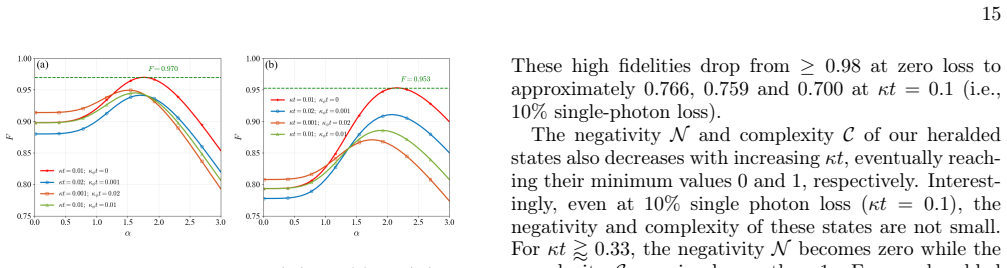
By injecting m photons into the idler port of an optical parametric amplifier and detecting n photons at the output, the scheme realizes effective high-order photon subtraction on squeezed vacuum. This yields large-amplitude squeezed Schrödinger cat states and low-order parity-selective Fock superpositions that exhibit strong Wigner negativity, high phase-space complexity that remains substantial under photon loss after negativity vanishes, and phase-estimation performance that surpasses the Heisenberg limit.
What carries the argument
The multiphoton heralding protocol in a single OPA, in which m-photon injection into the idler and n-photon detection at the output implement effective high-order photon subtraction.
Load-bearing premise
The scheme assumes an ideal OPA with perfect photon-number resolution in the heralding detectors and no extra noise or mode mismatch.
What would settle it
An experiment that prepares the heralded states, applies controlled photon loss, reconstructs their Wigner functions, and checks whether phase-space complexity persists after negativity is lost, or measures phase-estimation variance to test whether it exceeds the Heisenberg limit.
Figures



read the original abstract
We propose a multiphoton heralding scheme using an optical parametric amplifier (OPA) that converts squeezed vacuum into two families of non-Gaussian states: large-amplitude squeezed Schr\"odinger cat states and low-order parity-selective Fock superpositions. By injecting m photons into the idler port and detecting n photons at the output, effective high-order photon subtraction is realized in a single OPA device. The heralded states exhibit strong Wigner negativity and high phase-space complexity. Remarkably, under photon loss, the complexity remains substantial even after negativity vanishes, indicating a loss-resilient quantum resource. These states also surpass the Heisenberg limit in phase estimation. Our protocol establishes the OPA as a versatile platform for generating non-Gaussian states, with promising applications in loss-resilient quantum metrology and fault-tolerant quantum information processing.
Editorial analysis
A structured set of objections, weighed in public.
Referee Report
Summary. The manuscript proposes a multiphoton heralding protocol in a single optical parametric amplifier (OPA) that converts squeezed vacuum into large-amplitude squeezed Schrödinger cat states and low-order parity-selective Fock superpositions. Injecting m photons into the idler port and detecting n photons at the signal output realizes effective high-order photon subtraction. The resulting states are shown to possess strong Wigner negativity and high phase-space complexity; the complexity remains substantial under photon loss even after negativity vanishes. The states are further claimed to surpass the Heisenberg limit in phase estimation via their quantum Fisher information.
Significance. If the derivations hold, the work supplies an exact, parameter-free construction (once m, n, and the squeezing parameter are fixed) for non-Gaussian states in a single device, together with a concrete demonstration that a phase-space complexity measure survives loss after Wigner negativity disappears and that the quantum Fisher information exceeds the Heisenberg bound. These features would be directly relevant to loss-resilient metrology and continuous-variable quantum information processing.
major comments (2)
- [phase estimation section] § on phase estimation, QFI derivation: the claim that the states surpass the Heisenberg limit requires an explicit comparison of the computed quantum Fisher information to the HL bound N² (where N is the mean photon number of the heralded state); without this comparison the surpassing statement is not yet substantiated.
- [loss section] § on loss resilience, beam-splitter channel: the phase-space complexity measure is recomputed after the loss channel, but the precise functional form of the complexity (and the numerical threshold at which negativity vanishes while complexity remains substantial) must be stated for representative m, n pairs so that the resilience claim can be verified.
minor comments (2)
- [introduction or methods] The abstract states that the scheme assumes an ideal OPA with perfect photon-number resolution; a short paragraph in the main text should list the principal experimental imperfections (mode mismatch, detector efficiency, pump depletion) that are omitted from the model.
- [theoretical framework] Notation for the two-mode squeeze operator and the projection onto |n⟩ should be introduced once with an equation number and then used consistently.
Simulated Author's Rebuttal
We thank the referee for the careful reading and constructive comments. We address each major point below and will revise the manuscript accordingly to strengthen the claims.
read point-by-point responses
-
Referee: [phase estimation section] § on phase estimation, QFI derivation: the claim that the states surpass the Heisenberg limit requires an explicit comparison of the computed quantum Fisher information to the HL bound N² (where N is the mean photon number of the heralded state); without this comparison the surpassing statement is not yet substantiated.
Authors: We agree that an explicit comparison to the HL bound N² is required for full substantiation. In the revised manuscript we will add a direct numerical comparison of the computed QFI against N² for the heralded states at the chosen m, n and squeezing values, confirming the surpassing of the Heisenberg limit. revision: yes
-
Referee: [loss section] § on loss resilience, beam-splitter channel: the phase-space complexity measure is recomputed after the loss channel, but the precise functional form of the complexity (and the numerical threshold at which negativity vanishes while complexity remains substantial) must be stated for representative m, n pairs so that the resilience claim can be verified.
Authors: We will explicitly state the functional form of the phase-space complexity measure and tabulate the numerical thresholds (negativity vanishing point versus retained complexity value) for representative m, n pairs under the beam-splitter loss channel. This will make the loss-resilience claim directly verifiable. revision: yes
Circularity Check
No significant circularity detected
full rationale
The derivation applies the two-mode squeeze operator to an input Fock state |m> followed by projection onto |n>, which is an exact algebraic construction within the ideal OPA model and does not reduce to any fitted parameter or self-referential definition. Loss resilience and phase-estimation advantage are obtained by applying a standard beam-splitter loss channel to the resulting density matrix and computing the Wigner function or quantum Fisher information; both operations are parameter-free once m, n, and the squeezing parameter are specified. No self-citation chain, ansatz smuggling, or renaming of known results is invoked as load-bearing support. The protocol is therefore self-contained against external benchmarks.
Axiom & Free-Parameter Ledger
free parameters (2)
- m (injected idler photons)
- n (detected output photons)
axioms (1)
- domain assumption Ideal OPA Hamiltonian and perfect photon-number-resolving detection
Lean theorems connected to this paper
-
IndisputableMonolith/Cost/FunctionalEquation.leanwashburn_uniqueness_aczel unclear?
unclearRelation between the paper passage and the cited Recognition theorem.
By injecting m photons into the idler port and detecting n photons at the output, effective high-order photon subtraction is realized in a single OPA device... Wigner negativity N and complexity C(ρ) = e^{S_W(ρ)−1} I(ρ)
-
IndisputableMonolith/Foundation/RealityFromDistinction.leanreality_from_one_distinction unclear?
unclearRelation between the paper passage and the cited Recognition theorem.
The OPA... S(τ) = exp[τ* ab − τ a†b†]... parity of the heralded signal state must be (−1)^{m+n}
What do these tags mean?
- matches
- The paper's claim is directly supported by a theorem in the formal canon.
- supports
- The theorem supports part of the paper's argument, but the paper may add assumptions or extra steps.
- extends
- The paper goes beyond the formal theorem; the theorem is a base layer rather than the whole result.
- uses
- The paper appears to rely on the theorem as machinery.
- contradicts
- The paper's claim conflicts with a theorem or certificate in the canon.
- unclear
- Pith found a possible connection, but the passage is too broad, indirect, or ambiguous to say the theorem truly supports the claim.
Reference graph
Works this paper leans on
-
[1]
vsR 4 ∼10 −4 for BS subtraction). While our previous study [24] focused exclusively on the (1,1) configuration, arXiv:2605.23617v1 [quant-ph] 22 May 2026 2 the present work extends the analysis to multiphoton in- put and detection, revealing a general parity selection rule and identifying optimal (m,n) pairs for generating high-fidelity SC states and high...
work page internal anchor Pith review Pith/arXiv arXiv 2026
-
[2]
Coherent state|α⟩ |α⟩=D(α)|0⟩ =e − |α|2 2 ∞X n=0 αn √ n! |n⟩(5) whereD(α) =e (α∗a−αa†) is the displacement operator and for simplicity we takeαto be real
-
[3]
SV state|ξ⟩ |ξ⟩=S(z)|0⟩(6) whereS(z) =exp[ 1 2(z∗a2 −za †2)]is the single-mode squeezing operator with a complex squeezing parameter z=re iθ. In the Fock basis, |ξ⟩= 1√ coshr ∞X n−0 p (2n)! n!2n (−ξ)n|2n⟩,(7) 3 whereξ=e iθ tanhrandcoshr= (1− |ξ| 2)1/4. The squeezing level in decibels (dB) is given by −20 log10(e−r)
-
[4]
The casesθ= 0andθ=π correspond to even and odd SC states, respectively
SC state|Cat⟩ θ, α |Cat⟩ θ,α =N −1/2 θ |α⟩+e iθ| −α⟩ ,(8) where the normalization constant isN θ = 2 1 +e −2α2 cosθ . The casesθ= 0andθ=π correspond to even and odd SC states, respectively. The SC state is a fundamental state in CV quantum information processing, as it can be seen as a rough approximation to the GKP qubit [47]. In the recent work [48] Erl...
-
[5]
for re- gionsr∈[1,3]andg∈(1,10]and found that the fidelity always in0.983±0.002level. While this is slightly lower than the optimal fidelity achieved atα= 1.732(see Ta- ble I, whereF1 ≥0.993), it still represents a highly com- petitive level of quantum state fidelity for SC states in this amplitude regime. Achievingα≥2is critical for quantum information, ...
-
[6]
Specifically, the relative error be- tween the optimizedαand √ 5is below13.6%across the broad parameter ranges. These results demonstrate that the (m= 4,n= 1) configuration provides a viable pathway for generating high-fidelity, large-amplitude SC states that are essential for fault-tolerant CV quantum information processing. Intheabovesubsectionswehaveex...
-
[7]
Incontrast, the(m= 1,n= 3)and(m= 1, n= 4) configurations, despite havingm+n= 4and 5, give rise to qualitatively different states: even-parity Fock superpositions (c0|0⟩+c 2|2⟩+c 4|4⟩) and odd-parity Fock superpositions (c1|1⟩+c 3|3⟩+c 5|5⟩), rather than two-component SC states. This parity-dependent selec- tion rule, which has no counterpart in convention...
-
[8]
configuration reaches1.15%per trial, while the large-amplitude (m= 4,n= 1) configuration has a single-trial probability on the order of10 −7. These probabilities are comparable to those of other heralded non-Gaussian state schemes (e.g., mutli-photon-added coherent states [7] and cluster states [72]). Although low at first glance, such probabilities can b...
-
[9]
S. L. Braunstein and P. van Loock, Rev. Mod. Phys.77, 513 (2005)
work page 2005
- [10]
- [11]
- [12]
- [13]
-
[14]
M. S. Winnel, J. J. Guanzon, D. Singh, and T. C. Ralph, Phys. Rev. Lett.132, 230602 (2024)
work page 2024
-
[15]
J. FadrnÃœ, M. Neset, M. Bielak, M. JeÅŸek, J. BÃlek, and J. Fiurášek, npj Quantum Inf.10, 89 (2024)
work page 2024
-
[16]
W. Wang, L. Hu, Y. Xu, K. Liu, Y. Ma, S.-B. Zheng, R. Vijay, Y. P. Song, L.-M. Duan, and L. Sun, Phys. Rev. Lett.118, 223604 (2017)
work page 2017
- [17]
- [18]
-
[19]
Y. Zheng, O. Hahn, P. Stadler, P. Holmvall, F. Qui- 18 Table VI. The realization of effectivek-photon (up to7-photon) subtraction with our protocol. k(m,n) SC typeκ ϕ α FRealization with BS scheme (Exps) 1(1,0) or (0,1) odd0.30±0.06 0.9±0.1 0.998±0.001Ref. [26, 32] 2(1,1) even0.59±0.07 1.4±0.1 0.997±0.001Ref. [27] 3(1,2) odd0.45±0.15 1.7±0.1 0.998±0.001Re...
work page 2021
-
[20]
T. Yoshida, D. Okuno, T. Kashiwazaki, T. Umeki, S. Miki, F. China, M. Yabuno, H. Terai, and S. Takeda, PRX Quantum6, 010311 (2025)
work page 2025
-
[21]
A. L. Grimsmo and S. Puri, PRX Quantum2, 020101 (2021)
work page 2021
-
[22]
S. B. Korolev, E. N. Bashmakova, and T. Y. Golubeva, Quantum Inf. Process.23, 354 (2024)
work page 2024
- [23]
- [24]
-
[25]
T. C. Ralph, A. Gilchrist, G. J. Milburn, W. J. Munro, and S. Glancy, Phys. Rev. A68, 042319 (2003)
work page 2003
- [26]
- [27]
- [28]
-
[29]
P. A. Knott, T. J. Proctor, A. J. Hayes, J. P. Cooling, and J. A. Dunningham, Phys. Rev. A93, 033859 (2016)
work page 2016
-
[30]
M. H. Michael, M. Silveri, R. T. Brierley, V. V. Albert, J. Salmilehto, L. Jiang, and S. M. Girvin, Phys. Rev. X 6, 031006 (2016)
work page 2016
-
[31]
Y. Zeng, F. Quijandría, C. Gneiting, and F. Nori, Phys. Rev. Lett.136, 190602 (2026)
work page 2026
-
[32]
Q. Xu, G. Zheng, Y.-X. Wang, P. Zoller, A. A. Clerk, and L. Jiang, npj Quantum Inf.9, 78 (2023)
work page 2023
- [33]
-
[34]
A. Ourjoumtsev, R. Tualle-Brouri, J. Laurat, and P. Grangier, Science312, 83 (2006)
work page 2006
-
[35]
H. Takahashi, K. Wakui, S. Suzuki, M. Takeoka, K. Hayasaka, A. Furusawa, and M. Sasaki, Phys. Rev. Lett.101, 233605 (2008)
work page 2008
-
[36]
T. Gerrits, S. Glancy, T. S. Clement, B. Calkins, A. E. Lita, A. J. Miller, A. L. Migdall, S. W. Nam, R. P. Mirin, and E. Knill, Phys. Rev. A82, 031802(R) (2010)
work page 2010
- [37]
-
[38]
A. Ourjoumtsev, H. Jeong, R. Tualle-Brouri, and P. Grangier, Nature448, 784 (2007)
work page 2007
- [39]
- [40]
- [41]
-
[42]
K. Takase, J.-i. Yoshikawa, W. Asavanant, M. Endo, and A. Furusawa, Phys. Rev. A103, 013710 (2021)
work page 2021
- [43]
- [44]
-
[45]
Q. Hu, T. Yusufu, and Y. Turek, Phys. Rev. A105, 022608 (2022)
work page 2022
- [46]
-
[47]
J. Fiurášek, S. Grebien, and R. Schnabel, Phys. Rev. A 111, 043704 (2025)
work page 2025
-
[48]
S. Grebien, J. Göttsch, B. Hage, J. Fiurášek, and R. Schnabel, Phys. Rev. Lett.129, 273604 (2022)
work page 2022
-
[49]
Y. Kurochkin, A. S. Prasad, and A. I. Lvovsky, Phys. Rev. Lett.112, 070402 (2014)
work page 2014
-
[50]
A. I. Lvovsky and J. Mlynek, Phys. Rev. Lett.88, 250401 (2002)
work page 2002
- [51]
-
[52]
S. U. Shringarpure and J. D. Franson, Phys. Rev. A100, 043802 (2019)
work page 2019
-
[53]
X.-X. Yao, B. Zhang, and Y. Turek, Phys. Rev. A113, 033712 (2026)
work page 2026
-
[54]
J. Johansson, P. Nation, and F. Nori, Comput. Phys. Commun.184, 1234 (2013)
work page 2013
-
[55]
D. Gottesman, A. Kitaev, and J. Preskill, Phys. Rev. A 64, 012310 (2001)
work page 2001
-
[56]
A unified optical platform for non-gaussian and fault-tolerant gottesman-kitaev- preskill states,
O. Erkilic, A. Das, B. Shajilal, P. K. Lam, T. C. Ralph, and S. M. Assad, “A unified optical platform for non-gaussian and fault-tolerant gottesman-kitaev- preskill states,” (2025), arXiv:2512.02607 [quant-ph]
-
[57]
R. A. Brewster, I. C. Nodurft, T. B. Pittman, and J. D. Franson, Phys. Rev. A96, 042307 (2017)
work page 2017
-
[58]
A. Kenfack and K. Życzkowski, J Opt B Quantum Semi- classical Opt6, 396 (2004)
work page 2004
-
[59]
S. Tang, F. Albarelli, Y. Zhang, S. Luo, and M. G. A. Paris, Quantum Sci. Technol.10, 045047 (2025)
work page 2025
- [60]
-
[61]
A. L. Grimsmo, J. Combes, and B. Q. Baragiola, Phys. Rev. X10, 011058 (2020)
work page 2020
-
[62]
D. S. Schlegel, F. Minganti, and V. Savona, Phys. Rev. A106, 022431 (2022)
work page 2022
-
[63]
R. J. Birrittella, M. E. Baz, and C. C. Gerry, J. Opt. Soc. Am. B35, 1514 (2018)
work page 2018
-
[64]
D. Su, C. R. Myers, and K. K. Sabapathy, Phys. Rev. A 19 100, 052301 (2019)
work page 2019
-
[65]
J. Liu, M. Zhang, H. Chen, L. Wang, and H. Yuan, Adv. Quantum Technol.5, 2100080 (2022)
work page 2022
-
[66]
A. N. Boto, P. Kok, D. S. Abrams, S. L. Braunstein, C. P. Williams, and J. P. Dowling, Phys. Rev. Lett.85, 2733 (2000)
work page 2000
-
[67]
Y.-H. Chen, W. Qin, R. Stassi, X. Wang, and F. Nori, Phys. Rev. Res.3, 033275 (2021)
work page 2021
- [68]
-
[69]
U. Chabaud, G. Roeland, M. Walschaers, F. Grosshans, V. Parigi, D. Markham, and N. Treps, PRX Quantum 2, 020333 (2021)
work page 2021
- [70]
-
[71]
W. H. P. Pernice, C. Schuck, O. Minaeva, M. Li, G. N. Goltsman, A. V. Sergienko, and H. X. Tang, Nat. Com- mun3, 1325 (2012)
work page 2012
- [72]
-
[73]
M. Uria, P. Solano, and C. Hermann-Avigliano, Phys. Rev. Lett.125, 093603 (2020)
work page 2020
-
[74]
M. Cosacchi, J. Wiercinski, T. Seidelmann, M. Cygorek, A. Vagov, D. E. Reiter, and V. M. Axt, Phys. Rev. Res. 2, 033489 (2020)
work page 2020
- [75]
- [76]
-
[77]
Y. Liu, J. Zhao, Z. Wei, F. X. Kärtner, and G. Chang, Opt. Lett.48, 1052 (2023)
work page 2023
-
[78]
Generation of heralded optical ‘schroedinger cat’ states by photon-addition,
Y.-R. Chen, H.-Y. Hsieh, J. Ning, H.-C. Wu, H. L. Chen, Z.-H. Shi, P. Yang, O. Steuernagel, C.-M. Wu, and R.-K. Lee, “Generation of heralded optical ‘schroedinger cat’ states by photon-addition,” (2023), arXiv:2306.13011 [quant-ph]
- [79]
-
[80]
N. C. Menicucci, P. van Loock, M. Gu, C. Weedbrook, T. C. Ralph, and M. A. Nielsen, Phys. Rev. Lett.97, 110501 (2006)
work page 2006
discussion (0)
Sign in with ORCID, Apple, or X to comment. Anyone can read and Pith papers without signing in.