Probing the structure of chi_(c1)(3872): Heavy quark symmetries at work
Pith reviewed 2026-06-30 01:51 UTC · model grok-4.3
The pith
Heavy quark symmetry framework reproduces LHCb radiative decay data for χ_c1(3872) when identified as the χ_c1(2P) state.
A machine-rendered reading of the paper's core claim, the machinery that carries it, and where it could break.
Core claim
In the heavy quark large mass limit, the electric dipole matrix elements governing χ_c1(2P) radiative decays to S-wave charmonia yield predictions that match LHCb data for χ_c1(3872) under the assignment of this meson to the χ_c1(2P) state.
What carries the argument
The heavy quark large mass limit applied to electric dipole (E1) transitions between charmonium states.
If this is right
- The χ_c1(3872) is consistent with a conventional charmonium assignment as χ_c1(2P).
- Heavy quark symmetries yield reliable quantitative predictions for radiative transitions in the charm sector.
- The same symmetry framework can be applied to other P-wave charmonium states and their decays.
Where Pith is reading between the lines
- If the assignment holds, exotic interpretations such as molecular or tetraquark structures would require additional mixing mechanisms to preserve the observed E1 rates.
- The approach suggests that analogous symmetry analyses could distinguish conventional bottomonium states from any exotic candidates at higher masses.
- Future precision measurements of angular distributions in the decays could further test the pure E1 character assumed in the limit.
Load-bearing premise
The heavy quark large-mass limit remains quantitatively reliable for the charm sector at the 2P mass scale, with no significant mixing that would alter the E1 matrix elements.
What would settle it
A measurement of the absolute radiative decay widths or branching fraction ratios from χ_c1(3872) that deviates substantially from the values computed in the heavy quark limit under the χ_c1(2P) identification.
Figures
read the original abstract
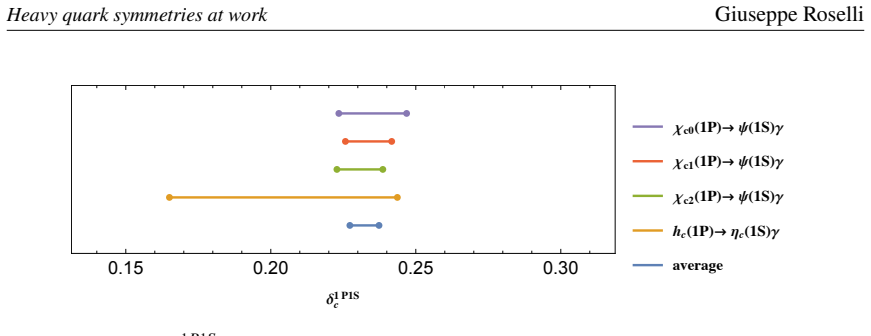
More than two decades have elapsed since the discovery of $\chi_{c1}(3872)$. For this meson, previously denoted as $X(3872)$, an impressive amount of theoretical and experimental studies has been devoted concerning its properties, decays and production mechanisms. Despite the extensive work, a full understanding of the nature of $\chi_{c1}(3872)$ is missing. I describe a theoretical framework based on the heavy quark large mass limit to analyze the radiative decays of heavy quarkonia, in particular the electric dipole transitions of $\chi_{c1}(2P)$ to $S$-wave charmonia. The results favorably compare to recent LHCb collaboration measurements for $\chi_{c1}(3872)$, if this meson is identified with $\chi_{c1}(2P)$.
Editorial analysis
A structured set of objections, weighed in public.
Referee Report
Summary. The manuscript develops a theoretical framework based on the heavy-quark large-mass limit to compute electric-dipole (E1) radiative transitions of the χ_c1(2P) charmonium state to S-wave states. It reports that these results compare favorably with recent LHCb measurements on χ_c1(3872) once the latter is identified with χ_c1(2P), thereby supporting a conventional charmonium assignment for the state.
Significance. If the comparison is robust, the work supplies a symmetry-based argument that strengthens the conventional 2P assignment over exotic interpretations. The approach is parameter-free within the strict m_Q → ∞ limit, which is a methodological strength when the limit applies. The central claim, however, hinges on the quantitative reliability of that limit for charm at the 2P mass scale.
major comments (1)
- [Results / comparison with LHCb data] The manuscript presents the E1 rates in the strict infinite-mass limit and states that they 'favorably compare' to LHCb data, yet supplies no estimate of 1/m_c corrections (expected O(30–50 %) for m_c ≈ 1.5 GeV) nor any test of sensitivity to the nearby DD* threshold. Because the numerical agreement is the sole evidence offered for the χ_c1(2P) assignment, the absence of an error budget or threshold-variation study renders the comparison inconclusive; a concrete test would be to recompute the matrix elements with leading 1/m operators or with wave functions modified by coupled-channel effects.
Simulated Author's Rebuttal
We thank the referee for the careful reading and the recommendation for major revision. The principal concern is the lack of an error budget for 1/m_c corrections and threshold sensitivity in the comparison to LHCb data. We respond to this point below.
read point-by-point responses
-
Referee: [Results / comparison with LHCb data] The manuscript presents the E1 rates in the strict infinite-mass limit and states that they 'favorably compare' to LHCb data, yet supplies no estimate of 1/m_c corrections (expected O(30–50 %) for m_c ≈ 1.5 GeV) nor any test of sensitivity to the nearby DD* threshold. Because the numerical agreement is the sole evidence offered for the χ_c1(2P) assignment, the absence of an error budget or threshold-variation study renders the comparison inconclusive; a concrete test would be to recompute the matrix elements with leading 1/m operators or with wave functions modified by coupled-channel effects.
Authors: We agree that 1/m_c corrections are expected to reach O(30–50 %) for m_c ≈ 1.5 GeV and that the DD* threshold lies nearby. Our framework, however, is formulated exclusively in the strict m_Q → ∞ limit, where the E1 rates are completely determined by heavy-quark symmetries and contain no adjustable parameters. The central purpose of the work is to show that this parameter-free limit already yields rates consistent with the LHCb measurements once χ_c1(3872) is assigned as χ_c1(2P). Introducing leading 1/m operators or coupled-channel modifications would necessarily require additional model-dependent inputs (e.g., specific wave-function ansätze or coupling strengths), thereby losing the symmetry-based, parameter-free character that is the methodological strength of the paper. We therefore maintain that the comparison in the infinite-mass limit supplies meaningful supporting evidence for the conventional assignment, even while acknowledging that a full quantitative error budget lies outside the present approach. revision: no
- Quantitative estimation of 1/m_c corrections or coupled-channel effects, as these extensions lie outside the strict heavy-quark large-mass limit employed in the manuscript.
Circularity Check
No circularity: derivation uses external heavy-quark limit and compares to independent LHCb data
full rationale
The paper introduces a framework based on the heavy quark large-mass limit to compute E1 matrix elements for χ_c1(2P) → S-wave charmonia and states that the results compare favorably to LHCb measurements under the given identification. No equations or text in the provided material indicate that any computed quantity is obtained by fitting parameters to the same LHCb numbers later used for comparison, nor does any load-bearing step reduce to a self-citation, self-definition, or renaming of a known result. The central claim remains a direct application of an established symmetry limit whose quantitative accuracy for charm is an external assumption, not a tautology constructed from the target data.
Axiom & Free-Parameter Ledger
axioms (1)
- domain assumption Heavy-quark large-mass limit applies quantitatively to charm quarks at the 2P mass scale
Reference graph
Works this paper leans on
- [1]
-
[2]
Navaset al.[Particle Data Group], Phys
S. Navaset al.[Particle Data Group], Phys. Rev. D110, 030001 (2024)
2024
-
[3]
S.K.Choietal.[Belle],Phys.Rev.Lett.91(2003),262001[arXiv:hep-ex/0309032[hep-ex]]
work page internal anchor Pith review Pith/arXiv arXiv 2003
-
[4]
D. Acostaet al.[CDF], Phys. Rev. Lett.93(2004), 072001 [arXiv:hep-ex/0312021 [hep-ex]]. 5 Heavy quark symmetries at workGiuseppe Roselli
work page internal anchor Pith review Pith/arXiv arXiv 2004
-
[5]
M. Aaboudet al.[ATLAS], JHEP01(2017), 117 [arXiv:1610.09303 [hep-ex]]
work page internal anchor Pith review Pith/arXiv arXiv 2017
- [6]
-
[7]
V.M.Abazovetal.[D0],Phys.Rev.Lett.93(2004),162002[arXiv:hep-ex/0405004[hep-ex]]
work page internal anchor Pith review Pith/arXiv arXiv 2004
-
[8]
Observation of X(3872) production in pp collisions at sqrt(s)= 7 TeV
R. Aaijet al.[LHCb], Eur. Phys. J. C72(2012), 1972 [arXiv:1112.5310 [hep-ex]]
work page internal anchor Pith review Pith/arXiv arXiv 2012
-
[9]
Observation of $e^{+} e^{-} \to \gamma X(3872)$ at BESIII
M. Ablikimet al.[BESIII], Phys. Rev. Lett.112(2014), 092001 [arXiv:1310.4101 [hep-ex]]
work page internal anchor Pith review Pith/arXiv arXiv 2014
-
[10]
S. Chatrchyanet al.[CMS], JHEP04(2013), 154 [arXiv:1302.3968 [hep-ex]]
work page internal anchor Pith review Pith/arXiv arXiv 2013
-
[11]
Determination of the X(3872) meson quantum numbers
R. Aaijet al.[LHCb], Phys. Rev. Lett.110(2013), 222001 [arXiv:1302.6269 [hep-ex]]
work page internal anchor Pith review Pith/arXiv arXiv 2013
-
[12]
R. Aaijet al.[LHCb], Phys. Rev. D102(2020), 092005 [arXiv:2005.13419 [hep-ex]]
-
[13]
Abeet al.[Belle], [arXiv:hep-ex/0505037 [hep-ex]]
K. Abeet al.[Belle], [arXiv:hep-ex/0505037 [hep-ex]]
-
[14]
Evidence for the decay X(3872) --> J/psi omega
P. del Amo Sanchezet al.[BaBar], Phys. Rev. D82(2010), 011101 [arXiv:1005.5190 [hep- ex]]
work page internal anchor Pith review Pith/arXiv arXiv 2010
-
[15]
M.Ablikimetal.[BESIII],Phys.Rev.Lett.122(2019),232002[arXiv:1903.04695[hep-ex]]
work page internal anchor Pith review Pith/arXiv arXiv 2019
-
[16]
N. Brambilla, S. Eidelman, C. Hanhart, A. Nefediev, C. P. Shen, C. E. Thomas, A. Vairo and C. Z. Yuan, Phys. Rept.873(2020), 1 [arXiv:1907.07583 [hep-ex]]
-
[17]
C. A. Meyer and E. S. Swanson, Prog. Part. Nucl. Phys.82(2015), 21 [arXiv:1502.07276 [hep-ph]]
work page internal anchor Pith review Pith/arXiv arXiv 2015
-
[18]
Low-energy Universality and the New Charmonium Resonance at 3870 MeV
E. Braaten and M. Kusunoki, Phys. Rev. D69(2004), 074005 [arXiv:hep-ph/0311147 [hep- ph]]
work page internal anchor Pith review Pith/arXiv arXiv 2004
-
[19]
E. S. Swanson, Phys. Lett. B588(2004), 189 [arXiv:hep-ph/0311229 [hep-ph]]
work page internal anchor Pith review Pith/arXiv arXiv 2004
-
[20]
C. Y. Wong, Phys. Rev. C69(2004), 055202 [arXiv:hep-ph/0311088 [hep-ph]]
work page internal anchor Pith review Pith/arXiv arXiv 2004
-
[21]
C.Hanhart,Y.S.Kalashnikova,A.E.KudryavtsevandA.V.Nefediev,Phys.Rev.D76(2007), 034007 [arXiv:0704.0605 [hep-ph]]
work page internal anchor Pith review Pith/arXiv arXiv 2007
- [22]
-
[23]
E. S. Swanson, Phys. Lett. B598(2004), 197 [arXiv:hep-ph/0406080 [hep-ph]]
work page internal anchor Pith review Pith/arXiv arXiv 2004
-
[24]
Aaijet al.[LHCb], JHEP11(2024), 121 [arXiv:2406.17006 [hep-ex]]
R. Aaijet al.[LHCb], JHEP11(2024), 121 [arXiv:2406.17006 [hep-ex]]
-
[25]
M. Neubert, Phys. Rept.245(1994), 259 [arXiv:hep-ph/9306320 [hep-ph]]
work page internal anchor Pith review Pith/arXiv arXiv 1994
-
[26]
B. A. Thacker and G. P. Lepage, Phys. Rev. D43(1991), 196
1991
-
[27]
Radiative transitions of heavy quarkonium states
F. De Fazio, Phys. Rev. D79(2009), 054015 [erratum: Phys. Rev. D83(2011), 099901] [arXiv:0812.0716 [hep-ph]]
work page internal anchor Pith review Pith/arXiv arXiv 2009
-
[28]
Casalbuoni, A
R. Casalbuoni, A. Deandrea, N. Di Bartolomeo, R. Gatto, F. Feruglio and G. Nardulli, Phys. Lett. B302(1993) 95. 6
1993
discussion (0)
Sign in with ORCID, Apple, or X to comment. Anyone can read and Pith papers without signing in.