REVIEW 4 major objections 36 references
Large Behavior Model: A Promptable Digital Twin of the Retail Customer
T0 review · 4 major / 0 minor · reviewed 2026-07-13 · grok-4.5
Pith's one-line read Language models grounded in real purchase histories can simulate individual retail customers better than frontier general-purpose models.
desk verdict Solid applied systems paper with real transfer numbers; the soft spot is that their own B-hard ladder shows prompt evidence, not internalized twins, drives most of the accuracy. read the letter →
The pith
A machine-rendered reading of the paper's core claim, the machinery that carries it, and where it could break.
The reading
What carries the argument
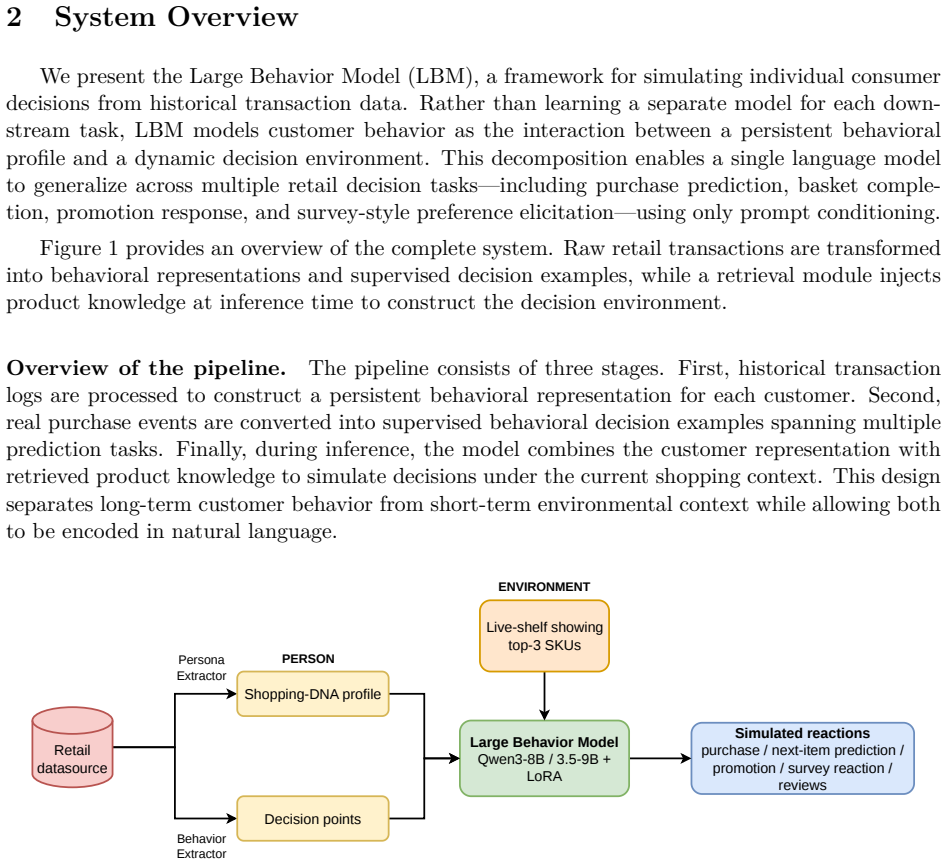
The Person–Environment formulation B = f(P, E). Person is a Shopping-DNA behavioral profile (plus segment-level LoRA adapters) derived from historical purchases; Environment is product context injected by retrieval-augmented generation. A four-stage pipeline—continued pre-training on verbalized behavior, supervised fine-tuning for decision formats, and GRPO reinforcement learning with verifiable rewards—turns a general language model into a promptable customer simulator.
What would settle it
Hold the Shopping-DNA text and retrieved product lines fixed, then compare the trained LBM against an untrained base model of the same size on the B-hard ladder: if accuracy stays near the trained model’s whenever a legible similarity cue is present, the claim that behavioral knowledge was learned into the weights fails.
Extended reading notes
Core claim
Behavioral knowledge encoded in longitudinal transaction histories can be learned by language models. Through a Person–Environment formulation—persistent customer profiles from purchase history plus retrieval-augmented product context—a single Large Behavior Model consistently outperforms frontier general-purpose language models on in-domain retail decision tasks and shows strong zero-shot and fine-tuned transfer across retailers and decision domains, with continued pre-training as the primary driver of that generalization.
Load-bearing premise
The measured gains come from the model having learned individual customer decision-making, not mainly from reading stronger evidence already written into the prompts.
Editorial extensions
If this is right
- One shared language model can simulate purchase, basket, promotion, and survey-style decisions without separate task-specific architectures.
- Behavioral representations learned from grocery transactions can transfer zero-shot to e-commerce voucher ranking and improve further with light fine-tuning.
- Continued pre-training on verbalized transactions, not model size alone, is the main route to behavioral generalization.
- Retailers can build scalable customer digital twins from existing transaction logs rather than surveys or many separate recommenders.
- Simulation fidelity is limited more by the quality of in-prompt behavioral evidence than by the size of the underlying model.
Reading between the lines
- If the B-hard results are right and accuracy tracks legible in-prompt similarity more than internalized taste, real deployments will depend on continuous high-quality profile writing and retrieval, not only on larger weights.
- The same Person–Environment recipe may apply outside retail wherever longitudinal event logs can be verbalized—healthcare choices, media consumption, or financial products.
- Replacing handcrafted Shopping-DNA with learned continuous prompt embeddings, as the authors themselves propose, is the clean test of whether the gains survive without human-written summaries.
- Segment-level adapters may hit a ceiling on fine-grained discrimination tasks that need true per-user sequence memory rather than persona averages.
Signed reviews
Editorial analysis
A structured set of objections, weighed in public.
Referee Report
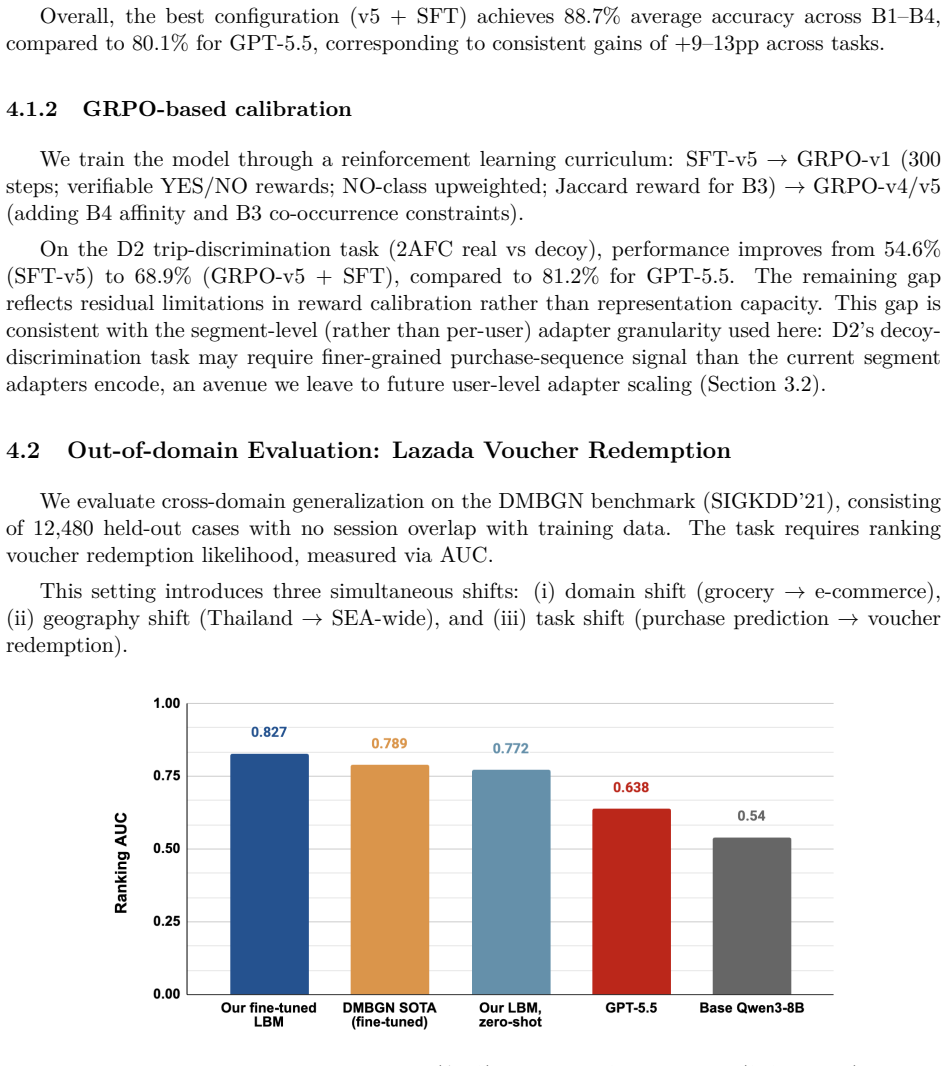
Summary. The paper proposes the Large Behavior Model (LBM), a language-model framework that simulates retail customer decisions via a Person–Environment factorization: a Shopping-DNA behavioral profile (plus segment-level LoRA) for the person, and retrieval-augmented product context for the environment. Training chains continued pre-training on verbalized transactions, supervised fine-tuning for decision formats, and GRPO with verifiable rewards for evidence-based calibration. On held-out classic-B (n=5,091) and B-hard v4 (n=2,490) tasks the model beats GPT-5.5 on average (especially hard-negative discrimination B2); it also shows zero-shot and fine-tuned transfer on Lazada voucher redemption (AUC 0.772 / 0.827). Ablations attribute generalization mainly to CPT, require RAG at train and inference, and credit GRPO with shifting reliance from LM priors to in-prompt evidence.
Significance. If the results hold under fair, controlled prompting, the work is a useful systems contribution: a single promptable model spanning purchase, basket, promotion, and cross-domain voucher tasks, with a clear CPT→SFT→GRPO recipe and an external SIGKDD-style transfer check. The Person–Environment framing and the explicit finding that retrieval placement and prompt evidence quality dominate performance are practically valuable for retail digital-twin deployments. Strengths include multi-task evaluation with hard negatives, an external voucher benchmark, and stage-wise ablations that separate format learning from behavioral generalization. The paper does not ship code or machine-checked proofs, but the experimental design is concrete enough to be reimplemented and stress-tested.
major comments (4)
- §3.6 and Figure 3 undercut the headline claim of internalized individual decision-making. Accuracy is near chance with no in-prompt evidence (v1), ~60% with similar-item names (v2), and 95.9% with one legible similarity line (v3); the text states that “the bottleneck is prompt signal, not weights” and that the model “primarily operates as an evidence-conditioned decision system rather than a latent similarity engine.” GRPO is likewise framed as evidence-over-prior calibration (§3.4, §3.8). Tables 3–4 gains—especially B2—are therefore consistent with superior packaging/reading of Shopping-DNA/RAG cues. To support “learned behavioral simulation” and “digital twin” language (Abstract; Contributions 2,5; §6), the paper needs either (i) an isolation experiment that strips explicit similarity/affinity lines while holding the same retrieved candidates and profile text, or (ii) a clear reframing
- Fairness of the GPT-5.5 baseline is not fully specified for Tables 3–4 and Figure 4. The manuscript must state, for each task, whether GPT-5.5 receives identical Shopping-DNA profiles, the same top-k RAG SKUs, and the same decision templates as LBM. If the frontier model is under-prompted relative to LBM, the +9.5pp / +15.7pp averages cannot be attributed to behavioral knowledge learned via CPT/SFT/GRPO. A short protocol paragraph (or appendix table) listing prompt contents per model is load-bearing for the central comparison claim.
- Statistical reporting is insufficient for the main claims. Tables 3–4 and the Lazada AUC results report point estimates only (n=5,091; n=2,490; 12,480 cases) with no confidence intervals, bootstrap, or significance tests, and no multi-seed variance for LoRA/GRPO training. Given that B2 drives much of the average gap and that B4 is near-tied or weak (52.0 vs 51.6 on B-hard), error bars and a simple paired test (or customer-level bootstrap) are needed before claiming consistent outperformance and transfer.
- Scale and personalization granularity limit the digital-twin claim. Primary data cover 1,500 customers (Table 1); adapters are segment-level, not user-level (§3.2), and the D2 trip-discrimination gap vs GPT-5.5 (68.9% vs 81.2%) is attributed to that choice. Claims of scaling “efficiently to millions of users” (Introduction) and of a faithful individual twin are not yet supported by the reported cohort or adapter design. Either qualify the claim to segment-conditioned simulation or add a user-level adapter scaling study on a denser subset.
Circularity Check
Empirical systems paper with held-out and external benchmarks; no derivation that reduces predictions to inputs by construction.
full rationale
This is an empirical ML systems paper, not a first-principles derivation. Training uses observed purchases as supervision (CPT on verbalized transactions, SFT on decision examples, GRPO with verifiable YES/NO and Jaccard rewards); evaluation uses held-out baskets (Classic-B, B-hard) and an external voucher-redemption benchmark (DMBGN/Lazada) with no session overlap. The Person–Environment formulation (B=f(P,E)) is a modeling choice, not a tautology that forces the reported accuracies. Shopping-DNA is built only from the training period to avoid leakage, and gains vs GPT-5.5 are measured on real outcomes rather than redefined targets. Mild self-referential risk exists because profiles, retrieval candidates, and rewards are constructed from the same behavioral logs that define the tasks, and the paper itself shows accuracy is dominated by in-prompt evidence quality (B-hard ladder). That is a validity/overclaim concern about what is learned, not circularity of the form “prediction equals fitted input by construction.” No uniqueness theorem, self-citation chain, or ansatz is load-bearing for the results. Score 1 for that mild construction overlap only; steps empty because nothing reduces by definition to its inputs.
Assumptions & free parameters
free parameters (5)
- LoRA rank r and alpha
- RAG top-k and embedding dimension
- GRPO reward weights and curriculum
- Segment definitions for adapters
- Shopping-DNA feature schema
assumptions (5)
- domain assumption Customer behavior is adequately modeled as B = f(P, E) with P from historical purchases and E from retrieved product context (Lewin-inspired).
- ad hoc to paper Verbalized transaction summaries plus segment-level LoRA capture persistent individual preferences well enough for multi-task simulation without continuous user embeddings.
- domain assumption Held-out real purchases and hard negatives are valid ground truth for “faithful” behavioral simulation (vs open-ended review/survey language).
- domain assumption Standard transformer LM training objectives (next-token CPT, SFT, GRPO-style RL) transfer behavioral structure when data are verbalized.
- standard math No evaluation-period leakage into Shopping-DNA (train-period transactions only).
invented entities (3)
-
Shopping-DNA profile
-
Large Behavior Model (LBM) as unified Person–Environment simulator
-
B-hard difficulty ladder (prompt-signal versions v1–v4)
Cite this review
Pith. "Pith review of Large Behavior Model: A Promptable Digital Twin of the Retail Customer." pith.science (2026). https://pith.science/paper/USEKNUBG
@misc{pith2026260706993,
  author       = {Pith},
  title        = {Pith review of: Large Behavior Model: A Promptable Digital Twin of the Retail Customer},
  year         = {2026},
  howpublished = {\url{https://pith.science/paper/USEKNUBG}},
  note         = {Machine review of arXiv:2607.06993}
}
read the original abstract
Customer behavior modeling underpins recommendation, marketing, and decision support, yet existing approaches either optimize predictive accuracy without explaining decisions or simulate users without grounding them in real behavioral data. We present the Large Behavioral Model (LBM) that learns customer decision making directly from large-scale retail transactions through a unified Person-Environment formulation. Customer state is represented by a behavioral profile derived from historical purchases, while product context is incorporated through retrieval-augmented generation. The model is trained using continued pre-training on verbalized behavioral data, supervised fine-tuning for decision generation, and reinforcement learning with verifiable rewards for evidence-based calibration. We evaluate the proposed framework on purchase prediction, hard-negative discrimination, basket completion, promotion response, and cross-domain voucher redemption. The model consistently outperforms frontier general-purpose language models on in-domain retail tasks while demonstrating strong zero-shot and fine-tuned transfer across retailers and decision domains. Ablation studies show that continued pre-training is the primary driver of behavioral generalization, retrieval is most effective when applied during both training and inference, and reinforcement learning improves reliance on explicit behavioral evidence over generic language-model priors. These results demonstrate that behavioral knowledge encoded in transaction histories can be effectively learned by language models, providing a scalable foundation for customer digital twins and behavior simulation.
Figures


Figures from the paper (2 more)

Reference graph
Works this paper leans on
-
[1]
Conditional logit analysis of qualitative choice behavior,
D. McFadden, “Conditional logit analysis of qualitative choice behavior,” inFrontiers in Econometrics, P. Zarembka, Ed. Academic Press, 1974, pp. 105–142
1974
-
[2]
K. E. Train,Discrete Choice Methods with Simulation, 2nd ed. Cambridge University Press, 2009
2009
-
[3]
Marketing analytics for data-rich environments,
M. Wedel and P. K. Kannan, “Marketing analytics for data-rich environments,”Journal of Marketing, vol. 80, no. 6, pp. 97–121, 2016. 14
2016
-
[4]
Lewin,Principles of Topological Psychology
K. Lewin,Principles of Topological Psychology. McGraw-Hill, 1936
1936
-
[5]
N. K. Malhotra,Marketing Research: An Applied Orientation, 7th ed. Pearson, 2019
2019
-
[6]
A logit model of brand choice calibrated on scanner data,
P. M. Guadagni and J. D. C. Little, “A logit model of brand choice calibrated on scanner data,”Marketing Science, vol. 2, no. 3, pp. 203–238, 1983
1983
-
[7]
Matrix factorization techniques for recommender sys- tems,
Y. Koren, R. Bell, and C. Volinsky, “Matrix factorization techniques for recommender sys- tems,”Computer, vol. 42, no. 8, pp. 30–37, 2009
2009
-
[8]
Neural collaborative filtering,
X. He, L. Liao, H. Zhang, L. Nie, X. Hu, and T.-S. Chua, “Neural collaborative filtering,” in Proceedings of the 26th International Conference on World Wide Web (WWW). International World Wide Web Conferences Steering Committee, 2017, pp. 173–182
2017
Show all 36 references
-
[9]
Self-attentive sequential recommendation,
W.-C. Kang and J. McAuley, “Self-attentive sequential recommendation,” inProceedings of the IEEE International Conference on Data Mining (ICDM). IEEE, 2018, pp. 197–206
2018
-
[10]
BERT4Rec: Sequential rec- ommendation with bidirectional encoder representations from transformer,
F. Sun, J. Liu, J. Wu, C. Pei, X. Lin, W. Ou, and P. Jiang, “BERT4Rec: Sequential rec- ommendation with bidirectional encoder representations from transformer,” inProceedings of the 28th ACM International Conference on Information and Knowledge Management (CIKM). ACM, 2019, pp...
2019
-
[11]
Actions speak louder than words: Trillion-parameter sequential transducers for generative recommendations,
J. Zhaiet al., “Actions speak louder than words: Trillion-parameter sequential transducers for generative recommendations,”arXiv preprint arXiv:2402.17152, 2024
2024 arXiv
-
[12]
Recommender systems with generative retrieval,
S. Rajputet al., “Recommender systems with generative retrieval,” inAdvances in Neural Information Processing Systems (NeurIPS), 2023
2023
-
[13]
Training language models to follow instructions with human feedback,
L. Ouyang, J. Wu, X. Jianget al., “Training language models to follow instructions with human feedback,” inAdvances in Neural Information Processing Systems (NeurIPS), vol. 35, 2022, pp. 27730–27744
2022
-
[14]
The Llama 3 herd of models,
A. Dubey, A. Jauhri, A. Pandeyet al., “The Llama 3 herd of models,”arXiv preprint arXiv:2407.21783, 2024
2024 arXiv
-
[15]
Qwen3 technical report,
Qwen Team, “Qwen3 technical report,”arXiv preprint arXiv:2505.09388, 2025
2025 arXiv
-
[16]
Gemma 2: Improving open language models at a practical size,
Gemma Team, M. Riviere, S. Pathaket al., “Gemma 2: Improving open language models at a practical size,”arXiv preprint arXiv:2408.00118, 2024
2024 arXiv
-
[17]
Generative agents: Interactive simulacra of human behavior,
J. S. Park, J. C. O’Brien, C. J. Cai, M. R. Morris, P. Liang, and M. S. Bernstein, “Generative agents: Interactive simulacra of human behavior,” inProceedings of the 36th Annual ACM Symposium on User Interface Software and Technology (UIST). ACM, 2023, pp. 1–22
2023
-
[18]
Out of one, many: Using language models to simulate human samples,
L. P. Argyle, E. C. Busby, N. Fulda, J. R. Gubler, C. Rytting, and D. Wingate, “Out of one, many: Using language models to simulate human samples,”Political Analysis, vol. 31, no. 3, pp. 337–351, 2023
2023
-
[19]
Generative agent simulations of 1,000 people,
J. S. Park, C. Q. Zou, A. Shaw, B. M. Hill, C. Cai, M. R. Morris, R. Willer, P. Liang, and M. S. Bernstein, “Generative agent simulations of 1,000 people,”arXiv preprint arXiv:2411.10109, 2024. 15
2024 arXiv
-
[20]
Large content and behavior models to understand, simulate, and optimize content and behavior,
A. Khandelwal, A. Agrawal, A. Bhattacharyyaet al., “Large content and behavior models to understand, simulate, and optimize content and behavior,” 2024. [Online]. Available: https://arxiv.org/abs/2309.00359
2024 arXiv
-
[21]
Can llm agents simulate multi-turn human behavior? evidence from real online customer behavior data,
Y. Lu, J. Huang, Y. Hanet al., “Can llm agents simulate multi-turn human behavior? evidence from real online customer behavior data,” 2026. [Online]. Available: https://arxiv.org/abs/2503.20749
2026 arXiv
-
[22]
Shop-r1: Rewarding llms to simulate human behavior in online shopping via reinforcement learning,
Y. Zhang, T. Wang, J. Gesiet al., “Shop-r1: Rewarding llms to simulate human behavior in online shopping via reinforcement learning,” 2026. [Online]. Available: https://arxiv.org/abs/2507.17842
2026
-
[23]
Customer-r1: Personalized simulation of human behaviors via rl-based llm agent in online shopping,
Z. Wang, Y. Lu, Y. Zhang, J. Huang, and D. Wang, “Customer-r1: Personalized simulation of human behaviors via rl-based llm agent in online shopping,” 2025. [Online]. Available: https://arxiv.org/abs/2510.07230
2025
-
[24]
The need for a socially- grounded persona framework for user simulation,
P. N. Venkit, Y. Li, Y. Pruksachatkun, and C.-S. Wu, “The need for a socially- grounded persona framework for user simulation,” 2026. [Online]. Available: https: //arxiv.org/abs/2601.07110
2026
-
[25]
Nemotron-personas: Multilingual, region-specific synthetic persona datasets,
NVIDIA, “Nemotron-personas: Multilingual, region-specific synthetic persona datasets,” https://huggingface.co/collections/nvidia/nemotron-personas, 2026, hugging Face Collection, accessed 2026
2026
-
[26]
A survey on llm-based conversational user simulation,
B. Ni, Y. Wang, L. Wanget al., “A survey on llm-based conversational user simulation,” inProceedings of the 19th Conference of the European Chapter of the Association for Computational Linguistics (Volume 1: Long Papers). Association for Computational Linguistics, 2026, p. 426...
2026 doi
-
[27]
Mind the sim2real gap in user simulation for agentic tasks,
X. Zhou, W. Sun, Q. Maet al., “Mind the sim2real gap in user simulation for agentic tasks,”
-
[28]
Available: https://arxiv.org/abs/2603.11245
[Online]. Available: https://arxiv.org/abs/2603.11245
-
[29]
Digital twins as funhouse mirrors: Five key distortions,
T. Peng, G. Gui, M. Bruckset al., “Digital twins as funhouse mirrors: Five key distortions,”
-
[30]
Available: https://arxiv.org/abs/2509.19088
[Online]. Available: https://arxiv.org/abs/2509.19088
-
[31]
Long context, less focus: A scaling gap in llms revealed through privacy and personalization,
S. Gu, “Long context, less focus: A scaling gap in llms revealed through privacy and personalization,” 2026. [Online]. Available: https://arxiv.org/abs/2602.15028
2026
-
[32]
User-llm: Efficient llm contextualization with user embeddings,
L. Ning, L. Liu, J. Wu, N. Wu, D. Berlowitz, S. Prakash, B. Green, S. O’Banion, and J. Xie, “User-llm: Efficient llm contextualization with user embeddings,” 2024. [Online]. Available: https://arxiv.org/abs/2402.13598
2024 arXiv
-
[33]
Do llms benefit from user and item embeddings in recommendation tasks?
M. R. I. Hossain, L. Feng, L. Sigal, and M. O. Ahmed, “Do llms benefit from user and item embeddings in recommendation tasks?” 2026. [Online]. Available: https://arxiv.org/abs/2601.04690
2026
-
[34]
Curp: Codebook-based continuous user representation for personalized generation with llms,
L. Wang, X. Mou, X. Liu, X. Huang, and Z. Wei, “Curp: Codebook-based continuous user representation for personalized generation with llms,” 2026. [Online]. Available: https://arxiv.org/abs/2602.00742 16
2026 arXiv
-
[35]
Retrieval-augmented generation for knowledge-intensive nlp tasks,
P. Lewis, E. Perez, A. Piktuset al., “Retrieval-augmented generation for knowledge-intensive nlp tasks,” inAdvances in Neural Information Processing Systems, vol. 33, 2020, pp. 9459– 9474
2020
-
[36]
Twin-2k-500: A dataset for building digital twins of over 2,000 people based on their answers to over 500 questions,
O. Toubia, G. Z. Gui, T. Peng, D. J. Merlau, A. Li, and H. Chen, “Twin-2k-500: A dataset for building digital twins of over 2,000 people based on their answers to over 500 questions,” arXiv preprint arXiv:2505.17479, 2025. A Reproducibility Base models.Qwen3-8B (PoC / Phase-7)...
2025 arXiv
Reviewed July 13, 2026 · model on record in the stance chip above.
Discussion (0). Continue with ORCID to comment.