REVIEW 3 major objections 4 minor 34 references
Impact of qubit anharmonicity on near-resonant Rabi oscillations
T0 review · 3 major / 4 minor · reviewed 2026-08-09 · deepseek-v4-flash
Pith's one-line read Near-resonant Rabi oscillations in a three-level superconducting qubit acquire a correction to the squared Rabi frequency that is linear in the detuning-to-anharmonicity ratio, and fluxonium measurements confirm the predicted slope at…
desk verdict A clean, small but real result: the Rabi frequency carries a detuning-anharmonicity correction that matters for coupler-activated CZ gates, and the two-sweet-spot verification gives it credibility. read the letter →
The pith
A machine-rendered reading of the paper's core claim, the machinery that carries it, and where it could break.
The reading
What carries the argument
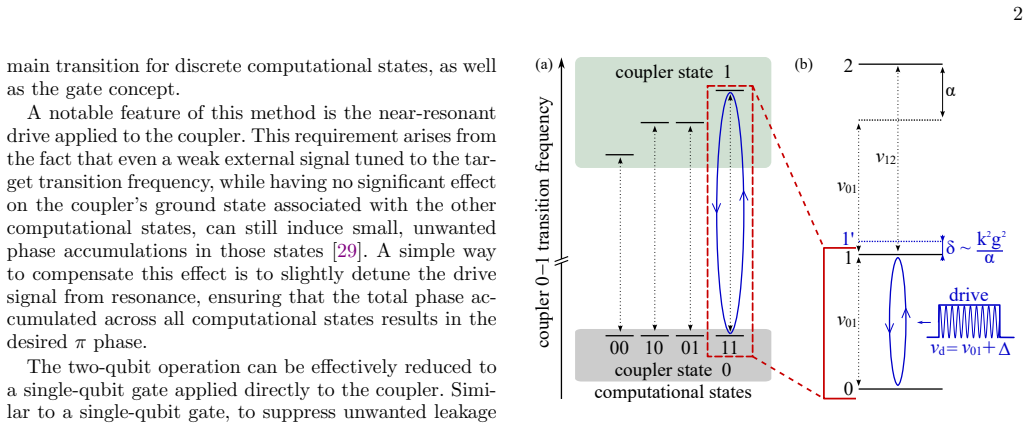
The load-bearing object is the rotating-wave three-level Hamiltonian of Eq. (1), restricted to the states $|0\rangle$, $|1\rangle$, $|2\rangle$ with the 0-2 transition forbidden by parity and with drive amplitude $g$, detuning $\Delta$, anharmonicity $\alpha$, and matrix-element ratio $k = m_{12}/m_{01}$. The argument goes by diagonalizing this Hamiltonian exactly, then expanding the 0-1 Rabi frequency in $g/\alpha$ under the assumptions $g \ll \alpha$ and $\Delta \ll \alpha$, producing Eq. (2) with the slope $s = 1 + (k^2/2)(\Delta/\alpha)$. The physical mechanism is the ac Stark shift $\delta = (k^2/4)(g^2/\alpha)$ of the 1-2 transition, which shifts the 0-1 frequency and thereby changes the Rabi frequency. This machinery carries the argument by converting a multi-level drive problem into a single three-level diagonalization whose leading correction is directly measurable in the slope of $\Omega_{\mathrm{Rabi}}^2$ versus $g^2$.
What would settle it
Measure the squared Rabi frequency versus drive amplitude on a device whose 0-2 transition is not parity-forbidden, or at detunings approaching the anharmonicity, and check whether the slope departs from $1 + (k^2/2)(\Delta/\alpha)$ by more than the experimental uncertainty.
Extended reading notes
Core claim
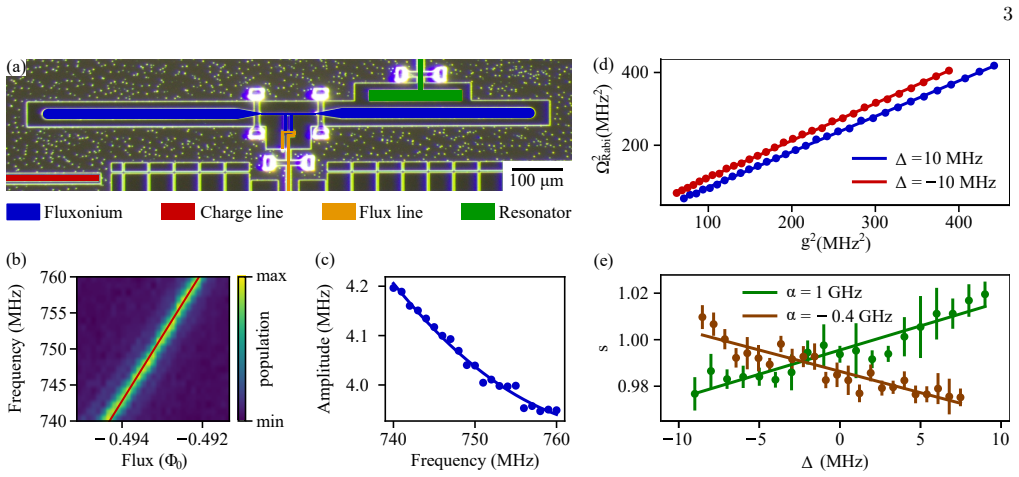
The paper's central claim is that the Rabi frequency of the 0-1 transition of a weakly driven, near-resonant three-level system is not $\sqrt{\Delta^2 + g^2}$ but rather, to leading order in $g/\alpha$, $$\Omega_{\mathrm{Rabi}}^2 \approx \$\Delta$^2 + $g^{2}$\left(1 + \frac{$k^{2}$}{2}\frac{\$\Delta$}{\$\alpha$}\right),$$ where $\Delta$ is the drive detuning, $g$ the drive amplitude, $\alpha$ the anharmonicity, and $k = m_{12}/m_{01}$ the ratio of 1-2 to 0-1 transition matrix elements. The coefficient $s = \Omega_{\mathrm{Rabi}}^2/g^2$ therefore depends on $\Delta/\alpha$. The paper derives this from the rotating-wave three-level Hamiltonian with the 0-2 transition forbidden, identifies the physical origin as the ac Stark shift of the 1-2 transition, and verifies it experimentally on fluxonium qubits near both sweet spots, obtaining slopes $2.08 \pm 0.18$ ns and $-2.16 \pm 0.19$ ns against predictions of $2.23$ ns and $-2.26$ ns.
Load-bearing premise
The prediction stands or falls on the three-level truncation with the 0-2 transition exactly forbidden and the rotating-wave approximation; if higher levels or the 0-2 coupling participate, the simple linear correction changes.
Editorial extensions
If this is right
- The slope $s$ relating $\Omega_{\mathrm{Rabi}}^2$ to $g^2$ carries the sign of the anharmonicity, so the correction appears with opposite trends at the two fluxonium sweet spots.
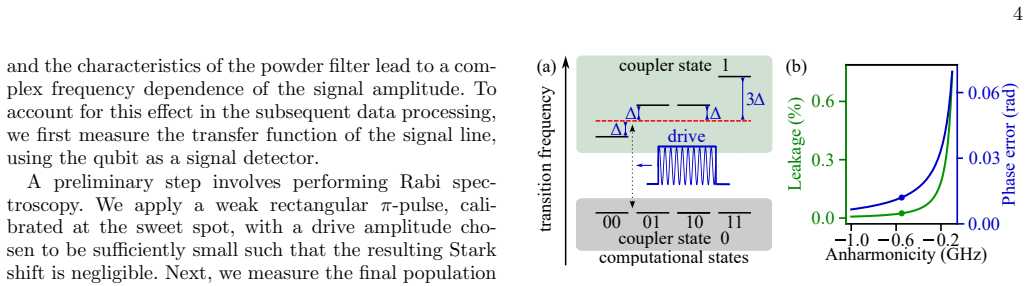
- For the coupler-activated CZ gate with $\Delta = 14$ MHz, $\alpha = -550$ MHz, and $k = 1.29$, neglecting the correction yields a leakage of about $0.02\%$ and a phase error of about $0.016$ rad.
- The error from neglecting the correction grows as the coupler anharmonicity shrinks, making the effect important for low-anharmonicity couplers.
- A frequency calibration that accounts for the multilevel Stark shift removes these leakage and phase errors entirely.
Reading between the lines
- The same correction should appear in any three-level system driven near resonance, not just fluxonium, so transmon-based couplers with smaller anharmonicity would show a larger relative effect.
- The measured slope $s$ is an independent handle on the matrix-element ratio $k$, so the same Rabi experiment could double as a parameter-extraction tool.
- A natural calibration protocol follows from the formula: measure $\Omega_{\mathrm{Rabi}}^2$ versus $g^2$ at two detunings and use the slope difference to set the drive parameters for the gate.
- Pushing the drive amplitude up until $g$ approaches $\alpha$ would test the limits of the leading-order expansion, since the exact cubic solution predicts deviations that the linearized formula does not.
Editorial analysis
A structured set of objections, weighed in public.
Referee Report
Summary. The paper reports an experimental and theoretical study of Rabi oscillations in a fluxonium qubit under weak near-resonant driving, motivated by microwave-activated coupler CZ gates. The authors reduce the system to a three-level model with the 0–2 transition forbidden, solve the resulting Hamiltonian exactly in Appendix A, and obtain the approximation Ω_Rabi² ≈ Δ² + g²(1 + (k²/2)(Δ/α)), so that the slope s of Ω_Rabi² versus g² is predicted to vary linearly with the detuning-to-anharmonicity ratio. They measure s near both fluxonium sweet spots, where the anharmonicity has opposite signs, obtaining slopes 2.08 ± 0.18 ns and −2.16 ± 0.19 ns against predicted values 2.23 and −2.26 ns. They then estimate leakage and phase errors in a coupler-activated CZ gate if this correction is neglected.
Significance. The result is a clean, externally checked prediction: α and k are extracted from spectroscopy rather than fitted to the Rabi data, and the predicted sign reversal of the slope with the sign of α is confirmed. The exact diagonalization in Appendix A makes the expansion checkable, and the CZ error analysis gives a concrete practical motivation. If the truncation concerns are addressed, this is a useful calibration correction for microwave-activated gates on anharmonic qubits. The main limitation is that the three-level truncation and the exactly forbidden 0–2 transition are assumed rather than quantitatively bounded, so the theoretical prediction currently lacks a systematic error estimate.
major comments (3)
- [Section II, assumptions (i) and (v); Section III] The three-level truncation is the least quantitatively supported pillar of the derivation. The manuscript states that the harmonic mode is engineered to differ by more than 1 GHz from the sweet-spot frequencies, but the probed correction is a virtual 1–2 transition: at the low sweet spot ν01 = 0.75 GHz and α = 1.335 GHz, ν12 = 2.085 GHz, so a mode placed more than 1 GHz from ν01 can lie within roughly 0.3 GHz of ν12. Such a mode can renormalize k and α and hence the predicted slope s. No quantitative estimate is given for the error from truncating to three levels, and no measured bound is given for the residual 0–2 matrix element assumed to vanish in assumption (v). Please add a truncation-error estimate, for example a four-level Schrieffer–Wolff calculation or a numerical diagonalization including the harmonic mode, and report the harmonic-mode frequency relative to ν12 together with a bound on the 0–2 coupling. The empirical agreement provides a posteriori support, but it does not by itself distinguish the three-level model from a four-level model with a renormalized slope.
- [Section II, Eq. (4)] As written, δ = k²g²/(4α) has the wrong sign to be the Stark shift responsible for Eq. (2) under the stated convention α = ν12 − ν01. For α > 0 the virtual 1–2 coupling shifts level |1> downward; using δ with the opposite sign in the effective two-level detuning gives Ω² ≈ Δ² + g²(1 − k²Δ/(2α)), which contradicts both Eq. (2) and the measured positive slope at the low sweet spot. To be consistent with Eq. (2), the shift entering the effective detuning must be δ = −k²g²/(4α), or the text should clearly state a different sign convention. Please correct Eq. (4) and any related text in Fig. 1.
- [Section III, Fig. 2(e)] The agreement statement would be quantitative if the predicted slopes carried uncertainties propagated from the spectroscopy-derived parameters k and α from Appendix C. Currently the predictions are point values (2.23 and −2.26 ns) while the fitted slopes have ±0.18 and ±0.19 ns errors. Please propagate the uncertainties in k and α, including correlations, into s, and state whether the residuals are within the combined experimental and theoretical uncertainty.
minor comments (4)
- [Section II, Eq. (2)] The expansion is written with O(g⁴/α⁴), but the slope s in Eq. (3) is valid only after also neglecting terms of order Δ²/α² in the coefficient of g²; please state explicitly that Eq. (3) is the leading-order slope in both Δ/α and g/α.
- [Section III, Fig. 2(d)–(e)] The fitting procedure is not fully specified; please state how many repetitions were averaged, how the Rabi frequencies were extracted, and how the slope uncertainties were obtained.
- [Section IV, Eq. (6)] The gate parameters g = √(5/3) Δ, νd = (ν00 + ν10)/2, and τ = √(3/2) π/Δ are introduced without derivation; a brief derivation or reference would help the reader assess the error estimates.
- [References] Reference [22] contains a formatting artifact and should be cleaned before publication.
Circularity Check
No significant circularity: the central prediction Eq. (2) follows from an explicit three-level Hamiltonian with independently measured parameters, and the experiment is a genuine external check.
full rationale
The paper's derivation chain is self-contained. Equation (2) is obtained by exact diagonalization of the three-level RWA Hamiltonian (1) in Appendix A, followed by a controlled expansion in g/α and Δ/α. The predicted slope s = 1 + (k^2/2)(Δ/α) contains only parameters α and k, which are obtained from separate spectroscopy data (fluxonium parameters in Table I and Appendix C), not from the Rabi-oscillation data used to test the prediction. The experiment measures Ω_Rabi^2 versus g^2 at various detunings and extracts the slope s; the agreement between measured slopes (2.08 ± 0.18 ns and −2.16 ± 0.19 ns) and predicted values (2.23 ns and −2.26 ns) is a genuine external check. Calibrating g via resonant Rabi oscillations is an operational definition of drive amplitude, not a fit of the detuning dependence, and the nontrivial content is the linear-in-Δ variation of s. The self-citations to prior work [1, 29] provide context for the coupler-activated CZ gate and the illustrative parameter values in Section IV, but the central derivation does not rely on any unverified self-cited result. The stated assumptions in Section II, including three-level truncation and the forbidden 0–2 transition, are explicit model restrictions; they may pose correctness risks, but they are not circular. No equation or fitted parameter is shown to reduce by construction to the claim being tested.
Assumptions & free parameters
free parameters (2)
- anharmonicity alpha =
1.335 GHz (low sweet spot, device A), -0.403 GHz (high sweet spot, device B)
- matrix element ratio k = m12/m01 =
2.44 (low sweet spot), 1.35 (high sweet spot)
assumptions (5)
- domain assumption The system can be effectively described by a three-level model (assumption (i)).
- domain assumption Rotating wave approximation is valid (assumption (ii)).
- domain assumption Equal-parity 0-2 transition is forbidden at sweet spots (assumption (v)).
- domain assumption Detuning and drive strength satisfy Delta much less than alpha and g much less than alpha (assumptions (iii) and (iv)).
- domain assumption Rabi frequency measured at resonance calibrates the drive amplitude g without significant anharmonic correction.
Cite this review
Pith. "Pith review of Impact of qubit anharmonicity on near-resonant Rabi oscillations." pith.science (2026). https://pith.science/paper/USHPNFLZ
@misc{pith2026250118521,
  author       = {Pith},
  title        = {Pith review of: Impact of qubit anharmonicity on near-resonant Rabi oscillations},
  year         = {2026},
  howpublished = {\url{https://pith.science/paper/USHPNFLZ}},
  note         = {Machine review of arXiv:2501.18521}
}
read the original abstract
Precise quantum control relies on a deep understanding of the dynamics of quantum systems under external drives. This study investigates the impact of anharmonicity on qubit dynamics under conditions typical for two-qubit entangling gates activated by weak near-resonant microwave drives. We measure the Rabi oscillation frequency as a function of drive amplitude and detuning. Our results reveal a linear dependence of the squared Rabi frequency on the squared drive amplitude, which relates to the ratio of detuning to anharmonicity, demonstrating strong agreement between experimental data and analytical predictions. Additionally, we analyze the leakage and phase errors arising from inaccurate Rabi frequency adjustments in the CZ gate implementation on fluxonium qubits driven by a microwave signal applied to the coupler.
Figures
Figures from the paper (1 more)
Reference graph
Works this paper leans on
-
[1]
Coupler microwave-activated controlled-phase gate on fluxonium qubits
Ilya A Simakov, Grigoriy S Mazhorin, Ilya N Moskalenko, Nikolay N Abramov, Alexander A Grigorev, Dmitry O Moskalev, Anastasiya A Pishchimova, Nikita S Smirnov, Evgeniy V Zikiy, Ilya A Rodionov, et al. Coupler microwave-activated controlled-phase gate on fluxonium qubits. PRX Quantum, 4(4):040321, 2023
work page 2023
-
[2]
Suppressing Counter-Rotating Errors for Fast Single-Qubit Gates with Fluxonium
David A Rower, Leon Ding, Helin Zhang, Max Hays, Jun- young An, Patrick M Harrington, Ilan T Rosen, Jeffrey M Gertler, Thomas M Hazard, Bethany M Niedzielski, et al. Suppressing counter-rotating errors for fast single-qubit gates with fluxonium. arXiv preprint arXiv:2406.08295, 2024
work page Pith review arXiv 2024
-
[3]
24 days- stable cnot-gate on fluxonium qubits with over 99.9% fi- delity
Wei-Ju Lin, Hyunheung Cho, Yinqi Chen, Maxim G Vav- ilov, Chen Wang, and Vladimir E Manucharyan. 24 days- stable cnot-gate on fluxonium qubits with over 99.9% fi- delity. arXiv preprint arXiv:2407.15783, 2024
arXiv 2024
-
[4]
Leakage reduction in fast superconducting qubit gates via optimal control
Max Werninghaus, Daniel J Egger, Federico Roy, Shai Machnes, Frank K Wilhelm, and Stefan Filipp. Leakage reduction in fast superconducting qubit gates via optimal control. npj Quantum Information, 7(1):14, 2021
work page 2021
-
[5]
Eric Hyypp¨ a, Antti Veps¨ al¨ ainen, Miha Papiˇ c, Chun Fai Chan, Sinan Inel, Alessandro Landra, Wei Liu, J¨ urgen Luus, Fabian Marxer, Caspar Ockeloen-Korppi, et al. Reducing leakage of single-qubit gates for superconduct- ing quantum processors using analytical control pulse en- velopes. PRX Quantum, 5(3):030353, 2024
work page 2024
-
[6]
Accurate control of josephson phase qubits
Matthias Steffen, John M Martinis, and Isaac L Chuang. Accurate control of josephson phase qubits. Physical Re- view B, 68(22):224518, 2003
work page 2003
-
[7]
Efficient initialization of flux- onium qubits based on auxiliary energy levels
Tenghui Wang, Feng Wu, Fei Wang, Xizheng Ma, Gengyan Zhang, Jianjun Chen, Hao Deng, Ran Gao, Ruizi Hu, Lu Ma, et al. Efficient initialization of flux- onium qubits based on auxiliary energy levels. Physical Review Letters, 132(23):230601, 2024
work page 2024
-
[8]
High-fidelity measurement of qubits encoded in multilevel superconducting circuits
Salvatore S Elder, Christopher S Wang, Philip Reinhold, Connor T Hann, Kevin S Chou, Brian J Lester, Serge Rosenblum, Luigi Frunzio, Liang Jiang, and Robert J Schoelkopf. High-fidelity measurement of qubits encoded in multilevel superconducting circuits. Physical Review X, 10(1):011001, 2020
work page 2020
Show all 34 references
-
[9]
Circuit qed with fluxonium qubits: Theory of the dispersive regime
Guanyu Zhu, David G Ferguson, Vladimir E Manucharyan, and Jens Koch. Circuit qed with fluxonium qubits: Theory of the dispersive regime. Physical Review B—Condensed Matter and Materials Physics, 87(2):024510, 2013
2013
-
[10]
Fast logic with slow 8 qubits: microwave-activated controlled-z gate on low- frequency fluxoniums
Quentin Ficheux, Long B Nguyen, Aaron Somoroff, Hao- nan Xiong, Konstantin N Nesterov, Maxim G Vavilov, and Vladimir E Manucharyan. Fast logic with slow 8 qubits: microwave-activated controlled-z gate on low- frequency fluxoniums. Physical Review X, 11(2):021026, 2021
2021
-
[11]
High-fidelity, frequency-flexible two-qubit fluxo- nium gates with a transmon coupler
Leon Ding, Max Hays, Youngkyu Sung, Bharath Kan- nan, Junyoung An, Agustin Di Paolo, Amir H Karam- lou, Thomas M Hazard, Kate Azar, David K Kim, et al. High-fidelity, frequency-flexible two-qubit fluxo- nium gates with a transmon coupler. Physical Review X, 13(3):031035, 2023
2023
-
[12]
High fidelity two-qubit gates on fluxoniums using a tunable coupler
Ilya N Moskalenko, Ilya A Simakov, Nikolay N Abramov, Alexander A Grigorev, Dmitry O Moskalev, Anas- tasiya A Pishchimova, Nikita S Smirnov, Evgeniy V Zikiy, Ilya A Rodionov, and Ilya S Besedin. High fidelity two-qubit gates on fluxoniums using a tunable coupler. npj Quantum I...
2022
-
[13]
Extending the computational reach of a superconducting qutrit proces- sor
Noah Goss, Samuele Ferracin, Akel Hashim, Arnaud Carignan-Dugas, John Mark Kreikebaum, Ravi K Naik, David I Santiago, and Irfan Siddiqi. Extending the computational reach of a superconducting qutrit proces- sor. npj Quantum Information, 10(1):101, 2024. doi: 10.1038/s41534-024-00892-z
2024 doi
-
[14]
M. S. Blok, V. V. Ramasesh, T. Schuster, K. O’Brien, J. M. Kreikebaum, D. Dahlen, A. Morvan, B. Yoshida, N. Y. Yao, and I. Siddiqi. Quantum informa- tion scrambling on a superconducting qutrit proces- sor. Phys. Rev. X , 11:021010, Apr 2021. doi: 10.1103/PhysRevX.11.021010
2021 doi
-
[15]
Performing SU( d) opera- tions and rudimentary algorithms in a superconducting transmon qudit for d = 3 and d = 4
Pei Liu, Ruixia Wang, Jing-Ning Zhang, Yingshan Zhang, Xiaoxia Cai, Huikai Xu, Zhiyuan Li, Jiaxiu Han, Xuegang Li, Guangming Xue, Weiyang Liu, Li You, Yirong Jin, and Haifeng Yu. Performing SU( d) opera- tions and rudimentary algorithms in a superconducting transmon qudit for ...
2023 doi
-
[16]
Schus- ter
Tanay Roy, Ziqian Li, Eliot Kapit, and DavidI. Schus- ter. Two-qutrit quantum algorithms on a programmable superconducting processor. Phys. Rev. Appl., 19:064024, Jun 2023. doi:10.1103/PhysRevApplied.19.064024
2023 doi
-
[17]
Nikolaeva, Ilia V
Anastasiia S. Nikolaeva, Ilia V. Zalivako, Alexander S. Borisenko, Nikita V. Semenin, Kristina P. Galstyan, An- drey E. Korolkov, Evgeniy O. Kiktenko, Ksenia Yu. Khabarova, Ilya A. Semerikov, Aleksey K. Fedorov, and Nikolay N. Kolachevsky. Scalable improvement of the generaliz...
2024
-
[18]
Local sensing with the multilevel ac stark effect
Andre Schneider, Jochen Braum¨ uller, Lingzhen Guo, Patrizia Stehle, Hannes Rotzinger, Michael Marthaler, Alexey V Ustinov, and Martin Weides. Local sensing with the multilevel ac stark effect. Physical Review A, 97 (6):062334, 2018
2018
-
[19]
Multilevel effects in the rabi oscillations of a josephson phase qubit
SK Dutta, Frederick W Strauch, RM Lewis, Kaushik Mi- tra, Hanhee Paik, TA Palomaki, Eite Tiesinga, JR An- derson, Alex J Dragt, CJ Lobb, et al. Multilevel effects in the rabi oscillations of a josephson phase qubit. Physical Review B—Condensed Matter and Materials Physics, 78 ...
2008
-
[20]
Strong-field effects in the rabi oscillations of the superconducting phase qubit
Frederick W Strauch, SK Dutta, Hanhee Paik, TA Palo- maki, K Mitra, BK Cooper, RM Lewis, JR Anderson, AJ Dragt, CJ Lobb, et al. Strong-field effects in the rabi oscillations of the superconducting phase qubit. IEEE transactions on applied superconductivity, 17(2):105–108, 2007
2007
-
[21]
Rabi oscillations in a superconducting nanowire circuit
Yannick Sch¨ on, Jan Nicolas Voss, Micha Wildermuth, Andre Schneider, Sebastian T Skacel, Martin P Weides, Jared H Cole, Hannes Rotzinger, and Alexey V Ustinov. Rabi oscillations in a superconducting nanowire circuit. npj Quantum Materials, 5(1):18, 2020
2020
-
[22]
Measurement of autler-townes and mollow tran- sitions¡? format?¿ in a strongly driven superconducting qubit
M Baur, Stefan Filipp, R Bianchetti, JM Fink, M G¨ oppl, L Steffen, Peter J Leek, Alexandre Blais, and Andreas Wallraff. Measurement of autler-townes and mollow tran- sitions¡? format?¿ in a strongly driven superconducting qubit. Physical review letters, 102(24):243602, 2009
2009
-
[23]
Vacuum-induced autler-townes splitting in a supercon- ducting artificial atom
ZH Peng, JH Ding, Y Zhou, LL Ying, Z Wang, L Zhou, LM Kuang, Yu-xi Liu, OV Astafiev, and JS Tsai. Vacuum-induced autler-townes splitting in a supercon- ducting artificial atom. Physical Review A, 97(6):063809, 2018
2018
-
[24]
G. P. Fedorov, V. B. Yursa, A. E. Efimov, K. I. Shiianov, A. Yu. Dmitriev, I. A. Rodionov, A. A. Dobronosova, D. O. Moskalev, A. A. Pishchimova, E. I. Malevannaya, and O. V. Astafiev. Light dressing of a diatomic super- conducting artificial molecule. Phys. Rev. A, 102:013707,...
2020 doi
-
[25]
Mul- tiphoton transitions in josephson-junction qubits
SN Shevchenko, AN Omelyanchouk, and E Il’ichev. Mul- tiphoton transitions in josephson-junction qubits. Low Temperature Physics, 38(4):283–300, 2012
2012
-
[26]
Control of spectro- scopic features of multiphoton transitions in two cou- pled qubits by driving fields
VO Munyaev and MV Bastrakova. Control of spectro- scopic features of multiphoton transitions in two cou- pled qubits by driving fields. Physical Review A, 104 (1):012613, 2021
2021
-
[27]
Electromagnetically induced trans- parency and autler-townes splitting in superconducting flux quantum circuits
Hui-Chen Sun, Yu-xi Liu, Hou Ian, JQ You, E Il’Ichev, and Franco Nori. Electromagnetically induced trans- parency and autler-townes splitting in superconducting flux quantum circuits. Physical Review A, 89(6):063822, 2014
2014
-
[28]
Multipartite entanglement in rabi-driven superconducting qubits
Marie Lu, Jean-Loup Ville, Joachim Cohen, Alexan- dru Petrescu, Sydney Schreppler, Larry Chen, Chris- tian J¨ unger, Chiara Pelletti, Alexei Marchenkov, Archan Banerjee, et al. Multipartite entanglement in rabi-driven superconducting qubits. PRX Quantum, 3(4):040322, 2022
2022
-
[29]
High-fidelity transmon-coupler-activated ccz gate on fluxonium qubits
Ilya A Simakov, Grigoriy S Mazhorin, Ilya N Moskalenko, Seidali S Seidov, and Ilya S Besedin. High-fidelity transmon-coupler-activated ccz gate on fluxonium qubits. Physical Review Applied, 21(4):044035, 2024
2024
-
[30]
Fluxonium: Single cooper-pair circuit free of charge offsets
Vladimir E Manucharyan, Jens Koch, Leonid I Glazman, and Michel H Devoret. Fluxonium: Single cooper-pair circuit free of charge offsets. Science, 326(5949):113–116, 2009
2009
-
[31]
Planar architecture for studying a fluxonium qubit
IN Moskalenko, IS Besedin, IA Tsitsilin, GS Mazhorin, NN Abramov, A Grigor’ev, IA Rodionov, AA Do- bronosova, DO Moskalev, AA Pishchimova, and A V Usti- nov. Planar architecture for studying a fluxonium qubit. Jetp Lett., 110(8):574–579, 2019
2019
-
[32]
ac stark shift and dephasing of a superconducting qubit strongly coupled to a cavity field
DI Schuster, Andreas Wallraff, Alexandre Blais, L Frun- zio, R-S Huang, J Majer, SM Girvin, and RJ Schoelkopf. ac stark shift and dephasing of a superconducting qubit strongly coupled to a cavity field. Physical Review Let- ters, 94(12):123602, 2005
2005
-
[33]
Tunable coupling scheme for implementing two- qubit gates on fluxonium qubits
IN Moskalenko, IS Besedin, IA Simakov, and A V Usti- nov. Tunable coupling scheme for implementing two- qubit gates on fluxonium qubits. Applied Physics Letters, 119(19), 2021
2021
-
[34]
R. L. Wigington and N. S. Nahman. Transient anal- ysis of coaxial cables considering skin effect. Pro- ceedings of the IRE , 45(2):166–174, 1957. doi: 10.1109/JRPROC.1957.278385
1957
Reviewed August 9, 2026 · model on record in the stance chip above.
Discussion (0). Continue with ORCID to comment.