Electrostatically stabilized surface flat bands in rhombohedral graphite at zero displacement field
Pith reviewed 2026-06-30 14:36 UTC · model grok-4.3
The pith
Nonuniform near-surface electrostatic potential flattens surface bands in rhombohedral graphite even at zero displacement field.
A machine-rendered reading of the paper's core claim, the machinery that carries it, and where it could break.
Core claim
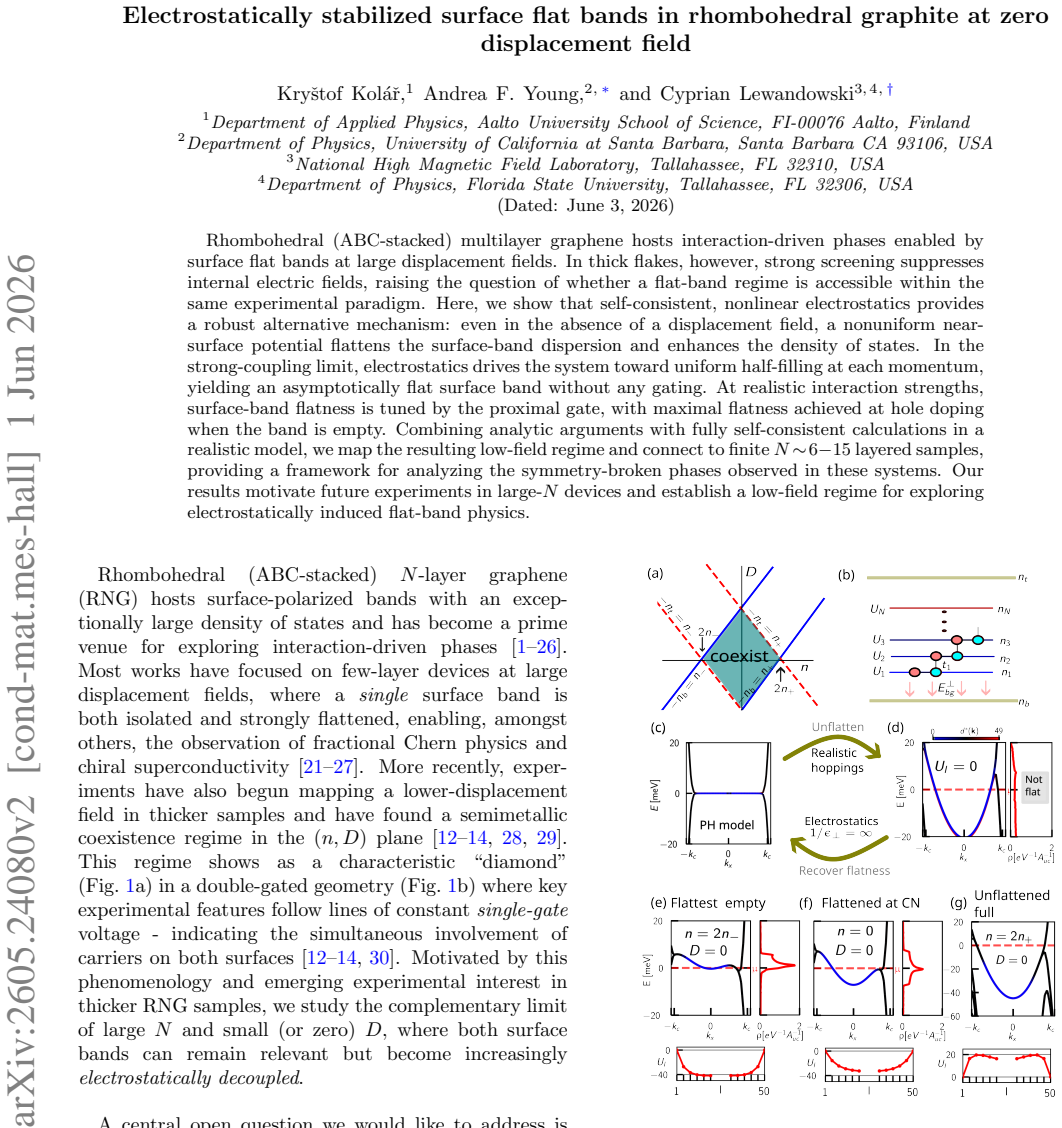
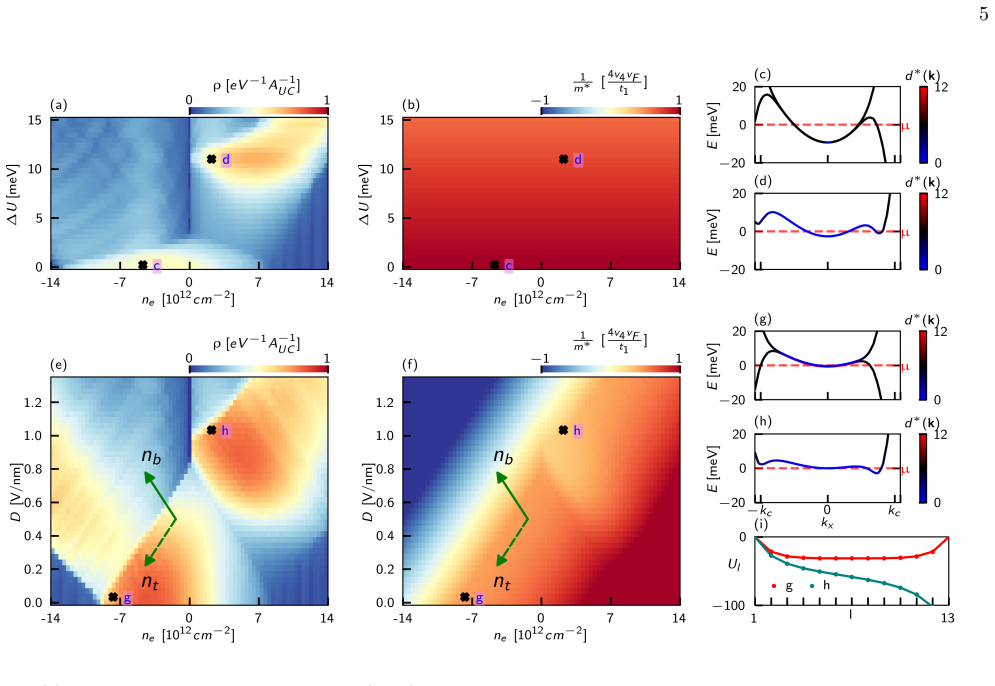
Self-consistent, nonlinear electrostatics provides a robust alternative mechanism for flattening surface bands: even without a displacement field, the nonuniform near-surface potential flattens the surface-band dispersion and enhances the density of states. In the strong-coupling limit, electrostatics drives the system toward uniform half-filling at each momentum, yielding an asymptotically flat surface band without any gating. At realistic interaction strengths, surface-band flatness is tuned by the proximal gate, with maximal flatness achieved at hole doping when the band is empty.
What carries the argument
Self-consistent nonlinear electrostatic screening that determines the near-surface potential and its feedback on the band structure.
If this is right
- Surface band flatness can be achieved and tuned by the proximal gate in the absence of displacement field.
- The mechanism applies to finite layer numbers around 6-15.
- It provides a framework for analyzing observed symmetry-broken phases.
- Experiments in large-N devices are motivated to explore this low-field flat-band physics.
Where Pith is reading between the lines
- This suggests flat-band phenomena could appear in thicker samples than those accessible via displacement fields alone.
- Similar electrostatic flattening might occur in other layered materials with surface states.
- Experiments could test the doping dependence to distinguish this from gating-induced effects.
- Connection to half-filling suggests possible links to correlated insulating states at specific fillings.
Load-bearing premise
The nonlinear electrostatic screening model solved self-consistently accurately captures the near-surface potential and how it modifies the band dispersion without any external displacement field.
What would settle it
Direct measurement of the surface band dispersion in a thick rhombohedral graphite sample at zero displacement field that shows no flattening or density of states enhancement compared to non-self-consistent calculations would falsify the mechanism.
Figures
read the original abstract
Rhombohedral (ABC-stacked) multilayer graphene hosts interaction-driven phases enabled by surface flat bands at large displacement fields. In thick flakes, however, strong screening suppresses internal electric fields, raising the question of whether a flat-band regime is accessible within the same experimental paradigm. Here, we show that self-consistent, nonlinear electrostatics provides a robust alternative mechanism: even in the absence of a displacement field, a nonuniform near-surface potential flattens the surface-band dispersion and enhances the density of states. In the strong-coupling limit, electrostatics drives the system toward uniform half-filling at each momentum, yielding an asymptotically flat surface band without any gating. At realistic interaction strengths, surface-band flatness is tuned by the proximal gate, with maximal flatness achieved at hole doping when the band is empty. Combining analytic arguments with fully self-consistent calculations in a realistic model, we map the resulting low-field regime and connect to finite $N\!\sim\! 6-15$ layered samples, providing a framework for analyzing the symmetry-broken phases observed in these systems. Our results motivate future experiments in large-$N$ devices and establish a low-field regime for exploring electrostatically induced flat-band physics.
Editorial analysis
A structured set of objections, weighed in public.
Referee Report
Summary. The manuscript claims that in rhombohedral multilayer graphene, self-consistent nonlinear electrostatics generates a nonuniform near-surface potential that flattens the surface-band dispersion and raises the density of states even at zero external displacement field. In the strong-coupling limit this mechanism asymptotically enforces uniform half-filling at each momentum, producing a flat band without gating; at realistic couplings flatness is maximized by proximal-gate hole doping when the band is empty. Analytic arguments are combined with fully self-consistent calculations for finite N ≈ 6–15 to map the low-field regime and link to observed symmetry-broken phases.
Significance. If the central mechanism is robust, the work supplies a parameter-light route to flat-band physics in thick samples at experimentally accessible low fields, bypassing the screening suppression that normally requires large displacement fields. The explicit strong-coupling analytic limit together with the self-consistent numerics constitute a concrete, falsifiable framework that can be tested in large-N devices.
major comments (2)
- [analytic arguments (strong-coupling limit)] The central claim that electrostatic self-consistency alone produces asymptotically flat bands at zero external D rests on the accuracy of the nonlinear screening relation used to obtain the near-surface potential. The abstract states that this relation drives uniform half-filling at each momentum, yet the manuscript provides no explicit comparison of the adopted density-potential functional against microscopic calculations that include exchange or nonlocal screening; if the low-density surface regime deviates from the assumed form, the flattening does not follow.
- [self-consistent calculations for N ∼ 6–15] The self-consistent calculations for finite N are presented as supporting the analytic picture, but the manuscript does not report the sensitivity of the resulting band flatness to the choice of interaction strength or to the precise form of the screening kernel; without such controls it remains unclear whether the reported flatness is an intrinsic outcome or an artifact of parameter tuning within the model.
minor comments (2)
- Notation for the surface-band dispersion and the electrostatic potential should be unified between the analytic section and the numerical figures to avoid ambiguity when comparing the two.
- The abstract refers to “maximal flatness achieved at hole doping when the band is empty”; a brief statement of the corresponding filling factor or chemical-potential window in the main text would help readers locate the relevant data.
Simulated Author's Rebuttal
We thank the referee for the careful reading and constructive comments, which help clarify the assumptions underlying our electrostatic model. We address each major point below and have revised the manuscript accordingly to improve transparency and robustness.
read point-by-point responses
-
Referee: [analytic arguments (strong-coupling limit)] The central claim that electrostatic self-consistency alone produces asymptotically flat bands at zero external D rests on the accuracy of the nonlinear screening relation used to obtain the near-surface potential. The abstract states that this relation drives uniform half-filling at each momentum, yet the manuscript provides no explicit comparison of the adopted density-potential functional against microscopic calculations that include exchange or nonlocal screening; if the low-density surface regime deviates from the assumed form, the flattening does not follow.
Authors: The nonlinear screening relation is the standard Thomas-Fermi form for the surface charge response in multilayer graphene, chosen because it captures the leading electrostatic nonlinearity at the densities relevant to the surface bands. In the strong-coupling analytic limit the flattening is a direct consequence of the self-consistency condition that forces the local potential to track the chemical potential so as to maintain half-filling at every momentum; this limit is insensitive to the precise functional provided the potential-density relation remains monotonic. We nevertheless agree that an explicit benchmark against exchange-inclusive or nonlocal calculations would strengthen the presentation. In the revised manuscript we have added a dedicated paragraph in the methods section that (i) states the adopted functional explicitly, (ii) cites prior microscopic studies on screening in graphene, and (iii) notes that quantitative deviations at extremely low density may occur but do not alter the qualitative asymptotic flatness. A full microscopic recalculation lies beyond the scope of the present work. revision: partial
-
Referee: [self-consistent calculations for N ∼ 6–15] The self-consistent calculations for finite N are presented as supporting the analytic picture, but the manuscript does not report the sensitivity of the resulting band flatness to the choice of interaction strength or to the precise form of the screening kernel; without such controls it remains unclear whether the reported flatness is an intrinsic outcome or an artifact of parameter tuning within the model.
Authors: We accept that explicit sensitivity checks improve confidence in the numerical results. The original calculations used the Coulomb interaction screened by the hBN substrate and the standard multilayer electrostatic kernel. We have now performed additional self-consistent runs in which the interaction strength is varied by ±20 % and a nonlocal correction to the screening kernel is included. The surface-band flatness remains qualitatively unchanged; only the precise location of the optimal proximal-gate doping shifts by a few percent. These controls are documented in a new supplementary figure and a short paragraph in the main text of the revised manuscript. revision: yes
Circularity Check
No circularity; derivation self-contained via self-consistent electrostatics
full rationale
The paper derives surface-band flattening from solving nonlinear electrostatic screening equations self-consistently, where the near-surface potential is determined by the density response and vice versa. This produces the claimed asymptotic flatness in the strong-coupling limit as an output of the equations rather than an input. No load-bearing steps reduce to self-definition, fitted parameters renamed as predictions, or self-citation chains; the analytic argument and numerical results for finite N follow directly from the model without tautological reduction. The absence of external displacement field is an explicit boundary condition, not smuggled in via prior work.
Axiom & Free-Parameter Ledger
free parameters (2)
- interaction strength
- number of layers N
axioms (1)
- domain assumption Nonlinear electrostatics governs the self-consistent potential distribution in the multilayer stack
Reference graph
Works this paper leans on
-
[1]
Y. Shi, S. Xu, Y. Yang, S. Slizovskiy, S. V. Morozov, S.- K. Son, S. Ozdemir, C. Mullan, J. Barrier, J. Yin, A. I. Berdyugin, B. A. Piot, T. Taniguchi, K. Watanabe, V. I. Fal’ko, K. S. Novoselov, A. K. Geim, and A. Mishchenko, Electronic phase separation in multilayer rhombohedral graphite, Nature584, 210 (2020)
2020
-
[2]
Slizovskiy, E
S. Slizovskiy, E. McCann, M. Koshino, and V. I. Falko, Films of rhombohedral graphite as two-dimensional topological semimetals, Communications Physics2, 164 (2019)
2019
-
[3]
Zhang, Q
H. Zhang, Q. Li, M. G. Scheer, R. Wang, C. Tuo, N. Zou, W. Chen, J. Li, X. Cai, C. Bao, M.-R. Li, K. Deng, K. Watanabe, T. Taniguchi, M. Ye, P. Tang, Y. Xu, P. Yu, J. Avila, P. Dudin, J. D. Denlinger, H. Yao, B. Lian, W. Duan, and S. Zhou, Correlated topological flat bands in rhombohedral graphite, Proceedings of the National Academy of Sciences121, e2410...
2024
-
[4]
Zhang, Y.-Y
Y. Zhang, Y.-Y. Zhou, S. Zhang, H. Cai, L.-H. Tong, W.- Y. Liao, R.-J. Zou, S.-M. Xue, Y. Tian, T. Chen, Q. Tian, C. Zhang, Y. Wang, X. Zou, X. Liu, Y. Hu, Y.-N. Ren, L. Zhang, L. Zhang, W.-X. Wang, L. He, L. Liao, Z. Qin, and L.-J. Yin, Layer-dependent evolution of electronic structures and correlations in rhombohedral multilayer graphene, Nature Nanotec...
2025
-
[5]
Otani, M
M. Otani, M. Koshino, Y. Takagi, and S. Okada, Intrin- sic magnetic moment on (0001) surfaces of rhombohedral graphite, Phys. Rev. B81, 161403(R) (2010)
2010
-
[6]
Henck, J
H. Henck, J. Avila, Z. Ben Aziza, D. Pierucci, J. Baima, B. Pamuk, J. Chaste, D. Utt, M. Bartos, K. Nogajew- ski, B. A. Piot, M. Orlita, M. Potemski, M. Calandra, M. C. Asensio, F. Mauri, C. Faugeras, and A. Ouerghi, Flat electronic bands in long sequences of rhombohedral- stacked graphene, Phys. Rev. B97, 245421 (2018)
2018
-
[7]
H. Zhou, T. Xie, A. Ghazaryan, T. Holder, J. R. Ehrets, E. M. Spanton, T. Taniguchi, K. Watanabe, E. Berg, M. Serbyn, and A. F. Young, Half- and quarter-metals in rhombohedral trilayer graphene, Nature598, 429433 (2021)
2021
-
[8]
H. Zhou, T. Xie, T. Taniguchi, K. Watanabe, and A. F. Young, Superconductivity in rhombohedral trilayer graphene, Nature598, 434438 (2021)
2021
-
[9]
K. Liu, J. Zheng, Y. Sha, B. Lyu, F. Li, Y. Park, Y. Ren, K. Watanabe, T. Taniguchi, J. Jia, W. Luo, Z. Shi, J. Jung, and G. Chen, Spontaneous broken-symmetry in- sulator and metals in tetralayer rhombohedral graphene, Nature Nanotechnology19, 188195 (2023)
2023
-
[10]
Auerbach, S
N. Auerbach, S. Dutta, M. Uzan, Y. Vituri, Y. Zhou, A. Y. Meltzer, S. Grover, T. Holder, P. Emanuel, M. E. Huber, Y. Myasoedov, K. Watanabe, T. Taniguchi, Y. Oreg, E. Berg, and E. Zeldov, Isospin magnetic tex- ture and intervalley exchange interaction in rhombohe- dral tetralayer graphene, Nature Physics21, 17651772 (2025)
2025
-
[11]
T. Han, Z. Lu, G. Scuri, J. Sung, J. Wang, T. Han, K. Watanabe, T. Taniguchi, L. Fu, H. Park, and L. Ju, Orbital multiferroicity in pentalayer rhombohedral graphene, Nature623, 4147 (2023)
2023
-
[12]
Y. Guo, O. I. Sheekey, T. Arp, K. Kol´ aˇ r, T. Charpentier, L. Holleis, B. Foutty, A. Keough, M. Kang-Chou, M. E. Huber, T. Taniguchi, K. Watanabe, C. Lewandowski, and A. F. Young, Flat band surface state super- conductivity in thick rhombohedral graphene, arXiv e-prints , arXiv:2511.17423 (2025), arXiv:2511.17423 [cond-mat.supr-con]
-
[13]
Superconductivity from dual-surface carriers in rhombohedral graphene,
M. Kumar, D. Waleffe, A. Okounkova, R. Tejani, V. Tien Phong, K. Watanabe, T. Taniguchi, C. Lewandowski, J. Folk, and M. Yankowitz, Superconductivity from dual-surface carriers in rhombohedral graphene, arXiv e-prints , arXiv:2507.18598 (2025), arXiv:2507.18598 [cond-mat.mes-hall]
- [14]
-
[15]
Stripe Order in the Metallic and Superconducting Phases of Rhombohedral Hexalayer Graphene
P. Qin, H.-T. Wu, R. Q. Nguyen, E. Morissette, N. J. Zhang, K. Watanabe, T. Taniguchi, and J. I. A. Li, Extreme Anisotropy in the Metallic and Superconduct- ing Phases of Rhombohedral Hexalayer Graphene, arXiv e-prints , arXiv:2504.05129 (2025), arXiv:2504.05129 [cond-mat.mes-hall]
work page internal anchor Pith review Pith/arXiv arXiv 2025
-
[16]
W. Zhou, J. Ding, J. Hua, L. Zhang, K. Watanabe, T. Taniguchi, W. Zhu, and S. Xu, Layer-polarized fer- romagnetism in rhombohedral multilayer graphene, Na- ture Communications15, 10.1038/s41467-024-46913-5 (2024)
-
[17]
Z. Lu, T. Han, Y. Yao, Z. Hadjri, J. Yang, J. Seo, L. Shi, S. Ye, K. Watanabe, T. Taniguchi, and L. Ju, Extended quantum anomalous hall states in graphene/hbn moir´ e superlattices, Nature637, 1090 (2025)
2025
-
[18]
Myhro, S
K. Myhro, S. Che, Y. Shi, Y. Lee, K. Thilahar, K. Bleich, D. Smirnov, and C. N. Lau, Large tunable intrinsic gap in rhombohedral-stacked tetralayer graphene at half filling, 2D Materials5, 045013 (2018)
2018
-
[19]
Hagym´ asi, M
I. Hagym´ asi, M. S. Mohd Isa, Z. Tajkov, K. M´ arity, L. Oroszl´ any, J. Koltai, A. Alassaf, P. Kun, K. Kandrai, A. P´ alink´ as, P. Vancs´ o, L. Tapaszt´ o, and P. Nemes-Incze, Observation of competing, correlated ground states in the flat band of rhombohedral graphite, Science Advances8, eabo6879 (2022)
2022
-
[20]
T. Han, Z. Lu, G. Scuri, J. Sung, J. Wang, T. Han, K. Watanabe, T. Taniguchi, H. Park, and L. Ju, Cor- related insulator and Chern insulators in pentalayer rhombohedral-stacked graphene, Nature Nanotechnology 19, 181 (2024)
2024
-
[21]
Waters, A
D. Waters, A. Okounkova, R. Su, B. Zhou, J. Yao, K. Watanabe, T. Taniguchi, X. Xu, Y.-H. Zhang, J. Folk, and M. Yankowitz, Chern insulators at integer and frac- tional filling in moir´ e pentalayer graphene, Phys. Rev. X 15, 011045 (2025)
2025
-
[22]
Y. Choi, Y. Choi, M. Valentini, C. L. Patterson, L. F. W. Holleis, O. I. Sheekey, H. Stoyanov, X. Cheng, T. Taniguchi, K. Watanabe, and A. F. Young, Supercon- ductivity and quantized anomalous Hall effect in rhom- bohedral graphene, Nature639, 342 (2025)
2025
-
[23]
S. H. Aronson, T. Han, Z. Lu, Y. Yao, J. P. Butler, K. Watanabe, T. Taniguchi, L. Ju, and R. C. Ashoori, Displacement field-controlled fractional chern insulators and charge density waves in a graphene/hbn moir´ e su- perlattice, Physical Review X15, 031026 (2025)
2025
-
[24]
T. Han, Z. Lu, Z. Hadjri, L. Shi, Z. Wu, W. Xu, Y. Yao, A. A. Cotten, O. Sharifi Sedeh, H. Weldeyesus, J. Yang, J. Seo, S. Ye, M. Zhou, H. Liu, G. Shi, Z. Hua, K. Watan- abe, T. Taniguchi, P. Xiong, D. M. Zumb¨ uhl, L. Fu, and L. Ju, Signatures of chiral superconductivity in rhombo- hedral graphene, Nature643, 654661 (2025)
2025
-
[25]
J. Seo, A. A. Cotten, M. Xu, O. S. Sedeh, H. Weldeyesus, T. Han, Z. Lu, Z. Wu, S. Ye, W. Xu, J. Yang, E. Aitken, P. P. Liong, Z. Hadjri, R. Gazizulin, K. Watanabe, T. Taniguchi, M. Li, D. M. Zumb¨ uhl, and L. Ju, Fam- ily of Unconventional Superconductivities in Crystalline Graphene (2025), arXiv:2509.03295 [cond-mat.mes-hall]
work page internal anchor Pith review arXiv 2025
-
[26]
F. Xu, Z. Sun, J. Li, C. Zheng, C. Xu, J. Gao, T. Jia, Y. Su, K. Watanabe, T. Taniguchi, B. Tong, L. Lu, J. Jia, Z. Shi, S. Jiang, J. Lin, Y. Zhang, Y. Zhang, S. Lei, X. Liu, and T. Li, Signatures of unconventional superconductivity near reentrant and fractional quan- tum anomalous Hall insulators (2026), arXiv:2504.06972 [cond-mat.mes-hall]
work page internal anchor Pith review Pith/arXiv arXiv 2026
-
[27]
Z. Lu, T. Han, Y. Yao, A. P. Reddy, J. Yang, J. Seo, K. Watanabe, T. Taniguchi, L. Fu, and L. Ju, Fractional quantum anomalous hall effect in multilayer graphene, Nature626, 759764 (2024)
2024
-
[28]
W. Zhou, J. Ding, J. Hua, L. Zhang, K. Watanabe, T. Taniguchi, W. Zhu, and S. Xu, Layer-polarized ferro- magnetism in rhombohedral multilayer graphene, Nature Communications15, 2597 (2024)
2024
-
[29]
E. J. Seifert, E. Akyuz, R. M. Feenstra, and B. M. Hunt, Increasing flatness of surface bands of multilayer rhombo- hedral graphite with crystal thickness, Physical Review B110, L241407 (2024)
2024
-
[30]
Kol´ aˇ r, D
K. Kol´ aˇ r, D. Waters, J. Folk, M. Yankowitz, and C. Lewandowski, Single-gate tracking behavior in flat- band multilayer graphene devices, Phys. Rev. B113, 075131 (2026)
2026
-
[31]
Guinea, A
F. Guinea, A. H. Castro Neto, and N. M. R. Peres, Elec- tronic states and landau levels in graphene stacks, Phys- ical Review B73, 245426 (2006)
2006
-
[32]
Koshino and E
M. Koshino and E. McCann, Trigonal warping and berry’s phasenπin abc-stacked multilayer graphene, Physical Review B80, 165409 (2009)
2009
-
[33]
Zhang, B
F. Zhang, B. Sahu, H. Min, and A. H. MacDonald, Band structure of abc-stacked graphene trilayers, Physical Re- view B82, 035409 (2010)
2010
-
[34]
T. T. Heikkil¨ a and G. E. Volovik, Dimensional crossover in topological matter: Evolution of the multiple Dirac point in the layered system to the flat band on the sur- face, JETP Letters93, 59 (2011)
2011
-
[35]
N. B. Kopnin, M. Ij¨ as, A. Harju, and T. T. Heikkil¨ a, High-temperature surface superconductivity in rhombo- hedral graphite, Physical Review B87, 140503 (2013)
2013
-
[36]
Min and A
H. Min and A. H. MacDonald, Chiral decomposition in the electronic structure of graphene multilayers, Phys. Rev. B77, 155416 (2008)
2008
-
[37]
McCann and M
E. McCann and M. Koshino, The electronic properties of bilayer graphene, Reports on Progress in Physics76, 056503 (2013)
2013
- [38]
-
[39]
Ghazaryan, T
A. Ghazaryan, T. Holder, E. Berg, and M. Serbyn, Mul- tilayer graphenes as a platform for interaction-driven physics and topological superconductivity, Physical Re- view B107, 104502 (2023)
2023
-
[40]
Koshino, Interlayer screening effect in graphene mul- tilayers with$ABA$and$ABC$stacking, Physical Re- view B81, 125304 (2010)
M. Koshino, Interlayer screening effect in graphene mul- tilayers with$ABA$and$ABC$stacking, Physical Re- view B81, 125304 (2010)
2010
-
[41]
A. A. Avetisyan, B. Partoens, and F. M. Peeters, Electric-field control of the band gap and fermi energy in graphene multilayers by top and back gates, Phys. Rev. B80, 195401 (2009)
2009
-
[42]
A. A. Avetisyan, B. Partoens, and F. M. Peeters, Stack- ing order dependent electric field tuning of the band gap in graphene multilayers, Phys. Rev. B81, 115432 (2010)
2010
-
[43]
Slizovskiy, A
S. Slizovskiy, A. Garcia-Ruiz, A. I. Berdyugin, N. Xin, T. Taniguchi, K. Watanabe, A. K. Geim, N. D. Drum- mond, and V. I. Falko, Out-of-plane dielectric suscepti- bility of graphene in twistronic and bernal bilayers, Nano Letters21, 66786683 (2021). 8
2021
-
[44]
W. P. Su, J. R. Schrieffer, and A. J. Heeger, Solitons in polyacetylene, Phys. Rev. Lett.42, 1698 (1979)
1979
-
[45]
T. T. Heikkil¨ a, N. B. Kopnin, and G. E. Volovik, Flat bands in topological media, JETP Letters94, 233 (2011)
2011
-
[46]
A. A. Burkov, M. D. Hook, and L. Balents, Topological nodal semimetals, Physical Review B84, 235126 (2011)
2011
-
[47]
McCann and V
E. McCann and V. I. Fal’ko, Landau-Level Degeneracy and Quantum Hall Effect in a Graphite Bilayer, Physical Review Letters96, 086805 (2006)
2006
-
[48]
Nilsson, A
J. Nilsson, A. H. Castro Neto, F. Guinea, and N. M. R. Peres, Electronic properties of bilayer and multilayer graphene, Physical Review B78, 045405 (2008)
2008
-
[49]
(2026), see Supplementary material for further details, which includes [57, 59–61]
2026
-
[50]
In that viewpoint, the layer-potential terms arise from theq= 0 Hartree contribution of charges lo- calized in different layers
We note that our description here centers on a capacitor- plate model for clarity, but it could also be obtained by considering the standard density- density interaction and incorporating the layer dependence of the Coulomb in- teraction. In that viewpoint, the layer-potential terms arise from theq= 0 Hartree contribution of charges lo- calized in differe...
-
[51]
Jiang, T
G. Jiang, T. T. Heikkil¨ a, and P. T¨ orm¨ a, Ideal quantum geometry of the surface states of rhombohedral graphite and its effects on the surface superconductivity, Phys. Rev. B113, L041111 (2026)
2026
- [52]
-
[53]
A. S. Patri and M. Franz, Family of multilayer graphene superconductors with tunable chirality: Momentum- space vortices nucleated by a ring of berry curvature, Phys. Rev. B112, 214505 (2025)
2025
-
[54]
Y. Jia, J. Yu, J. Liu, J. Herzog-Arbeitman, Z. Qi, H. Pi, N. Regnault, H. Weng, B. A. Bernevig, and Q. Wu, Moir´ e fractional chern insulators. i. first-principles calculations and continuum models of twisted bilayer mote 2, Phys. Rev. B109, 205121 (2024)
2024
-
[55]
Herzog-Arbeitman, Y
J. Herzog-Arbeitman, Y. Wang, J. Liu, P. M. Tam, Z. Qi, Y. Jia, D. K. Efetov, O. Vafek, N. Regnault, H. Weng, Q. Wu, B. A. Bernevig, and J. Yu, Moir´ e fractional chern insulators. ii. first-principles calculations and continuum models of rhombohedral graphene superlattices, Phys. Rev. B109, 205122 (2024)
2024
-
[56]
Z. Dong, A. S. Patri, and T. Senthil, Theory of quan- tum anomalous hall phases in pentalayer rhombohedral graphene moir´ e structures, Phys. Rev. Lett.133, 206502 (2024)
2024
-
[57]
Y. H. Kwan, J. Yu, J. Herzog-Arbeitman, D. K. Efetov, N. Regnault, and B. A. Bernevig, Moir´ e fractional chern insulators. iii. hartree-fock phase diagram, magic angle regime for chern insulator states, role of moir´ e potential, and goldstone gaps in rhombohedral graphene superlat- tices, Phys. Rev. B112, 075109 (2025)
2025
-
[58]
P. J. Ledwith, A. Vishwanath, and E. Khalaf, Family of ideal chern flatbands with arbitrary chern number in chi- ral twisted graphene multilayers, Phys. Rev. Lett.128, 176404 (2022)
2022
-
[59]
J. Herzog-Arbeitman, Y. Wang, J. Liu, P. M. Tam, Z. Qi, Y. Jia, D. K. Efetov, O. Vafek, N. Regnault, H. Weng, Q. Wu, B. A. Bernevig, and J. Yu, Moir´ e fractional chern insulators ii: First-principles calculations and continuum models of rhombohedral graphene superlattices (2023), arXiv:2311.12920 [cond-mat]
-
[60]
Bistritzer and A
R. Bistritzer and A. H. MacDonald, Moire bands in twisted double-layer graphene, Proceedings of the Na- tional Academy of Sciences108, 12233 (2011)
2011
-
[61]
Canc` es and C
E. Canc` es and C. Le Bris, Can we outperform the DIIS approach for electronic structure calculations?, Interna- tional Journal of Quantum Chemistry79, 82 (2000)
2000
-
[62]
Kol´ aˇ r, Y
K. Kol´ aˇ r, Y. Zhang, S. Nadj-Perge, F. von Oppen, and C. Lewandowski, Electrostatic fate ofn-layer moir´ e graphene, Physical Review B108, 195148 (2023)
2023
-
[63]
V. Tien Phong and C. Lewandowski, Coulomb Interaction-Stabilized Isolated Narrow Bands with Chern NumbersC>1 in Twisted Rhombohedral Trilayer- Bilayer Graphene, arXiv e-prints , arXiv:2505.07981 (2025), arXiv:2505.07981 [cond-mat.mes-hall]. 9 Supplementary material Contents Acknowledgments 6 References 6 I. Additional details 9 A. Energy shift of a given ...
discussion (0)
Sign in with ORCID, Apple, or X to comment. Anyone can read and Pith papers without signing in.