REVIEW 4 major objections 5 minor 38 references
Budgeted Online Active Learning with Expert Advice and Episodic Priors
T0 review · 4 major / 5 minor · reviewed 2026-08-07 · deepseek-v4-flash
Pith's one-line read Past unlabeled seasons can tell an active learner exactly when to spend its few labels.
desk verdict A genuinely new combination of expert advice and episodic priors for budgeted online active learning, with a sound core idea but under-reported empirical evidence. read the letter →
The pith
A machine-rendered reading of the paper's core claim, the machinery that carries it, and where it could break.
The reading
What carries the argument
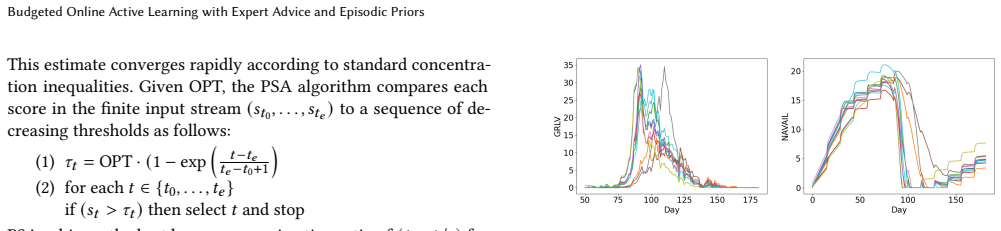
The load-bearing object is the budgeted online active learning framework of Algorithm 1, which splits the horizon into $B$ segments and in each segment runs an OnlineMax stopping rule on a score function, using the single selected label to update the expert weights. The score is the weighted variance of the Hedge-weighted expert predictions, $\sum_i p_{i,t}(f_i(x_{1:t}) - y_t)^2$, measuring committee disagreement. The new machinery is the episodic-prior OnlineMax: PSA computes $\mathrm{OPT} = \frac{1}{K}\sum_{k}\max_{t}\mathrm{Score}(x^k_t)$ from historical sub-episodes and compares current scores to decreasing thresholds $\tau_t = \mathrm{OPT}\cdot(1-\exp(\frac{t-t_e}{t_e-t_0+1}))$; ETS chooses the threshold that maximizes the average first score above threshold over the history. These rules are what let the learner exploit the past instead of ignoring it.
What would settle it
Conduct the same BOAL protocol on a year with anomalous weather (e.g., an extreme heat or cold event) held out from threshold calibration, and check whether PSA/ETS RMSE falls back to the level of the secretary-algorithm baseline or uniform sampling; equivalently, measure the correlation between predicted thresholds from history and realized score maxima over many years and look for years where the correlation breaks.
Extended reading notes
Core claim
On its own terms, this paper establishes that in budgeted online active learning with budgets of 2–5 labels, historical unlabeled episodes can be used to estimate when high-value query opportunities will appear, and that those estimates translate into better query selection. Its two query-selection rules, PSA and ETS, replace the secretary algorithm's blind observation window with thresholds derived from past seasons: PSA estimates the expected maximum score $\mathrm{OPT}$ over historical sub-episodes and lowers its threshold over time, while ETS empirically picks the threshold $\tau^*$ whose average first-exceeding historical score is highest. Combined with a Hedge-weighted committee of experts and a weighted-variance score, the rules produce significantly lower RMSE than uniform querying and than the prior work [15] that uses the secretary algorithm without episodic knowledge. The paper reads this as evidence that episodic priors and expert advice together make extremely small budgets usable in real-world seasonal prediction.
Load-bearing premise
The load-bearing premise is that the historical episodes' score patterns tell us the current episode's score patterns; if the current season's weather or expert behavior shifts away from history, the calibrated thresholds become miscalibrated and the method degrades to the secretary baseline.
Editorial extensions
If this is right
- Even budgets of 2–3 labels, when placed by episodic-prior rules, significantly reduce prediction error over uniform sampling and over non-episodic secretary-based selection in both simulated and real agricultural problems.
- ETS selects queries whose disagreement scores approach the hindsight maximum, suggesting the historical calibration is near-optimal for score maximization.
- The benefit persists with lower-quality expert sets, indicating the method does not rely on a particularly strong committee.
- The framework transfers to any finite-horizon stream with historical unlabeled episodes, such as environmental sensing, industrial process monitoring, or subject-specific health tracking.
Reading between the lines
- Editorial inference: the method's value depends on the disagreement score being a faithful proxy for learning gain; swapping in expected-loss reduction or expected model-change scores would likely change which threshold rule wins and is a natural next experiment.
- Editorial inference: a robust variant that calibrates thresholds from lower quantiles or worst-case historical episodes, rather than averages, would guard against the distribution-shift failure mode and is a concrete testable extension.
- Editorial inference: the same two-rules-of-thumb could be applied to other episodic streams—ocean monitoring, epidemic curves, retail seasonality—where past cycles are abundant and labels are rare.
- Editorial inference: adaptive segment lengths, such as splitting the horizon unevenly based on historical score volatility, may further improve over the fixed equal segmentation used here.
Editorial analysis
A structured set of objections, weighed in public.
Referee Report
Summary. The paper studies budgeted online active learning (BOAL) over finite-horizon streams with extremely small labeling budgets. It combines online learning from expert advice (Hedge) with query selection that exploits historical unlabeled episodes. Two query-selection instantiations are proposed: PSA, which uses a prophet-secretary threshold rule with an estimated expected maximum score, and ETS, which selects a threshold empirically by simulating historical episodes. Experiments on WOFOST-simulated crops and real grape cold-hardiness data compare these methods against uniform querying, the secretary-algorithm baseline SA, and a no-query baseline. The authors report that PSA and ETS significantly outperform the baselines and that ETS approaches the Max Oracle in query score.
Significance. If the result holds, the paper fills a real gap: prior active learning with experts has not explicitly handled fixed query budgets over finite horizons, and prior budgeted stream-based methods have not used historical unlabeled episodes. The two proposed query-timing mechanisms are simple and interpretable, and the evaluation includes a realistic simulator, decades of real-world data, multiple crops/cultivars, and a lower-quality-expert robustness check. The paper would be a useful step for applications such as agricultural monitoring where labels are extremely scarce. However, the strength of the evidence is currently limited by incomplete statistical reporting and by an untested stationarity assumption that is load-bearing for the central claim.
major comments (4)
- [Section 7.3, Tables 1-3] The central claim that PSA and ETS 'significantly outperform' baselines is supported only by averaged RMSE numbers and short statements of Wilcoxon outcomes. No standard deviations, confidence intervals, test statistics, or p-values are reported, and the number of repeated runs per cell is not given in the tables. With many paired comparisons across budgets, crops, and cultivars, the reader cannot assess the magnitude, variability, or multiplicity of the effects. Please report per-comparison distributions or confidence intervals and provide the Wilcoxon test details, ideally with a multiple-comparison correction or a clear statement of the raw comparison plan.
- [Sections 6.1-6.2 and 7.3] The methods' threshold estimates assume that the current episode's Score distribution matches the historical episodes used to compute OPT (PSA) and tau* (ETS). This stationarity assumption is load-bearing for the claim that PSA/ETS generalize beyond the evaluated years. The hold-out-year evaluation does not quantify year-to-year distribution shift, and no experiment tests regimes such as unusually warm or cold years, or systematically reweighted historical years. Please add a distribution-shift sensitivity study, or explicitly restrict the paper's claims to settings where such stationarity is plausible.
- [Section 6.2] The definition of s_k_tau is incomplete for historical episodes in which no score exceeds tau: 'the first score in s_k_{t0:te} that is larger than tau' does not exist for such episodes, leaving the average s*_tau undefined. Since the ETS algorithm chooses tau* by maximizing this average, the procedure is underspecified for high thresholds. Please state the convention used (e.g., assigning the final episode score, or a penalty for non-crossing) and confirm that the experiments follow that convention.
- [Section 7.2] The real-world evaluation is restricted to the 8 cultivars with the highest model accuracy, and the paper does not report how the results vary with this selection. While Table 3 provides a lower-quality-expert check, it does not address the possible optimism caused by cherry-picking cultivars with accurate label imputation. Please add a sensitivity analysis over the number or composition of selected cultivars, or discuss the implications of this selection for the generality of the real-world results.
minor comments (5)
- [Section 7.3] The paper states that 37 BOAL runs are conducted but does not explain how the 1984-2023 weather period is split into test years and historical years. A brief explanation of the exact split would improve reproducibility.
- [Section 7.2] The neural-network filling of season labels is used to simulate daily queries, and the paper notes that evaluation is on real samples. This is a reasonable design, but the dependence of the entire experimental protocol on that imputation model deserves an explicit limitation statement, since a systematic imputation error could distort the relative ordering of query policies.
- [Algorithm 1] The pseudocode says 'break' after querying, which exits the inner loop, but it would be clearer to also show that the outer loop continues to the next segment; the current formatting could be misread as terminating the entire procedure.
- [Section 7.6] The claim that ETS is 'close to optimal' for selecting the highest Score is based on the Max Oracle comparison, but the tables show cases where the gap is non-negligible (e.g., Maize GRLV at budget 2). The wording should be softened to 'often close' with attention to the largest gaps.
- [Throughout] There are several typographical inconsistencies, such as 'agromanagement' appearing where 'agromanagement' or 'agricultural management' is intended, and the repeated phrase 'Preprint — do not distribute.' on each page. A final proofreading pass would be helpful.
Circularity Check
No significant circularity: episodic thresholds are fitted to held-out historical years, and RMSE improvements are evaluated on independent test episodes and real-world samples.
full rationale
The paper's central empirical claim is that query-selection methods (PSA, ETS) using historical unlabeled episodes improve BOAL performance over secretary-based SA and uniform sampling. Walking the derivation chain: PSA computes OPT from the average maximum Score over historical sub-episodes (Section 6.1) and uses it to set a decreasing threshold; ETS chooses the threshold tau* maximizing the average first-exceeding Score over historical episodes (Section 6.2). Both thresholds are estimated entirely from held-out historical years (36 years, with the test season excluded per Section 7.3), and no parameter is fitted to the test labels. The Hedge expert weights are updated only on queried labels from the current episode, which is the standard online-learning update and not a fitted input. The RMSE evaluations in Tables 1-3 compare final predictions against held-out seasons and, for cold hardiness, against real-world data samples; the filled daily labels are an experimental simulator, not the evaluation target. The Section 7.6 near-Max-Oracle result is an empirical diagnostic using the same Score objective that ETS optimizes, but it is presented as an explanation rather than as the main claim; the main claim rests on independent RMSE comparisons. The only self-citation is [29] for the cold-hardiness multi-task model; that model is described in Appendix A and used as a tool to create the target filling and expert sets, and its use does not make the query-selection comparison circular because all methods are evaluated under the same simulator and the final evaluation is on real-world samples. No equation in the paper reduces a predicted quantity to an input by construction.
Assumptions & free parameters
free parameters (2)
- Hedge learning rate eta =
1
- ETS threshold grid T =
not specified in paper
assumptions (5)
- standard math Classical results: secretary algorithm optimality (Dynkin 1963), prophet inequality (Samuel-Cahn 1984), prophet-secretary (1-1/e) approximation (Ehsani et al. 2018), Hedge regret O(sqrt(T log N)) (Freund and Schapire 1997).
- domain assumption Historical episodes E(t0,te) are representative of the current episode's Score distribution.
- domain assumption The expert set F contains at least one 'good enough' expert, and the target can be approximated by a weighted combination of experts.
- domain assumption The weighted variance of expert predictions is a valid informativeness measure for regression active learning.
- domain assumption Neural-network-filled labels accurately represent daily cold hardiness for query simulation in the real-world experiments.
Cite this review
Pith. "Pith review of Budgeted Online Active Learning with Expert Advice and Episodic Priors." pith.science (2026). https://pith.science/paper/UTBRWVRJ
@misc{pith2026250603307,
  author       = {Pith},
  title        = {Pith review of: Budgeted Online Active Learning with Expert Advice and Episodic Priors},
  year         = {2026},
  howpublished = {\url{https://pith.science/paper/UTBRWVRJ}},
  note         = {Machine review of arXiv:2506.03307}
}
read the original abstract
This paper introduces a novel approach to budgeted online active learning from finite-horizon data streams with extremely limited labeling budgets. In agricultural applications, such streams might include daily weather data over a growing season, and labels require costly measurements of weather-dependent plant characteristics. Our method integrates two key sources of prior information: a collection of preexisting expert predictors and episodic behavioral knowledge of the experts based on unlabeled data streams. Unlike previous research on online active learning with experts, our work simultaneously considers query budgets, finite horizons, and episodic knowledge, enabling effective learning in applications with severely limited labeling capacity. We demonstrate the utility of our approach through experiments on various prediction problems derived from both a realistic agricultural crop simulator and real-world data from multiple grape cultivars. The results show that our method significantly outperforms baseline expert predictions, uniform query selection, and existing approaches that consider budgets and limited horizons but neglect episodic knowledge, even under highly constrained labeling budgets.
Figures

Reference graph
Works this paper leans on
-
[1]
Les Atlas, David Cohn, and Richard Ladner. 1990. Training connectionist net- works with queries and selective sampling. Advances in neural information processing systems 2 (1990)
work page 1990
-
[2]
MohammadHossein Bateni, MohammadTaghi Hajiaghayi, and Morteza Zadi- moghaddam. 2013. Submodular secretary problem and extensions. ACM Trans- actions on Algorithms (TALG) 9, 4 (2013), 1–23
work page 2013
-
[3]
Kenneth J. Boote, James W. Jones, and Nigel B. Pickering. 1996. Potential Uses and Limitations of Crop Models | Agronomy Journal. https://acsess.onlinelibrary. wiley.com/doi/abs/10.2134/agronj1996.00021962008800050005x
-
[4]
Rui Castro, Fredrik Hellström, and Tim van Erven. 2024. Adaptive selective sampling for online prediction with experts. Advances in Neural Information Processing Systems 36 (2024)
work page 2024
-
[5]
Nicolo Cesa-Bianchi, Yoav Freund, David Haussler, David P Helmbold, Robert E Schapire, and Manfred K Warmuth. 1997. How to use expert advice. Journal of the ACM (JACM) 44, 3 (1997), 427–485
work page 1997
-
[6]
Nicolo Cesa-Bianchi, Gábor Lugosi, and Gilles Stoltz. 2005. Minimizing regret with label efficient prediction. IEEE Transactions on Information Theory 51, 6 (2005), 2152–2162
work page 2005
-
[7]
Jnaneshwar Das, Frédéric Py, Julio BJ Harvey, John P Ryan, Alyssa Gellene, Rishi Graham, David A Caron, Kanna Rajan, and Gaurav S Sukhatme. 2015. Data- driven robotic sampling for marine ecosystem monitoring. The International Journal of Robotics Research 34, 12 (2015), 1435–1452
work page 2015
-
[8]
Allard de Wit, Hendrik Boogaard, Davide Fumagalli, Sander Janssen, Rob Knapen, Daniel van Kraalingen, Iwan Supit, Raymond van der Wijngaart, and Kees van Diepen. 2019. 25 years of the WOFOST cropping systems model. Agricultural Systems 168 (Jan. 2019), 154–167
work page 2019
Show all 38 references
-
[9]
Evgenii Borisovich Dynkin. 1963. The optimum choice of the instant for stopping a Markov process. Soviet Mathematics 4 (1963), 627–629
1963
-
[10]
Soheil Ehsani, MohammadTaghi Hajiaghayi, Thomas Kesselheim, and Sahil Singla. 2018. Prophet secretary for combinatorial auctions and matroids. In Pro- ceedings of the twenty-ninth annual acm-siam symposium on discrete algorithms . SIAM, 700–714
2018
-
[11]
Hossein Esfandiari, MohammadTaghi Hajiaghayi, Vahid Liaghat, and Morteza Monemizadeh. 2017. Prophet secretary. SIAM Journal on Discrete Mathematics 31, 3 (2017), 1685–1701
2017
-
[12]
Ferguson, Michelle M
John C. Ferguson, Michelle M. Moyer, Lynn J. Mills, Gerrit Hoogenboom, and Markus Keller. 2014. Modeling Dormant Bud Cold Hardiness and Budbreak in Twenty-Three Vitis Genotypes Reveals Variation by Region of Origin. American Journal of Enology and Viticulture 65, 1 (2014), 59–...
2014
-
[13]
Yoav Freund and Robert E Schapire. 1997. A decision-theoretic generalization of on-line learning and an application to boosting. Journal of computer and system sciences 55, 1 (1997), 119–139
1997
-
[14]
Yoav Freund, H Sebastian Seung, Eli Shamir, and Naftali Tishby. 1997. Selective sampling using the query by committee algorithm. Machine learning 28 (1997), 133–168
1997
-
[15]
Kaito Fujii and Hisashi Kashima. 2016. Budgeted stream-based active learning via adaptive submodular maximization. Advances in Neural Information Processing Systems 29 (2016)
2016
-
[16]
Shuji Hao, Peiying Hu, Peilin Zhao, Steven CH Hoi, and Chunyan Miao. 2018. Online active learning with expert advice. ACM Transactions on Knowledge Discovery from Data (TKDD) 12, 5 (2018), 1–22
2018
-
[17]
Satoshi Hara, Mitsuru Matsuura, Junya Honda, and Shinji Ito. 2024. Active model selection: A variance minimization approach. Machine Learning (2024), 1–19
2024
-
[18]
Mark Herbster and Manfred K Warmuth. 1998. Tracking the best expert.Machine learning 32, 2 (1998), 151–178
1998
-
[19]
Mohammad Reza Karimi, Nezihe Merve Gürel, Bojan Karlaš, Johannes Rausch, Ce Zhang, and Andreas Krause. 2021. Online active model selection for pre-trained classifiers. In International Conference on Artificial Intelligence and Statistics . PMLR, 307–315
2021
-
[20]
Kingma and Jimmy Ba
Diederik P. Kingma and Jimmy Ba. 2015. Adam: A Method for Stochastic Opti- mization. In 3rd International Conference on Learning Representations, ICLR 2015 . OpenReview.net, San Diego, CA, USA, 1–15. http://arxiv.org/abs/1412.6980
2015 arXiv
-
[21]
Ulrich Krengel and Louis Sucheston. 1977. Semiamarts and finite values. Bull. Amer. Math. Soc. 83, 4 (1977), 745–747. Preprint — do not distribute. Goebel, Solow, Pesantez-Cabrera, Keller, and Fern
1977
-
[22]
Anders Krogh and Jesper Vedelsby. 1994. Neural network ensembles, cross validation, and active learning. Advances in neural information processing systems 7 (1994)
1994
-
[23]
Bhuvesh Kumar, Jacob D Abernethy, and Venkatesh Saligrama. 2022. Active- hedge: Hedge meets active learning. In International Conference on Machine Learning. PMLR, 11694–11709
2022
-
[24]
Nick Littlestone and Manfred K Warmuth. 1994. The weighted majority algorithm. Information and computation 108, 2 (1994), 212–261
1994
-
[25]
X. Liu, F. Xia, R. L. Stevens, and Y. Chen. 2022. Contextual active online model selection with expert advice. In Proceedings of the ICML Workshop on Adaptive Experimental Design and Active Learning in the Real World
2022
-
[26]
Wenhao Luo, Changjoo Nam, and Katia Sycara. 2017. Online decision making for stream-based robotic sampling via submodular optimization. In 2017 IEEE International Conference on Multisensor Fusion and Integration for Intelligent Systems (MFI). IEEE, 118–123
2017
-
[27]
Siddharth Mitra and Aditya Gopalan. 2020. On adaptivity in information- constrained online learning. In Proceedings of the AAAI Conference on Artificial Intelligence, Vol. 34. 5199–5206
2020
-
[28]
Ester Samuel-Cahn. 1984. Comparison of threshold stop rules and maximum for independent nonnegative random variables. the Annals of Probability (1984), 1213–1216
1984
-
[29]
Aseem Saxena, Paola Pesantez-Cabrera, Rohan Ballapragada, Kin-Ho Lam, Markus Keller, and Alan Fern. 2023. Grape cold hardiness prediction via multi- task learning. In Proceedings of the Thirty-Seventh AAAI Conference on Artificial Intelligence and Thirty-Fifth Conference on In...
2023 doi
-
[30]
Burr Settles. 2009. Active learning literature survey. (2009)
2009
-
[31]
H Sebastian Seung, Manfred Opper, and Haim Sompolinsky. 1992. Query by committee. In Proceedings of the fifth annual workshop on Computational learning theory. 287–294
1992
-
[32]
Anh Truong, S Rasoul Etesami, and Negar Kiyavash. 2021. Selective Labeling in Learning with Expert Advice. In 2021 American Control Conference (ACC). IEEE, 2537–2542
2021
-
[33]
Van-Anh Truong and Xinshang Wang. 2019. Prophet Inequality with Correlated Arrival Probabilities, with Application to Two Sided Matchings. arXiv: Optimiza- tion and Control (2019). https://api.semanticscholar.org/CorpusID:119314431
2019
-
[34]
van Diepen, J
C.a. van Diepen, J. Wolf, H. van Keulen, and C. Rappoldt. 1989. WOFOST: a simulation model of crop production. Soil Use and Management 5, 1 (1989), 16–24
1989
-
[35]
F Wilcoxon. 1945. Individual comparisons by ranking methods. Biom. Bull., 1, 80–83
1945
-
[36]
WSU. 2023. AgWeatherNet. https://weather.wsu.edu
2023
-
[37]
Yifan Zhang, Peilin Zhao, Jiezhang Cao, Wenye Ma, Junzhou Huang, Qingyao Wu, and Mingkui Tan. 2018. Online adaptive asymmetric active learning for budgeted imbalanced data. In Proceedings of the 24th ACM SIGKDD International Conference on Knowledge Discovery & Data Mining . 2768–2777
2018
-
[38]
Peilin Zhao, Steven C. H. Hoi, and Jinfeng Zhuang. 2013. Active Learn- ing with Expert Advice. In Proceedings of the Twenty-Ninth Conference on Uncertainty in Artificial Intelligence, UAI 2013, Bellevue, W A, USA, Au- gust 11-15, 2013 , Ann E. Nicholson and Padhraic Smyth (Eds...
2013
Reviewed August 7, 2026 · model on record in the stance chip above.
Discussion (0). Continue with ORCID to comment.