REVIEW 6 major objections 5 minor 36 references
Cross-Receiver Generalization for RF Fingerprint Identification via Feature Disentanglement and Adversarial Training
T0 review · 6 major / 5 minor · reviewed 2026-08-04 · deepseek-v4-flash
Pith's one-line read This paper claims that a framework called DRIFT, which explicitly disentangles transmitter-specific from receiver-specific representations in received I/Q signals, lets an RF fingerprint identification model trained on a few known receivers
desk verdict A genuinely useful cross-receiver RFFI method with a consistent empirical win, but the dataset description doesn't match the experiments and the theory is more assertion than proof. read the letter →
The pith
A machine-rendered reading of the paper's core claim, the machinery that carries it, and where it could break.
The reading
What carries the argument
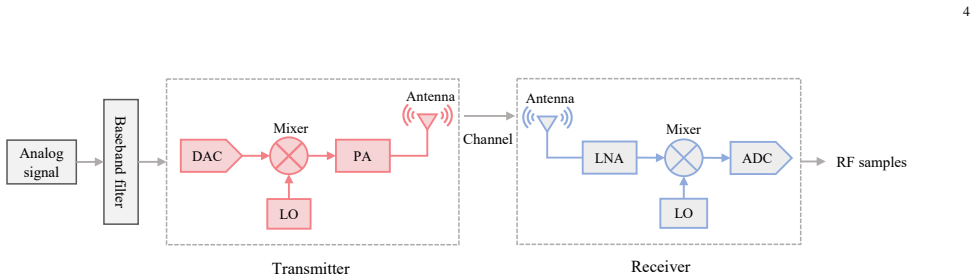
The central object is the multiplicative signal model X_t_ij = g_j · h_t_ij · f_i · s_i(t), which attributes receiver-specific distortion g_j separately from transmitter-specific hardware impairments f_i. The machinery that carries the argument is the fixed dimension-wise split in Eq. (17): the 512-dimensional embedding is split into a 256-dim transmitter half and a 256-dim receiver half. Three losses act on these halves: a gradient reversal layer (GRL) adversarially aligns the transmitter half across receivers, a center loss clusters the receiver half by receiver identity, and a negative-MSE separation loss maximizes the distance between the two halves. Together these enforce the disentangl
What would settle it
Train DRIFT on several receivers as in the paper, then use a receiver whose distortion is deliberately manufactured to violate the multiplicative model—for example, a receiver with a strong frequency-selective filter or a nonlinear memory effect—and measure accuracy on that unseen receiver; if accuracy drops to the level of the basic ERM baseline (around 60–65%), the separable-subspace assumption is not general. Alternatively, after training, freeze the feature extractor and train a receiver classifier on the transmitter-specific half z*; if that classifier can predict the receiver with well a
Extended reading notes
Core claim
The central claim is that cross-receiver generalization does not require seeing the new receiver during training; it only requires learning a representation in which receiver-specific impairments occupy a separable, removable subspace. The paper proposes DRIFT, which takes the 512-dimensional embedding from a ResNet-18 backbone and splits it in half: the first 256 dimensions are trained to be transmitter-discriminative and receiver-invariant via a gradient reversal layer, while the second 256 dimensions are trained to predict the receiver identity and pulled toward a per-receiver center. A negative MSE loss pushes the two halves apart in latent space. Under the assumption in Eq. (1) that rec
Load-bearing premise
The entire argument rests on the premise that receiver-induced distortion is a multiplicative, separable factor g_j that occupies a fixed, distinct half of the learned feature space, so that removing that half and aligning the rest preserves transmitter identity; if receiver distortion is nonlinear, frequency-dependent, or entangled with transmitter features in a way that violates Eq. (1), the cross-receiver guarantee does not follow.
Editorial extensions
If this is right
- If DRIFT is correct, a deployed RFFI model can be replaced by a new receiver without collecting labeled data from that receiver, and still maintain roughly 74–83% identification accuracy.
- Training on three to five receivers with the same set of transmitters is sufficient to learn receiver-invariant transmitter features, making the approach practical for IoT networks with a small number of known receiver nodes.
- The simplified generalization bound (Eq. 14) provides a principled target: lowering pairwise H-divergence between source domains and the distance to the target's convex hull reduces worst-case unseen-receiver risk.
- The ablation study in Table III shows that all three modules (GRL, center loss, MSE separation) are complementary; removing any combination degrades accuracy, indicating that the disentanglement mechanism, not any single loss, drives the gains.
- The cross-day experiments (Table II) suggest the same disentangled features are also robust to temporal channel variation, not just receiver replacement, extending the method's practical reach.
Reading between the lines
- The paper's fixed, hand-assigned split of the embedding into transmitter and receiver halves is a strong inductive bias; a learned or adaptive partition might generalize better to receivers whose impairments do not line up with the first or second 256 dimensions.
- The same disentanglement recipe could be extended to channel effects as a third factor, separating h_t_ij from both transmitter and receiver; if it works, it would yield a channel-, receiver-, and time-agnostic fingerprinting system.
- A testable extension is to evaluate DRIFT on receivers with strongly nonlinear or frequency-selective front-ends (e.g., heavy clipping or severe I/Q imbalance) to see whether the multiplicative model in Eq. (1) still holds; a collapse in accuracy would pinpoint the boundary of the assumption.
- The center loss on receiver features implicitly assumes each receiver has a single style; a receiver with mode-dependent distortions (e.g., temperature-dependent clock drift) might need a mixture-of-centers variant.
Editorial analysis
A structured set of objections, weighed in public.
Referee Report
Summary. The paper proposes DRIFT, a cross-receiver domain-generalization framework for RF fingerprint identification. The signal model in Eq. (1) factors a received I/Q sample into transmitter hardware impairments, channel response, and receiver hardware impairments. DRIFT first extracts a 512-d representation with a 1D ResNet-18, splits it by dimension into a 256-d transmitter-specific and 256-d receiver-specific part, and then applies a transmitter classifier, a receiver classifier, a GRL adversarial receiver discriminator on the transmitter part, a center loss on the receiver part, and a negative-MSE separation loss. A domain-generalization bound is invoked to motivate reducing the H-divergence terms. Experiments on a WiSig subset compare DRIFT against DANN, RIEI, MTL, and ERM under multiple training receiver sets, unseen test receivers, and cross-day evaluation. The paper reports consistent improvements, with average accuracies from 74% to 83% versus 60–81% for baselines.
Significance. Cross-receiver RFFI is a practically important problem, and the reported gains, if correct, would substantively improve receiver-agnostic device identification. The paper includes a physically motivated signal model, public-dataset experiments, four baselines, ablations of each loss term, and a hyperparameter study. These are useful contributions. However, the immediate significance is limited by the absence of code or data-split release, the lack of multiple-seed variance reporting, and the unresolved dataset-composition inconsistency that affects the benchmark identity. The theory section also asserts rather than derives the key mechanism. The empirical ranking of DRIFT is consistently favorable across tables, which supports the core claim more than any individual number, but the above issues must be resolved before the result can be accepted as stated.
major comments (6)
- [Section VI.A and VI.C, Table I] The dataset composition is internally inconsistent. Section VI.A states that the ManySig subset 'consists of six receivers and twelve transmitters,' yet the experiments use twelve distinct receiver IDs (1-1, 1-19, 14-7, 18-2, 7-7, 8-8, 19-2, 2-1, 2-19, 20-1, 7-14, 3-19). The training-sample formula '6×800×n' and test formula '6×200' imply six transmitters, not twelve. This is exactly the composition of the ManyRx subset rather than ManySig. The mismatch changes the label count K, the number of domains, and the benchmark identity, so the reported averages and the 'consistently outperforms' conclusion are scoped to a benchmark different from the one described. The authors must clarify which subset was actually used and either rerun on the claimed subset or correct the dataset description, and provide the exact Tx/Rx split.
- [Section IV.B, after Eq. (14)] The theoretical argument asserts, without proof, that disentangling transmitter and receiver features reduces gamma and epsilon. Specifically, the text states that pairwise source divergence and the target-to-mixture divergence 'can be reduced' after separation, but no derivation, theorem, or empirical measurement is given. A GRL, center loss, or dimension split can in principle also increase representation divergence. Either prove the reduction under the assumptions of Eq. (1) and Eq. (17), or reframe this section as heuristic motivation and support it with measured gamma/epsilon values or ablation evidence.
- [Section V.A, Eq. (17)] The central mechanism assumes that receiver-specific impairments occupy exactly the second half of a 512-d embedding and that transmitter-specific features occupy the first half. This fixed dimension split is an unvalidated architectural assumption. There is no evidence that receiver distortion is linearly separable in this coordinate-aligned subspace, or that GRL and center loss remove all receiver information that does not fall in that half. The paper should test this assumption, e.g., by varying the split ratio, visualizing the separated subspaces, or measuring residual receiver information in z*.
- [Section VI.F and Table I] The hyperparameters lambda_1=1, lambda_2=0.01, lambda_3=0.02 were selected using a sensitivity analysis performed on the training receiver combination {1-1, 14-7, 18-2, 7-7}, and that same combination is a headline configuration in Table I and Table II. Tuning on a member of the evaluation family can inflate the reported result for that configuration. The default hyperparameters should be fixed on a separate validation split, or results for all configurations should also be reported with a single default hyperparameter set that was not tuned on any tested configuration.
- [Algorithm 1 line 11 and Section V.C Eqs. (23)-(24)] The gradient update has a sign inconsistency in the adversarial component. Eq. (24) says the GRL backward pass multiplies the gradient by -lambda I. In Algorithm 1, the update is written as theta <- theta - eta (nabla L_CE - lambda_1 nabla L_grl + ...). If the GRL already reverses the gradient, this subtracts the adversarial gradient a second time; if the minus sign in the update is meant to implement the reversal, then Eq. (22)-(24) and the forward/backward definition of GRL are not stated consistently. The exact PyTorch/autograd implementation of the GRL stop-gradient and the sign convention in the total loss need to be clarified for reproduction.
- [All experiments, especially Tables I-III] The experiments use a fixed random seed and average only the last five epochs. No error bars, multiple seeds, or statistical significance tests are reported. Since some headline differences are only a few percentage points (e.g., DRIFT 79.27 vs. RIEI 71.53 in Table II Group 1, or DRIFT 69.67 vs. RIEI 69.37 in Group 2), the claim of consistent superiority needs variance estimates or at least three seeds with standard deviations. The fix-seed statement in Section VI.B does not replace this.
minor comments (5)
- [Section VI.C, first paragraph] The text reports DANN's four-receiver average as 62.68%, but Table I shows DANN average 60.85% for the {1-1, 14-7, 18-2, 7-7} training set. The MTL average is also omitted in that sentence.
- [Section IV.B, last sentence] 'The detailed design of the proposed framework is presented in Section IV' should refer to Section V.
- [Section VI.B, Algorithm 2] The method named DANN is attributed to Shen et al. [14]. Domain-adversarial neural networks originate with Ganin et al. [36]; Shen et al. build on this idea. The citation should distinguish the original DANN from the receiver-GRL variant used here.
- [Table II] The test receivers for the cross-day experiments are not enumerated, and only averaged accuracies are shown. List the exact test receiver set for each training group and ideally report per-receiver, per-day results to make the cross-day claim independently assessable.
- [Algorithm 1, line 5] The center c_d is updated inside the mini-batch loop, but the notation 1/|S_d| sum over S_d suggests the full receiver domain. Clarify whether the center is computed on the current batch or maintained as a global moving average.
Circularity Check
No significant circularity: DRIFT is validated against external baselines on a public dataset, and its theory is a standard DG bound with a stated assumption, not an input–output identity.
full rationale
The paper's central empirical claim—that DRIFT 'consistently outperforms state-of-the-art baselines under cross-receiver evaluation'—is established by comparing against independently published methods (DANN, RIEI, MTL, ERM) on the public WiSig dataset. These baselines are not the authors' own prior results, so the comparison has independent content. The theoretical Section IV imports a standard domain-generalization bound from prior work [32]–[34], then simplifies it under the explicit assumption in Eq. (10) that source and target label functions coincide; this is a stated modeling assumption, not a hidden use of the target result. The subsequent claim that disentanglement reduces γ and ε is an informal motivation rather than a circular derivation: the paper does not fit those quantities from test data and then present them as predictions. The only self-citations are unrelated radio-map papers [11], [12] and are not load-bearing. Two concerns noted by the reader are not circularity: the hyperparameter sensitivity analysis in Section VI.F selects default weights on one of the reported receiver combinations, which is a model-selection caveat, and the dataset-composition inconsistency between Section VI.A ('six receivers and twelve transmitters') and the training-sample formula '6×800×n' in Section VI.C is a reproducibility issue. Neither reduces a claimed result to its own input by construction. Hence the paper is not circular as defined by the rubric.
Assumptions & free parameters
free parameters (7)
- lambda_1 (GRL loss weight) =
1
- lambda_2 (center loss weight) =
0.01
- lambda_3 (negative MSE separation weight) =
0.02
- feature split ratio =
256/256 (1:1)
- training epochs T =
not stated
- learning rate eta =
0.0001
- batch size B =
64
assumptions (6)
- domain assumption Received I/Q signal factorizes as X = g_j * h_ij * f_i * s_i(t) (Eq. 1).
- domain assumption All source and target domains share the same label function f_S1 = ... = f_Sn = f_U (Eq. 10).
- domain assumption Signals from different transmitters received by one receiver share similar receiver characteristics, justifying clustering z' around receiver centroids (Eq. 25).
- standard math Standard domain generalization bound (Theorem 1) from [32]-[34] is valid for this setting.
- domain assumption Gradient reversal (Eqs. 23-24) makes features domain-invariant in the presence of a finite discriminator.
- ad hoc to paper The 512-d embedding can be partitioned into orthogonal transmitter and receiver subspaces by dimension index.
Cite this review
Pith. "Pith review of Cross-Receiver Generalization for RF Fingerprint Identification via Feature Disentanglement and Adversarial Training." pith.science (2026). https://pith.science/paper/UU22RKNE
@misc{pith2026251009405,
  author       = {Pith},
  title        = {Pith review of: Cross-Receiver Generalization for RF Fingerprint Identification via Feature Disentanglement and Adversarial Training},
  year         = {2026},
  howpublished = {\url{https://pith.science/paper/UU22RKNE}},
  note         = {Machine review of arXiv:2510.09405}
}
read the original abstract
Radio frequency fingerprint identification (RFFI) is a key technique for wireless network security, leveraging intrinsic hardware imperfections to enable transmitter identification. Although deep neural networks are effective at extracting discriminative RF features, their performance is significantly affected by receiver-induced variability in practical deployments. In real-world scenarios, RF signals inherently entangle transmitter-specific characteristics with receiver-dependent distortions, leading models to capture receiver-related patterns when training and evaluation are conducted on the same device. Consequently, replacing the receiver during deployment often results in notable performance degradation. To address this issue, we propose a cross-receiver robust RFFI framework that explicitly disentangles transmitter-specific and receiver-specific representations. The proposed method integrates adversarial domain alignment with receiver-aware regularization to suppress residual receiver information in transmitter features while enforcing intra-receiver consistency in receiver-specific representations. A feature separation constraint is further introduced to decouple the two components in the latent space. Extensive experiments on multi-receiver WiFi datasets demonstrate that the proposed method consistently outperforms state-of-the-art baselines under cross-receiver evaluation and significantly improves robustness to receiver replacement.
Figures


Reference graph
Works this paper leans on
-
[1]
Internet of vehicles in big data era,
W. Xu, H. Zhou, N. Cheng, F. Lyu, W. Shi, J. Chen, and X. Shen, “Internet of vehicles in big data era,”IEEE/CAA Journal of Automatica Sinica, vol. 5, no. 1, pp. 19–35, 2017
2017
-
[2]
Connected vehicles: Solutions and challenges,
N. Lu, N. Cheng, N. Zhang, X. Shen, and J. W. Mark, “Connected vehicles: Solutions and challenges,”IEEE internet of things journal, vol. 1, no. 4, pp. 289–299, 2014
2014
-
[3]
Specific emitter identification based on hilbert–huang transform-based time–frequency–energy distri- bution features,
Y . Yuan, Z. Huang, H. Wu, and X. Wang, “Specific emitter identification based on hilbert–huang transform-based time–frequency–energy distri- bution features,”IET communications, vol. 8, no. 13, pp. 2404–2412, 2014
2014
-
[4]
Specific emitter identifica- tion via convolutional neural networks,
L. Ding, S. Wang, F. Wang, and W. Zhang, “Specific emitter identifica- tion via convolutional neural networks,”IEEE communications letters, vol. 22, no. 12, pp. 2591–2594, 2018
2018
-
[5]
Deep learning based rf fingerprint identification using differential constellation trace figure,
L. Peng, J. Zhang, M. Liu, and A. Hu, “Deep learning based rf fingerprint identification using differential constellation trace figure,” IEEE Transactions on Vehicular Technology, vol. 69, no. 1, pp. 1091– 1095, 2019
2019
-
[6]
Multimodal sparse representation-based classification scheme for rf fingerprinting,
K. Yang, J. Kang, J. Jang, and H.-N. Lee, “Multimodal sparse representation-based classification scheme for rf fingerprinting,”IEEE Communications Letters, vol. 23, no. 5, pp. 867–870, 2019
2019
-
[7]
Accurate and effi- cient wireless device fingerprinting using channel state information,
J. Hua, H. Sun, Z. Shen, Z. Qian, and S. Zhong, “Accurate and effi- cient wireless device fingerprinting using channel state information,” in IEEE INFOCOM 2018-IEEE Conference on Computer Communications. IEEE, 2018, pp. 1700–1708
2018
-
[8]
Radio fre- quency fingerprint identification for lora using spectrogram and cnn,
G. Shen, J. Zhang, A. Marshall, L. Peng, and X. Wang, “Radio fre- quency fingerprint identification for lora using spectrogram and cnn,” in IEEE INFOCOM 2021-IEEE Conference on Computer Communications. IEEE, 2021, pp. 1–10
2021
Show all 36 references
-
[9]
Robust wireless fin- gerprinting via complex-valued neural networks,
S. Gopalakrishnan, M. Cekic, and U. Madhow, “Robust wireless fin- gerprinting via complex-valued neural networks,” in2019 IEEE Global Communications Conference (GLOBECOM). IEEE, 2019, pp. 1–6
2019
-
[10]
Ex- posing the fingerprint: Dissecting the impact of the wireless channel on radio fingerprinting,
A. Al-Shawabka, F. Restuccia, S. D’Oro, T. Jian, B. C. Rendon, N. Soltani, J. Dy, S. Ioannidis, K. Chowdhury, and T. Melodia, “Ex- posing the fingerprint: Dissecting the impact of the wireless channel on radio fingerprinting,” inIEEE INFOCOM 2020-IEEE Conference on Computer Co...
2020
-
[11]
Radiodiff: An effective generative diffusion model for sampling-free dynamic radio map construction,
X. Wang, K. Tao, N. Cheng, Z. Yin, Z. Li, Y . Zhang, and X. Shen, “Radiodiff: An effective generative diffusion model for sampling-free dynamic radio map construction,”IEEE Transactions on Cognitive Communications and Networking, 2024
2024
-
[12]
Radiodiff-k 2: Helmholtz equation informed generative diffu- sion model for multipath-aware radio map construction,
X. Wang, Q. Zhang, N. Cheng, R. Sun, Z. Li, S. Cui, and X. Shen, “Radiodiff-k 2: Helmholtz equation informed generative diffu- sion model for multipath-aware radio map construction,”arXiv preprint arXiv:2504.15623, 2025
2025
-
[13]
Oracle: Optimized radio classification through convo- lutional neural networks,
K. Sankhe, M. Belgiovine, F. Zhou, S. Riyaz, S. Ioannidis, and K. Chowdhury, “Oracle: Optimized radio classification through convo- lutional neural networks,” inIEEE INFOCOM 2019-IEEE conference on computer communications. IEEE, 2019, pp. 370–378
2019
-
[14]
Towards scalable and channel-robust radio frequency fingerprint identification for lora,
G. Shen, J. Zhang, A. Marshall, and J. R. Cavallaro, “Towards scalable and channel-robust radio frequency fingerprint identification for lora,” IEEE Transactions on Information Forensics and Security, vol. 17, pp. 774–787, 2022
2022
-
[15]
Wisig: A large-scale wifi signal dataset for receiver and channel agnostic rf fingerprinting,
S. Hanna, S. Karunaratne, and D. Cabric, “Wisig: A large-scale wifi signal dataset for receiver and channel agnostic rf fingerprinting,”IEEE Access, vol. 10, pp. 22 808–22 818, 2022
2022
-
[16]
A deep learning approach to iot authentication,
R. Das, A. Gadre, S. Zhang, S. Kumar, and J. M. Moura, “A deep learning approach to iot authentication,” in2018 IEEE international conference on communications (ICC). IEEE, 2018, pp. 1–6
2018
-
[17]
Deep learning for rf device fingerprinting in cognitive communication networks,
K. Merchant, S. Revay, G. Stantchev, and B. Nousain, “Deep learning for rf device fingerprinting in cognitive communication networks,”IEEE journal of selected topics in signal processing, vol. 12, no. 1, pp. 160– 167, 2018
2018
-
[18]
Adaptive rf fingerprints fusion via dual attention convolutions,
W. Zhang, W. Zhao, X. Tan, L. Shao, and C. Ran, “Adaptive rf fingerprints fusion via dual attention convolutions,”IEEE Internet of Things Journal, vol. 9, no. 24, pp. 25 181–25 195, 2022
2022
-
[19]
Toward length-versatile and noise-robust radio frequency fingerprint identification,
G. Shen, J. Zhang, A. Marshall, M. Valkama, and J. R. Cavallaro, “Toward length-versatile and noise-robust radio frequency fingerprint identification,”IEEE Transactions on Information Forensics and Secu- rity, vol. 18, pp. 2355–2367, 2023
2023
-
[20]
Multi-channel attentive feature fusion for radio frequency fingerprinting,
Y . Zeng, Y . Gong, J. Liu, S. Lin, Z. Han, R. Cao, K. Huang, and K. B. Letaief, “Multi-channel attentive feature fusion for radio frequency fingerprinting,”IEEE Transactions on Wireless Communications, vol. 23, no. 5, pp. 4243–4254, 2023
2023
-
[21]
Equalization assisted domain adaptation for radio frequency fingerprint identification,
R. Pan, H. Chen, H. Chen, and W.-Q. Wang, “Equalization assisted domain adaptation for radio frequency fingerprint identification,”IEEE Wireless Communications Letters, 2024
2024
-
[22]
Channel-robust rf fingerprint identification using multi-task learning and receiver collabo- ration,
Z. Chai, X. Peng, X. Huang, M. Li, and X. Yang, “Channel-robust rf fingerprint identification using multi-task learning and receiver collabo- ration,”IEEE Signal Processing Letters, 2024
2024
-
[23]
Prototype- driven unsupervised domain adaptation for specific emitter identifica- tion,
J. Chen, L. Yu, Y . Chen, X. Zheng, P. Chen, and K. Cheng, “Prototype- driven unsupervised domain adaptation for specific emitter identifica- tion,”IEEE Internet of Things Journal, 2024
2024
-
[24]
Cross-domain, scalable, and in- terpretable rf device fingerprinting,
T. Zhao, X. Wang, and S. Mao, “Cross-domain, scalable, and in- terpretable rf device fingerprinting,” inIEEE INFOCOM 2024-IEEE Conference on Computer Communications. IEEE, 2024, pp. 2099– 2108
2024
-
[25]
Vc-sei: Robust variable-channel specific emitter identification method using semi-supervised domain adaptation,
H. Wan, Q. Wang, X. Fu, Y . Wang, H. Zhao, Y . Lin, H. Sari, and G. Gui, “Vc-sei: Robust variable-channel specific emitter identification method using semi-supervised domain adaptation,”IEEE Transactions on Wireless Communications, 2024
2024
-
[26]
Cross-receiver radio frequency fingerprint identification based on contrastive learning and subdomain adaptation,
X. Zha, T. Li, Z. Qiu, and F. Li, “Cross-receiver radio frequency fingerprint identification based on contrastive learning and subdomain adaptation,”IEEE Signal Processing Letters, vol. 30, pp. 70–74, 2023
2023
-
[27]
Cross-device radio frequency fingerprinting identification based on do- main adaptation,
Z. Chen, Z. Pang, W. Hou, H. Wen, M. Wen, R. Zhao, and T. Tang, “Cross-device radio frequency fingerprinting identification based on do- main adaptation,”IEEE Transactions on Consumer Electronics, vol. 70, no. 1, pp. 2391–2400, 2024
2024
-
[28]
Avoiding shortcuts: Enhancing channel-robust specific emitter identification via single-source domain generalization,
Y . Wang, T. Ohtsuki, Z. Sun, D. Niyato, X. Wang, and G. Gui, “Avoiding shortcuts: Enhancing channel-robust specific emitter identification via single-source domain generalization,”IEEE Transactions on Wireless Communications, 2025
2025
-
[29]
Gan-rxa: A practical scalable solution to receiver-agnostic transmitter fingerprinting,
T. Zhao, S. Sarkar, E. Krijestorac, and D. Cabric, “Gan-rxa: A practical scalable solution to receiver-agnostic transmitter fingerprinting,”IEEE Transactions on Cognitive Communications and Networking, vol. 10, no. 2, pp. 403–416, 2023
2023
-
[30]
Domain generaliza- tion for cross-receiver radio frequency fingerprint identification,
Y . Zhang, Q. Li, H. Liu, L. Yang, and J. Yang, “Domain generaliza- tion for cross-receiver radio frequency fingerprint identification,”IEEE Internet of Things Journal, 2024
2024
-
[31]
Detecting change in data streams,
D. Kifer, S. Ben-David, and J. Gehrke, “Detecting change in data streams,” inVLDB, vol. 4. Toronto, Canada, 2004, pp. 180–191
2004
-
[32]
Generalizing to unseen domains via distribution matching,
I. Albuquerque, J. Monteiro, M. Darvishi, T. H. Falk, and I. Mitliagkas, “Generalizing to unseen domains via distribution matching,”arXiv preprint arXiv:1911.00804, 2019
1911 arXiv
-
[33]
On learning invariant representations for domain adaptation,
H. Zhao, R. T. Des Combes, K. Zhang, and G. Gordon, “On learning invariant representations for domain adaptation,” inInternational con- ference on machine learning. PMLR, 2019, pp. 7523–7532
2019
-
[34]
A theory of learning from different domains,
S. Ben-David, J. Blitzer, K. Crammer, A. Kulesza, F. Pereira, and J. W. Vaughan, “A theory of learning from different domains,”Machine learning, vol. 79, pp. 151–175, 2010
2010
-
[35]
Deep residual learning for image recognition,
K. He, X. Zhang, S. Ren, and J. Sun, “Deep residual learning for image recognition,” inProceedings of the IEEE conference on computer vision and pattern recognition, 2016, pp. 770–778
2016
-
[36]
Domain-adversarial training of neural networks,
Y . Ganin, E. Ustinova, H. Ajakan, P. Germain, H. Larochelle, F. Lavi- olette, M. March, and V . Lempitsky, “Domain-adversarial training of neural networks,”Journal of machine learning research, vol. 17, no. 59, pp. 1–35, 2016
2016
Reviewed August 4, 2026 · model on record in the stance chip above.
Discussion (0). Sign in to comment.