REVIEW 5 major objections 5 minor 40 references
Don't Peek at the Answer: Outcome-Masked Group Relative Policy Optimization for Label-Free RLVR
T0 review · 5 major / 5 minor · reviewed 2026-08-08 · deepseek-v4-flash
Pith's one-line read Label-free RLVR collapses when answer tokens are directly reinforced; masking answer-span gradients while keeping a soft answer-frequency reward makes it match ground-truth-reward training.
desk verdict A genuinely new and simple fix—masking answer-span gradients—backed by broad experiments; the theory proves stability, not correctness, and the paper should reconcile Eq. (1) with the appendix and clarify checkpoint selection. read the letter →
The pith
A machine-rendered reading of the paper's core claim, the machinery that carries it, and where it could break.
The reading
What carries the argument
The central object is the outcome mask $m_{i,t}$ in the masked GRPO objective, a binary token-level mask set to 0 on the answer span $z_i$ and 1 on the reasoning chain $y_i$, applied to both the clipped policy-gradient term and the KL regularizer. Its job is to block the direct pathway $\theta \to z$ while leaving the pathway $\theta \to y \to h_T \to z$ open, so reward gains must come from better reasoning. The objective is driven by a soft reward $r_i^q = \Pr(z = z_i \mid z \in \mathcal{Z}_{\mathrm{aug}})$, the answer's frequency share in the group answer pool, plus a format reward; advantage $\hat{A}_i$ standardizes these within each group as in GRPO. Contrast-Augmented Reward (CAR) enlarges the pool from $G$ trajectories to $O(G^2)$ by prompting the model to answer the original question after seeing pairs of existing reasoning traces, using the extra answers only for reward estimation, not as training trajectories. Together the mask and the soft frequency reward enforce that the only surviving optimization path is improving the reasoning that supports an answer.
What would settle it
On a synthetic benchmark where the correct answer varies but the model's group majority is wrong on nearly every prompt (for example, all sampled traces converge on a common incorrect value), train OM-GRPO to convergence and check whether Pass@8 accuracy improves. If accuracy does not improve while answer diversity stays high, the frequency-based soft reward is not supplying a correctness signal and the claim that label-free training matches ground-truth training fails in that regime.
Extended reading notes
Core claim
Label-free RLVR does not have to be a fragile stand-in for gold-supervised training. The paper demonstrates that the collapse seen in majority-voting self-rewarding is driven by answer-token over-optimization: a globally shared answer bias receives positive feedback from every group in which it is the mode, and under token-wise KL regularization the cheapest way to satisfy the reward is to shift probability mass on the short answer span rather than across the long reasoning trace. OM-GRPO removes that shortcut by setting the gradient mask to zero on the answer span for both the policy-gradient and KL terms, while still computing answer-level rewards. The paper further shows that a soft reward proportional to answer frequency in the group provides an implicit contrastive signal, and that augmenting the answer pool with pairwise comparisons (CAR) improves the reliability of the consensus. With these pieces, the trained policy matches supervised ground-truth-reward training on average while keeping answer diversity high and the reasoning–answer link intact. The theoretical analysis proves that the masked objective eliminates direct answer-level reinforcement and makes reasoning collapse KL-expensive, so the attracting collapsed state of vanilla majority-voting GRPO is no longer reachable through the same shortcut.
Load-bearing premise
The load-bearing premise is that group answer-frequency in a soft reward is a reliable enough proxy for actual correctness; if the sampled group mostly agrees on a wrong answer, masking slows the drift toward that wrong answer but does not remove it.
Editorial extensions
If this is right
- Label-free RLVR can be run for many epochs without the sharp accuracy collapse that majority-voting, confidence, entropy, and agreement-based baselines exhibit.
- Without any gold answers, the method reaches average performance comparable to supervised ground-truth-reward training across MATH, GSM8K, AMC, AIME, LiveCodeBench, CRUX, IFEval, and MMLU-Pro.
- Contrast-Augmented Reward gives better reward estimates than increasing the rollout budget, outperforming n=16 sampling at comparable cost and beating n=64 sampling by 3.64x in training time.
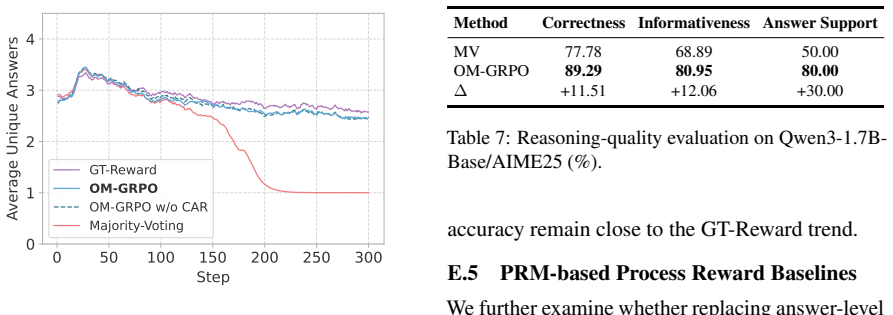
- Outcome masking transfers to test-time training, where it prevents collapse and outperforms majority voting by 4.24 points, and to open-ended generation with entropy-based rewards.
- Removing the mask reintroduces collapse, and partial answer-token weighting at 0.5 or 0.75 loses stability, so full masking is the reliable configuration.
Reading between the lines
- If masking works by removing a short, low-KL shortcut, the same principle may transfer to other RLVR settings where a short output span carries the reward, such as tool calls, code answers, or structured outputs; this is an extension the paper does not test.
- The theoretical argument shows the collapse mechanism is answer-frequency driven and independent of correctness, so OM-GRPO cannot by itself fix a distribution where the group consensus is systematically wrong; pairing it with an occasional external verifier would be a natural next test.
- The paper's experiments cap at 7B open models, so whether the stability persists at larger scales is untested, as the paper itself notes.
- CAR's pairwise comparisons are produced by the same policy being trained, creating a self-referential loop; comparing CAR against a fixed external judge or a frozen reference model could isolate whether the benefit comes from genuine comparison quality or from distributional self-consistency.
Editorial analysis
A structured set of objections, weighed in public.
Referee Report
Summary. The paper proposes OM-GRPO, a label-free RLVR method that decouples reward estimation from policy optimization by (i) computing a soft frequency-based consensus reward over a group of sampled trajectories, (ii) masking the gradient and KL updates on the answer span, and (iii) augmenting the answer pool with cheap pairwise comparisons (CAR). The central claim is that this design prevents answer-token reward hacking and training collapse, outperforms existing label-free RLVR baselines, and matches ground-truth-reward RLVR, with a test-time-training gain of 4.24 points over majority voting. Evidence includes three backbones, nine benchmarks, component ablations, training-dynamics curves, weak-initialization and low-contamination tests, and a theoretical appendix on collapse prevention.
Significance. If the central claim holds, OM-GRPO is a simple and valuable contribution: it shows that masking answer-span gradients is sufficient to stop the known collapse in voting-based self-reward, without requiring gold labels or an extra reward model. The empirical effort is a genuine strength: three backbones, nine benchmarks, TTRL experiments, ablations separating OMU, soft reward, and CAR, plus explicit training-dynamics, answer-diversity, and consensus-accuracy analyses. The paper also reports wall-clock overhead transparently. The main risk is that the method inherits its correctness signal from group consensus, so the paper establishes stability more firmly than it establishes correctness; this is acknowledged in the Limitations section but should be framed more precisely in the main text and theory.
major comments (5)
- [Section 4.1 and Table 1] The baseline evaluation is asymmetric. Section 4.1 states that baselines with late-stage collapse are reported at their best validation checkpoint, but no equivalent statement is made for OM-GRPO or for GT-Reward. Table 1 therefore appears to compare OM-GRPO's final (or unspecified) checkpoint against baselines' best checkpoints, which can distort the claimed margin over label-free baselines and the comparison to GT-Reward. Please state the checkpoint-selection rule for every method and report both best and final checkpoints for OM-GRPO, or compare all methods under a single protocol.
- [Eq. (1) and Eq. (20)] The main-text objective in Eq. (1) applies the token mask mi,t to the policy-gradient/clip term but not to the KL regularizer, whereas the theoretical objective in Appendix D.2.2, Eq. (20), masks both the policy-gradient term and the KL term on the answer span. Lemma 7 and Theorem 2 rely on the masked KL term for the "KL barrier against reasoning collapse" argument. As written, the theory does not apply to the stated main objective. Please align the equations or clarify which masking is actually used in the implementation, and adjust the proof accordingly.
- [Appendix D.2 and Section 3.1] Theorem 2 proves that masking answer-span gradients removes the direct answer-token shortcut and that reasoning collapse is KL-costly, but it does not prove that the group consensus is correct. The reward in Eq. (2) is a pure answer-frequency signal, so a consistently wrong consensus can receive the same high soft reward as a correct consensus; in that regime the masked objective would stably reinforce reasoning that produces the wrong answer. The empirical consensus-accuracy curves in Figure 6 and the weak-initialization and low-contamination experiments mitigate this concern for the tested distributions, and the Limitations section concedes the reliance on outcome-based signals. However, the main text phrase "provably eliminated" (Section 3.2) and the wording of Theorem 2 overstate the theoretical reach. Please state the correctness assumption explicitly, soften the proof claims accordingly, or add a formal treatment of the wrong-consensus case.
- [Section 3.3 and Appendix E.7] CAR uses the policy being trained as its own pairwise judge: the augmented answer pool is generated by the same model whose weights are being updated. The mechanistic analysis in Appendix E.7 shows that position bias decreases and that correct trajectories produce lower pairwise entropy, which is useful evidence. However, it does not include a control against an independent judge or a fixed reference policy over the full training run, so it remains possible that the comparison branch itself drifts with the policy. Please add such a control or clearly state that the pairwise comparisons are assumed to remain faithful throughout training.
- [Section 4.2 and footnote 3] The term "avg@k setting" is used for the main result, but the metric is not defined in the main text; it is only inferred from Appendix A that each benchmark uses a different k (e.g., avg@16 for AIME, avg@4 for MATH500 and GSM8K, avg@8 for AMC). Please define the aggregate metric in Section 4.2 and clarify whether the reported averages in Table 1 are unweighted means across benchmarks with different k values.
minor comments (5)
- [Introduction] In the second paragraph of Section 1, "Majority V oting" contains a stray space; this also appears in the baseline list in Section 4.1.
- [Appendix D] The appendix title uses "Overcome-Masked Update" (in D.2) while the main text consistently uses "Outcome-Masked Update"; please unify the terminology.
- [Appendix E.2] The Table 5 caption reads "Pass@k Results (%) ofRL performancecomparison" and should be spaced and reworded for readability.
- [Figure 9] The caption and the in-text discussion in Appendix E.7 refer to panels (a)-(d), but the figure layout and the order of discussion make it hard to map the panels; please align the panel labels with the textual references.
- [Section 4.4] The ablation paragraph reports average drops for "w/o OMU" on only two of the three backbones; for completeness, please report the corresponding drop for Llama-3.2-3B-Instruct as well.
Circularity Check
No load-bearing circularity: the 'matches GT-reward' claim is benchmark-empirical; the only definitional move is Appendix D.2's proof that masked answer tokens have zero gradient, which is the mask definition restated.
-
self definitional
[Appendix D.2, Lemma 5/Theorem 2; mask defined in Eq. (1), Section 3.2]
"Lemma 5. Under the masked objective (20), for any sample i and any position t such that mi,t = 0, ∂Lmask/∂logπθ(τi,t |x, τi,<t) = 0. Proof. By construction, neither the policy-gradient term nor the KL regularization term in (20) contains any factor involving logπθ(τi,t |x, τi,<t) for t > T."
The result is true by construction: m_{i,t} was defined in Eq. (1) as 0 for answer-span tokens, so the loss in Eq. (20) contains no answer-token log-probability terms. Presenting this as a 'theoretical proof' that masking redirects credit restates the definition of the mask rather than deriving a consequence. Theorem 2 extends this with a KL-barrier argument for stability, but the further claim that optimization must 'reliably support correct answers' does not follow from the masked objective alone, since the majority-vote reward in Appendix D.2 does not encode correctness. This step is non-load-bearing for the paper's central empirical claim, which is tested against external benchmarks.
full rationale
OM-GRPO's headline result—label-free RLVR that 'matches supervised GT-reward training'—is an empirical claim. It is supported by Table 1 comparisons with GT-Reward and label-free baselines, component ablations (Table 3), 10-epoch stability curves (Figure 3), TTRL results (Table 2), Pass@k results, low-contamination benchmarks (Table 6), and a ReCEval-style reasoning-quality evaluation (Table 7). These are external benchmarks with no fitted constants re-labeled as predictions and no load-bearing self-citation; the cited MV, Entropy, Self-Certainty, and CoReward baselines are prior work by other groups. The only definitional moment is Appendix D.2, where Lemma 5 states that masked answer tokens have zero gradient—exactly what the mask m_{i,t}=0 in Eq. (1) means—so the 'theory' restates its own construction. Theorem 2 contributes a KL-barrier stability argument but does not prove that group consensus is correct; the paper's Limitations section explicitly concedes that OM-GRPO 'still relies on outcome-based reward signals rather than explicit supervision of reasoning quality.' Because the main claim is independently benchmark-tested and the tautological lemma is not the sole evidence, the circularity is minor and non-load-bearing.
Assumptions & free parameters
free parameters (2)
- Group size G =
8
- KL coefficient beta =
0.005
assumptions (3)
- domain assumption The extracted answer span inside \boxed{} is present and parseable for essentially all training rollouts, and the format reward correctly identifies parseable outputs.
- domain assumption Answer-frequency consensus within a small sampled group is positively correlated with answer correctness for the training distribution.
- ad hoc to paper The simplified categorical softmax model in Appendix D (Eqs. 5-6) captures the relevant collapse dynamics of the transformer policy.
Cite this review
Pith. "Pith review of Don't Peek at the Answer: Outcome-Masked Group Relative Policy Optimization for Label-Free RLVR." pith.science (2026). https://pith.science/paper/UU7TUH2F
@misc{pith2026260803119,
  author       = {Pith},
  title        = {Pith review of: Don't Peek at the Answer: Outcome-Masked Group Relative Policy Optimization for Label-Free RLVR},
  year         = {2026},
  howpublished = {\url{https://pith.science/paper/UU7TUH2F}},
  note         = {Machine review of arXiv:2608.03119}
}
read the original abstract
Reinforcement Learning with Verifiable Rewards (RLVR) improves LLM reasoning but typically relies on ground-truth (GT) answers, limiting scalability. Voting-based label-free RLVR replace gold supervision with answer-level consensus from model samples. However, collapse arises when the same answer-level signal is used both to estimate rewards and to drive token-level policy optimization, encouraging the model to directly reinforce answer tokens rather than improve reasoning. We propose OM-GRPO, a label-free RLVR framework that decouples reward estimation from policy optimization. OM-GRPO masks gradients on the answer span while retaining answer-level rewards through a soft consensus signal, shifting optimization pressure away from answer tokens. We further introduce Contrast-Augmented Reward, which refines reward estimation via low-cost pairwise comparisons over existing trajectories without additional rollouts. Across diverse reasoning benchmarks and three LLM backbones, OM-GRPO consistently outperforms existing label-free RLVR methods and matches supervised GT-reward training with stable optimization. This stability is particularly beneficial in the Test-Time Training setting, where OM-GRPO surpasses majority voting by 4.24 points.
Figures


Figures from the paper (12 more)




Reference graph
Works this paper leans on
-
[1]
Shivam Agarwal, Zimin Zhang, Lifan Yuan, Jiawei Han, and Hao Peng. 2025. https://doi.org/10.48550/ARXIV.2505.15134 The unreasonable effectiveness of entropy minimization in llm reasoning . CoRR, abs/2505.15134
-
[2]
Jie Cheng, Gang Xiong, Ruixi Qiao, Lijun Li, Chao Guo, Junle Wang, Yisheng Lv, and Fei-Yue Wang. 2025. https://arxiv.org/abs/2504.15275 Stop summation: Min-form credit assignment is all process reward model needs for reasoning . Preprint, arXiv:2504.15275
arXiv 2025
-
[3]
Karl Cobbe, Vineet Kosaraju, Mohammad Bavarian, Mark Chen, Heewoo Jun, Lukasz Kaiser, Matthias Plappert, Jerry Tworek, Jacob Hilton, Reiichiro Nakano, Christopher Hesse, and John Schulman. 2021. https://doi.org/10.48550/ARXIV.2110.14168 Training verifiers to solve math word problems . CoRR, abs/2110.14168
-
[4]
DeepSeek - AI, Daya Guo, Dejian Yang, Haowei Zhang, Junxiao Song, Ruoyu Zhang, Runxin Xu, Qihao Zhu, Shirong Ma, Peiyi Wang, Xiao Bi, Xiaokang Zhang, Xingkai Yu, Yu Wu, Z. F. Wu, Zhibin Gou, Zhihong Shao, Zhuoshu Li, Ziyi Gao, and 81 others. 2025. https://doi.org/10.48550/ARXIV.2501.12948 Deepseek-r1: Incentivizing reasoning capability in llms via reinfor...
-
[5]
Abhimanyu Dubey, Abhinav Jauhri, Abhinav Pandey, Abhishek Kadian, Ahmad Al - Dahle, Aiesha Letman, Akhil Mathur, Alan Schelten, Amy Yang, Angela Fan, Anirudh Goyal, Anthony Hartshorn, Aobo Yang, Archi Mitra, Archie Sravankumar, Artem Korenev, Arthur Hinsvark, Arun Rao, Aston Zhang, and et al. 2024. https://doi.org/10.48550/ARXIV.2407.21783 The llama 3 her...
-
[6]
Alex Gu, Baptiste Rozi \`e re, Hugh Leather, Armando Solar-Lezama, Gabriel Synnaeve, and Sida I. Wang. 2024. https://doi.org/10.48550/ARXIV.2401.03065 Cruxeval: A benchmark for code reasoning, understanding and execution . CoRR, abs/2401.03065
-
[7]
Dan Hendrycks, Collin Burns, Saurav Kadavath, Akul Arora, Steven Basart, Eric Tang, Dawn Song, and Jacob Steinhardt. 2021. https://datasets-benchmarks-proceedings.neurips.cc/paper/2021/hash/be83ab3ecd0db773eb2dc1b0a17836a1-Abstract-round2.html Measuring mathematical problem solving with the MATH dataset . In Proceedings of the Neural Information Processin...
work page 2021
-
[8]
Jingcheng Hu, Yinmin Zhang, Qi Han, Daxin Jiang, Xiangyu Zhang, and Heung - Yeung Shum. 2025. https://doi.org/10.48550/ARXIV.2503.24290 Open-reasoner-zero: An open source approach to scaling up reinforcement learning on the base model . CoRR, abs/2503.24290
Show all 40 references
-
[9]
Hugging Face H4 . 2024. AIME 2024 Benchmark . https://huggingface.co/datasets/HuggingFaceH4/aime_2024
2024
-
[10]
Aaron Jaech, Adam Kalai, Adam Lerer, Adam Richardson, Ahmed El-Kishky, Aiden Low, Alec Helyar, Aleksander Madry, Alex Beutel, Alex Carney, Alex Iftimie, Alex Karpenko, Alex Tachard Passos, Alexander Neitz, Alexander Prokofiev, Alexander Wei, Allison Tam, Ally Bennett, Ananya K...
2024 arXiv
- [11]
- [12]
-
[13]
Miranda, Alisa Liu, Nouha Dziri, Shane Lyu, Yuling Gu, Saumya Malik, Victoria Graf, Jena D
Nathan Lambert, Jacob Morrison, Valentina Pyatkin, Shengyi Huang, Hamish Ivison, Faeze Brahman, Lester James V. Miranda, Alisa Liu, Nouha Dziri, Shane Lyu, Yuling Gu, Saumya Malik, Victoria Graf, Jena D. Hwang, Jiangjiang Yang, Ronan Le Bras, Oyvind Tafjord, Chris Wilhelm, Luc...
-
[14]
Harrison Lee, Samrat Phatale, Hassan Mansoor, Thomas Mesnard, Johan Ferret, Kellie Lu, Colton Bishop, Ethan Hall, Victor Carbune, Abhinav Rastogi, and Sushant Prakash. 2024. https://arxiv.org/abs/2309.00267 Rlaif vs. rlhf: Scaling reinforcement learning from human feedback wit...
2024 arXiv
- [15]
-
[16]
math-ai Team . 2024. Amc23: American mathematics competitions 2023 test set. https://huggingface.co/datasets/math-ai/amc23. Hugging Face dataset; 40 AMC 2023 problems; accessed 2025-09-16
2024
-
[17]
OpenCompass . 2025. AIME 2025 Benchmark . https://huggingface.co/datasets/opencompass/AIME2025
2025
- [18]
- [19]
- [20]
-
[21]
Archiki Prasad, Swarnadeep Saha, Xiang Zhou, and Mohit Bansal. 2023. https://doi.org/10.18653/v1/2023.emnlp-main.622 R e CE val: Evaluating reasoning chains via correctness and informativeness . In Proceedings of the 2023 Conference on Empirical Methods in Natural Language Pro...
2023 doi
-
[22]
Manning, Stefano Ermon, and Chelsea Finn
Rafael Rafailov, Archit Sharma, Eric Mitchell, Christopher D. Manning, Stefano Ermon, and Chelsea Finn. 2023. http://papers.nips.cc/paper\_files/paper/2023/hash/a85b405ed65c6477a4fe8302b5e06ce7-Abstract-Conference.html Direct preference optimization: Your language model is sec...
2023
-
[23]
Sheikh Shafayat, Fahim Tajwar, Ruslan Salakhutdinov, Jeff Schneider, and Andrea Zanette. 2025. https://doi.org/10.48550/ARXIV.2505.21444 Can large reasoning models self - train? CoRR, abs/2505.21444
2025 doi
- [24]
-
[25]
Guangming Sheng, Chi Zhang, Zilingfeng Ye, Xibin Wu, Wang Zhang, Ru Zhang, Yanghua Peng, Haibin Lin, and Chuan Wu. 2025. https://doi.org/10.1145/3689031.3696075 Hybridflow: A flexible and efficient RLHF framework . In Proceedings of the Twentieth European Conference on Compute...
2025
- [26]
- [27]
-
[28]
Xuezhi Wang, Jason Wei, Dale Schuurmans, Quoc V Le, Ed H Chi, Sharan Narang, Aakanksha Chowdhery, and Denny Zhou. 2023. https://openreview.net/forum?id=pZ3i2yt5DoY Self-consistency improves chain of thought reasoning in language models . In International Conference on Learning...
2023
- [29]
- [30]
- [31]
- [32]
- [33]
-
[34]
Zhaoning Yu, Will Su, Leitian Tao, Haozhu Wang, Aashu Singh, Hanchao Yu, Jianyu Wang, Hongyang Gao, Weizhe Yuan, Jason Weston, Ping Yu, and Jing Xu. 2025 b . https://arxiv.org/abs/2510.02172 Restrain: From spurious votes to signals -- self-driven rl with self-penalization . Pr...
2025
-
[35]
Yang Yue, Zhiqi Chen, Rui Lu, Andrew Zhao, Zhaokai Wang, Yang Yue, Shiji Song, and Gao Huang. 2025. https://arxiv.org/abs/2504.13837 Does reinforcement learning really incentivize reasoning capacity in llms beyond the base model? Preprint, arXiv:2504.13837
2025 arXiv
-
[36]
Zizhuo Zhang, Jianing Zhu, Xinmu Ge, Zihua Zhao, Zhanke Zhou, Xuan Li, Xiao Feng, Jiangchao Yao, and Bo Han. 2025. https://doi.org/10.48550/ARXIV.2508.00410 Co - reward: Self - supervised reinforcement learning for large language model reasoning via contrastive agreement . CoR...
2025 doi
- [37]
- [38]
- [39]
-
[40]
Jiaru Zou, Ling Yang, Jingwen Gu, Jiahao Qiu, Ke Shen, Jingrui He, and Mengdi Wang. 2025. https://arxiv.org/abs/2506.18896 Reasonflux-prm: Trajectory-aware prms for long chain-of-thought reasoning in llms . Preprint, arXiv:2506.18896
2025
Reviewed August 8, 2026 · model on record in the stance chip above.
Discussion (0). Continue with ORCID to comment.