REVIEW 4 major objections 5 minor 23 references
Rivalry of diffusion, external field and gravity in micro-convection of magnetic colloids
T0 review · 4 major / 5 minor · reviewed 2026-08-14 · deepseek-v4-flash
Pith's one-line read Gravity, not the magnetic field, inflates micro-convection mixing rates
desk verdict Likely-important gravitational artifact claim, but the paper's own critical-field verification contradicts it and needs a real answer, not a parenthetical caveat. read the letter →
The pith
A machine-rendered reading of the paper's core claim, the machinery that carries it, and where it could break.
The reading
What carries the argument
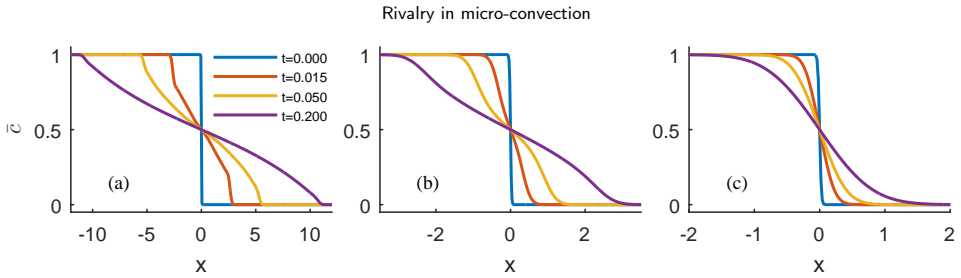
The central object is the gravitational Rayleigh number $Ra_g = \Delta\rho\, g\, h^3 / (8 D \eta)$, built from the density mismatch $\Delta\rho$, channel thickness $h$, diffusion coefficient $D$, and viscosity $\eta$. The argument runs through a Stokes-flow model in the $x$–$z$ plane with a concentration-dependent gravity force and a convection–diffusion equation (Eqs. 2–3); solutions are thickness-averaged to mimic microscope images, and the slope of the concentration profile at the interface yields an effective diffusion coefficient via $1/\bigl(4\pi(\partial c/\partial x)^2\bigr) = D t$. This machinery converts a three-way rivalry (diffusion, magnetic field, gravity) into a single dimensionless number whose size decides whether gravity visibly smears the interface.
What would settle it
Run the same micro-convection experiment with the cell inverted, so the denser magnetic fluid sits above the less dense non-magnetic fluid; the gravity-driven convection should vanish and $D_{\mathrm{eff}}$ should drop to the true diffusion coefficient $D$. If $D_{\mathrm{eff}}$ remains inflated in that orientation, the smearing is not (only) gravitational. Alternatively, measure the concentration profile across the channel thickness with confocal microscopy and look directly for the denser fluid sliding underneath.
Extended reading notes
Core claim
The central claim is that the enhanced interface smearing observed in magnetic micro-convection experiments arises from gravity-induced convective motion inside the microfluidic channel, caused by the density difference between the miscible magnetic and non-magnetic fluids, and that this motion can be described by an effective diffusion coefficient. The paper establishes a linear law $D_{\mathrm{eff}}/D_0 = 0.053 (Ra_g - Ra_c^g)$ for gravitational Rayleigh numbers above a critical value $Ra_c^g = 105$, with pure diffusion for smaller $Ra_g$. This explains the previously unexplained inflated $D_{\mathrm{eff}}$ used in the earlier Brinkman-model comparison and leaves the magnetic micro-convection dynamics itself described by that model once gravity is excluded.
Load-bearing premise
The observations assume that Taylor-Aris (shear-flow) dispersion does not contribute in the imaging window near the channel inlet, so the entire extra smearing is credited to gravity.
Editorial extensions
If this is right
- The inflated effective diffusion coefficients used in previous magnetic micro-convection analyses were gravitational artifacts; the true nanoparticle diffusion coefficient should be used in the Brinkman model.
- The gravitational Rayleigh number $Ra_g$ provides a simple criterion ($Ra_g > 100$) for when gravity will noticeably affect interface smearing in any colloidal microfluidic system.
- Reducing channel thickness suppresses gravity-driven smearing: at $h = 25\,\mu$m ($Ra_g \approx 110$) the effective diffusion is only about five times the true diffusion, compared to 670 times at $h = 130\,\mu$m.
- Gravity-driven smearing is distinct from Taylor-Aris dispersion: the effective diffusion grows linearly with $Ra_g$, whereas Taylor-Aris grows with the square of the Péclet number.
- The magnetic micro-convection finger size remains close to the cell thickness (with a slight deviation at 25 µm), and the critical field measurements are consistent with the Brinkman model once gravity is accounted for.
Reading between the lines
- The same gravitational mechanism likely affects other colloidal microfluidic mixers where a density mismatch exists, even without a magnetic field, so reported mixing efficiencies should be checked for gravitational contributions.
- A testable extension: measure $D_{\mathrm{eff}}$ at intermediate $Ra_g$ values more densely to confirm the linear law and locate the critical threshold, or use density-matched magnetic fluids to isolate magnetic micro-convection cleanly.
- The similarity between gravity-driven smearing and pure diffusion suggests that any technique relying on interface width as a diffusion measurement in microchannels must control for this effect; the slope-vs-time relation alone cannot distinguish the two.
Signed reviews
Editorial analysis
A structured set of objections, weighed in public.
Referee Report
Summary. The paper addresses the long-standing puzzle that effective diffusion coefficients inferred from magnetic micro-convection experiments are orders of magnitude larger than the true nanoparticle diffusion coefficient. It proposes that this excess smearing is caused by gravity-driven convective motion due to a small density difference between the miscible magnetic and non-magnetic fluids, not by enhanced mixing from the magnetic field. The process is characterized by a gravitational Rayleigh number Rag, and numerical simulations of coupled Stokes and convection-diffusion equations are used to derive a linear relation Deff/D0 = 0.053(Rag - 105), where D0 is the true diffusivity. Experiments in microfluidic cells of thickness 130, 50, and 25 µm, with Rag values of approximately 13500, 900, and 110, respectively, show qualitatively reduced smearing for thinner cells. The paper also attempts to verify the pre-existing Brinkman model for magnetic micro-convection by comparing predicted and measured critical magnetic fields.
Significance. If the gravitational interpretation is correct, it resolves a long-standing inconsistency in the magnetic micro-convection literature and provides a practical quantitative criterion for when gravity effects must be considered in miscible colloidal microfluidics. The model is conceptually simple, and the three-thickness experimental design is a good strategy for testing the Rag scaling. The paper also clearly documents the numerical simulations. However, the quantitative verification is incomplete: the experimental Deff values do not match Eq. (4) for the two thinner cells, and the magnetic critical-field comparison fails for two of three thicknesses. The dismissal of Taylor-Aris dispersion is not backed by a quantitative estimate. These issues are load-bearing because the central claim—that the inflated Deff is a gravitational artifact—rests on the agreement between the numerical model and experiment.
major comments (4)
- [§3, Eq. (4) and Fig. 7] The numerical relation Deff/D0 = 0.053(Rag - 105) does not provide quantitative agreement with the experimental data for the two thinner cells. For Rag = 110, Eq. (4) gives Deff/D0 = 0.265, while the measured value is 5.2; for Rag = 900, the relation gives 42, while the measured value is 15.2. Only the h = 130 µm point (Rag = 13500) agrees well (predicted 710, measured 670). The statement that there is "reasonably good agreement" is therefore not supported, and the central scaling claim is not quantitatively verified.
- [§3, critical magnetic field comparison] Using the measured gravitational Deff in the critical-field formula yields Hc = 53 Oe for h = 130 µm and Hc = 24 Oe for h = 25 µm, while the measured values are 19 Oe and 34 Oe, respectively; only the h = 50 µm cell agrees (21 Oe vs 21 Oe). The explanations offered—that straight fingers in the 130 µm cell may not originate from magnetic micro-convection, and that the 25 µm discrepancy is due to flow fluctuations—are ad hoc and are not supported by independent evidence. This inconsistency is load-bearing because the paper's conclusion that "residual magnetic micro-convection follows earlier predictions" depends on this verification.
- [§3, Taylor-Aris dispersion] The exclusion of Taylor-Aris (shear-flow) dispersion is not quantified. For the h = 25 µm cell with v ≈ 333 µm/s and D0 = 2.5 × 10^-7 cm^2/s, the Péclet number is Pe ≈ 330, giving D_TA/D0 ≈ 1 + Pe^2/210 ≈ 500, which is two orders of magnitude above the reported Deff/D0 = 5.2. Although the observation times (≈ 1–4 s) are shorter than the diffusive cross-channel time h^2/D0 ≈ 25 s, the pre-asymptotic shear contribution can still be significant and must be estimated quantitatively to rule out a flow-induced component in the observed thickness-dependent smearing.
- [§3, extraction of Deff for the thinnest cell] The experimental data for the h = 25 µm cell are described as "much noisier," and the linear fit in Fig. 6(b) appears to rely on a small number of points. The resulting Deff/D0 = 5.2 is the strongest outlier from Eq. (4) and is a key datum for the paper's claim. Without an uncertainty estimate or repeat measurements, it is difficult to judge whether this point indicates a physical discrepancy or an experimental artifact.
minor comments (5)
- [§2.2, Eqs. (2)–(3)] The model uses the Stokes equations with no-slip boundaries, but for a thin Hele-Shaw cell the depth-averaged Darcy/Brinkman model is more conventional; a sentence justifying the 2D Stokes representation would be useful.
- [§2.4] The viscosity of the magnetic fluid is assumed equal to that of water despite a nanoparticle volume fraction of 2.8%; a measurement or a brief justification of this assumption would strengthen the quantitative claims.
- [§3, critical-field formula] The expression Hc = sqrt(12 η D Ra_m^crit / (χ h)) appears dimensionally inconsistent as written; please check whether the denominator should be χ h^2 and clarify which diffusion coefficient (D or Deff) is inserted.
- [§3, scaling discussion] The statement that "Rag Pe" is imprecise; it would be clearer to write the proportionality explicitly, e.g., Rag = (Δρ g h^2 / (8 η D)) · Pe, or to present the relation in terms of the gravity velocity scale.
- [Figure 5 caption] The caption says "Numerical simulation results for (d) Rag = 15000, (e) Rag = 1000 and (f) Rag = 100" but the text in §3 refers to "Fig.5(a)-(c)" for experimental panels; please ensure the panel references are consistent.
Circularity Check
No circularity: the gravitational Deff prediction is parameter-free, and the critical-field check uses independently measured Deff with openly reported mismatches.
full rationale
The central derivation is self-contained. The gravitational model in §2.2 (Eqs. 2–3) uses the Stokes and convection–diffusion equations with an explicit dimensionless scaling; the gravitational Rayleigh number Rag = Δρ g h^3/(8Dη) is fixed entirely by independently measured inputs (density difference, channel thickness, particle diffusion coefficient, viscosity). The effective diffusion coefficient is not an input: it is extracted from numerical concentration profiles via the same Fick-law relation (1) that defines the experimental Deff, and the numerical Deff(Rag) curve is compared with experimental points in Fig. 7. No parameter is fitted to the experimental Deff values, so the comparison is a genuine prediction. Eq. (4) is a fit to the numerical data, not to experiments, and the experimental points plotted against it remain an external check. The only subsequent use of measured Deff is the critical-field estimate Hc = sqrt(12ηD Ra_m^crit/(χh)) in §3. There Deff is used as the effective diffusivity, but it comes from the no-field experiments, not from the Hc measurements; moreover the paper openly reports disagreement for h = 130 μm and h = 25 μm, so it is a consistency test rather than a forced agreement. Self-citations to [7], [13], and [17] supply the model equations, the critical magnetic Rayleigh number Ra_m^crit ≈ 6, and additional numerical details; those results are stated in the paper and are parameter-free theoretical inputs, so they are independent support rather than circular. The exclusion of Taylor-Aris dispersion is asserted without a quantitative calculation, but that is an external experimental concern, not a by-construction reduction. No circular step found.
Assumptions & free parameters
free parameters (2)
- Proportionality constant in Deff/D0 versus Rag relation =
0.053
- Critical gravitational Rayleigh number Rag_c =
105
assumptions (4)
- domain assumption Fluid viscosities are equal and constant across the interface
- domain assumption Taylor-Aris dispersion is negligible in the early observation region
- domain assumption The quasi-2D Hele-Shaw model (Stokes plus convection-diffusion in the x-z plane) captures the concentration dynamics
- domain assumption Image intensity maps linearly to concentration via the Beer-Lambert law after manual corrections
Cite this review
Pith. "Pith review of Rivalry of diffusion, external field and gravity in micro-convection of magnetic colloids." pith.science (2026). https://pith.science/paper/UUUBFQWY
@misc{pith2026190805011,
  author       = {Pith},
  title        = {Pith review of: Rivalry of diffusion, external field and gravity in micro-convection of magnetic colloids},
  year         = {2026},
  howpublished = {\url{https://pith.science/paper/UUUBFQWY}},
  note         = {Machine review of arXiv:1908.05011}
}
read the original abstract
Magnetic fields and magnetic materials have promising microfluidic applications. For example, magnetic micro-convection can enhance mixing considerably. However, previous studies have not explained increased effective diffusion during this phenomenon. Here we show that enhanced interface smearing comes from a gravity induced convective motion within a thin microfluidic channel, caused by a small density difference between miscible magnetic and non-magnetic fluids. This motion resembles diffusive behavior and can be described with an effective diffusion coefficient. We explain this with a theoretical model, based on a dimensionless gravitational Rayleigh number, and verify it by numerical simulations and experiments with different cell thicknesses. Results indicate the applicability and limitations for microfluidic applications of other colloidal systems. Residual magnetic micro-convection follows earlier predictions.
Figures


Figures from the paper (6 more)


Reference graph
Works this paper leans on
-
[1]
E. K. Sackmann, A. L. Fulton, D. J. Beebe, The present and future role of microfluidics in biomedical research, Nature 507 (2014) 181 – 189. Review Article
work page 2014
-
[2]
X.Chen,L.Zhang, Areviewonmicromixersactuatedwithmagnetic nanomaterials, Microchimica Acta 184 (2017) 3639 – 3649
work page 2017
-
[3]
S. Boroun, F. Larachi, Role of magnetic nanoparticles in mixing, transport phenomena and reaction engineering – challenges and op- portunities, Current Opinion in Chemical Engineering 13 (2016) 91 – 99. Energy and Environmental Engineering / Reaction engineering and catalysis
work page 2016
-
[4]
R.-J.Yang,H.-H.Hou,Y.-N.Wang,L.-M.Fu,Micro-magnetofluidics in microfluidic systems: A review, Sensors and Actuators B: Chemi- cal 224 (2016) 1 – 15
work page 2016
-
[5]
M. M. Maiorov, A. C¯ebers, Magnetic microconvection on the diffu- sion front of ferroparticles, Magnetohydrodynamics 19 (1983) 376 – 380
work page 1983
-
[6]
C.Derec, P.Boltenhagen, S.Neveu, J.-C.Bacri, Magneticinstability betweenmisciblefluidsinaHele-Shawcell, Magnetohydrodynamics 44 (2008) 135 – 142
work page 2008
-
[7]
K. ¯Erglis,A.Tatulcenkov,G.Kitenbergs,O.Petrichenko,F.G.Ergin, B.B.Watz,A.C ¯ebers, Magneticfielddrivenmicro-convectioninthe hele-shaw cell, Journal of Fluid Mechanics 714 (2013) 612 – 633
work page 2013
- [8]
Show all 23 references
-
[9]
H.Li,C.-Y.Kao,C.-Y.Wen, Labyrinthineandsecondarywaveinsta- bilities of a miscible magnetic fluid drop in a hele-shaw cell, Journal of Fluid Mechanics 836 (2018) 374 – 396
2018
-
[10]
Chen, W.-K
C.-Y. Chen, W.-K. Tsai, J. A. Miranda, Hybrid ferrohydrodynamic instability: Coexisting peak and labyrinthine patterns, Phys. Rev. E 77 (2008) 056306
2008
-
[11]
Kitenbergs, K.¯Erglis, R
G. Kitenbergs, K.¯Erglis, R. Perzynski, A. C¯ebers, Magnetic particle mixing with magnetic micro-convection for microfluidics, Journal of Magnetism and Magnetic Materials 380 (2015) 227 – 230
2015
-
[12]
J. G. Lee, V. Porter, W. A. Shelton, B. Bharti, Magnetic field-driven convection for directed surface patterning of colloids, Langmuir 34 (2018) 15416 – 15424
2018
-
[13]
C¯ebers, Magnetic field driven micro-convection in the hele- shaw cell: the Brinkman model and its comparison with experiment, Journal of Fluid Mechanics 774 (2015) 170 – 191
G.Kitenbergs,A.Tatul ,/uni010Denkovs,K.¯Erglis,O.Petrichenko,R.Perzyn- ski, A. C¯ebers, Magnetic field driven micro-convection in the hele- shaw cell: the Brinkman model and its comparison with experiment, Journal of Fluid Mechanics 774 (2015) 170 – 191
2015
-
[14]
G.Kitenbergs,A.Tatul ,/uni010Denkovs,L.Puk,ina,A.C ¯ebers, Gravityeffects onmixingwithmagneticmicro-convectioninmicrofluidics, TheEu- ropean Physical Journal E 41 (2018) 138
2018
-
[15]
D. C. Duffy, J. C. McDonald, O. J. A. Schueller, G. M. Whitesides, Rapidprototypingofmicrofluidicsystemsinpoly(dimethylsiloxane), Analytical Chemistry 70 (1998) 4974–4984
1998
-
[16]
F.G.Ergin,G.Kitenbergs,A.C ¯ebers, Revisitingvelocity,concentra- tion and interface measurements in a magnetic micromixer, in: C. J. Kähler, R. Hain, S. Scharnowski, T. Fuchs (Eds.), Proceedings of the 13th International Symposium on Particle Image Velocimetry, 2019, pp. 1119–...
2019
-
[17]
Kitenbergs, Hydrodynamic instabilities in microfluidic magnetic fluid flows, Ph.D
G. Kitenbergs, Hydrodynamic instabilities in microfluidic magnetic fluid flows, Ph.D. thesis, University of Pierre and Marie Curie and University of Latvia, Paris, France and Riga, Latvia, 2015
2015
-
[18]
S. K. Yoon, M. Mitchell, E. R. Choban, P. J. A. Kenis, Gravity- induced reorientation of the interface between two liquids of differ- ent densities flowing laminarly through a microchannel, Lab Chip 5 (2005) 1259–1263. G.Kitenbergs et al.: Preprint submitted to Elsevier Page 7 o...
2005
-
[19]
M. A. Bennet, Multi-parameter quantitative mapping of microfluidic devices, Ph.D. thesis, University of Edinburgh, Edinburgh, United Kingdom, 2011
2011
-
[20]
Yamaguchi, T
Y. Yamaguchi, T. Honda, M. Briones, K. Yamashita, M. Miyazaki, H. Nakamura, H. Maeda, Influence of gravity on two-layer lami- nar flow in a microchannel, Chemical Engineering & Technology 30 (2007) 379–382
2007
-
[21]
G. I. Taylor, Dispersion of soluble matter in solvent flowing slowly through a tube, Proceedings of the Royal Society of London. Series A. Mathematical and Physical Sciences 219 (1953) 186–203
1953
-
[22]
Series A
R.Aris, Onthedispersionofasolutebydiffusion,convectionandex- changebetweenphases, ProceedingsoftheRoyalSocietyofLondon. Series A. Mathematical and Physical Sciences 252 (1959) 538–550
1959
-
[23]
taylor dispersion of a so- luteinamicrofluidicchannel
K. D. Dorfman, H. Brenner, Comment on “taylor dispersion of a so- luteinamicrofluidicchannel”[j.appl.phys.89,4667(2001)],Journal of Applied Physics 90 (2001) 6553–6554. G.Kitenbergs et al.: Preprint submitted to Elsevier Page 8 of 8
2001
Reviewed August 14, 2026 · model on record in the stance chip above.
Discussion (0). Continue with ORCID to comment.