REVIEW 3 major objections 5 minor 57 references
Response of macroscopic and microscopic dynamical quantifiers to the quantum critical region
T0 review · 3 major / 5 minor · reviewed 2026-08-14 · deepseek-v4-flash
Pith's one-line read After a quench, absorbed energy, nearest-neighbor entanglement, and mutual information can demarcate the quantum critical region via a temperature threshold.
desk verdict Solid qualitative result on quench probes of the QCR, but the quantitative boundary is set by an uncalibrated tolerance and is not yet shown to match the equilibrium QCR. read the letter →
The pith
A machine-rendered reading of the paper's core claim, the machinery that carries it, and where it could break.
The reading
What carries the argument
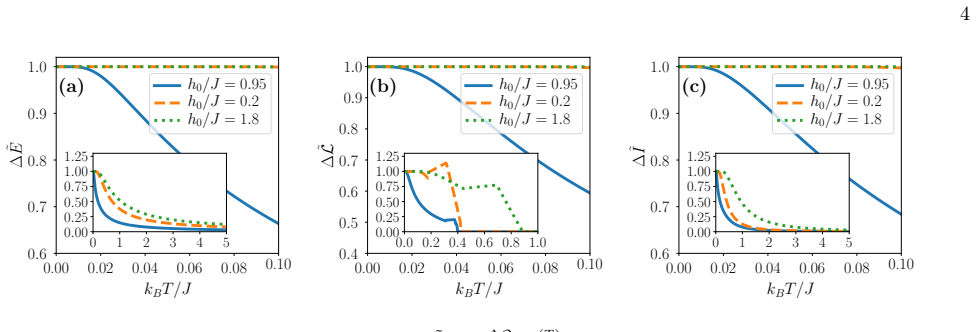
The load-bearing object is the exactly solvable transverse-field quantum $XY$ chain, reduced by Jordan-Wigner and Bogoliubov transformations to non-interacting fermions, which lets correlators, entanglement, and absorbed energy be evaluated analytically after a quench. The paper uses two quench protocols—a square pulse that returns the field to $h_0$ for the energy probe, and a sudden quench to a fixed final field $h_1/J = 1$ for the entanglement and mutual-information probes—and records the maximal change of each quantifier normalized by its zero-temperature value. The demarcation mechanism is Eq. (14): the boundary of the QCR is declared at the temperature $T^*$ where the fractional deviation from the zero-temperature value reaches the tolerance $\eta = 10^{-6}$; below $T^*$ the response counts as temperature-independent, above it the initial point is counted as inside the QCR. The choice $h_1 = J$ is meant to maximize the temperature sensitivity of the response.
What would settle it
Recompute Eq. (14) with $\eta = 10^{-4}$ and $\eta = 10^{-8}$ and extract $T^*(h_0)$ for $h_0$ near $h_c$; also fit the slope of $T^*(h_0)$ versus $|h_0 - h_c|$. If the reconstructed boundary moves by more than the intrinsic fuzziness of the QCR, or if the slope does not match the Ising-universality constant $C$, the claim of faithful mimicry fails.
Extended reading notes
Core claim
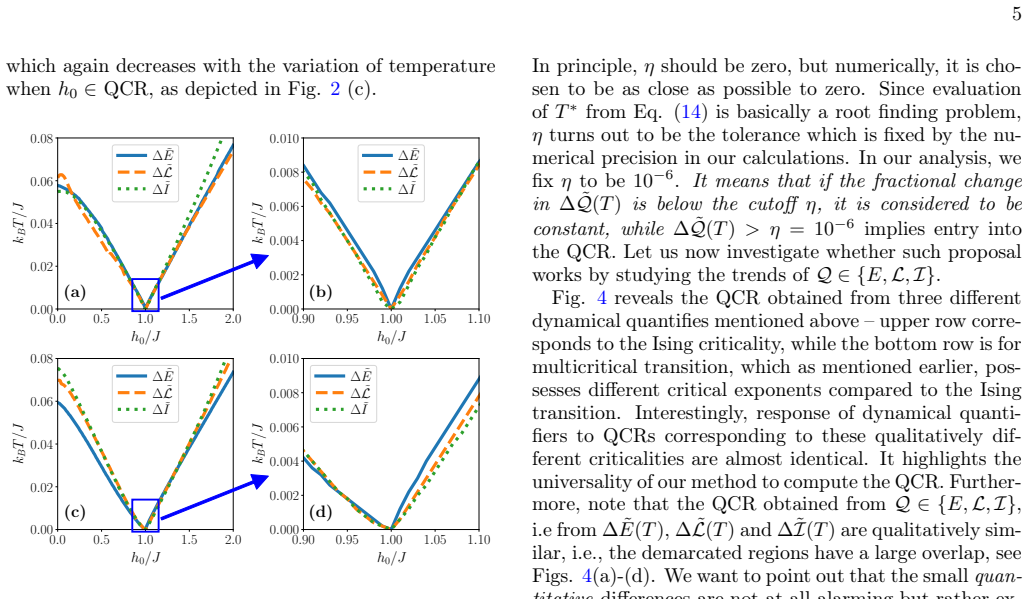
The central claim is that a quench starting inside the QCR produces a temperature-dependent response that is qualitatively different from quenches starting in the ordered or disordered phases. For $k_B T / J \lesssim 0.1$, the normalized maximal changes $\Delta\tilde{E}$, $\Delta\tilde{L}$, and $\Delta\tilde{I}$ stay nearly constant when $h_0$ is far from the critical field, but drop rapidly when $h_0$ lies in the QCR, with faster drop for $h_0$ closer to $h_c$. The paper converts this into a demarcation rule: for fixed $h_0$, the QCR boundary is the temperature $T^*(h_0)$ at which $|\Delta Q_{\max}(T) - \Delta Q_{\max}(0)| / |\Delta Q_{\max}(0)| = \eta$ with $\eta = 10^{-6}$. The resulting regions from the three quantifiers overlap closely, and the same procedure works for the Ising transition and for the multicritical point $\gamma = 1 - |h_0/J|$, which the paper reads as evidence that the dynamical quantifiers are tracking the equilibrium QCR rather than an artifact of one probe.
Load-bearing premise
The entire quantitative demarcation rests on an arbitrary tolerance $\eta = 10^{-6}$: if a different tolerance moves the extracted boundary substantially, or if the boundary does not match the equilibrium prediction $T \approx C|h - h_c|$ with the right universality constant, the claim that the dynamics faithfully mimics the equilibrium QCR fails.
Editorial extensions
If this is right
- One of the three probes alone can delineate the QCR in the $(h_0, T)$ plane, eliminating the need for an order parameter or a gap-closing criterion in the crossover region.
- The signature is insensitive to quench length: altering $h_1/J$ while keeping it in the same regime preserves the fast-falloff feature, so the detector does not require fine-tuned quench amplitudes.
- The criterion applies to distinct criticalities with different critical exponents, indicating that the method is not restricted to one universality class.
- For non-integrable models, where exact analytics are unavailable, the authors expect similar signatures on time scales short compared with thermalization, suggesting the probes may work beyond exactly solvable chains.
Reading between the lines
- A natural next test, not performed in the paper, is to compare the extracted $T^*(h_0)$ against the equilibrium cone $T \approx C|h - h_c|$ with the known Ising universality constant $C$; matching slopes would make "faithful mimicry" quantitative rather than qualitative.
- The tolerance $\eta$ is an uncalibrated knob: scanning $\eta$ from, say, $10^{-4}$ to $10^{-8}$ and checking that the reconstructed cone retains its shape and slope would show whether the demarcation is a physical boundary or a numerical convention.
- If the effect is controlled by critical scaling at the QCP rather than by integrability, short-time entanglement quenches could serve as a QCR probe in cold-atom or trapped-ion transverse-field Ising simulators, where no exact free-fermion solution exists.
Signed reviews
Editorial analysis
A structured set of objections, weighed in public.
Referee Report
Summary. The manuscript studies finite-temperature quench dynamics in the one-dimensional transverse-field XY model. For a thermal initial state at temperature T and initial field h0, it computes (i) the maximum energy absorbed during a finite square pulse, (ii) the maximal change in logarithmic negativity, and (iii) the maximal change in quantum mutual information after a sudden quench. It reports that the scaled versions of these quantities fall off with temperature much more rapidly when h0 is in the quantum critical region (QCR) than when h0 is deep in the ordered or disordered phases. The authors then define a boundary temperature T*(h0) through Eq. (14), using a fractional-change tolerance η=10^-6, and use it to draw QCR boundaries in the (h0,T) plane for both the Ising and multicritical transitions. The central claim is that these dynamical quantifiers 'faithfully mimic' the equilibrium physics of the QCR.
Significance. If the quantitative claim were established, the proposed dynamical quantifiers would be experimentally relevant markers of the finite-temperature QCR and would connect macroscopic response (absorbed energy) with microscopic correlations in a single framework. The paper has genuine strengths: the exact analytic treatment in Appendix A, the simultaneous consideration of three different quantifiers, the check of quench-length independence in Fig. 3, and the explicit acknowledgment that the QCR boundary is intrinsically fuzzy. The main weakness is that the quantitative demarcation procedure is not calibrated to the equilibrium definition (1); this is fixable, and the underlying study is worth publishing after revision.
major comments (3)
- [Sec. IV, Eq. (14)] The boundary temperature T* is defined by the arbitrary tolerance η=10^-6, and the paper provides no sensitivity analysis and no comparison with the equilibrium QCR boundary T≈C|h-hc| quoted in Eq. (1). For h0 away from hc, the initial Hamiltonian has a gap Δ∝|h0-hc|, so the low-temperature fractional change in ΔQmax is exponentially small; solving Eq. (14) yields T* proportional to Δ/ln(1/η), roughly an order of magnitude below the equilibrium crossover scale. The shape of the region in Fig. 4 is therefore essentially a contour of fixed fractional change of the dynamical quantifier, not a demonstrated property of the equilibrium QCR. Unless the authors show that varying η over a reasonable range leaves T*(h0) consistent with Eq. (1), or explain why an alternative scale is physical, the central claim that the quantifiers 'faithfully mimic equilibrium physics' is not established.
- [Sec. III A and Fig. 3] The final quench field is fixed to h1/J=1 because it 'gives rise to strong temperature dependence,' but no quantitative criterion is given for this choice and only two alternative values (h1/J=0.3 and 2) are tested qualitatively. Since T* defined by Eq. (14) is computed for h1/J=1 throughout Fig. 4, the extracted boundary could depend on this choice. The authors should either demonstrate that the boundaries in Fig. 4 are stable under h1 variation or state the domain of validity of their quantitative demarcation.
- [Sec. IV, Fig. 4] The claim that the method is universal, made in the discussion of the multicritical and Ising transitions, rests on only two critical points. The two examples are useful, but 'universality' is stronger than what two representative points can establish; the text should be reworded to 'qualitatively similar for the two criticalities studied' unless additional universality classes are examined.
minor comments (5)
- [Sec. III A, bullet list] In the third bullet, the symbol Δ˜Q is used, but the surrounding text discusses Δ˜E; please use consistent notation.
- [Introduction] There are several typos, including 'characetrize' (should be 'characterize') and 'effected' (should be 'affected').
- [Sec. IV, Eq. (14)] The text should clarify that T* is the first solution of Eq. (14), since at higher temperatures the quantifier can cross the threshold again, as seen in the non-monotonic behavior of Δ˜L in Fig. 2(b).
- [Sec. III, low-temperature window] The choice of the analysis window kBT/J≲0.1 is stated without justification; a sentence explaining the choice relative to the relevant gap or crossover scale would strengthen the presentation.
- [References] Reference [24] is incomplete: it gives volume and page but no journal name.
Circularity Check
Quantitative QCR demarcation is defined by the quantifier's own threshold in Eq. (14), not by the equilibrium line Eq. (1), so the faithful-mimicry claim is partly self-referential.
-
self definitional
[Section IV, Eq. (14) and Fig. 4]
"T∗ can be computed from the solution of the following condition: |ΔQmax(T )− ΔQmax(T = 0)| / |ΔQmax(T = 0)| =η. ... In our analysis, we fixη to be 10−6. It means that if the fractional change in ΔQ~(T ) is below the cutoffη, it is considered to be constant, while ΔQ~(T ) > η = 10−6 implies entry into the QCR."
T* is not obtained from the equilibrium QCR line Eq. (1) or from any independent criterion; it is defined as the temperature at which the proposed quantifier's own fractional change reaches the arbitrary tolerance η. Calling this crossing 'entry into the QCR' makes the demarcated region a contour of the detector, so the claimed faithful mimicry of equilibrium physics reduces to the definition in Eq. (14) unless η is calibrated against Eq. (1).
full rationale
The model is exactly solvable and the dynamical quantifiers are computed from the Hamiltonian without fitting to equilibrium data, and no load-bearing self-citation appears: refs. [16,36,37] are background citations for known entanglement/DQPT features. The central issue is the quantitative demarcation in Sec. IV: Eq. (14) defines T* as the temperature where |ΔQmax(T)-ΔQmax(0)|/|ΔQmax(0)| = η for η=10^-6, and Fig. 4 is constructed by solving this equation. The extracted boundary is therefore a threshold contour of the proposed quantifier, not an independent test of the equilibrium QCR line T≈C|h-hc| from Eq. (1). The paper neither varies η nor compares T*(h0) with Eq. (1), so the statement that these quantifiers 'faithfully mimic equilibrium physics' is partly self-referential at the quantitative level. The qualitative faster-falloff behavior near hc and the mutual overlap of the three quantifiers provide independent content, so the circularity is partial, not total.
Assumptions & free parameters
free parameters (3)
- eta (tolerance in QCR boundary criterion) =
10^-6
- final quench field h1/J =
1
- low-temperature analysis window kBT/J =
0.1
assumptions (4)
- standard math The 1D transverse-field XY model is exactly solvable via Jordan-Wigner, Fourier, and Bogoliubov transformations.
- domain assumption The initial state is a canonical Gibbs state at temperature T with respect to the initial Hamiltonian.
- domain assumption The quantum critical region at low temperature is bounded by T approximately C|h - hc|, with the zero-temperature QCP at the vertex.
- ad hoc to paper The criterion Eq. (14), with eta = 10^-6, is a valid operational definition of the QCR boundary.
Cite this review
Pith. "Pith review of Response of macroscopic and microscopic dynamical quantifiers to the quantum critical region." pith.science (2026). https://pith.science/paper/UUVIE34G
@misc{pith2026190806374,
  author       = {Pith},
  title        = {Pith review of: Response of macroscopic and microscopic dynamical quantifiers to the quantum critical region},
  year         = {2026},
  howpublished = {\url{https://pith.science/paper/UUVIE34G}},
  note         = {Machine review of arXiv:1908.06374}
}
abstract
At finite temperatures, the quantum critical region (QCR) emerges as a consequence of the interplay between thermal and quantum fluctuations. We seek for suitable physical quantities, which during dynamics can give prominent response to QCR in the transverse field quantum $XY$ model. We report that the maximum energy absorbed, the nearest neighbor entanglement and the quantum mutual information of the time evolved state after a quench of the transverse magnetic field exhibits a faster fall off with temperature when the initial magnetic field is taken from within the QCR, compared to the choice of the initial point from different phases. We propose a class of dynamical quantifiers, originated from the response of these physical quantities and show that they can faithfully mimic the equilibrium physics, namely detection of the QCR at finite temperatures.
Figures


Figures from the paper (1 more)
Reference graph
Works this paper leans on
-
[1]
If the initial field strength,h0, is chosen from deep inside the ordered or disordered phases,∆ ˜E(T ) is an almost constant function ofT, i.e., it changes negligibly with changing temperature
-
[2]
from points close to the quantum critical point, there is a rapid fall of∆ ˜E(T ) with temperature
Ifh0 is inside the quantum critical region, i.e. from points close to the quantum critical point, there is a rapid fall of∆ ˜E(T ) with temperature. The closer the initial quench point is to the QCP, the faster the fall
-
[3]
The relevant physics reported in 1 and 2 above is independent of the quench length,|h0/J−h1/J|, in the sense that they do not effect the fall off feature in ∆ ˜E(T ). For example, for the quench: h0 J (0.2) → h1 J (0.3, 2), we get that all the rele- vant quantities under consideration remain almost constant for kBT J ≲ 0.1, while for the quench: h0 J (0.95)...
work page 2019
- [4]
-
[5]
Evaluation of energy absorbed in a time pulse The energy absorbed in a square time pulse that last a timeτ is evaluated as ∆E(T,τ ) = Tr( ˆH0e−i ˆH1τρ0ei ˆH1τ)−Tr( ˆH0ρ0) (A7) where ρ0 =e− ˆH0 kB T/Tre− ˆH0 kB T . Now, after Fourier trans- formation, we have ∆E(T,τ ) = 1 2π ∫ dp [ Tr( ˆHp 0e−i ˆH p 1τρp 0ei ˆH p 1τ)−Tr( ˆHp 0ρp 0) ] , (A8) 7 where, ˆHp 0,...
-
[6]
Evaluation of entanglement For ˆρAB(t,T ), we always get a state in which the only non-zero local magnetization is in the z-direction, mz(t,T ) and possess the following correlation matrix T (t,T ) = Cxx(t,T ) Cxy(t,T ) 0 Cyx(t,T ) Cyy(t,T ) 0 0 0 Czz(t,T ) ,(A12) with Cxy(t,T ) = Cyx(t,T ). The computation of entan- glement simplifies with the obse...
-
[7]
Evaluation of mutual information For computing the mutual information, we first eval- uate the spectrum of ˆρAB(t,T ), and its single site re- ductions, ˆρA(t,T ) = TrB ˆρAB(t,T ) which is equal to ˆρB(t,T ) = TrA ˆρAB(t,T ). The spectrum of ˆρAB(t,T ), XˆρAB(t,T), is obtained from the eigenvalues ofˆρAB(t,T ) and is given by X ˆρAB(t,T) = 1 4× { 1−Czz(t,T...
-
[8]
B. K. Chakrabarti, A. Dutta, and P. Sen, Quantum Ising phases and transitions in transverse Ising models (Springer Berlin Heidelberg, 1996)
work page 1996
Show all 57 references
-
[9]
Sachdev, Quantum Phase Transitions (Cambridge University Press, 2009)
S. Sachdev, Quantum Phase Transitions (Cambridge University Press, 2009)
2009
-
[10]
Suzuki, J
S. Suzuki, J. Inoue, and B. K. Chakrabarti, Quantum Ising Phases and Transitions in Transverse Ising Models 8 (Springer Berlin Heidelberg, 2013)
2013
-
[11]
Heyl, Phys
M. Heyl, Phys. Rev. Lett.115, 140602 (2015)
2015
-
[12]
Sengupta, S
K. Sengupta, S. Powell, and S. Sachdev, Phys. Rev. A 69, 053616 (2004)
2004
-
[13]
Sen(De), U
A. Sen(De), U. Sen, and M. Lewenstein, Phys. Rev. A 72, 052319 (2005)
2005
-
[14]
Pollmann, S
F. Pollmann, S. Mukerjee, A. G. Green, and J. E. Moore, Phys. Rev. E81, 020101 (2010)
2010
-
[15]
M. Heyl, A. Polkovnikov, and S. Kehrein, Phys. Rev. Lett. 110, 135704 (2013)
2013
-
[16]
Heyl, Phys
M. Heyl, Phys. Rev. Lett.113, 205701 (2014)
2014
-
[17]
Žunkovič, M
B. Žunkovič, M. Heyl, M. Knap, and A. Silva, Phys. Rev. Lett.120, 130601 (2018)
2018
-
[18]
Sachdev and J
S. Sachdev and J. Ye, Phys. Rev. Lett.69, 2411 (1992)
1992
-
[19]
Heyl, Rep
M. Heyl, Rep. Prog. Phys.81, 054001 (2018)
2018
-
[20]
S. A. Weidinger, M. Heyl, A. Silva, and M. Knap, Phys. Rev. B96, 134313 (2017)
2017
-
[21]
Vajna and B
S. Vajna and B. Dóra, Phys. Rev. B89, 161105 (2014)
2014
-
[22]
Canovi, E
E. Canovi, E. Ercolessi, P. Naldesi, L. Taddia, and D. Vodola, Phys. Rev. B89, 104303 (2014)
2014
-
[23]
Haldar, S
S. Haldar, S. Roy, T. Chanda, A. Sen(De), and U. Sen, Phys. Rev. B101, 224304 (2020)
2020
-
[24]
Chakravarty, B
S. Chakravarty, B. I. Halperin, and D. R. Nelson, Phys. Rev. B39, 2344 (1989)
1989
-
[25]
Amico and D
L. Amico and D. Patanè, Europhysics Letters (EPL)77, 17001 (2007)
2007
-
[26]
Sachdev and A
S. Sachdev and A. P. Young, Phys. Rev. Lett.78, 2220 (1997)
1997
-
[27]
Sachdev, Science288, 475 (2000)
S. Sachdev, Science288, 475 (2000)
2000
-
[28]
Rüegg, B
C. Rüegg, B. Normand, M. Matsumoto, A. Furrer, D. F. McMorrow, K. W. Krämer, H. U. Güdel, S. N. Gvasaliya, H. Mutka, and M. Boehm, Phys. Rev. Lett.100, 205701 (2008)
2008
-
[29]
Therefore, this intrinsic non-equilibrium quan- tity could mimic equilibrium properties
that the energy absorbed in a square pulse quench of the magnetic field (see below), in the long time limit develops some kinks when the quench crosses an equilib- rium quantum critical point of the transverse fieldXY model. Therefore, this intrinsic non-equilibrium quan- tity c...
-
[30]
Q. Zhu, B. Wang, C. Sun, D. Xiong, H. Xiong, and B. Lü, New Journal of Physics17, 063015 (2015)
2015
-
[31]
feng Yang, D
Y. feng Yang, D. Pines, and G. Lonzarich, Proceedings of the National Academy of Sciences114, 6250 (2017)
2017
-
[32]
Frérot and T
I. Frérot and T. Roscilde,10, 577 (2019)
2019
-
[33]
A. D. Rane, U. Mishra, A. Biswas, A. Sen(De), and U. Sen, Phys. Rev. E90, 022144 (2014)
2014
-
[34]
A. W. Kinross, M. Fu, T. J. Munsie, H. A. Dabkowska, G. M. Luke, S. Sachdev, and T. Imai, Phys. Rev. X4, 031008 (2014)
2014
-
[35]
Barouch, B
E. Barouch, B. M. McCoy, and M. Dresden, Phys. Rev. A 2, 1075 (1970)
1970
-
[36]
Bhattacharyya, S
S. Bhattacharyya, S. Dasgupta, and A. Das, Scientific Reports 5, 16490 (2015)
2015
-
[37]
Horodecki, P
R. Horodecki, P. Horodecki, M. Horodecki, and K. Horodecki, Rev. Mod. Phys.81, 865 (2009)
2009
-
[38]
Osterloh, L
A. Osterloh, L. Amico, G. Falci, and R. Fazio, Nature 416, 608 (2002)
2002
-
[39]
T. J. Osborne and M. A. Nielsen, Phys. Rev. A 66, 032110 (2002)
2002
-
[40]
Amico, R
L. Amico, R. Fazio, A. Osterloh, and V. Vedral, Rev. Mod. Phys.80, 517 (2008)
2008
-
[41]
Lewenstein, A
M. Lewenstein, A. Sanpera, V. Ahufinger, B. Damski, A. Sen(De), and U. Sen, Advances in Physics56, 243 (2007)
2007
-
[42]
Lewenstein, A
M. Lewenstein, A. Sanpera, and V. Ahufinger,Ultracold Atoms in Optical Lattices: Simulating quantum many- body systems (Oxford University Press, 2017)
2017
-
[43]
Chanda, T
T. Chanda, T. Das, D. Sadhukhan, A. K. Pal, A. Sen(De), and U. Sen, Phys. Rev. A94, 042310 (2016)
2016
-
[44]
S. Roy, T. Chanda, T. Das, D. Sadhukhan, A. Sen(De), and U. Sen, Phys. Rev. B99, 064422 (2019)
2019
-
[45]
Peres,Quantum Theory: Concepts and Methods (Fun- damental Theories of Physics Book 57) (Springer, 2006)
A. Peres,Quantum Theory: Concepts and Methods (Fun- damental Theories of Physics Book 57) (Springer, 2006)
2006
-
[46]
Vidal and R
G. Vidal and R. F. Werner, Phys. Rev. A65, 032314 (2002)
2002
-
[47]
M. B. Plenio, Phys. Rev. Lett.95, 090503 (2005)
2005
-
[48]
Peres, Phys
A. Peres, Phys. Rev. Lett.77, 1413 (1996)
1996
-
[49]
Horodecki, P
M. Horodecki, P. Horodecki, and R. Horodecki, Phys. Lett. A223, 1 (1996)
1996
-
[50]
T. M. Cover and J. A. Thomas,Elements of Informa- tion Theory (Wiley Series in Telecommunications and Signal Processing) (Wiley-Interscience, New York, NY, USA, 2006) pp. 19–25
2006
-
[51]
Henderson and V
L. Henderson and V. Vedral, J Phys A: Mathematical and General34, 6899 (2001)
2001
-
[52]
Groisman, S
B. Groisman, S. Popescu, and A. Winter, Phys. Rev. A 72, 032317 (2005)
2005
-
[53]
E. Lieb, T. Schultz, and D. Mattis, Ann. Phys.16, 407 (1961)
1961
-
[54]
Barouch and B
E. Barouch and B. M. McCoy, Phys. Rev. A 3, 786 (1971)
1971
-
[55]
Barouch and B
E. Barouch and B. M. McCoy, Phys. Rev. A3, 2137 (1971)
1971
-
[56]
Yu and J
T. Yu and J. H. Eberly, Quantum Information & Com- putation 7, 459 (2007)
2007
-
[57]
P. E. Mendonça, M. A. Marchiolli, and D. Galetti, An- nals of Physics351, 79 (2014)
2014
Reviewed August 14, 2026 · model on record in the stance chip above.
Discussion (0). Continue with ORCID to comment.