REVIEW 4 major objections 6 minor 7 cited by
Automating the Search for Artificial Life with Foundation Models
T0 review · 4 major / 6 minor · reviewed 2026-08-11 · deepseek-v4-flash
Pith's one-line read Automated Search for Artificial Life (ASAL) claims that vision-language foundation models can automate the discovery of lifelike simulations, finding target phenomena, temporally open-ended novelty, and diverse simulation landscapes…
desk verdict ASAL is a solid, well-engineered method paper that brings vision-language FMs into ALife search, but its strongest claims about open-endedness and newly discovered lifeforms outrun the validation. read the letter →
The pith
A machine-rendered reading of the paper's core claim, the machinery that carries it, and where it could break.
The reading
What carries the argument
The load-bearing object is the vision-language embedding of a rendered simulation frame. CLIP, and in the ablation DINOv2, maps each frame to a representation space where text prompts can be compared with images; ASAL then defines three objectives in that space: text-image alignment for targets, historical nearest-neighbor similarity for open-endedness, and nearest-neighbor distance for illumination. A renderer is part of the substrate parameterization for cases like Neural Cellular Automata where the raw state is not visually interpretable. The search optimizers are Sep-CMA-ES for single targets, Adam with backpropagation through time for temporal NCA targets, brute force for the 262,144 life-like cellular automata, and a custom genetic algorithm for illumination.
What would settle it
A blind human-preference study would settle the load-bearing assumption. Take the highest-scoring open-ended cellular automata from the brute-force search and an equal number of randomly chosen automata, render their rollouts, and ask human raters which are more interesting or more lifelike. If preference does not track the ASAL open-endedness score, or if humans find the random automata just as engaging, then the claimed human alignment of the foundation-model representation is not doing the work.
Extended reading notes
Core claim
ASAL is a three-mode search procedure. In supervised-target mode it maximizes the CLIP similarity between a rendered simulation frame and a text prompt, optionally at multiple timesteps to produce temporal sequences. In open-endedness mode it minimizes the similarity between each frame and its closest historical frame in CLIP space, treating sustained historical novelty as the signature of open-endedness. In illumination mode it searches for a population of simulations whose frames are far from their nearest neighbor in CLIP space. The paper reports that this procedure rediscovers known lifeforms, finds previously unseen Lenia and Boids organisms, and identifies life-like cellular automata whose CLIP-space trajectories keep diverging, which the authors describe as open-ended in the same sense as Conway's Game of Life. It also uses the same embeddings to quantify nonlinearity in parameter interpolation, the 'more is different' particle-number threshold in Particle Life, parameter sensitivity, and the time at which a Lenia simulation plateaus.
Load-bearing premise
The method assumes that the internal representation a vision-language model builds of a rendered simulation frame matches what a human would find interesting, novel, or diverse, so that maximizing novelty or diversity in that representation yields genuinely lifelike discoveries instead of patterns that merely fool the model.
Editorial extensions
If this is right
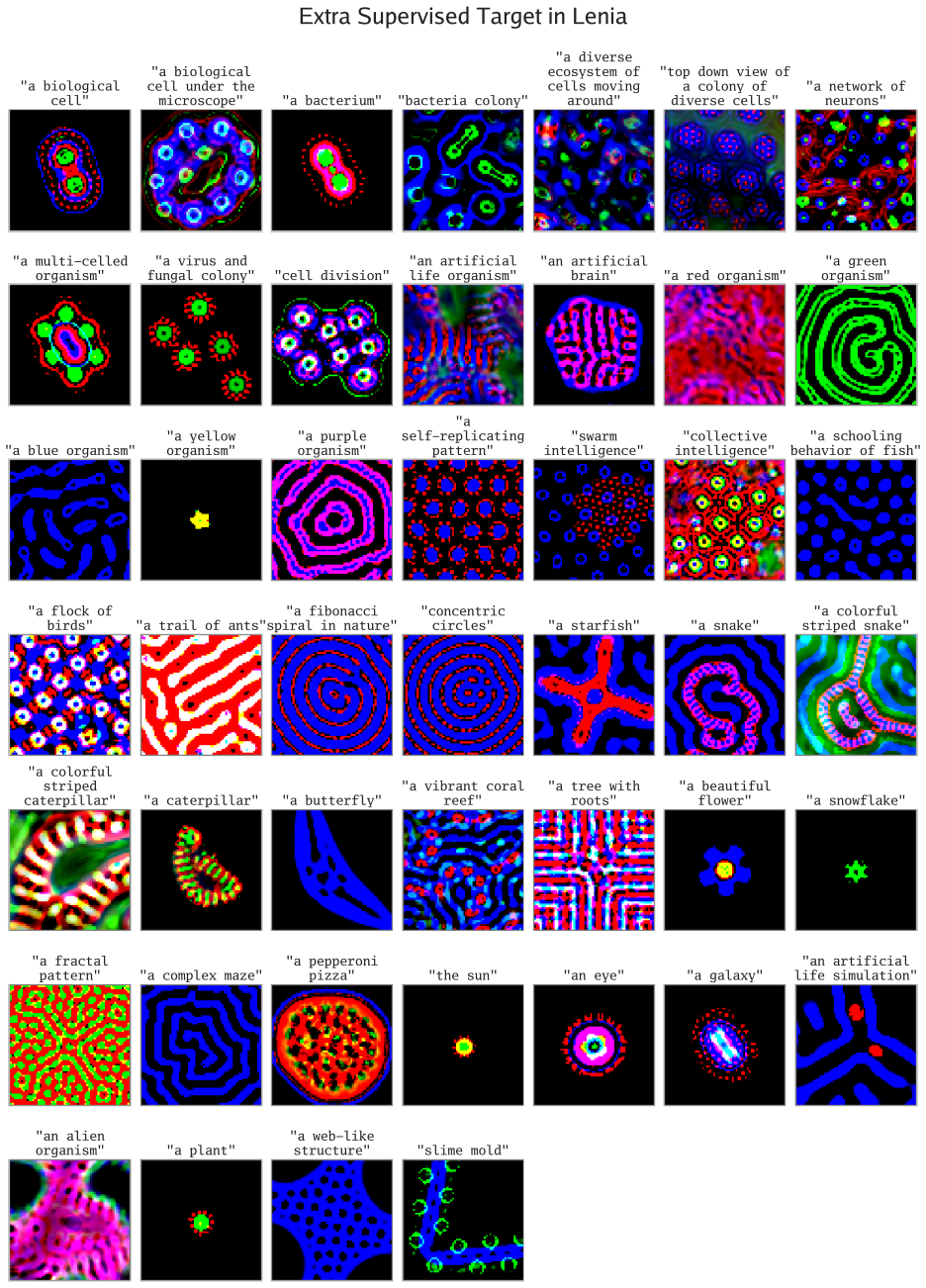
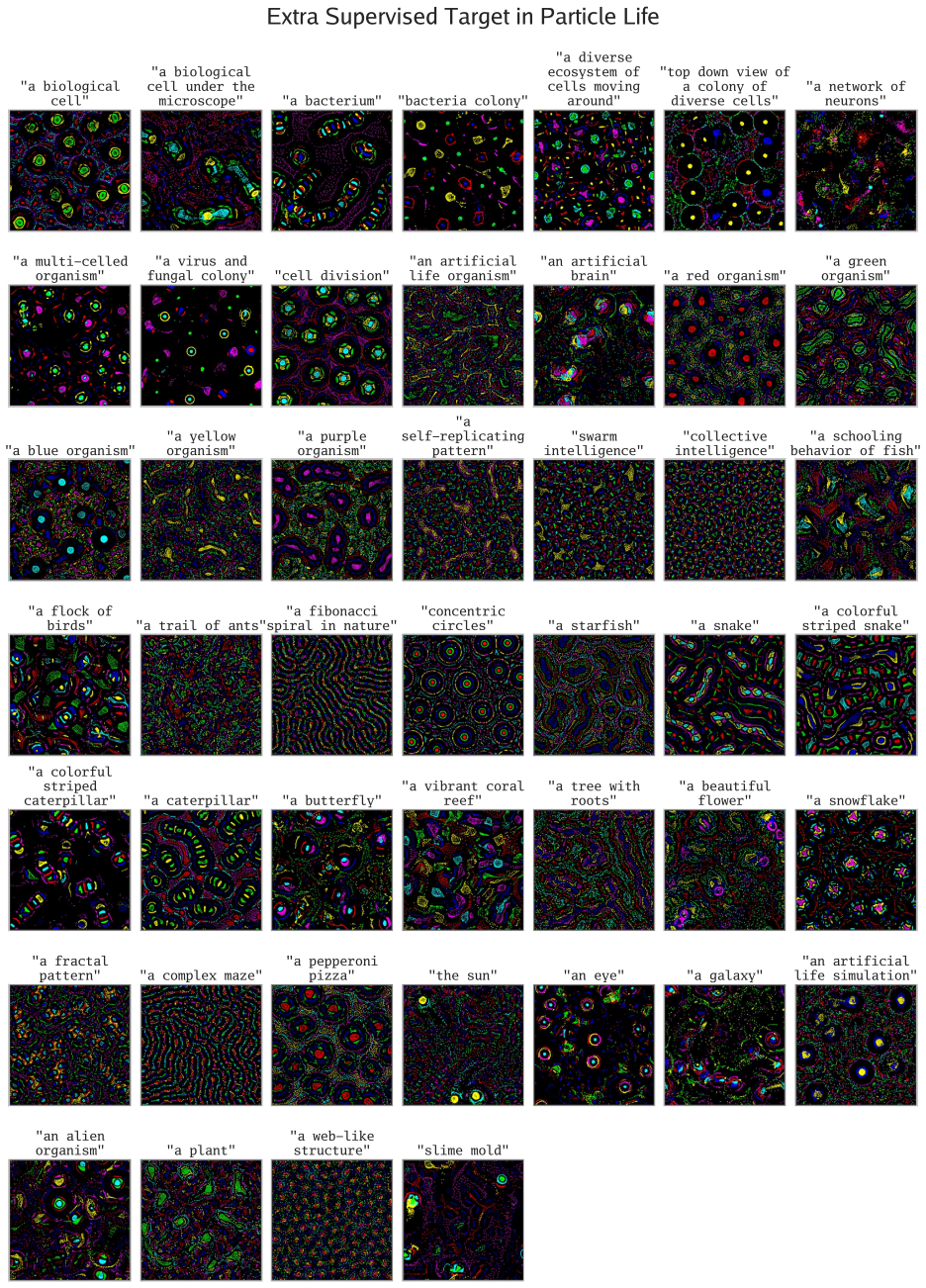
- Researchers can request a phenomenon in plain language, such as 'a caterpillar' or 'a network of neurons', and recover a simulation that produces it, as shown in Lenia, Boids, and Particle Life.
- Searching for historical novelty in CLIP space can serve as a concrete, computable stand-in for open-endedness on any substrate that renders to images.
- Illumination produces a 'simulation atlas' that maps the space of possible behaviors of a substrate, organized by visual similarity rather than by hand-picked descriptors.
- The same embedding-based similarity can become a quantitative instrument: measuring parameter nonlinearity, ranking parameter importance, and detecting when a simulation has reached a static plateau.
- Because the method is agnostic to the choice of foundation model and substrate, the same search recipes can be re-run as better vision models and new substrates appear.
Reading between the lines
- A natural next test is whether the open-endedness score tracks human judgments: if human raters are shown pairs of cellular automata and asked which keeps getting more interesting, their choices should match the CLIP-space novelty ranking for the central claim to carry over to perceived open-endedness.
- The same pipeline could be applied outside ALife, for example to search hypergraph update rules or physical model parameters for behavior that an embedding model finds natural, since the only requirement is a renderable state and an embedding space.
- Temporal prompts may be a route to directed counterfactual evolution: specifying a sequence like 'primordial soup', then 'predator-prey', then 'alien animals' tests whether a substrate can host a chosen evolutionary trajectory, not just a single final state.
- If future video-language models replace CLIP, the open-endedness and illumination objectives could be computed on whole trajectories rather than single final frames, which would likely sharpen the distinction between genuinely open-ended and merely varied simulations.
Editorial analysis
A structured set of objections, weighed in public.
Referee Report
Summary. The paper introduces ASAL, a framework that uses vision-language foundation models (CLIP, DINOv2) to search for artificial life simulations. Three search mechanisms are proposed: supervised target search via text prompts (Eq. 2), open-endedness search via historical nearest-neighbor novelty in FM embedding space (Eq. 3), and illumination via nearest-neighbor diversity (Eq. 4). The method is applied to Boids, Particle Life, Game of Life/Life-like CA, Lenia, and Neural Cellular Automata. The authors report discovery of target phenomena, previously unseen Lenia and Boids forms, Life-like CAs that are open-ended like Conway's Game of Life, and simulation atlases. Additional FM-based metrics quantify nonlinearity, parameter sensitivity, and plateau behavior.
Significance. If validated, ASAL would be a significant advance: it is substrate-agnostic, requires no hand-crafted objectives beyond a pretrained FM, and covers three distinct search goals. The paper ships code, presents an exhaustive brute-force evaluation of all 262,144 Life-like CAs for the open-endedness objective, and demonstrates qualitative success across diverse substrates. The FM-based quantification in Section 4.4 is a useful contribution. However, the strongest claims—open-endedness and 'previously unseen' lifeforms—are validated only through CLIP embedding statistics and qualitative inspection, not through human judgments or independent benchmarks. The contribution is currently a promising proof of concept rather than a fully established result.
major comments (4)
- [Section 3.2, Eq. (3); Section 4.2] The central claim that ASAL discovers cellular automata that are open-ended 'like Conway's Game of Life' is supported exclusively by the historical CLIP-novelty score in Eq. (3). Since Conway's Game of Life is ranked by that same score (top 5% in Figure 5c), the finding is metric-relative, and no independent validation shows that the score tracks human perceptions of open-endedness or known OE properties such as unbounded growth, glider production, or computational universality. The paper is transparent that the subjectivity is outsourced to the representation, but a human rating study or a comparison with established complexity/open-endedness indicators (e.g., Shannon entropy over time, diversity of emergent attractors) is necessary to justify the wording 'open-ended like Conway's Game of Life'.
- [Section 4.3 and 4.1; Appendix B.1] The claims of discovering 'previously unseen Lenia and Boids lifeforms' are not checked against an exhaustive inventory of known forms (e.g., Chan's Lenia expanded universe or LeniaBreeder's catalog), and the supporting evidence consists of qualitative screenshots. In addition, the supervised-target and illumination experiments use a single initial state seed per evaluation (Appendix B.1) and report no quantitative diversity or novelty metrics. To make the novelty claim load-bearing, the authors should either compare against a systematic catalog or provide quantitative evidence that the discovered final states lie outside previously documented behavioral classes.
- [Section 4.5, Figure 8] The foundation-model ablation for illumination reports no numeric results; the text states only that 'CLIP seems slightly better than DINOv2' and that both are 'qualitatively better' than pixel representations. Given that the paper's core premise is the advantage of FM representations, the ablation should include a quantitative measure of coverage, diversity, or human-rated quality of the illuminated atlas. As written, the ablation does not substantiate the claimed importance of the FM choice.
- [Appendix B.2; Section 4.2] The open-endedness ranking of Life-like CAs depends on several procedural choices—32 subsampled timesteps from a 2,048-step rollout, 256 random initial states with sparsity sampled from U(0.05, 0.4), and a single CLIP ViT variant—but no sensitivity analysis is provided. Since the headline result is a ranking that places Conway's Game of Life only in the top 5%, it is important to show that the ranking is stable under changes in timestep subsampling and initial-state sparsity; otherwise the specific top-ranked rules in Figure 5a may be artifacts of these choices.
minor comments (6)
- [Section 3.3] Typo: 'diverse phonenema' should be 'diverse phenomena'.
- [Equation (4)] Grammar: 'an "diversity" score' should be 'a "diversity" score'.
- [Section 3.1, Figure 2] The phrase 'colors match the equation below' is not meaningful in a black-and-white print version; please add explicit labels or markers instead.
- [Section 4.4] Figure 7a reports CLIP similarity values but provides no baseline or calibration to indicate what counts as high or low similarity; adding a random-pair baseline would help interpretation.
- [Section 4.4(d)] The plateau-halting metric in Figure 7d is presented for a single Lenia simulation; a few examples or a quantitative threshold would strengthen the claimed utility as a halting condition.
- [Appendix A] The Lenia substrate description notes that the search space is centered at a solution from Chan (2020), but the anchor and its bounds are not specified; this makes the search space definition incomplete for replication.
Circularity Check
No significant circularity: ASAL's objectives are explicit operational definitions, and the Conway's Game of Life ranking is an independent brute-force result, not a fitted input.
full rationale
The paper's three objectives are defined directly in terms of CLIP/DINOv2 embeddings (Eqs. 2-4), so statements such as "open-endedness" or "diversity" are transparently operationalized rather than derived from hidden inputs. The Conway's Game of Life result is obtained by brute-force evaluation of all 262,144 Life-like CAs against the pre-specified Eq. 3 metric; no parameter is fit to make Conway rank highly, and the benchmark is external to the optimized objectives. The assumption that FM embeddings approximate human perception is stated as an assumption (Section 3.2: "the vision-language FM representations act as a proxy for a human's representation"), supported by independent perceptual-similarity work and tested only qualitatively in the ablation, but an untested assumption is a validation gap, not a circular reduction. Self-citations to prior novelty-search and perceptual-similarity work provide background and are not used to forbid alternatives or to import a uniqueness theorem. The paper therefore exhibits no Eq.-to-Eq. reduction in which an output is equivalent to its input by construction.
Assumptions & free parameters
free parameters (4)
- Open-endedness timestep subsampling =
32
- Illumination pruning neighbor count =
2
- Life-like CA initial sparsity =
U(0.05, 0.4)
- Lenia search-space anchor =
Chan (2020) solution
assumptions (4)
- domain assumption CLIP and DINOv2 embeddings of rendered simulation frames are a valid proxy for human judgments of interest, novelty, and diversity.
- domain assumption Historical novelty in a fixed representation space captures open-endedness.
- domain assumption Rendering a simulation state as a single image preserves enough information for the FM to judge the simulation.
- domain assumption The substrate parameterizations used are representative enough that discovered configurations are genuinely novel lifeforms.
Cite this review
Pith. "Pith review of Automating the Search for Artificial Life with Foundation Models." pith.science (2026). https://pith.science/paper/UV3AK3H7
@misc{pith2026241217799,
  author       = {Pith},
  title        = {Pith review of: Automating the Search for Artificial Life with Foundation Models},
  year         = {2026},
  howpublished = {\url{https://pith.science/paper/UV3AK3H7}},
  note         = {Machine review of arXiv:2412.17799}
}
read the original abstract
With the recent Nobel Prize awarded for radical advances in protein discovery, foundation models (FMs) for exploring large combinatorial spaces promise to revolutionize many scientific fields. Artificial Life (ALife) has not yet integrated FMs, thus presenting a major opportunity for the field to alleviate the historical burden of relying chiefly on manual design and trial-and-error to discover the configurations of lifelike simulations. This paper presents, for the first time, a successful realization of this opportunity using vision-language FMs. The proposed approach, called Automated Search for Artificial Life (ASAL), (1) finds simulations that produce target phenomena, (2) discovers simulations that generate temporally open-ended novelty, and (3) illuminates an entire space of interestingly diverse simulations. Because of the generality of FMs, ASAL works effectively across a diverse range of ALife substrates including Boids, Particle Life, Game of Life, Lenia, and Neural Cellular Automata. A major result highlighting the potential of this technique is the discovery of previously unseen Lenia and Boids lifeforms, as well as cellular automata that are open-ended like Conway's Game of Life. Additionally, the use of FMs allows for the quantification of previously qualitative phenomena in a human-aligned way. This new paradigm promises to accelerate ALife research beyond what is possible through human ingenuity alone.
Figures


Figures from the paper (15 more)





Forward citations
Cited by 7 Pith papers
-
ZapGPT: Free-form Language Prompting for Simulated Cellular Control
ZapGPT evolves a prompt-to-intervention model against a vision-language evaluator and reports that single-prompt training generalizes to unseen free-form language prompts.
-
AutomataGPT: Forecasting and Ruleset Inference for Two-Dimensional Cellular Automata
A transformer pretrained on 100 cellular automaton rules forecasts unseen rules at 98.5% one-step accuracy and infers new rules with up to 96% functional accuracy.
-
Exploring Flow-Lenia Universes with a Curiosity-driven AI Scientist: Discovering Diverse Ecosystem Dynamics
IMGEP goal exploration on simulation-wide metrics discovers more diverse Flow-Lenia ecosystem and matter-movement dynamics than random search, though key metric details and a claimed scaling study are missing.
-
Evolution and The Knightian Blindspot of Machine Learning
ML's formalisms, particularly RL's, exclude Knightian uncertainty, and evolution's diversify-and-filter mechanisms point toward a direct remedy.
-
Participatory Evolution of Artificial Life Systems via Semantic Feedback
A closed-loop system uses CLIP-based semantic similarity to evolve a swarm simulation toward natural-language prompts, with user ratings favoring it over manual tuning.
-
Humans Coexist, So Must Embodied Artificial Agents
Coexistence, defined as sustained meaningful and reciprocal interaction among an agent, humans, and environment, is presented as a necessary design goal for embodied AI.
-
Extracting Interaction Kernels for Many-Particle Systems by a Two-Phase Approach
A two-phase sparse-regression method recovers interaction kernels of stochastic many-particle systems by fitting the residual of the mean-field PDE to kernel-density-estimated densities.
Reference graph
Works this paper leans on
-
[2]
T emporal T argetsFor the temporal target experiments in the NCA substrate, the Adam optimizer with truncated backpropagation through time is used. Following the original NCA paper [Mordvintsev et al., 2020], a pool of 256 simulation states is maintained. Batches of 8 states are sampled and rolled out 16 timesteps at a time, where truncated backpropagatio...
work page 2020
-
[8]
Dreamsim: Learning new dimensions of human visual similarity using synthetic data
Stephanie Fu, Netanel Tamir, Shobhita Sundaram, Lucy Chai, Richard Zhang, Tali Dekel, and Phillip Isola. Dreamsim: Learning new dimensions of human visual similarity using synthetic data. arXiv preprint arXiv:2306.09344,
-
[9]
Learning one abstract bit at a time through self-invented experiments encoded as neural networks
Vincent Herrmann, Louis Kirsch, and J¨ urgen Schmidhuber. Learning one abstract bit at a time through self-invented experiments encoded as neural networks. arXiv preprint arXiv:2212.14374,
-
[10]
Open-endedness is essential for artificial superhuman intelligence
Edward Hughes, Michael Dennis, Jack Parker-Holder, Feryal Behbahani, Aditi Mavalankar, Yuge Shi, Tom Schaul, and Tim Rocktaschel. Open-endedness is essential for artificial superhuman intelligence. arXiv preprint arXiv:2406.04268,
-
[11]
The platonic representation hypothesis
Minyoung Huh, Brian Cheung, Tongzhou Wang, and Phillip Isola. The platonic representation hypothesis. arXiv preprint arXiv:2405.07987,
-
[12]
Scaling laws for neural language models
15 Jared Kaplan, Sam McCandlish, Tom Henighan, Tom B Brown, Benjamin Chess, Rewon Child, Scott Gray, Alec Radford, Jeffrey Wu, and Dario Amodei. Scaling laws for neural language models. arXiv preprint arXiv:2001.08361,
arXiv 2001
-
[15]
Umap: Uniform manifold approximation and projection for dimension reduction
Leland McInnes, John Healy, and James Melville. Umap: Uniform manifold approximation and projection for dimension reduction. arXiv preprint arXiv:1802.03426,
-
[17]
Alexander Mordvintsev, Ettore Randazzo, Eyvind Niklasson, and Michael Levin
Accessed: 2024-09-30. Alexander Mordvintsev, Ettore Randazzo, Eyvind Niklasson, and Michael Levin. Growing neural cellular automata. Distill, 5(2):e23,
work page 2024
Show all 37 references
-
[18]
Particle lenia and the energy-based for- mulation
Alexander Mordvintsev, Eyvind Niklasson, and Ettore Randazzo. Particle lenia and the energy-based for- mulation. 2022 Cited on, page 49,
2022
-
[19]
Sophistication as randomness deficiency
Francisco Mota, Scott Aaronson, Lu ´ ıs Antunes, and Andr´ e Souto. Sophistication as randomness deficiency. In Descriptional Complexity of Formal Systems: 15th International Workshop, DCFS 2013, London, ON, Canada, July 22-25,
2013
-
[24]
Biomaker ca: a biome maker project using cellular automata
Ettore Randazzo and Alexander Mordvintsev. Biomaker ca: a biome maker project using cellular automata. arXiv preprint arXiv:2307.09320,
-
[25]
Intrinsically motivated discovery of diverse patterns in self-organizing systems
Chris Reinke, Mayalen Etcheverry, and Pierre-Yves Oudeyer. Intrinsically motivated discovery of diverse patterns in self-organizing systems. arXiv preprint arXiv:1908.06663,
1908 arXiv
-
[27]
Mastering chess and shogi by self-play with a general reinforcement learning algorithm
David Silver, Thomas Hubert, Julian Schrittwieser, Ioannis Antonoglou, Matthew Lai, Arthur Guez, Marc Lanctot, Laurent Sifre, Dharshan Kumaran, Thore Graepel, et al. Mastering chess and shogi by self-play with a general reinforcement learning algorithm. arXiv preprint arXiv:17...
-
[28]
Neural mmo: A massively multiagent game environment for training and evaluating intelligent agents
Joseph Suarez, Yilun Du, Phillip Isola, and Igor Mordatch. Neural mmo: A massively multiagent game environment for training and evaluating intelligent agents. arXiv preprint arXiv:1903.00784,
1903 arXiv
-
[30]
Rui Wang, Joel Lehman, Aditya Rawal, Jiale Zhi, Yulun Li, Jeffrey Clune, and Kenneth Stanley
Ac- cessed: 2024-09-30. Rui Wang, Joel Lehman, Aditya Rawal, Jiale Zhi, Yulun Li, Jeffrey Clune, and Kenneth Stanley. Enhanced poet: Open-ended reinforcement learning through unbounded invention of learning challenges and their solutions. In International conference on machine...
2024
-
[31]
A class of models with the potential to represent fundamental physics
Stephen Wolfram. A class of models with the potential to represent fundamental physics. arXiv preprint arXiv:2004.08210,
2004 arXiv
-
[32]
Accessed: 2024-12-07
URL http://www.mirekw.com/ ca/rullex_life.html. Accessed: 2024-12-07. 18 Hu Xu, Gargi Ghosh, Po-Yao Huang, Dmytro Okhonko, Armen Aghajanyan, Florian Metze, Luke Zettle- moyer, and Christoph Feichtenhofer. Videoclip: Contrastive pre-training for zero-shot video-text under- stan...
2024 arXiv
-
[35]
The y-axis measures the negative score from Equation
20 0 2000 4000 6000 8000 10000 0.36 0.34 0.32 0.30 0.28 0.26 0.24 0.22 CLIP Alignment LossLenia 0 2000 4000 6000 8000 10000 0.34 0.32 0.30 0.28 0.26 0.24 0.22 0.20 0.18 Boids 0 200 400 600 800 1000 0.34 0.32 0.30 0.28 0.26 0.24 0.22 0.20 Particle Life mean over prompts and see...
2000
-
[37]
a biological cell
22 "a biological cell" "a biological cell under the microscope" "a bacterium" "bacteria colony" "a diverse ecosystem of cells moving around" "top down view of a colony of diverse cells" "a network of neurons" "a multi-celled organism" "a virus and fungal colony" "cell division...
-
[1994]
Omni: Open-endedness via models of human notions of interestingness
Jenny Zhang, Joel Lehman, Kenneth Stanley, and Jeff Clune. Omni: Open-endedness via models of human notions of interestingness. arXiv preprint arXiv:2306.01711,
-
[1997]
Snowbird’98, Utah, 1998; see also ?
ftp://ftp.idsia.ch/pub/juergen/interest.ps.gz; extended abstract in Proc. Snowbird’98, Utah, 1998; see also ?. J¨ urgen Schmidhuber. Powerplay: Training an increasingly general problem solver by continually searching for the simplest still unsolvable problem. Frontiers in psyc...
1998
-
[2000]
On the opportunities and risks of foundation models
Rishi Bommasani, Drew A Hudson, Ehsan Adeli, Russ Altman, Simran Arora, Sydney von Arx, Michael S Bernstein, Jeannette Bohg, Antoine Bosselut, Emma Brunskill, et al. On the opportunities and risks of foundation models. arXiv preprint arXiv:2108.07258,
-
[2001]
Jaxlife: An open-ended agentic simu- lator
Chris Lu, Michael Beukman, Michael Matthews, and Jakob Foerster. Jaxlife: An open-ended agentic simu- lator. In ALIFE 2024: Proceedings of the 2024 Artificial Life Conference. MIT Press, 2024a. Chris Lu, Samuel Holt, Claudio Fanconi, Alex J Chan, Jakob Foerster, Mihaela van de...
2024 arXiv
-
[2004]
Dinov2: Learning robust visual features without supervision
Maxime Oquab, Timoth´ ee Darcet, Th´ eo Moutakanni, Huy Vo, Marc Szafraniec, Vasil Khalidov, Pierre Fernandez, Daniel Haziza, Francisco Massa, Alaaeldin El-Nouby, et al. Dinov2: Learning robust visual features without supervision. arXiv preprint arXiv:2304.07193,
-
[2009]
Revisiting the edge of chaos: Evolving cellular automata to perform computations
Melanie Mitchell, Peter Hraber, and James P Crutchfield. Revisiting the edge of chaos: Evolving cellular automata to perform computations. arXiv preprint adap-org/9303003,
-
[2010]
Toward artificial open-ended evolution within lenia using quality- diversity
Maxence Faldor and Antoine Cully. Toward artificial open-ended evolution within lenia using quality- diversity. arXiv preprint arXiv:2406.04235,
-
[2013]
Illuminating search spaces by mapping elites
16 Jean-Baptiste Mouret and Jeff Clune. Illuminating search spaces by mapping elites. arXiv preprint arXiv:1504.04909,
-
[2014]
Computational life: How well-formed, self-replicating programs emerge from simple interaction
Jyrki Alakuijala, James Evans, Ben Laurie, Alexander Mordvintsev, Eyvind Niklasson, Ettore Randazzo, Luca Versari, et al. Computational life: How well-formed, self-replicating programs emerge from simple interaction. arXiv preprint arXiv:2406.19108,
-
[2015]
From text to life: On the reciprocal relationship between artificial life and large language models
Eleni Nisioti, Claire Glanois, Elias Najarro, Andrew Dai, Elliot Meyerson, Joachim Winther Pedersen, Laetitia Teodorescu, Conor F Hayes, Shyam Sudhakaran, and Sebastian Risi. From text to life: On the reciprocal relationship between artificial life and large language models. I...
2024
-
[2017]
Flow-lenia: Towards open-ended evolution in cellular automata through mass conser- vation and parameter localization
Erwan Plantec, Gautier Hamon, Mayalen Etcheverry, Pierre-Yves Oudeyer, Cl´ ement Moulin-Frier, and Bert Wang-Chak Chan. Flow-lenia: Towards open-ended evolution in cellular automata through mass conser- vation and parameter localization. In Artificial Life Conference Proceedin...
2023
-
[2018]
bird-like objects
19 A Substrate Details • Boids simulates N “bird-like objects” (boids) moving in a 2-D Euclidean space [Reynolds, 1987]. All boids weight-share a single neural network that steers each boid left or right based on the K nearby boids in its local frame of reference . The substra...
1987
-
[2019]
Video understanding with large language models: A survey
Yunlong Tang, Jing Bi, Siting Xu, Luchuan Song, Susan Liang, Teng Wang, Daoan Zhang, Jie An, Jingyang Lin, Rongyi Zhu, et al. Video understanding with large language models: A survey. arXiv preprint arXiv:2312.17432,
-
[2020]
Good- hart’s law in reinforcement learning
Jacek Karwowski, Oliver Hayman, Xingjian Bai, Klaus Kiendlhofer, Charlie Griffin, and Joar Skalse. Good- hart’s law in reinforcement learning. arXiv preprint arXiv:2310.09144,
-
[2021]
Lenia-biology of artificial life
Bert Wang-Chak Chan. Lenia-biology of artificial life. arXiv preprint arXiv:1812.05433,
-
[2022]
The vendi score: A diversity evaluation metric for machine learning
Dan Friedman and Adji Bousso Dieng. The vendi score: A diversity evaluation metric for machine learning. arXiv preprint arXiv:2210.02410,
-
[2023]
Ai-gas: Ai-generating algorithms, an alternate paradigm for producing general artificial intelli- gence
14 Jeff Clune. Ai-gas: Ai-generating algorithms, an alternate paradigm for producing general artificial intelli- gence. arXiv preprint arXiv:1905.10985,
1905 arXiv
-
[2024]
Omni-epic: Open-endedness via models of human notions of interestingness with environments programmed in code.arXiv preprint arXiv:2405.15568,
Maxence Faldor, Jenny Zhang, Antoine Cully, and Jeff Clune. Omni-epic: Open-endedness via models of human notions of interestingness with environments programmed in code.arXiv preprint arXiv:2405.15568,
Reviewed August 11, 2026 · model on record in the stance chip above.
Discussion (0). Continue with ORCID to comment.