REVIEW 1 cited by
Towards Post-Quantum Secure Pharmacovigilance with ML-KEM and ML-DSA
T0 review · reviewed 2026-06-27 · grok-4.3
Pith's one-line read A prototype pipeline applies ML-KEM and ML-DSA to secure pharmacovigilance data for the post-quantum era.
desk verdict This is a clean educational demo wiring standard NIST post-quantum primitives into a file pipeline for synthetic healthcare data, with no new crypto or analysis. read the letter →
The pith
A machine-rendered reading of the paper's core claim, the machinery that carries it, and where it could break.
The reading
What carries the argument
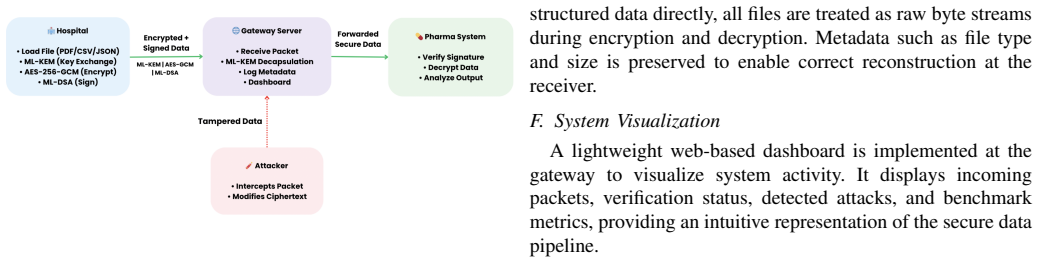
The file processing pipeline that converts any input file to raw bytes for encryption with AES-256-GCM after ML-KEM key derivation and signs the result with ML-DSA-65.
What would settle it
Measuring runtime and security properties when the pipeline processes actual adverse event reports from a real pharmacovigilance database would test whether the overhead stays small and the protection holds.
Extended reading notes
Core claim
The paper demonstrates a complete post-quantum pharmacovigilance pipeline using ML-KEM-768, HKDF-SHA-256, AES-256-GCM, and ML-DSA-65, where files are encrypted and signed as raw bytes, and performance measurements indicate that the post-quantum key establishment adds negligible overhead compared to the symmetric encryption and signature operations.
Load-bearing premise
Synthetic datasets of varying sizes and formats can stand in for real pharmacovigilance data when assessing the pipeline's performance and practicality.
Editorial extensions
If this is right
- The pipeline works across TXT, CSV, JSON, and PDF formats without custom handling for each.
- ML-KEM-768 adds only a constant overhead independent of file size.
- AES encryption and ML-DSA signing account for most of the runtime as file size grows.
- The prototype includes separate components simulating hospital, gateway, pharma receiver, and attacker roles.
- Benchmarking shows the approach is feasible for educational purposes in healthcare data security.
Reading between the lines
- Similar pipelines could apply to other domains requiring long-term data confidentiality such as financial records or government archives.
- Further work would need to address integration with existing healthcare standards and regulatory compliance for production use.
- Optimization efforts should target the AES and ML-DSA components rather than the key encapsulation step.
- Testing with real pharmacovigilance data could reveal additional practical constraints not visible in synthetic sets.
Editorial analysis
A structured set of objections, weighed in public.
Referee Report
Summary. The paper presents an educational prototype of a post-quantum secure pharmacovigilance data pipeline. It integrates ML-KEM-768 for key establishment, HKDF-SHA-256 for key derivation, AES-256-GCM for file encryption, and ML-DSA-65 for signatures and tamper detection. Files are handled as raw bytes to support multiple formats (TXT, CSV, JSON, PDF) while preserving metadata. The prototype includes hospital, gateway, receiver, attacker, benchmarking, and dashboard components. Evaluation on synthetic datasets shows ML-KEM contributes small constant overhead while AES encryption and ML-DSA signing dominate runtime as file size grows. The work explicitly disclaims being a production system and frames itself as an educational exploration of primitive integration.
Significance. If the component wiring and benchmark methodology are implemented as described, the manuscript provides a concrete demonstration of performance trends when applying NIST post-quantum standards to byte-stream data pipelines. This may have modest educational value for illustrating post-quantum migration in long-term sensitive-data contexts, but the absence of novel primitives, proofs, or real-world threat modeling limits broader impact.
Simulated Author's Rebuttal
We thank the referee for the positive review and recommendation to accept. The manuscript is explicitly positioned as an educational prototype, and we agree with the assessment of its scope and modest educational value in illustrating post-quantum primitive integration.
Circularity Check
No significant circularity identified
full rationale
The paper is a systems-implementation description of an educational prototype that wires together standard, externally-specified post-quantum primitives (ML-KEM-768, HKDF-SHA-256, AES-256-GCM, ML-DSA-65) and benchmarks them on synthetic byte streams. No equations, fitted parameters, uniqueness theorems, or predictions appear; performance claims are direct measurements of the described components. No self-citations are load-bearing. The work is therefore self-contained against its own stated scope and external cryptographic standards.
Assumptions & free parameters
Cite this review
Pith. "Pith review of Towards Post-Quantum Secure Pharmacovigilance with ML-KEM and ML-DSA." pith.science (2026). https://pith.science/paper/UVEI26XV
@misc{pith2026260609412,
  author       = {Pith},
  title        = {Pith review of: Towards Post-Quantum Secure Pharmacovigilance with ML-KEM and ML-DSA},
  year         = {2026},
  howpublished = {\url{https://pith.science/paper/UVEI26XV}},
  note         = {Machine review of arXiv:2606.09412}
}
read the original abstract
Pharmacovigilance systems handle sensitive healthcare and drug-safety data, including adverse event reports and clinical observations. As quantum computing advances, classical public-key cryptographic systems such as RSA and elliptic-curve cryptography may become vulnerable, creating long-term risks for healthcare data that must remain confidential for many years. This paper presents an educational prototype of a post-quantum secure pharmacovigilance data pipeline. The system uses ML-KEM-768 for post-quantum key establishment, HKDF-SHA-256 for deriving an AES key, AES-256-GCM for efficient file encryption, and ML-DSA-65 for digital signatures and tamper detection. The pipeline supports multiple file formats, including TXT, CSV, JSON, and PDF, by treating files as raw bytes and preserving metadata for reconstruction at the receiver. The prototype includes separate hospital, gateway, pharma receiver, attacker, benchmarking, and dashboard components. We evaluate the system using synthetic pharmacovigilance datasets of different sizes and formats. Our results show that ML-KEM adds a small constant overhead, while AES encryption and ML-DSA signing dominate runtime as file size increases. This work is not a production-ready healthcare system, but rather an educational systems-level exploration of how post-quantum cryptographic primitives can be integrated into healthcare-style data pipelines.
Figures


Forward citations
Cited by 1 Pith paper
-
DSA Nonce Vulnerabilities: An Interactive Analysis
A new interactive Tkinter/PyCryptodome/SageMath tool visualises DSA signing, verification, and nonce-reuse, linear-nonce, and HNP/LLL key-recovery attacks, passing its own functional and performance tests.
Reference graph
Works this paper leans on
-
[1]
Pharmacovigilance,
World Health Organization, “Pharmacovigilance,” https: //www.who.int/teams/regulation-prequalification/regulation-and-safety/ pharmacovigilance, 2023
2023
-
[2]
Post-quantum cryptography project,
NIST, “Post-quantum cryptography project,” https://csrc.nist.gov/ projects/post-quantum-cryptography, 2016
2016
-
[3]
Polynomial-time algorithms for prime factorization and dis- crete logarithms on a quantum computer,
P. W. Shor, “Polynomial-time algorithms for prime factorization and dis- crete logarithms on a quantum computer,”SIAM Journal on Computing, 1997
1997
-
[4]
Fips 203: Module-lattice-based key-encapsulation mechanism standard,
NIST, “Fips 203: Module-lattice-based key-encapsulation mechanism standard,” https://csrc.nist.gov/pubs/fips/203/final, 2024
2024
-
[5]
Fips 204: Module-lattice-based digital signature standard,
——, “Fips 204: Module-lattice-based digital signature standard,” https: //csrc.nist.gov/pubs/fips/204/final, 2024
2024
-
[6]
Adverse drug reactions: definitions, diagnosis, and management,
I. R. Edwards and J. K. Aronson, “Adverse drug reactions: definitions, diagnosis, and management,”The Lancet, 2000
2000
-
[7]
Defending against future threats: Cloudflare goes post-quantum,
B. Westerbaan and C. D. Rubin, “Defending against future threats: Cloudflare goes post-quantum,” https://blog.cloudflare.com/ post-quantum-for-all/, 2022
2022
-
[8]
Crystals-kyber specification (round 3),
R. Avanzi, J. Bos, L. Ducas, E. Kiltz, T. Lepoint, V . Lyuba- shevsky, J. M. Schanck, P. Schwabe, G. Seiler, and D. Stehl ´e, “Crystals-kyber specification (round 3),” https://pq-crystals.org/kyber/ data/kyber-specification-round3-20210804.pdf, 2021
2021
Show all 11 references
-
[9]
Transition to post-quantum cryptography standards,
NIST, “Transition to post-quantum cryptography standards,” https:// nvlpubs.nist.gov/nistpubs/ir/2024/NIST.IR.8547.ipd.pdf, 2024
2024
-
[10]
kyber-py: A pure python implementation of ml-kem and crystals-kyber,
G. Pope, “kyber-py: A pure python implementation of ml-kem and crystals-kyber,” https://github.com/GiacomoPope/kyber-py, 2023
2023
-
[11]
dilithium-py: A pure python implementation of ml-dsa and crystals-dilithium,
——, “dilithium-py: A pure python implementation of ml-dsa and crystals-dilithium,” https://github.com/GiacomoPope/dilithium-py, 2023. APPENDIXA PROJECTRESOURCES The complete implementation of the proposed system is available at: •GitHub Repository: https://github.com/saeedesai...
2023
Reviewed June 27, 2026 · model on record in the stance chip above.
Discussion (0). Continue with ORCID to comment.