REVIEW 4 minor 96 references
First joint carbon-oxygen double-differential KI cross sections show neutrino-nucleus models fail to describe T2K data.
Reviewed by Pith at T0; open to challenge. T0 means a machine referee read the full paper against a public rubric. the ladder, T0–T4 →
T0 review · grok-4.5
2026-07-14 10:14 UTC pith:UWBRHQRW
load-bearing objection First joint C/O double-differential KI cross sections from T2K; solid extraction, useful model discrimination, statistics-limited but ready for generator work.
Signal selection and model-independent extraction of pionless charged-current muon neutrino cross section using double-differential kinematic imbalance observables on carbon and oxygen with the T2K experiment
The pith
A machine-rendered reading of the paper's core claim, the machinery that carries it, and where it could break.
Core claim
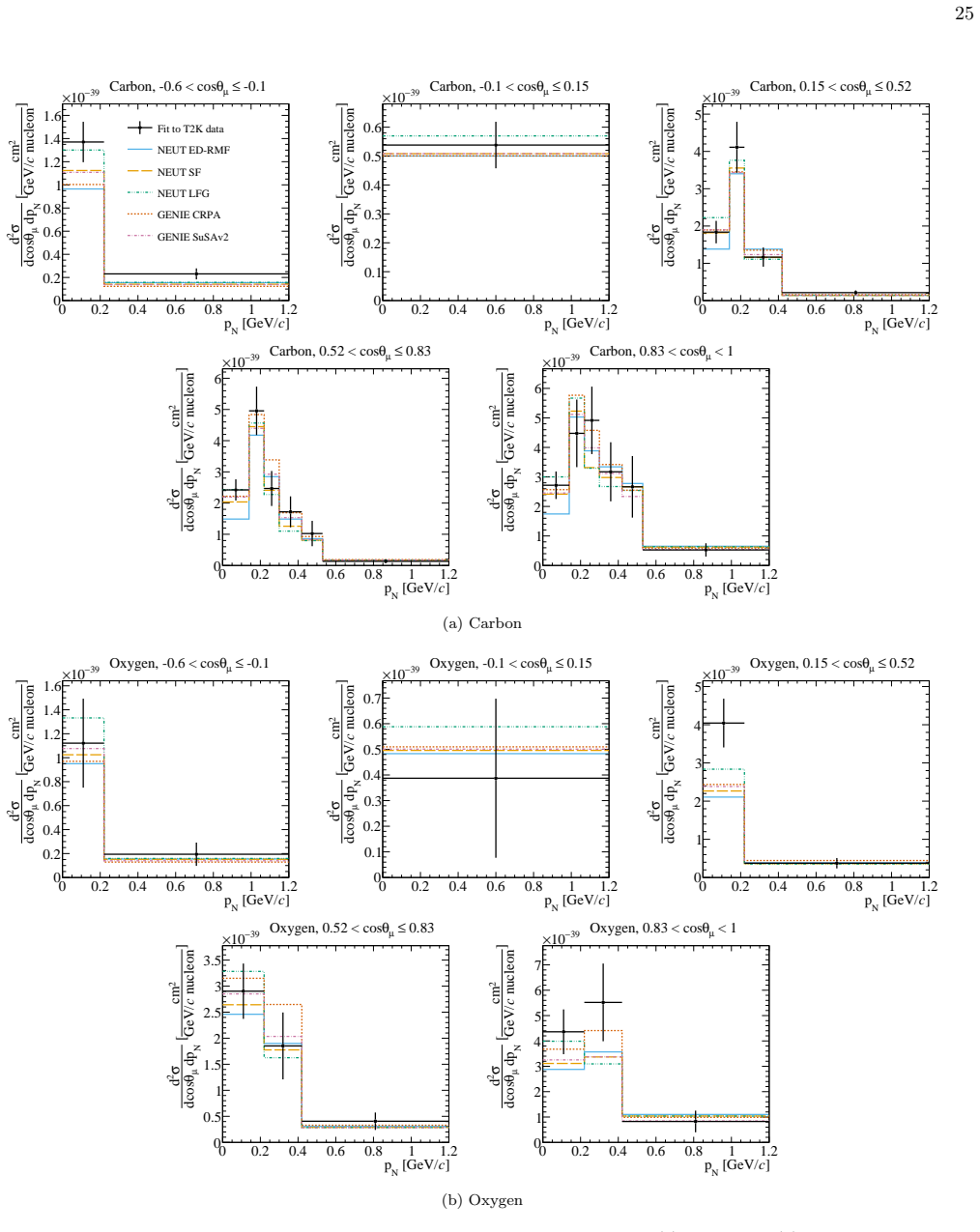
Current neutrino-nucleus interaction generators do not adequately describe the measured double-differential CC0πNp cross sections on carbon and oxygen in the δpT–δαT and pN–cosθμ spaces; the same kinematic-imbalance observables possess strong discriminating power among the nuclear-effect contributions that currently limit oscillation analyses.
What carries the argument
Double-differential kinematic-imbalance (KI) observables — specifically δpT–δαT and pN–cosθμ reconstructed from the muon and leading proton — which map distinct nuclear processes onto distinct regions of phase space and thereby allow a free-template, model-independent extraction of the joint carbon-oxygen signal.
Load-bearing premise
The background model constrained by control samples is flexible enough that residual tension with data (post-fit p-value ~0.008 in one space) does not bias the extracted signal cross section.
What would settle it
A future high-statistics measurement in the same KI spaces that finds a generator model simultaneously describing both the δpT peak at low δαT and the high-pN tail at large muon scattering angle within the reported uncertainties.
If this is right
- Generator builders must revise nuclear ground-state, multi-nucleon and final-state-interaction modelling until both carbon and oxygen KI distributions are reproduced simultaneously.
- Oscillation analyses that rely on the same interaction models inherit a residual bias that can only be reduced by incorporating these double-differential constraints.
- The upgraded ND280 Super-FGD, with larger active mass and better low-momentum proton acceptance, will convert the present statistics-limited result into a precision test of nuclear models.
- Regions of intermediate δpT and pN remain under-predicted, pointing to a need for stronger multi-nucleon or continuum-random-phase-approximation contributions.
Where Pith is reading between the lines
- Because oxygen is the far-detector target, a model that fails oxygen KI data while fitting carbon will still bias Hyper-Kamiokande and DUNE oscillation parameters.
- The same free-template method can be reapplied to antineutrino and electron-neutrino beams once statistics allow, testing lepton-flavor universality of nuclear effects.
- Discrepancies that persist after reweighting final-state-interaction strength suggest that the problem is not merely cascade tuning but the treatment of two-body currents already at the primary vertex.
Editorial analysis
A structured set of objections, weighed in public.
Referee Report
Summary. The paper reports the first joint measurement of νμ CC0πNp cross sections on carbon and oxygen with the T2K ND280 detector, presented as double-differential distributions in the kinematic-imbalance spaces δpT–δαT and pN–cosθμ. Signal selection, control samples for the dominant CC1π+ background, phase-space constraints, a full systematic covariance (detector, flux, interaction modeling, target nucleons), and a free-signal-template unfolding with GUNDAM are documented in detail. Coverage tests and extensive physics pseudo-data fits (SF→LFG/CRPA, FSI strength, GENIE reweight, etc.) support model independence of the extracted cross sections. The data are then compared with a suite of NEUT and GENIE nuclear models; several configurations are disfavored while others (NEUT SF/ED-RMF, GENIE SuSAv2+hN) describe the joint C/O data better, illustrating the discriminating power of the KI observables.
Significance. If the result holds, the measurement supplies a high-value, joint C/O double-differential data set in observables that isolate initial-state motion, multi-nucleon correlations and FSI. The free-signal-template extraction, control-sample constraints, and exhaustive pseudo-data validation (Table V, all p ≈ 1) constitute a transparent and largely model-independent procedure. The explicit demonstration that current generators fail in intermediate δpT/pN regions while still discriminating among nuclear-effect models is directly relevant to T2K, Hyper-Kamiokande and DUNE oscillation systematics. The accompanying data release further strengthens the paper’s utility for generator development.
minor comments (4)
- Sec. VI.A and Appendix A: the low post-fit p-value (~0.008) in the δpT–δαT fit is thoroughly investigated and shown not to bias the signal; a short cross-reference in the main text to the quantitative bound (maximum bin-wise shift < 60 % of the uncertainty) would help readers who stop at Sec. VI.
- Figs. 11–19: the vertical scale of the oxygen panels is sometimes compressed relative to carbon; a common scale or an explicit note would ease visual comparison of the two targets.
- Table I and Sec. IV.B: the residual non-C/O and OOFV fractions are small but non-zero; a one-sentence statement of how they are treated in the unfolding (subtracted via MC or absorbed into the free templates) would remove any residual ambiguity.
- Eq. (4) and the definition of ⟨ϵ⟩p: the numerical values 26.1 MeV (C) and 23.0 MeV (O) are taken from Ref. [29]; a brief remark that the uncertainty on these mean excitation energies is negligible compared with the reported cross-section uncertainties would be useful.
Circularity Check
No significant circularity: free-signal-template extraction validated against alternate generators and nuclear models; model comparisons are external.
full rationale
This is a standard experimental cross-section measurement. Signal templates ti are left unconstrained (Eq. 10) and fitted to data in reconstructed space; the unfolded cross section (Eq. 12) is then formed from the reweighted true-signal component after background subtraction. Efficiencies and backgrounds carry residual MC dependence, but this is quantified via extensive physics pseudo-data tests (Table V: all p-values ≈1 when reweighting to LFG, CRPA, GENIE, altered FSI/SPP, etc.) and by the Appendix A study that frees background templates (raising the δpT–δαT p-value from ~0.008 to ~0.09) without shifting the extracted signal beyond a fraction of the reported uncertainty. Model comparisons in Sec. VII are against independent generator configurations (NEUT SF/ED-RMF/LFG, GENIE SuSAv2/CRPA/hA/hN/Bertini) that were not fitted to these data. No self-definitional loop, no fitted parameter renamed as a prediction of the same data, and no load-bearing uniqueness theorem imported from overlapping authors. The measurement is therefore self-contained against external benchmarks.
Axiom & Free-Parameter Ledger
free parameters (3)
- signal template normalizations ti (per true bin, carbon and oxygen)
- detector, flux and interaction systematic nuisance parameters
- target nucleon numbers nC, nO
axioms (3)
- domain assumption Neutrino direction can be approximated by the ND280 z-axis (max deviation <2° treated as detector systematic).
- domain assumption NEUT v5.6.4.1 (and alternate generators) provide adequate efficiency and background shape templates once free signal parameters and constrained systematics are applied.
- standard math Standard Poisson + Barlow-Beeston likelihood and multivariate-Gaussian systematic penalty.
read the original abstract
We present the first joint measurement of muon neutrino CC$0\pi Np$ interactions on carbon and oxygen targets, in two double-differential kinematic imbalance (KI) observable spaces, $\delta p_{T}$-$\delta \alpha_{T}$ and $p_{N}$-$\cos\theta_{\mu}$. The measurement employs the ND280 detector of the T2K experiment and includes a detailed description of the event selection used to define signal and control regions, the evaluation of systematic uncertainties, and the signal extraction procedure, together with validation studies supporting a robust cross-section measurement. The results of this analysis indicate that current neutrino-nucleus interaction models do not adequately describe the data, and demonstrate the strong discriminating power of KI observables. This measurement highlights the need for improved theoretical nuclear modeling within neutrino interaction generators to achieve increased precision in neutrino oscillation measurements.
Figures




Reference graph
Works this paper leans on
-
[1]
We measure the differential cross section in each true observable bin i
Cross-section Definition and Calculation The cross section is extracted as: d2σT i (dXdY) i = N T i,sig Φν ·n T ·ϵ T i · 1 (∆X∆Y) i .(12) 15 In this definition, ( dXdY )i refers to the combinations of two analysis observables (dδpT dδαT or dpN dcosθ µ) and T indicates the target (carbon or oxygen). We measure the differential cross section in each true ob...
2000
-
[2]
Detector Systematic Uncertainties Detector systematic uncertainties account for poten- tial mismodeling in the simulation of particle propagation within the ND280 detector and the electronics response of the sub-detectors. These also include uncertainties arising from the event reconstruction and selection procedures, stemming from: (1) the modeling of re...
-
[3]
Neutrino Flux Systematic Uncertainties The neutrino flux systematic uncertainties represent the uncertainties in the predicted neutrino flux reaching the ND280 detector. Several factors limit the precision of this prediction, including the modeling of hadronic 16 interactions within the graphite target and surrounding materials, the characterization of th...
-
[4]
The CCRES and CCDIS com- ponents enter the signal sample only in cases where the produced pion is absorbed in the nucleus
Neutrino Interaction Modeling Systematic Uncertainties In this measurement, the signal is defined by a νµ CC0πN p final-state topology, which receives contribu- tions primarily from CCQE, multi-nucleon (predomi- nantly 2p2h), and CCRES interactions, with a smaller contribution from CCDIS. The CCRES and CCDIS com- ponents enter the signal sample only in ca...
-
[5]
The dominant contributions to these uncertainties originate from the measured densi- ties of the constituent materials in the FGD detectors [24]
Target Nucleon Number Systematic Uncertainties The systematic uncertainties associated with the num- ber of target nucleons arise from the mass estimation of the target nuclei, specifically carbon and oxygen, within the FGD1 and FGD2 FVs. The dominant contributions to these uncertainties originate from the measured densi- ties of the constituent materials...
-
[6]
A fit is performed for each pseudo-data set to assess the stabil- ity and performance of the extraction
Coverage Fits The coverage validation incorporates random statisti- cal and systematic fluctuations into the input MC tem- plate to generate an ensemble of pseudo-data sets. A fit is performed for each pseudo-data set to assess the stabil- ity and performance of the extraction. Specifically, the post-fit χ2 distribution is analyzed. Ideally, this should f...
-
[7]
Physics Pseudo-data Fits The objective of the physics pseudo-data fits is to validate the model independence of the cross-section ex- traction with respect to the neutrino-nucleus interaction models employed by the MC template. Pseudo-data sets are generated by reweighting the simulation to reproduce various interaction models, accounting for variations i...
-
[8]
K. Abeet al.(T2K), Phys. Rev. Lett.135, 261801 (2025), arXiv:2506.05889 [hep-ex]
arXiv 2025
-
[9]
S. Abubakaret al.(NOvA), Phys. Rev. Lett.136, 011802 (2026), arXiv:2509.04361 [hep-ex]
arXiv 2026
-
[10]
Abubakaret al.(T2K, NOvA), Nature646, 818 (2025), arXiv:2510.19888 [hep-ex]
S. Abubakaret al.(T2K, NOvA), Nature646, 818 (2025), arXiv:2510.19888 [hep-ex]
arXiv 2025
-
[11]
P. Coloma, P. Huber, C.-M. Jen, and C. Mariani, Phys. Rev. D89, 073015 (2014), arXiv:1311.4506 [hep-ph]
Pith/arXiv arXiv 2014
-
[12]
U. Mosel, Ann. Rev. Nucl. Part. Sci.66, 171 (2016), arXiv:1602.00696 [nucl-th]
Pith/arXiv arXiv 2016
-
[13]
Alvarez-Rusoet al.(NuSTEC), Prog
L. Alvarez-Rusoet al.(NuSTEC), Prog. Part. Nucl. Phys. 100, 1 (2018), arXiv:1706.03621 [hep-ph]
Pith/arXiv arXiv 2018
-
[14]
K. Abeet al.(T2K), Nucl. Instrum. Meth. A659, 106 (2011), arXiv:1106.1238 [physics.ins-det]
arXiv 2011
-
[15]
K. Abeet al.(T2K), Eur. Phys. J. C83, 782 (2023), arXiv:2303.03222 [hep-ex]
arXiv 2023
-
[16]
D. S. Ayreset al.(NOvA) 10.2172/935497 (2007)
doi:10.2172/935497 2007
-
[17]
M. A. Aceroet al.(NOvA), Phys. Rev. D106, 032004 (2022), arXiv:2108.08219 [hep-ex]
Pith/arXiv arXiv 2022
-
[18]
Abeet al.(Hyper-Kamiokande), (2018), arXiv:1805.04163 [physics.ins-det]
K. Abeet al.(Hyper-Kamiokande), (2018), arXiv:1805.04163 [physics.ins-det]
Pith/arXiv arXiv 2018
-
[19]
Acciarriet al.(DUNE), (2015), arXiv:1512.06148 [physics.ins-det]
R. Acciarriet al.(DUNE), (2015), arXiv:1512.06148 [physics.ins-det]
arXiv 2015
-
[20]
X. G. Lu, L. Pickering, S. Dolan, G. Barr, D. Coplowe, Y. Uchida, D. Wark, M. O. Wascko, A. Weber, and T. Yuan, Phys. Rev. C94, 015503 (2016), arXiv:1512.05748 [nucl-th]
Pith/arXiv arXiv 2016
-
[21]
X. Lu and J. T. Sobczyk, Phys. Rev. C99, 055504 (2019), arXiv:1901.06411 [hep-ph]
Pith/arXiv arXiv 2019
-
[22]
K. Abeet al., Nucl. Instrum. Meth. A694, 211 (2012), arXiv:1111.3119 [physics.ins-det]
Pith/arXiv arXiv 2012
-
[23]
Yasutome, PoS369, 10.22323/1.369.0119 (2019)
K. Yasutome, PoS369, 10.22323/1.369.0119 (2019)
-
[24]
Fukudaet al.(Super-Kamiokande), Nucl
Y. Fukudaet al.(Super-Kamiokande), Nucl. Instrum. Meth. A501, 418 (2003)
2003
-
[25]
Suzuki (T2K), Nucl
K. Suzuki (T2K), Nucl. Phys. B Proc. Suppl.229-232, 453 (2012)
2012
-
[26]
Beaviset al.(E899) 10.2172/52878 (1995)
D. Beaviset al.(E899) 10.2172/52878 (1995)
-
[27]
K. Abeet al.(T2K), Phys. Rev. D87, 012001 (2013), [Ad- dendum: Phys.Rev.D 87, 019902 (2013)], arXiv:1211.0469 [hep-ex]
Pith/arXiv arXiv 2013
-
[28]
S. Aokiet al., Nucl. Instrum. Meth. A698, 135 (2013), arXiv:1206.3553 [physics.ins-det]
Pith/arXiv arXiv 2013
-
[29]
Allanet al.(T2K UK), JINST8, P10019, arXiv:1308.3445 [physics.ins-det]
D. Allanet al.(T2K UK), JINST8, P10019, arXiv:1308.3445 [physics.ins-det]
-
[30]
S. Assylbekovet al., Nucl. Instrum. Meth. A686, 48 (2012), arXiv:1111.5030 [physics.ins-det]
Pith/arXiv arXiv 2012
-
[31]
P. A. Amaudruzet al.(T2K ND280 FGD), Nucl. Instrum. Meth. A696, 1 (2012), arXiv:1204.3666 [physics.ins-det]
Pith/arXiv arXiv 2012
-
[32]
Abgrallet al.(T2K ND280 TPC), Nucl
N. Abgrallet al.(T2K ND280 TPC), Nucl. Instrum. Meth. A637, 25 (2011), arXiv:1012.0865 [physics.ins-det]
Pith/arXiv arXiv 2011
-
[33]
Abeet al.(T2K), (2019), arXiv:1901.03750 [physics.ins-det]
K. Abeet al.(T2K), (2019), arXiv:1901.03750 [physics.ins-det]
arXiv 2019
-
[34]
Abratenkoet al.(MicroBooNE), Phys
P. Abratenkoet al.(MicroBooNE), Phys. Rev. D109, 092007 (2024), arXiv:2310.06082 [nucl-ex]
Pith/arXiv arXiv 2024
-
[35]
A. P. Furmanski and J. T. Sobczyk, Phys. Rev. C95, 065501 (2017), arXiv:1609.03530 [hep-ex]
Pith/arXiv arXiv 2017
-
[36]
A. Bodek and T. Cai, Eur. Phys. J. C79, 293 (2019), arXiv:1801.07975 [nucl-th]
Pith/arXiv arXiv 2019
-
[37]
A. Ferrari, P. R. Sala, A. Fasso, and J. Ranft 10.2172/877507 (2005)
doi:10.2172/877507 2005
-
[38]
T. T. B¨ ohlen, F. Cerutti, M. P. W. Chin, A. Fass` o, A. Fer- rari, P. G. Ortega, A. Mairani, P. R. Sala, G. Smirnov, and V. Vlachoudis, Nucl. Data Sheets120, 211 (2014)
2014
-
[39]
Abgrallet al.(NA61/SHINE), Eur
N. Abgrallet al.(NA61/SHINE), Eur. Phys. J. C76, 617 (2016), arXiv:1603.06774 [hep-ex]
Pith/arXiv arXiv 2016
-
[40]
Abgrallet al.(NA61/SHINE), Eur
N. Abgrallet al.(NA61/SHINE), Eur. Phys. J. C79, 100 (2019), arXiv:1808.04927 [hep-ex]
Pith/arXiv arXiv 2019
-
[41]
R. Brun, F. Bruyant, F. Carminati, S. Giani, M. Maire, A. McPherson, G. Patrick, and L. Urban 10.17181/CERN.MUHF.DMJ1 (1994)
-
[42]
Zeitnitz and T
C. Zeitnitz and T. A. Gabriel, in3rd International Confer- ence on Calorimetry in High-energy Physics (Note: dates changed from Oct 6-9)(1992)
1992
-
[43]
Hayato, Acta Phys
Y. Hayato, Acta Phys. Polon. B40, 2477 (2009)
2009
-
[44]
Y. Hayato and L. Pickering, Eur. Phys. J. ST230, 4469 (2021), arXiv:2106.15809 [hep-ph]
Pith/arXiv arXiv 2021
-
[45]
Benhar, A
O. Benhar, A. Fabrocini, S. Fantoni, and I. Sick, Nucl. Phys. A579, 493 (1994)
1994
-
[46]
J. Chakraniet al., Phys. Rev. D109, 072006 (2024), arXiv:2308.01838 [hep-ex]
Pith/arXiv arXiv 2024
-
[47]
J. Nieves, I. Ruiz Simo, and M. J. Vicente Vacas, Phys. Rev. C83, 045501 (2011), arXiv:1102.2777 [hep-ph]
Pith/arXiv arXiv 2011
-
[48]
R. Gran, J. Nieves, F. Sanchez, and M. J. Vicente Vacas, Phys. Rev. D88, 113007 (2013), arXiv:1307.8105 [hep- 32 ph]
Pith/arXiv arXiv 2013
-
[49]
Rein and L
D. Rein and L. M. Sehgal, Annals Phys.133, 79 (1981)
1981
-
[50]
K. M. Graczyk, J. ˙Zmuda, and J. T. Sobczyk, Phys. Rev. D90, 093001 (2014), arXiv:1407.5445 [hep-ph]
Pith/arXiv arXiv 2014
-
[51]
K. M. Graczyk and J. T. Sobczyk, Phys. Rev. D77, 053001 (2008), [Erratum: Phys.Rev.D 79, 079903 (2009)], arXiv:0707.3561 [hep-ph]
Pith/arXiv arXiv 2008
-
[52]
K. S. Kuzmin, V. V. Lyubushkin, and V. A. Naumov, Mod. Phys. Lett. A19, 2815 (2004), arXiv:hep-ph/0312107
Pith/arXiv arXiv 2004
-
[53]
C. Berger and L. M. Sehgal, Phys. Rev. D76, 113004 (2007), arXiv:0709.4378 [hep-ph]
Pith/arXiv arXiv 2007
-
[54]
K. M. Graczyk and J. T. Sobczyk, Phys. Rev. D77, 053003 (2008), arXiv:0709.4634 [hep-ph]
Pith/arXiv arXiv 2008
-
[55]
Sj¨ ostrand, Computer Physics Communications246, 106910 (2020)
T. Sj¨ ostrand, Computer Physics Communications246, 106910 (2020)
2020
-
[56]
A. Bodek and U.-k. Yang, AIP Conf. Proc.792, 257 (2005), arXiv:hep-ph/0508007
Pith/arXiv arXiv 2005
-
[57]
Serber, Phys
R. Serber, Phys. Rev.72, 1114 (1947)
1947
-
[58]
L. L. Salcedo, E. Oset, M. J. Vicente-Vacas, and C. Garcia- Recio, Nucl. Phys. A484, 557 (1988)
1988
-
[59]
Agostinelliet al.(GEANT4), Nucl
S. Agostinelliet al.(GEANT4), Nucl. Instrum. Meth. A 506, 250 (2003)
2003
-
[60]
Allisonet al., IEEE Trans
J. Allisonet al., IEEE Trans. Nucl. Sci.53, 270 (2006)
2006
-
[61]
Allisonet al., Nucl
J. Allisonet al., Nucl. Instrum. Meth. A835, 186 (2016)
2016
-
[62]
K. Abeet al.(T2K), Phys. Rev. D101, 112004 (2020), arXiv:2004.05434 [hep-ex]
Pith/arXiv arXiv 2020
-
[63]
K. Abeet al.(T2K), Phys. Rev. D101, 112001 (2020), arXiv:2002.09323 [hep-ex]
Pith/arXiv arXiv 2020
-
[64]
Abratenkoet al.(MicroBooNE), Phys
P. Abratenkoet al.(MicroBooNE), Phys. Rev. D108, 053002 (2023), arXiv:2301.03700 [hep-ex]
Pith/arXiv arXiv 2023
-
[65]
Abratenkoet al.(MicroBooNE), Phys
P. Abratenkoet al.(MicroBooNE), Phys. Rev. D112, 112004 (2025), arXiv:2403.19574 [hep-ex]
Pith/arXiv arXiv 2025
-
[66]
K. Abeet al.(T2K), Phys. Rev. D98, 032003 (2018), arXiv:1802.05078 [hep-ex]
Pith/arXiv arXiv 2018
-
[67]
K. Abeet al.(T2K), Phys. Rev. D112, 072008 (2025), arXiv:2503.06843 [hep-ex]
arXiv 2025
-
[68]
Abeet al.(T2K), (2025), arXiv:2509.07814 [hep-ex]
K. Abeet al.(T2K), (2025), arXiv:2509.07814 [hep-ex]
arXiv 2025
-
[69]
K. Abeet al.(T2K), Phys. Rev. D108, 112009 (2023), arXiv:2303.14228 [hep-ex]
arXiv 2023
-
[70]
GUNDAM organization, GUNDAM (2024)
2024
-
[71]
Barlow and C
R. Barlow and C. Beeston, Computer Physics Communi- cations77, 219 (1993)
1993
-
[72]
J. S. Conway, inPHYSTAT 2011(2011) pp. 115–120, arXiv:1103.0354 [physics.data-an]
Pith/arXiv arXiv 2011
-
[73]
G. H. Golub and C. F. Van Loan,Matrix computations (JHU press, 2013)
2013
-
[74]
Abgrallet al.(NA61/SHINE), Eur
N. Abgrallet al.(NA61/SHINE), Eur. Phys. J. C76, 84 (2016), arXiv:1510.02703 [hep-ex]
Pith/arXiv arXiv 2016
-
[75]
B. Bourguille, J. Nieves, and F. S´ anchez, JHEP04, 004, arXiv:2012.12653 [hep-ph]
Pith/arXiv arXiv 2012
-
[76]
E. Kolbe, K. Langanke, and P. Vogel, Nucl. Phys. A652, 91 (1999), arXiv:nucl-th/9903022
Pith/arXiv arXiv 1999
-
[77]
Jachowicz, K
N. Jachowicz, K. Heyde, J. Ryckebusch, and S. Rombouts, Phys. Rev. C65, 025501 (2002)
2002
-
[78]
Stowellet al.(The MINERvA Collaboration), Phys
P. Stowellet al.(The MINERvA Collaboration), Phys. Rev. D100, 072005 (2019), arXiv:1903.01558 [hep-ex]
Pith/arXiv arXiv 2019
-
[79]
C. Andreopouloset al., Nucl. Instrum. Meth. A614, 87 (2010), arXiv:0905.2517 [hep-ph]
Pith/arXiv arXiv 2010
-
[80]
Alvarez-Rusoet al.(GENIE), Eur
L. Alvarez-Rusoet al.(GENIE), Eur. Phys. J. ST230, 4449 (2021), arXiv:2106.09381 [hep-ph]
Pith/arXiv arXiv 2021
discussion (0)
Sign in with ORCID, Apple, or X to comment. Anyone can read and Pith papers without signing in.