REVIEW 3 major objections 4 minor 32 references
Warm-Starting MaxCut Relaxation via Low-Depth Quantum Approximate Optimization Algorithm
T0 review · 3 major / 4 minor · reviewed 2026-08-07 · deepseek-v4-flash
Pith's one-line read Cut probabilities from a depth-one QAOA circuit provide a high-quality starting point for the Burer-Monteiro MaxCut heuristic.
desk verdict A careful numerical study of QAOA-seeded Burer-Monteiro warm starts, but the missing classical spectral baseline leaves the quantum-attribution claim unproven. read the letter →
The pith
A machine-rendered reading of the paper's core claim, the machinery that carries it, and where it could break.
The reading
What carries the argument
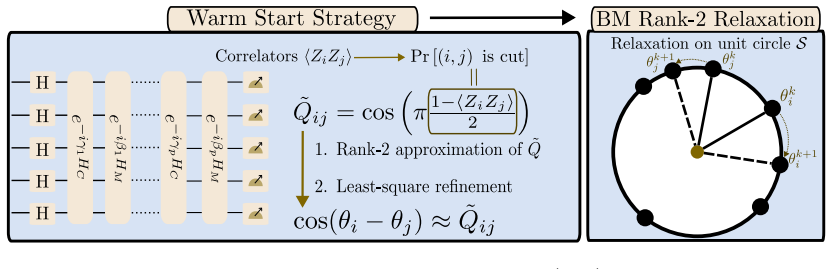
The central object is the map from QAOA edge-cut probabilities to an initial angular configuration for BM. For each edge, depth-one QAOA gives $\langle Z_i Z_j\rangle$, hence cut probability $p_{ij}=(1-\langle Z_i Z_j\rangle)/2$; the paper forms $\tilde{Q}_{ij}=\cos(\pi p_{ij})=\sin(\frac{\pi}{2}\langle Z_i Z_j\rangle)$ and solves the least-squares problem $\min_\theta \sum_{(i,j)\in E}(\cos(\theta_i-\theta_j)-\tilde{Q}_{ij})^2$ to find angles whose rank-two correlation matrix best matches the QAOA data. A spectral ansatz from the two leading eigenvectors of $\tilde Q$ seeds this fit, and the fitted $\theta$ is passed to BM, which minimizes the nonconvex objective $f(\theta)=\sum W_{ij}/2 \cos(\theta_i-\theta_j)$ and rounds via a diameter sweep.
What would settle it
Measure the optimized residual of the least-squares fit of $\cos(\theta_i-\theta_j)$ to $\tilde{Q}_{ij}$ across many instances and compare the WS advantage (for example, the crossover iteration versus random multi-start) for each instance; if instances with near-random residuals still show the same early-iteration head start, the rank-two representability story is not the operative mechanism.
Extended reading notes
Core claim
The paper claims that the pairwise correlations of a depth-one QAOA state, evaluated classically in closed form, encode enough structural information about a MaxCut instance to give the Burer-Monteiro rank-two relaxation a substantial head start. Concretely, the QAOA cut probabilities are converted into candidate initial angles $\theta_i$, and BM starting from those angles finds high-quality cuts after very few iterations, in contrast to random multi-start. The numerical evidence covers ER-10 graphs and fully-connected SK spin glasses at $n=500$ and $n=1000$; the head start is visible in best-energy curves and win rates at small budgets, while random multi-start eventually catches up and slightly outperforms WS given enough iterations. The paper interprets this as an exploitation/exploration tradeoff and notes the effect is weaker at $n=1000$, suggesting favorable scaling.
Load-bearing premise
The cut probabilities extracted from depth-one QAOA can be approximated by a rank-two cosine matrix $\cos(\theta_i-\theta_j)$, so the least-squares fit yields angles that point toward good BM basins.
Editorial extensions
If this is right
- At a fixed small iteration budget, warm-started BM finds better MaxCut energies than random multi-start on ER-10 and SK instances, with crossover at roughly 159-182 iterations for ER-10 at n=500, 674-925 at n=1000, and about 100 or 600 iterations for SK.
- Given enough iterations, random multi-start catches up and slightly beats WS on average, so the quantum-informed start is an exploitation strategy rather than a free lunch.
- The RandomLocal control shows the improvement comes from the QAOA seed itself, not from the restart policy.
- The warm-start construction costs about one BM restart plus a closed-form QAOA expectation evaluation, so the early advantage translates directly into time-to-quality.
Reading between the lines
- Because depth-one QAOA correlators are classically simulable in closed form, the practical value of this method does not depend on having quantum hardware; but if hardware can produce those correlators at scale faster than classical simulation, the same pipeline becomes a concrete near-term quantum utility route.
- The crossover point grows with n (about 159-182 at n=500 vs 674-925 at n=1000 for ER-10), suggesting the rank-two representability or the benefit of QAOA information improves with system size; a direct residual-versus-advantage study would test this.
- The same least-squares angle-fitting step could initialize other low-rank SDP heuristics or be fed by correlators from deeper circuits, measurement samples, or other quantum-inspired sources; the paper only tests depth-1 QAOA.
Editorial analysis
A structured set of objections, weighed in public.
Referee Report
Summary. This paper proposes a hybrid quantum-classical warm-start for MaxCut: depth-1 QAOA pair correlators ⟨ZiZj⟩ are mapped through a Goemans-Williamson-inspired trigonometric transform to a matrix Q̃, a rank-2 angular embedding is obtained by eigendecomposition followed by least-squares fitting to cos(θi−θj), and the resulting angles initialize the Burer–Monteiro rank-two relaxation. Numerical experiments on Erdős–Rényi graphs with 10% edge density (ER-10) and Sherrington–Kirkpatrick (SK) spin glasses at n=500 and n=1000 compare the QAOA warm-start against random multistart and fixed-random restart baselines, reporting best-found energy, paired differences, and win rates as functions of the iteration budget. The central claim is that QAOA-informed initialization provides a significant head start at small iteration budgets, while random multistart eventually catches up and slightly outperforms it at larger budgets, revealing an exploitation/exploration tradeoff.
Significance. If the attribution of the observed head start to QAOA correlators were established, the paper would provide a useful data point for quantum-assisted classical optimization: it combines closed-form depth-1 QAOA correlators with a strong classical heuristic and reports careful statistics (500 or 300 instances per class, three seeds averaged, cluster-bootstrap 95% confidence intervals, paired differences, and win rates). The authors also honestly acknowledge that the reported budgets exclude QAOA optimization and warm-start construction, and they explicitly frame the result as an improvement in the BM refinement stage rather than an end-to-end quantum advantage. The main weakness is that the experiments do not isolate the quantum-specific contribution of the initialization, because the warm-start construction is itself spectral and no classical spectral initialization is used as a control.
major comments (3)
- [Sections IV-B and V-B] The numerical comparison includes only random initialization policies (Random MultiStart and RandomLocal) as baselines. Since the warm-start pipeline is itself spectral—it eigendecomposes Q̃ and uses the two leading eigenvectors to form the initial angular ansatz before the least-squares refinement—a classical structured initialization run through the identical pipeline (for example, angles derived from the signed adjacency matrix, the graph Laplacian, or a Goemans–Williamson SDP solution) is needed to determine whether the observed head start is specific to QAOA correlators or is a generic property of structured low-rank seeds. As it stands, the data show that a spectral-angular seed beats random restarts, but they do not establish the central claim that QAOA-derived correlations provide useful structural information.
- [Section IV-B, Eq. (11)] The paper does not report the quality of the rank-2 fit that is the mechanism of the warm start. The core assumption is that Q̃_ij = cos(π p_ij) is well approximated by cos(θi − θj); if the least-squares residual of Eq. (11) is large for many instances, the fitted angles may not actually encode QAOA correlations, and the observed benefit could be an artifact of the spectral ansatz or of the optimization procedure. The authors should report the distribution of the residual F(θ*) over the instance ensembles, or another measure of agreement between the fitted and target edge probabilities, to support the claimed mechanism.
- [Section VI] The statement that 'The RandomLocal control indicates that this improvement is attributable to the information contained in the QAOA-derived seeds' is too strong. RandomLocal controls for the restart policy by fixing a random initial point, but it does not control for the presence of structured spectral information. A fixed random seed contains no spectral structure, so this control does not rule out the possibility that any structured initialization, classical or quantum, would yield a similar head start.
minor comments (4)
- [Section IV, opening paragraph] There is a typo: 'best-known pratical heuristic' should be 'best-known practical heuristic'.
- [Abstract and Section VI] The head start is measured in BM iteration budgets, and the authors explicitly state that QAOA optimization and warm-start construction are excluded from the reported budgets. This caveat should appear earlier in the paper, and the phrase 'modest fraction of a full run' in the Introduction should be supported by timing data or removed, since no wall-clock measurements are presented.
- [Section V-A] The paper does not specify how the QAOA parameters (γ, β) are optimized for each instance (e.g., grid search, gradient-based optimization, or analytical formulas). Providing this detail would improve reproducibility.
- [Figure 2 caption] The phrase 'the mean stops being ahead of the baseline' should specify whether it refers to the mean best energy or the mean paired difference, and how the crossover point is estimated from the plotted curves.
Circularity Check
No significant circularity: the warm-start construction is evaluated against random baselines, and the QAOA-derived inputs are independent of the Burer-Monteiro objective and final solution quality.
full rationale
The claimed derivation chain maps depth-one QAOA correlators to an initial angular point for Burer-Monteiro. In Eqs. (8)-(11), the paper defines Q̃_ij from ⟨ZiZj⟩ and then fits angles θ by minimizing (cos(θi−θj)−Q̃_ij)^2. This least-squares target is the QAOA-derived matrix, not the BM objective of Eq. (6) and not the final cut quality; the BM objective is still optimized from the warm-started point using the original weights W. No parameter is fitted to the reported head-start metric, and the closed-form correlator expressions are attributed to external references [16] and [17]. The self-citations present ([1], [11]-[13], [20]) are contextual or reproducibility-related and are not load-bearing for the central numerical claim. The absence of a classical spectral initialization baseline is a potential threat to attribution of the observed advantage to QAOA specifically, but that is a comparison/robustness concern, not a circularity: the paper does not define its warm-start in terms of its conclusions, nor does it rename a fitted quantity as a prediction. Therefore no circular step can be exhibited from the paper's own equations.
Assumptions & free parameters
assumptions (4)
- domain assumption Closed-form expressions for depth-1 QAOA local correlators ⟨Z_i Z_j⟩ exist and are efficiently computable.
- standard math The cut probability under GW hyperplane rounding satisfies Pr_e = arccos(⟨v_i, v_j⟩)/π.
- ad hoc to paper The QAOA-derived cut probabilities can be approximated by a rank-2 angular model cos(θ_i - θ_j) with small residual.
- domain assumption The Burer-Monteiro rank-two heuristic is a strong MaxCut solver.
Cite this review
Pith. "Pith review of Warm-Starting MaxCut Relaxation via Low-Depth Quantum Approximate Optimization Algorithm." pith.science (2026). https://pith.science/paper/UWG6DAKI
@misc{pith2026260806212,
  author       = {Pith},
  title        = {Pith review of: Warm-Starting MaxCut Relaxation via Low-Depth Quantum Approximate Optimization Algorithm},
  year         = {2026},
  howpublished = {\url{https://pith.science/paper/UWG6DAKI}},
  note         = {Machine review of arXiv:2608.06212}
}
abstract
Quantum optimization has attracted growing interest as quantum hardware continues to improve, yet state-of-the-art classical solvers remain a formidable benchmark for practical utility. Rather than seeking a fully quantum replacement for classical optimization, we propose a hybrid strategy that uses quantum information to enhance leading classical heuristics. Specifically, we introduce a warm-start method based on local correlators obtained from the Quantum Approximate Optimization Algorithm (QAOA), and use this information to initialize the Burer-Monteiro (BM) rank-two relaxation. We demonstrate numerically that, compared to a random, multi-start initialization baseline (a standard strategy used for BM), this quantum-informed initialization offers a significant head start, i.e., high-quality solutions with very small number of iterations, for two problem classes -- random Erd\H{o}s R\'{e}nyi graphs with edge density of $10\%$ (ER-10) and fully-connected Sherrington Kirkpatrick (SK) spin glass models, at $n=500$ and $n=1000$ qubits. At the same time, given enough iterations, the random baseline often eventually catches up and slightly outperforms the warm-start strategy on average, an effect visibly stronger for $n=500$ than for $n=1000$. The results demonstrate an exploitation/exploration tradeoff of using WS to quickly arrive at very good solutions vs exploring slightly better solutions with a larger iterations budget via a standard strategy. Our results highlight how low-depth quantum circuits can provide useful structural information for classical optimization and suggest a promising route toward near-term quantum utility through quantum-assisted initialization.
Figures


Reference graph
Works this paper leans on
-
[1]
F. B. Maciejewski, B. G. Bach, J. Biamonte, S.A. Hadfield, and D. Venturelli. quapopt – open source GitHub repository for quantum approximate optimization. https://github.com/usra-riacs/ quantum-approximate-optimization, 2025
work page 2025
-
[2]
Iain Dunning, Swati Gupta, and John Silberholz. What works best when? a systematic evaluation of heuristics for max-cut and qubo.INFORMS Journal on Computing, 30(3):608–624, 2018
work page 2018
-
[3]
Quantum computing for finance.Nature Reviews Physics, 5(8):450–465, 2023
Dylan Herman, Cody Googin, Xiaoyuan Liu, Yue Sun, Alexey Galda, Ilya Safro, Marco Pistoia, and Yuri Alexeev. Quantum computing for finance.Nature Reviews Physics, 5(8):450–465, 2023
2023
-
[4]
Recent advances in graph partitioning.Algorithm engineering, pages 117–158, 2016
Aydın Buluc ¸, Henning Meyerhenke, Ilya Safro, Peter Sanders, and Christian Schulz. Recent advances in graph partitioning.Algorithm engineering, pages 117–158, 2016
work page 2016
-
[5]
Ising formulations of many np problems.Frontiers in physics, 2:74887, 2014
Andrew Lucas. Ising formulations of many np problems.Frontiers in physics, 2:74887, 2014
2014
-
[6]
Improved approximation algorithms for maximum cut and satisfiability problems using semidefi- nite programming.Journal of the ACM (JACM), 42(6):1115–1145, 1995
Michel X Goemans and David P Williamson. Improved approximation algorithms for maximum cut and satisfiability problems using semidefi- nite programming.Journal of the ACM (JACM), 42(6):1115–1145, 1995
1995
-
[7]
Optimal inapproximability results for max-cut and other 2-variable csps? SIAM Journal on Computing, 37(1):319–357, 2007
Subhash Khot, Guy Kindler, Elchanan Mossel, and Ryan O’Donnell. Optimal inapproximability results for max-cut and other 2-variable csps? SIAM Journal on Computing, 37(1):319–357, 2007
2007
-
[8]
Samuel Burer, Renato DC Monteiro, and Yin Zhang. Rank-two relax- ation heuristics for max-cut and other binary quadratic programs.SIAM Journal on Optimization, 12(2):503–521, 2002
work page 2002
Show all 32 references
-
[9]
A quantum approximate optimization algorithm.arXiv preprint arXiv:1411.4028, 2014
Edward Farhi, Jeffrey Goldstone, and Sam Gutmann. A quantum approximate optimization algorithm.arXiv preprint arXiv:1411.4028, 2014
2014 arXiv
-
[10]
Toward a linear-ramp qaoa protocol: evidence of a scaling advantage in solving some combinatorial optimization problems.npj Quantum Information, 11(1):131, 2025
JA Montanez-Barrera and Kristel Michielsen. Toward a linear-ramp qaoa protocol: evidence of a scaling advantage in solving some combinatorial optimization problems.npj Quantum Information, 11(1):131, 2025
2025
-
[11]
Mlqaoa: Graph learning ac- celerated hybrid quantum-classical multilevel qaoa
Bao Bach, Jose Falla, and Ilya Safro. Mlqaoa: Graph learning ac- celerated hybrid quantum-classical multilevel qaoa. In2024 IEEE International Conference on Quantum Computing and Engineering (QCE), volume 01, pages 1–12, 2024
2024
-
[12]
Solving large-scale qubo with transferred parameters from multilevel qaoa of low depth
Bao G Bach, Filip B Maciejewski, and Ilya Safro. Solving large-scale qubo with transferred parameters from multilevel qaoa of low depth. In2025 IEEE International Conference on Quantum Computing and Engineering (QCE), pages 1–10. IEEE, 2025
-
[13]
Multilevel combi- natorial optimization across quantum architectures.ACM Transactions on Quantum Computing, 2(1):1–29, 2021
Hayato Ushijima-Mwesigwa, Ruslan Shaydulin, Christian FA Negre, Susan M Mniszewski, Yuri Alexeev, and Ilya Safro. Multilevel combi- natorial optimization across quantum architectures.ACM Transactions on Quantum Computing, 2(1):1–29, 2021
2021
-
[14]
Local classical max-cut algorithm outperformsp= 2 qaoa on high-girth regular graphs.Quantum, 5:437, 2021
Kunal Marwaha. Local classical max-cut algorithm outperformsp= 2 qaoa on high-girth regular graphs.Quantum, 5:437, 2021
2021
-
[15]
Maxcut quantum approximate opti- mization algorithm performance guarantees for p¿ 1.Physical Review A, 103(4):042612, 2021
Jonathan Wurtz and Peter Love. Maxcut quantum approximate opti- mization algorithm performance guarantees for p¿ 1.Physical Review A, 103(4):042612, 2021
2021
-
[16]
Quantum approximate optimization algorithm for maxcut: A fermionic view.Physical Review A, 97(2):022304, 2018
Zhihui Wang, Stuart Hadfield, Zhang Jiang, and Eleanor G Rieffel. Quantum approximate optimization algorithm for maxcut: A fermionic view.Physical Review A, 97(2):022304, 2018
2018
-
[17]
Expectation values from the single-layer quantum approximate optimization algorithm on ising problems.Quantum Science and Technology, 7(4):045036, 2022
Asier Ozaeta, Wim van Dam, and Peter L McMahon. Expectation values from the single-layer quantum approximate optimization algorithm on ising problems.Quantum Science and Technology, 7(4):045036, 2022
2022
-
[18]
Warm-starting quantum optimization.Quantum, 5:479, 2021
Daniel J Egger, Jakub Mare ˇcek, and Stefan Woerner. Warm-starting quantum optimization.Quantum, 5:479, 2021. Fig. 2. The top plots show the best-found energy (left y-axis, solid lines) and paired energy differences (right y-axis, dashed lines) between the given solver (WS wit...
2021
-
[19]
Bridging classical and quantum with sdp initialized warm-starts for qaoa.ACM Transactions on Quantum Computing, 4(2):1–39, 2023
Reuben Tate, Majid Farhadi, Creston Herold, Greg Mohler, and Swati Gupta. Bridging classical and quantum with sdp initialized warm-starts for qaoa.ACM Transactions on Quantum Computing, 4(2):1–39, 2023
2023
-
[20]
Beinit: Avoiding barren plateaus in variational quantum algorithms
Ankit Kulshrestha and Ilya Safro. Beinit: Avoiding barren plateaus in variational quantum algorithms. pages 197–203, 2022
2022
-
[21]
Optimization via quantum preconditioning.Physical Review Applied, 24(4):044013, 2025
Maxime Dupont, Tina Oberoi, and Bhuvanesh Sundar. Optimization via quantum preconditioning.Physical Review Applied, 24(4):044013, 2025
2025
-
[22]
Quantum-informed recursive optimization algorithms.arXiv preprint arXiv:2308.13607, 2023
Jernej Rudi Fin ˇzgar, Aron Kerschbaumer, Martin JA Schuetz, Chris- tian B Mendl, and Helmut G Katzgraber. Quantum-informed recursive optimization algorithms.arXiv preprint arXiv:2308.13607, 2023
2023 arXiv
-
[23]
Obstacles to variational quantum optimization from symmetry protec- tion.Physical review letters, 125(26):260505, 2020
Sergey Bravyi, Alexander Kliesch, Robert Koenig, and Eugene Tang. Obstacles to variational quantum optimization from symmetry protec- tion.Physical review letters, 125(26):260505, 2020
2020
-
[24]
Quantum-enhanced optimization by warm starts.arXiv preprint arXiv:2508.16309, 2025
Ieva ˇCepait˙e, Niam Vaishnav, Leo Zhou, and Ashley Montanaro. Quantum-enhanced optimization by warm starts.arXiv preprint arXiv:2508.16309, 2025
2025 arXiv
-
[25]
Some simplified np-complete problems
Michael R Garey, David S Johnson, and Larry Stockmeyer. Some simplified np-complete problems. InProceedings of the sixth annual ACM symposium on Theory of computing, pages 47–63, 1974
1974
-
[26]
The max-cut problem and quadratic 0–1 optimization; polyhedral aspects, relaxations and bounds.Annals of Operations Research, 33(3):151–180, 1991
Endre Boros and Peter L Hammer. The max-cut problem and quadratic 0–1 optimization; polyhedral aspects, relaxations and bounds.Annals of Operations Research, 33(3):151–180, 1991
1991
-
[27]
An application of combinatorial optimization to statistical physics and circuit layout design.Operations Research, 36(3):493–513, 1988
Francisco Barahona, Martin Gr ¨otschel, Michael J ¨unger, and Gerhard Reinelt. An application of combinatorial optimization to statistical physics and circuit layout design.Operations Research, 36(3):493–513, 1988
1988
-
[28]
Quantum combinatorial optimization in the nisq era: A systematic mapping study.ACM Computing Surveys, 56(3):1–36, 2023
Felix Gemeinhardt, Antonio Garmendia, Manuel Wimmer, Benjamin Weder, and Frank Leymann. Quantum combinatorial optimization in the nisq era: A systematic mapping study.ACM Computing Surveys, 56(3):1–36, 2023
2023
-
[29]
Extending relax-and-round combinatorial optimization solvers with quantum correlations.Physical Review A, 109(1):012429, 2024
Maxime Dupont and Bhuvanesh Sundar. Extending relax-and-round combinatorial optimization solvers with quantum correlations.Physical Review A, 109(1):012429, 2024
2024
-
[30]
Iterative quantum algorithms for maximum independent set.Physical Review A, 110(5):052435, 2024
Lucas T Brady and Stuart Hadfield. Iterative quantum algorithms for maximum independent set.Physical Review A, 110(5):052435, 2024
2024
-
[31]
Tabu search: A tutorial.Interfaces, 20(4):74–94, 1990
Fred Glover. Tabu search: A tutorial.Interfaces, 20(4):74–94, 1990
1990
-
[32]
Quantum supremacy through the quantum approximate optimization algorithm.arXiv preprint arXiv:1602.07674, 2016
Edward Farhi and Aram W Harrow. Quantum supremacy through the quantum approximate optimization algorithm.arXiv preprint arXiv:1602.07674, 2016. ACKNOWLEDGMENT B.G.B. and I.S. acknowledge support under the NSF award #2444042. F.B.M. acknowledges support under the NSF award Fig....
2016 arXiv
Reviewed August 7, 2026 · model on record in the stance chip above.
Discussion (0). Sign in to comment.