REVIEW 4 major objections 5 minor 2 cited by
Probing the structure of the $D_{s 0}^*(2317)$ and $X(3872)$ states through correlation functions
T0 review · 4 major / 5 minor · reviewed 2026-08-06 · deepseek-v4-flash
Pith's one-line read The paper claims that femtoscopic correlation functions of D0K+ and D0Dbar*0 pairs can distinguish whether the D_s0*(2317) and X(3872) are pure molecules, mixtures with a bare quark-model state, or coupled-channel composites, and that the…
desk verdict A clearly written paper with genuinely new channel-specific predictions, but the central claim of compositeness-sensitive lineshapes needs a regulator/source robustness scan before I would trust it. read the letter →
The pith
A machine-rendered reading of the paper's core claim, the machinery that carries it, and where it could break.
The reading
What carries the argument
The calculations rest on the Koonin-Pratt formula, which writes the correlation function as an integral over the emission source (taken as a Gaussian of radius R) of the squared relative wave function. The wave function is built from the T-matrix, obtained by solving a Lippmann-Schwinger equation with a contact-range potential; a bare quark-model state is included as an energy-dependent pole term alpha/(sqrt(s)-m_bare), and coupled channels enter through a matrix potential with a fixed ratio between DK and D_s eta couplings. The compositeness is computed from the pole residue and the derivative of the loop function, and the scattering length and effective range are read off from the inverse T-matrix near threshold. The key mechanism is that the energy dependence introduced by the bare pole changes the low-momentum correlation function in a way that a purely constant contact interaction cannot.
What would settle it
Measure the D0K+ correlation function in high-multiplicity collisions with a source radius near 1 fm and fine momentum resolution below k = 50 MeV: if no low-momentum peak or enhancement appears in a scenario where a bare state near 2.348 GeV is present, the claim that the correlation function can probe the bare-state position would be contradicted.
Extended reading notes
Core claim
The central discovery is that the lineshape of a two-hadron momentum correlation function encodes more than the scattering length: it distinguishes a pure molecular state from a state mixed with a bare quark-model seed. Using contact effective-field-theory potentials fixed to the physical masses and assumed compositeness values, the authors show that adding a bare-state pole term alpha over (sqrt(s) minus m_bare) substantially changes the D0K+ correlation function, and that the position of the pole, whether m_bare sits below or above the DK threshold, produces a low-momentum peak or enhancement. In the coupled DK-D_s eta case, the D_s eta channel contributes little, while the D+K0 coupled channel matters. For X(3872), the D0Dbar*0 correlation function falls below unity in a compositeness-dependent way, and the bare-state dressing modifies both scattering length and effective range, with the effective range even becoming negative in some scenarios. The paper establishes a bijective (one-to-one) relationship between compositeness and correlation functions, at least within the model, by recovering the input compositeness from a fit to synthetic correlation-function points.
Load-bearing premise
The predicted lineshape differences rely on the assumption that a single Gaussian source of radius R = 1 fm and a contact-range interaction with a sharp cutoff q_max = 1 GeV accurately describes the low-momentum correlation function; if real sources are non-Gaussian or the cutoff dependence is stronger than modeled, the distinguishing features could wash out.
Editorial extensions
If this is right
- If the D0K+ correlation function is measured in high-energy collisions, a low-momentum peak or enhancement would indicate the presence and position of a bare csbar state below or near the DK threshold.
- The compositeness of the D_s0*(2317) could be extracted from the measured D0K+ correlation function, distinguishing a 100% DK molecule from a roughly 70% molecular mixture.
- For the X(3872), measured D0Dbar*0 correlation functions would provide a compositeness diagnostic through the depth and sign of the correlation function below unity.
- The D_s eta channel has negligible influence on the D0K+ correlation functions, so a single-channel DK analysis may suffice for this observable.
Reading between the lines
- The same formalism could be applied to other threshold-bound exotics, such as the T_cc tetraquark or candidate pentaquarks, to map out bare-state admixtures wherever a quark-model seed is suspected.
- If future data resolve the low-momentum correlation function with high precision, the predicted peak position for a bare state could be converted into a mass measurement with accuracy limited by the source size R.
- The sensitivity to cutoff and source size at low momentum suggests that combining correlation functions measured at several source sizes (from different collision systems) might isolate short-range from long-range contributions.
Signed reviews
Editorial analysis
A structured set of objections, weighed in public.
Referee Report
Summary. The paper studies femtoscopic correlation functions as a probe of the internal structure of the D_s0*(2317) and X(3872) states. Using a contact-range effective field theory, the authors construct DK and Dbar*D potentials for four scenarios of D_s0*(2317) (pure molecule, molecule plus bare state, DK-D_s eta coupled channel, and the latter plus a bare state) by reproducing the known mass and an assumed compositeness. They then compute D0K+ correlation functions and find that the line shape depends on the molecular fraction and on the mass of the bare state. For X(3872), they use a similar zero-range model, with and without a bare charmonium state, and compute D0Dbar*0 correlation functions, claiming clearly distinguishable line shapes for different compositeness values. The paper also presents a synthetic-data inverse-problem exercise to extract compositeness from correlation functions.
Significance. If the predicted line-shape differences survive a broader variation of model inputs, the paper would establish femtoscopy as a genuinely useful discriminator of molecular versus compact content for D_s0*(2317) and X(3872), complementing spectroscopy and lattice QCD. The paper has concrete strengths: it works within a well-defined EFT framework, it compares the derived DK scattering lengths with lattice QCD results, and it explicitly tests the inversion of correlation functions into compositeness using synthetic data. These are useful proof-of-principle steps. The significance is currently limited, however, by the strong model dependence of the central claims: the potentials are fitted to the quantities whose sensitivity is then advertised, and the regulator and source-size dependence is not systematically quantified.
major comments (4)
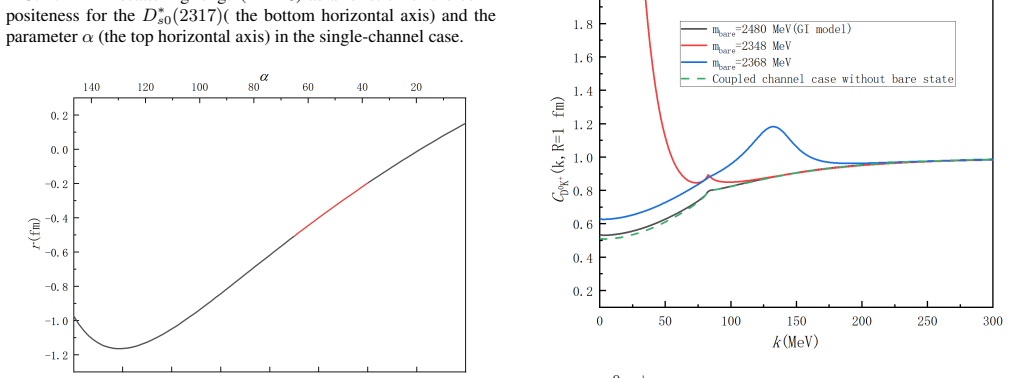
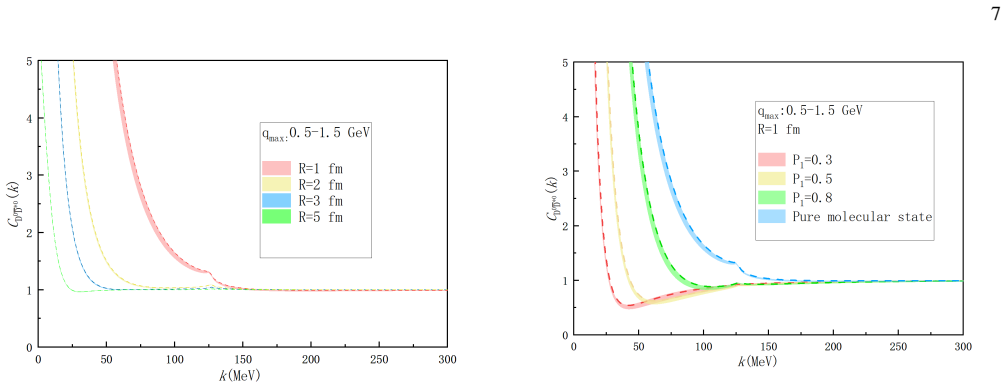
- [Sec. III.A, Fig. 4 and Sec. III.B, Fig. 7] The central claim that the D0K+ correlation-function line shapes are 'clearly distinguishable' for different compositeness values is not supported by a robustness analysis. The authors choose q_max = 1 GeV and R = 1 fm, explicitly noting in Sec. III.A that R = 1 fm gives the largest deviation from unity, and they state in Sec. III.B that for smaller compositeness the low-momentum correlation function has a broad q_max dependence. Since the D_s0*(2317) scenarios of interest use P ~ 0.7, the separation between the P = 0.7 and P = 1 curves must be shown to exceed the bands obtained by scanning q_max (e.g., 0.5-1.5 GeV) and R (e.g., 0.5-2 fm). Without such a scan, the claimed discrimination could be an artifact of the selected regulator and source parameters rather than a robust observable signature.
- [Sec. III.C] The inverse-problem demonstration does not support the Summary's claim of a 'bijective relationship between compositeness and CFs'. The synthetic data are generated from the same potential model (Scenario IV) and fitted with the same functional form, the same q_max, and the same R, so the exercise tests the numerical stability of the fit, not whether a measured correlation function uniquely determines compositeness in a model-independent way. To support the stronger claim, the authors would need to show that alternative interaction models (different V forms, cutoffs, or additional coupled channels) that reproduce the same correlation function do not lead to different extracted compositeness, or that the extracted value is stable under such variations.
- [Sec. III.D, Figs. 9 and 10] The X(3872) correlation functions are computed with a single-channel zero-range model that yields r0 = 0.28 fm, which the authors acknowledge violates the Wigner bound for a zero-range interaction. Since X(3872) is a shallow bound state with a large scattering length, the low-momentum correlation function is sensitive to the effective range, and the acausal zero-range model may produce line shapes that differ from those of a causal model (e.g., the bare-state model, which gives r1 = -4.72 fm). The paper should either use a potential with r0 < 0 throughout the X(3872) section or explicitly demonstrate that the correlation-function predictions are insensitive to the effective range over the momentum range shown.
- [Sec. III.B, Eqs. (10)-(13) and Figs. 6-8] The channel basis used in the coupled-channel correlation-function calculations is not specified consistently. Equation (12) defines a potential matrix for DK-D_s eta, but the text in Sec. III.B attributes the coupled-channel effect on the correlation functions to D0K+ and D+K0 rather than to D_s eta. This makes it impossible to determine whether the T-matrix in Eq. (10) is evaluated in the (DK, D_s eta) basis or in a (D0K+, D+K0) basis, and it undermines the stated claim that the correlation functions are sensitive to D+K0 admixture. The authors should define the channels explicitly and, if D+K0 is included as a coupled channel, provide the corresponding potential matrix and loop functions.
minor comments (5)
- [Introduction] The name 'Godfrey-Isgur' is misspelled as 'Goldfrey-Isgur' in the first paragraph of the Introduction.
- [Sec. III.A] The sentence 'The corresponding CFs are shown in Fig. 7' appears to refer to Fig. 5, which displays the correlation functions for different bare-state masses; Fig. 7 shows the compositeness dependence in the coupled-channel case.
- [Sec. III.C] The phrase 'we take a point about every 2MeV at at momentum less than 40' contains a duplicated 'at' and the momentum value lacks units; it should presumably read 'every 2 MeV at momenta less than 40 MeV/c' or similar.
- [Sec. III.D] The text 'we obtain the scattering length a_D0Dbar*0 ≈ 19.58 fm and effective range r = -1 fm' uses 'r' without a subscript, inconsistent with Eq. (15); please use r0 or r1 consistently for the effective range.
- [Sec. III.B] The sentence 'we assume that the weights of the DK channel and the D_s eta channel are the same' is inconsistent with the immediately following ratio omega_DK/omega_Ds eta = 1/0.35 obtained from Eq. (21); please clarify which weights are assumed equal and which are obtained from the thermal-weight estimate.
Circularity Check
Partial circularity: the inverse-problem claim that compositeness is 'reliably extracted' from D0K+ CFs is a self-consistency loop (synthetic data generated and fit with the same Eq. (10)); the forward CF scenario predictions are model outputs, not circular.
-
fitted input called prediction
[Sec. III.C (Inverse problem) and Sec. IV Summary]
"we employ a random sampling method to select multiple points from the DKCFs in Scenario IV, treating them as synthetic experimental data: ... then we fit these data with Eq.(10) to fix the parameter in the potential. ... By fitting the resampled data points, we obtain the potential parameters ... yielding a result of 0.698±0.06, which are in excellent agreement with the original input values."
The 'data' are produced by the same coupled-channel formula Eq. (10) using the Scenario IV inputs (C_a=−95.32, α=8.56 GeV, P1=0.7) that the fit is then designed to recover. Fitting the forward model's own output with the same forward model and finding the input parameters back is a numerical round-trip, not an independent extraction. The summary conclusion that 'compositeness can be reliably extracted from the CFs' (Sec. IV) converts this self-consistency check into a predictive capability. No real experimental CF enters; the recovered P1=0.698 is the input P1=0.7 after inversion, so the 'prediction' is forced by construction.
full rationale
The forward-model parts of the paper are not circular: the D_s0*(2317) potentials are fixed by reproducing the mass and an assumed compositeness, and the D0K+ correlation functions are then computed from those potentials. The sensitivity of the lineshape to compositeness, the bare-state mass, and coupled-channel admixtures is a genuine forward-model consequence, not a renaming of the inputs. Likewise, the X(3872) CFs follow from an assumed potential and prescribed molecular fractions; the resulting line-shape differences are model outputs. The scattering-length comparison with lattice QCD provides external, independent support for the framework. The self-citations (e.g., Refs. [70], [77], [89]) are published prior results or standard Koonin-Pratt formalism, and the paper does not invoke a self-citation chain or uniqueness theorem to force its choices. The main circular element is the inverse-problem section: synthetic data generated from Eq. (10) are fit with Eq. (10), so recovering the input compositeness is a consistency check, not an empirical validation. Two additional caveats (not treated as formal circularity) weaken the headline sensitivity claims: R=1 fm is selected because it gives the largest deviation from unity, and qmax=1 GeV is a fixed regulator; the paper's own broad qmax bands for small compositeness mean the 'clearly distinguishable' line shapes at P~0.7 should be read as conditional on those favorable choices. The X(3872) zero-range result r0=0.28 fm also violates the Wigner bound, as the paper acknowledges, indicating a modeling limitation rather than a circular derivation. Overall, one constructed 'prediction' (the inverse extraction) reduces by construction, giving partial circularity; the central forward predictions retain independent content.
Assumptions & free parameters
free parameters (6)
- Contact coupling C_a for DK (and DbarD*) =
C_a = -95.32 for Scenario IV; values for other scenarios not tabulated
- Bare-state coupling alpha =
alpha = 8.56 GeV for Scenario IV; 8.41 +/- 0.72 GeV from synthetic fit
- Bare-state mass m_bare =
2.348 GeV and 2.368 GeV for D_s0*; 3.95 GeV for X(3872)
- Assumed compositeness P =
P = 0.7 for D_s0* in Scenarios II/IV; P1 = 0.8, P2 = 0.05 for X(3872)
- Regulator cutoff q_max =
1 GeV central; 0.5-1.5 GeV for uncertainty bands
- Source size R =
1 fm selected; 2, 3, 5 fm scanned
assumptions (5)
- domain assumption The correlation function is given by the Koonin-Pratt formula with a single Gaussian source of radius R.
- domain assumption The strong interaction can be represented by a contact-range (zero-range) EFT potential with a sharp cutoff q_max.
- ad hoc to paper A bare c-anti-s state dressed by the DK continuum is parameterized by V = alpha/(sqrt(s)-m_bare) with coefficients A_i from SU(3).
- domain assumption The X(3872) is assumed to be a shallow D0Dbar*0 bound state, later mixed with a bare charmonium state.
- domain assumption The hadronization weights of different coupled channels are estimated by omega_i/omega_j = exp[-(m_i1+m_i2)/T*] with T* = 154 MeV.
Cite this review
Pith. "Pith review of Probing the structure of the $D_{s 0}^*(2317)$ and $X(3872)$ states through correlation functions." pith.science (2026). https://pith.science/paper/UWO75EAV
@misc{pith2026250623476,
  author       = {Pith},
  title        = {Pith review of: Probing the structure of the $D_s 0^*(2317)$ and $X(3872)$ states through correlation functions},
  year         = {2026},
  howpublished = {\url{https://pith.science/paper/UWO75EAV}},
  note         = {Machine review of arXiv:2506.23476}
}
abstract
Over the past 20 years, many new hadron states have been discovered, but understanding their nature remains a key experimental and theoretical challenge. Recent studies have established that hadron-hadron interactions primarily govern the generation of new hadronic states, with their spectroscopy serving as a powerful tool for probing these interactions and determining the corresponding compositeness. In this work, we study four scenarios to determine the $DK$ interaction by reproducing the mass of the $D_{s0}^*(2317)$, i.e., assuming the $D_{s0}^*(2317)$ as a $DK$ molecule, a mixture of a $DK$ molecule and a bare state, a $DK-D_s\eta$ molecule, and a mixture of a $DK-D_s\eta$ molecule and a bare state. Using the $D^{0}K^{+}$ interactions derived from these scenarios, we predict the $D^{0}K^{+}$ correlation functions. Our results demonstrate that the lineshape of the $D^{0}K^{+}$ correlation function is sensitive to the admixture effects from the coupled-channel $D^+K^0$ and the bare state. Furthermore, we find that the $D^{0}K^{+}$ correlation function can probe the position of the bare state, if such a QCD bare state exists. Using the shallow-bound state candidate $X(3872)$ as input, we study the $D^0\bar{D}^{*0}$ correlation functions. These functions are highly sensitive to short-range dynamics and bare-state admixtures, resulting in clearly distinguishable correlation-function line shapes across different values of compositeness.
Figures


Figures from the paper (5 more)



Forward citations
Cited by 2 Pith papers
-
Finding Low Star Discrepancy 3D Kronecker Point Sets Using Algorithm Configuration Techniques
Optimizing the two Kronecker parameters with irace yields new state-of-the-art L∞ star discrepancy for 3D point sets of size at least 500 and for ranges of sizes.
-
Mass spectra and electromagnetic characteristics of the $K^{(*)}\bar D^{(*)}$ and $K^{(*)}{D}^{(*)}$ molecular tetraquarks from the coupled-channel dynamics
Using coupled-channel one-boson-exchange dynamics the authors predict several K(*) bar D(*) and K(*) D(*) molecular tetraquark candidates and their electromagnetic properties.
Reference graph
Works this paper leans on
-
[1]
Eichten, K
E. Eichten, K. Gottfried, T. Kinoshita, J. B. Kogut, K. D. Lane, and T.-M. Yan, Phys. Rev. Lett.34, 369 (1975), [Erratum: Phys.Rev.Lett. 36, 1276 (1976)]
1975
-
[2]
G. S. Bali, Phys. Rept.343, 1 (2001), arXiv:hep-ph/0001312
arXiv 2001
-
[3]
Godfrey and N
S. Godfrey and N. Isgur, Phys. Rev. D32, 189 (1985)
1985
-
[4]
Capstick and N
S. Capstick and N. Isgur, Phys. Rev. D34, 2809 (1986)
1986
-
[5]
Gell-Mann, Phys
M. Gell-Mann, Phys. Lett.8, 214 (1964)
1964
-
[6]
N. Brambilla et al., Eur. Phys. J. C71, 1534 (2011), arXiv:1010.5827 [hep-ph]
arXiv 2011
-
[7]
S. L. Olsen, T. Skwarnicki, and D. Zieminska, Rev. Mod. Phys. 90, 015003 (2018), arXiv:1708.04012 [hep-ph]
arXiv 2018
-
[8]
N. Brambilla, S. Eidelman, C. Hanhart, A. Nefediev, C.-P. Shen, C. E. Thomas, A. Vairo, and C.-Z. Yuan, Phys. Rept. 873, 1 (2020), arXiv:1907.07583 [hep-ex]
arXiv 2020
Show all 90 references
-
[9]
H.-X. Chen, W. Chen, X. Liu, and S.-L. Zhu, Phys. Rept.639, 1 (2016), arXiv:1601.02092 [hep-ph]
2016 arXiv
-
[10]
R. F. Lebed, R. E. Mitchell, and E. S. Swanson, Prog. Part. Nucl. Phys.93, 143 (2017), arXiv:1610.04528 [hep-ph]
2017 arXiv
-
[11]
Oset et al., Int
E. Oset et al., Int. J. Mod. Phys. E25, 1630001 (2016), arXiv:1601.03972 [hep-ph]
2016 arXiv
-
[12]
Esposito, A
A. Esposito, A. Pilloni, and A. D. Polosa, Phys. Rept.668, 1 (2017), arXiv:1611.07920 [hep-ph]
2017 arXiv
-
[13]
Y . Dong, A. Faessler, and V . E. Lyubovitskij, Prog. Part. Nucl. Phys.94, 282 (2017)
2017
-
[14]
F.-K. Guo, C. Hanhart, U.-G. Meißner, Q. Wang, Q. Zhao, and B.-S. Zou, Rev. Mod. Phys.90, 015004 (2018), [Erratum: Rev.Mod.Phys. 94, 029901 (2022)], arXiv:1705.00141 [hep- ph]
2018 arXiv
-
[15]
A. Ali, J. S. Lange, and S. Stone, Prog. Part. Nucl. Phys.97, 123 (2017), arXiv:1706.00610 [hep-ph]
2017 arXiv
-
[16]
Karliner, J
M. Karliner, J. L. Rosner, and T. Skwarnicki, Ann. Rev. Nucl. Part. Sci.68, 17 (2018), arXiv:1711.10626 [hep-ph]
2018 arXiv
-
[17]
Guo, X.-H
F.-K. Guo, X.-H. Liu, and S. Sakai, Prog. Part. Nucl. Phys.112, 103757 (2020), arXiv:1912.07030 [hep-ph]
2020 arXiv
-
[18]
Liu, Y .-W
M.-Z. Liu, Y .-W. Pan, Z.-W. Liu, T.-W. Wu, J.-X. Lu, and L.-S. Geng, Phys. Rept.1108, 1 (2025), arXiv:2404.06399 [hep-ph]
2025 arXiv
-
[19]
Wang, Front
Z.-G. Wang, Front. Phys. (Beijing)21, 016300 (2026), arXiv:2502.11351 [hep-ph]
2026 arXiv
-
[20]
D ¨oring, J
M. D ¨oring, J. Haidenbauer, M. Mai, and T. Sato, Prog. Part. Nucl. Phys.146, 104213 (2026), arXiv:2505.02745 [nucl-th]
2026
-
[21]
Aubert et al
B. Aubert et al. (BaBar), Phys. Rev. Lett.90, 242001 (2003), arXiv:hep-ex/0304021
2003 arXiv
-
[22]
S. K. Choi et al. (Belle), Phys. Rev. Lett.91, 262001 (2003), arXiv:hep-ex/0309032
2003 arXiv
-
[23]
Ablikim et al
M. Ablikim et al. (BESIII), Phys. Rev. D97, 051103 (2018), arXiv:1711.08293 [hep-ex]
2018 arXiv
-
[24]
Godfrey, Phys
S. Godfrey, Phys. Lett. B568, 254 (2003), arXiv:hep- ph/0305122
2003
-
[25]
Colangelo and F
P. Colangelo and F. De Fazio, Phys. Lett. B570, 180 (2003), arXiv:hep-ph/0305140
2003 arXiv
-
[26]
Colangelo, F
P. Colangelo, F. De Fazio, and A. Ozpineci, Phys. Rev. D72, 074004 (2005), arXiv:hep-ph/0505195
2005 arXiv
-
[27]
P. G. Ortega, J. Segovia, D. R. Entem, and F. Fernandez, Phys. Rev. D94, 074037 (2016), arXiv:1603.07000 [hep-ph]
2016 arXiv
-
[28]
Albaladejo, P
M. Albaladejo, P. Fernandez-Soler, J. Nieves, and P. G. Ortega, Eur. Phys. J. C78, 722 (2018), arXiv:1805.07104 [hep-ph]
2018 arXiv
-
[29]
S.-Q. Luo, B. Chen, X. Liu, and T. Matsuki, Phys. Rev. D103, 074027 (2021), arXiv:2102.00679 [hep-ph]
2021 arXiv
-
[30]
Yang, G.-J
Z. Yang, G.-J. Wang, J.-J. Wu, M. Oka, and S.-L. Zhu, Phys. Rev. Lett.128, 112001 (2022), arXiv:2107.04860 [hep-ph]
2022 arXiv
-
[31]
Mart´ınez Torres, E
A. Mart´ınez Torres, E. Oset, S. Prelovsek, and A. Ramos, JHEP 05, 153 (2015), arXiv:1412.1706 [hep-lat]
2015 arXiv
-
[32]
Guo, U.-G
Z.-H. Guo, U.-G. Meißner, and D.-L. Yao, Phys. Rev. D92, 094008 (2015), arXiv:1507.03123 [hep-ph]
2015 arXiv
-
[33]
Yao, M.-L
D.-L. Yao, M.-L. Du, F.-K. Guo, and U.-G. Meißner, JHEP11, 058 (2015), arXiv:1502.05981 [hep-ph]
2015 arXiv
-
[34]
Guo, PoSLA TTICE2022, 232 (2023)
F.-K. Guo, PoSLA TTICE2022, 232 (2023)
2023
-
[35]
Gil-Dom ´ınguez and R
F. Gil-Dom ´ınguez and R. Molina, Phys. Rev. D109, 096002 (2024), arXiv:2306.01848 [hep-ph]
2024 arXiv
-
[36]
Aaij et al
R. Aaij et al. (LHCb), Phys. Rev. D102, 092005 (2020), arXiv:2005.13419 [hep-ex]
2020
-
[37]
Ablikim et al
M. Ablikim et al. (BESIII), Phys. Rev. Lett.132, 151903 (2024), arXiv:2309.01502 [hep-ex]
2024
-
[38]
B. S. Zou, Nucl. Phys. A914, 454 (2013), arXiv:1301.1128 [hep-ph]
2013 arXiv
-
[39]
Inoue, N
T. Inoue, N. Ishii, S. Aoki, T. Doi, T. Hatsuda, Y . Ikeda, K. Mu- rano, H. Nemura, and K. Sasaki (HAL QCD), Phys. Rev. Lett. 106, 162002 (2011), arXiv:1012.5928 [hep-lat]
2011 arXiv
-
[40]
Y . Lyu, S. Aoki, T. Doi, T. Hatsuda, Y . Ikeda, and J. Meng, Phys. Rev. Lett.131, 161901 (2023), arXiv:2302.04505 [hep- lat]
2023 arXiv
-
[41]
Bulava et al
J. Bulava et al. (Baryon Scattering (BaSc)), Phys. Rev. Lett. 132, 051901 (2024), arXiv:2307.10413 [hep-lat]
2024
-
[42]
H. Xing, J. Liang, L. Liu, P. Sun, and Y .-B. Yang, (2022), arXiv:2210.08555 [hep-lat]
2022 arXiv
-
[43]
Shi, F.-K
P.-P. Shi, F.-K. Guo, C. Liu, L. Liu, P. Sun, J.-J. Wu, and H. Xing, (2025), arXiv:2502.07438 [hep-lat]
2025 arXiv
-
[44]
L. Liu, K. Orginos, F.-K. Guo, C. Hanhart, and U.-G. Meissner, Phys. Rev.D87, 014508 (2013), arXiv:1208.4535 [hep-lat]
2013 arXiv
-
[45]
Mohler, C
D. Mohler, C. B. Lang, L. Leskovec, S. Prelovsek, and R. M. Woloshyn, Phys. Rev. Lett.111, 222001 (2013), arXiv:1308.3175 [hep-lat]
2013 arXiv
-
[46]
C. B. Lang, L. Leskovec, D. Mohler, S. Prelovsek, and R. M. Woloshyn, Phys. Rev. D90, 034510 (2014), arXiv:1403.8103 [hep-lat]
2014 arXiv
-
[47]
G. S. Bali, S. Collins, A. Cox, and A. Sch ¨afer, Phys. Rev. D96, 074501 (2017), arXiv:1706.01247 [hep-lat]
2017 arXiv
-
[48]
Alexandrou, J
C. Alexandrou, J. Berlin, J. Finkenrath, T. Leontiou, and M. Wagner, Phys. Rev. D101, 034502 (2020), arXiv:1911.08435 [hep-lat]
2020 arXiv
-
[49]
Fabbietti, V
L. Fabbietti, V . Mantovani Sarti, and O. Vazquez Doce, Ann. Rev. Nucl. Part. Sci.71, 377 (2021), arXiv:2012.09806 [nucl- ex]
2021 arXiv
-
[50]
Liu, J.-X
Z.-W. Liu, J.-X. Lu, and L.-S. Geng, PoSQNP2024, 044 (2025)
2025
-
[51]
Adamczyk et al
L. Adamczyk et al. (STAR), Phys. Rev. Lett.114, 022301 (2015), arXiv:1408.4360 [nucl-ex]
2015 arXiv
-
[52]
Adamczyk et al
L. Adamczyk et al. (STAR), Nature527, 345 (2015), arXiv:1507.07158 [nucl-ex]
2015 arXiv
-
[53]
Acharya et al
S. Acharya et al. (ALICE), Phys. Rev. Lett.124, 092301 (2020), arXiv:1905.13470 [nucl-ex]
2020 arXiv
-
[54]
Acharya et al
S. Acharya et al. (ALICE), Phys. Rev. Lett.123, 112002 (2019), arXiv:1904.12198 [nucl-ex]
2019 arXiv
-
[55]
Collaboration et al
A. Collaboration et al. (ALICE), Nature588, 232 (2020), [Er- 9 ratum: Nature 590, E13 (2021)], arXiv:2005.11495 [nucl-ex]
2020 arXiv
-
[56]
Acharya et al
S. Acharya et al. (ALICE), Phys. Rev. Lett.127, 172301 (2021), arXiv:2105.05578 [nucl-ex]
2021 arXiv
-
[57]
Morita, T
K. Morita, T. Furumoto, and A. Ohnishi, Phys. Rev. C91, 024916 (2015), arXiv:1408.6682 [nucl-th]
2015 arXiv
-
[58]
Morita, A
K. Morita, A. Ohnishi, F. Etminan, and T. Hatsuda, Phys. Rev. C94, 031901 (2016), [Erratum: Phys.Rev.C 100, 069902 (2019)], arXiv:1605.06765 [hep-ph]
2016 arXiv
-
[59]
Ohnishi, K
A. Ohnishi, K. Morita, K. Miyahara, and T. Hyodo, Nucl. Phys. A954, 294 (2016), arXiv:1603.05761 [nucl-th]
2016 arXiv
- [60]
-
[61]
Morita, S
K. Morita, S. Gongyo, T. Hatsuda, T. Hyodo, Y . Kamiya, and A. Ohnishi, Phys. Rev. C101, 015201 (2020), arXiv:1908.05414 [nucl-th]
2020 arXiv
-
[62]
Kamiya, T
Y . Kamiya, T. Hyodo, K. Morita, A. Ohnishi, and W. Weise, Phys. Rev. Lett.124, 132501 (2020), arXiv:1911.01041 [nucl- th]
2020 arXiv
-
[63]
Ogata, T
K. Ogata, T. Fukui, Y . Kamiya, and A. Ohnishi, Phys. Rev. C 103, 065205 (2021), arXiv:2103.00100 [nucl-th]
2021 arXiv
-
[64]
Kamiya, K
Y . Kamiya, K. Sasaki, T. Fukui, T. Hyodo, K. Morita, K. Ogata, A. Ohnishi, and T. Hatsuda, Phys. Rev. C105, 014915 (2022), arXiv:2108.09644 [hep-ph]
2022 arXiv
-
[65]
Haidenbauer and U.-G
J. Haidenbauer and U.-G. Meißner, Phys. Lett. B829, 137074 (2022), arXiv:2109.11794 [nucl-th]
2022 arXiv
-
[66]
Liu, K.-W
Z.-W. Liu, K.-W. Li, and L.-S. Geng, Chin. Phys. C47, 024108 (2023), arXiv:2201.04997 [hep-ph]
2023 arXiv
-
[67]
Liu, J.-X
Z.-W. Liu, J.-X. Lu, and L.-S. Geng, Phys. Rev. D107, 074019 (2023), arXiv:2302.01046 [hep-ph]
2023 arXiv
-
[68]
Liu, J.-X
Z.-W. Liu, J.-X. Lu, M.-Z. Liu, and L.-S. Geng, Phys. Rev. D 108, L031503 (2023), arXiv:2305.19048 [hep-ph]
2023 arXiv
-
[69]
Molina, Z.-W
R. Molina, Z.-W. Liu, L.-S. Geng, and E. Oset, Eur. Phys. J. C 84, 328 (2024), arXiv:2312.11993 [hep-ph]
2024 arXiv
-
[70]
Liu, J.-X
Z.-W. Liu, J.-X. Lu, M.-Z. Liu, and L.-S. Geng, Sci. Bull.70, 3515 (2025), arXiv:2404.18607 [hep-ph]
2025
-
[71]
Ge, Z.-W
D.-L. Ge, Z.-W. Liu, J.-X. Lu, and L.-S. Geng, Phys. Rev. C 112, 034003 (2025), arXiv:2502.18872 [nucl-th]
2025 arXiv
-
[72]
Epelbaum, S
E. Epelbaum, S. Heihoff, U.-G. Meißner, and A. Tscherwon, (2025), arXiv:2504.08631 [nucl-th]
2025 arXiv
-
[73]
G ¨obel and A
M. G ¨obel and A. Kievsky, Phys. Lett. B869, 139835 (2025), arXiv:2505.13433 [nucl-th]
2025 arXiv
-
[74]
Molina and E
R. Molina and E. Oset, Phys. Rev. D112, 096006 (2025), arXiv:2506.03669 [hep-ph]
2025 arXiv
-
[75]
Weinberg, Phys
S. Weinberg, Phys. Rev.130, 776 (1963)
1963
-
[76]
Weinberg, Phys
S. Weinberg, Phys. Rev.137, B672 (1965)
1965
-
[77]
Wu, M.-Z
T.-W. Wu, M.-Z. Liu, and L.-S. Geng, Phys. Rev. Lett.135, 031902 (2025), arXiv:2501.11358 [hep-ph]
2025 arXiv
-
[78]
S. E. Koonin, Phys. Lett. B70, 43 (1977)
1977
-
[79]
Pratt, T
S. Pratt, T. Csorgo, and J. Zimanyi, Phys. Rev. C42, 2646 (1990)
1990
-
[80]
Liu, D.-L
Z.-W. Liu, D.-L. Ge, J.-X. Lu, M.-Z. Liu, and L.-S. Geng, Phys. Rev. D112, 054019 (2025), arXiv:2504.04853 [hep-ph]
2025 arXiv
-
[81]
P.-P. Shi, M. Albaladejo, M.-L. Du, F.-K. Guo, and J. Nieves, Phys. Rev. D111, 074043 (2025), arXiv:2410.19563 [hep-ph]
2025 arXiv
-
[82]
Ikeno, G
N. Ikeno, G. Toledo, and E. Oset, Phys. Lett. B847, 138281 (2023), arXiv:2305.16431 [hep-ph]
2023 arXiv
-
[83]
Li, J.-Y
H.-P. Li, J.-Y . Yi, C.-W. Xiao, D.-L. Yao, W.-H. Liang, and E. Oset, Chin. Phys. C48, 053107 (2024), arXiv:2401.14302 [hep-ph]
2024 arXiv
-
[84]
Guo, P.-N
F.-K. Guo, P.-N. Shen, H.-C. Chiang, R.-G. Ping, and B.- S. Zou, Phys. Lett.B641, 278 (2006), arXiv:hep-ph/0603072 [hep-ph]
2006 arXiv
-
[85]
Altenbuchinger, L
M. Altenbuchinger, L. S. Geng, and W. Weise, Phys. Rev. D 89, 014026 (2014), arXiv:1309.4743 [hep-ph]
2014 arXiv
-
[86]
J.-X. Lin, J. Song, M. Albaladejo, A. Feijoo, and E. Oset, Phys. Rev. D112, 014044 (2025), arXiv:2505.15650 [hep-ph]
2025 arXiv
-
[87]
Gamermann, E
D. Gamermann, E. Oset, D. Strottman, and M. J. Vicente Va- cas, Phys. Rev.D76, 074016 (2007), arXiv:hep-ph/0612179 [hep-ph]
2007 arXiv
-
[88]
Matuschek, V
I. Matuschek, V . Baru, F.-K. Guo, and C. Hanhart, Eur. Phys. J. A57, 101 (2021), arXiv:2007.05329 [hep-ph]
2021 arXiv
-
[89]
Shen, M.-Z
Y .-B. Shen, M.-Z. Liu, Z.-W. Liu, and L.-S. Geng, Phys. Rev. D111, 034001 (2025), arXiv:2409.06409 [hep-ph]
2025 arXiv
-
[90]
Baru, X.-K
V . Baru, X.-K. Dong, M.-L. Du, A. Filin, F.-K. Guo, C. Han- hart, A. Nefediev, J. Nieves, and Q. Wang, Phys. Lett. B833, 137290 (2022), arXiv:2110.07484 [hep-ph]
2022 arXiv
Reviewed August 6, 2026 · model on record in the stance chip above.
Discussion (0). Continue with ORCID to comment.