Effects of confinement in a Brownian gas with simultaneous stochastic resetting and dynamically emergent correlations
Pith reviewed 2026-07-01 02:56 UTC · model grok-4.3
The pith
Confinement changes how common resets induce correlations in Brownian particles, with box walls causing non-monotonic overshoot while harmonic potentials yield monotonic growth.
A machine-rendered reading of the paper's core claim, the machinery that carries it, and where it could break.
Core claim
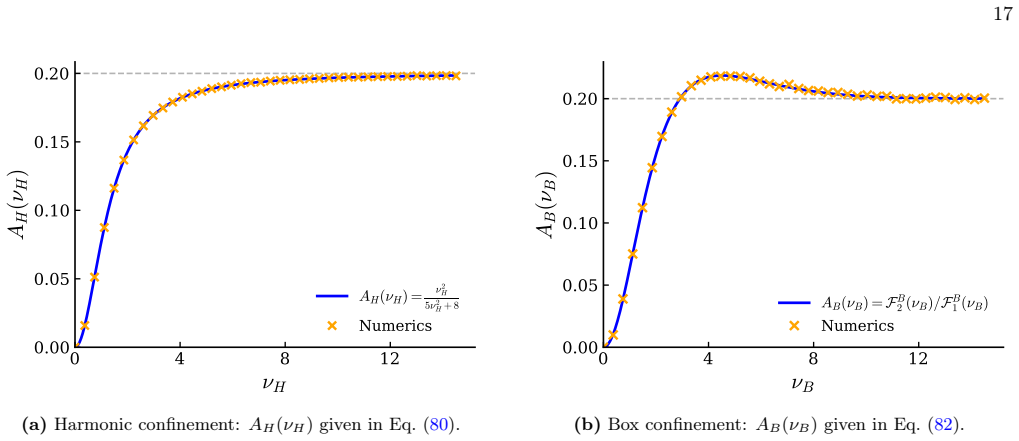
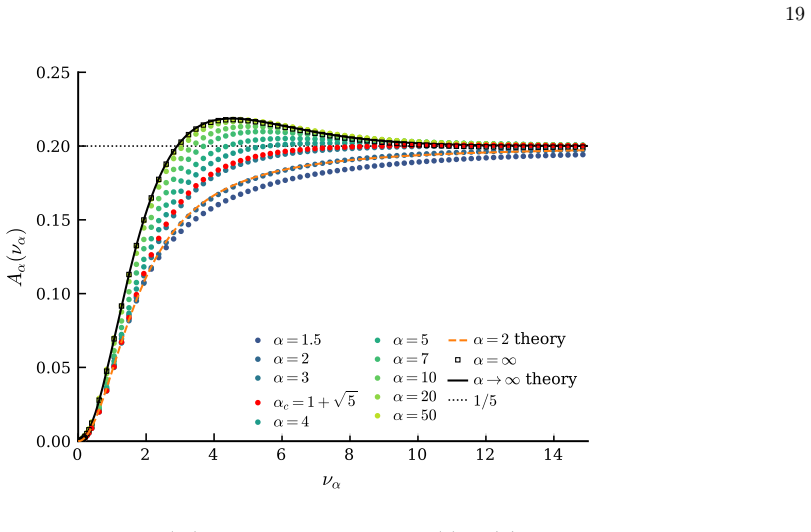
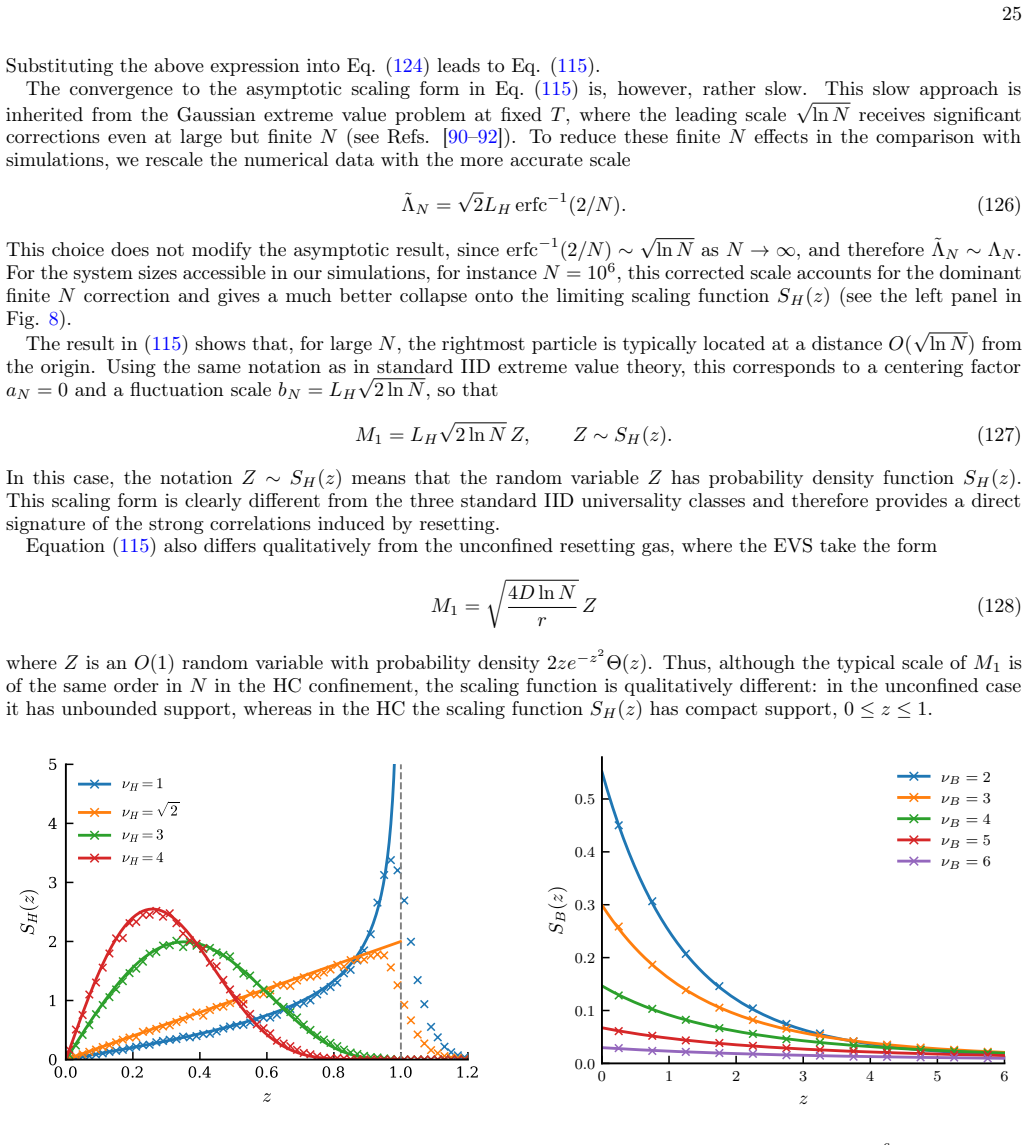
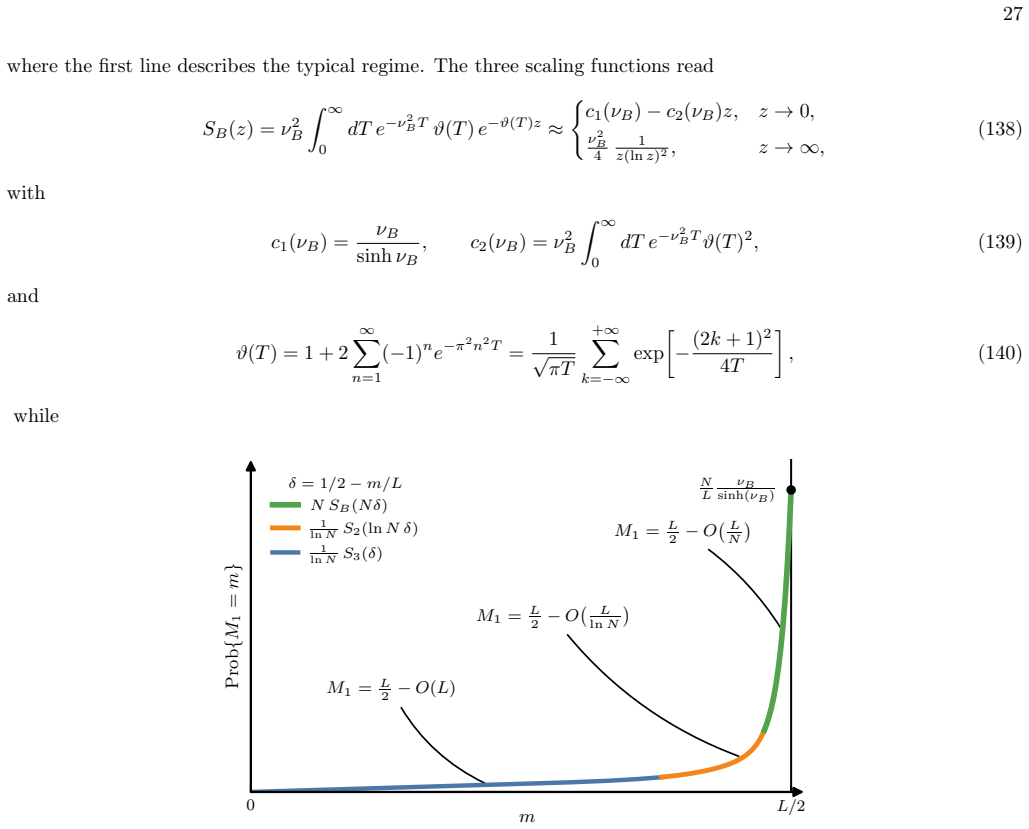
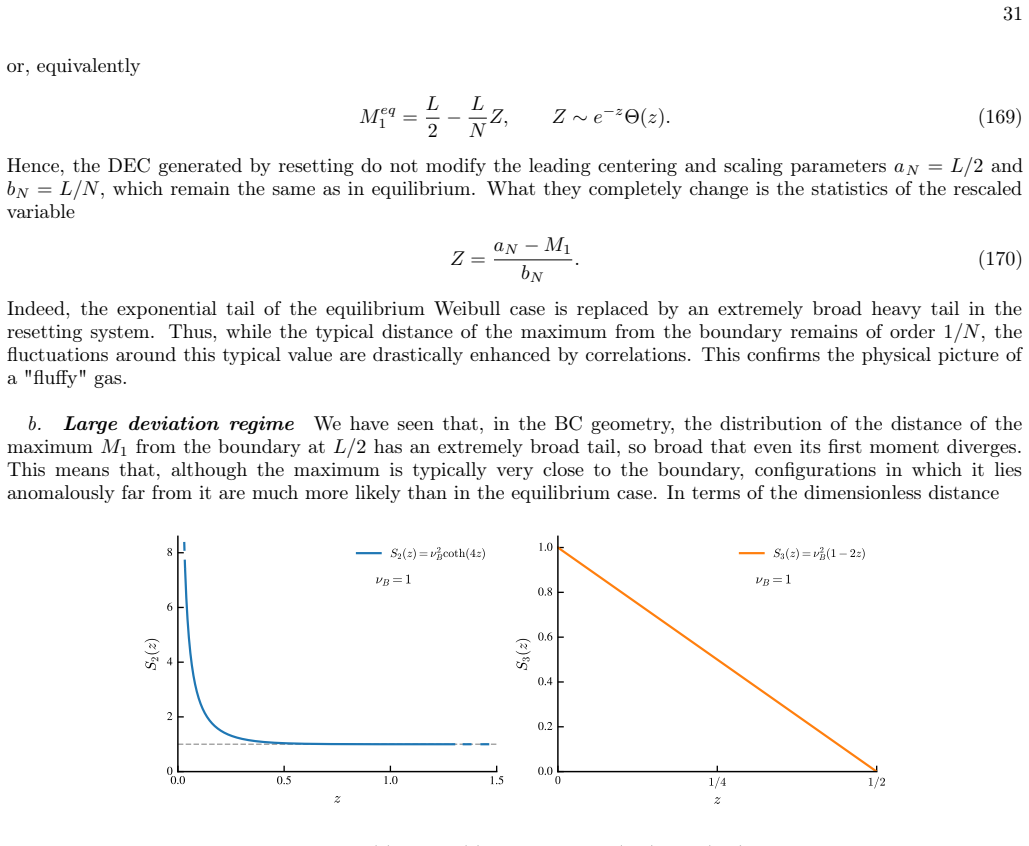
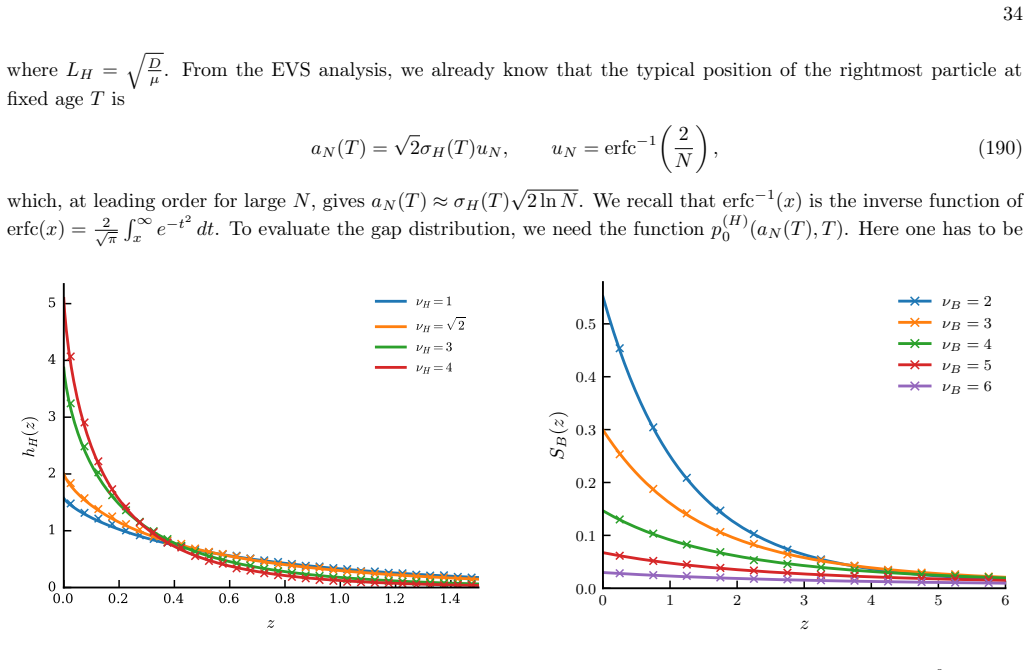
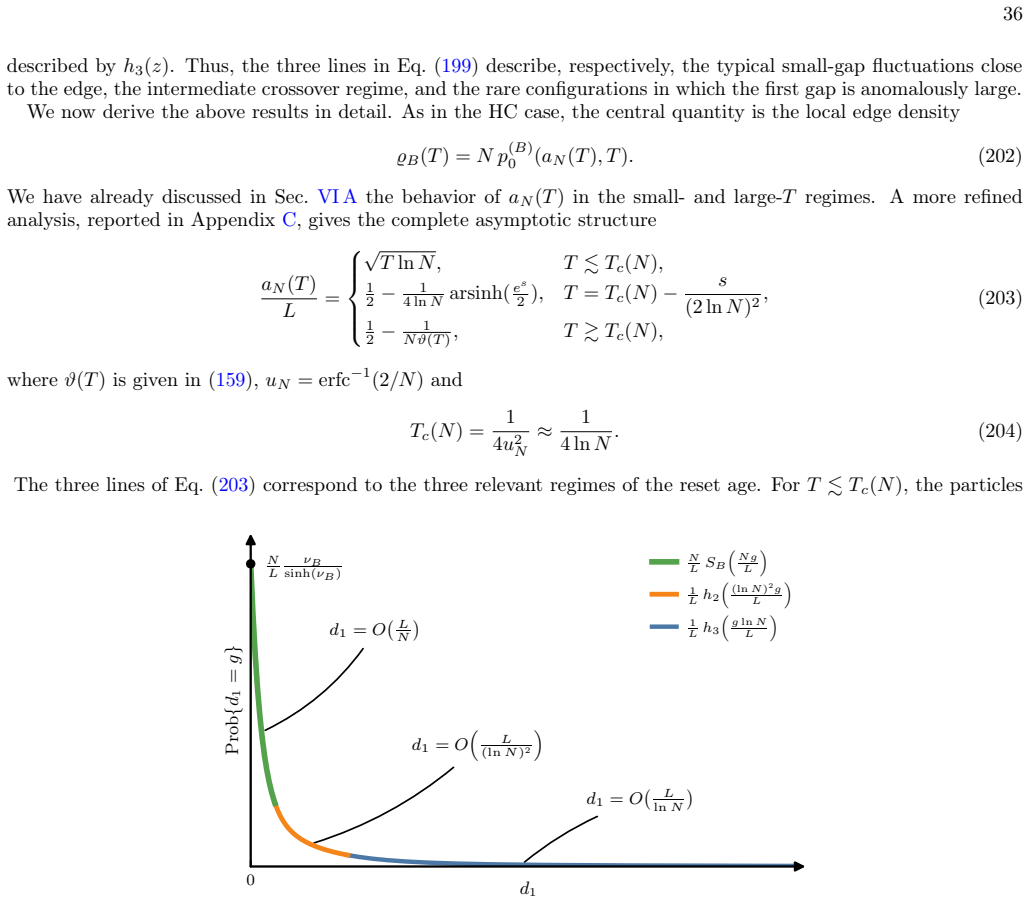
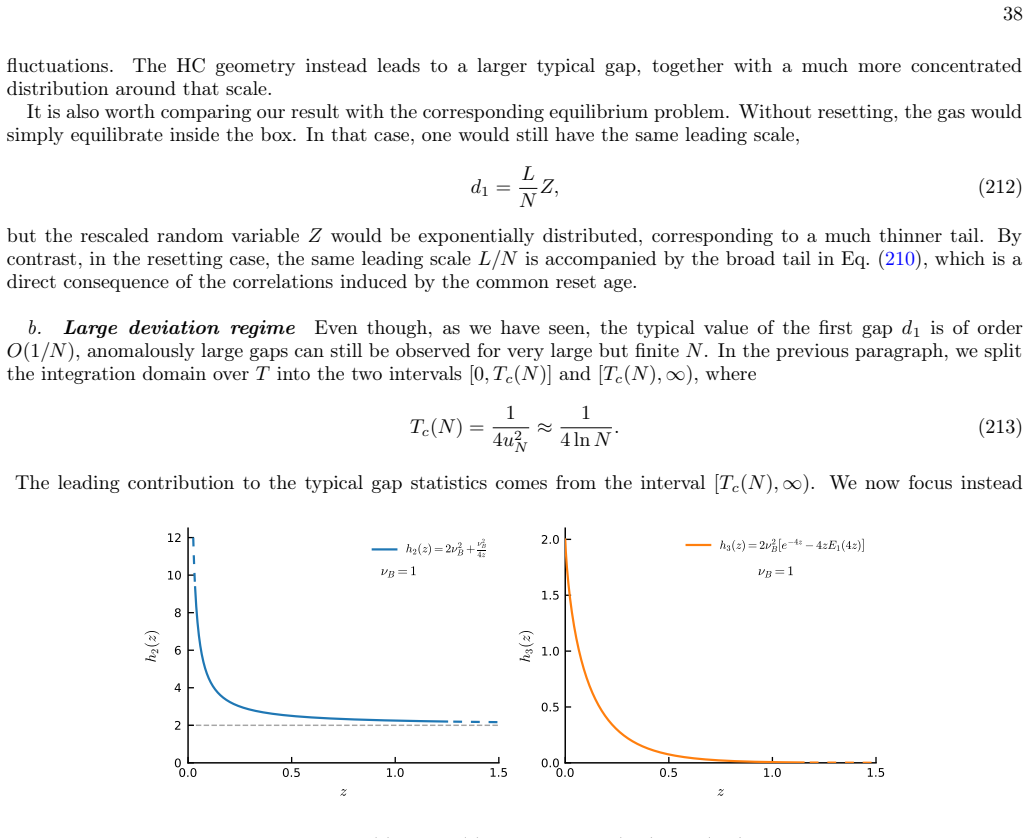
In the stationary state the joint distribution remains exactly solvable because resets are common to all particles. The normalized correlation coefficient is non-monotonic and overshoots the free value under box confinement because hard walls suppress decorrelating trajectories, while under harmonic confinement it increases monotonically. For general α the monotonicity holds only when 0 < α < 1 + √5. The largest particle position scales as √(ln N) with bounded support under harmonic confinement but sits O(1/N) from the wall with power-law tails under box confinement; the first gap shows correspondingly smaller typical size but stronger anomalous fluctuations in the box case. These behaviors
What carries the argument
Competition between confinement length scale and resetting length scale, which controls the exact stationary joint distribution and thereby sets the sign and magnitude of dynamically emergent correlations.
If this is right
- Edge observables (maximum position, first gap) split into qualitatively different scaling and fluctuation classes for harmonic versus box confinement.
- The monotonicity switch at α_c = 1 + √5 separates two regimes of correlation response for any power-law potential.
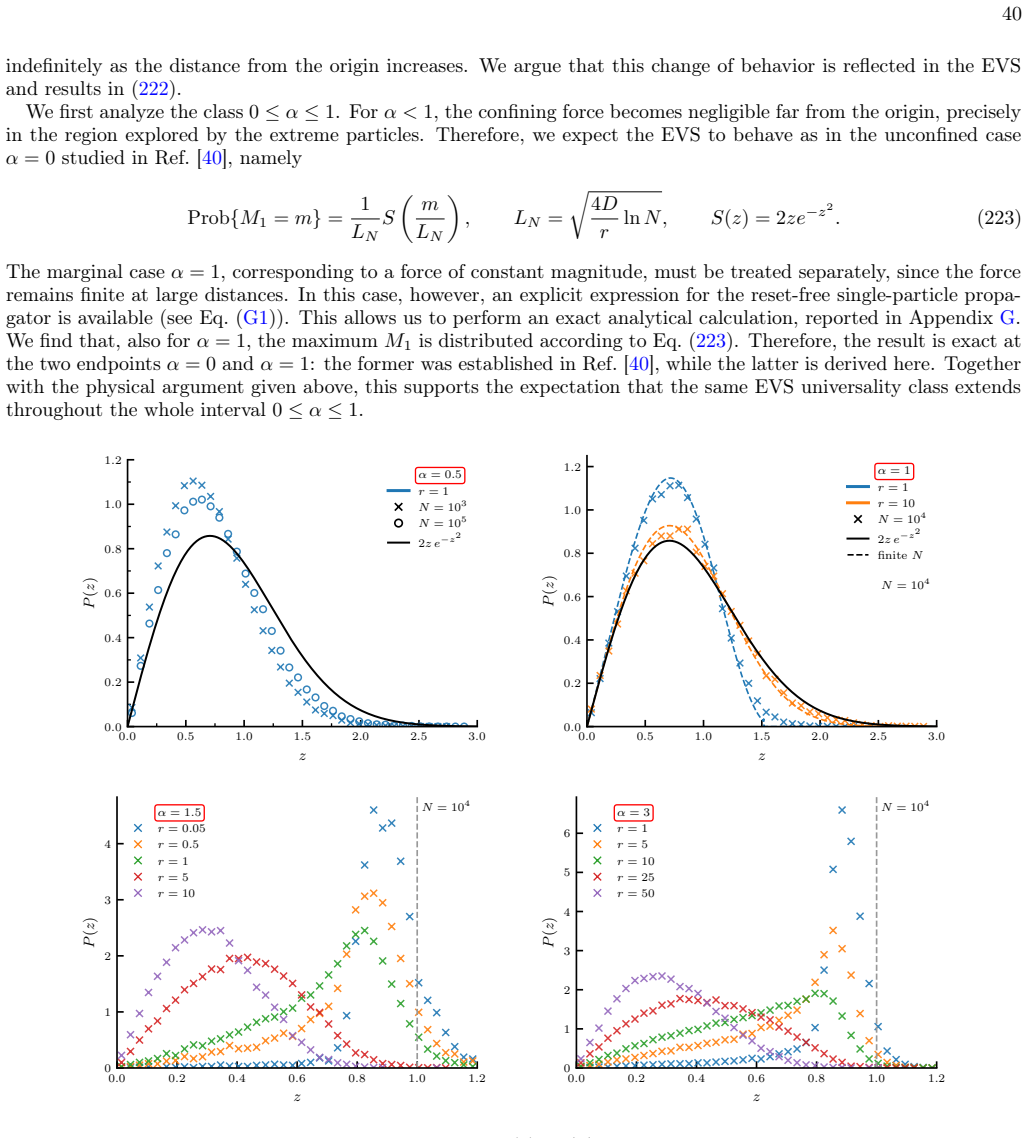
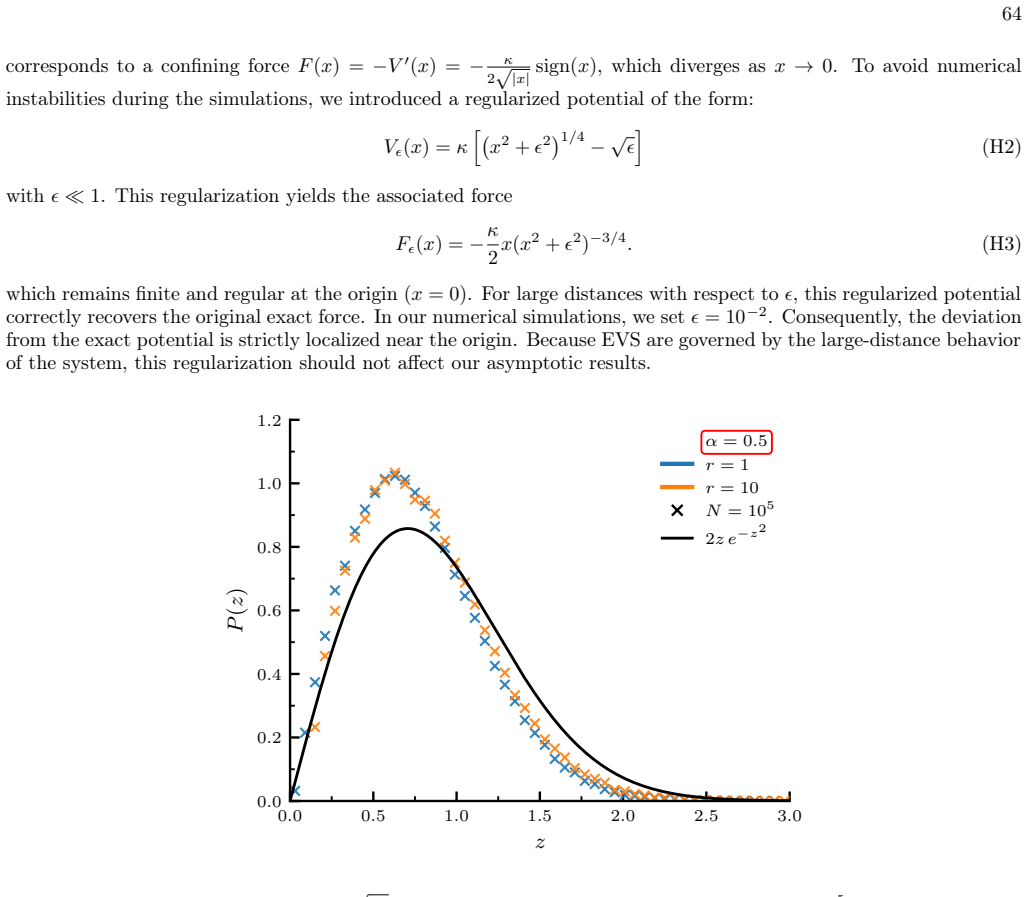
- The three universality classes for extreme-value statistics persist across the full range of α.
Where Pith is reading between the lines
- Tuning the potential exponent around α_c could serve as a switch for correlation strength in experimental reset systems.
- The same length-scale competition may govern correlation patterns in other common-reset models such as run-and-tumble particles.
- Numerical checks of the α → ∞ class could be performed by simulating increasingly steep power-law walls.
Load-bearing premise
Particles interact only through shared resets, so the stationary joint distribution factors exactly and is controlled solely by the two length scales.
What would settle it
Plot the normalized correlation coefficient versus resetting rate for a single pair of particles in a hard-wall box and check whether the curve rises above the unconfined value before returning.
Figures
read the original abstract
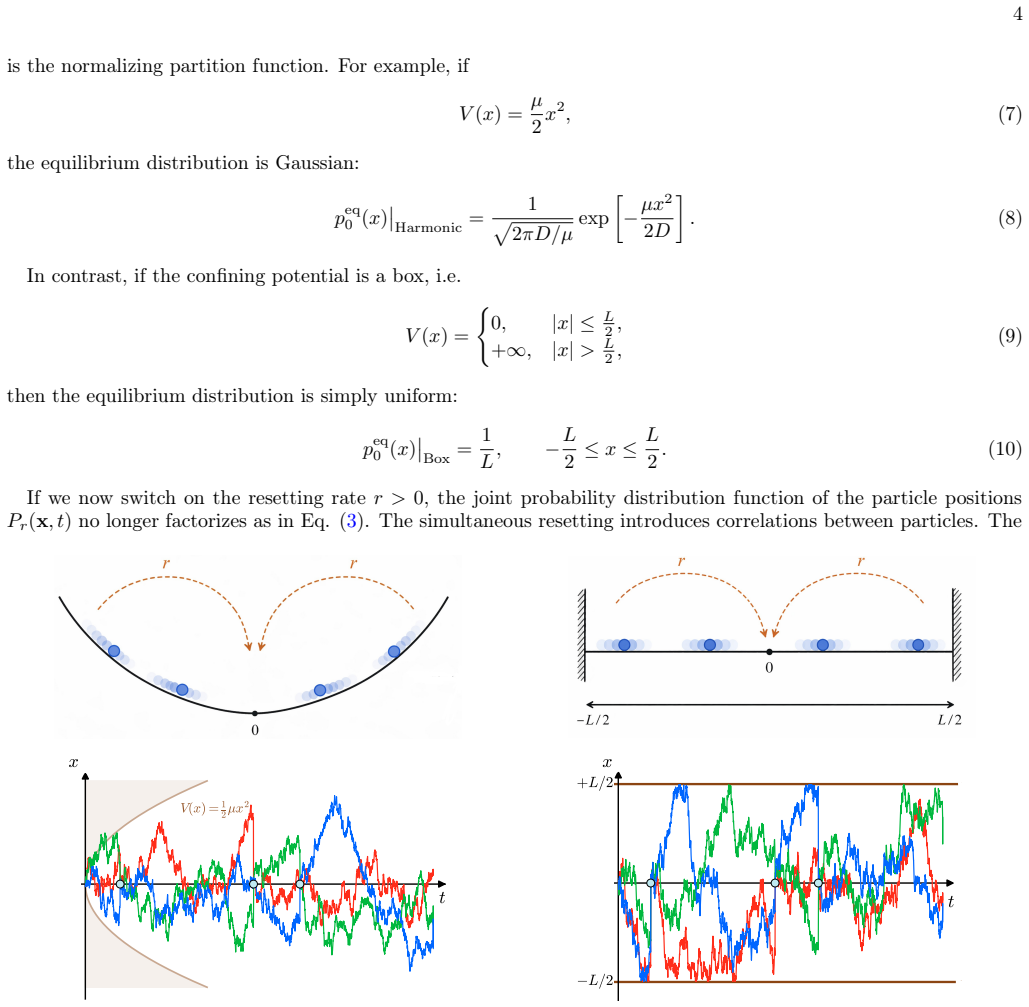
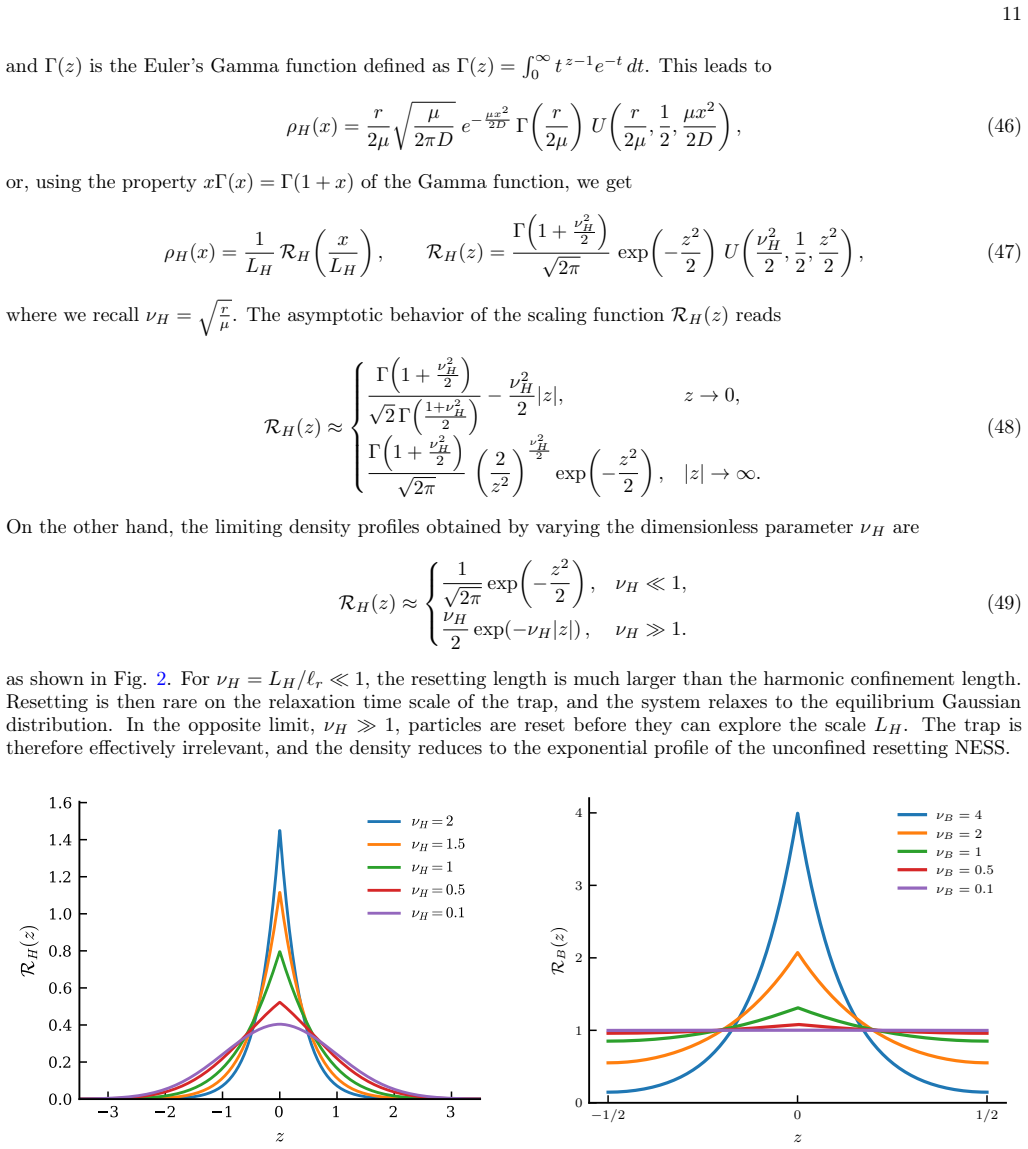
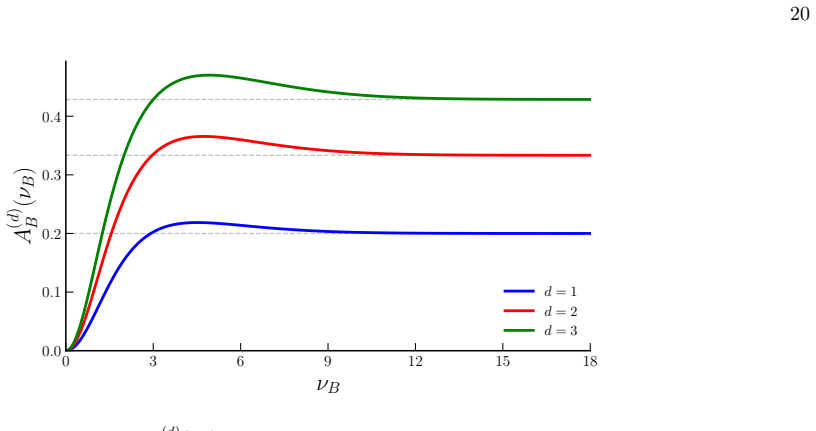
We study $N$ non-interacting Brownian particles in an external potential under simultaneous stochastic resetting to the origin. Although they do not interact directly, common resets generate strong dynamically emergent correlations (DEC). We analyze how confinement modifies these correlations and the nonequilibrium stationary state for $V(x)=\kappa |x|^\alpha$, $\alpha\geq0$, focusing mainly on two analytically tractable cases: harmonic confinement (HC), $\alpha=2$, and box confinement (BC), $\alpha\to\infty$. In both cases the stationary state is controlled by the competition between confinement and resetting lengths. We derive exact results for the stationary joint distribution, density, correlations, extreme value statistics (EVS), and gap statistics. While the density behaves similarly in HC and BC, the normalized correlation coefficient differs sharply. In BC it is non-monotonic and overshoots the unconfined value, as hard walls suppress decorrelating trajectories. In HC it instead increases monotonically toward the unconfined limit. For general $\alpha$, the behavior is monotonic for $0<\alpha<\alpha_c=1+\sqrt{5}$ and non-monotonic for $\alpha>\alpha_c$. The difference between HC and BC is also visible in edge observables. In HC, the maximum scales as $M_1=O(\sqrt{\ln N})$ and has a limiting distribution with bounded support and a shape transition controlled by the ratio of the two length scales. In BC, the maximum is at distance $O(1/N)$ from the boundary, as in equilibrium, but its fluctuations have a broad power-law tail with logarithmic corrections. The first gap shows a similar contrast: BC gives a smaller typical gap but stronger anomalous fluctuations than HC. Finally, we extend the EVS analysis to general $\alpha$ and identify, via simulations and scaling arguments, three universality classes: $0\leq\alpha\leq1$, $1<\alpha<\infty$, and the singular limit $\alpha\to\infty$.
Editorial analysis
A structured set of objections, weighed in public.
Referee Report
Summary. The manuscript studies N non-interacting Brownian particles subject to simultaneous stochastic resetting in the potential V(x)=κ|x|^α (α≥0). It derives exact expressions for the stationary joint distribution, density, normalized correlation coefficient, extreme-value statistics, and gap statistics in the analytically tractable limits of harmonic confinement (α=2) and box confinement (α→∞), showing that the stationary state is controlled by the competition between confinement and resetting length scales. For general α the normalized correlation coefficient is monotonic for 0<α<α_c=1+√5 and non-monotonic for α>α_c; extreme-value statistics fall into three universality classes (0≤α≤1, 1<α<∞, α→∞) identified by scaling arguments and simulations.
Significance. If the exact derivations hold, the work provides a clear, parameter-free account of how confinement alters resetting-induced correlations and edge observables. The exact solvability for the HC and BC cases, the identification of the critical exponent α_c, and the classification of EVS into three universality classes constitute genuine advances in the statistical mechanics of resetting processes.
Simulated Author's Rebuttal
We thank the referee for their careful reading of the manuscript, positive assessment of its contributions, and recommendation to accept.
Circularity Check
No significant circularity; derivations start from model equations
full rationale
The paper states that it derives exact results for the stationary joint distribution, density, correlations, and EVS directly from the Fokker-Planck dynamics of non-interacting particles subject to common resets and the potential V(x)=κ|x|^α. The normalized correlation coefficient distinctions (monotonic vs non-monotonic, α_c=1+√5) and the three EVS universality classes follow from this exact solvability and scaling arguments without any parameter fitting, self-definitional loops, or load-bearing self-citations that reduce the central claims to their own inputs. The derivation chain is self-contained against the stated assumptions.
Axiom & Free-Parameter Ledger
axioms (2)
- domain assumption Particles are non-interacting Brownian motions subject to simultaneous Poissonian resetting to the origin.
- domain assumption The nonequilibrium stationary state exists and is governed by the ratio of confinement and resetting length scales.
Reference graph
Works this paper leans on
-
[1]
blocking argument
Box confinement (BC) We now turn to the distribution of the first gapd1 in the BC geometry. As for the EVS, in this confinement geometry we study not only the typical regime, but also the intermediate and large deviation regimes, since the typical scaling function has a very broad tail. The distribution ofd1 reads Prob{d1 =g}= N L SB g...
-
[2]
More explicitly, J1(j1,n) = 0, k n = j1,n LB = 2j1,n L , n≥1.(B24) We now determine the coefficients of the spectral expansion
Dimensiond= 2 In two dimensions, one has η= 0, L B = L 2 , V 2(LB) =πL 2 B = πL2 4 .(B22) The radial eigenfunctions are therefore Φn(x) =J 0(knx),(B23) 49 and the reflecting boundary condition selects the positive zeros ofJ1. More explicitly, J1(j1,n) = 0, k n = j1,n LB = 2j1,n L , n≥1.(B24) We now determine the coefficients of the spectral expansion. We ...
-
[3]
Dimensiond= 3 In three dimensions, one has η= 1 2 , L B = L 2 , V 3(LB) = 4πL3 B 3 = πL3 6 .(B50) The regular radial eigenfunctions are proportional tox−1/2J1/2(knx). Using the identityJ 1/2(x) = q 2 πx sinx[95], we can equivalently write eigenfunctions as Φn(x) = sin(knx) x .(B51) The reflecting boundary condition selects the positive zeros ofJ3/2. Equiv...
-
[4]
Thus, in terms of yN(T)we sety N(T) = 1 2 −ε, whereε≪1, in (C4). We can now write sin 2πn 1 2 −ε = sin(πn−2πnε) = (−1) n+1 sin(2πnε),(C11) and, by expanding for smallε, we obtain ε− ∞X n=1 (−1)n+1 πn (2πnε)e −(πn)2T ≈ 1 N .(C12) We then recall the definition in Eq. (159) of the functionϑ(T), namely ϑ(T) = 1−2 ∞X n=1 (−1)n+1e−(πn)2T = 1 + 2 ∞X n=1 (−1)ne−(...
-
[5]
Brown,XXVII
R. Brown,XXVII. A brief account of microscopical observations made in the months of June, July and August 1827, on the particles contained in the pollen of plants; and on the general existence of active molecules in organic and inorganic bodies, Philos. Mag. Ser. 24, 161–173 (1828)
-
[6]
Einstein,Über die von der molekularkinetischen Theorie der Wärme geforderte Bewegung von in ruhenden Flüssigkeiten suspendierten Teilchen, Ann
A. Einstein,Über die von der molekularkinetischen Theorie der Wärme geforderte Bewegung von in ruhenden Flüssigkeiten suspendierten Teilchen, Ann. Phys.17, 549–560 (1905)
1905
-
[7]
C. W. Gardiner,Stochastic Methods: A Handbook for the Natural and Social Sciences, 4th ed. (Springer-Verlag, Berlin Heidelberg, 2009)
2009
-
[8]
Risken,The Fokker-Planck Equation: Methods of Solution and Applications, 2nd ed
H. Risken,The Fokker-Planck Equation: Methods of Solution and Applications, 2nd ed. (Springer-Verlag, Berlin Heidelberg, 1996)
1996
-
[9]
M. R. Evans, S. N. Majumdar,Diffusion with Stochastic Resetting, Phys. Rev. Lett.106, 160601 (2011)
2011
-
[10]
M. R. Evans, S. N. Majumdar,Diffusion with optimal resetting, J. Phys. A: Math. Theor.44, 435001 (2011)
2011
-
[11]
M. R. Evans, S. N. Majumdar,Diffusion with resetting in arbitrary spatial dimension, J. Phys. A: Math. Theor.47, 285001 (2014)
2014
-
[12]
Reuveni,Optimal stochastic restart renders fluctuations in first passage times universal, Phys
S. Reuveni,Optimal stochastic restart renders fluctuations in first passage times universal, Phys. Rev. Lett.116, 170601 (2016)
2016
-
[13]
U. Bhat, C. De Bacco, S. Redner,Stochastic search with Poisson and deterministic resetting, J. Stat. Mech. 083401 (2016)
2016
-
[14]
Nagar, S
A. Nagar, S. Gupta,Diffusion with stochastic resetting at power-law times, Phys. Rev. E93, 060102(R) (2016)
2016
-
[15]
A. Pal, S. Reuveni,First passage under restart, Phys. Rev. Lett.118, 030603 (2017)
2017
-
[16]
Chechkin, I
A. Chechkin, I. M. Sokolov,Random search with resetting: A unified renewal approach, Phys. Rev. Lett.121, 050601 (2018)
2018
-
[17]
A. Pal, Ł. Kuśmierz, S. Reuveni,Time-dependent density of diffusion with stochastic resetting is invariant to return speed, Phys. Rev. E100, 040101(R) (2019)
2019
-
[18]
Durang, S
X. Durang, S. Lee, L. Lizana, J.-H. Jeon,First-passage statistics under stochastic resetting in bounded domains, J. Phys. A: Math. Theor.52, 224001 (2019)
2019
-
[19]
Gupta, C
D. Gupta, C. A. Plata, A. Pal,Work fluctuations and Jarzynski equality in stochastic resetting, Phys. Rev. Lett.124, 110608 (2020)
2020
-
[20]
M. R. Evans, S. N. Majumdar, G. Schehr,Stochastic resetting and applications, J. Phys. A: Math. Theor.53, 193001 (2020)
2020
-
[21]
P. C. Bressloff,Search processes with stochastic resetting and multiple targets, Phys. Rev. E102, 022115 (2020)
2020
-
[22]
P. C. Bressloff,Queueing theory of search processes with stochastic resetting, Phys. Rev. E102, 032109 (2020)
2020
-
[23]
P. C. Bressloff,Accumulation time of stochastic processes with resetting, J. Phys. A: Math. Theor.54, 354001 (2021)
2021
-
[24]
Sandev, V
T. Sandev, V. Domazetoski, L. Kocarev, R. Metzler, A. Chechkin,Heterogeneous diffusion with stochastic resetting, J. Phys. A: Math. Theor.55, 074003 (2022)
2022
-
[25]
A. Pal, S. Kostinski, S. Reuveni,The inspection paradox in stochastic resetting, J. Phys. A: Math. Theor.55, 021001 (2022)
2022
-
[26]
Gupta, A
S. Gupta, A. M. Jayannavar,Stochastic resetting: A (very) brief review, Front. Phys.10, 789097 (2022)
2022
-
[27]
Nagar, S
A. Nagar, S. Gupta,Stochastic resetting in interacting particle systems: a review, J. Phys. A: Math. Theor.56, 283001 (2023)
2023
-
[28]
A. K. Hartmann, S. N. Majumdar,Diffusion with stochastic resetting on a lattice, Phys. Rev. E112, 034102 (2025)
2025
-
[29]
Gupta, S
S. Gupta, S. N. Majumdar, G. Schehr,Fluctuating Interfaces Subject to Stochastic Resetting, Phys. Rev. Lett.112, 220601 (2014)
2014
-
[30]
U. Basu, A. Kundu, A. Pal,Symmetric exclusion process under stochastic resetting, Phys. Rev. E100, 032136 (2019)
2019
-
[31]
Magoni, S
M. Magoni, S. N. Majumdar, G. Schehr,Ising model with stochastic resetting, Phys. Rev. Research2, 033182 (2020)
2020
- [32]
- [33]
-
[34]
Besga, A
B. Besga, A. Bovon, A. Petrosyan, S. N. Majumdar, and S. Ciliberto,Optimal mean first-passage time for a Brownian searcher subjected to resetting: Experimental and theoretical results, Phys. Rev. Res.2, 032029(R) (2020)
2020
-
[35]
Tal-Friedman, A
O. Tal-Friedman, A. Pal, A. Sekhon, S. Reuveni, and Y. Roichman,Experimental realization of diffusion with stochastic resetting, J. Phys. Chem. Lett.11, 7350–7355 (2020)
2020
-
[36]
Ginot and C
F. Ginot and C. Bechinger,Experimental investigation of stochastic resetting in a non-Markovian environment, New J. Phys.28, 015001 (2026)
2026
-
[37]
Faisant, B
F. Faisant, B. Besga, A. Petrosyan, S. Ciliberto, and S. N. Majumdar,Optimal mean first-passage time of a Brownian searcher with resetting in one and two dimensions: experiments, theory and numerical tests, J. Stat. Mech.2021, 113203 (2021)
2021
-
[38]
Boyer, C
D. Boyer, C. Solis-Salas,Random walks with preferential relocations to places visited in the past and their application to biology, Phys. Rev. Lett.112, 240601 (2014)
2014
-
[39]
Boyer, J
D. Boyer, J. C. R. Romo-Cruz,Solvable random-walk model with memory and its relations with Markovian models of anomalous diffusion, Phys. Rev. E90, 042136 (2014). 66
2014
-
[40]
Boyer, M
D. Boyer, M. R. Evans, S. N. Majumdar,Long time scaling behaviour for diffusion with resetting and memory, J. Stat. Mech.2017, 023208 (2017)
2017
-
[41]
Boyer, S
D. Boyer, S. N. Majumdar,Power-law relaxation of a confined diffusing particle subject to resetting with memory, J. Stat. Mech.2024, 073206 (2024)
2024
-
[42]
Boyer, M
D. Boyer, M. R. Evans, S. N. Majumdar,Diffusion with preferential relocation in a confining potential, J. Stat. Mech. 2025, 013209 (2025)
2025
-
[43]
Boyer, S
D. Boyer, S. N. Majumdar,Emerging correlations between diffusing particles evolving via simultaneous resetting with memory, J. Phys. A: Math. Theor.59, 125001 (2026)
2026
-
[44]
Biroli, H
M. Biroli, H. Larralde, S. N. Majumdar, and G. Schehr,Extreme statistics and spacing distribution in a Brownian gas correlated by resetting, Phys. Rev. Lett.130, 207101 (2023)
2023
-
[45]
S. N. Majumdar and G. Schehr,Dynamically Emergent Correlations, EPL155, 11001 (2026)
2026
-
[46]
Biroli, H
M. Biroli, H. Larralde, S. N. Majumdar, G. Schehr,Exact extreme, order, and sum statistics in a class of strongly correlated systems, Phys. Rev. E109, 014101 (2024)
2024
-
[47]
de Mauro, M
G. de Mauro, M. Biroli, S. N. Majumdar, and G. Schehr,Dynamically emergent correlations in Brownian particles subject to simultaneous non-Poissonian resetting protocols, Phys. Rev. E113, 014120 (2026)
2026
-
[48]
Biroli, S
M. Biroli, S. N. Majumdar, G. Schehr,First-passage resetting gas, EPL153, 31002 (2026)
2026
-
[49]
Biroli, S
M. Biroli, S. N. Majumdar, G. Schehr,Resetting Dyson Brownian motion, Phys. Rev. E112, 014101 (2025)
2025
-
[50]
G. de Mauro, S. N. Majumdar, and G. Schehr,Tuning the strength of emergent correlations in a Brownian gas via batch resetting, arXiv:2601.20077 (2026)
-
[51]
Magoni, F
M. Magoni, F. Carollo, G. Perfetto, I. Lesanovsky,Emergent quantum correlations and collective behavior in noninteracting quantum systems subject to stochastic resetting, Phys. Rev. A106, 052210 (2022)
2022
-
[52]
Kulkarni, S
M. Kulkarni, S. N. Majumdar, S. Sabhapandit,Dynamically emergent correlations in bosons via quantum resetting, J. Phys. A: Math. Theor.58, 105003 (2025)
2025
-
[53]
D. Soldner, I. Lesanovsky, G. Perfetto,Nonanaliticities and ergodicity breaking in noninteracting many-body dynamics via stochastic resetting and global measurements, arXiv:2510.11450 (2025)
-
[54]
Galla,A diffusion approximation for systems with frequent weak resetting, arXiv:2602.21635
T. Galla,A diffusion approximation for systems with frequent weak resetting, arXiv:2602.21635 (2026)
- [55]
-
[56]
Biroli, M
M. Biroli, M. Kulkarni, S. N. Majumdar, and G. Schehr,Dynamically emergent correlations between particles in a switching harmonic trap, Phys. Rev. E109, L032106 (2024)
2024
-
[57]
Theor.57, 335003 (2024)
S.Sabhapandit, S.N.Majumdar,Noninteracting particles in a harmonic trap with a stochastically driven center, J.Phys.A: Math. Theor.57, 335003 (2024)
2024
-
[58]
Mesquita, S
N. Mesquita, S. N. Majumdar, S. Sabhapandit,Dynamically emergent correlations in a Brownian gas with diffusing diffusivity, J. Stat. Mech.2025, 103207 (2025)
2025
-
[59]
O. Vilk, M. Assaf, and B. Meerson,Fluctuations and first-passage properties of systems of Brownian particles with reset, Phys. Rev. E106, 024117 (2022)
2022
-
[60]
Meerson and O
B. Meerson and O. Vilk,Age-structured hydrodynamics of ensembles of anomalously diffusing particles with renewal reset- ting, Phys. Rev. Res.8, 023103 (2026)
2026
-
[61]
Vilk,Macroscopic localization and collective memory in Poisson renewal resetting, Phys
O. Vilk,Macroscopic localization and collective memory in Poisson renewal resetting, Phys. Rev. Res.8, 023305 (2026)
2026
-
[62]
Majumder, R
R. Majumder, R. Chattopadhyay, S. Gupta,Kuramoto model subject to subsystem resetting: How resetting a part of the system may synchronize the whole of it, Phys. Rev. E109, 064137 (2024)
2024
-
[63]
Acharya, R
A. Acharya, R. Majumder, S. Gupta,Manipulating Phases in Many-Body Interacting Systems with Subsystem Resetting, Phys. Rev. Lett.135, 127103 (2025)
2025
-
[64]
Analytical approach to subsystem resetting in generalized Kuramoto models
R. Majumder, A. Acharya, S. Gupta,Analytical approach to subsystem resetting in generalized Kuramoto models, arXiv:2604.04769 (2026)
work page internal anchor Pith review Pith/arXiv arXiv 2026
-
[65]
Pal,Diffusion in a potential landscape with stochastic resetting, Phys
A. Pal,Diffusion in a potential landscape with stochastic resetting, Phys. Rev. E91, 012113 (2015)
2015
-
[66]
Christou, A
C. Christou, A. Schadschneider,Diffusion with resetting in bounded domains, J. Phys. A: Math. Theor.48, 285003 (2015)
2015
-
[67]
É.Roldán, S.Gupta,Path-integral formalism for stochastic resetting: Exactly solved examples and shortcuts to confinement, Phys. Rev. E96, 022130 (2017)
2017
-
[68]
A. Pal, V. V. Prasad,First passage under stochastic resetting in an interval, Phys. Rev. E99, 032123 (2019)
2019
-
[69]
Ahmad, I
S. Ahmad, I. Nayak, A. Bansal, A. Nandi, D. Das,First passage of a particle in a potential under stochastic resetting: A vanishing transition of optimal resetting rate, Phys. Rev. E99, 022130 (2019)
2019
-
[70]
R. K. Singh, R. Metzler, T. Sandev,Resetting dynamics in a confining potential, J. Phys. A: Math. Theor.53, 505003 (2020)
2020
-
[71]
Gupta, C
D. Gupta, C. A. Plata, A. Kundu, A. Pal,Stochastic resetting with stochastic returns using external trap, J. Phys. A: Math. Theor.54, 025003 (2021)
2021
-
[72]
Gupta, A
D. Gupta, A. Pal, A. Kundu,Resetting with stochastic return through linear confining potential, J. Stat. Mech.2021, 043202 (2021)
2021
-
[73]
E. J. Gumbel,Statistics of Extremes, Columbia University Press, New York (1958)
1958
-
[74]
M. R. Leadbetter, G. Lindgren, and H. Rootzén,Extremes and Related Properties of Random Sequences and Processes, Springer-Verlag, New York (1983)
1983
-
[75]
J. Y. Fortin and M. Clusel,Applications of extreme value statistics in physics, J. Phys. A: Math. Theor.48, 183001 (2015)
2015
-
[76]
H. A. David and H. N. Nagaraja,Order Statistics, 3rd ed., Wiley, Hoboken, NJ (2003)
2003
-
[77]
B. C. Arnold, N. Balakrishnan, and H. N. Nagaraja,A First Course in Order Statistics, Wiley, New York (1992)
1992
-
[78]
S. N. Majumdar, A. Pal, and G. Schehr,Extreme value statistics of correlated random variables: A pedagogical review, 67 Phys. Rep.840, 1–32 (2020)
2020
-
[79]
S. N. Majumdar and G. Schehr,Statistics of Extremes and Records in Random Sequences, Oxford University Press, Oxford (2024)
2024
-
[80]
Vatash and Y
R. Vatash and Y. Roichman,Many-body colloidal dynamics under stochastic resetting: Competing effects of particle inter- actions on the steady-state distribution, Phys. Rev. Res.7, L032020 (2025)
2025
discussion (0)
Sign in with ORCID, Apple, or X to comment. Anyone can read and Pith papers without signing in.