REVIEW 3 major objections 4 minor 36 references
TANGO-VIO: Triangulation-Aware Navigation with Guaranteed Feature-Observability for Visual-Inertial Odometry
T0 review · 3 major / 4 minor · reviewed 2026-08-04 · deepseek-v4-flash
Pith's one-line read TANGO-VIO embeds a triangulation-quality metric into a control barrier function and proves a forward-invariance guarantee for visual-inertial odometry.
desk verdict Useful CBF-based parallax-enforcing velocity filter with convincing experiments, but the forward-invariance guarantee is built on a drift term that does not exist in the actual sliding window. read the letter →
The pith
A machine-rendered reading of the paper's core claim, the machinery that carries it, and where it could break.
The reading
What carries the argument
The central object is the stacked-bearing matrix M_i = Σ_j (η_{i,j}^2 I − b_{i,j} b_{i,j}^T) for each tracked feature, where b_{i,j} is the bearing from camera pose j to feature i. Its determinant measures how much multi-view parallax constrains the 3D point; the barrier h(x) is the average log-determinant over all features minus a threshold. The argument rides on the bearing-rate relation, which maps current translational velocity into bearing change via a projection matrix divided by range squared. Substituting this into the log-det derivative yields the control-affine form ḣ = f(x) + g(x)^T v_B, so the CBF-QP can be solved in closed form.
What would settle it
Run the hard-CBF filter while commanding the vehicle through a pure rotation (zero translation). The advective model produces a nonzero drift term f(x) from recorded past-pose velocities, yet the actual stacked-bearing matrices of the fixed historical poses should be constant, so the measured average log-determinant should not change; if the metric stays constant while f(x) is nonzero, the proof's model does not match the implemented system. More directly, compare the one-step predicted change in the average log-det (f(x)+g(x)^T v_B) against the actual change measured between consecutive VIO u
Extended reading notes
Core claim
The central claim: a triangulation-quality floor for visual-inertial odometry can be enforced in real time by putting the average log-determinant of feature-wise stacked-bearing matrices into a control barrier function. The derivative of this barrier is control-affine, splitting into a drift term from past poses and a control term multiplying the current velocity. Enforcing the hard CBF condition renders the safe set forward invariant, so the floor holds for all future time; a closed-form quadratic program gives the minimum-deviation correction. Flights confirm the predicted outcome: features keep triangulating and VIO drift drops from about 54% to below 1%.
Load-bearing premise
The forward-invariance guarantee assumes that all camera poses in the active window translate with their recorded velocities, so their bearing vectors change continuously; in the real sliding-window implementation the historical poses are fixed in the anchor frame, making the model's drift term a potential artifact.
Editorial extensions
If this is right
- If the hard CBF condition is enforced, the average log-determinant of the stacked-bearing matrices stays above the prescribed floor at all times, so the triangulation subproblem never becomes ill-conditioned.
- The corrected velocity is the minimum weighted deviation from the nominal command, with deviations along the nominal direction penalized less than lateral ones, so speed adjustments come before redirection.
- In the soft-CBF mode, the slack variable δ_T explicitly quantifies the instantaneous relaxation of the guarantee, letting the filter trade triangulation quality against path tracking near stops.
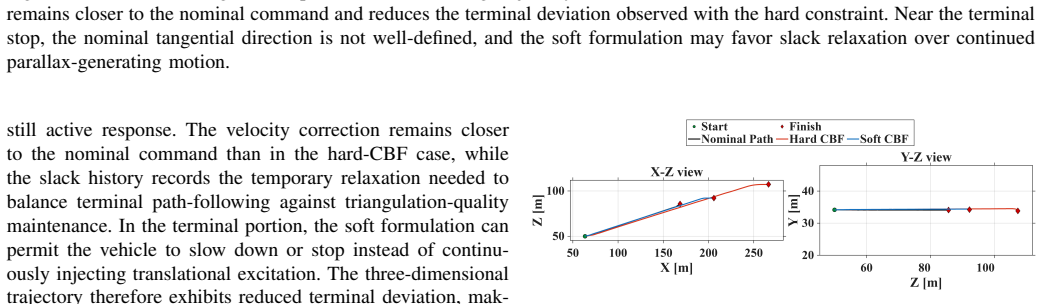
- Feature statistics from the climbing experiments show that the corrective motion increases newly triangulated features and keeps the persistent-feature population stable over intervals where the nominal motion loses visual information.
- In software-in-the-loop tests on the climbing trajectory, VIO drift drops from 53.88% (nominal) to 0.282% (hard CBF) and RPE RMSE from 6.090 m to 0.291 m.
Reading between the lines
- The continuous-time proof assumes past camera poses advect with their recorded velocities (Eq. 38). In the implemented discrete sliding window those poses are frozen, so the drift term may not reflect the actual system; a proper guarantee for the discrete update would require re-deriving the barrier derivative with fixed past poses.
- The same log-determinant barrier could be reused in other sliding-window estimators—monocular SLAM, structure-from-motion, bundle adjustment—as a generic 'enough parallax' safety filter, not just in VIO.
- An adaptive floor, raised when features are few or poorly tracked and lowered when they are abundant, could reduce the path distortion the hard-CBF mode inevitably introduces; this is a testable extension the authors mention as future work.
- The directional weighting matrix could be made mission-phase dependent (e.g., preferring vertical corrections during a climb, horizontal during straight legs), letting the minimum-deviation filter express richer priorities.
Editorial analysis
A structured set of objections, weighed in public.
Referee Report
Summary. The paper proposes TANGO-VIO, a real-time velocity-command safety filter for visual-inertial odometry that aims to maintain a lower bound on the average log-determinant of per-feature stacked-bearing matrices. A control barrier function is constructed from this metric, and the filter solves a weighted minimum-deviation QP in either hard-CBF or slack-enabled soft-CBF mode. The authors derive bearing-rate dynamics, split the barrier derivative into drift and control terms, give a closed-form solution for the QP, and validate the approach in Gazebo SITL simulations and real flight experiments using OpenVINS. The core claimed contribution is a forward-invariance guarantee for the aggregate triangulation-quality safe set whenever the hard CBF condition is enforced.
Significance. If the forward-invariance guarantee were valid, TANGO-VIO would be a novel and practically relevant mechanism for actively preserving feature-geometric observability in VIO, with a clear information-theoretic metric, a closed-form safety filter, and validation in both simulation and real flight. The SITL-to-flight consistency and the direct measurement of feature-triangulation outcomes are genuine strengths. However, the central theoretical guarantee is not established because the derivation of the barrier derivative does not match the implemented sliding-window system. The experimental results remain interesting as an empirical demonstration that additional excitation can improve feature triangulation and VIO accuracy, but they do not rescue the paper's main claim of a certified safety guarantee.
major comments (3)
- [Section III-B, Eqs. (38), (41), (44)] The drift term f(x) in Eq. (41) is built by applying Eq. (15), A dot p_Cj = R^A_Cj R^C_B v_B,j, to every historical pose j < n. In the actual sliding window, the anchor frame F_A is fixed and the historical camera poses are fixed states, so A dot p_Cj = 0 for j < n. Consequently, b_i,j, pi_i,j, and M_i are constant with respect to those historical poses, and the true derivative of h along the actual system trajectory contains only the current-pose term g(x)^T v_B. The comparison-lemma argument following Eq. (44) therefore proves forward invariance only for the fictitious advected-window model in which historical poses translate at their recorded velocities. The QP in Eq. (51) can use a positive f(x) to declare a nominal command safe when the actual hdot is negative. No discretization bound, zero-order-hold analysis, or receding-window correction is provided to transfer the guarantee to t
- [Section IV, Tables I-II and Figs. 10-11] The reported improvements in feature counts and VIO drift are obtained with the safety filter driven by the erroneous f(x) term. They show that injecting extra translational motion can improve triangulation, but they do not validate the CBF guarantee, because the activation of that motion is based on the incorrect barrier derivative. The experiments should be interpreted as a heuristic demonstration, not as evidence for the forward-invariance theorem.
- [Section III-B, Eqs. (27)-(30)] The log-det metric is defined only when every M_i is positive definite. If any M_i becomes singular, h(x) is undefined at the boundary it is meant to protect. The forward-invariance argument would ensure det M_i >= e^{l_min} > 0 if the guarantee held, but since the derivative model is invalid, the paper provides no mechanism preventing the system from reaching a state where h is not defined. This is secondary to the main issue but should be addressed in any revision.
minor comments (4)
- [Notation, Section II-A] The paper alternates between using s as the number of features and as a scalar in the same equations (e.g., Eq. (27) vs. Eq. (34)). This is not confusing in context, but a consistent notation would help.
- [Section IV-A.3] The shaded low-parallax intervals are identified from the nominal baseline and then overlaid on the CBF cases. It would be clearer to state explicitly that the intervals are not re-derived from the filtered trajectories, to avoid any appearance of selection bias.
- [Section IV-A.1] The threshold l_min is selected empirically and no tuning rule is proposed. This is acceptable for an experimental paper, but a sensitivity study with respect to l_min would strengthen the practical claims.
- [Throughout] The term 'feature-observability' is defined in a feature-geometric sense, which is sensible, but it may be confused with the nonlinear observability of the full VIO state. A brief remark distinguishing these meanings at first use would reduce ambiguity.
Circularity Check
No significant circularity: the log-det barrier is the defined safety objective, and the CBF derivation is constructive and externally validated.
full rationale
The load-bearing derivation is self-contained. Eq. (13) defines M_i as the sum of bearing projection matrices; Eq. (29) defines h as the average log-det metric minus a prescribed threshold; Eqs. (25), (33)-(42) compute hdot from bearing kinematics; Eq. (44) imposes the CBF condition. The forward-invariance statement is the standard CBF comparison-lemma result applied to this h, not a hidden restatement of an input. The threshold ell_min is an explicit tuning parameter ('The threshold was selected empirically through preliminary trials, and no general tuning rule is proposed'), and the downstream quantities (newly triangulated features, drift, RPE) come from OpenVINS execution rather than from the barrier equation, so no fitted parameter is renamed as a prediction. The only self-reference by the authors ([5]) appears in a general list of KF-based VIO architectures and carries no load-bearing weight; there is no imported uniqueness theorem or ansatz. The notable weakness is the advection modeling of historical poses in Eq. (38)/(41), which may not match the fixed sliding window of the implementation; that is a validity/modeling concern about the guarantee's applicability, not circular reasoning. No circular step is exhibited, so the score is 0.
Assumptions & free parameters
free parameters (5)
- l_min (average log-det threshold) =
-2.5
- gamma (CBF class-K gain) =
3
- w_parallel and w_perp (weighting matrix weights) =
1 and 10
- p_T (triangulation priority weight) =
5
- velocity command limit =
10 m/s
assumptions (5)
- domain assumption Tracked point features are stationary over the active camera-pose window (Assumption III.1).
- ad hoc to paper The active camera-pose window can be treated as a time-indexed trajectory segment whose historical poses translate with their recorded velocities.
- domain assumption Bearing normalization scale eta_i,j is constant and unit-normalized bearings have eta = 1.
- domain assumption Each stacked-bearing matrix M_i is positive definite so log det M_i is defined.
- standard math Standard CBF comparison lemma: if hdot >= -alpha(h) with alpha in class-K_infinity, then the safe set is forward invariant.
Cite this review
Pith. "Pith review of TANGO-VIO: Triangulation-Aware Navigation with Guaranteed Feature-Observability for Visual-Inertial Odometry." pith.science (2026). https://pith.science/paper/UX2GYDHJ
@misc{pith2026260802079,
  author       = {Pith},
  title        = {Pith review of: TANGO-VIO: Triangulation-Aware Navigation with Guaranteed Feature-Observability for Visual-Inertial Odometry},
  year         = {2026},
  howpublished = {\url{https://pith.science/paper/UX2GYDHJ}},
  note         = {Machine review of arXiv:2608.02079}
}
read the original abstract
In vision-aided navigation and visual-inertial odometry, the quality of triangulated three-dimensional feature positions is a fundamental prerequisite for state estimation accuracy. Triangulation becomes ill-conditioned or even impossible when a camera undergoes pure rotation without translation, or when the observed bearing vectors provide insufficient parallax. Even though visual-inertial odometry has been extensively studied, the active maintenance of feature-observability during navigation has not been sufficiently addressed in the literature. To address this gap, this study presents TANGO-VIO, a triangulation-aware navigation framework that embeds a log-determinant metric of the feature-wise stacked-bearing matrix into a control barrier function. In this proposed method, the observability guarantee is established in the feature-geometric sense by enforcing a lower bound on the aggregate triangulation-information metric through a nominal-direction-weighted minimum-deviation velocity correction. The proposed architecture is evaluated through software-inthe- loop simulations and real flight experiments. The results show improved triangulation conditioning under low-parallax motion, while the flight response closely reproduces the corresponding simulation behavior and confirms the practical realizability of the proposed safety filter. Supplementary materials are available on the project webpage.
Figures


Figures from the paper (12 more)




Reference graph
Works this paper leans on
-
[1]
A multi-state constraint Kalman filter for vision-aided inertial navi- gation,
A. I. Mourikis and S. I. Roumeliotis, “A multi-state constraint Kalman filter for vision-aided inertial navi- gation,” inProceedings 2007 IEEE International Con- ference on Robotics and Automation, 2007, pp. 3565– 3572.DOI: 10.1109/ROBOT.2007.364024
arXiv 2007
-
[2]
Real- time monocular SLAM: Why filter?
H. Strasdat, J. M. M. Montiel, and A. J. Davison, “Real- time monocular SLAM: Why filter?” In2010 IEEE International Conference on Robotics and Automation, 2010, pp. 2657–2664.DOI: 10 . 1109 / ROBOT. 2010 . 5509636
2010
-
[3]
High-precision, consistent EKF-based visual-inertial odometry,
M. Li and A. I. Mourikis, “High-precision, consistent EKF-based visual-inertial odometry,”The International Journal of Robotics Research, vol. 32, no. 6, pp. 690– 711, 2013.DOI: 10.1177/0278364913481251 16
-
[4]
Iterated extended Kalman filter based visual-inertial odometry using direct photometric feed- back,
M. Bloesch, M. Burri, S. Omari, M. Hutter, and R. Siegwart, “Iterated extended Kalman filter based visual-inertial odometry using direct photometric feed- back,”The International Journal of Robotics Research, vol. 36, no. 10, pp. 1053–1072, 2017.DOI: 10.1177/ 0278364917728574
2017
-
[5]
Particle filter- based localization using visual feature synchronization in GNSS-denied navigation,
A. S ¸anlan, H. T. Ba ˘gcı, and E. Koyuncu, “Particle filter- based localization using visual feature synchronization in GNSS-denied navigation,” in2025 Integrated Com- munications, Navigation and Surveillance Conference (ICNS), 2025, pp. 1–8.DOI: 10.1109/ICNS65417.2025. 10976891
arXiv 2025
-
[6]
PO-KF: A pose-only representation-based Kalman filter for visual inertial odometry,
L. Wang, H. Tang, T. Zhang, Y . Wang, Q. Zhang, and X. Niu, “PO-KF: A pose-only representation-based Kalman filter for visual inertial odometry,”IEEE In- ternet of Things Journal, vol. 12, no. 10, pp. 14 856– 14 875, 2025.DOI: 10.1109/JIOT.2025.3526811
arXiv 2025
-
[7]
Keyframe-based visual-inertial odometry using nonlinear optimization,
S. Leutenegger, S. Lynen, M. Bosse, R. Siegwart, and P. Furgale, “Keyframe-based visual-inertial odometry using nonlinear optimization,”The International Jour- nal of Robotics Research, vol. 34, no. 3, pp. 314–334, 2015.DOI: 10.1177/0278364914554813
-
[8]
VINS-Mono: A robust and versatile monocular visual-inertial state estima- tor,
T. Qin, P. Li, and S. Shen, “VINS-Mono: A robust and versatile monocular visual-inertial state estima- tor,”IEEE Transactions on Robotics, vol. 34, no. 4, pp. 1004–1020, 2018.DOI: 10.1109/TRO.2018.2853729
arXiv 2018
Show all 36 references
-
[9]
Kimera: An open-source library for real-time metric- semantic localization and mapping,
A. Rosinol, M. Abate, Y . Chang, and L. Carlone, “Kimera: An open-source library for real-time metric- semantic localization and mapping,” in2020 IEEE International Conference on Robotics and Automa- tion (ICRA), 2020, pp. 1689–1696.DOI: 10 . 1109 / ICRA40945.2020.9196885
2020
-
[10]
ORB-SLAM3: An accurate open-source library for visual, visual-inertial, and mul- timap SLAM,
C. Campos, R. Elvira, J. J. G. Rodr ´ıguez, J. M. M. Montiel, and J. D. Tard ´os, “ORB-SLAM3: An accurate open-source library for visual, visual-inertial, and mul- timap SLAM,”IEEE Transactions on Robotics, vol. 37, no. 6, pp. 1874–1890, 2021.DOI: 10.1109/TRO.2021. 3075644
2021 doi
-
[11]
Super- VINS: A real-time visual-inertial SLAM framework for challenging imaging conditions,
H. Luo, Y . Liu, C. Guo, Z. Li, and W. Song, “Super- VINS: A real-time visual-inertial SLAM framework for challenging imaging conditions,”IEEE Sensors Journal, vol. 25, no. 13, pp. 26 042–26 050, 2025.DOI: 10.1109/ JSEN.2025.3556257
2025
-
[12]
A benchmark com- parison of monocular visual-inertial odometry algo- rithms for flying robots,
J. Delmerico and D. Scaramuzza, “A benchmark com- parison of monocular visual-inertial odometry algo- rithms for flying robots,” in2018 IEEE International Conference on Robotics and Automation (ICRA), 2018, pp. 2502–2509.DOI: 10.1109/ICRA.2018.8460664
2018
-
[13]
Unobservable directions of VINS under special motions,
K. Wu and S. I. Roumeliotis, “Unobservable directions of VINS under special motions,” University of Min- nesota, Department of Computer Science and Engineer- ing, Minneapolis, MN, USA, Technical Report, Sep. 2016
2016
-
[14]
Consistency analysis and improvement of vision-aided inertial navigation,
J. A. Hesch, D. G. Kottas, S. L. Bowman, and S. I. Roumeliotis, “Consistency analysis and improvement of vision-aided inertial navigation,”IEEE Transactions on Robotics, vol. 30, no. 1, pp. 158–176, 2014.DOI: 10. 1109/TRO.2013.2277549
2014
-
[15]
Observability, identifiability and sensitivity of vision-aided inertial navigation,
J. Hernandez, K. Tsotsos, and S. Soatto, “Observability, identifiability and sensitivity of vision-aided inertial navigation,” in2015 IEEE International Conference on Robotics and Automation (ICRA), 2015, pp. 2319–2325. DOI: 10.1109/ICRA.2015.7139507
2015
-
[16]
Hailu and B
H. Hailu and B. Gebregziabher,Motion as a sensing modality for metric scale in monocular visual-inertial odometry, 2026.DOI: 10 . 48550 / arXiv . 2603 . 26740 arXiv: 2603.26740[cs.RO]
2026
-
[17]
Observability-aware trajectory optimization for self- calibration with application to UA Vs,
K. Hausman, J. A. Preiss, G. S. Sukhatme, and S. Weiss, “Observability-aware trajectory optimization for self- calibration with application to UA Vs,”IEEE Robotics and Automation Letters, vol. 2, no. 3, pp. 1770–1777, 2017.DOI: 10.1109/LRA.2017.2647799
2017
-
[18]
Observability-aware trajectory optimization: Theory, viability, and state of the art,
C. Grebe, E. Wise, and J. Kelly, “Observability-aware trajectory optimization: Theory, viability, and state of the art,” in2021 IEEE International Conference on Mul- tisensor Fusion and Integration for Intelligent Systems (MFI), 2021, pp. 1–8.DOI: 10.1109/MFI52462.2021. 9591177
2021
-
[19]
Perception-aware receding horizon trajectory planning for multicopters with visual-inertial odometry,
X. Wu, S. Chen, K. Sreenath, and M. W. Mueller, “Perception-aware receding horizon trajectory planning for multicopters with visual-inertial odometry,”IEEE Access, vol. 10, pp. 87 911–87 922, 2022.DOI: 10.1109/ ACCESS.2022.3200342
2022
-
[20]
An adaptive optimal control ap- proach to monocular depth observability maximization,
T. E. Ogri, M. Qureshi, Z. I. Bell, K. Waters, and R. Kamalapurkar, “An adaptive optimal control ap- proach to monocular depth observability maximization,” in2024 American Control Conference (ACC), 2024, pp. 2356–2361.DOI: 10 . 23919 / ACC60939 . 2024 . 10644784
2024
-
[21]
Monocular inspection of spacecraft under illumination constraints and avoidance regions,
T. E. Ogri, M. Qureshi, Z. I. Bell, M. Longmire, and R. Kamalapurkar, “Monocular inspection of spacecraft under illumination constraints and avoidance regions,” in2025 American Control Conference (ACC), 2025, pp. 1713–1718.DOI: 10 . 23919 / ACC63710 . 2025 . 11108034
2025
-
[22]
Inertial navigation aiding by stationary updates,
A. Ramanandan, A. Chen, and J. A. Farrell, “Inertial navigation aiding by stationary updates,”IEEE Trans- actions on Intelligent Transportation Systems, vol. 13, no. 1, pp. 235–248, 2012.DOI: 10.1109/TITS.2011. 2168818
2012 doi
-
[23]
De- tecting and dealing with hovering maneuvers in vision- aided inertial navigation systems,
D. G. Kottas, K. J. Wu, and S. I. Roumeliotis, “De- tecting and dealing with hovering maneuvers in vision- aided inertial navigation systems,” in2013 IEEE/RSJ International Conference on Intelligent Robots and Sys- tems, 2013, pp. 3172–3179.DOI: 10.1109/IROS.2013. 6696807
2013 doi
-
[24]
Range- visual-inertial odometry: Scale observability without ex- citation,
J. Delaune, D. S. Bayard, and R. Brockers, “Range- visual-inertial odometry: Scale observability without ex- citation,”IEEE Robotics and Automation Letters, vol. 6, no. 2, pp. 2421–2428, 2021.DOI: 10.1109/LRA.2021. 3058918
2021 doi
-
[25]
Structure-invariant range-visual-inertial odometry,
I. Alberico, J. Delaune, G. Cioffi, and D. Scaramuzza, “Structure-invariant range-visual-inertial odometry,” in 2024 IEEE/RSJ International Conference on Intelligent Robots and Systems (IROS), 2024, pp. 10 613–10 620. DOI: 10.1109/IROS58592.2024.10801775 17
2024
-
[26]
A novel visual scale re- covery for resource-limited platform using single-point laser and spatial constraints,
H. Xu, X. Liu, and Y . Liu, “A novel visual scale re- covery for resource-limited platform using single-point laser and spatial constraints,”IEEE Sensors Journal, vol. 23, no. 19, pp. 23 356–23 366, 2023.DOI: 10.1109/ JSEN.2023.3305448
2023
-
[27]
Range-aided visual-inertial ini- tialization for micro air vehicles under insufficiently excited motion,
J. Huo and S. Liu, “Range-aided visual-inertial ini- tialization for micro air vehicles under insufficiently excited motion,” in2023 10th International Forum on Electrical Engineering and Automation (IFEEA), 2023, pp. 629–633.DOI: 10.1109/IFEEA60725.2023. 10429223
2023
-
[28]
RD- VIO: Relative-depth-aided visual-inertial odometry for autonomous underwater vehicles,
S. Ding, T. Ma, Y . Li, S. Xu, and Z. Yang, “RD- VIO: Relative-depth-aided visual-inertial odometry for autonomous underwater vehicles,”Applied Ocean Re- search, vol. 134, p. 103 532, 2023.DOI: 10.1016/j.apor. 2023.103532
2023
-
[29]
Control barrier functions: Theory and applications,
A. D. Ames, S. Coogan, M. Egerstedt, G. Notomista, K. Sreenath, and P. Tabuada, “Control barrier functions: Theory and applications,” in2019 18th European Con- trol Conference (ECC), 2019, pp. 3420–3431.DOI: 10. 23919/ECC.2019.8796030
2019
-
[30]
Constrained image-based visual servoing using barrier functions,
I. Salehi, G. Rotithor, R. Saltus, and A. P. Dani, “Constrained image-based visual servoing using barrier functions,” in2021 IEEE International Conference on Robotics and Automation (ICRA), 2021, pp. 14 254– 14 260.DOI: 10.1109/ICRA48506.2021.9560983
2021
-
[31]
Control barrier function based visual servoing for mobile manipulator systems under func- tional limitations,
S. Heshmati-Alamdari, M. Sharifi, G. C. Karras, and G. K. Fourlas, “Control barrier function based visual servoing for mobile manipulator systems under func- tional limitations,”Robotics and Autonomous Systems, vol. 182, p. 104 813, 2024.DOI: 10.1016/j.robot.2024. 104813
2024 doi
-
[32]
Safe control using vision-based control barrier function (V-CBF),
H. Abdi, G. Raja, and R. Ghabcheloo, “Safe control using vision-based control barrier function (V-CBF),” in 2023 IEEE International Conference on Robotics and Automation (ICRA), 2023, pp. 782–788.DOI: 10.1109/ ICRA48891.2023.10160805
2023
-
[33]
Using control barrier functions to incorporate observability: Application to range-based target tracking,
D. Coleman, S. D. Bopardikar, and X. Tan, “Using control barrier functions to incorporate observability: Application to range-based target tracking,”Journal of Dynamic Systems, Measurement, and Control, vol. 146, no. 4, p. 041 004, 2024.DOI: 10.1115/1.4064749
2024 doi
-
[34]
Optimization-based esti- mator design for vision-aided inertial navigation,
M. Li and A. I. Mourikis, “Optimization-based esti- mator design for vision-aided inertial navigation,” in Robotics: Science and Systems VIII, 2012, pp. 241–248. DOI: 10.15607/RSS.2012.VIII.031
2012 doi
-
[35]
Delaune, D
J. Delaune, D. S. Bayard, and R. Brockers,xVIO: A range-visual-inertial odometry framework, 2020.DOI: 10 . 48550 / arXiv . 2010 . 06677 arXiv: 2010 . 06677 [cs.RO]
2020
-
[36]
OpenVINS: A research platform for visual- inertial estimation,
P. Geneva, K. Eckenhoff, W. Lee, Y . Yang, and G. Huang, “OpenVINS: A research platform for visual- inertial estimation,” in2020 IEEE International Con- ference on Robotics and Automation (ICRA), 2020, pp. 4666–4672.DOI: 10 . 1109 / ICRA40945 . 2020 . 9196524
2020
Reviewed August 4, 2026 · model on record in the stance chip above.
Discussion (0). Sign in to comment.